In this post we’ll talk briefly about lens brands and manufacturers. When it comes to vintage analog lenses, people either choose a brand first, and then a focal length, or vice-versa. There are as many different brands as there are historic camera and lens manufacturers. Typically most vintage lenses come from East and West Germany, and Japan, largely because that is where the camera industry was focused. Choosing a brand can be a matter of personal interest, cost, or more often than not – popularity.
When looking at the type of vintage lens, you have to understand that there are different families of lenses, usually focused on a particular brand from a specific epoch. In order to choose a vintage lens it is important to obtain a basic understanding of the brand of interest – dates of manufacture, basic lens information (e.g. construction, materials, potential issues), and reviews. A particular 50mm lens from one manufacture may have evolved over many years, often with differing characteristics. For example the Asahi Super-Takumar 50mm f/1.4 appeared in 1964 as an 8-element lens, and evolved into a 7-element lens containing some elements which incorporated Thorium. It then became the Super-Multi-Coated Takumar, and finally the SMC Takumar. All have differing characteristics, although fundamentally they are all 50mm f/1.4 lenses.
These days there is quite a lot of digital material online, including scanned brochures, and lens reviews. The aim here is to just cover some of the more common manufacturers. Brands of lenses are generally divided into three major categories – (i) the core companies that produced cameras and lenses, (ii) companies with smaller 35mm impression, and (iii) independent companies that just produced lenses for many different manufacturers (not all camera makers produced lenses). To make it even more confusing, some camera companies rebranded lenses from other companies on their cameras. Many major manufacturers offered an extensive array of interchangeable lenses from extremely wide angle to mammoth telephoto lenses. In addition there were companies that specialize only in the development of lenses, including special purpose lenses.
Note that I have not included very small companies, e.g. Wrayflex, or companies who just produced cameras, and very few of their own lenses, e.g. ALPA (they used lenses from a number of manufacturers), Exakta (they only made/rebranded a couple of their lens as Exakta), or KW (makers of the Praktica line of cameras).
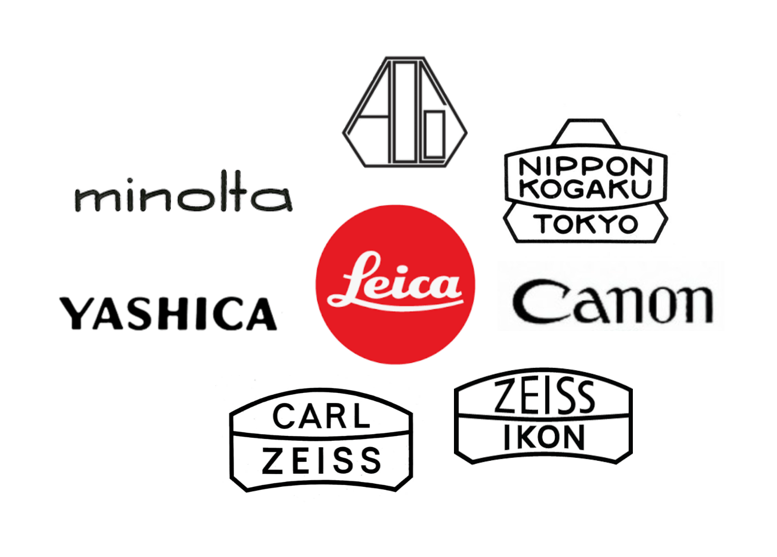
Landmark brand lenses
The first category involves milestone manufacturers who got into the 35mm game early, and focused heavily on SLRs. This means manufacturers like Asahi Pentax, Minolta, Yashica, Nikon, Canon, Leica, Zeiss Ikon, and Zeiss. These companies often may have started producing 35mm rangefinder cameras, and then transitioned to 35mm SLRs, and associated lenses (Asahi was the only one of these that did not produce a rangefinder camera). The exception here is Carl Zeiss, who did not make camera’s but was one of the largest optical lens manufacturers. They often designed a broad range of lenses to suit the needs of their cameras. These companies did not rely on 3rd party lens makers (although they did not prevent other companies making lenses for their cameras), and set the standard for many of the lens mounts used. Exakta, while manufacturing many cameras, and the bayonet-mount, designed few of their own lenses.
Second-tier brand lenses
Next are the companies that I consider second tier, i.e. they had a smaller footprint, made only SLRs or got into the game late. That’s not to say they didn’t make good lenses, but their lenses often don’t have the same character as the older lenses. They may have made cameras for other formats, or dabbled in the 35mm SLR market (because they thought they could compete), so the lenses available might just be an effect of short-lived cameras. This includes Konica, Fuji, Olympus, Topcon, Petri, Mamiya, Miranda, Ricoh, Rollei, Voigtländer. For example, Olympus did not introduce it’s first full-frame 35mm SLR, the Olympus OM-1 until 1972. Fuji first interchangeable lens SLR was the Fujica ST701 from 1970. Some of these manufacturers uses rebadged 3rd party lenses. For example Miranda initially used lenses from Zunow or Ofunar, and by the late 1950s had moved to Soligor.
Independent (i.e. 3rd party) brand lenses
The final level of brands are those companies who really just produced lenses. They essentially produced lenses for the cameras of other brands (or more commonly for specific camera mounts). They were 3rd party suppliers, and some were experts in lens design, having been in the business since the 19th century. This included a long list of German and Japanese companies, e.g. Meyer-Optik, Tokina, Soligor, Enna-Werk, Heinz Kilfitt, and Astro-Berlin. Some of these manufacturers produced a broad range of lenses for many different brands, while others produced specific types of lenses such a telephoto lenses. As they often focused solely on lenses, some of these manufacturers produced exceptionally good lenses.
 Crafting Pixels