People expressing themselves in speech or writing are generally rather careful to avoid saying anything that might stamp them fools. Not so photographers, if one is to judge by the flood of trite and boring pictures published year in and year out in photographic magazines and annuals and shown in exhibitions. Using an analogy with speech, most of these pictures are as hackneyed as saying that a rose is a rose is a rose; they repeat what has already been said a thousand times before; they say badly what others have said better; or they say nothing at all, in which case they are visual gibberish, meaningless statements toward which a viewer’s reaction can only be, So what?
Andreas Feininger, The Perfect Photograph (1974)
Andreas Feininger
Photographic books for Christmas
If you know someone who dabbles in photography, and are looking for a Christmas gift, below are some book ideas. Some are new, others can be found on the vintage market, e.g. Abebooks.
- Any book by photographer Andreas Feininger. He produced a lot of really good books on photographic knowledge. Good ones include Feininger on Photography (1949), and The Complete Photographer (1965). Theses books are less about technology, and more about technique, much of which is just as relevant today in the age of digital.
- Robert Capa’s book, Slightly Out Of Focus: The Legendary Photojournalist’s Illustrated Memoir Of World War II (reprint 2001). A good insight into Hungarian photographer Robert Capa’s experiences during WW2 from the man himself.
- A deeper dive Capa’s photographs can be found in the more recently published Robert Capa: The Work 1932-1954 (2023).
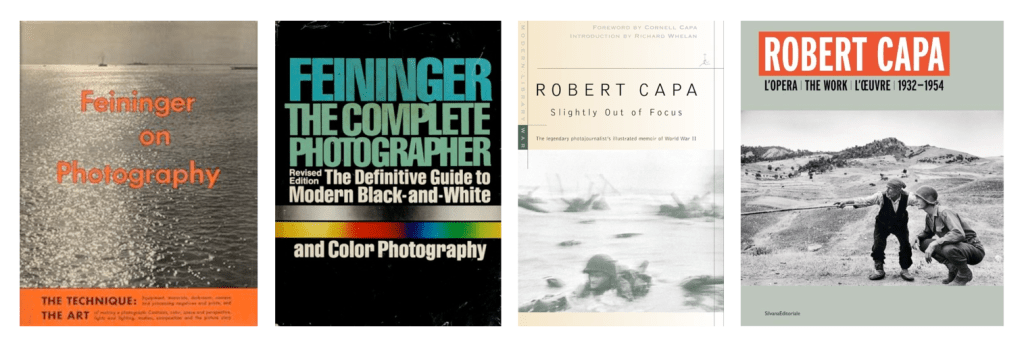
- A very minimalistic approach to film photography can be found in Analog Photography: Reference Manual for Shooting, by Andrew Bellamy (2017). It dives into the fundamentals of 35mm film photography.
- In Daido Moriyama: How I Take Photographs (2019), Japanese street photographer Daido Moriyama explains his approach to street photography. A great book for anyone interested in getting a real insight into street photographer from one of the icons of the genre.
- A great coffee table book is Accidentally Wes Anderson (2020), photographs of real places plucked from the world of his films.
- For a vintage camera buff, there is a great little book, A History Of Photography In 50 Cameras (2022), which explores 180 years of photography through 50 iconic cameras.
Feininger on motion
In contrast to “moving pictures”, every single photograph, even the most violent action shot, is a “still”. Nothing that happens in time and space − a change, a motion − can be photographed instantaneously without stripping it of its most outstanding quality : movement, the element of time . . . . No ordinary action shot can “reproduce” an action, because it reduces change and movement − the basis of all action − to a standstill, freezing it into immobility. . . . In photographing action, more than anywhere else in still photography, we must rely on “symbols” and on “translation”, if we are to capture the essence of that action in a “still”.
Feininger on Photography (1949)
Feininger on seeing
“Photographers — idiots, of which there are so many — say, ‘Oh, if only I had a Nikon or a Leica, I could make great photographs.”’ That’s the dumbest thing I ever heard in my life. It’s nothing but a matter of seeing, and thinking, and interest. That’s what makes a good photograph.”
Andreas Feininger in an interview with American Society of Media Photography (1990)
Feininger on black-and-white photographs
“Through absence of color, three-dimensionality and motion, the black-and-white photography is ipso facto ‘unnatural’. It expresses reality symbolically: gray tone values instead of color, two-dimensional projection (perspective) instead of space, blurredness or single-phase instead of constant motion. It is ‘symbolic’ in the same sense that speech and writing are, where sounds (words) are symbols for objects and conceptions, and signs (letters) are symbols for sounds (words). Photography means ‘reproduction’ only in the rare cases where the rendering of a two-dimensional, black-and-white object is the aim; otherwise it must be called a translation.”
Andreas Feininger, Feininger on Photography (1949, pp.195-196)
Feininger on B&W versus colour
“Black-and-white photography is essentially an abstract medium, while color photography is primarily realistic. Furthermore, in black-and-white a photographer is limited to two dimensions – perspective and contrast – whereas in color a photographer works with three: perspective, contrast, and color. In order to be able to exploit the abstract qualities of his medium, a photographer who works in black-and-white deliberately trains himself to disregard color; instead, he evaluates color in terms of black-and-white, shades of gray, and contrast of light and dark. A color photographer’s approach is the exact reverse: not only is he very much aware of color as ‘color’, but he decidedly tries to develop a ‘color eye’ – a sensitivity to the slightest shifts in hue, saturation, and brightness of color.”
Andreas Feininger, “Successful Color Photography (1966)
 Crafting Pixels