This is a story of another camera that could have been quite successful, but unfortunately didn’t make it past the initial batch of cameras. Alsaphot was the photographic department of a French company called Alsetex, and produced cameras from 1949 to 1970. Using a brand logo which incorporated an Alsatian stork, the company produced a broad range of cameras. This included the Dauphin I, II and III, small 6×6 reflex cameras in the style of the Voigtländer Brilliant and the Cima (4×6), Ajax (6×6), and D’Assas (6×6) viewfindser cameras.
In 1947 the company hired French inventor Lucien Dodin (1900-1989) as technical director. Dodin designed two cameras, the Cyclops, and Alsaflex. The Cyclops, which appeared in 1950 was a 6×9cm format camera. Dodin’s claim to fame was the design of the “stigmometer”, or Dodin telemeter, more commonly known as the split-image rangefinder, something found in many SLRs.
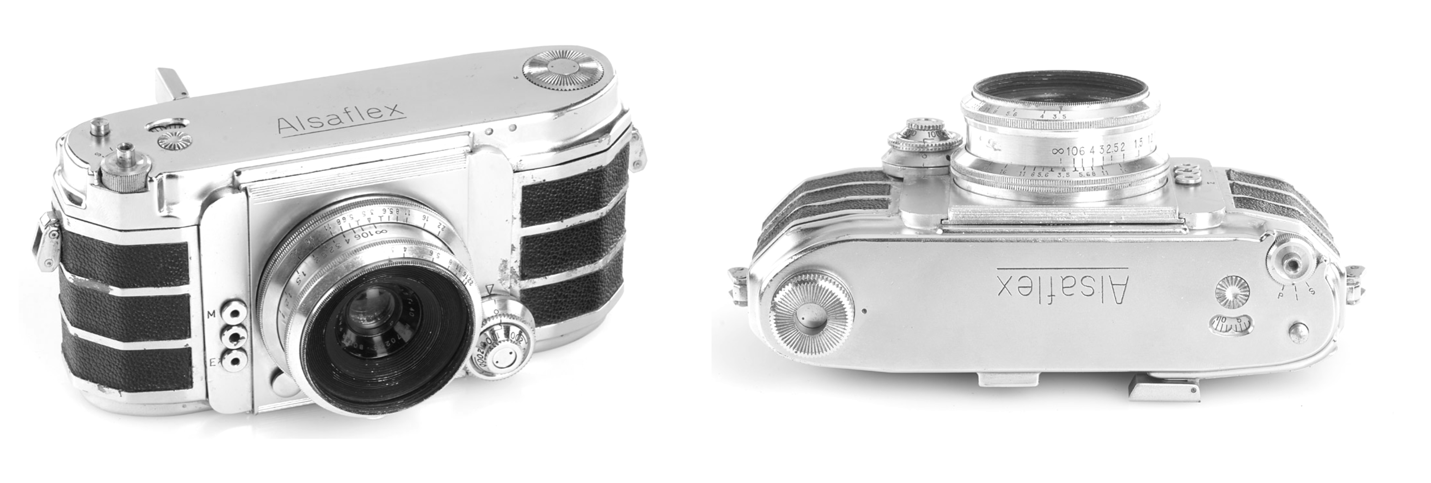
The Alsaflex was an SLR camera which used the 24×24mm format on 35mm film, and incorporated Dodin’s stigmometer. The viewfinder was reduced in size by using lateral reflection, the retractable mirror pivoting around a vertical axis – essentially a Porro prism. The camera was innovative because it was quite compact for an SLR. It sported a bayonet mount with interchangeable lenses, with a Saphir Boyer 40mm f/3.5 (with automatic aperture selection) as the standard lens. The shutter was of a new design, made of metal and in the shape of a fan, with speeds from 1 to 1/2400 sec. The body of the camera was die-cast (150mm×70mm×42mm) with a back that could open to accommodate carious accessories. The camera has a rapid lever actuation which causes the film to advance, the mirror and the frame counter to be set up, and the shutter to cock in a single movement. When activated during shutter release, the mirror retracts without vibration.
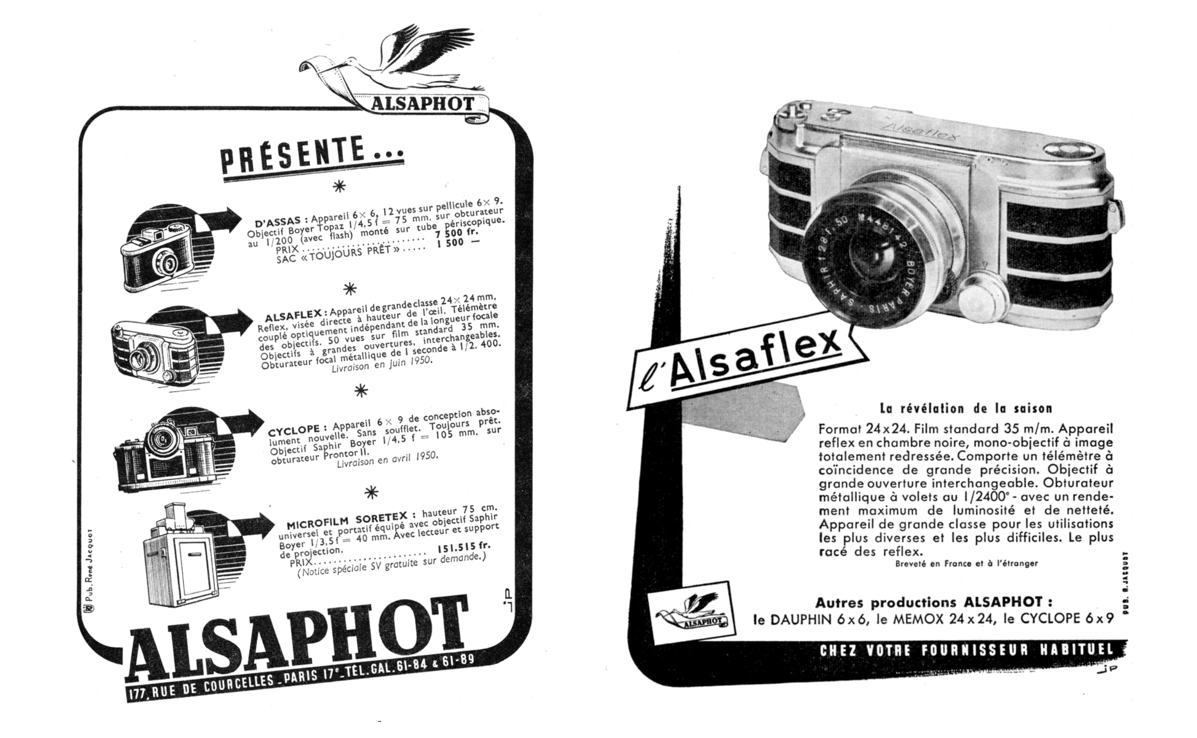
A second variant, the Dudragne is a special, much simpler model of the Alsaflex, without a horizontal viewfinder eyepiece, X-sync and 1/100 speeds, and made to be used with a retinograph (instrument for examining the retina of the eye) made by Dudragne. Interestingly, the license for the viewfinder using the Porro prism would be taken over in 1963 by Olympus for the Pen F series. The camera appeared in advertising in early 1950, suggesting it would be released in May 1950, but in reality it would be 1952, and very few would be produced. It was advertised as having an “optically coupled rangefinder independent of the focal length of the lens”.
Alsaphot itself declined in the 1960s with the rise of both German and Japanese imports. In 1954 the Alsaflex with a Saphir Boyer 50mm f/2.8 was advertised for 138,000 Frs or about C$384 [1]. When the occasional camera go on sale, the price is generally in the range of €3000-5000.
- In January 1954, 1 Canadian $ equals about 360 Old French Francs.
 Crafting Pixels