So a 50mm lens is a 50mm lens, is a 50mm lens, right? Well that’s not exactly true. The focal length of a 50mm lens is always 50mm, regardless of the system it is associated with. The focal length of a lens is independent of the camera system. So a 50mm lens on an SLR will have the same focal length as a 50mm lens on a DSLR, which is the same as one on an APS-C sensor, or a medium-format sensor. What is different is how they behave in terms of angle-of-view (AOV), with respect to a particular sensor size.
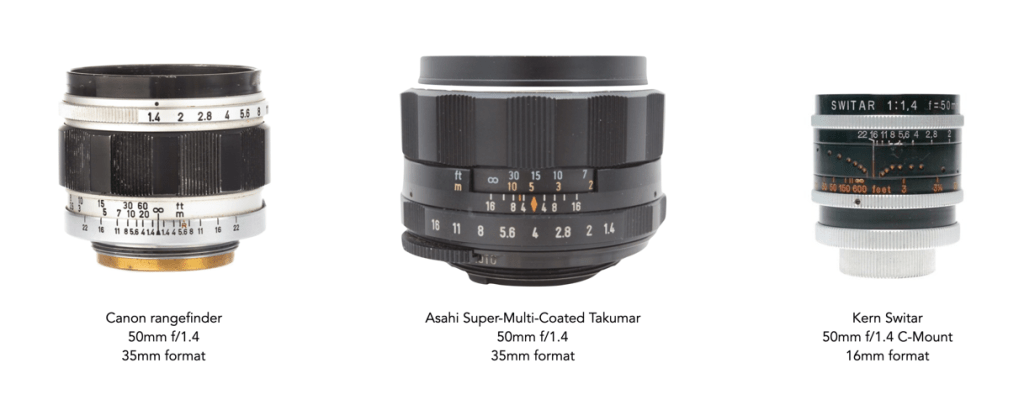
Table 1 shows the behavioural differences of 50mm lenses on various systems. For example a 50mm lens from a 35mm rangefinder camera has a (horizontal) AOV of 39.6°, whereas the AOV of an APS-C camera, is 26.6°. This is because due to crop-factors, a 50mm lens on an APS-C sensor is equivalent to a 75mm on a full-frame camera (from an AOV perspective). To get a 39.6° equivalent AOV on an APS-C camera, you need roughly a 33mm lens – but the closest lens to this is a 35mm APS-C lens (35mm×1.5≈52mm).
| System | AOV (diag) | AOV (hor) | Crop-factor | FF equiv. |
|---|---|---|---|---|
| 16mm cine | 14.5° | 11.7° | ×3.4 | 170mm |
| 1″ sensor | 18.2° | 14.6° | ×2.7 | 135mm |
| Micro-Four Thirds | 24.5° | 19.6° | ×2.0 | 100mm |
| APS-C | 31.7° | 26.6° | ×1.5 | 75mm |
| film SLR | 46.8° | 39.6° | ×1.0 | 50mm |
| film rangefinder | 46.8° | 39.6° | ×1.0 | 50mm |
| digital SLR (full-frame) | 46.8° | 39.6° | ×1.0 | 50mm |
| digital Medium (44×33mm) | 57.4° | 47.5° | ×0.8 | 40mm |
| 6×7 (72×56mm) | 84° | 67.6° | ×0.5 | 25mm |
| 4×5” | 117° | 104° | ×0.27 | 13.5mm |
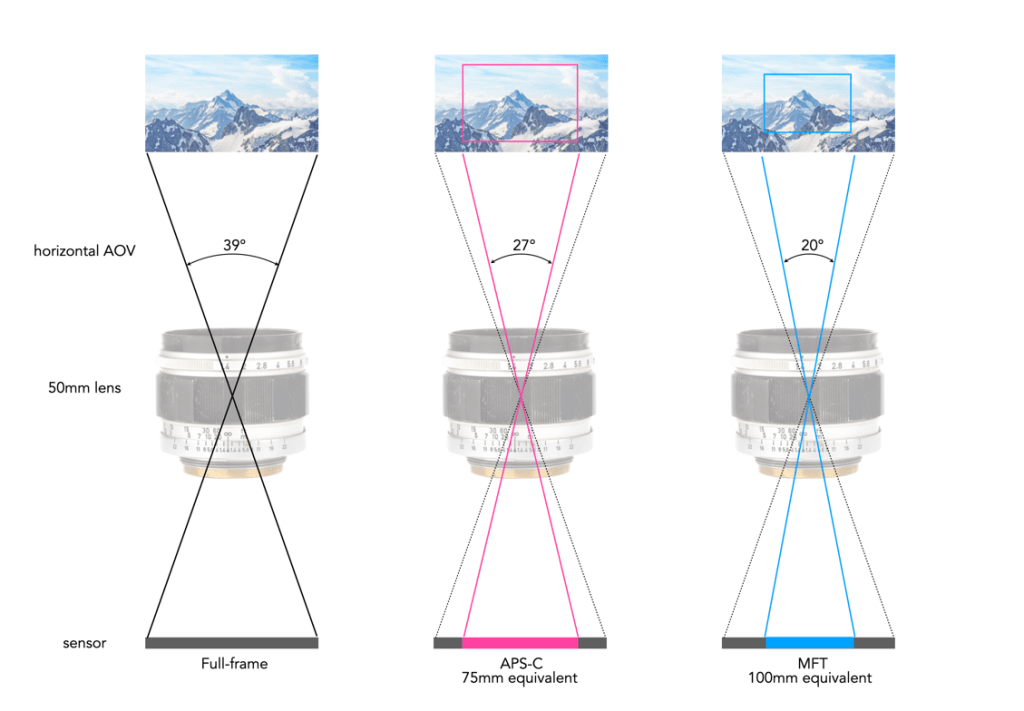
Note that because a 50mm lens on a Micro-Four-Thirds camera behaves like a 100mm FF lens, most manufacturers won’t sell a native 50mm MFT lens, opting instead for the 50mm FF equivalent – the 25mm. That’s because a 25mm MFT lens provides the “normal” angle-of-view, just like a 35mm APS-C lens, or a 100mm 6×7 lens. A vintage 50mm SLR lens used on an APS-C camera will behave like it was designed for APS-C, i.e. it will have a horizontal AOV of around 26.6°. The remaining 6.5° either side is just cut off because of the smaller sensor (as shown in Figure 2).
Invariably, all focal lengths are treated similarly. A 35mm is always 35mm, an 85mm is always 85mm. It’s just their behaviour, or rather their “view on life”, that changes.

 Crafting Pixels