Why do we take photographs?

Do we ever stop to question why we take photographs? There are many reasons of course. Here are some of the main ones. Note that some photographs may span more than one category.

To convey objective information − These may be the easiest type of photographs to take, because they are of the documentary type. This might include photographs of a dish to illustrate a recipe, or portray the architectural details of a vintage door, or even artistic differences between fire hydrants.

Documenting a drink in a cafe
or a huge bunny in Montreal

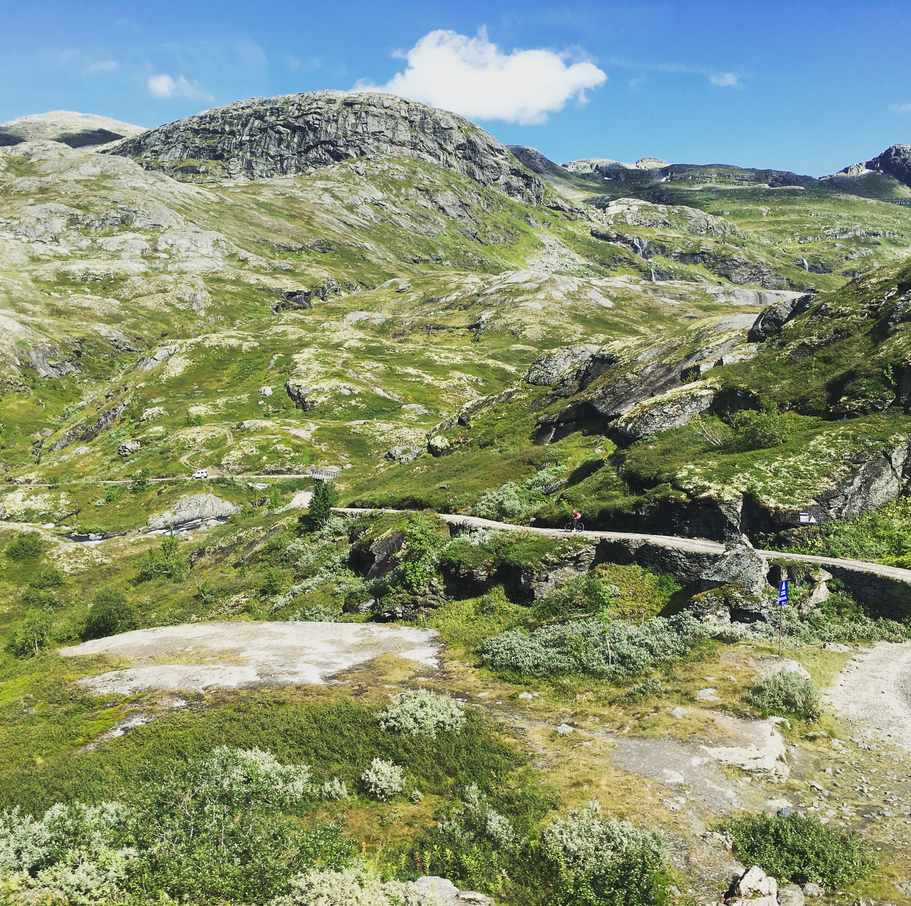
To accurately reproduce natural or human-made objects or scenes − Not quiet the same a the documentary image, which is a clear interpretation of one specific thing. The reproductive image is more concerned with a general representation. A good example are landscapes.

Reproducing a treeless landscape in Norway…
…or canned tomatoes in an Italian grocery

To represent a memory of people, places or things − This type of photograph is focused more on emotion, to provide a sense of nostalgia of experiences past.

A memory of Peggy’s Cove…
…or eating brown cheese

To embody a design or pattern − Some pictures are taken to describe some mathematical entity, or pattern. For example Fibonacci spirals in plants, perspectives of buildings, texture of bark on trees. Some of these are human-made, others natural, but design is always paramount.

A carving pattern on a Norwegian wooden chest…
…or mottled stained glass in the Montreal Metro

To interpret the manner in which humans interact with their environments − An interpretive record of a segment of human life, and activity that is interesting. This could be things like travel, sports, historical experiences, etc.

Living on a lake (a Crannog in Scotland)…
…or travelling on a train in Norway

Converting colour images to grayscale

Digital cameras often provide one or more “monochrome” filters, essentially converting the colour image to grayscale (and perhaps adding some form of contrast etc.). How is this done? There are a number of ways, and each will produce a slightly different grayscale image.

All photographs are simulacra, imitations of a reality that is captured by a camera’s film or sensor, and converted to a physical representation. Take a colour photograph, and in most cases there will be some likeness between the colours shown in the picture, and the colours which occur in real life. This may not be perfect, because it is almost impossible to 100% accurately reproduce the colours of real life. Part of this has to do with each person’s intrinsic human visual system, and how it reproduces the colour in a scene. Another part has to do with the type of film/sensor used to acquire the image in the first place. But greens are green, and blues are blue.

Black-and-white images are in a realm of their own, because humans don’t visualize in achromatic terms. So what is a true grayscale equivalent of a colour image? The truth is there is no one single rendition. Though the term B&W derives from the world of achromatic films, even there there is no gold standard. Different films, and different cameras will present the same reality in different ways. There are various ways of acquiring a B&W picture. In an analog world there is film. In a digital world, one can choose a B&W film-simulation from a cameras repertoire of choices, or covert a colour image to B&W. No two cameras necessarily produce the same B&W image.

The conversion of an RGB colour image to a grayscale image involves computing the equivalent gray (or luminance) value Y, for each RGB pixel. There are many ways of converting a colour image to grayscale, and all will produce slightly different results.

  • Convert the colour image to the Lab colour space, and extract the Luminance channel.
  • Extract one of the RGB channels. The one closest is the Green channel.
  • Combine all three channels of the RGB colour space, using a particular weighted formula.
  • Convert the colour image to a colour space such as HSV or HSB, and extract the value or brightness components.
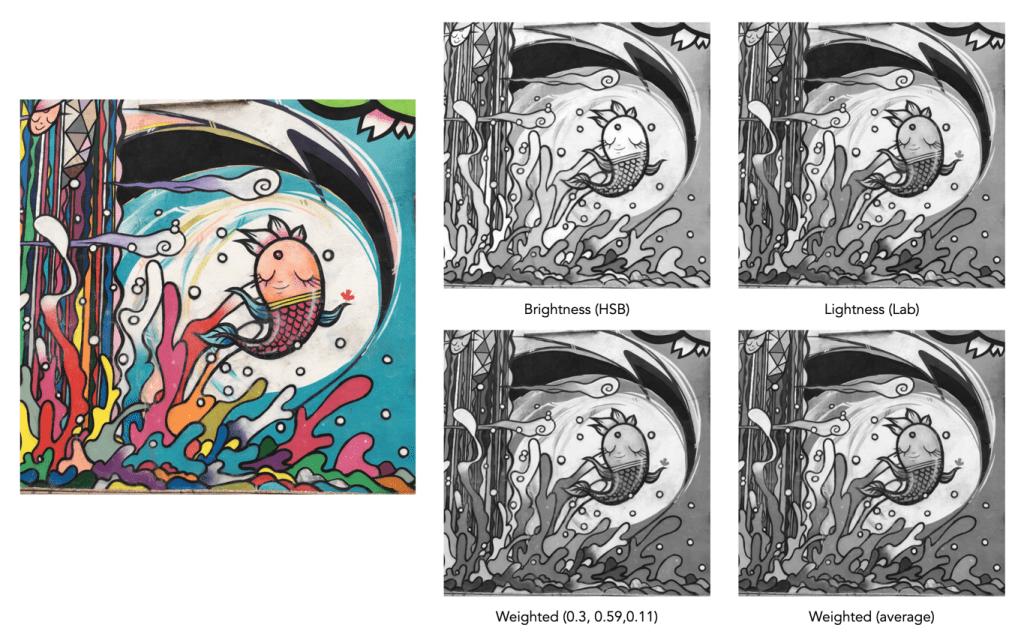
Examples of grayscale images produced using various methods – they may all seem the same, but there are actually subtle differences.

The lightness method

This averages the most prominent and least prominent colours.

Y = (max(R, G, B) + ,min(R, G, B)) / 2

The average method

The easiest way of calculating Y is by averaging the R, G, and B components.

Y = (R + G + B) / 3

Since we perceive red and green substantially brighter than blue, the resulting grayscale image will appear too dark in the red and green regions, and too light in the blue regions. A better approach is using a weighted sum of the colour components.

The weighted method

The weighted method weighs the red, green and blue according to their wavelengths. The weights most commonly used were created for encoding colour NTSC signals for analog television using the YUV colour model. The YUV color model represents the human perception of colour more closely than the standard RGB model used in computer graphics hardware. The Y component of the model provides a grayscale image:

Y = 0.299R + 0.587G + 0.114B

It is the same formula used in the conversion of RGB to YIQ, and YCbCr. According to this, red contributes approximately 30%, green 59% and blue 11%. Another common techniques is to converting RGB to a form of luminance using an equation like Rec 709 (ITU-BT.709), which is used on contemporary monitors.

Y = 0.2126R + 0.7152G + 0.0722B 

Note that while it may seem strange to use encodings developed for TV signals, they are optimized for linear RGB values. In some situations however, such as sRGB, the components are nonlinear.

Colour space components

Instead of using a weighted sum, it is also possible to use the “intensity” component of an alternate colour space, such as the value from HSV, brightness from HSB, or Luminance from the Lab colour space. This again involves converting from RGB to another colour space. This is the process most commonly used when there is some form of manipulation to be performed on a colour image via its grayscale component, e.g. luminance stretching.

Huelessness and desaturation ≠ gray

An RGB image is hueless, or gray, when the RGB components of each pixel are the same, i.e. R=G=B. Technically, rather than a grayscale image, this is a hueless colour image.

One of the simplest ways of removing colour from an image is desaturation. This effectively means that a colour image is converted to a colour space such as HSB (Hue-Saturation-Brightness), where the saturation value is effectively set to zero for all pixels. This pushes the hues towards gray. Setting it to zero is the similar to extracting the brightness component of the image. In many image manipulation apps, desaturation creates an image that appears to be grayscale, but it is not (it is still stored as an RGB image with R=G=B).


Ultimately the particular monochrome filter used by a camera strongly depends on the colour being absorbed by the photosites, because they do not work in monochrome space. In addition certain camera simulation recipes for monochrome digital images manipulate the grayscale image produced in some manner, e.g. increase contrast.

Vintage lens makers – ISCO Göttingen (Germany)

ISCO was essentially an offshoot of Schneider. It was founded in 1936 with the name Jos. Schneider & Co., Optische Werke, Göttingen. The factory was constructed in Göttingen as a second production site on behalf of the Reich Ministry of Aviation. The site produced manufactured Schneider lenses, and during the war years they produced cameras for aerial reconnaissance (the Luftwaffe required fast lenses with exceptional resolution). Lenses included the high-speed Night Xenons with 125mm, 330mm, 400mm, and 500mm focal lengths. During WW2 they produced around 45,000 lenses for aerial cameras, the main supplier of the Luftwaffe.

Due to the nature of the war production, the plant was dismantled by the Allied powers at the end of the war. The company name was not allowed to be used until 1953, so the company operated under the name Optische Werke Göttingen. They initially produced lenses for cinematic projectors, with names like Kiptar and Super-Kiptar. In 1951 camera lenses were produced for the first time, initially as built-in lenses for various camera manufacturers, e.g. Apparate & Kamerabau, Balda, Bilora, Franka, Wirgin. These were triplets of 4-element lenses, such as Isconar and Westanar. From 1956 ISCO increased its designs for wide-screen projection, and included lenses for 8mm, 16mm and 35mm cine cameras.

An an example of a well known ISCO lens

The first lens for SLR cameras appeared in 1952, and was the Westar 50mm f/2.8. It was sold with Exa cameras in the US. This was followed by the Westagon 50mm f/2, and Westrocolor 50mm f/1.9. In 1958 ISCO designed the Westrogon 24mm f/4, the worlds first extreme wide-angle lens for SLR cameras, ahead of the Zeiss 20/25mm Flektogons. Lenses were produced under a number of names: Westar (50mm, 100mm), Westanar (50/85/135/150/180mm), Westagon (50mm), Westron (28/35mm), Westromat (35/135mm), Westrogon (24mm), Westrocolor (50mm), Isco-Mat (35/50/135mm), Iscotar (50mm), Isconar (50/80/100/135mm), Tele-Iscaron (135/180/400mm), Tele-Westanar (135/180mm), Isconar (90/100/135mm) and Iscorama.

With the decline of the German camera industry, the demand for SLR interchangeable lenses also decreased. ISCO shifted its production back to the field of projection lenses for film, narrow film and slides. In 2009 the name was changed to Schneider Kreuznach ISCO Division GmbH & Co. KG. The lenses now produced are full frame lens set for both anamorphic and spherical cine photography.

Further reading

Why choose a vintage SLR?

There are generally two camps when looking at vintage photographic gear: those interested in using vintage lenses on digital cameras, and those interested in shooting with a vintage camera. The first have little or no interest in shooting with film, the latter likely focus on it. There is also a third category – the collector, and their needs might be distinctly different from active users of vintage gear. People choose vintage SLR cameras for a number of reasons (an SLR is just one choice amongst 35mm cameras, people also opt for rangefinder cameras, or point-and-shoot). Perhaps they want to get back to basics, and use with a system that has complete manual functionality, or perhaps they are interested in experimenting with film. It could be they just like the feel and process of using a film camera, or even for nostalgic reasons. It is in many respects a much more fundamental, slow form of photography, even though it requires much more participation from the perspective of calculating the right exposure, choosing the appropriate film etc.

There are a number of choices

Vintage SLR’s come in many different forms – fully manual to some level of automation can be accommodated in some manner. For example the cameras produced in the 1950s to the mid 1960s are all-metal, and all-mechanical (manual focusing, exposure and film advance). They are often very aesthetically pleasing and have lens options which often produce artistic renderings. After this came the first auto exposure SLRs, which meant shutter-priority followed by aperture-priority. These cameras still had a lot of mechanical parts, but some of the functionality was taken over by solid-state electronics. The introduction of electronic SLRs pushed automation ever further. From the mid-1970s until the late 1980s came the electronic SLRs became the norm mostly to cut both costs and mechanical complexity. These camera bodies contain more plastic, and the first program-auto exposure settings.

SLRs are good for many photographic genres

Of course another motive focuses on the type of photography the camera is going to be used for. This is important because it allows a set minimum requirements to be established. There are some genres of photography that are better suited to the use of vintage cameras than others. General everyday or travel photography, landscapes, street or portrait photography are ideally suited to vintage cameras. This is because these genres are suited to manual focusing, and adjustment of exposure settings on the fly. Alternatively, wildlife or sports photography are not the best genres for a vintage camera (despite the plethora of telephoto lenses on the market). Both these genres generally require telephoto lenses, which with manual focusing isn’t optimal. Some people likely chose a mechanical SLR in order to experiment with street-photography at the most basic level, or an electronic SLR for travel photography.

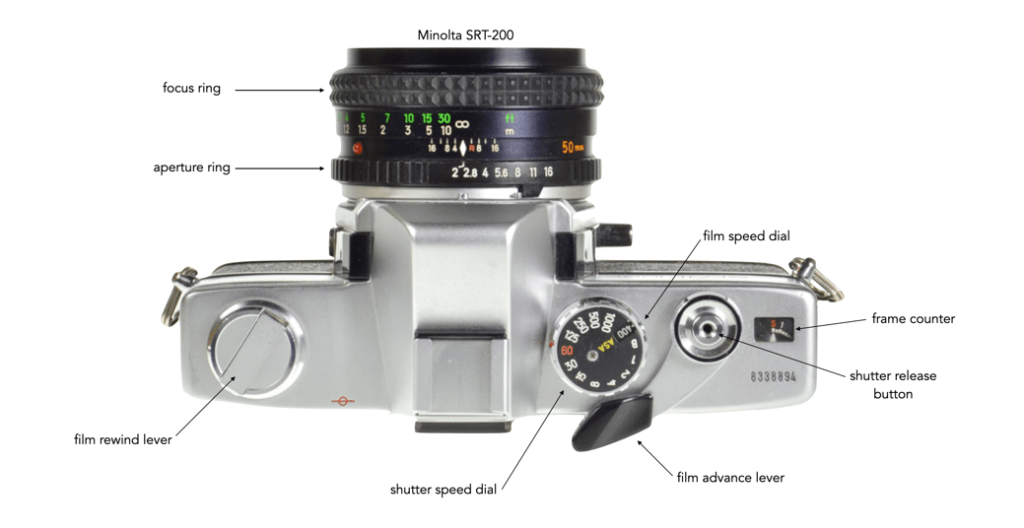
Fig 1: Many SLRs offer a very simple tactile experience

The tactile experience is often better than with digital

Although there are many differing forms of 35mm cameras, SLRs do stand out for their tactile experience. Early SLRs were entirely manual, meaning that there were many differing parameters which had to be manually modified in order to obtain the correct exposure. This means cameras had various lever and knobs which had to be adjusted – there is the shutter button, adjustments for film speed, shutter speed, and on the lens, aperture and focus mechanisms. There is a level of interaction which is a vastly more tactile experience than pushing a button, or setting a menu item on a digital camera.

Analog is nostalgic

Analog photography can be somewhat limiting, in that there isn’t a memory card with limitless capability to store photographs. Film will limit the number of pictures able to be taken, so every shot has to count. This amps up the level of creativity, forcing the photographer to slow down, observe the surrounding world, and think about the picture being taken. Choosing a vintage 35mm SLR, or even a rangefinder for that matter, means embarking on a more participatory experience, where the level of self expressiveness is determined by the complexity of the camera itself. The physical nature of film – loading it, winding it on, hearing the shutter open and close – combine to provide a more natural [pure] experience.

Fig 2: Price points (Cad$) of various SLRs (in good+ condition)

SLRs are available at a good price

Vintage SLRs are available at many different price ranges. Yes there are expensive SLRs – usually this has to do with scarceness. For example someone might be interested in a 1936 Exakta Kine 35mm SLR, the first SLR, which could be worth anywhere from C$3000-4000. Or perhaps an ALPA camera, which are generally upwards of C$1200. But there are plenty of relatively inexpensive cameras, partially because there were so many manufacturers in the 1960s, and so many cameras were produced. You can find an Olympus, Pentax, or Minolta camera (body only) for between C$300 and C$500 (certified/restored). Less well-known brands of the period are even cheaper, e.g. Konica, Petri, Ricoh, Yashica, Miranda, Fujica etc, often including a 50mm lens.

SLRs are well built

Before the more extensive use of plastics in the 1970s, metal was king. Many cameras up until this period (and even beyond) used a die-cast metal body, which means the cameras were built tough.

SLRs are educational

One of the issues with digital cameras is that so much is automated. That’s not a bad thing in a lot of situations because it allows you to concentrate on framing the shot. However because of this, the inner workings of the camera are sometimes lost to the photographer. An SLR will also help the novice learn the fundamentals of photography – the hard way. This means you have to gain a more intimate understanding of how things like shutter speeds, apertures, and exposure works. However on the flip-side you do gain better control of the photographic process.

Choosing a vintage SLR camera – technical FAQ

This FAQ deals more with the “tech” side of things. Vintage cameras are mostly mechanical, i.e. they are filled with gears and doohickeys of all sorts.

How complex are vintage cameras?

Quite complex, at least from a mechanical perspective. The earlier rangefinders may have been somewhat less complex, but as cameras attained more features, the mechanical complexity increased. They are a world away from the early plate cameras with very moving parts. In some respects electronically controlled cameras can often have simpler designs.

Which brands are most dependable?

This is really hard to pinpoint. You really have to go off reliability, popularity, and reviews. Every manufacturer created good SLRs, and ones that were less that stellar. The less dependable cameras are often those that have known mechanical issues, obscure mechanisms (e.g. “new” shutter mechanisms, or materials that just didn’t work), or have poor usability. If this question is asked on some forum, everyone will have a different answer.

Which brands to avoid?

I don’t like to pigeonhole brands, but for the novice I would honestly avoid East German and Russian SLRs. There should be a lot of these cameras, but in reality there often aren’t, perhaps because they haven’t stood the test of time. The exception is the manual Ihagee Exakta cameras, which generally are quite good from a mechanical viewpoint.

What’s the most important technical issue with vintage cameras?

Arguably the most critical things have to do with the shutter. Shutters are generally constructed of light-tight cloth, metal, or plastic curtains, all of which can be damaged. Does the shutter actually work properly on all shutter speeds, i.e. does it open and close, and not get hung up somewhere? In some cameras the shutter will work fine for fast speeds and perhaps get hung up on one or two of the slower speeds. You can usually test this by opening up the back of the camera and checking the shutter at each speed setting. More critical may be whether or not the shutter speeds are accurate. Again some may be, others may not be.

Are batteries an issue?

There are vintage cameras that use batteries, mostly those that use meters of some sort, or contain electronics. Some vintage cameras use Mercury-oxide batteries which are a problem, because sometimes can’t often be satisfactorily replaced (they were banned in the late 1990s). Also, sometimes even when you find a battery, aging electronics can lead to issues. I have a Minolta X11 (specified to use S76 1.5V “silver-oxide” batteries) which works well, except for one thing – the batteries drain really quickly. This was a quick fix though, only add the batteries when the camera is actually being used.

Are SLR cameras repairable?

Yes, but these days it is sometimes hard to find people that fix them, and it can be expensive. Some repair specialists just remedy specific camera brands. It is also an issue of how readily parts are available – if you have a camera where a lot were made, (say 500,000) it is obviously easier to find donor cameras to provide parts than it is a vintage camera where very few were made. A film camera CLA (Clean, Lube, Adjust) can cost anywhere from C$150-300. In some cases it may be preferable to pay more for a certified camera rather than go through the hassle of repairing an inexpensive one.

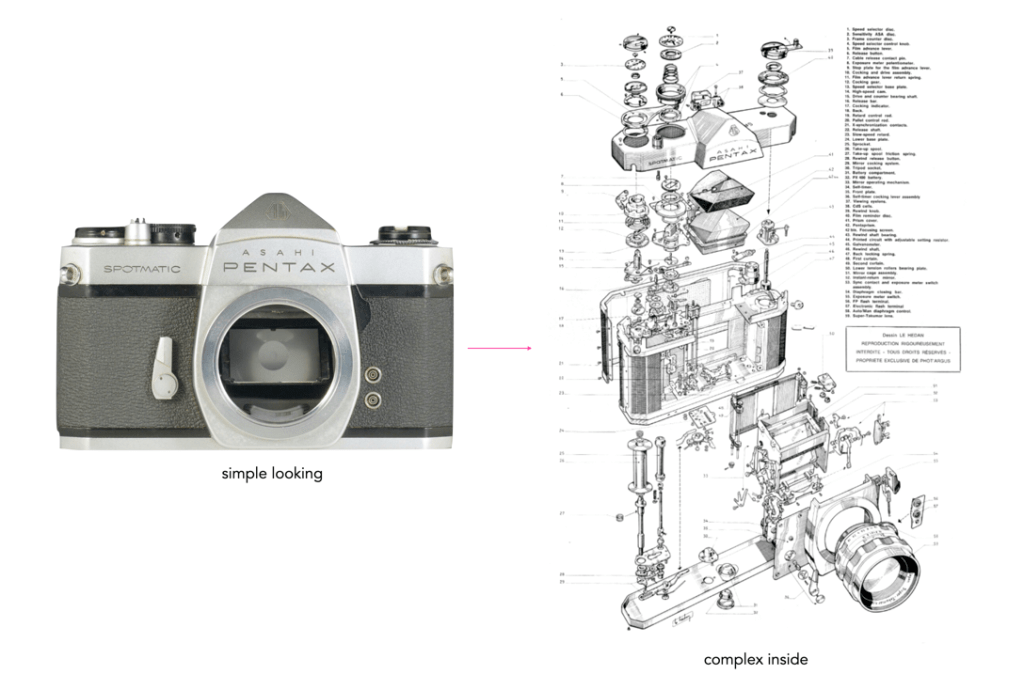
Manual cameras are pretty complex inside (Asahi Spotmatic, 1964)

Can I fix a camera myself?

Hmmm… yes and no. Let me put it into context. If a camera is cheap you could try and fix it, depending of course on the complexity of the issue. To do this, you need to have the right tools, and probably a camera manual. The problem is that sometimes the sheer age (50-80 years) can mean things are seized up, and un-seizing can sometimes lead to things breaking. I would honestly not go down that path (having tried fixing something simple, it just broke something else). It takes a lot of patience and quite a bit of knowledge to pull things apart and put them back together in working order. Even manual cameras are complex – the innards are a haven of interwoven mechanical things. Open a camera at your own peril.

Are light meters an issue?

Invariably yes. Some of the meters, like the early selenium meters can often work quite well, whereas the Cadmium Sulfide (CdS) meters may not work as well. Sometimes cameras will be advertised as “meter not functioning”. Sometimes due to age, the light meter may not be that accurate anyway, so it might be best to use an external light meter, or even a digital one.

Are there issues with electronic 35mm SLRs?

Yes, electronics don’t always stand the test of time well. Electronics tend to be adverse towards moisture, and dust, which will find their way into a camera and cause issues. It may be possible to find (or even manufacture) mechanical part replacements, electronics are another thing altogether. That being said, electronic cameras are usually quite reliable.

Twig art via water flow

A lot of photographic inspiration often comes from nature. Last week I was walking in a park a few hours after the torrential “100 year storm”, and noticed that all the twigs lying on the ground had been washed down the grassy hill, forming these clumps of miniature log-jams. They were just a lot of fun from a artistic viewpoint, showing again that nature truly knows how to do randomized, chaotic art.

How do we define beauty?

It’s funny when someone says a photograph is beautiful, because not everyone will have the same perception. This is because the idea of beauty is a very subjective one. Beauty is a term which cannot truly be quantified in any real manner. What society has done is imprint certain standards of beauty based on a few peoples opinions. If you look at the picture of the pink flower below, you might say it’s beautiful – but why is it beautiful? Is it because most people would say that, or is it because it is colourful. A brown flower would likely be considered not-so-beautiful. Is it because the flower smells nice? (which obviously you cannot tell from a photograph). The second flower below, a Frangipani is simpler, but may be beautiful because of its decadently sweet, floral, fragrance. Could beauty be an amalgam of visual and olfactory senses?

Are pink roses considered more beautiful?
This Frangipani flower is plain, but still beautiful.

For most of human existence, beauty has not really mattered that much (well, except maybe for those who had wealth, I mean gold is shiny, which likely contributes to its allure). Most humans were concerned with survival. That is not to say that aesthetics did not play a role in the things they made, but let’s face it, catching food took precedence over making things look pretty. Beauty may have existed more in the natural world. In fact it may be these natural patterns that exist in nature that has lead to humans being somewhat hardwired to experience beauty.

“Beauty is no quality in things themselves: It exists merely in the mind which contemplates them; and each mind perceives a different beauty. One person may even perceive deformity, where another is sensible of beauty; and every individual ought to acquiesce in his own sentiment, without pretending to regulate those of others.”

Hume, David, “Of the Standard of Taste”, Essays Moral and Political, p.136 (1757)

Beauty has to do with the idea of aesthetics, which is essentially the appreciation of beauty. The term “aesthetics” was introduced in 1750 by German philosopher Alexander Gottlieb Baumgarten who defined taste, in its wider meaning, as the ability to judge according to the senses, instead of according to the intellect. When we say something is beautiful, we are expressing an aesthetic judgment. When you pick a raspberry from a bush, you tend to choose the bright red, firm raspberries, with no apparent visual defects, those that are most beautiful (of course these is nothing to say they will taste good from pure visual assessment alone).

Is there not beauty in the piped twist of a French crullers?
The beauty in a matcha latte lies in the contrast between the green of the matcha and the foamy heart.

Beauty can be objective and universal, as certain things are beautiful to everyone. Perhaps flowers are a good example, or things in the natural world. However beauty in the human-made world is more subjective and individual. It is no different with our other senses. A delicious food to some, may taste repugnant to others. Another good example is art. Some people can find a piece of art beautiful, while others find it loathsome. Beauty truly is in the eye of the beholder. Each person’s perception of beauty is also influenced by their environment. In 1951 artist Robert Rauschenberg produced White Painting, basically white latex house paint applied with a roller and brush on two canvas panels. Some will find beauty in this nothingness, many won’t (well because there is nothing there).

The same is true of photographs, where beauty truly is subjective, mainly because photographs inherently represent the visual perspectives of the photographer, not necessarily those of the viewer. In some cases what is viewed in a photograph may not have the same beauty as the scene in real life, perhaps due to the lack of depth (i.e. flatness), or the misinterpretation of colour. In other cases, the photograph tells a different story of beauty to the real world. For instance colour may not be quintessential to beauty. The absence of colour in B&W images is not to everyone’s taste, yet it helps to tell a story in a way that means the colour does not distract the viewer from the image’s inner beauty, perhaps highlighting the expressions and textures of the scene.

There are many elements to producing a beautiful photograph, but at the end of the day, beauty is very much tied to the perceptions of the viewer. And unlike the physical world where we can harness all out senses to decipher our understanding of beauty, in visual media we have only our eyes.

A brief note on historical photographic patents in Germany

When it comes to “who invented what first” in the photographic industry, there is always a lot of discussion when it comes to German patents. For example the idea that the Contax S had the first pentaprism for 35mm SLRs is based on a early patent. But just because a patent existed somewhere didn’t mean that similar technology wasn’t being developed elsewhere in parallel. And concepts don’t always make it to reality.

During the Second World War, German companies often applied for patents in other European countries, such as France and Switzerland. France made somewhat sense, considering it was mostly occupied by Germany during the war. Why this was done is still up for debate, but the end result is that there are often patents for photographic objects which exist outside Germany, but no longer have an associated German patent (for whatever reason). For example, information on the the precursor to the Spiegel-Contax (Contax S) camera, the Syntax, which was designed during the war, is available by means of a French patent FR884054 filed on August 9, 1941. The patent is supposedly based on a German utility patent filed on August 23, 1940, however a search of German patents finds nothing. Is that because it never existed, was never processed, or was lost? (The non-German patents normally identify that they are based on a German patent, however no German patent numbers are provided). It was also possible that during a war economy, only inventions that were important to the war effort were granted, many as so-called “secret” patents.

A patent is only effective within the scope of the respective patent law. Companies therefore register patents abroad in order to protect their inventions there from unauthorized imitation. In most cases during the war, these patents were confiscated. For example with the “Patents, Designs, Copyright and Trade Marks (Emergency) Act, 1939” of September 21, 1939, the British began confiscating enemy patents. Other Allied countries undoubtedly enacted similar laws.

The fate of German patents in the period 1945-1950 is somewhat interesting. According to the German Patent and Trademark Office, in 1944 due to the bombings, large portions of the patent office in Berlin (some 250-320K volumes were moved to the town of Heringen, and stored in a 500m deep potash mine shaft. The town was occupied by U.S. troops on 3 April 1945, and the shaft was located, although the patents were not exactly in great shape, and likely would have disintegrated if brought to the surface. So a team was sent down the mineshaft to microfiche the patents. Other patents were dispersed throughout Germany, and supposedly one set of copies of 180,000 patent applications were taken into eastern Germany where they were later lost by fire. Now the U.S. were actively engaged in tracking down secret documents from the industrial and research community. This involved 17 U.S. industries, and hundreds of civilian investigators. They discovered vacuum tubes made of heavy porcelain, magnetophone tape, and infrared technologies.

Starting in July 1945, U.S. troops seized some 145,000 “non-concluded” patent files. Essentially nearly all the German patents ended up in West Germany, meaning that the companies in East Germany likely no longer had access to the protection of these patents. Quite a number of the patents seized were used to help industries in allied countries. Why were not more photographic patents used? The allied countries really didn’t have the same level of photographic industry as Germany. Most German camera/lens companies actually ended up in the Soviet occupation zone. In addition, it is likely the main company in the Western zone, Leitz, had enough pull to allow it to continue operating.

In addition, from the end of April 1945 until 1 October 1948 there was no facility to file patents, aka the “patent-office-free-period” when no patents could be filed. Germans in the western zones were able to file patents again on 1 October 1948 and the German Patent Office began operations on 1 October 1949. In East Germany, patents could be submitted again on 15 September 1948, and on 6 September 1950, the Office for Inventions and Patents of the GDR was established.

What about the old patents which had basically been neutralized? Well in West Germany, the provisions on the maintenance of old IP rights were covered by the “First Act on the Amendment and Transition of the Provisions in the Field of Industrial Property Protection” of 8 July 1949. A request to maintain the IP rights had to be filed by 30 September 1950. A similar act appeared in East Germany in 1950. An example is one of Zeiss’s patents for pentaprisms from 15.4.1942: “Z 679 IXa/42 h ‘Spiegelprisma mit konstanter Ablenkung’ ” – basically a version of the 1946 Swiss patent, CH241034. It was reapproved on 14 June, 1951 (DE000Z0000679MAZ). Note that the 1942 patent does not appear in the German Patent Office searchable database.

It is therefore possible to find some patents, but others were likely lost in the attempt to save them during the tail end of the war. So the idea of defining who invented something first during the 1940s in Europe, but in particular Germany is very challenging, as noted in my post on Who had the first 35mm SLR with a pentaprism? Having said that it is generally easy to find historic patents from countries like Germany, Switzerland, and France. It is much harder to find them from Italy, or even Belgium.

Further reading:

Choosing a vintage SLR camera – some FAQ

This past covers more aspects of buying a vintage camera in FAQ form. When it comes to 35mm interchangeable-lens cameras there are two categories: rangefinder and single-lens-reflex (SLR). This FAQ is concerned with SLRs because they became the dominant form of SLR camera found on the used market.

What are the best vintage cameras?

Identifying the best vintage camera is very much a subjective thing. Unlike lenses though, which are often chosen for the aesthetic appeal they impart upon photographs, cameras are all about functionality. All cameras really serve the same purpose, as a vessel to hold the lens, and film, and control the process of taking a photo. So the best vintage cameras are often those that achieve this in a way that doesn’t compromise functionality. They should be simple to use, aesthetically pleasing, ergonomic, and don’t suffer from a series of maladies, e.g. shutters that could imminently fail, poor engineering or manufacture etc.

Which camera types are best?

It really depends on what sort of features are required, and perhaps what sort of lens mount (not all lens mounts are inter-compatible, and it is hard to find adapters for film cameras). Do you want fully manual, semi-automatic, or fully electronic? Do you want a built-in light meter (which is tricky because many don’t work anymore)? Then you have to figure out which ones are problematic from some functional viewpoint, e.g. problems with shutters, or flaky electronics. For example Olympus made 14 major models of manual focus SLR in the period 1972 until 2002, and two automatic models. The OM-707 was an auto-only camera, and somewhat of a disaster from a usability perspective. The Olympus OM-4Ti (1986-2002) is considered by many to be best film SLRs money can buy.

What is the most versatile camera mount?

In reality, M42 is likely the most common lens mount, at least up until the early 1970s. There were a lot of lenses made for this mount from a myriad of manufacturers. There were also a bunch of cameras that used it as the mount. Next in line might be the Exakta mount.

Can film cameras use lenses from other brands?

Unlike mirrorless digital cameras, which have a short focal flange distance, allowing for adapters to suit a bunch of 35mm film lenses, the same is not true for film cameras. Some cameras can use lenses with other mounts, many can’t. For example the Minolta cameras with an SR-mount can use M42 mount lenses, because the flange distance on the camera (43.50mm) is less than that of the lens, allowing an adapter to convert the M42 to SR-flange (MD,MC) – however the opposite is not true.

Do some people buy cameras because they are aesthetically pleasing?

Yes. Some people love how cameras look, even if they don’t function that well. Form over function is a real thing for some people, of course beauty is always in the eye of the beholder.

Why were some SLRs unsuccessful?

Sometimes cameras didn’t sell that well, and as a result weren’t that successful. This was usually down to poor choices in the design of the camera. A good example is Rollei which had its own bayonet mount lens system known as the QBM – proprietary lens mounts means a smaller choice of lenses. Poor usability, or finicky mechanical features often lead photographers to abandon a camera. Sometimes it can be poor aesthetics, as with the case of the Minolta Maxxum 7000, although to be honest requiring photographers to dump all their lenses in favour of a new system with autofocus, probably wasn’t the best idea.

What about brands?

There are three major categories of vintage camera manufacturers. The first are landmark manufacturers who got into the game early, and focused heavily on SLRs. They likely had a start in 35mm rangefinder cameras. This means manufacturers like Exakta, Asahi-Pentax, Nikon, and Canon. Pentax is the only one of the three that did not produce rangefinder cameras. Next are the companies that are second tier, i.e. they had a smaller footprint, made only SLRs or got into the game late. This includes Konica, Minolta, Fuji, Olympus, Topcon, Yashica, Petri, Mamiya, Miranda, Ricoh, Zeiss Ikon, KW, ALPA. Lastly are the companies who didn’t really do a great job with 35mm SLR – Leica, Rollei, Voigtländer. Each manufacturer produced both good and mediocre cameras, and so it really requires some investigation into the right brand.

Are Japanese SLRs better than German ones?

In all probability, yes. There are undoubtedly some good German SLRs, mostly from East Germany, produced in the 1950s and 1960s. West Germany really didn’t produce that many successful SLRs. Both countries struggled to produce SLRs that could compete with the ones produced by Japanese manufacturers. There are a few good German SLRs, e.g. the Contax S2, but the reality is there is likely better Japanese cameras that are way cheaper.

Should I buy a camera made in East Germany?

With the exception of Exakta cameras, many post-war Eastern bloc cameras suffer from lower standards of engineering, reliability, and in some cases poorer usability than West German and Japanese cameras. When they were new, this was less of an issue because these cameras were often sold for dramatically lower prices. However aging cameras can be fraught with issues. Check the reliability of any camera you are interested in.

Why are there so many Eastern-bloc cameras?

Cold hard currency. The communist-bloc countries needed currency, and one was to achieve that was to produce goods to sell in the west. Banking on Germany’s pre-war reputation for producing photographic equipment, this was a very lucrative option. Dresden, which ended up in East Germany, was once the European epicentre of photographic innovation. The cameras were often sold cheaply, thanks in part to Eastern-bloc government subsidies.

What’s are the best East German SLRs?

Anything in the Exakta range, or perhaps a Praktina, or Praktica IV.

What about the weird brand SLRS?

Oh, you’re talking about the small independent brands?

  • Rectaflex (Italy, 1949) – over-engineered, heavy yet reliable, these cameras are expensive only because of their rarity.
  • Alpa (Switzerland, 1942) – exacting, well-built cameras. Some models such as the 6c are extremely good cameras, although some are susceptible to shutter issues. Expensive, but provides a unique character, and high level of quality.
  • Wrayflex (England, 1950) – the only commercially successful, English made SLR.
  • Edixa Reflex (West Germany, mid 1950s) – moderate quality cameras made by Wirgin (Weidbaden), these cameras rarely operate for very long.

Why are there so few cameras not made in Germany or Japan?

This is in part due to a lack of interest in developing their photographic sectors. While the allies poached a lot of high-tech workers from Germany, particularly from the armaments sector, they didn’t relocate any photographic expertise, except from the Russian occupied zone in Germany to the US zone. The boom in SLRs which occurred in the 1950s was driven by cheap cameras and lenses coming out of East Germany, and the growth of the photographic sector in Japan. Countries like the US, UK, and France could not compete, or just didn’t have the ability to get into a market that was dominated pre-war by Germany.

What’s does “mint” mean?

This is a term used by some resellers to indicate that a camera is in near perfect condition, almost like it came out of the factory last week. In many cases it likely means the camera sat in its box, and was never used (if it comes with the box and instructions, even better). However just because it’s mint doesn’t always mean that everything will function the same as it did when it came out of the factory 60 years ago. Materials still may degrade, grease solidifies, and gears seize up.

What about electronically-controlled 35mm SLRs?

This is often a choice for people who don’t want to deal with a fully manual camera. This means any 35mm SLR where electronics aid in calculating things like exposure. This could range from something like an aperture-priority-only camera to an autofocus equipped, completely automatic SLR. The only problem with these cameras can be aging electronics. If the electronics stop working, you basically have a paper weight. Choose a camera that is well reviewed and barely ever gets negative reviews. Note that manual cameras often had light meters, but that doesn’t make them electronic cameras (a camera with a light meter can generally be used even if the light meter doesn’t work.)


Choosing a vintage 35mm (interchangeable lens) camera

Choosing a vintage lens is one thing, choosing a vintage camera is a completely different matter. This is partially because people often choose vintage lenses for use with digital cameras, whereas people choose vintage cameras because they are interested in film photography. Choosing a 35mm camera is tricky, because unlike vintage lenses, which are often quite simple in their mechanical ways, 35mm cameras can be quite complex.

Firstly 35mm encompasses two core types of interchangeable lens: rangefinder, and single-lens-reflex (SLR). The rangefinder period started in 1925 with the commercial introduction of the Leica I, and reigned until the early 1960s when 35mm SLR cameras began to dominate. The first production 35mm SLR emerged as the Kine Exakta in 1936 and they progressively gained more of the market. So the first choice really is whether you want to choose a 35mm rangefinder camera, or a 35mm SLR? The choice is based on different perspectives of how a photograph is taken. This choice also dictates the age of a camera, which can be a major issue.

Cameras can be broadly categorized into pre-WW2, and post-WW2. With age comes the same proclivities as suffered by any complex mechanical device. This includes things like penetration of dust and other contaminants which can lead to gears not working properly, or springs loosing their tension. Lubrication grease can dry up, and shutter mechanisms can become brittle. There are a lot of issues which are often very challenging to fix. The problem is exacerbated by the fact that it is impossible to see inside to view the state of the mechanisms. Even the simplest of designs can include an incredible amount of mechanics, mostly to control the shutter, but in some cases the aperture as well.

How to choose a vintage 35mm SLR camera (with camera clues)

There is also complexity. Early cameras were obviously manual, and as the decades progressed they incorporated progressively more automatic features, i.e. electronics. In either case, film cameras can be complex with many moving parts. Automatic control and light meters obviously came with another issue – power, or rather batteries.

Apart from the physical issues, choosing a film camera is more about personal choice than anything else. There are a lot of 35mm cameras out there. The best way to choose a camera is to first roughly decide on rangefinder or SLR. The next decision is manual, semi-automatic or automatic. This can be followed by brand, and then narrow it down to a specific model, perhaps based on features. The best way to decide on a specific model, is to make a short-list, and then find some reviews of the cameras. Reviews will usually provide some context on the pros and cons of the camera, including any potential red flags, e.g. commonly recognized faults. If there aren’t any reviews, then that in itself could be a red flag, meaning few people are actually using the camera. Many of these camera reviews are quite extensive, so they should be able to help choose an appropriate film camera.

Beyond the functionality of vintages cameras, to some there is also the aesthetic appeal. Some people like certain 35mm cameras because of how they look. Mostly this is a legacy of likeable cameras.

My best advise for buying a vintage camera is to buy one from a reputable dealer, one who has examined the camera, perhaps fixed any problems, or in any case is willing to specify what issues there are with a camera. A good example is Kamerastore from Finland. They will identify a camera as “Not Passed”, “Passed”, “Certified”, or “Restored”. For example you can buy a restored Olympus OM-1 for around C$370 that has new light seals and has had both the light meter and exposure calibrated. If you find a good camera somewhere for a really good price, and most things seem to work, you can take a gamble, but things like shutter speeds might not be accurate.