The good, the bad, and the bokeh

The idea of “bokeh” originated in Japan, the western term derived from the the two Japanese Katakana characters bo and ke, “ボケ”, which roughly translates to “to be out of focus”, “to be blurred”, or “out-of-focus blur”. The term made its western debut in 1997 courtesy of Mike Johnston in Photo Techniques magazine. For a long time, there was little or no interest in the concept, but in recent years, and with the use of vintage lenses on digital cameras, it has come to the forefront. Maybe too much so.

All images contain blur in one form or another, typically in the form of out-of-focus (OOF) regions. The blur that separates a subject/object from its surroundings is the result of shallow depth-of-field (it can occur behind or in front of the subject/object). In many cases OOF regions contribute to the overall aesthetic appeal of an image, either by isolating an object/subject or setting a particular mood. Bokeh is often defined as the quality and aesthetic appeal of the OOF regions of an image, as rendered by the camera lens. Sometimes a particular lens will produce exceptional out-of-focus regions, while others will produce harsh OOF in the same scene.

Bokeh is an optical phenomena that occurs naturally. In this photograph it exists as soft blur in the background. No orbs needed!

One of the problems with the term is that it is somewhat imprecise, and often used inappropriately. The Japanese boke is a very subjective, aesthetic quality, so there is no real way to describe it beyond its definition. An article which appeared in the same issue of Photo Techniques, “Notes on the Terminology of Bokeh” by Oren Grad explored many of the Japanese terms used to describe bokeh. For example when a lens diaphragm with six blades is stopped down the iris may become visible in the form of surudoi kado (sharp corners), resulting in ten boke (point bokeh). But there is no indication that this is necessarily “bad bokeh”. Amongst many terms, bokeh could be sofuto (soft) or katai (hard), hanzatsu (complex) or kuzureru (breaking-up). Some of the terms relate purely to out-of-focus highlights, but bokeh is the overall effect as well.

It is true that bo-ke plays a large role in Japanese photographic culture, where it is an aesthetic quality, but bokeh is not just about the optical aesthetics – there is such a number of differing variables at play. Bokeh can even be different within a single lens, changing with a change in aperture or focus, the nature of the subjects/objects in the frame, and lighting conditions. Bokeh, like photography itself is often an enigma of chance. Now it seems like every lens review has to include a lenses ability to produce bokeh. But we are not talking about the bo-ke of Japan, we are talking westernized Bokeh… dreamy, creamy, soapy bubbles. All these pictures with orb-like features in them. Blah! Smooth, or “creamy” blur is desirable, orbs with defined edges are undesirable, or “bad” bokeh.

“Bokeh is not a natural artifact, because humans don’t perceive it outside of photography.”

I mean, I don’t begrudge people for taking these surreal pictures, but real bokeh is not all about these glowing orbs. And what exactly does “buttery” mean? Or creamy? Sorry, these are ridiculous terms. You can’t describe out-of-focus regions as buttery, or creamy. Shortbread biscuits are buttery, but describing bokeh as buttery is weird. Is it meant to signify smoothness? Because butter is only smooth when left at room temperature (and even that is tenuous). The same with using “creamy” as a descriptive word. Mash potatoes can be creamy, as can ice-cream, but not bokeh. Creamy and buttery are not words that describe smooth, they describe mouthfeel and taste.

Most people who use the term bokeh, really don’t know what the term means, and spend too much time trying to create it, rather than letting it occur naturally, usually at the expense of the subject within the image.

Vintage lens makers – Enna Werk (Germany)

Enna Werk was a small German optical company founded in 1920 by Alfred Neumann and located in Munich. There seem to be two stories regarding its name: (i) Enna is the founder’s daughter’s name reversed, or (ii) Enna is derived from the reversed initials “N.A.”, of its founder (pronounced Enna). During WWII, the company supplied lenses for the German military. In 1945 the plant was destroyed by allied air raids and was relocated to Ebersberg, near Munich. After the death of Neumann, the running of the company was taken over by his son-in-law, Dr. Werner Appelt and renamed “Enna-Werk Optische Anstalt Dr. Appelt K.G.”. By 1948 the plant at Konradinstraße in Munich was rebuilt.

Fig 1: Some of the more interesting Enna lenses

Circa 1950 the company started making lenses under its own name – prior to this the company only manufactured lenses for other companies, including Alpa, Balda, Braun, Corfield, Edixa (Wirgin), and Ihagee. In 1952 it started producing lenses for interchangeable rangefinder cameras. This was followed in 1953 by the production of SLR lenses with a focal length range between 24 and 600 mm. By 1964 Enna had produced 4 million lenses. The primary lens designer was Dr. Siegfried Schäfer and some of his designs are based on drafts by Ludwig Bertele, designer of the famous Sonnar. They made lenses in various mounts including M42, M39, and Exakta.

The first interchangeable SLR lens was the 35mm wide-angle Lithagon f/4.5 (1953), followed soon afterwards by f/3.5 and f/2.8 and even f/2.5 versions (1956). A Lithagon with a 28mm focal length, the Ultra-Lithagon 28mm f/3.5 was unrivalled at the time (1955). A very fast Ennalyt 85mm f/1.5 appeared in 1954, followed a year later by a telephoto, the Tele-Ennalyt 135mm f/3.5. Enna had a number of milestones, which included the world’s fastest wide-angle lens, the 9-element Super-Lithagon 35mm f/1.9 in 1958, and the worlds first telephoto zoom lens, the Enna Tele-Zoom 85-250mm f/4 in 1961 (only two years after the release of the Zoomar, the worlds first zoom lens). The high-speed 6-lens Ennaston (later Ennalyt) 85mm f/1.5 was also one of the world-renowned lens developments in the 1950s.

Fig 2: Enna Lithagon 24mm f/4

Enna was the first lens manufacturer in West Germany to introduce a wide-angle lens of the Retrofocus type. This lens design, developed almost simultaneously by Angenieux Paris and Carl Zeiss Jena (Flektogon), enabled shorter focal lengths than 40mm in 35mm SLR cameras for the first time. This lens was the Ultra Lithagon 28mm f/3.5 (Patent#US2959100A) which appeared in 1955 (it was also the second 28mm lens ever made). It was the brainchild of Hans Lautenbacher, and was so named due to the existence of the Lithagon 35mm. His contributions also included the retrofocus lens calculations which produced the wide-angle Lithagon 35mm f/2.8 (1953, Patent#DE1062028), and Enna’s ultrawide Lithagon 24mm f/4 (1960, Patent#DE1228820).

Enna is most typically associated with the Lithagon family of lenses, mostly in the wide-angle spectrum. The name had to be abandoned around 1960 for legal reasons. From then on the lenses were called “Ennagon” or “Ennalyt”. Prior to 1956 Enna lenses read “Enna-Werk München” on the lens ring, and from 1957 onwards they read “ENNA München.” In 1958 Enna introduced the Sockel lens system “Springblendensockel”, a precursor to Tamron’s Adapt-all system. This allowed various lens units to be mounted to different cameras using appropriate adapters. The adapters incorporated both the aperture and focusing controls. There were two (incompatible) versions of the system: the first was semi-automatic, offering twelve lenses from 24-240mm for Exakta and M42 mounts; the second was automatic with ten lenses, and additional adapters for Alpa and Miranda.

The company still exists, but now focuses on precision plastic injection molding. This diversification had begun in the early 1970s, with the realization that German lens production was loosing ground to Japan. They started with the production of plastic parts for the camera industry, and by the 1990s it had become the main focus of the company.

Notable lenses:

  • Ultra Lithagon 28mm f/3.5
  • Super-Lithagon 35mm f/1.9
  • Lithagon 24mm f/4

Further reading:

Is weather sealing on a camera or lens necessary?

Experienced photographers and camera manufacturers often talk about weather-sealing. But what is it?

Weather-sealing is a term used to convey that there is a protective layer that helps block out things that are harmful to the electronics of a camera (or the internal workings of a lens) – things like dust, water, snow, and humidity. Whether a camera has weather-sealing or not, and how much weather sealing is dependent on the particular manufacturer. Typically the more expensive a camera, the greater the chance of weather sealing. Weather sealing consists of gaskets, and perhaps a lining made from rubber or silicon. This is particularly important in regions such as the lens mount, and any moving parts.

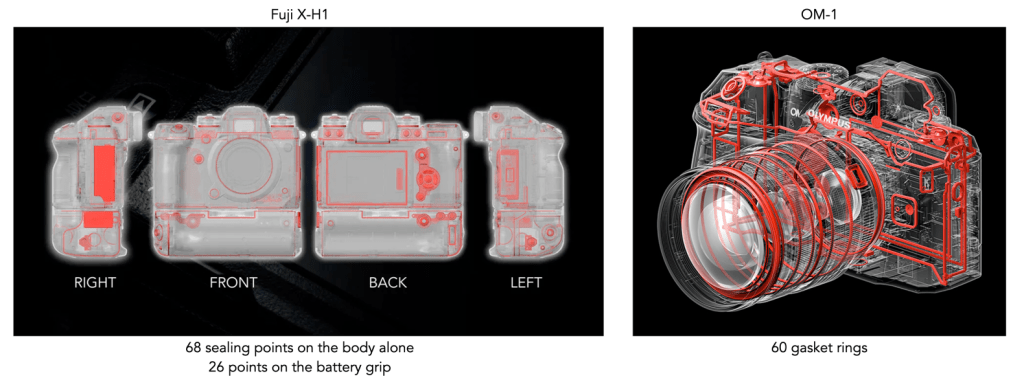
Weather sealing is challenging, partially because there are seams everywhere – between panels on the body and the battery and card compartments, the various controls like switches, push-buttons, rotating knobs and dials. Any break in continuity offers an opportunity for water to seep in. Larger components are the easiest to seal, often achieved using a gasket of some form, e.g. foam, rubber, between adjacent panels. Smaller controls also have foam or rubber gaskets, or O-rings where they interact with the camera body. Consider the Fuji X-H1 as an example (Figure 1). Fuji explained the weather sealing in “X-H1 Development Story #3”. They describe it as having a total of 68 sealing points on the body alone, and additional 26 sealing points for the battery grip. The X-H1 has rubber gaskets all over the body. The memory card door is locked firmly in place with a lock switch and the door has rubber seals to prevent moisture seeping into the compartment. Even the buttons and the joystick have rubber seals around to prevent moisture and dust from getting into the camera.

Fig.1: Weather sealing points on the Fuji X-H1 and Olympus OM-1

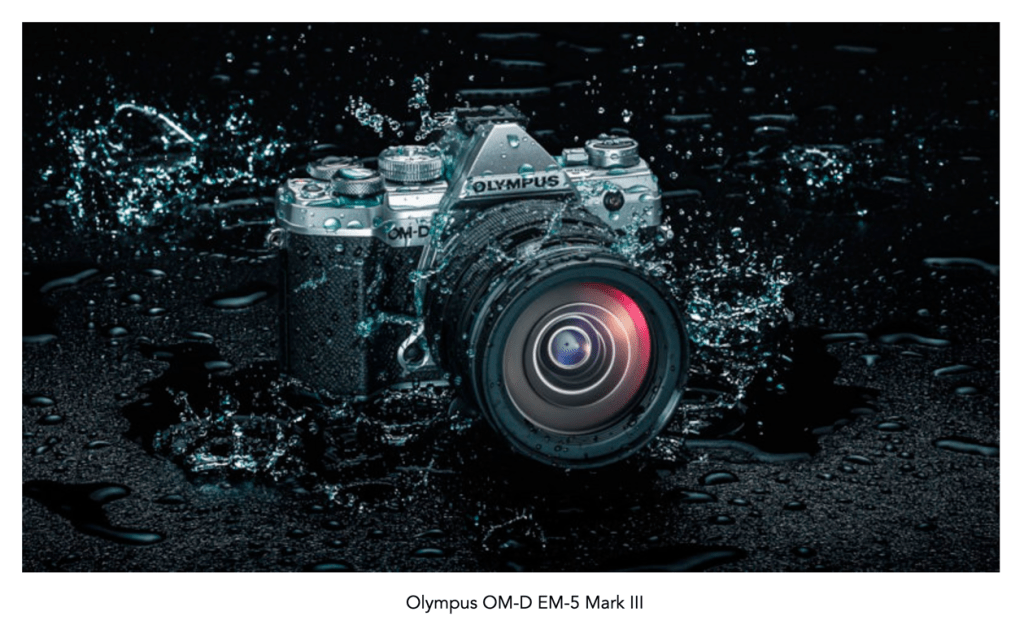
But weather-sealing is not the same as being water resistant, or waterproof. Weather sealing means a camera can withstand a few small droplets of moisture, or perhaps foggy environs, but it does not mean it one can sit out in a rainstorm. A waterproof camera on the other hand is one which can be fully submerged. Weather sealing also does not prevent condensation. This could only be prevented by filling the camera (and lens) with some inert gas, and sealing it completely. The sheer act of changing lenses allows air inside, and if moving from a warmer or cooler environment too quickly there is a risk of condensation forming. What does weather-sealing really mean? It’s honestly a bit like the terms used on outdoor gear like raincoats, i.e. somewhat vague. Ads for weather-sealing can be a bit bemusing. For example in the ad for the Olympus OM-D EM-5 Mark III, there is a camera sitting in a rainstorm with water splashing around it (Figure 2) – practical? I think not.

Fig.2: “WEATHERSEALED CONSTRUCTION: When your camera is splashproof, dustproof and freezeproof, you can stop worrying about the weather and focus on shooting.”

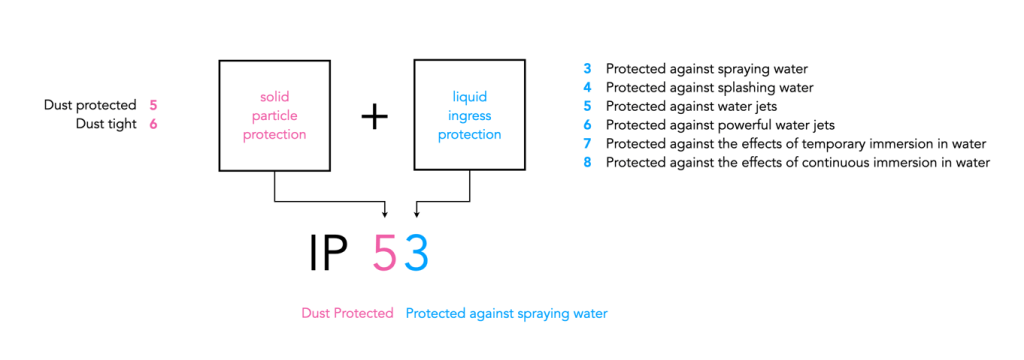
There is no real standardized means of rating weather sealing on cameras, however there is a system known as the IP or “Ingress Protection” rating and it is the standard that rates devices on their sealing properties. The IP rating is commonly used for smartphones, and security cameras. For example many recent iPhone’s have an IP rating of IP68. Notice the two digits, IP68? The first digit “6” indicates indicates the level of resistance and protection to harmful dust. The second digit “8” indicates the level of resistance to water. A rating of “8” means “protected from immersion in water with a depth of more than one meter.” These phones are well protected against dust and are also water-resistant but not fully waterproof.

One of the few digital cameras to get an IP rating, the OM-1 Mark II (formerly Olympus) has a rating of IP-53. This rating provides the second-highest level of dust protection that exists (partial protection against dust that may harm equipment) and certifies that the camera can continue to operate with water falling as a spray onto it at an angle of up to 60°. This means the camera can withstand most weather phenomena, and work in temperatures as low as -10°C. The OM System M.Zuiko 12-40mm f/2.8 Pro II lens (2022) has the same rating. The camera in the rainstorm, the OM-D EM-5 Mark III had an IPX1 rating, meaning it is water resistant to some extent, i.e. protected against vertically falling drops of water (which did not exactly make it splashproof, as IPX1 is the lowest level of protection against liquids). A step above IP-53 is the Leica SL3 with a rating of IP-54 which means the camera is protected from water spray from any direction.

Fig.3: An example of the most common IP constituents used for cameras

The biggest question is does a camera need weather sealing? The answer is based on whether or not a photograph engages in activities where dust and moisture become an issue. This includes travel to places that are susceptible to inclement, or “four seasons in one day” type weather. Weather sealing is somewhat of an insurance policy, but isn’t necessary for most photographers. It is also better at keeping out dust than moisture. The reality is that most camera manufacturers don’t actually designate an IP rating for their cameras – that’s not to say cameras aren’t well protected against the elements. And terms like splashproof, and weather resistance are really not that useful if they aren’t definable (e.g. in terms of IP ratings), otherwise you have to ask – how resistant?

So how does one deal with weather if you are in photographing in places with inclement weather? Firstly, store the camera gear in a waterproof bag. Avoid sand – it is not the same thing as dust. Also avoid salt water, it does not behave in the same way as fresh water – salt is everyone’s enemy. If shooting in a place like Iceland, where rain is always a possibility, use a rain and dust covers. Sleeves like the Op/Tech Rainsleeve are inexpensive and easy to carry (the Original sells for about C$15 for a pack of two). Another option is a shell from Peak Design which sells for about C$65 (medium). Something that is certainly taboo is changing a lens in rainy or windy conditions – it might be one of the worst things that can be done to a camera.

Want to see how weather sealing works? Check out this article by Dave Etchells [6] who delves into the intricacies of weather sealing technology at Olympus. He investigates both cameras and lenses, with photos of the weather sealing inside the camera (from Olympus R&D).He has also tested the Fuji X-T3 [4], the Canon EOS R [7], and Nikon Z6/Z7 [8]. There is also a great article on PetaPixel [9], that explores the various ways OM (formerly Olympus) tests its cameras (arguably one of the best testing environments around).

Further reading:

  1. Fuji, “Weather resistant technology” (2015)
  2. Jeff Carter, “Out in All Weathers”, FujiLove (2018)
  3. Chris Gampat, “Watch the Not Weather-sealed FujiFilm XS10 Survive being Frozen”, The Phoblographer (2020)
  4. Dave Etchells, “Fuji X-T3 Weather-Resistance Test Results”, Imaging Resource (2019)
  5. What nobody told you about Fujifilm weather sealing.
  6. Dave Etchells, “How to REALLY weather-seal a camera. We go deep behind the scenes at Olympus R&D headquarters”, Imaging Resource (2020)
  7. Dave Etchells, “Canon EOS R Weather-Resistance Test Results”, Imaging Resource (2019)
  8. Dave Etchells, “Nikon Z6 / Nikon Z7 Weather-Resistance Test Results”, Imaging Resource (2019)
  9. Jaron Schneider, “How OM Digital Torture Tests its Weatherproof Cameras”, PetaPixel (2022)
  10. Chris Gampat, “No, Your Camera is not Waterproof. It’s Protected, Maybe.”, The Phoblographer (2022)
  11. Mac, “Peak Design Shell Camera Cover Review”, Halfway Anywhere (2023)

Choosing a vintage SLR camera – buying FAQ

This FAQ deals more with the purchasing side of things of SLR cameras.

What is the average price of a vintage SLR?

There is no such thing. See below.

What sort of things impact price?

The cost of a vintage SLR is directly associated with a number of differing things. Firstly things like brand and rarity. Rare cameras cost a lot, sometimes it doesn’t even matter that their condition is somewhat mediocre. Next there is the brand, specific type, year of manufacture, condition, i.e. what works, and what doesn’t, and of course the spec of the lens attached to the camera. Some cameras will sell just as bodies, and others will be coupled together with a lens of some sort – it might be the stock lens the camera camera with, or perhaps something similar.

Why are some cameras so expensive?

Some cameras are expensive, either because the camera is rare, or has some attribute that makes it more expensive, or a review by someone with a lot of followers has pushed prices up. It also depends on the condition of a camera, those in pristine condition will have a greater value associated with them.

Are prices sometimes overinflated?

Basically yes. Sometimes this is due to someone’s belief that a camera (or lens) is worth far more than it actually is. Sometimes it is because of availability – there may have been 10,000 copies of a camera manufactured, but if only two are currently available on the market, it will invariably push up the price. Desirability also helps over-inflate prices.

Is price equitable with value?

Not always. Someone might advertise a camera for $4000, even though it’s value may only be $2500 – this may be related to availability (or possibly the camera is just overpriced).

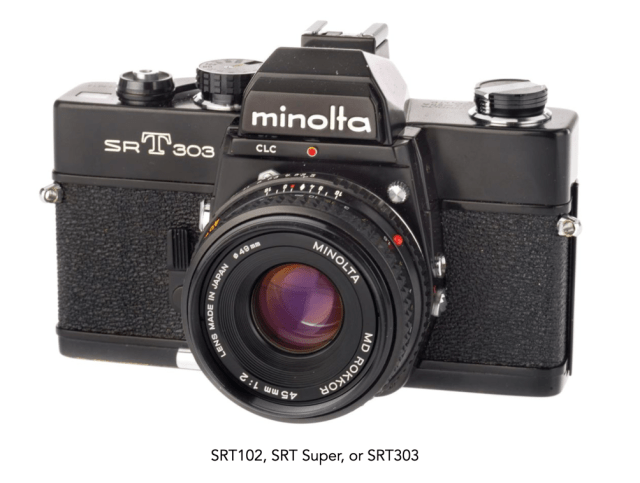
This is an extremely inexpensive manual SLR, usually around $100-250 (with lens). It has three different designations, for the markets it was sold in: SRT102 (North America), SRT330 (Europe), and SRT Super (Asia)

What is the cheapest SLR?

There are quite a few cheap SLRs on the market. For example Asahi Pentax sold over 4 million Spotmatic cameras between 1960 and 1977 – a Spotmatic SP1000 can go as cheap as C$150, whereas a Spotmatic F might go for C$350. Generally lesser-known brands are always less expensive, e.g. Konica, Miranda, Yashica.

Is the market for vintage cameras the same as that for vintage lenses?

No, largely because there is one end-user for cameras, and two for lenses. Lenses will be bought by people who (i) want to use them on a film camera, or (ii) want to use them on a digital camera. Photographers purchasing vintage cameras will only use them for film, and may only purchase one or two film cameras (useless they have GAP), whereas lens purchasers may buy many.

Should I take a risk on a cheap camera?

Sometimes there are sellers who are selling a camera without knowing what they have, usually because it was part of an estate, and not something they normally deal with. If the item is cheap enough, there is likely very little risk, but if it seems too expensive (or seems to have excessive shipping), avoid it. This is especially true if the item is marked “rare”.

How do you know a camera will be in good condition?

You don’t, unless you buy it from a reputable dealer. Someone who has been dealing in vintage photographic equipment for a long time, and sells a good amount of it will provide a good insight into a particular camera body, including providing a quality rating. Otherwise, without a full evaluation it is difficult to know exactly how well a camera will function. For example, unless shutter speeds are tested, there is no way to properly determine that they function accurately. The word “functioning” is pretty vague if there aren’t any qualifying statements. It could just mean the person has played with all the knobs and levers, and they work. Whether the shutter speeds are accurate is another thing altogether.

Are there red-flags for purchasing cameras online?

Yes – if a listing somewhere only has 1-2 images, and offers no real description, then stay well clear – unless of course it is a $500 camera selling for $20, and even then you have to wonder if there is anything wrong with it.

Is eBay any good?

Like anything, it really depends on the seller. Some sell only camera gear, and have been doing it for a while, or have a physical shop and use eBay as their storefront. Always check the resellers ratings, and review comments.

There are a lot of vintage cameras available on eBay from Japan – are they trustworthy?

In most circumstances yes. There are a lot of physical camera stores in Japan, so its no surprise that there are a lot of online stores. Japanese resellers are amongst the best around, because nearly all of them rate every aspect of a camera, cosmetic and functional. If something seems like a bargain it is likely because there are a lot of vintage cameras in Japan.

What should camera ratings include?

If we take the example of Japanese resellers, there are normally four categories: overall condition, appearance, optics, and functionality (body and lens). Appearance deals with aesthetics of the lens, and indicates any defects present on the lens body, e.g. scratches or scuffs. Optics deals with the presence of absence of optical issues: haze, fungus, balsam separation, scratches, dust. Finally functionality deals with the operation of the lens, and camera (e.g. shutter speeds).

What does “untested” mean?

If a posting is marked as untested, it basically means exactly that, you are buying the camera “as is”. There is usually some basic information on condition, but the camera functions haven’t been tested in any manner, i.e. shutter speeds, or with film. If a camera is marked as “parts-only”, it means exactly that, i.e. it does not function properly.

What’s the easiest way to bulk process image format changes?

Sometimes there is a need to perform a task on a whole bunch of images. I’m not talking about any sort of in depth image manipulation, but rather tasks that are tedious to do image by image. A good example is reducing the size of a series of images to be used on a website, or perhaps converting them from one image format to another. The easiest way of doing this is by means of the ImageMagick command line utility mogrify. Here is an example:

mogrify -auto-orient -format png *.jpg

This converts all the jpg files in a folder to png files. The -auto-orient option adjusts an image so that its orientation is suitable for viewing. To add the additional task of reducing the size of the image by 50%, we just have to add the -resize 50% option.

mogrify -auto-orient -resize 50% -format png *.JPG

Now using ImageMagick does require one to learn about the command line. On a Mac this is best provided by iTerm2. It basically provides access to all the folders in a low-level way, so that commands are provided by means of a command-line interface (a bit old-fashioned, but highly efficient for processing files).

Vintage lenses – Why did early fast SLR lenses have focal lengths of 55mm and 58mm (and not 50mm)?

Vintage “normal” lenses most often range from 40mm to 58mm, although the greatest number of theses lenses fall in the range 50-58mm. A lens which satisfies the ideal of being “normal” has a focal length close to the diagonal of the film format. So, 24×36mm = 43mm. 35mm is an exception to this rule – when Oskar Barnack developed the original Leica he fitted it with a 50mm Elmax to ensure the most could be done with the small negative area. From that, the 50mm became the ubiquitous standard. With the proliferation of 35mm single lens reflex (SLR) cameras, manufacturers in the early years tended to fit 55-58mm lenses. But why was this the norm instead of 50mm?

There are a variety of reasons. Let’s start at the beginning.

When Ihagee (Dresden) released the worlds first 35mm SLR in 1936 it had a series of standard lenses, but basically there were two categories: the slow 5.0cm lenses which ranged from f/2.8 to f/3.5 (e.g. Tessar, Xenar), and the marginally faster, 5.0cm/5.8cm f/1.9-2.0 lenses, e.g. the 5.8cm f/2 Biotar (developed for the Exakta). The first post-war Exakta did not appear until 1949, the Exakta II, along with a cornucopia of standard lenses from numerous manufacturers, but the fastest 50mm lens was still the Zeiss Tessar f/2.8.

The “… to 60-mm…” was included in the normal-lens category only because such lenses are frequently supplied as standard optics on single-lens reflexes. The reason is that in many cases the designers have found it easier to meet the special requirements of through-the-lens focusing by going to a slightly longer focal lens. Fifty-eight mm is the most common choice.

Bob Schwalberg, “Interchangeable lenses by the carload”, Popular Photography, pp.36-38,197 (May, 1956)

The 35mm SLR experienced a rapid increase in popularity among amateur photographers in the 1950s, especially after manufacturers realized that the installation of a prism viewfinder made handling this type of camera much easier. With this came the need for faster lenses, for two reasons – the ability to take pictures in poor lighting conditions, and a brighter viewfinder image makes it easier to focus. Lens such as the Biotar 58mm f/2 were considered to have a long focal length – to the amateur this was less than favourable, because they would get less coverage than 50mm. Over the course of the 1950s, manufacturers worked on new lens configurations to increase the speed of 50mm lenses, however 55mm and 58mm lenses still maintained the edge in terms of speed.

Fig.1: The two fastest pre-1950 35mm normal SLR lenses. Note the angle-of-view (horizontal) between 50mm and 58mm is not that different.

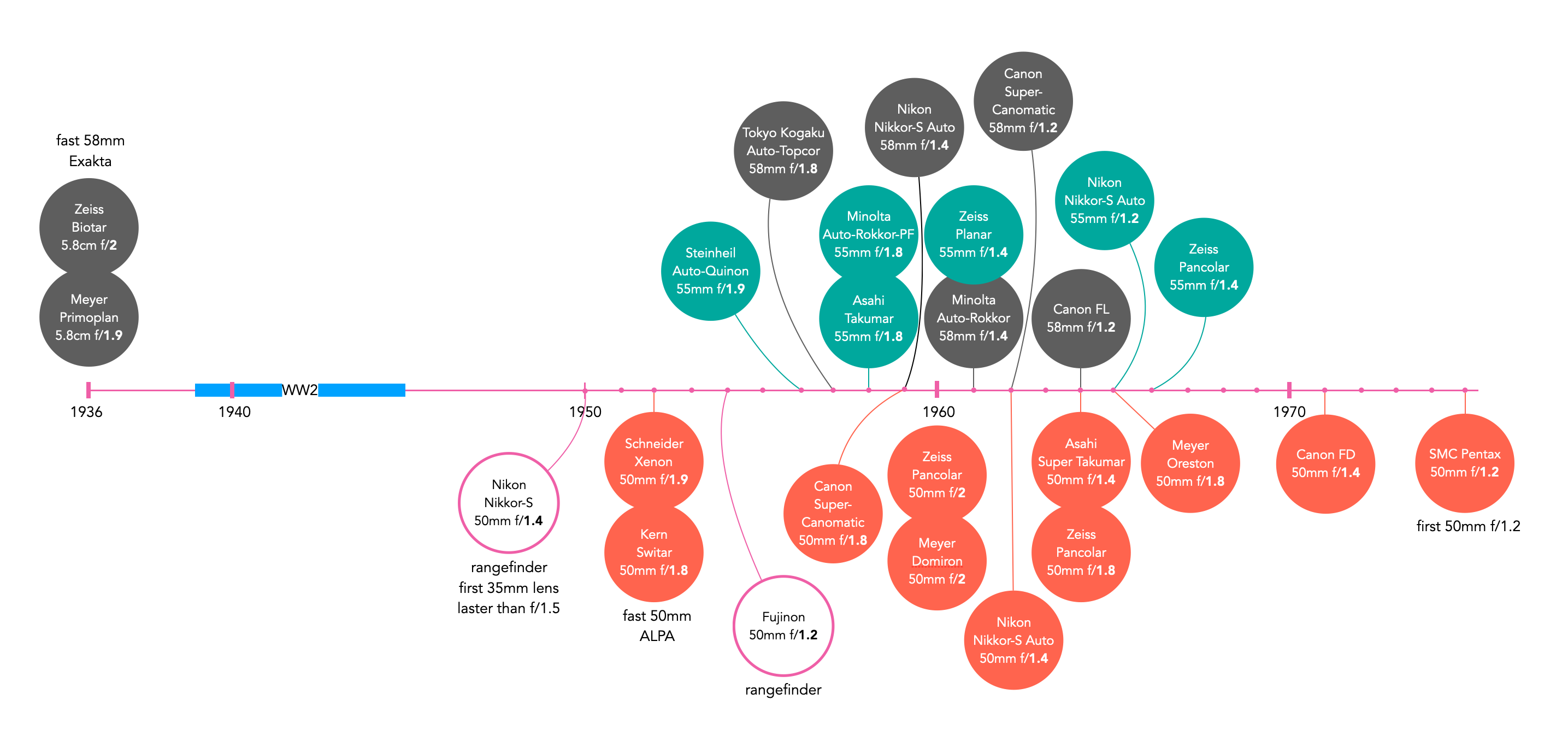
The original Asahi Takumar lenses which evolved with the 1952 Asahiflex (M37 mount), only included a single 50mm lens, with a speed of f/3.5. Both the 55mm (f/2.2) and 58mm (f/2.2,2.4) lenses had faster speeds. The 58mm f/2.4 in 1954, which became the standard lens for the Asahiflex II. The Auto Takumar’s focused on 55mm lenses with both f/1.8 and f/2.0 lenses. It was not until the Super-Takumar’s appeared in 1964, that the fast 50mm became more normal, with the f/1.4 lens. Canon didn’t produce much in the way of fast SLR lenses until the FL series lenses, introduced for the Canon FX, and FP, which debuted in 1964. Here there was a fast 50mm f/1.4, yet the f/1.2 lenses were still in 55mm and 58mm. In truth, even 50mm lenses faster then f/1.8 did not appear in Japan until the mid-1960s. many of the super-fast 50mm lenses were developed for rangefinder cameras, and never extended to SLRs.

The post-war German 50mm lenses did not really get much faster than f/1.8. This is in part because although the competition in Japan spurned a lens “speed-war”, the same was not true in Germany. The fastest lenses of the early 1950s was still the Biotar 58mm f/2, and Meyer Primoplan 58mm f/1.9. By 1960, at least for the Exakta Varex there was now a 50mm f/2 in the guise of the Zeiss Pancolar. By 1962 Exakta brochures had sidelined the Biotar 58mm, in favour of the Meyer Optik Domiron 50mm f/2. The Japanese had however established f/1.8 as the standard speed for a 50mm. The Zeiss Pancolar 50mm f/1.8 is an extremely good lens, but did not appear until 1964. Similarly the Görlitz Oreston 50mm f/1.8 did not appear until 1965. One of the reasons these “average” speed lens were produced is volume. The production of Praktica cameras in the mid-1960s reached 100,000 units per year, all of which needed a standard lens. It was all about economics.

Fig.2: Speed milestones in 55/58mm and 50mm lenses. Note that while a 50mm f/1.2 lens for rangefinder cameras existed as early as 1954, it would not be until 1975 that one appeared for 35mm SLRs. (note that the diagram may not represent every possible lens)

It was not the same in the world of 35mm rangefinder cameras. There was already a fast pre-war lens, the Zeiss Sonnar 50mm f/1.5 (7 elements/3 groups). The original Sonnar was designed with six elements in three groups, which would allow a maximum of an f/2 aperture. In 1931, a redesign with a new formula was developed with seven elements in three groups, allowing a maximum aperture of f/1.5. But the problem with the Sonnar design was that for shorter focal lengths, e.g. 50mm, it had a short back-focal-distance (BFD) which although being an advantage in rangefinder cameras, made them incompatible with most SLR cameras due to the space taken up the (retracting) mirror (which increases the flange focal distance). The set-up is illustrated in Figures 3 and 4. In Figure 3, the lens is shown how it would normally appear in a Contax rangefinder camera. However if the same lens were used in a 35mm Exakta (Figure 4), there would be an issue because the BFD would be too short because of the increase length of the flange focal distance, which is due to the clearance needed by the mirror.

Fig.3: Lens to film on a Sonnar 50mm f/1.5 lens attached to a 35mm Contax rangefinder
Fig 4: Lens to film on a Sonnar 50mm f/1.5 lens superimposed on a 35mm SLR.

This illustrates the biggest problem with making a fast 50mm lens was the fact that the addition of a mirror in the SLR meant that lenses had to be further from the film plane, requiring a redesign of the optical formula of the lenses. The easier solution was to marginally increase the focal length.

Trying to adapt the Sonnar design to 50mm was probably cost prohibitive as well. The Sonnar’s had large glass elements with massive core thickness, which required very thick sheets of raw glass, and they had strongly spherical lens surfaces. The latter issue lead to more issues when cementing lenses together, i.e. it was time consuming and required great precision. The Tessar 50mm’s on the other hand could be produced much more efficiently which made them less expensive to produce. The only real Sonnar design for SLRs was produced by Asahi, the Takumar 58mm f/2 from 1956 (6 elements/4 groups).

Partly to more easily provide clearance, for the moving mirror, and partly to produce a larger viewing image, the post-pentaprism wave of SLRs got off to a slow start in the early fifties with 58-mm standard lenses. Since physiological factors dictate an eyepiece of approximately 58mm focus, the choice of this focal length for the normal lens gave a 1-1, fully life-sized viewing image.

Bob Schwalberg, “The shifty fifty”, Popular Photography, pp.73-75,118,119 (Sep., 1970)

Some of the reasons were likely simpler than all that. When Carl Zeiss released the Contax S, the world’s first 35mm production SLR camera with an eye-level prism viewfinder and exchangeable lenses in 1949, the camera came with the Biotar 58mm f/2 as the kit lens. The popularity of the Biotar, spurned others to adopt a similar lens design. One of the reasons the Biotar had a large following was because it was felt that it provided a deeper and more three-dimensional image. There were many Biotar types of lenses, but at 58 mm the image in the prism finder had approximately the same scale as one viewed with a naked eye. Last but not least, as we have seen in a previous post, 58mm approximates the 30° central symbol recognition of the HVS, which means it quite nicely fits into the scope of focused human vision.

Aside from mechanical issues, there may have been other more aesthetic reasons for the 55mm/58mm lens frenzy. There is an experiential rule that says a portrait lens for half-body portrait should be about 1.5 times the focal length of a “normal” lens (2 times for head-shots). If we take the normal range to be about 40-55mm, this would make an appropriate lens about 60-82.5mm. So a 58mm lens is quite close to the minimum for half-body portraits. No surprise that the upper bound is also close to 85mm, a favourite with portrait photographers. Why did this matter? Because of the large market for amateur photographers in the 1950s who were interested in taking pictures of family etc.

The trend of 55/58mm lenses had reversed itself by the mid-1960s, with 50mm lenses becoming faster likely due to the advent of faster glass, and better optical formulae.

Why do we take photographs?

Do we ever stop to question why we take photographs? There are many reasons of course. Here are some of the main ones. Note that some photographs may span more than one category.

To convey objective information − These may be the easiest type of photographs to take, because they are of the documentary type. This might include photographs of a dish to illustrate a recipe, or portray the architectural details of a vintage door, or even artistic differences between fire hydrants.

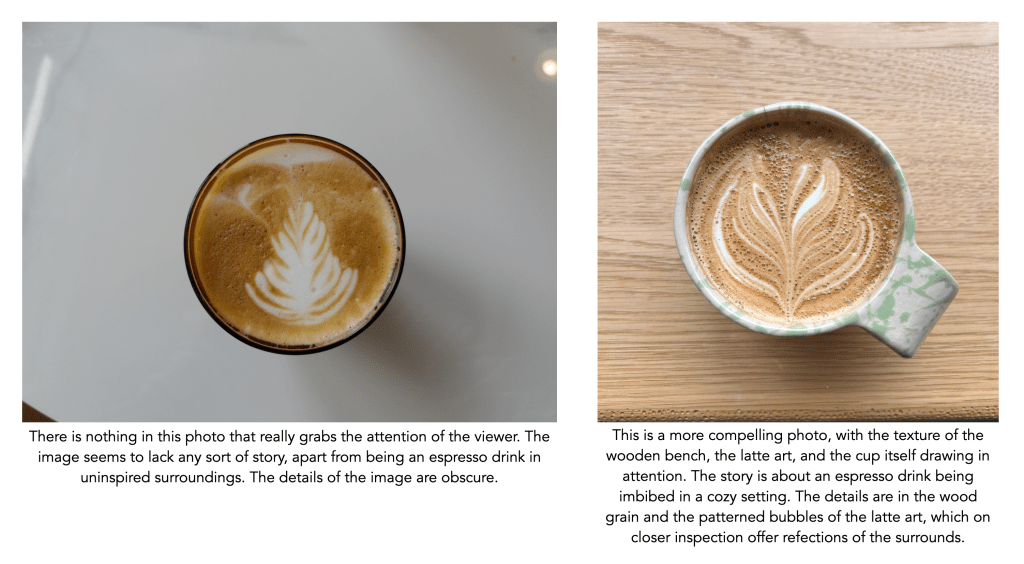
Documenting a drink in a cafe
or a huge bunny in Montreal

To accurately reproduce natural or human-made objects or scenes − Not quiet the same a the documentary image, which is a clear interpretation of one specific thing. The reproductive image is more concerned with a general representation. A good example are landscapes.

Reproducing a treeless landscape in Norway…
…or canned tomatoes in an Italian grocery

To represent a memory of people, places or things − This type of photograph is focused more on emotion, to provide a sense of nostalgia of experiences past.

A memory of Peggy’s Cove…
…or eating brown cheese

To embody a design or pattern − Some pictures are taken to describe some mathematical entity, or pattern. For example Fibonacci spirals in plants, perspectives of buildings, texture of bark on trees. Some of these are human-made, others natural, but design is always paramount.

A carving pattern on a Norwegian wooden chest…
…or mottled stained glass in the Montreal Metro

To interpret the manner in which humans interact with their environments − An interpretive record of a segment of human life, and activity that is interesting. This could be things like travel, sports, historical experiences, etc.

Living on a lake (a Crannog in Scotland)…
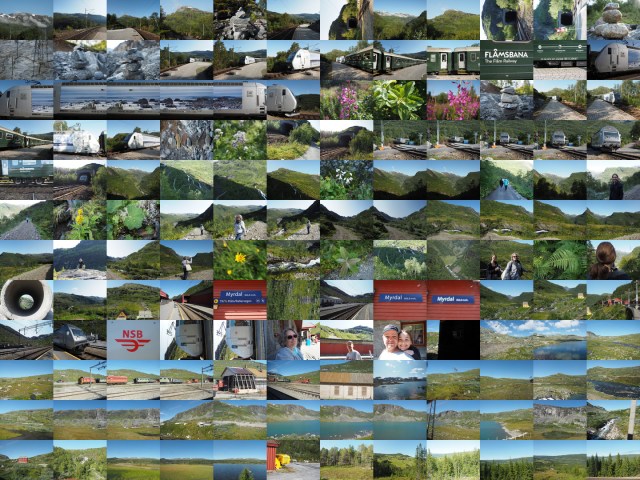
…or travelling on a train in Norway

Converting colour images to grayscale

Digital cameras often provide one or more “monochrome” filters, essentially converting the colour image to grayscale (and perhaps adding some form of contrast etc.). How is this done? There are a number of ways, and each will produce a slightly different grayscale image.

All photographs are simulacra, imitations of a reality that is captured by a camera’s film or sensor, and converted to a physical representation. Take a colour photograph, and in most cases there will be some likeness between the colours shown in the picture, and the colours which occur in real life. This may not be perfect, because it is almost impossible to 100% accurately reproduce the colours of real life. Part of this has to do with each person’s intrinsic human visual system, and how it reproduces the colour in a scene. Another part has to do with the type of film/sensor used to acquire the image in the first place. But greens are green, and blues are blue.

Black-and-white images are in a realm of their own, because humans don’t visualize in achromatic terms. So what is a true grayscale equivalent of a colour image? The truth is there is no one single rendition. Though the term B&W derives from the world of achromatic films, even there there is no gold standard. Different films, and different cameras will present the same reality in different ways. There are various ways of acquiring a B&W picture. In an analog world there is film. In a digital world, one can choose a B&W film-simulation from a cameras repertoire of choices, or covert a colour image to B&W. No two cameras necessarily produce the same B&W image.

The conversion of an RGB colour image to a grayscale image involves computing the equivalent gray (or luminance) value Y, for each RGB pixel. There are many ways of converting a colour image to grayscale, and all will produce slightly different results.

  • Convert the colour image to the Lab colour space, and extract the Luminance channel.
  • Extract one of the RGB channels. The one closest is the Green channel.
  • Combine all three channels of the RGB colour space, using a particular weighted formula.
  • Convert the colour image to a colour space such as HSV or HSB, and extract the value or brightness components.
Examples of grayscale images produced using various methods – they may all seem the same, but there are actually subtle differences.

The lightness method

This averages the most prominent and least prominent colours.

Y = (max(R, G, B) + ,min(R, G, B)) / 2

The average method

The easiest way of calculating Y is by averaging the R, G, and B components.

Y = (R + G + B) / 3

Since we perceive red and green substantially brighter than blue, the resulting grayscale image will appear too dark in the red and green regions, and too light in the blue regions. A better approach is using a weighted sum of the colour components.

The weighted method

The weighted method weighs the red, green and blue according to their wavelengths. The weights most commonly used were created for encoding colour NTSC signals for analog television using the YUV colour model. The YUV color model represents the human perception of colour more closely than the standard RGB model used in computer graphics hardware. The Y component of the model provides a grayscale image:

Y = 0.299R + 0.587G + 0.114B

It is the same formula used in the conversion of RGB to YIQ, and YCbCr. According to this, red contributes approximately 30%, green 59% and blue 11%. Another common techniques is to converting RGB to a form of luminance using an equation like Rec 709 (ITU-BT.709), which is used on contemporary monitors.

Y = 0.2126R + 0.7152G + 0.0722B 

Note that while it may seem strange to use encodings developed for TV signals, they are optimized for linear RGB values. In some situations however, such as sRGB, the components are nonlinear.

Colour space components

Instead of using a weighted sum, it is also possible to use the “intensity” component of an alternate colour space, such as the value from HSV, brightness from HSB, or Luminance from the Lab colour space. This again involves converting from RGB to another colour space. This is the process most commonly used when there is some form of manipulation to be performed on a colour image via its grayscale component, e.g. luminance stretching.

Huelessness and desaturation ≠ gray

An RGB image is hueless, or gray, when the RGB components of each pixel are the same, i.e. R=G=B. Technically, rather than a grayscale image, this is a hueless colour image.

One of the simplest ways of removing colour from an image is desaturation. This effectively means that a colour image is converted to a colour space such as HSB (Hue-Saturation-Brightness), where the saturation value is effectively set to zero for all pixels. This pushes the hues towards gray. Setting it to zero is the similar to extracting the brightness component of the image. In many image manipulation apps, desaturation creates an image that appears to be grayscale, but it is not (it is still stored as an RGB image with R=G=B).


Ultimately the particular monochrome filter used by a camera strongly depends on the colour being absorbed by the photosites, because they do not work in monochrome space. In addition certain camera simulation recipes for monochrome digital images manipulate the grayscale image produced in some manner, e.g. increase contrast.

Vintage lens makers – ISCO Göttingen (Germany)

ISCO was essentially an offshoot of Schneider. It was founded in 1936 with the name Jos. Schneider & Co., Optische Werke, Göttingen. The factory was constructed in Göttingen as a second production site on behalf of the Reich Ministry of Aviation. The site produced manufactured Schneider lenses, and during the war years they produced cameras for aerial reconnaissance (the Luftwaffe required fast lenses with exceptional resolution). Lenses included the high-speed Night Xenons with 125mm, 330mm, 400mm, and 500mm focal lengths. During WW2 they produced around 45,000 lenses for aerial cameras, the main supplier of the Luftwaffe.

Due to the nature of the war production, the plant was dismantled by the Allied powers at the end of the war. The company name was not allowed to be used until 1953, so the company operated under the name Optische Werke Göttingen. They initially produced lenses for cinematic projectors, with names like Kiptar and Super-Kiptar. In 1951 camera lenses were produced for the first time, initially as built-in lenses for various camera manufacturers, e.g. Apparate & Kamerabau, Balda, Bilora, Franka, Wirgin. These were triplets of 4-element lenses, such as Isconar and Westanar. From 1956 ISCO increased its designs for wide-screen projection, and included lenses for 8mm, 16mm and 35mm cine cameras.

An an example of a well known ISCO lens

The first lens for SLR cameras appeared in 1952, and was the Westar 50mm f/2.8. It was sold with Exa cameras in the US. This was followed by the Westagon 50mm f/2, and Westrocolor 50mm f/1.9. In 1958 ISCO designed the Westrogon 24mm f/4, the worlds first extreme wide-angle lens for SLR cameras, ahead of the Zeiss 20/25mm Flektogons. Lenses were produced under a number of names: Westar (50mm, 100mm), Westanar (50/85/135/150/180mm), Westagon (50mm), Westron (28/35mm), Westromat (35/135mm), Westrogon (24mm), Westrocolor (50mm), Isco-Mat (35/50/135mm), Iscotar (50mm), Isconar (50/80/100/135mm), Tele-Iscaron (135/180/400mm), Tele-Westanar (135/180mm), Isconar (90/100/135mm) and Iscorama.

With the decline of the German camera industry, the demand for SLR interchangeable lenses also decreased. ISCO shifted its production back to the field of projection lenses for film, narrow film and slides. In 2009 the name was changed to Schneider Kreuznach ISCO Division GmbH & Co. KG. The lenses now produced are full frame lens set for both anamorphic and spherical cine photography.

Further reading

Why choose a vintage SLR?

There are generally two camps when looking at vintage photographic gear: those interested in using vintage lenses on digital cameras, and those interested in shooting with a vintage camera. The first have little or no interest in shooting with film, the latter likely focus on it. There is also a third category – the collector, and their needs might be distinctly different from active users of vintage gear. People choose vintage SLR cameras for a number of reasons (an SLR is just one choice amongst 35mm cameras, people also opt for rangefinder cameras, or point-and-shoot). Perhaps they want to get back to basics, and use with a system that has complete manual functionality, or perhaps they are interested in experimenting with film. It could be they just like the feel and process of using a film camera, or even for nostalgic reasons. It is in many respects a much more fundamental, slow form of photography, even though it requires much more participation from the perspective of calculating the right exposure, choosing the appropriate film etc.

There are a number of choices

Vintage SLR’s come in many different forms – fully manual to some level of automation can be accommodated in some manner. For example the cameras produced in the 1950s to the mid 1960s are all-metal, and all-mechanical (manual focusing, exposure and film advance). They are often very aesthetically pleasing and have lens options which often produce artistic renderings. After this came the first auto exposure SLRs, which meant shutter-priority followed by aperture-priority. These cameras still had a lot of mechanical parts, but some of the functionality was taken over by solid-state electronics. The introduction of electronic SLRs pushed automation ever further. From the mid-1970s until the late 1980s came the electronic SLRs became the norm mostly to cut both costs and mechanical complexity. These camera bodies contain more plastic, and the first program-auto exposure settings.

SLRs are good for many photographic genres

Of course another motive focuses on the type of photography the camera is going to be used for. This is important because it allows a set minimum requirements to be established. There are some genres of photography that are better suited to the use of vintage cameras than others. General everyday or travel photography, landscapes, street or portrait photography are ideally suited to vintage cameras. This is because these genres are suited to manual focusing, and adjustment of exposure settings on the fly. Alternatively, wildlife or sports photography are not the best genres for a vintage camera (despite the plethora of telephoto lenses on the market). Both these genres generally require telephoto lenses, which with manual focusing isn’t optimal. Some people likely chose a mechanical SLR in order to experiment with street-photography at the most basic level, or an electronic SLR for travel photography.

Fig 1: Many SLRs offer a very simple tactile experience

The tactile experience is often better than with digital

Although there are many differing forms of 35mm cameras, SLRs do stand out for their tactile experience. Early SLRs were entirely manual, meaning that there were many differing parameters which had to be manually modified in order to obtain the correct exposure. This means cameras had various lever and knobs which had to be adjusted – there is the shutter button, adjustments for film speed, shutter speed, and on the lens, aperture and focus mechanisms. There is a level of interaction which is a vastly more tactile experience than pushing a button, or setting a menu item on a digital camera.

Analog is nostalgic

Analog photography can be somewhat limiting, in that there isn’t a memory card with limitless capability to store photographs. Film will limit the number of pictures able to be taken, so every shot has to count. This amps up the level of creativity, forcing the photographer to slow down, observe the surrounding world, and think about the picture being taken. Choosing a vintage 35mm SLR, or even a rangefinder for that matter, means embarking on a more participatory experience, where the level of self expressiveness is determined by the complexity of the camera itself. The physical nature of film – loading it, winding it on, hearing the shutter open and close – combine to provide a more natural [pure] experience.

Fig 2: Price points (Cad$) of various SLRs (in good+ condition)

SLRs are available at a good price

Vintage SLRs are available at many different price ranges. Yes there are expensive SLRs – usually this has to do with scarceness. For example someone might be interested in a 1936 Exakta Kine 35mm SLR, the first SLR, which could be worth anywhere from C$3000-4000. Or perhaps an ALPA camera, which are generally upwards of C$1200. But there are plenty of relatively inexpensive cameras, partially because there were so many manufacturers in the 1960s, and so many cameras were produced. You can find an Olympus, Pentax, or Minolta camera (body only) for between C$300 and C$500 (certified/restored). Less well-known brands of the period are even cheaper, e.g. Konica, Petri, Ricoh, Yashica, Miranda, Fujica etc, often including a 50mm lens.

SLRs are well built

Before the more extensive use of plastics in the 1970s, metal was king. Many cameras up until this period (and even beyond) used a die-cast metal body, which means the cameras were built tough.

SLRs are educational

One of the issues with digital cameras is that so much is automated. That’s not a bad thing in a lot of situations because it allows you to concentrate on framing the shot. However because of this, the inner workings of the camera are sometimes lost to the photographer. An SLR will also help the novice learn the fundamentals of photography – the hard way. This means you have to gain a more intimate understanding of how things like shutter speeds, apertures, and exposure works. However on the flip-side you do gain better control of the photographic process.