Photosite size and light

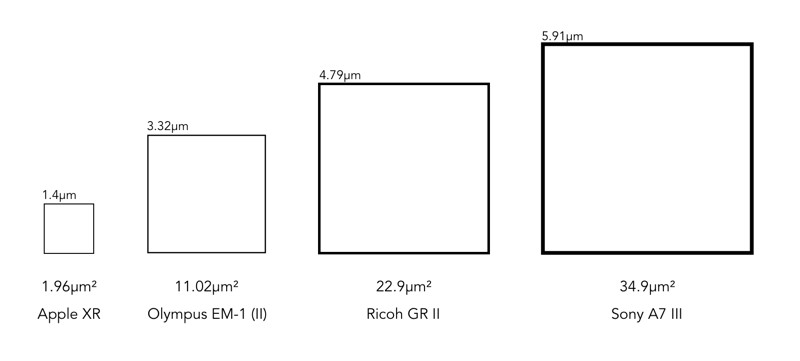
It doesn’t really matter what the overall size of a sensor is, it is the size of the photosites that matter. The area of the photosite affects how much light can be gathered. The larger the area, the more light that can be collected, resulting in a greater dynamic range, and potentially a better signal quality. Conversely, smaller photosites can provide more detail for a given sensor size. Let’s compare a series of sensors: a smartphone (Apple XR), a MFT sensor (Olympus E-M1(II)), an APS-C sensor (Ricoh GRII) and a full frame sensor (Sony A7 III).

A comparison of different photosite sizes (both photosize pitch and area are shown)

The surface area of the photosites on the Sony sensor is 34.93µm², meaning there are roughly 3× more photons hitting the full-frame photosite than the MFT photosite (11.02µm²), and nearly 18× more than the photosite on the smartphone. So how does this affect the images created?

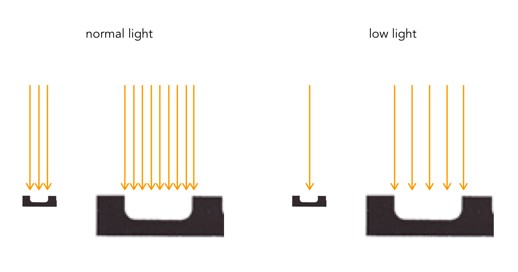
The size of a photosite relates directly to the amount of light that can be captured. Large photosites are able to perform well in low-light situations, whereas small photosites struggle to capture light, leading to an increase in noise. Being able to capture more light means a higher signal output from a photosite. This means it will require less amplification (a lower ISO), than a sensor with smaller photosites. Collecting more light with the same exposure time and, therefore, respond with higher sensitivity. An exaggerated example is shown in the figure below.

Small vs. large photosites, normal vs. low light

Larger photosites are usually associated with larger sensors, and that’s the reason why many full-frame cameras are good in low-light situations. Photosites do not exist in isolation, and there are other factors which contribute to the light capturing abilities of photosites, e.g. the microlenses that help to gather more light for a photosite, and the small non-functional gaps between each photosite.

Megapixels and sensor resolution

A megapixel is 1 million pixels, and when used in terms of digital cameras, represents the maximum number of pixels which can be acquired by a camera’s sensor. In reality it conveys a sense of the image size which is produced, i.e. the image resolution. When looking at digital cameras, this can be somewhat confusing because there are different types of terms used to describe resolution.

For example the Fuji X-H1 has 24.3 megapixels. The maximum image resolution is is 6000×4000 or 24MP. This is sometimes known as the number of effective pixels (or photosites), and represents those pixels within the actual image area. However if we delve deeper into the specifications (e.g. Digital Camera Database), and you will find a term called sensor resolution. This is the total number of pixels, or rather photosites¹, on the sensor. For the X-H1 this is 6058×4012 pixels, which is where the 24.3MP comes from. The sensor resolution is calculated from sensor size and effective megapixels in the following manner:

  • Calculate the aspect ratio (r) between width and height of the sensor. The X-H1 has a sensor size of 23.5mm×15.6mm so r=23.5/15.6 = 1.51.
  • Calculate the √(no. pixels / r), so √(24300000/1.51) = 4012. This is the vertical sensor resolution.
  • Multiply 4012×1.51=6058, to determine the horizontal sensor resolution.

The Fuji X-H1 is said to have a sensor resolution of 24,304,696 (total) pixels, and a maximum image resolution of 24,000,000 (effective) pixels. So effectively 304,696 photosites on the sensor are not recorded as pixels, representing approximately 1%. These remaining pixels form a border to the image on the sensor.

Total versus effective pixels.

So to sum up there are four terms worth knowing:

  • effective pixels/megapixels – the number of pixels/megapixels in an image, or “active” photosites on a sensor.
  • maximum image resolution – another way to describe the effective pixels.
  • total photosites/pixels – the total number of photosites on a sensor.
  • sensor resolution – another way to describe the total photosites on a sensor.

¹ Remember, camera sensors have photosites, not pixels. Camera manufacturers use the term pixels because it is easier for people to understand.

Camera companies – what’s in a name?

Ever wonder where some of the camera/photographic companies got their names? Many are named for their founders: Hasselblad, Mamiya, Schneider, Voigtlander, Zeiss etc. Sometimes names are hard to pronounce, so acronyms are better: Chinon (from Chino), Cokin (from Coquin), Konica (from Konishi), Tamron (from Tamura). Leica is one of the oldest, using “Lei” from the name of the company founder, and “ca” from camera. Here are how some of the other leaders in the photograhic industry got their names…

AGFA – The name is built on the initials of the firms original German name – Actien-Gesellschaft für Anilin-Fabrikation, founded in 1867. 

CANON – Originally called Seikikogaku Kenkyujo (Precision Optical Industry Co. Ltd.), founded in 1934. The first 35mm camera produced were named, Kwanon, after the Buddhist deity of mercy. The initial Kwanon logo included an image of the goddess with 1,000 arms and flames. In 1935 they registered the name “CANON”, which seems like an Anglicization of Kwanon.

CONTAX – The first four letters derive from Contessa, a German maker of sheet-film cameras taken over by Zeiss-Ikon in 1926. The “AX” is a suffix common to German camera names, although some suggest is comes from another of Zeiss’s cameras the Tenax.

COSINA – Possibly an Anglicized version of the company’s Japanese name Kabushiki-gaisha Koshina, founded in 1959. The first part of the name is a reference to the Koshi area within Nakano, where the founder came from; while the “NA” represents Nakano.

ILFORD – Initially founded in 1879 in Ilford, UK, the Britannia Works Company, it was changed in 1902 to take on the name of the town.

KODAK – The name came from the first simple roll film cameras produced by Eastman Dry Plate Company in 1888. It had no real meaning. 

MINOLTA – The name is derived from the Japanese phrase describing the time of the rice harvest. Minoru refers to rice in its harvestable state, and ta is a rice field. The name also has a Western meaning, as an acronym for Machinery and Instruments Optical by Tashima. Minolta’s ROKKOR lenses are named for the mountains Rokko, near the company’s Osaka headquarters. 

NIKON – When founded in 1917, the company was called Nippon Kōgaku Kōgyō Kabushikigaisha. The name Nikon dates from 1946. Originally the suggestion was Nikko, an acronym made from Nippon Kogaku (Japan Optical Co.). However it was believed the name sounded too weak, so an N was added to the end.

OLYMPUS – The company was originally called Takachiho Manufacturing. Takachiho is a mountain in southwest Japan where the gods are believed to have lived and is analogous to Olympus, home to the gods in Greek mythology. Zuiko translates as “light of god”. 

PENTAX – Founded in 1919 as Asahi Kogaku Goshi Kaisha. Marketed as the Asahi Optical Co., Asahi means “rising sun”. Pentax is a combination of “PENTA” from Pentaprism, and “X” from Contax. It was originally a registered trademark of the East German VEB Zeiss Ikon and acquired by the Asahi Optical company in 1957.

POLAROID – Originally called Land-Wheelwright Laboratories, the company was renamed Polaroid after its first product (1937), a polarizing material used in military instruments and sunglasses. 

RICOH – An Anglicized acronym formed from the original Japanese name for the company, RIKagaku KOgyo, setup by the Institute for Physical and Chemical Research in 1936. Ricoh is also a homonym of the Japanese word for smart, rikoh

ROLLEI – Originally called the Werkstatt für Feinmechanik und Optik Franke & Heidecke when it was founded in 1920, the name Rollei was derived from the Roll-film Heidoscop, a stereo camera. 

TOKINA – Established in 1950 as Tokyo Optical Equipment Manufacturing. In the 1970s, the company began manufacturing lenses under its own brand Tokina. The prefix “TO” refers to Tokyo, the suffix “kina” is a Germanization of the Italian word for cinema, cine. 

VIVITAR – Named originally for its founders Ponder & Best, this US company imported a variety of camera brands, including Olympus, and Mamiya. When it started sourcing its own equipment a new name was created, based on the Latin vivere (to live), and the ar/tar suffix common to many of the prominent lenses such as Ektar, and Tessar. 

YASHICA – Originally called Yashima Optical Industries, when founded in 1949. Yashica is a combination of “YASHI” from Yashima, and “CA” for camera, similar to Leica.
The size of photosites

Photosites on image sensors come in different sizes. The size of a photosite on a sensor is based on the size of the sensor, and number of photosites on the sensor. Some sensor sizes have differing sizes of photosites, because more have been crammed onto the sensor. However different sensor sizes can also have the same sized photosites. For example the Olympus E-M5(II) (16.1MP) has a photosite size of 13.99 µm², and a Fujifilm X-T3 sporting 26.1MP has the same photosite size.

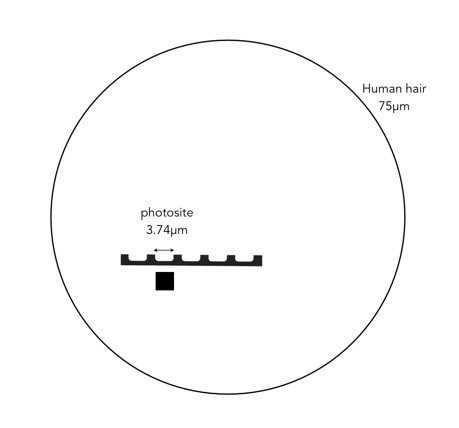
The size of a photosite, is often termed pixel pitch, and is measured in micrometres (or in old terms microns). A micrometre, represented by the symbol µm, is a unit of measure equivalent to one millionth of a metre. It is equivalent to 0.001mm. To put this into context, the nominal diameter of a human hair is 75µm. The area of a photosite is represented by µm². For example, the Olympus E-M5(II) has a pitch of 3.74µm, or 0.00374mm, which is 20 times smaller than a human hair.

comparison of human hair and photosite
Comparison the size of a photosite with a human hair

In order to increase the number of photosites a sensor has, their size has to decrease. Consider an example using a Micro-Four-Thirds (MFT) sensor. An Olympus OM-D E-M5 Mark II fits 16.1 million photosites onto the sensor, whereas an Olympus OM-D E-M1 Mark II fits 20.4 million. This means the pixels on the E-M1(II) will be smaller. This works out to a pixel area of roughly 13.99 µm² versus 11.02µm². This may seem trivial, but even a small difference in size may impact how a photosite functions.

Full frame sensors

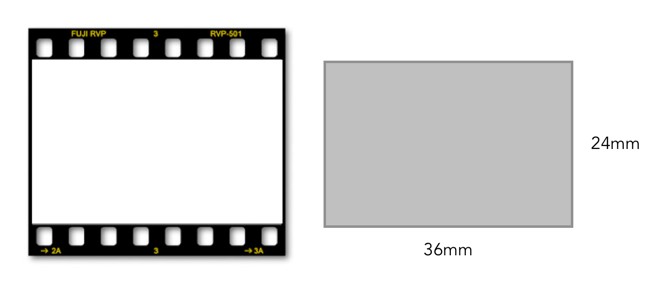
Now that we have looked at the origin of 35mm film cameras, let’s turn our attention to full-frame sensors. A full-frame sensor is so named because the sensor is 24mm×36mm in size, equivalent in size to a film frame in a film camera. Why are we basing new technology on old concepts? Mostly for posterity’s sake, because why fix something that isn’t broken? The 24mm×36mm size first appeared in the early 20th century, and eventually became the standard film “frame size”. When the transition to digital occurred, keeping the image size the same meant that photographers could easily transition the use of legacy lenses onto digital bodies. The 35mm format became the reference format. Full frame is now the largest consumer sensor format before medium format (like the Fujifilm GFX100).

An analog film frame versus a digital full-frame

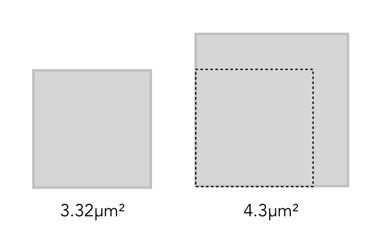
The size of a full-frame sensor has a significant impact on image quality. The large surface area means that more light can be gathered by the sensor, which is particularly beneficial in low-light conditions. The photosites often have a large pitch (more commonly referred to by manufacturers as the pixel pitch), it provides a broad dynamic range, and good low-light/high ISO performance. For example, the Leica SL2 (47.3MP) has a pixel pitch of 4.3μm, whereas the Olympus E-M1 (MII) with a MFT sensor has a pixel pitch of 3.32μm. When the area of a photosite is calculated, a photosite on the SL2 is 68% larger than one on the E-M1.

Pixel pitch differences: MFT vs. FF

The downside of a full-frame sensor is that camera’s must be larger to accommodate the large sensor.Larger cameras mean heavier cameras.

Organic photographic filters made of ice

Yesterday I was out int he backyard, cleaning out a sled that had tipped over and filled up with snow in the last snowstorm. Since then the snow had melted, and then refroze when it got cold again. Today there was a ½” (1cm) thick coating of ice, and about 4″ of water underneath. As I poured it out, it shattered. But then I picked up a piece and looked at it. It was consistently thick, and very clear. I put this down to the relative purity of the snow falling, and the process of refreezing. Then I thought, what would happen if I used a piece of this as a filter, through which I would take a photo?

Fig 1: A piece of the ice filter

There are likely very few organic substances which can be used to make camera (lens) filters. Water has to be pure enough so as to create somewhat transparent ice filters. Most water is not 100% pure, due to dissolved gases like oxygen, and impurities like suspended sediments, dust particles or flecks of minerals like calcium. When the water freezes, these internal impurities become concentrated, impeding light, and making the ice seem cloudy. Clear ice is almost entirely free of impurities. Also, when ice freezes quickly, ice crystals are small and numerous making the ice appear whiter. Transparent ice usually has larger and fewer crystals, a result of slow freezing. This ice was transparent because water freezing outside freezes from the top down. As a layer of water freezes, it pushes any air below it down, then the next layer freezes, etc.

Fig 2: A close-up of the the ice surface (the camera focused on the surface of the ice)

These pieces of ice reminded me of vintage pieces of glass that are imperfect, with bubbles, albeit melting. The image above shows a photograph of the ice surface, showing a few air trails (the white dots). I took some photographs using my Leica D-LUX 6, largely because I could easily take photos singe-handed while holding the piece of ice in the other hand.

Fig 3: A woozy, warped sense of the world

What are the results? Well, firstly these ice filters are not perfect – they are organic in natural, and therefore the effect may be dependent on how the layers of ice froze to create the slab. In Fig. 2, the image becomes quite defocused without any inherent warping. In Fig.3, objects are both organically warped, and blurred. The blur may be caused in part by the fact that the filter actually melts as it is being used, causing melt water to move down the filter.

Fig 4: Another show, showing ice bokeh.

In Fig.4, things are again warped, but what is special here is that due to the angle of sunlight, the air trails through the ice have formed circular, bokeh type effects, something we will term ice-bokeh. These images are very organic, and no two will be the same. This is made even more evident by the fact that the filter melts.

These filters are more for fun than anything else, adding a surreal art-like effect to a photograph. As each piece of ice is unique, each photograph taken again becomes a unique entity. It would be fun to experiment with different thicknesses, and different shapes. The one caveat is that these filters are cold and wet.

The first 35mm lens

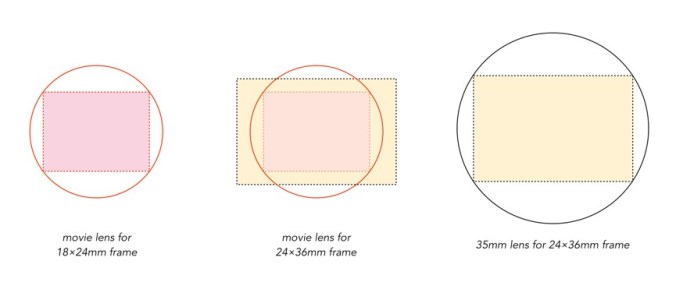
With the advent of 35mm film cameras came the need to design 35mm lenses. The first still cameras designed to use 35mm film inevitably used lenses modified from use on motion-picture cameras, or microscopes. This made sense when the 35mm cine-film used the 18×24mm frame format, however these lenses only covered part of a 24×36mm frame. The figure below shows frame coverage of a cine (movie) lens versus a 35mm lens.

Frame coverage of pre-35mm lenses

For instance the Tourist Multiple used a Bausch & Lomb Zeiss 4-element Tessar (50mm f / 3.5 lens), which was used on motion picture cameras.

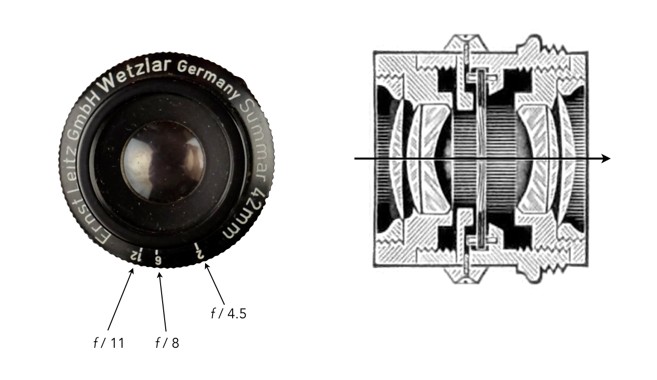
Leitz, founded in 1869, began as a company focused on the manufacture of microscopes, and other optical instruments. When work began on the Ur-Leica, Barnack and Berek tried a number of lenses. The simplest option was the 5cm f / 3.5 Zeiss Kino-Tessar movie camera lens. The problem is that the lens could not provide a light spot able to cover the 24×36mm frame format, as it was designed for a 18×24mm format. In addition it produced vignetting not suitable for a camera. The lens they ended up using was the 6-element 42mm f / 4.5 Leitz Mikro-Summar, in a classic double-Gauss formula. This lens had a number of shortcomings, including edge blurring, and a lack of contrast.

The Leitz Mikro-Summar (from 1907 catalog)

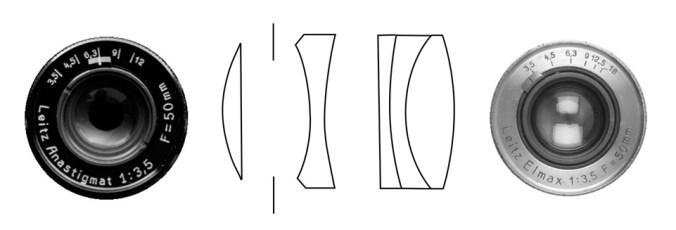
The design of a new 35mm lens was the responsibility of German physicist and mathematician, Max Berek (1886-1949). The first 35mm lens developed at Leica was a 50mm f/3.5 Anastigmat. Based on the “Cooke Triplet” lens design, it had 5 elements in 3 groups. The lens was later marginally redesigned, still containing 5 elements in 3 groups, and was given the name Elmax (The name is derived from Ernst Leitz and Max Berek.). These lenses were used on the pre-production Leica-0, of which 31 were manufactured from 1920-1925.

The Anastigmat / Elmax lenses

At that time, the calculation of such a lens was still very complex. Light beam paths from points near or away from the optical axis had to be calculated for three wavelengths and seven refractive surfaces, all by hand using logarithmic tables. Leitz was granted patent No. 343086 for the Anastigmat in 1920.

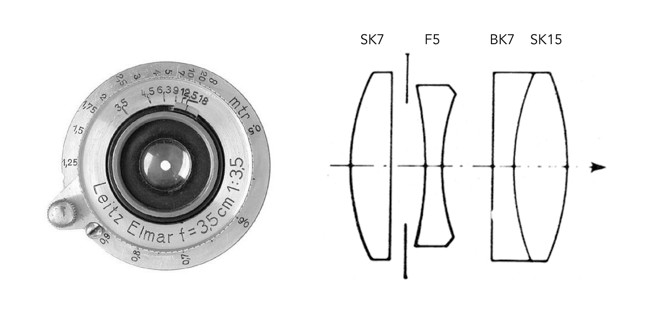
The first lens formula was difficult to build, so Berek changed the design to a triplet with the last element a cemented doublet, i.e., 4 elements in 3 groups. This lens was renamed Elmar, and was subsequently manufactured for decades (1925-1961). The lens was similar to a Tessar, except for the location of the diaphragm. On the Elmar the diaphragm was located between the first and second elements, rather than the rear two elements.

The Elmar lens

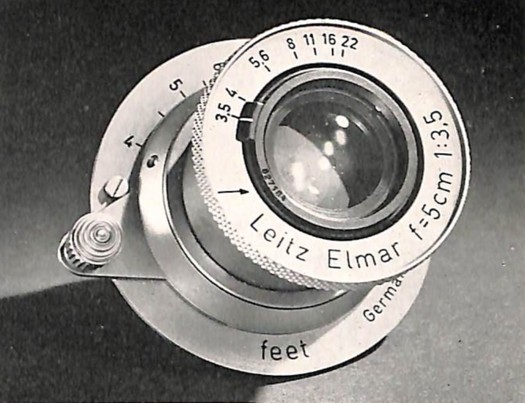
The first lenses which appeared were of the fixed type used on the Leica I. From 1930-1959, the Elmar was made in a screw mount, and an M (bayonet) mount from 1954-1961. From 1930-1932 the lenses were matched with one body, after which they became interchangeable (M39 mount). The lens would evolve to have a maximum aperture of f/2.8, and a minimum aperture of f/22. .

The Leica Elmar 50mm, with screw mount

Specifications: (Original)
50mm f / 3.5 Elmar lens
Angle of view: 45°
No. of elements: 4
Minimum focusing distance: 1.0m
Minimum aperture: 16
Aperture range: 3.5, 4.5, 6.3, 9, 12.5, 16
Weight: 92g

Here are some links to extra info on early Leica lenses:

The origins of 35mm camera film

Full-frame sensors take their dimensions from traditional 35mm film, but where did the ubiquitous 35mm come from?

The second half of the 19th Century spirited the development of many photographic materials and processes. Kodak’s first roll-film camera, the No.1 was introduced in 1888. By 1901, the use of roll-film had become quite common, with Kodak releasing the 120 film format, which was approximately 60mm wide and allowed for various frame sizes. Thomas Edison invented¹ the Kinetoscope in 1893, a device for showing basic film loops, and which used 35mm (1⅜”) gauge cine-film, half the size used in Eastman Kodak cameras. In March 1895, The Lumière Brothers introduced their Cinématographe, the first motion picture film camera, using the same width as Edison, 35mm. By 1909, 35mm had become the standard motion picture film.

Why is it called 35mm film? The 35mm represents the width of the film, irrespective of the size of the frame on the film.

A number of manufacturers started using 35mm cine-film for still photography between 1905 and 1913. The first patent for a 35mm camera was issued to Leo, Audobard and Baradat in England in 1908. It represented one of many patents and prototypes, few of which were produced commercially or even built. The first publicly available 35mm cameras were that used 35mm cine-film were the Tourist Multiple, and the Simplex. The Tourist Multiple, built by US company Herbert & Huesgen, was released in 1913. It was a half-frame camera, taking (750) 18×24mm exposures on 35mm cine-film. The Simplex, invented by Alfred Huger Moses, and was released in 1914. It existed in a number of different models, many of which allowed convertible full/half-frame exposures. The Simplex Model B was the only one to use standard 35mm format (it was only produced from 1914-1918).

The Simplex Model B.

It was Oskar Barnack (1879-1936), who produced the first commercially successful 35mm camera, at the Ernst Leitz Optische Werke in Wetzlar. In 1912, Barnack began work on a new motion picture camera, yet he struggled to get shutter timings right, largely because film emulsions were quite inconsistent. Proper exposure in the early days of motion picture was challenging because of the lack of devices such as photoelectric meters. In response to this, Barnack created a film tester to determine correct exposure settings. Barnack’s device would allow small test exposures to be processed, and exposure issues adjusted accordingly. This prototype device became known as the Ur-Leica, where the prefix “Ur” in German means prime, or original. It was equipped with a Mikro-Summar f / 4.5, 6-element, 42mm lens.

The Leica I (1927) © Kameraprojekt Graz 2015 / Wikimedia Commons

Barnack’s design allowed the camera to move the film horizontally, increasing the frame size to increase to 24×36mm, instead of the 18×24mm exposures of cameras that carried film vertically. This essentially created “double-sized” images. The aspect ratio also changed from 3:4 to 2:3. With the onset of WW1, it was not until 1924 that Leica decided to produce the 35mm camera, with the 35mm Leica I (A) making its first appearance as the Leipzig Spring Fair in 1925. The Leica I had an all-metal housing, a collapsible lens, and a focal-plane shutter. The Leica succeeded because it was compact, and the quality of the exposures was as good as the more commonly used roll film.

So why did 35mm film become so successful? It was partially to do with cost. Due to its use in the cinematic industry, 35mm motion picture film was widely available, and inexpensive. The number of exposures which could be loaded into a camera was 40. Initially the film had to be loaded in the dark, however Barnack soon realized this was a problem and developed a reloadable cassette which could easily be inserted into the camera, and could accommodate 36 exposures. By 1932, Leica’s competitor Zeiss had introduced the 35mm Contax, and Kodak entered the market in 1934 with the Retina I.

¹ It is widely believed that the Kinetoscope was actually designed by one of Eastman’s employees, William Dickson.

For more information on early 35mm cameras check out Max Bertacchi’s page dedicated to early 35mm cameras, or early Leica’s.

Fixed forever

In every photograph the moment is fixed forever. In some it is the very moment that we prize, because it is such vivid history. In a few the moment magically becomes forever.

Beaumont Newhall in The History of Photography, the Museum of Modern Art, New York, 1949.

British Robin at The Hermitage

Sometimes the best fauna related photographs are taken when you least expect it. We were having lunch at a picnic table in The Hermitage (Scotland) a couple of summers ago when an inquisitive Robin started jumping along the nearby fence. A few shots got one good one. The picture is cropped from the original, and only some minor histogram stretching was performed.

British Robin: Olympus E-M5(II) + M.12-40mm F2.8, picture taken at 40mm, f/3,2, 1/125 sec.