What’s with all the 3rd party ultra-wide and fisheye lenses?

Most large camera manufacturers don’t really make a lot of sub 20mm (FF eq.) lenses. Why? Mostly the cost involved, and likely the lack of sales potential – not many people want to spend a lot of money on a lens that provides a circular fisheye image. I mean these are fun lenses to play with, but in reality aren’t really that practical for everyday use. This may be why 3rd party manufacturers have taken up the mantra, producing low-cost, often reasonable quality sub-20mm lenses. Let’s look at some for Fuji-X.

Let’s divide this into two APS-C categories, the 9-13mm ultra-wide group, and the fisheye group <=8mm. Fisheye lenses can be further categorized into circular and full-frame fisheyes. With regard to focusing MF=manual, AF=auto. Angle-of-view is shown in degrees on the diagonal.

Fisheye lenses: 4-8mm (6-12mm FF)

7artisans Photoelectric 4mm f/2.8 Circular Fisheye (225°) MF US$149
Venus Optics Laowa 4mm f/2.8 Circular Fisheye (210°) MF US$199
Meike MK-6.5mm f/2 Circular Fisheye (190°) MF US$130
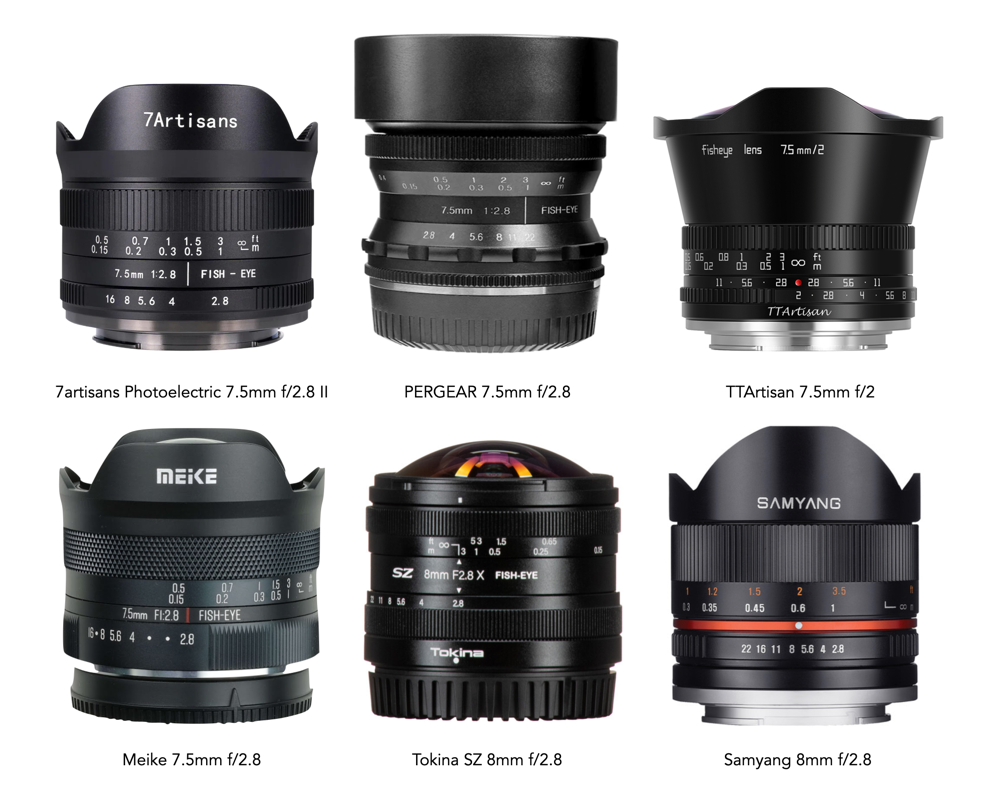
7artisans Photoelectric 7.5mm f/2.8 II Fisheye (190°) MF US$139
Pergear 7.5mm f/2.8 (179°) MF US$130
TTArtisan 7.5mm f/2 (190°) MF US$149
Meike 7.5mm f/2.8 Fisheye (180°) MF US$165
Tokina SZ 8mm f/2.8 (180°) MF US$299
Samyang 8mm f/2.8 Fisheye II (180°) MF US$299

Ultra-wide lenses: 9-12mm (13.5-18mm FF)

Venus Optics Laowa 9mm f/2.8 Zero-D (119°) MF US$399
Venus Optics Laowa 10mm f/4 Cookie (109°) MF US$299
Meike 10mm f/2 (107°) MF US$449
ZEISS Touit 12mm f/2.8 (99°) AF US$999
Samyang 12mm f/2.0 NCS CS (99°) MF US$399
7artisans Photoelectric 12mm f/2.8 (102°) MF US$149
Meike MK-12mm f/2.8 (99°) MF US$170
Pergear 12mm f/2 (97°) MF US$160

So which one to choose? It’s really hard to know. It really depends on what you want to do. All these lenses will have some sort of distortion, with the notable exception being the Laowa 9mm, which is described as “Zero-D”. The circular fisheye lenses are nice from an artistic point-of-view, but don’t have that many practical applications (well they are actually used in scientific applications such as assessing forest canopy cover).
Why are these lenses so cheap? Firstly nearly all of the inexpensive lenses, bar the Zeiss 12mm, are manual focus, because obviously incorporating auto-focus mechanisms into any lens is expensive. Another reason may be competition, but it may also be the notion that many of these focal lengths are more for use in an artisanal manner. If these lenses become too expensive, they push themselves out of the market. But inexpensive doesn’t mean a cheap lens. The Laowa 9mm has 15 elements in 10 groups, likely needed to reduce the lenses distortion – so it doesn’t lack good design. Is the Laowa glass inferior to that of Fuji? Possibly, but it’s impossible to tell.

Should you buy an ultra-wide, diagonal fisheye, or even a circular fisheye lens? Well, for the cost involved many of these lenses certainly won’t break the bank, and if you are interested in exploring some artistic photography then it may be a good fit. Which one? Well that’s a bit of a conundrum. Of the six 7.5-8mm lenses, it’s hard to know which is really the best. I would suggest checking out some online reviews, and see what people think of the various lenses.

The smartest camera?

People tend to believe that the more intelligent a camera they have, the better the resulting photographs will be. And there may be an air of truth to that, particularly in the realm of smartphones brimming with algorithms to produce reasonably good pictures. But the thing it that the subject of the photographs, and characteristics like the perspective of the shot are not decided by the camera – they are decided by the artistic-process of the person behind the camera.

It is a combination of the human brain, visual system and intrinsic aesthetic abilities of the photographer that decides what to photograph. The camera is but a tool. You can have the most expensive Leica, with the sharpest lenses, but all that is moot if you cannot take good photographs. Sure, everyone thinks they are a photographer these days. The ubiquity of cameras in mobile devices means that photography is all around us, but apart from a documentary purpose, very little of this is meaningful or even artful photography.

The reality is that human intelligence is much smarter than the artificial intelligence found in digital cameras. Yes, such AI can efficiently process photosites into pixels, and apply intelligent “improvement” algorithms in the process, but they cannot decide what to photograph.

Choosing a vintage lens – which brand?

In this post we’ll talk briefly about lens brands and manufacturers. When it comes to vintage analog lenses, people either choose a brand first, and then a focal length, or vice-versa. There are as many different brands as there are historic camera and lens manufacturers. Typically most vintage lenses come from East and West Germany, and Japan, largely because that is where the camera industry was focused. Choosing a brand can be a matter of personal interest, cost, or more often than not – popularity.

When looking at the type of vintage lens, you have to understand that there are different families of lenses, usually focused on a particular brand from a specific epoch. In order to choose a vintage lens it is important to obtain a basic understanding of the brand of interest – dates of manufacture, basic lens information (e.g. construction, materials, potential issues), and reviews. A particular 50mm lens from one manufacture may have evolved over many years, often with differing characteristics. For example the Asahi Super-Takumar 50mm f/1.4 appeared in 1964 as an 8-element lens, and evolved into a 7-element lens containing some elements which incorporated Thorium. It then became the Super-Multi-Coated Takumar, and finally the SMC Takumar. All have differing characteristics, although fundamentally they are all 50mm f/1.4 lenses.

These days there is quite a lot of digital material online, including scanned brochures, and lens reviews. The aim here is to just cover some of the more common manufacturers. Brands of lenses are generally divided into three major categories – (i) the core companies that produced cameras and lenses, (ii) companies with smaller 35mm impression, and (iii) independent companies that just produced lenses for many different manufacturers (not all camera makers produced lenses). To make it even more confusing, some camera companies rebranded lenses from other companies on their cameras. Many major manufacturers offered an extensive array of interchangeable lenses from extremely wide angle to mammoth telephoto lenses. In addition there were companies that specialize only in the development of lenses, including special purpose lenses.

Note that I have not included very small companies, e.g. Wrayflex, or companies who just produced cameras, and very few of their own lenses, e.g. ALPA (they used lenses from a number of manufacturers), Exakta (they only made/rebranded a couple of their lens as Exakta), or KW (makers of the Praktica line of cameras).

Landmark brand lenses

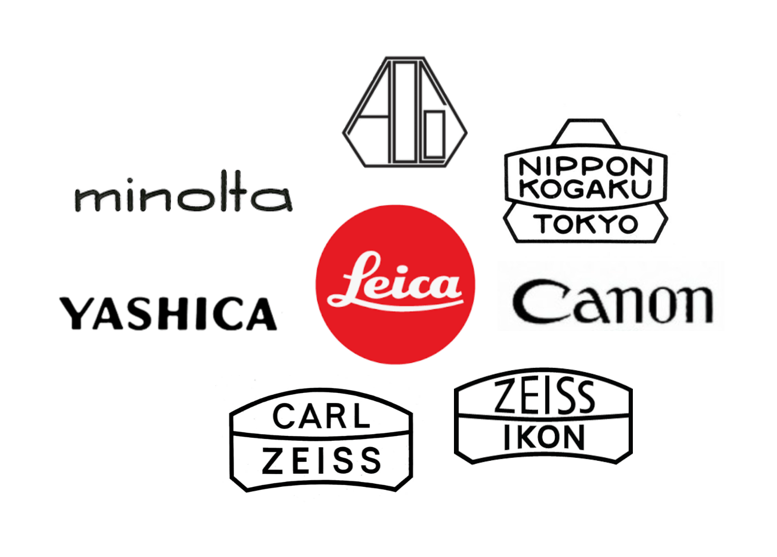
The first category involves milestone manufacturers who got into the 35mm game early, and focused heavily on SLRs. This means manufacturers like Asahi Pentax, Minolta, Yashica, Nikon, Canon, Leica, Zeiss Ikon, and Zeiss. These companies often may have started producing 35mm rangefinder cameras, and then transitioned to 35mm SLRs, and associated lenses (Asahi was the only one of these that did not produce a rangefinder camera). The exception here is Carl Zeiss, who did not make camera’s but was one of the largest optical lens manufacturers. They often designed a broad range of lenses to suit the needs of their cameras. These companies did not rely on 3rd party lens makers (although they did not prevent other companies making lenses for their cameras), and set the standard for many of the lens mounts used. Exakta, while manufacturing many cameras, and the bayonet-mount, designed few of their own lenses.

Second-tier brand lenses

Next are the companies that I consider second tier, i.e. they had a smaller footprint, made only SLRs or got into the game late. That’s not to say they didn’t make good lenses, but their lenses often don’t have the same character as the older lenses. They may have made cameras for other formats, or dabbled in the 35mm SLR market (because they thought they could compete), so the lenses available might just be an effect of short-lived cameras. This includes Konica, Fuji, Olympus, Topcon, Petri, Mamiya, Miranda, Ricoh, Rollei, Voigtländer. For example, Olympus did not introduce it’s first full-frame 35mm SLR, the Olympus OM-1 until 1972. Fuji first interchangeable lens SLR was the Fujica ST701 from 1970. Some of these manufacturers uses rebadged 3rd party lenses. For example Miranda initially used lenses from Zunow or Ofunar, and by the late 1950s had moved to Soligor.

Independent (i.e. 3rd party) brand lenses

The final level of brands are those companies who really just produced lenses. They essentially produced lenses for the cameras of other brands (or more commonly for specific camera mounts). They were 3rd party suppliers, and some were experts in lens design, having been in the business since the 19th century. This included a long list of German and Japanese companies, e.g. Meyer-Optik, Tokina, Soligor, Enna-Werk, Heinz Kilfitt, and Astro-Berlin. Some of these manufacturers produced a broad range of lenses for many different brands, while others produced specific types of lenses such a telephoto lenses. As they often focused solely on lenses, some of these manufacturers produced exceptionally good lenses.

Are modern ultrafast lenses useful?

Very few high-end camera companies have delved into the sub-f/1.2 genre of lenses, even for digital. The likes of Canon and Nikon have played that game before, in the 1960s, and are too practical to make that mistake again. The only ultrafast lens produced by a camera manufacturer is the Leica Noctilux-M 50mm f/0.95 Asph. Made for digital cameras, it has been in production since 2008. But at US$13K it is hardly a lens for the masses.

“The reason to buy a high-speed lens is to allow shooting in low-light situations or with short shutter speeds. Your photos may not be super-sharp, but at least you get a picture. If you need the high speed, then this f/1.4 lens or an f/1.2 version are the ones to have. However, if you can accept a speed of f/2, which is still plenty fast, then the slower lens is sharper. As an added benefit, the f/2 lens will be less costly than a faster one.”

G.H. Smith, Camera Lenses: From box camera to digital, SPIE (2006)

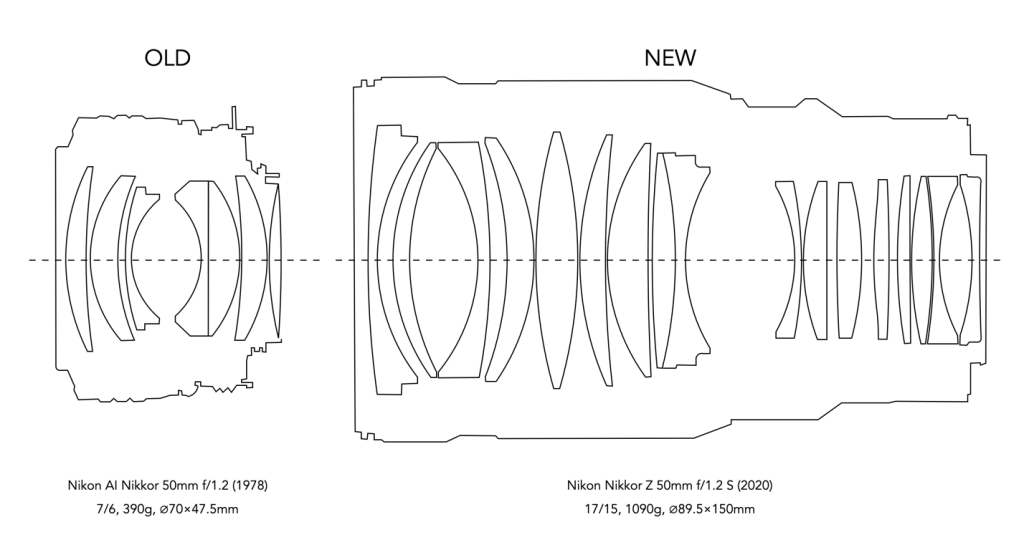
If you compare the inside of a modern digital lens versus its vintage analog compatriot, the first thing you might notice it the extreme complexity found in the modern lens. Consider the two lenses shown below. The Nikon AI Nikkor 50mm f/1.2 hailing from 1978 has 7 elements in 6 groups. Spring forward to 2020, and the Nikon Nikkor X 50mm f/1.2 S has a mind-blowing 17 elements in 15 groups. It’s also almost three times the weight of its predecessor. Is the image better? That is really in the eyes of the beholder.

Of the dedicated, high-end, lens companies only Voigtländer really stands out. They make lenses for a number of varied camera mounts. For Micro-Four Thirds (MFT) they actually offer a range of f/0.95 aspherical lenses, 10.5mm (21mm), 17.5mm (35mm), 25mm (50mm), 42.5mm (85mm), and 60mm (120mm). There is even a faster f/0.8 29mm (58mm) lens. These in reality are made for crop-sensors, with their full-frame equivalents more in the line of f/1.9. If one were to create a MFT equivalent of the Noctilux-M 50mm f/0.95, you would need something along the lines of a f/0.5. There are also third-party companies producing “inexpensive” ultrafast lenses (often by means of innovative lens designs). For example the Venus Optics Laowa, TTArtisan, Mitakon Zhongyi Speedmaster, Meike, 7artisans all have f/0.95 optics in various focal lengths, and sensors sizes. In 2022 TTArtisan introduced an f/0.95 35mm lens for APS-C for US$200.

But I do wonder why there is such interest in f/0.95 lenses? Dreamy bokeh? Why not just make f/1.0 lenses? I mean there isn’t that much difference between f/0.95 and f/1.0 – like 1/7th of a stop. I imagine it’s a marketing spiel, just like I imagine it was for Canon when they introduced their 50mm f/0.95 lens back in 1961. It’s a gimmick in the same way that items that cost $1.99 are perceived as cheaper than those marked $2. Why not go even further? I mean Voigtländer do have their f/0.8 29mm (58mm) super aspherical for MFT, which they toute as a world first (as of 2021), and introduce in their literature as the “conqueror of the night”. It’s not the fastest 35mm lens every made either, that honour goes to the Carl Zeiss Planar 50mm f/0.7.

There are limits to what lens speed will do for photography. An f/0.95 lens already has a very small depth of field, so small it makes it hard to focus. Many of these lenses may not even be that usable fully open, requiring them to be stopped down to f/2 before any semblance of usability is invoked. Sure, great for low-light but how often does anyone need that? Too many people use these lenses just for the bokeh effect, but that’s another story altogether. Somebody must be buying the Leica lens, as they are still making it. Likely more people are buying the cheaper lenses, just to experiment with. Check out this review of the TTArtisan 50mm f/0.95 by Dustin Abbott, who describes one of the pros as being “fun in low light”, and ultimately maybe that’s how we should view these ultrafast lenses, for fun, creative photography.

P.S. I do own a MFT f/0.95, more by happenstance than anything else. A few years back I bought the original Voigtländer 25mm f/0.95 (used, not new) for my Olympus MFT camera. It’s an incredibly solid lens, but it’s shallow DOF does make it tricky to focus.

Vintage lens makers – Tewe (Germany)

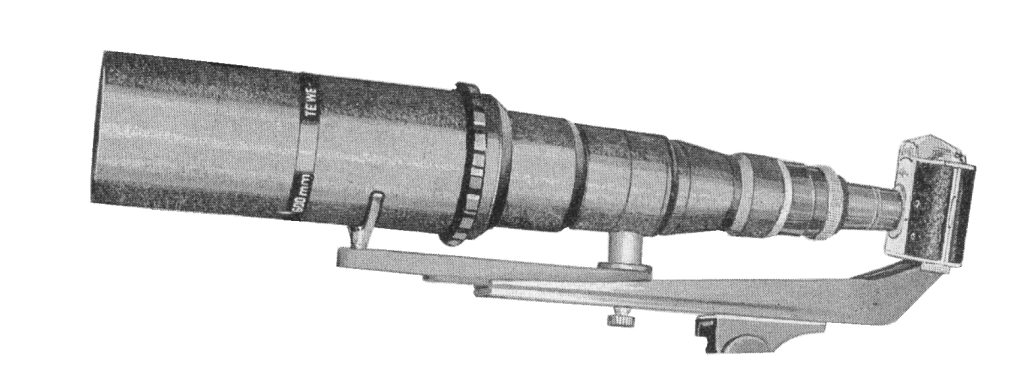
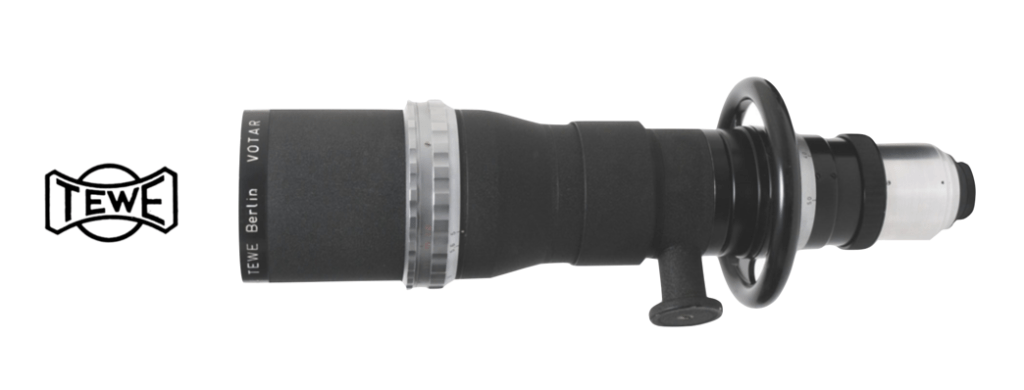
Tewe was a German company based in Berlin and well known for its long-distance lenses, up to 2000mm. Technische Werkstätten für Photo-Kinotechnik, Weiste & Co., TEWE OHG, was founded in 1935 in Schöneberg Berlin (in West Berlin during the Cold War period). The company initially developed long-focal length cinematic lenses, but by the 1950s and 60s they were producing long-focal length lenses for reflex cameras. Some of these lenses were designed in association with Astro-Berlin and Piesker. The company discontinued production in 1972.

Supposedly their lenses were used by astronomical observatories around the world, and lenses were well known for their “exceptional light intensity, unique brilliance, and needle-sharp, critical definition”. Their lenses were adapted for Exakta cameras, with lenses in the realm of 300-800mm.

Tewe Berlin Votar 500mm f/5
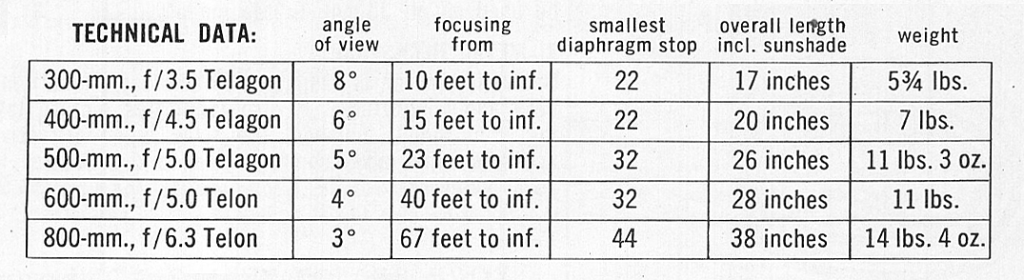
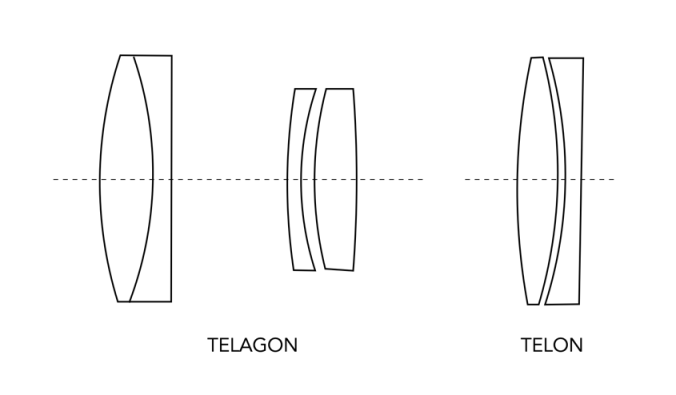
Some of the lenses produced by Tewe

These lenses were sold in two lens configurations, Telagon, or Telon. The Telagon had 4 elements in 3 groups, whereas the Telon was 2 elements in 2 groups. The Telon lenses were available in 400mm, 500mm, 600mm, and 800mm for 35mm, and a 1000mm for 6×6 cameras. The Telagon was available in 300/400/500/600mm. These lenses were heavy – the Telon 800mm was 6.5kg!

Which Fuji-X 16mm lens?

The 16mm focal length for Fuji-X is the equivalent of a 24mm full-frame lens (if these things matter to you ). It’s the start of ultra-wide focal lengths, providing wide-wide without those fish-eye effects. It does give a more exaggerated sense of perspective, with subjects close to the camera appearing quite large, and the relative size of more distant subjects reducing with distance. If you are choosing a 16mm lens, what are the options? Well, just a few, two from Fuji, and another two from 3rd party companies. Three of these lenses sit around the same price point, while the fourth is more than double.

This is a good example of why choosing lenses can be tricky. Which one is best? Read any number of reviews, and you will get any number of differing opinions. Is more expensive better? I think it depends largely on what you want to get out of the lens. If this 16mm lens (24mm equivalent) is to be used extensively for travel, then the Fuji 16mm f/2.8 might be one of the best choices – it is compact and super-light (at 40% the weight of its f/1.4 sibling), it is weather-sealed, and inexpensive. It also gets an impressive amount of positive reviews. Its much pricier sibling, the wider aperture f/1.4 is heavier, but with the added bonus of having the closest shooting distance, and better performance in low-light.

Fujifilm 16mm f/1.4
R WR
Fujifilm 16mm f/2.8
R WR
Samyang 16mm f/2
ED AS UMC CS
Sigma 16mm
f/1.4 DC DN
Aperture range1.4 – 162.8 – 222 – 221.4 – 16
Minimum distance15cm17cm20cm25cm
Optical design
elements / groups
13 / 1110 / 813 / 1116 / 13
Lens design
length, ∅
73mm, 73.4mm45.4mm, 60mm115.8mm, 86.11mm92.6mm, 72.2mm
Weight375g155g615g405g
Weather sealingYesYesNodust, splash proof
Focusingautoautomanualauto
Made?JapanJapanSouth KoreaJapan
CostUS$999US$399US$359US$449
A basic comparison of 16mm lenses for Fuji-X

The Sigma 16mm offers the same wide aperture as the Fuji f/1.4, at half the cost. So for the cost-conscious it might be a good choice, but it is 20mm longer, and is built mostly from a Thermally Stable Composite” (TSC) polycarbonate material (both Fuji lenses have metal bodies). It also does not have an aperture ring, so the aperture needs to be controlled by the camera. Neither f/1.4 lens is compact, which makes sense – a larger aperture means more glass, and hence a larger lens. My final choice? The Fujifilm 16mm f/2.8. Why? I doubt I’ll need the speed of the f/1.4, and I like the lens’s light weight, and reasonable minimal distance focusing. And the price is nice.

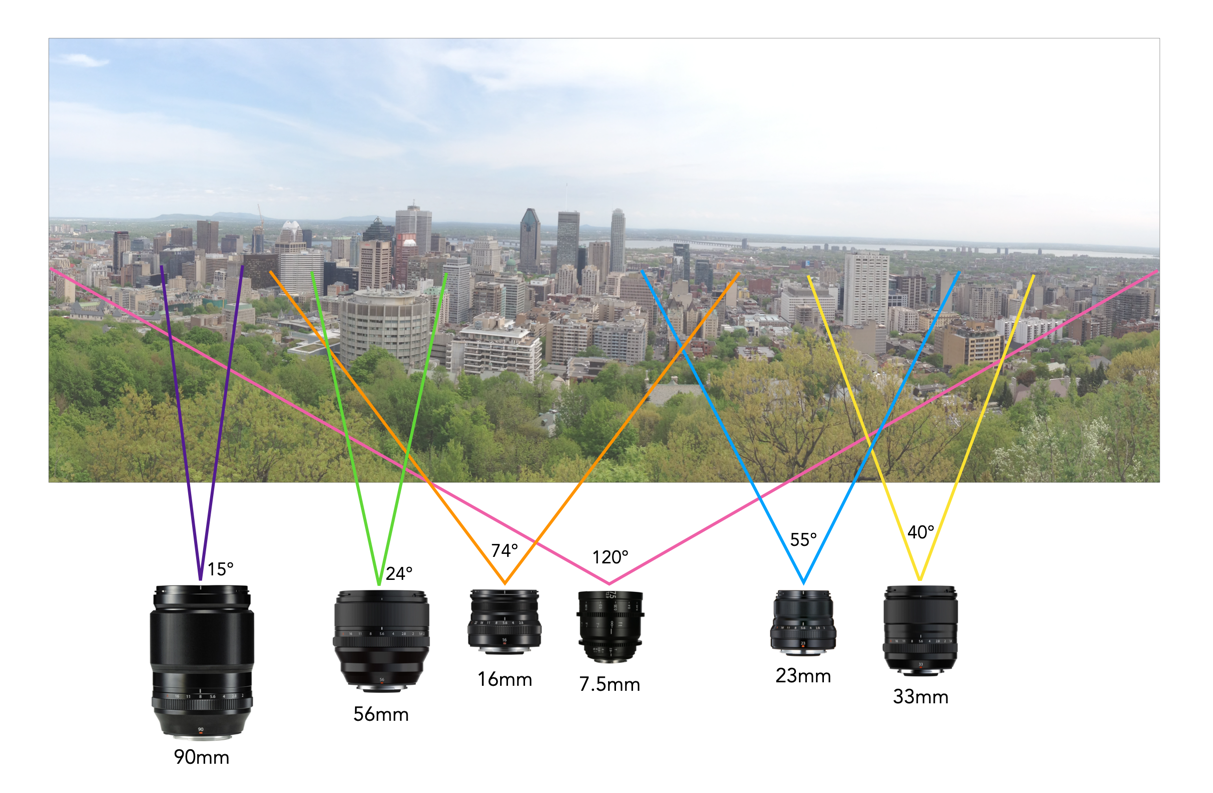
What about 13mm or 14mm lenses? Well, that’s really a personal choice. They are equivalent to 19.5mm and 21mm respectively. It really is a matter of preference. A 13mm will provide 85° (hor) AOV, and the 14mm 81° (hor). If we compare this against the 16mm at 74° (hor) it provides marginally more angle. And there aren’t many options out there. Fujifilm has a 14mm f/2.8 which sells for US$900, and Viltrox has a 13mm f/1.4 for US$459.

Further reading:

Choosing the right digital lens can be challenging

Choosing a digital camera, and a sensor size is one thing, but I think the thing that really stumps people is choosing the most appropriate lenses to use. Of course for the amateur photographer, what the lens will be used for may be the most important consideration. Travel? Landscapes? Street photography? The task is always made easier if there are some constraints on the number of lenses available. For example the range of lenses available for Micro-Four-Thirds, or even Fuji-X cameras has always been a little bit constrained, well until recently with the expansion of 3rd-party lenses.

So how do you choose the right lens? Like vintage lenses, digital lenses are principally chosen based on focal length (which advocates their use), and speed, i.e. aperture size. In addition there is cost, and “extras” such as weather sealing, and stabilization. The problem comes with the variety of lenses available – consider the long list of Fuji-X lenses, many of which are 3rd-party. Which one should you choose? Do you choose a prime or a zoom, a Fujifilm, or a third-party? Do you need an 8mm APS-C lens? Would 13mm be better? What about 16mm? Is manual focus okay, or would you prefer auto-focus? It’s not easy, even with the myriad of videos reviewing lenses.

I’ll concentrate on Fuji-X here, because it’s at the heart of my current lens dilemma (my camera is a Fujifilm X-H1). Now my photography is a mixed bag of street, landscape, architecture and travel. I currently have the 23mm f/2 R WR (which is a FF 35mm equiv.). Now I’m looking to expand, primarily a wide-angle lens. Here are some of the typical focal lengths for Fuji-X (APS-C sensor), and their applications. Measurements in ( ) represent the full-frame equivalences.

  • 50-56mm (75-85mm) – Good for portraiture.
  • 33-35mm (50-53mm) – Good for general photography, portraiture and cityscapes.
  • 23mm (35mm) – The upper end of the wide spectrum, provides more scene than the 33mm, but without the distortion of wider focal lengths. Good for street photography.
  • 18mm (28mm) – The standard choice for landscapes (and sometimes architecture), providing a relatively wide angle of view, without introducing obvious distortions.
  • 14-16mm (21-24mm) – The common lower end of the wide spectrum, good for very broad landscapes. Can include some noticeable perspective distortion, especially if the camera is tilted.

Beyond that we begin to move into the ultra-wide focal lenses, of which there seem to be quite a number. 11-13mm (16-20mm) lenses encompass more of the scene than can be seen with normal vision, so there is an innate sense of exaggerated perspective. Subjects close to the camera appear quite large, with the relative size of more distant subjects reducing quickly with distance. These lenses can be ideal for photography where the distortion does not impact the aesthetics of the image.

Various Fuji (APS-C) lenses and their associated angles of view. (Photo taken from Belvédère Kondiaronk lookout on Mont Royal, Montreal)

In reality, going down this rabbit hole has led me towards the 16mm, and possibly something like a 33-35mm. I have enough vintage lenses to cover the 50mm+ spectrum, and this makes sense as I don’t envision using them that often. And I’m going to stick with prime lenses. Some people really like zoom lenses because of the flexibility they allow, but I find I always seem to stick to one focal length – the 12-40mm on my Olympus camera used when travelling is perpetually set at 12mm (24mm). There are other compromises as well – weight can be an issue, as well as slower apertures.

Choosing a digital lens is challenging, especially for the hobbyist photographer. There are a lot of options, regardless of the sensor. Even Micro Four Thirds also has a long list of lenses. If someone is unsure, then I suggest starting with lenses from the camera manufacturer. As to focal length, choose a lens that provides the most optimal angle-of-view for the application you are most interested in. For example, if you shoot with an APS-C camera, and your focus is street photography, then a 23mm (35mm) lens is the most optimal solution.

Are wide-angle lenses the new “normal” ?

As I have mentioned before, the standard Angle-of-View (AOV) of the human visual system (HVS) is about 60° (horizontally) – the central field of vision, so to speak. So why do companies still tout 50mm lenses as being “close to the angle of view of the human eye”? It’s honestly hard to know. Zeiss still describes its Touit 32mm f/1.8 as offering “…the same angle of view as the human eye.“, with a horizontal AOV of 40°. The dominant “standard” lens for full-frame has been the 50mm since the introduction of the Leica by Barnack in 1925. That’s nearly a century of using a lens that doesn’t really duplicate the AOV of human vision, mostly because it simplifies human vision far too much. It doesn’t even match the 43.3mm diagonal of the 36×24mm frame – which is normally the golden standard of a “normal” lens.

A 50mm lens has a horizontal AOV of 39.6°, which only comes close to representing the region of the HVS that deals with symbol recognition, which is a somewhat narrow scope. In fact, most people aren’t really concerned about whether they are using a lens that “approximates human vision”. One of the most talked about lenses in the Fuji-X environment is the 23mm lens, which is close to a 35mm in full-frame land. In all likelihood, there has probably been a gradual move away from 50mm towards the wider focal lengths. For example the iPhone 14 has two rear facing cameras: a 13mm ultra-wide, and a 26mm wide (equiv). No 50mm at all. With a wider AOV it is possible to crop from within the frame.

What a 28mm iPhone camera lens sees (orange) versus the smaller AOV of a 50mm lens (blue)

Some would probably advocate for the actual diagonal of a full-frame, i.e. 43mm. This would give an AOV of 45°, midway between 30 and 60 degrees. But is this optimal? I think it comes down to personal preference. I personally think that a 60° is likely a better approximation for a lens. So which lens better represents the 60°? For full-frame it is likely around 31mm, or around 20-21mm for APS-C. So we end up in the spectrum of wide lenses, and that’s not necessarily a bad thing. Humans visualize the world around them in terms of a wide lens – yes not all of it is in complete focus, but then the HVS works in much different ways to a camera lens.

Further reading:

Vintage lens makers – Steinheil (München)

C.A. Steinheil & Söhne is the oldest of Munich’s optical companies, founded in 1854. It was established by Carl August von Steinheil (1801-1870), who was a physicist, astronomer, mathematician, and engineer. The company manufactured telescopes, spectroscopes and photometers. Over time this was supplemented by the production of optical glass.

During one period there was a great indignation against adulteration of Munich beer by greedy brewers. In the early 1840’s Steinheil designed a “beer lens”, a triplet that consisted of two glass lenses, in the middle of which was a fluid lens, a tiny quantity of the beer. The gadget showed impurities by means of spectral comparison. This was known as the optico-areometric beer test, and was based on the connection between the light refracting power of the beer, and its constituents.

By the end of the 1930s the company had been renamed Optische Werke C. A. Steinheil Söhne GmbH. In 1954 the name Steinheil was trademarked in the USA. In 1962 the company was sold to the Elgeet company in Rochester (NY), followed shortly after in 1964 to the aviation conglomerate Lear Siegler in Santa Monica. This resulted in a decline in the manufacture of commercial lenses in favour of aerospace/military applications.

From the 1940s through to the 1970s, the company produced a myriad of lenses for Exakta, M42, and Leica mounts. Many of the early lenses had the classic chrome finish of the period. By the mid-1960’s Steinheil dumped the chrome finish in favour of black enamel finishes typically with a striped focus ring. Examples include Quinaron, Quinon, Quinar, Tele-Quinar, Culminar, Cassar, Cassaron, Culmigon, Cassarit, Macro -Quinaron, Macro-Quinone, Macro-Quinar, Macro-Cassarite, Exagon, Tele-Exaktar. Some examples include:

  • Auto Quinaron 35mm f/2.8 – extreme close focus to 11cm.
  • Auto Tele-Quinar 135mm f/2.8 – exceptional mid-range lens, aperture down to f/32, and a minimum focus distance of 12.5cm.
  • Tele-Quinar 200mm f/4.5 – excellent preset telephoto, aperture down to f/32, chrome body, 14-blade aperture.

B&W versus colour

“In black-and-white the photographer has to translate in his mind’s eye the colours of his subject into a range of tones before he presses the trigger, and that effort alone makes black-and-white in a way more creative than colour. It paraphrases and formalizes more. Structure, texture, and rich tonal quality are all weakened by colour, for colour tends to distract the eye from strong forms and their pure architecture. A decorative prettiness may be gained by colour, and sometimes emotional force too, but drama is often lost, not least the drama of a significant instant of action which will never recur. Light in its various moods has deep emotional meanings for everyone, and black-and-white can often convey those meanings more powerfully than colour.”

Eric de Maré, Color Photography (1973)