Having a hard time trying to decide on a focal length? Below is an easy visual guide to the most common focal lengths, displaying the amount of a scene captured. Note these are full-frame/35mm focal lengths, so smaller sensors will require calculating equivalencies. For example the view shown for the 50mm lens below would be equivalent to what is seen by a 33mm lens on an APS-C camera, or a 25mm lens on a Micro-Four-Thirds camera. The 135mm lens view would be equivalent to a 90mm APS-C or a 68mm MFT lens.
Focal length views for classic 35mm lens (+DSLR) cameras.
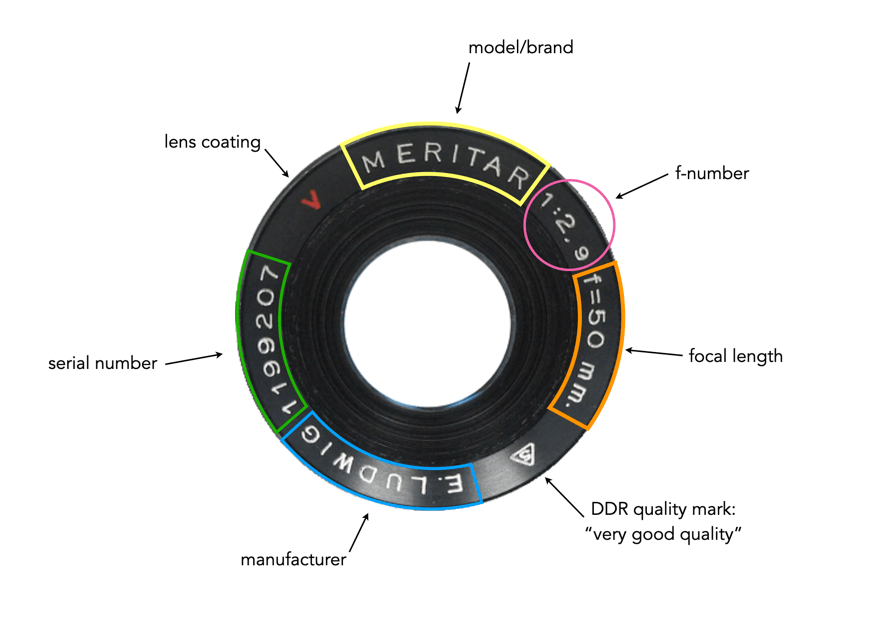
Vintage lenses are festooned with markings. There are the numbers related to focusing, and the f-stop values, but the details engraved upon the lens name plate will explain most things about the lens. This post will look at vintage lens markings by investigating a few examples. In general, most lenses have 5-6 markings: (i) lens model/brand; (ii) maximum aperture (speed); (iii) focal length, (iv) serial number; (v) company; and (vi) place of manufacture (these are shown in Figure 1 using colour coding to highlight). In addition there may be some symbols used to denote specialty characteristics such as lens coatings. These markings are usually found on the front of the lens on the rim sounding the first element. On lenses where there is no room on the front of the lens, the lens marking are usually found circumscribed around the outside of the lens.
Fig 1. The various markings on a lens (colour coded)
The first two items described are the manufacturer (or brand), and the type or name of the lens. In this case the manufacturer is E.Ludwig, and the type or name of the lens is a MERITAR. Most vintage lenses also provide the len’s serial number on the name plate – in this case 1199207. With come manufacturers the serial number helps track down information like where, and when it was manufactured. The most important information is the 1:2.9, which basically specifies the speed (maximum aperture) of the lens, here f/2.9. The last piece of information is f=50mm which specifies the focal length of the lens. On this particular lens there is also two additional symbols which specify lens coating and a quality mark.
Fig 2. Lens markings on various brands (same colour-coding as Fig.1, with the addition of red to denote place of manufacture)
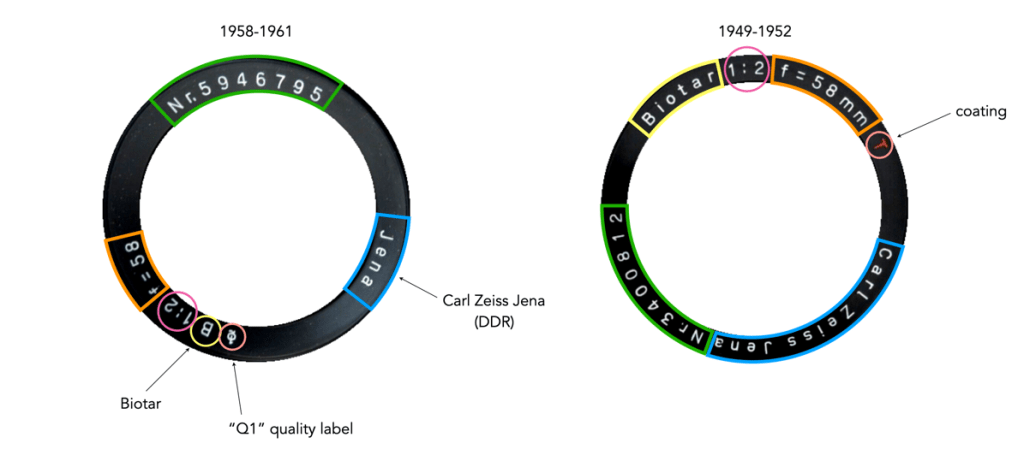
Figure 2 shows three more examples of lens markings from Kilfitt, Asahi, and Enna. Figure 3 shows lens markings from Zeiss Biotar 58mm f/2 lenses from two differing periods. The latter one has more cryptic lens marking – there is less info here because the lens was produced during the infamous Zeiss trademark dispute. Zeiss Jena in East Germany marked the Biotar lenses with a “B”, in order for them to be sold in the west.
Fig 3. Zeiss Biotar lenses from two differing periods
The focal length/aperture combination is the one thing that can be described in a number of different ways. The f-number is normally specified using a ratio, 1:x, rather than the f/ term. On some lenses the length and aperture are combined in the form aperture/focal length, e.g. 2.8/50. It’s actually somewhat rare to see f being used to specify maximum aperture, instead it is often used to signify focal length, e.g. f=58mm. Focal length is nearly always specified in metric, the only difference being that up until about 1950, many lenses were specified in centimetres, whereas afterwards the focal length became more standardized using millimetres. So an early lens might have been 5cm, versus the more standardized 50mm.
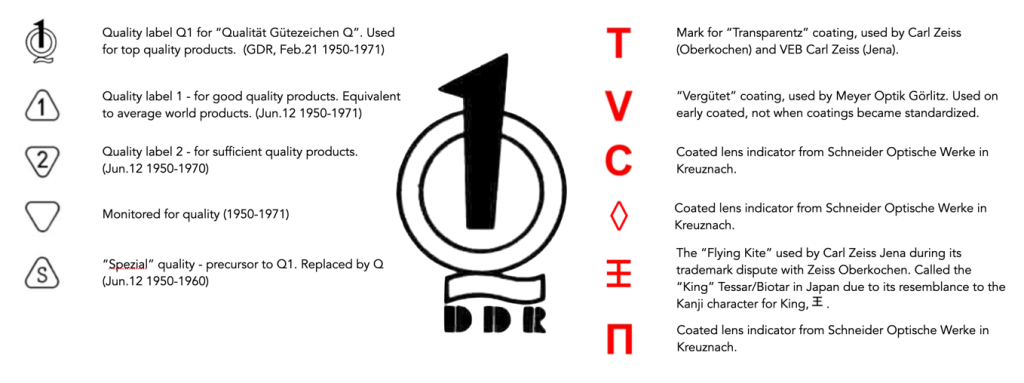
Fig 4. Specialized lens markings found on various German lenses.
Sometimes vintage lenses also carry other markings. Sometimes instead of a brand name, there is a logo to signify a brand. This is common in vintage Russian lenses where the same lens could have been manufactured in more than one plant. Some lenses also have a number with the diameter symbol, ∅, which indicates the filter size of the lens in mm. Some lenses also use letters to signify the presence of lens coatings, e.g. Meyer Optik specified a lens coating using a red “V”, after the focal length (which means Vergütet = coating). Examples of specialized lens markings for German lenses is shown in Figure 5.
Fig 5. Types of specialized lens markings found on German lenses.
Among the many things I resent about digital imaging is the slamming of the door on one of my favorite hobbies, camera collecting. Aside from getting a discontinued model cheap to use as a backup, can you tell me why someone would be excited about buying an obsolete digital camera for any purpose other than to use as a doorstop?
Herbert Keppler, On the joys of collecting. (Popular Photography & Imaging, August 2007)
The Soviets reportedly stripped Carl Zeiss Jena of 93% of its equipment, most of which was redistributed throughout factories in the USSR. This included 14 of the 16 glass furnaces at Zeiss [4], machines, office supplies and equipment, stocks and raw materials, boilers, elevators, switchboards etc. [5]. So what happened to the equipment taken by the Soviets as war reparations from the Jena plant from October 1946 to April 1947?
The majority of the dismantled equipment was transferred to three cities in the USSR – Moscow, Leningrad, and Kiev [8]. To Moscow went the rangefinder equipment, to Leningrad the equipment for the production of microscopes, micrometers and fine measuring devices, and to Kiev the geodetic equipment and the Contax Camera section [8]. Most of it seems to have been transferred to two factories in Russia: No.349, and No.393.
The Optical-Mechanical Plant No.349 near Leningrad (now St. Petersburg) was founded in 1914 in Petrograd. In 1919 it was nationalized, and in 1921 it was renamed the Factory of State Optics. Further reorganizations resulted in the factory in Leningrad becoming Gosudarstvennyy Opticheskiy Mekhanicheskiy Zavod (GOMZ), or State Optical-Mechanical Factory, in 1932. In 1965 GOMZ changed its name to LOMO (Leningradskoe Optiko Mekhanichesko Obedinenie), or Leningrad Optical-Mechanical Union. They produced optics for the Soviet military and space programs, as well as consumer cameras. Seventy-nine of the Zeiss experts from Jena were assigned to GOMZ, and the existing equipment in various parts of the factory was replaced by equipment dismantled from Jena [2]. By mid-1947 the process was completed, and the Soviet personnel were trained on using the equipment. A CIA report on the facility [2] suggests that much of the dismantled equipment stored in the open, or spoiled by mishandling, and the Soviets gained very little from the seized equipment [2].
Zavod (factory) No.393 is located in the small town of Krasnogorsk, a few kilometers from Moscow. Krasnogorsky Zavod was founded in 1942. During the Soviet era it became known as Krasnogorskiy Mechanicheskiy Zavod (Krasnogorskiy Mechanical Works), or KMZ for short. After 1945 it began producing lenses to Carl Zeiss specifications. The machinery at No.393 seems to be almost entirely made up of machines dismantled from Zeiss, Jena [6]. All the grinding and polishing machines at No.393 were transferred from Jena, amounting to one-third of the entire Zeiss plant as it existed prior to dismantling (100 lens grinding machines, 300 milling machines, and 100 metal grinding machines) [3]. The largest segment of machines was the 400 lathes of various sizes. All optical glass used at No.393 from 1946 to 1952 was from Jena, and of good quality [3].
No.393 produced a lot of optical items, including the Zorky camera, designated “FED”, and associated 5cm lenses. The Zorky was essentially a copy of the Leica IIc manufactured during the period 1940-1944. By 1951, about 400 cameras per month were being produced [6]. By 1947 the plant also made Moscow II 6×9cm camera, aerial cameras, photo-rectifiers, phototheodolites, 16mm motion picture cameras, and a series of military items.
The Contax camera section went to Arsenal No.1 in Kiev, Ukraine [8]. By the later 1940s this plant was making reproductions of the Contax II and Contax III cameras. These would morph into Kiev II and III cameras, eventually modified into the Kiev and 4A and 4AM. Some of the equipment also made it to smaller factories in the USSR. A good example of this is Optical Plant No.230 near the small town of Lytkarino (not far from Moscow). They received 50-60 grinding and polishing machines from Jena [7], although the CIA reports this as “bad and uncared-for equipment”. Some of the equipment was used to outfit a vacant optical plant in Zagorsk. Zeiss specialists installed the machinery, and trained Soviet workers [1].
The dismantling was in many ways not considered to be optimally successful, in all likelihood because insufficient care was taken with the sensitive equipment [4].
✽ Please note that while some people seem to regard the Soviet dismantling of equipment in East Germany to be looting, it was actually part of the reparation payments agreed upon in the Potsdam Agreement.
Further reading:
Please note that the CIA links don’t seem to work sometimes (since the issues with the US government websites began).
Of course people are also going to ask about the second camera seen on Sister Boniface Mysteries… the one belonging to Ruth Penny, Editor-in-Chief of the Albion Bugle. What is clear is that it is an Asahi Pentax model, likely an S2, S3, or even an SV (again the “Asahi Pentax” label has been covered up, but the Asahi design is still present). The S2 was introduced in 1959, the S3 in 1961, or even the SV (1963). For the S2, the lens is likely the Auto-Takumar 55mm f/2, for the S3, the Auto-Takumar 55mm f/1.8. It’s hard to make an exact designation because the camera’s all have a similar form, and the specific type markings appear atop the camera near the film rewind lever.
Look… a Pentax!
The flash seems to be a Metz Mecablitz 101 from the late 1950s/early 1960s. Note that these cameras had different designations based on market: S designated cameras were for the Japanese and European markets, and H for the North American (NA) market (as Asahi Optical was represented in North America by Honeywell Corp). So the S2 was designated the H2 in the NA market.
In the first episode of Sister Boniface Mysteries (BritBox), we are introduced to Sister Boniface, a Catholic nun with a PhD in forensic science. Now part of her job as police scientific adviser involves taking photographs, obviously given the time period in the early 1960s, she uses a 35mm SLR camera – but what camera?
The camera is introduced in the first episode, “Unnatural Causes”.
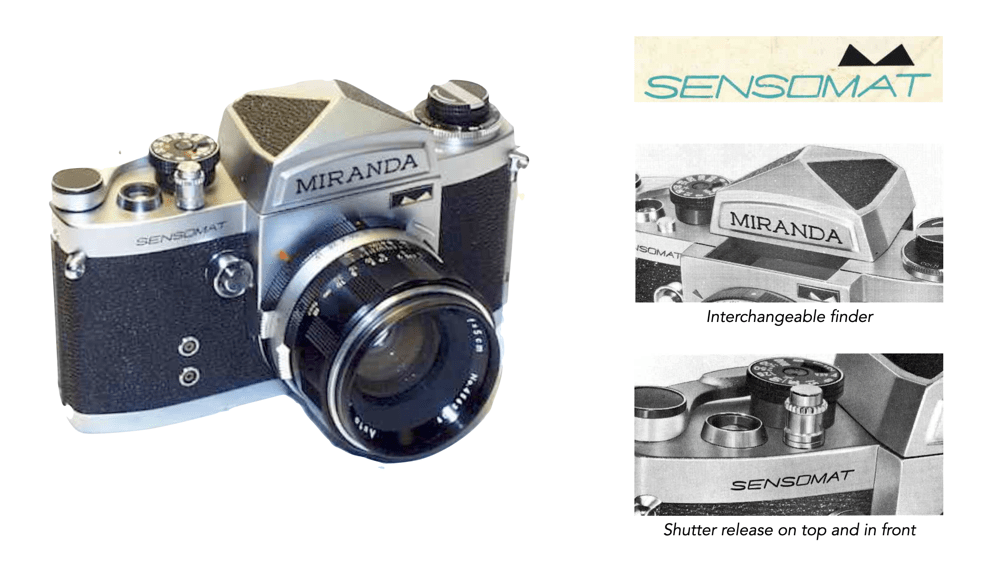
Well, it isn’t actually too hard to figure out the camera, despite the fact that the branding has been covered by black tape – the camera is from Japanese company Miranda, founded in 1947 and produced 35mm cameras from 1953 to 1976 (it was named Miranda Camera in 1957). During that period they introduced some 30 differing models nearly all with interchangeable pentaprism’s. The camera itself is a Miranda Sensomat, introduced in 1969. It was a budget camera, which had TTL CdS stop-down meter built-in the under mirror. The Sensomat range was produced from 1969-1974. The lens is likely the Auto-Miranda 50mm f/1.8, and the camera sold in 1969 for US$190 – it was advertised as being affordable.
The Miranda Sensomat
The interesting thing about the use of this camera is that the series is set in the early 1960s, and the camera was released in 1969, so there is some historical disparity. If one were choosing a Miranda camera of the period, a Miranda D might have been more appropriate. As to why the Miranda was chosen? Likely it was just a prop, it’s doubtful anyone thought about using a more historically significant camera for the period. Why cover up the brand? Likely due to not having to pay licensing fees, although it is unclear as to who currently owns the Miranda trademark.
Some online photographic stores have lenses that are marked as “rare”. This is sometimes a bit of a red flag, because as is often the case, these lenses are not really rare. Rare sometimes indicates that the seller has priced the lens high, even if the lens has defects. It is possible that “rare” emanates from an internet search that found few comparable lenses. For example there is nothing rare about a Helios 44-2 58mm f/2 lens, certainly not one that usually sells for under $100. There may be some early versions of the lens, e.g. the early “silver” ones, that are less common, but the lens itself is not rare. Rare lenses do exist, but these are usually rare because few were produced, or few are available. The Helios-40, 85mm f/1.5 is a less-common lens, and could rightly be portrayed as rare. In many respects it would be better to use the term “uncommon” when describing lenses that have low availability, leaving “rare” for the truly rare lenses.
Truly rare lenses include the likes of the Fisheye Nikkor Auto 6mm f/2.8, which can be worth upwards of $150K. The Canon 50mm f/0.95 on the other hand could probably be considered uncommon, as only 20,000 were produced. The Konica Hexanon 60mm f/1.2 is even rarer, with only 800 units supposedly produced. However it is fairly hard to define a Zeiss Sonnar 135mm lens as being rare, because a lot were produced, and there is nothing inherently special about them just because they are branded ZEISS (they sell for about C$75) – vintage 135mm lenses are a dime a dozen. The only rare 135mm lenses are those from companies who produced very few, or the lenses themselves had some sort of interesting or exclusive characteristic.
Is it rare or uncommon? The distinction is not always an easy one.
There are many reasons a lens could be considered rare. Vintage lenses with small focal lengths, or super-fast speeds (for a particular period) will always be quite rare, because few were likely produced (they were expensive to produce). A good example is the Vivitar Professional 135mm f/1.5 (T-mount) – nobody would necessarily use the terms Vivitar and rare in the same sentence, but is a special lens. Possibly only a few hundred of the 135mm lenses were made, having been originally produced for NASA in 1966-1967. But it’s claim to fame is that it was a superfast 135mm (and it was super large, 140mm long, 100mm diameter, and 2kg in weight). There are few, if any, on the market today.
A further reason is that a lens may represent the first of a series, or has some particular historical significance. A good example is the first 35mm macro lens, the Kilfitt Macro Kilar D 40mm f/3.5. Or perhaps it is rare because it is a pre-war lens – for example associated with the release of the Kine Exakta, the first 35mm SLR. A good example of this is the famed Biotar 75mm f/1.5, released in 1939, and was the fastest portrait lens at the time. Still another form of rarity – one where a lens is very rare in one version, but commonplace in another, even though both versions being optically identical – usually has something to do aesthetic differences between the the lenses, or the amount of time it was in production.
Some lenses are marked “rare” for the pure shock value – because if people think a lens is rare, they will be more likely to purchase it. So before buying a lens make sure to determine whether the lens is in fact rare, and whether it warrants the price being asked. In addition avoid purchasing a rare lens that is severely deficient, e.g. has stiff focusing or aperture mechanisms, or optical fungus. Spending $1000 on a defective lens, even if it is rare, is somewhat foolhardy (unless you are a collector, and have no plans to actually use the lens). It can be very challenging to have a rare lens repaired, depending of course on the type of damage – first it is hard to find someone to repair it, and it may also be hard and expensive to find parts (rare lenses means rare parts). For example I’ve seen one ad for a Konica Hexanon 57mm f/1.2, for C$500, cited the lens as being rare, with a series of caveats – internal spots of fungus on the optics, and stiff focus, and aperture mechanism. It turns out this lens is one of the least rare Hexanon lenses.
Note that some sellers use the term “rare find”, which is somewhat different in context. A rare find implies that there aren’t many available at a particular time.
P.S. Another term to be wary of is “mint”, which means pristine, or unblemished. Is it truly possible to define a lens as being devoid of all defects? Most vintage lenses contain contain at least some sort of dust internally (unless it was stored in its box in the right conditions for the past 50+ years).
If you know someone who dabbles in photography, and are looking for a Christmas gift, below are some book ideas. Some are new, others can be found on the vintage market, e.g. Abebooks.
Any book by photographer Andreas Feininger. He produced a lot of really good books on photographic knowledge. Good ones include Feininger on Photography (1949), and The Complete Photographer (1965). Theses books are less about technology, and more about technique, much of which is just as relevant today in the age of digital.
Robert Capa’s book, Slightly Out Of Focus: The Legendary Photojournalist’s Illustrated Memoir Of World War II (reprint 2001). A good insight into Hungarian photographer Robert Capa’s experiences during WW2 from the man himself.
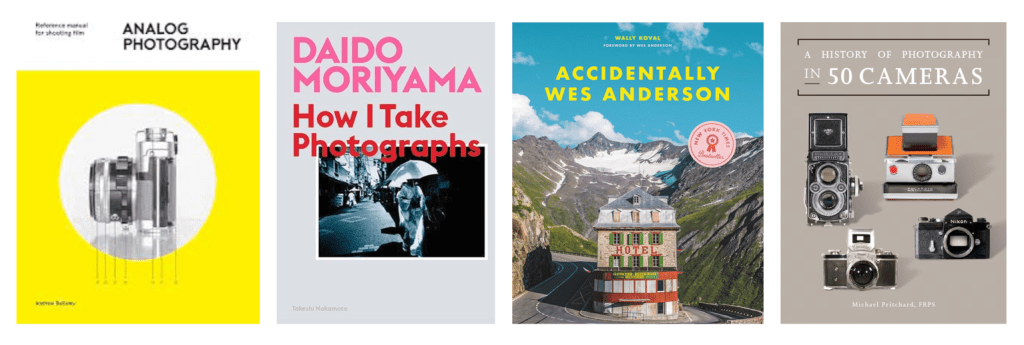
A very minimalistic approach to film photography can be found in Analog Photography: Reference Manual for Shooting, by Andrew Bellamy (2017). It dives into the fundamentals of 35mm film photography.
In Daido Moriyama: How I Take Photographs (2019), Japanese street photographer Daido Moriyama explains his approach to street photography. A great book for anyone interested in getting a real insight into street photographer from one of the icons of the genre.
A great coffee table book is Accidentally Wes Anderson (2020), photographs of real places plucked from the world of his films.
For a vintage camera buff, there is a great little book, A History Of Photography In 50 Cameras (2022), which explores 180 years of photography through 50 iconic cameras.







 Crafting Pixels