Vintage lenses – Why are telephoto lenses so cheap?

Go on to any vintage camera resellers website, and you will see that there are some lenses, notably telephoto lenses, that are inexpensive – I mean really cheap. Why? Doesn’t it require more material to make? Well, yes and no. They do have more metal (body), but the amount of glass is probably less than lenses with shorter focal lengths. Telephoto lenses generally have a very simple lens formulae, and so most of the added expense went into creating a large lens body. But that’s not really the problem.

Nearly all camera manufacturers provided an array of telephoto lenses. It’s a wonder they sold them all. For the reality is, then as now, telephoto lenses have a very narrow scope of use. The amateur photographer was likely only interested in the moderate telephotos, up until 135mm. The remaining lenses were the purvey of the professional photographer, and cinematographer. Who really needed a 300mm or 500mm lens, let alone 800mm? For example, in 1971, Asahi-Pentax sold 12 different Super-Takumar telephoto lenses:

  • Moderate : 85mm f/1.9 105mm f/2.8, 135mm f/2.5, 135mm f/3.5, 150mm f/4
  • Standard : 200mm f/5.6, 200mm f/4, 300mm f/6.3, 300mm f/4
  • Super : 400mm f/5.6, 500mm f/4.5, 1000mm f/8

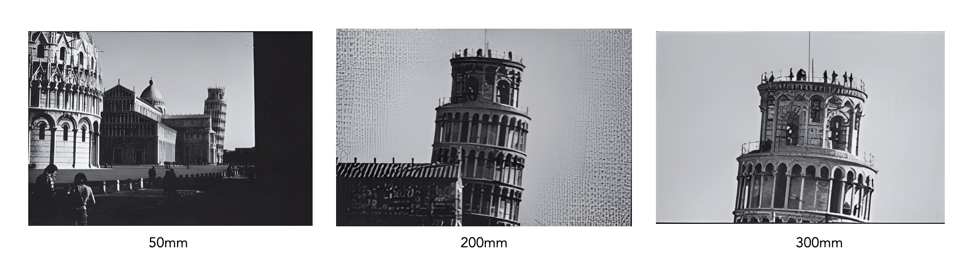
The problem is that these telephoto lenses were only used for a narrow scope of use. Even a 300mm lens only has a horizontal AOV of only 10°. By the time you get down to 400mm it’s only 5°. Both are very low angles.
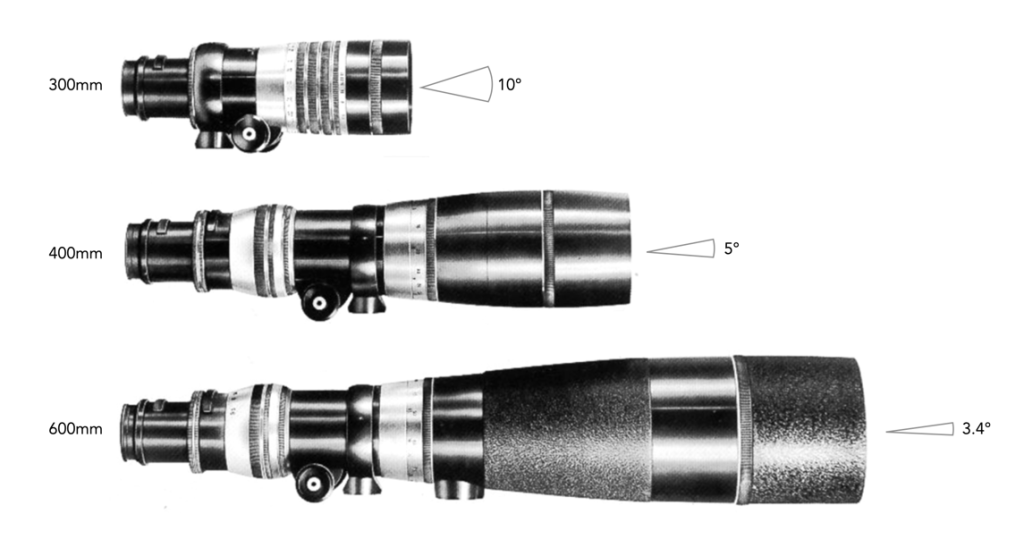
For the purpose of this discussion, let’s consider telephoto lenses above 120mm. That leaves three core categories: (i) the moderate telephoto’s around 135mm, (ii) the upper-end standards 200mm and 300mm, and the super-telephoto range > 300mm. Of the telephotos below 120mm, the most common are the 80-90mm lenses may be the most expensive of all telephotos, due to their popularity in portraiture work. Note that the prices quoted are for lenses in average to good condition, meaning that they are functional, yet may have minor optical issues, that won’t impact the quality of the image.

135mm

The most common lens in the moderate telephoto category is the 135mm, and there are a lot of them. Almost every lens manufacturer produced the 135mm as a “standard” telephoto lens. This may have been a legacy of rangefinder 25mm cameras which maxed out at 135mm (without the use of specialized devices). As such they are cheap because they are plentiful. The price only varies depending on manufacturer, lens speed, and mount (obscure mounts will reduce the price). If you search Kamerastore, you will find hundreds of 135mm lenses. A Soligor 135mm f/3.5 Tele-Auto (M42) can cost as little as C$60, whereas a Schneider-Kreuznach 135mm f/3.5 (M42) will only cost C$155. The rare exceptions seem to be lenses like the KMZ 135mm f/2.8 Tair-11, which sporting 20 aperture blades sells at about C$338.
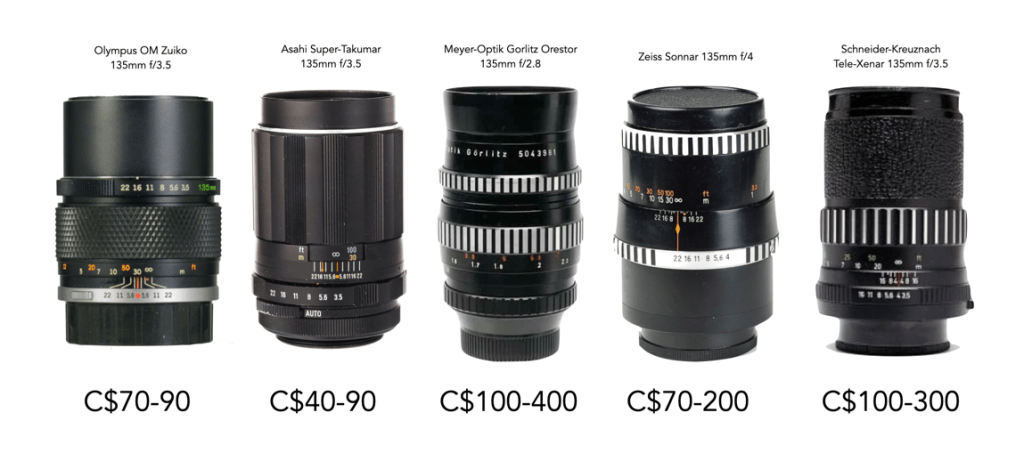
Prices are also low because their use in as lenses on digital cameras is just not that popular, largely because once adapted to crop-sensors, a 135mm becomes a 200mm (APS-C) or 270mm (MFT) lens. Other reasons they aren’t popular include being slow, with an average aperture of f/2.8-4.0, and some lenses like the Meyer-Optik Görlitz Orestor 135mm f/2.8 are heavy, i.e. over 500g.

200/300mm

The “standard” telephoto range is often even cheaper relative to it’s size. A 200mm Asahi Super-Takumar f/4 usually sells for around C$200, the Jupiter 21M for C$175. Once you move higher than 200mm, prices seem to stabilize at around C$1 per mm of focal length. Here the higher prices indicate some historically significant lens. For example both a Meyer-Optik Görlitz 300mm f/4.5 Telemegor, or an early Pentax 300mm f/4 Takumar might be priced around C$400.

Super-telephoto

Again, these lenses can be cheap, even though they are not as abundant as smaller telephoto lenses. You can get an Asahi Super-Multi-Coated Takumar 400mm f/5.6 for around C$400. A Meyer-Optik Görlitz 400mm f5.5 Telemegor on the other hand might only cost C$200. The expensive 400mm lenses are often those with some history. For example a Kilfitt Fern-Kilar 400mm f/5.6 normally costs upwards for C$600-800 because it is a rarer lens, and due to its association with the film Rear Window.

The verdict? Telephoto lenses above 120mm can be fun to play with, but most people won’t use them that often. I think that is partially the reason why 135mm lenses are so cheap (and often in such good condition). People bought them to broaden their focal length choices, found they weren’t very practical, and relegated them to a cupboard somewhere. They weren’t that useful for everyday shots, and certainly too bulky to travel with. Eventually the market for them likely waned due to the growth of the zoom lens market. I would honestly avoid telephotos above 200mm unless you have a good use for the lens (and you choose a lens with good reviews). Longer lenses are fun to play around with, but may not exactly be that practical. Super telephotos are for the birds (literally).

P.S. There are also a lot of third-party lenses suppliers that produced telephoto lenses that are even cheaper than camera brands. For example Chinon, Sigma, Soligor, Tokina, Hanimex and Vivitar.
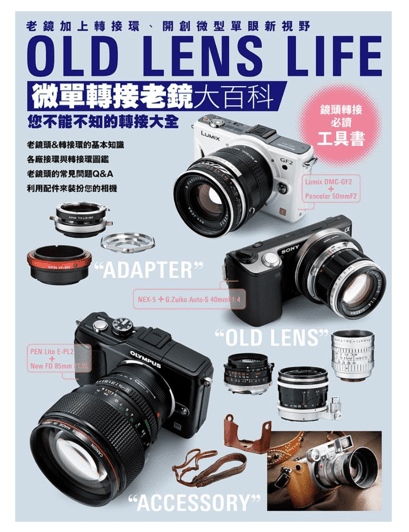
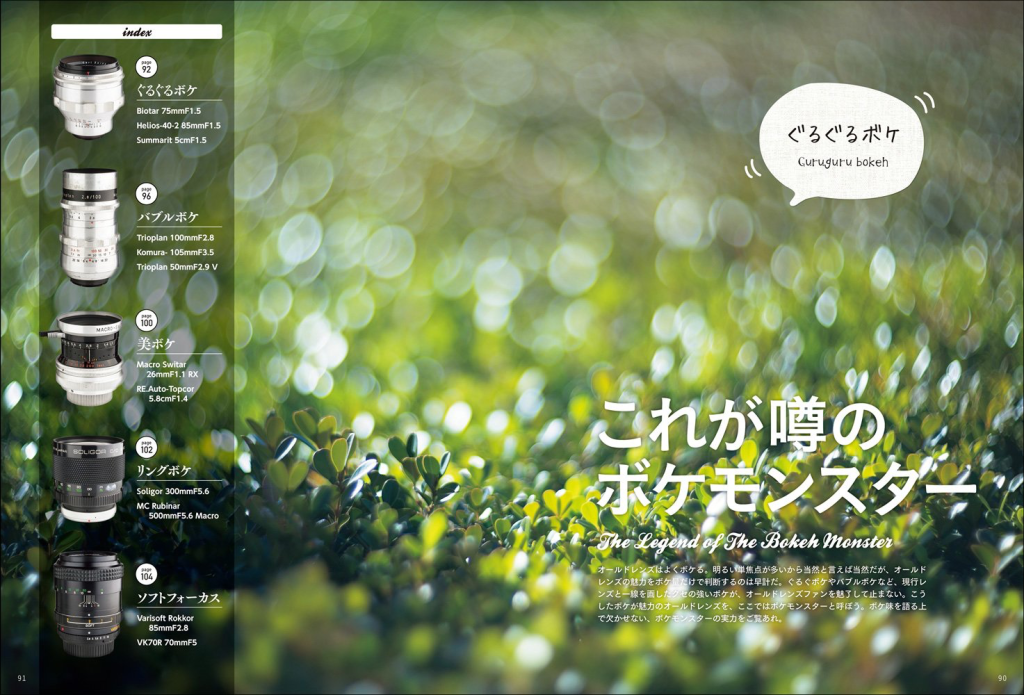
Old Lens Life magazine from Japan

In Japan they actually publish a magazine dedicated to vintage lenses – Old Lens Life. You can get copies from Amazon Japan (either paper or digital). It’s fascinating because a lot of the article titles are in English, and the text in Japanese, but with translation it shouldn’t be too hard to get the gist of what it being said. This magazine would actually do really well outside of Japan. Has anyone read a copy?

Choosing a vintage lens – more specialized focal lengths

While the standard focal lengths (28-150mm) are of most interest to the amateur vintage lens user, there are also more specialized options. These are for the photographer who wants to broaden the type of lens they use. Ironically the super-wide-angle and standard telephotos are at opposite ends of the spectrum, both from the perspective of focal-length, AOV, and cost. The shorter the focal length, the more expensive the lens, whereas the longer focal lengths are quite plentiful, and cheap.

Note that I have not included sub-15mm lenses because they nearly all verge on the specialized fisheye realm, and I’ll be covering that in another series of posts. Over 300mm, lenses tend to become very specialized, and not much use unless you are doing surveillance, or wildlife photography.

Super wide-angle lenses (15−25mm)

These are in the special lenses category, sometimes referred to as extreme wide-angle lenses. These lenses have a horizontal AOV of between 70-100°. Their primary function is to allow the inclusion of a broad subject area from a relatively close vantage point – this includes landscape with broad vistas, city scenes, and build interiors. Lenses in this category are corrected for curvilinear distortion (i.e. they reproduce straight lines), they reproduce parallel lines in the scene with greatly enhanced angles of convergence. The lower the focal length, generally the fewer the options available. Note that many of the lenses in this category did not appear until the mid-to-late 1960s.

24/25mm (74/72°)

Some consider 24mm to be where the “real” wide angles begin. There is a perceivable change in perspective from 28mm, although the horizontal AOV only changes from 65° to 74/72°. The biggest problem here is that there aren’t many options, in this focal length.

  • Examples Asahi Super-Multi-Coated Takumar 24mm f/3.5, Olympus Zuiko 24mm f/2.8; Isco-Gottingen Westrogon 24mm f/4;
  • Crop-sensors − 36/38mm (APS-C), 48/50mm (MFT)

20/21mm (84/81°)

These lenses obviously offer even a wider AOV than their 24/25mm counterparts. For some manufacturers this was the lower limit of the lenses they offered, partially because of the expense involved in designing them. The maximum aperture was at most f/2.8, with most of these lenses being f/4. The wider you go, the more aberrations like field curvature that exist.

  • Examples Carl Zeiss Jena Flektogon 20mm f/2.8 and f/2.4; Asahi Super-Multi-Coated Takumar 20mm f/4.5; Minolta MD 20mm f/2.8
  • Crop-sensors − 30/32mm (APS-C), 40/42mm (MFT)

15−18mm (100−90°)

These lenses didn’t really appear in great quantities until the 1970s. These uber-wide/(rectilinear) fisheyes performed well in the centre of the images, but the edges suffered from some field curvature and barrel distortion, but maybe that’s part of their appeal. Apertures were generally around f/3.5. Some of the lenses were fisheye’s others rectilinear wide’s. More Japanese lenses, and fewer German lenses.

  • Examples Asahi SMC Takumar 15mm f/3.5; Asahi Super-Multi-Coated Fish-Eye-Takumar 17mm f/4; Nikon Nikkor 15mm f/3.5; Asahi Fish-eye Takumar 18mm f/11.
  • Crop-sensors − 22-27mm (APS-C), 30-26mm (MFT)
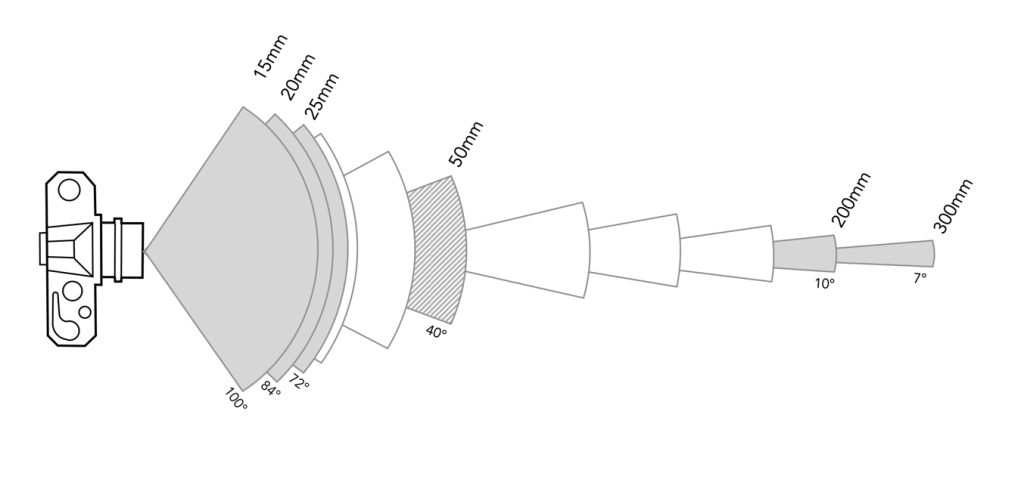
Specialized focal lengths, and their associated AOV (horizontal).

Standard telephoto lenses (180−300mm)

Telephoto lenses larger then 135mm were the purvey of the SLR, with rangefinder cameras requiring the use of a boxy reflex box. Still as with many prime telephotos, they were often sidelined by zoom telephotos.

180−200mm (11−10°)

There were a number of good 200mm lenses with fast apertures in the range f/2 to f/1.8 available in the tail end of the manual focus era. The core 200mm lenses were the f/3.5 to f/4.5 models offering a good balance of size, weight, and performance.

  • Examples Meyer-Optik Orestegor 200mm f/4; Asahi Super-Multi-Coated Takumar 200mm f/4; CZJ Sonnar 200mm f/2.8;
  • Crop-sensors − 270-300mm (APS-C), 360-400mm (MFT)

250−300mm (8−7°)

Most manufacturers offered a 300mm lens or two. Early models can be bulky, and rare. Only for those who are really serious about seeing things close-up.

  • Examples Kilfitt Tele-Kilar 300mm f/5.6; Meyer-Optik Telemegor 300mm f/4.5;
  • Crop-sensors − 375-450mm (APS-C), 500-600mm (MFT)

Did Darth Vader use a Zeiss lens?

In a galaxy, far, far away, they used cameras with lenses from Carl Zeiss Jena. It’s true, Vader was into photography, he had a dark-room and everything. Actually I never saw anyone with a still camera of any sort in the Star Wars universe, but I guess they must have existed – they did use “holocams”. So how did a reference to a sci-fi classic get associated with the design of a lens?

In some of the early SLR lenses from CZJ, especially lens series like the Pancolar, many people describe them as being “Star Wars” lenses. What does this really mean? These lenses often have another moniker – “zebra” lenses, because of their striped design. Does the zebra somehow associated them with Star Wars? Most of the talk of Star Wars revolves around the Carl Zeiss Jena Pancolar lenses, and in particular the 50mm f/2 (and in odd cases the f/1.8).

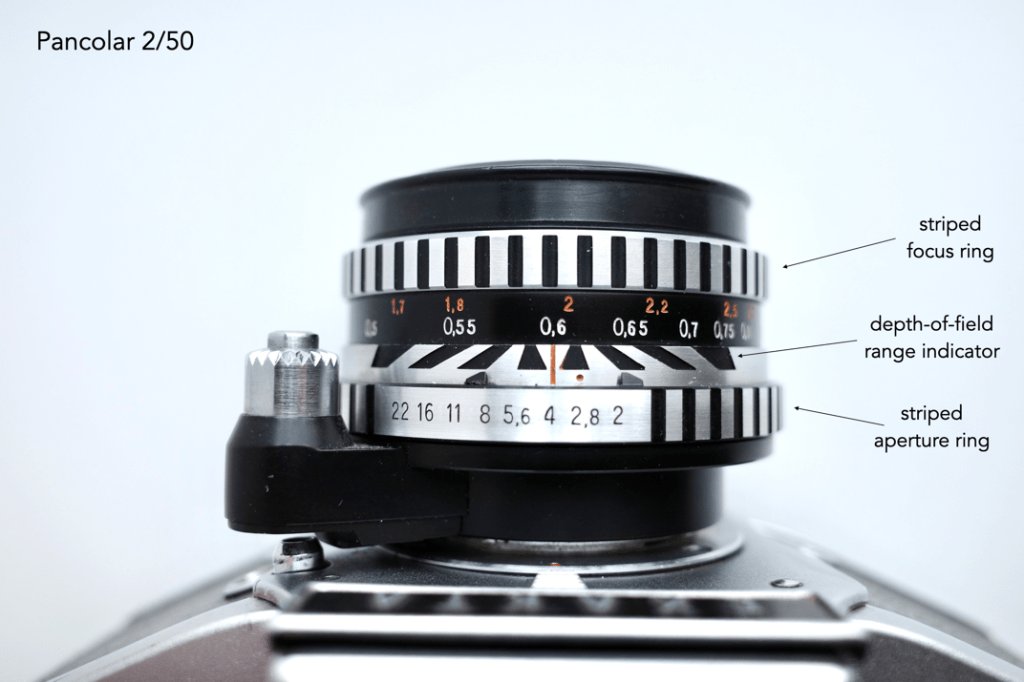
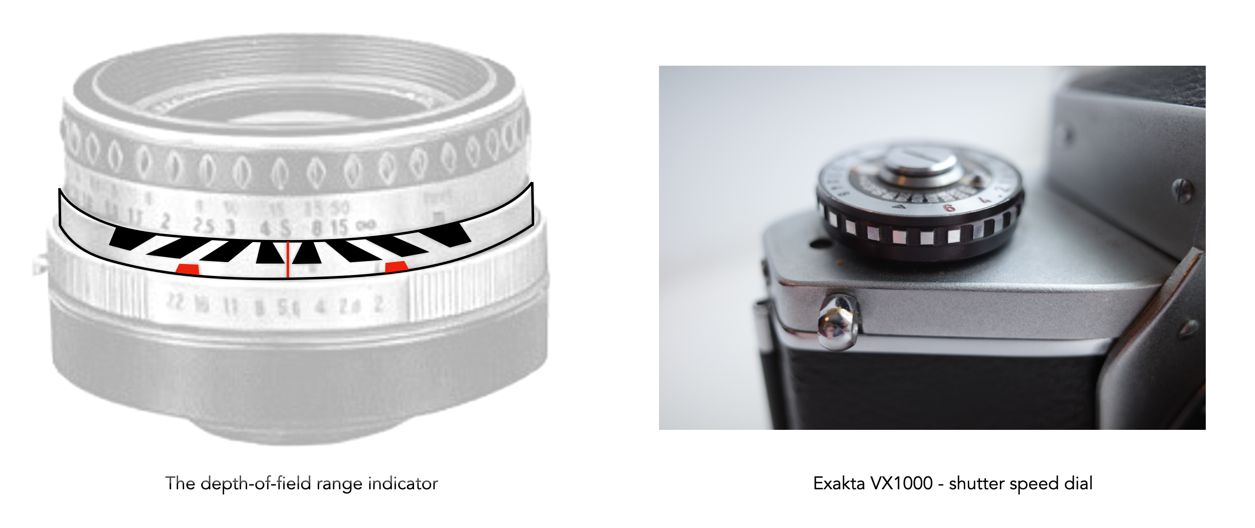
The Pancolar 50mm f/2, which first appeared as the Flexon 50mm f/2, was produced from 1959-69 (made mostly for Exakta mount), and had a number of differing aesthetic looks. Most differed by a change in the grip ring in the front of the lens, from a leather to plastic knobs, and finally to the stripped aluminum ring. Except for the earliest version of these lenses, they all sported the “converging” look of the “depth-of-field range indicator” (DoFRI), which appeared around 1962. Basically when the aperture was altered, the indicators (early models in red as shown, later models in black) would move in and out appropriately, so at f/2 they would converge at the red central line. A Zeiss brochure from 1962 which contained four lenses: Flektogon 4/50mm, Flektogon 2.8/35mm, Tessar 2.8/50mm and Pancolar 2/50mm. Strangely enough, the Pancolar was the only one with this converging distance design.

The “zebra design” is the colloquial term for lenses with grip rings that are aluminum – with vertical straight knurling that alternate black and bare aluminum. Supposedly this striped design evolved from the Exakta VX1000 which when released in 1966 had a shutter-speed selection knob of a similar design. The Pancolar 50mm f/2 also adopted the zebra design circa 1966, while still retaining the converging depth scale. The zebra looks was eventually replaced by the black-look lenses in the early 1970s.

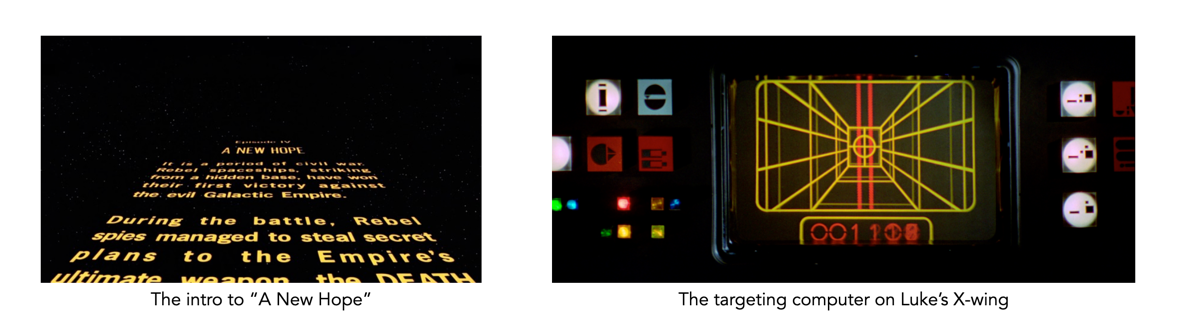
Some suggest the Star Wars moniker it is named for the characteristic look of the DoFRI, reminiscent of those very yellow credits at the beginning of the film. If anything, I think the range indicator could be better attributed to the targeting computer in Luke’s X-wing used on the trench run on the Death Star (Episode IV). It shows the same converging lines, and deals with a similar concept, i.e. distances of a sort. On later models of the 50mm f/2, the strips existed on the tandem with the DoFRI, but when the Pancolar 50mm f/1.8 appeared, it maintained the striped appearance, but lost the converging look DoFRI, opting instead for a more traditional one.

It seems then that the use of strips to describe the “Star Wars” look has no real basis. There were other Zeiss lenses that took on the zebra design, as well as other manufacturers, e.g. Meyer-Optik, Asahi (e.g. the Auto-Takumar 55mm f/1.9), using the design well into the 1970s, and no one ever talks about “Star Wars Takumars”.

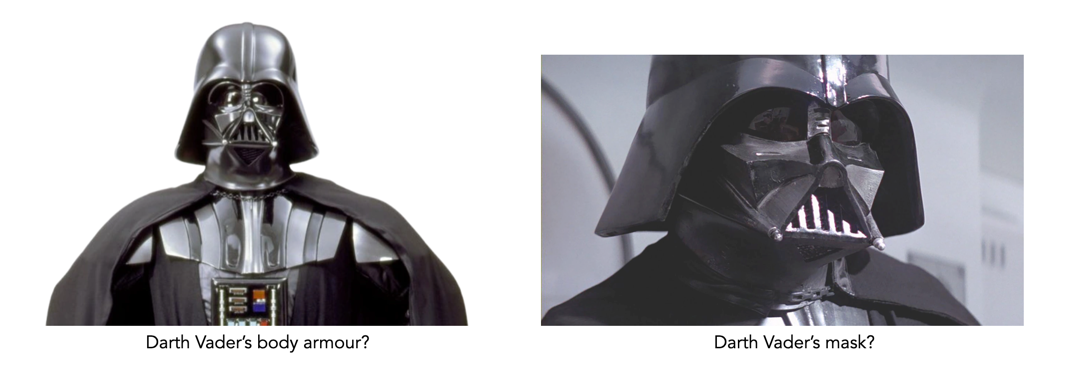
The reality is, no one really knows where the term originated or why it came into use. Were these lenses associated with Star Wars because of the striped design? Or perhaps it was a play on the “good” versus “evil” of West versus East Germany? If you look at a lens in isolation, it does have an association, but a dark one – it does share some characteristics with Darth Vader. It’s cloaked in blackness, and perhaps the striped design is associated with the strips on Vader’s armour? Or perhaps the strips were reminiscent of the mouth grill on Vader’s mask?

Maybe it just has a Star Wars feel about it, and you know, the more I look at it, the more I feel that way – maybe I’m being drawn in by the Force… must buy more…

Choosing a vintage lens – some FAQ

This is a follow-on to the general FAQ on vintage lenses, and answers questions related more to choosing a lens. There are often no truly definitive answers, i.e. there is no “one” perfect vintage lens.

Which focal lengths should I start with?

The most common focal length is 50mm, therefore this is the lens I would suggest starting with. On a crop-sensor such as APS-C, this will give you a 75mm moderate range telephoto, good for portraits etc. Next in line would be a 35mm, because this will give you a “normal” 52mm on an APS-C camera. At the end of the day, the focal length you choose is based on your photographic needs.

Do I need a fast vintage lens?

Sure, 50mm f/1.2 lenses are fast, and f/1.1’s are even faster, but in all likelihood you won’t need to spend the extra money for a fast lens. As digital cameras have higher native ISOs, lenses with f/1.8, f/2, f/2.8 and even f/3.5 are more than usable. Besides which, superfast lenses have a lot of limitations, and do you really want to spend that much money?

Should I choose a lens based on specifications?

Sometimes people will choose lenses based on its speed, i.e. large apertures. Don’t choose a lens based solely on its specifications. A lens has to have a real need for it to be useful, not a numeric one. If you have the wherewithal to buy a 50mm f/1.1 lens, then you have to actually be in a situation to use it, unless of course you are a collector. Besides which the character of a lens is more than just it’s technical specifications.

Should I choose a lens based on its aesthetic appeal?

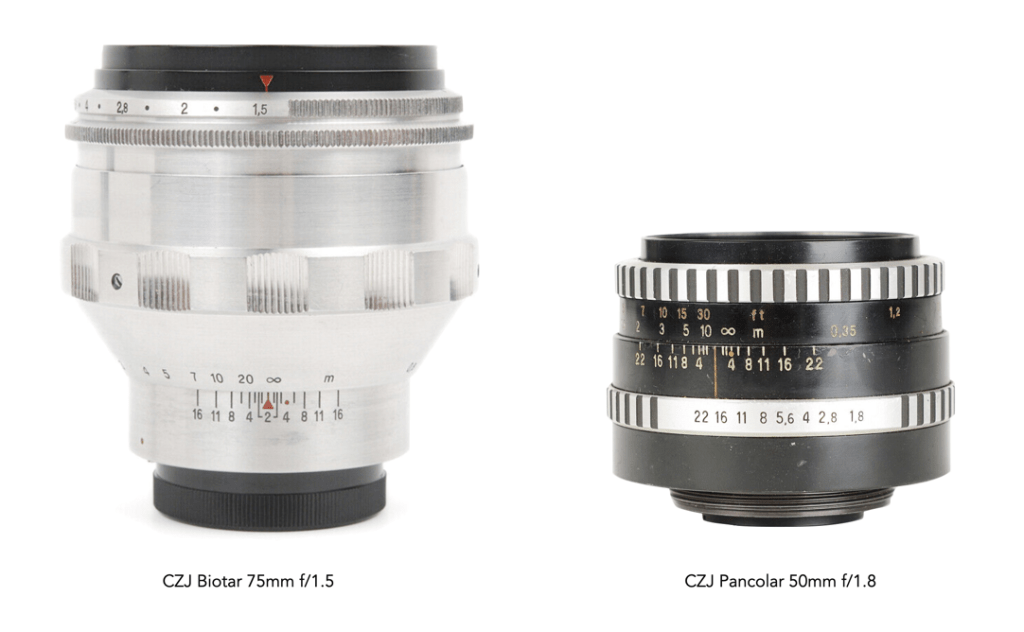
Sure, why not. I know most people think about the optical appeal of a lens, or the fabulous bokeh it will produce, but the reality is that aesthetics have to play some sort of role. I prefer the look of the older aluminum/chrome lenses over their matt black successors. For example I really like the “fat” version of the CZJ Biotar 75mm f/1.5 made from 1952-1968. It is made of aluminum and has an extremely scalloped focus ring, but these days it sells for upwards fo $2000, so not exactly affordable. I am also drawn towards the Zeiss lenses with the “Star Wars” motif, e.g. Pancolar 50mm.

Aesthetically pleasing lenses anyone?

Are hyped up lenses worth it?

Maybe, or maybe not. In reality how good a lens is is very subjective. Choosing a lens based on a single persons opinion may be somewhat flaky. If a number of people share the same opinion, then it may be worth pursuing that lens. However hyped up lenses often become quite expensive, or even hard to find. For example the the Helios-40 85mm f/1.5 is quiet a hyped up lens – great if you are crazy for Bokeh, but for $500 too expensive for a 85mm lens.

Are lenses nobody talks about worth it?

This is the flip-side to hyped-lenses. The problem with lenses nobody talks about is that nobody talks about them, maybe because they are mediocre, or perhaps nobody has explored them properly. Of course once people get wind of a lens that has been ignored for decades but has some endearing characteristics, expect it to become more expensive, and harder to find. These lenses are often quite cheap, so maybe it’s worth a risk?

Are legendary lenses really that good?

Some lens reviews like to use terms like “legendary”, “mythical”, and “superior”. It is all very subjective. Some lenses do have the qualities to pull off being given one of these monikers, but many aren’t. For example the Carl Zeiss Pancolar 80mm f/1.8 is considered by most to be a really exceptional lens. It is very sharp, and has great bokeh, but the downside is that it isn’t that common, and therefore prices range from C$1200-2000.

Does the brand matter?

Most camera companies produced good lenses. Some people say Zeiss are the best (East or West Germany, that is the question?), others lover Asahi Pentax, and still others like Canon, or Nikon. It’s really all about what lens characteristics of a particular manufacturer you end up coveting. That being said, even prominent companies produced some dog lenses. There were also companies that just produced a certain genre of lenses – for example Heinz Kilfitt (München) produced macro (they produced the first macro lens), telephoto and zoom lenses, such as the famous Killfitt Fern-Kilar 40mm f/5.6 used in the movie Rear Window. (I’ll be doing a separate post on brands)

Are third-party lenses any good?

People also forget that there are 3rd-party lenses, from manufacturers like Soligor, which are usually pretty good, and often quite inexpensive. It often depends on the characteristics of individual lenses.

What things do people forget when choosing a lens?

The most common are likely size and weight. Faster lenses are generally larger, and heavier. An early lens may be made of chrome-plated steel and therefore much heavier than the aluminum lenses that followed. Also, cheaper lenses may not be built that well, i.e. using lower quality components, or heaven forbid plastic parts.

Vintage lens makers – Komura (Japan)

There are some lenses that few people have ever heard about, usually because they provided third-party lenses for many differing camera mounts. One such lens brand is Komura, manufactured by Japanese optical company Sankyō Kōki K.K. (Sankyo Kohki), known in English as Sankyo Koki Co. Ltd. In 1962 the company, registered the US trademark Komura, indicating that it was firat used as a trademark in 1953. Before that it is believed the company use the brand name Chibanon or Chibanone. By the 1970s, the company had changed its name to Komura Lens Manufacturing Ltd.

The Komura literature touted their lenses as being “superbly sharp”. They seem to have produced at least 40 different lenses from 28mm to 800mm, for SLR, rangefinder, and C-mount cameras. Their 28-200mm lenses were made with direct individual mounts, mostly in the Leica thread mount and Nikon rangefinder, but also M42, Exakta, Nikon F, Minolta, Miranda, Konica, Canon, Pentax and Petri. Those from 200-800mm had a generic 47mm screw mount which required a specific adapter, called a ‘Unidapter’ to convert them to other camera mounts (apparently to reduce inventory requirements).

Today Komura lenses are little known, but can still be found, especially for Japan (eBay). A 105mm f/2 is usually advertised for between C$300-500, while 85mm f/1.4 lenses seem to go as high ac C$1200. Actually quite high prices for a brand that doesn’t have a lot of presence. To put this into perspective, the Komura 800mm f/8.0 sold for US$695 in 1965 (plus $8.50 for an appropriate adapter). Conversely the 500mm f/7.0 sold for US$175 (+ $4.95 adapter). The 85mm f/1.4 sold for US$162.

Choosing a vintage lens – classic focal lengths

The number one choice when selecting a vintage lens is usually focal length. This post will look at the classic types of focal lengths, to provide some insight into choosing one to suits your needs. For each lens focal length, I have included some of the more popular examples of lenses. I have not included cost estimates, because they can be so varied, and dependent on a number of factors.

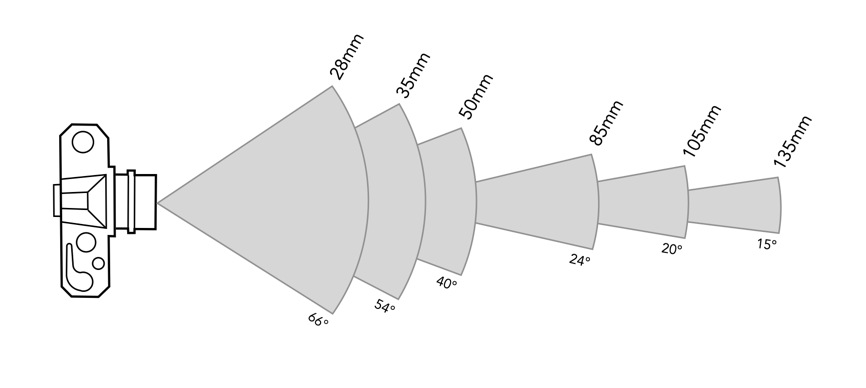
The values provided for the “crop sensor” denote the full0-frame equivalents when the lenses are used on crop-sensor bodies. For example a vintage 50mm lens on an APS-C sensor will behave the equivalent of a 75mm lens on an SLR. That means a 24mm super wide angle lenses on a DSLR will behave like a wide on an APS-C sensor, and a normal lens on a MFT sensor. Crop sensor focal lengths are simply calculated by multiplying the focal length of a lens by the appropriate crop factor: 1.5 (APS-C), 2.0 (MFT). Note that angles shown represent the angle-of-view (AOV) of the lens and are always horizontal. The AOV for the crop-factors are calculated in the same way as for the focal lengths.

Standard lenses (40−58mm)

Normal lenses tend to produce natural-looking pictures. There is a broad range of lenses in this category, both from the perspective of cost, weight, and aperture (speed). Wide apertures in the range f/1.2-1.4 are ideal for talking available light pictures indoors and out. Average aperture lenses are f/1.7 or f/1.8. Generally lens prices increase as apertures increase, hence why slow lenses are often inexpensive (and plentiful).

50mm (40°)

The 50mm lens is the most ubiquitous of all vintage lenses. Just about every camera came standard with a 50mm lens. 50mm lenses can generally be categorized into “fast” and “slow” lenses. Fast lenses are generally those with apertures of f/1.5 and larger, whereas slow 50’s were f/1.7 to f/2.8. Slow lenses are typical of the standard kit lenses found on cameras of the period, in part to reduce the cost of the basic system. Some higher end models were given an f/1.4 lens, and some like Canon advertised their Canon 7 rangefinder with the “dream lens”, the 50mm f/0.95. The super-fast lenses were designed for low-light situations, and really don’t make a lot of sense for the average photographer.

  • Examples Asahi Takumar 50mm f/1.8; CZJ Pancolar 50mm f/1.8; CZJ Tessar 50mm f/2.8; Meyer-Optik Görlitz Oreston 50mm f/1.8; Mamiya Sekor 50mm f/2; Carl Zeiss Planar 50mm f/1.8;
  • Crop-sensors − 75mm (APS-C), 100mm (MFT)

55mm (36°) and 57/58mm (35/34°)

Some cameras came standard with the “other” normals, 55mm and 57/58mm, depending on the manufacturer. Many of these lenses are from the period when SLR first appeared. Some suggest this was because of mechanical limitations imposed on producing fast 50mm lenses (impeded by the existence of a mirror), others suggest it is because photographers preferred the longer focal length because it was more portrait-focused. So the late 50’s to early 60’s saw a number of these lenses appear. 58mm lenses were generally f/1.4 to f/2, and 55mm were f/1.7 to 2.

  • Examples Helios-44 58mm f/2.0; Konica Hexanon AR 57mm f/1.2; Minolta Rokkor MC 58mm f/1.4; CZJ Biotar 58mm f/2; Mamiya Sekor 55mm f/1.4; Asahi Super-Takumar 55mm f/1.8;
  • Crop-sensors − 83/87mm (APS-C), 110/116mm (MFT)

40mm (48°) and 45mm (44°)

These focal lengths are not that common, usually appearing in the guise of “pancake” style lenses. These lenses are more likely to be found on fixed-lens cameras, for example the point-and-shoot Olympus Trip 35 (Zuiko 40mm f/2.8). These lenses are ideal for people who work outdoors, as they are light, and compact. They fit very discretely on any camera, but like many compacts look almost comical on larger cameras. These are the focal lengths closest to the diagonal of 36×24mm film, with 40mm offering 48.46° horizontal AOV. Generally they had apertures in the f/2 to f/2.8 range. Within the mainstream of lenses, these intermediary lenses are somewhat inconspicuous, possibly because there aren’t that many examples.

  • Examples Konica Hexanon AR 40mm f/1.8; Asahi SMC Pentax-M 40mm f/2.8; Minolta Rokkor MD 45mm f/2 (pancake)
  • Crop-sensors − 60/68mm (APS-C), 80/90mm (MFT)
Classic focal lengths, and their associated AOV (horizontal).

Wide-angle lenses (28−35mm)

Any lens shorter than a normal focal length qualifies as a wide-angle. They range from extreme fish-eye to the more moderate, and useful 24-35mm category. We have divided these into the “normal” wides, described here, and the super-wides. As the focal length decreases, the wide-angle characteristics increase – greater angle-of-view, greater depth of field, and greater apparent distortion.

35mm (54°)

Before the 1970s, the 35mm was the “standard” wide angle produced by many manufacturers. As such it was often the workhorse of wide-angle shots from the days of the rangefinders up to the 1970s, when wider lenses started to appear. Due to the increase in AOV, many photographers preferred its perspective and as a result was often carried as a secondary lens. It has a horizontal AOV of 54°, and was usually available is a wide range of apertures, from f/1.4 to f/4, and therefore there is no shortage of these wide-angle workhorses, and therefore can be quite inexpensive.

  • Examples CZJ Flektogon 35mm f/2.8; Enna München Lithagon 35mm f/3.5; Konica Hexanon AR 35mm f/2; Asahi Super-Takumar 35mm f/3.5
  • Crop-sensors − 52mm (APS-C), 70mm (MFT)

28mm (65°)

The 28mm has become the “standard” in wide angle lenses since the 1970s. Like the 35mm, there are copious lenses with many differing characteristics out there.

  • Examples Asahi Takumar 28mm f/3.5; Minolta Rokkor MC/MD 28mm f/3.5; Asahi Super-Takumar 28mm f/3.5;
  • Crop-sensors − 42mm (APS-C), 56mm (MFT)

29/30mm (64/62°)

Quite a rare option, it provides a small variation on the 28mm.

  • Examples Meyer-Optik Görlitz Lydith 30mm f/3.5 (also Pentacon 30mm); Pentacon 29mm f/2.8, and its predecessor the Meyer-Optik Görlitz Orestegon 29mm f/2.8
  • Crop-sensors − 44/45mm (APS-C), 58/60mm (MFT)

Moderate telephoto lenses (80−150mm)

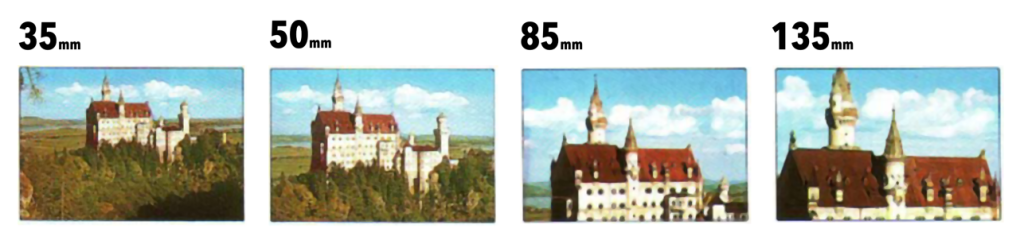
These are likely the most common telephoto lenses, the moderate telephotos are often considered “portrait” lenses. Often reasonably fast and lightweight, they are easy to hold by hand they provide at least twice the magnification of normal lenses. Angle-of-view is generally 14-25°.

80−90mm (25-23°)

These focal lengths were common in rangefinder lenses, and are sought after for taking portraits, likely due to their limited compression effects. Apertures range from f/1.8 to f/3.5.

  • Examples Jupiter 9 85mm f/2.0; Asahi Super-Multi-Coated Takumar 85mm f/1.8; CZJ Pancolar 80mm f/1.8; Helios 85mm f/1.5
  • Crop-sensors − 127-135mm (APS-C), 170-180mm (MFT)

105mm (19°)

Sometimes overlooked, but just slightly narrower field (19°) than the more popular 85mm (24°).

  • Examples Asahi Super-Multi-Coated Takumar 105mm f/2.4; Meyer-Görlitz Trioplan 105mm f/2.8
  • Crop-sensors − 157mm (APS-C), 210mm (MFT)

120−150mm (17-14°)

The ubiquitous 135mm is the most common lens in this range, and there are a lot of them. The 135 was likely the “standard” telephoto until telephoto-zooms started to make inroads in the 1970s. Available in a wide assortment of apertures, f/2.8 and f/3.5 were the most common.

  • Examples − Hard to pick one 135mm, there are SO many. CZJ Sonnar 135mm f/1.5; Meyer-Optik Görlitz Orestor 135mm f/2.8; Asahi Super-Multi-Coated Takumar 135mm f/3.5
  • Crop-sensors − 180-225mm (APS-C), 240-300mm (MFT)

Choosing a vintage lens – things to consider

After looking at the basics of vintage interchangeable lenses, there is a point when you will have to make some decisions about choosing a lens. There are literally millions of vintage lenses out there in the ether. Some are exceptional, most are good, some are mediocre. But even mediocre lenses can be interesting if they are cheap enough, and you want to experiment (even if that involves taking a lens apart and putting it back together again).

Choosing a lens is often quite a daunting experience, because there are so many possibilities, and it can be hard to narrow things down. Some people only buy lenses from a single manufacturer, others only buy lenses of a single focal length, others only buy lenses from a specific time period, and still others buy lenses that have a cool bokeh effect. The type of vintage lens you buy is a very individualistic thing. You can read the reviews about particular lenses, and formulate your own opinion about buying a lens, but you never really know what you get until you use it. Lenses come in different versions, and sometimes from different factories. Choosing a lens is also more than just looking at quantitative data such as lens sharpness, it is often more about the aesthetic appeal of the image produced, than the exactness of the MFT (Modulation Transfer Function) diagrams.

The best place to start is to decide what the lens will be used for. This aids in determining the focal length and lens characteristics, helping to constrain the search. For example someone who takes architectural photographs may be interested in a shift perspective lens such as the Olympus OM 35mm f/2.8 Shift lens. For astrophotographers, a sharp lens that is well corrected for coma is important. Those who take portraits may opt for a 85mm lens. If you have no specific needs, then start with a 50mm lens – it is by far the most common vintage focal length (and every manufacturer produced various models). Don’t forget that a lens behaviour will depend on the size of the camera’s sensor it is used on. For example a 50mm lens with a standard 46° diagonal angle-of-view, will behave like a “full-frame” 75mm lens on an APS-C sensor (with a diagonal AOV of 32°), i.e. the 50mm lens will be “the equivalent of” a 75mm FF lens.

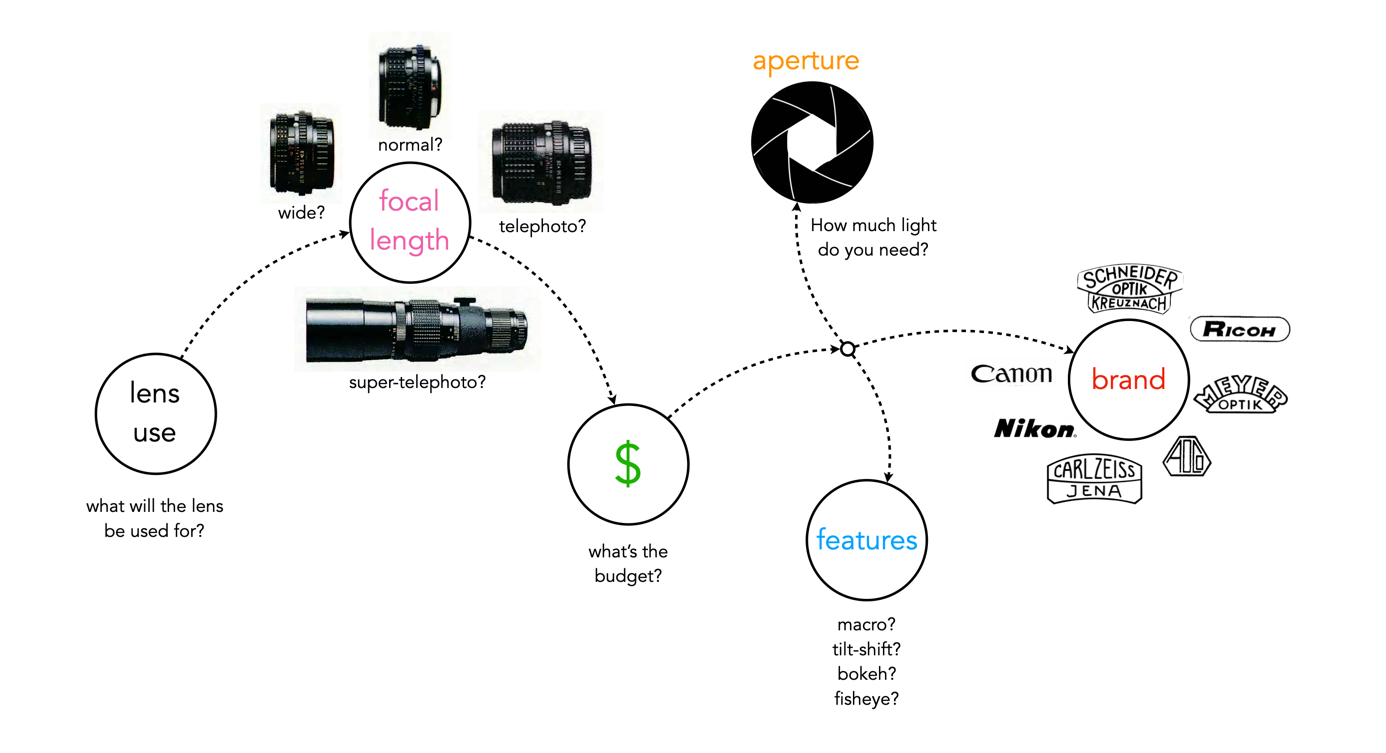
Things to consider when choosing a vintage lens: lens use, focal length, budget, features, aperture, brand
Things to consider when choosing a vintage lens

Once you have an idea of the focal length, then you need to decide what features you want: must-haves, nice-to-haves, and things-not-needed – and of course how much you want to spend. Choosing a focal length is of course the easy part. Now you have to choose a brand, and a configuration (aperture, number of aperture blades, mount). This is harder because there are a lot of choices. Sometimes the best approach is to take the lead from someone who has done some of the hard work for you. For the beginner, there is very little difference between any 50mm lenses from the core camera manufacturers: Pentax, Canon, Nikon, Minolta, Zeiss, etc., they are all pretty good. Of course the “elephant in the room” is often budget. Choosing an upper limit on how much you are willing to spend on a lens will help constrain your search from the get-go, which helps avoid pursuing lenses that are nice, but just ooh too expensive. it you can’t afford it, don’t go there.

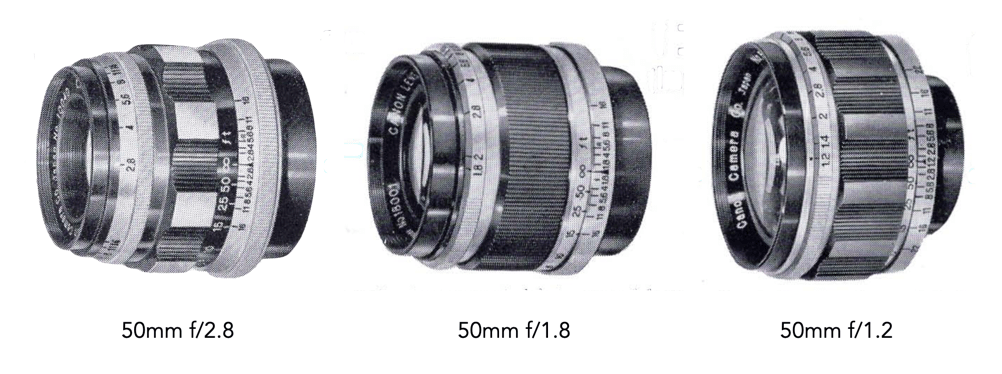
Now with a focal length, and a budget, it’s time to explore aperture, or lens speed, i.e. when the aperture of a lens is completely open, how much light comes in. In situations where you are shooting in broad daylight, then is there any need for a 50mm f/1.4 lens, or would a f/2 suffice? For example, Canon 50mm rangefinder lenses were produced in three different types: f/2.8, f/1.8, and f/1.2. The f/2.8 is 128g, the f/1.8 is 270g, and the f/1.2 is 322g. The f/1.2 lens will provide a lot of light, but at 2.5 times the weight. A lot of effort can be put into deciding the speed of the lens. However the faster the lens, i.e. the larger the aperture, the more expensive the lens will be. Don’t spend a lot of money on your first few of lenses. You can experiment with these lenses and decide whether using vintage lenses is for you.

Canon rangefinder 50mm lenses

Once you have chosen a lens, it is good to review some of the literature on the lens. How expensive is it? What about availability – is it common or rare? Is the lens generally found in good stead, or is it susceptible to abnormalities such as fogging/hazing, or has a front lens which is easily scratched? For example it is common knowledge that some of the Canon rangefinder LTM mount lenses are very susceptible to fogging. Is it easy to repair if there are issues?

Then it helps to look at some reviews, either on blogs, or videos. Just remember that reviews are a subjective viewpoint from someone with similar or differing circumstances to your own. Try and stick to reviewers that have a long history of reviewing vintage lenses. If their lens review, how did they evaluate the lens? Did they show actual photographs taken using the lens, in a good variety of situations? Did they take the shots using the same sensor size as your camera has? Was it a review performed with the lens on a film camera? It’s best to look at several different views, but always keep in mind that the lens you might buy will be different to the one they are reviewing. It could be a newer model of a lens which uses the same optical formula, but is housed differently, or uses a different aperture mechanism, e.g. number of blades; or perhaps it uses a different type of glass in some of the lens elements, e.g. thoriated versus regular glass. There is never a guarantee that the lens you buy will behave in exactly the same manner.

Don’t choose a lens solely on its specifications. Just because a 50mm f/1.2 lens seems like a good idea because it is rare, and some people proclaim it as the “best” lens, does not mean it will work properly for what you want it to do. Don’t be swayed by the large collections of some photographers. Some people take photographs for a living, and so may have more requirements, and also more ability to sustain large collections. Having dozens of 50mm lenses is fine, if you can afford them, and if you are actually going to use them (and it’s easy to fall down this rabbit hole). You may decide after some investigation that the lens you had coveted it really not something you need – for various reasons. Maybe it’s too expensive? Maybe it’s too hard to find? Maybe it is notorious for needing repairs?

Vintage lenses – some general FAQ

Here are some questions relating to vintage lenses, things that people might like to know before they dive into the world of vintage lenses (and how to choose them).

Can any vintage lens be used on a digital camera?

Just about. Most mirrorless full-frame and crop-sensor cameras can be used with vintage lenses, but there are some lenses which don’t work, either because they have a strange lens-mount, or the lens itself projects too far beyond the mount into the camera.

Are vintage lenses affordable?

Vintage lenses were once quite inexpensive, but as more people discover them, some are increasing in price – well the popular ones are. That being said, they are still often cheaper than modern glass, especially the faster lenses. For example, the Super-Multi-Coated Takumar 50mm f/1.4 sells for around C$100-150. The 8-element version of the lens, the Super-Takumar, in good condition usually sells for C$300-500 (which is still pretty affordable). The most affordable vintage lenses, are often those mass-produced kit-lenses that don’t get a second look at. Leica lenses are nearly always expensive.

What is the best vintage lens?

There is really no such thing, because the inherent character of a lens is very subjective. Many people swear by the Carl Zeiss Jena lenses, others prefer the Asahi Pentax Takumar series, and yet others gravitate towards Nikon. There are a lot of “best vintage lenses” lists out there, but it is best to look at reviews of people who use a lot of vintage lenses. For example Zenography, Simon’s utak, or Mark Holtze all have great vintage lens reviews on their respective YouTube channels.

Is there such a thing as a perfect vintage lens?

No, even the most sought-after lenses can have limitations. For example the 8-element Takumar 50mm f/1.4 does not outperform other legacy lenses in certain situations. It can be quite soft when the lens is shot wide open in some circumstances, and is a heavy lens. Yet people are still charmed by the lens because it does a really good job with colour rendering. It produces warm colours with very little vignetting. The Takumar lenses also have good ergonomics.

What about vintage zooms?

Some people like them, others don’t. The reality is that there are many really good, well-built early zoom lenses out there, and because they are often so underrated, they are really quite inexpensive.

Aren’t newer lenses better?

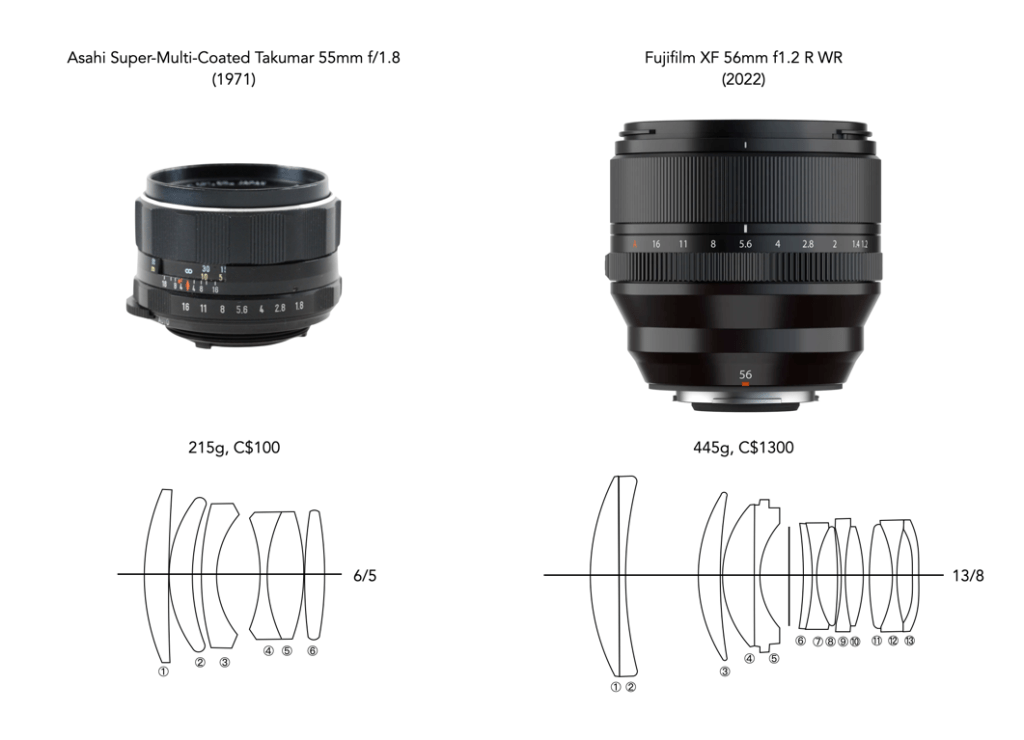
Newer lenses are more technologically savvy, and the glass is likely to be near perfect (although truthfully there is no such thing as a perfect lens). Modern lenses built for digital cameras try very hard to remove abnormalities, which is the very reason most people gravitate towards vintage lenses. Modern lenses are also inherently more complex. For example the Olympus Zuiko 25mm f1.2 Pro (MFT 50mm FF equivalent) has 19 lens elements in 14 groups, including low dispersion, high-refractive, and aspherical elements. The vintage equivalent, the Olympus OM Zuiko AUTO-S 50mm f1.2 has 7 elements in 6 groups. Vintage lenses often use a very simple optical designs that have been around for a hundred years. Do you really need a lens with 15 lens elements, or will 6 do?

Are all vintage lenses manual?

Practically all vintage lenses require manual focus, and manually setting the aperture. Manual focusing is slower than autofocus, but most mirrorless cameras provide tools, e.g. focus peaking, to help with the process of manual focusing. Manual focus lenses might not be an optimal choice for activities such as travel involving fast-paced tourism, but it brings you closer to understanding the subtleties how a camera-lens combination works.

Is there a good range of focal lengths?

Brands aside, there is usually a good selection of focal lengths available. The most common focal length is 50mm, because of it’s “normal” status, and the fact that it came as the standard “kit” lens on most cameras. After that there is a good range of wide-angles (28mm, 35mm), and short telephotos (85-135mm). Ultra-wide angle lenses are rarer, yet there seems to be a wide range of telephotos (possibly because they aren’t as popular).

What about the build quality of lenses?

Many of these lenses were built tough. They featured solidly build body’s with aluminum lens barrels and stainless steel mounts. Without a bunch of electronic and motors inside to facilitate things like auto-focus, vintage lenses can often be quite compact, and light. They are robust, easy to fix, and lack the complex electronics of modern lenses (meaning they will last for decades).

How does adapting a vintage lens to a crop-sensor affect it?

Most vintage lenses were designed for 35mm film cameras, and their equivalent is full-frame digital cameras. So a vintage lens put on a crop-sensor camera will behave the same way as any other lens on a crop sensor, i.e. its angle-of-view will be modified. For example you could choose any vintage 50mm lens, and when added to an APS-C camera it would behave like a 75mm lens in “full-frame equivalency”. Used on a camera with a MFT sensor, it would behave like a 100mm FF equivalent.

Can vintage lenses be used to create retro-looking images?

Possibly, it really all depends on the type of lens, and the type of digital camera it is used upon. There are many more variables involved with using digital cameras, as opposed to film cameras. It is possible to try and replicate the “look” of old photos, but digital cameras will not replicate film 100%.

Where is the best place to buy vintage lenses?

I have covered this in a separate post. I also maintain a list of “Where to buy what”.

Why choose a vintage lens?

There are many reasons why people choose to use vintage lenses. Many just opt for the chance of experimenting with their photography. Some people buy a particular lens for the Bokeh it produces, or its level of sharpness, or just perhaps for its unique character. Some use vintage lenses as an alternative to expensive digital lenses.

They have character

From a technical viewpoint vintage lenses are not better than modern lenses – in fact from an optical viewpoint they are likely quite inferior – in theory anyways. What they are however, is much simpler in design. There is no auto-anything – manual focus is top dog, as is aperture adjustment. They also have qualities that modern lenses often try to avoid in their design, e.g. optical aberrations. Yet it is these imperfections that provide vintage lenses with one thing new lenses often lack – a sense of character. We’re talking contrast, distortion, chromatic aberrations, illumination (flaring), and vignetting. This gives the images created a very distinctive look (although likely not as distinctive as it would coupled with various types of film). Sometimes this is in the way they render out-of-focus regions in a image or perhaps the sharpness of the image, or colour-rendition. Some people like to use vintage lenses because they produce nice contrast, or have nice bokeh, but it is all highly subjective. One person’s “bokeh-monster” will be another nightmare.

Some people may choose to use only vintage 50mm lenses. You may question why someone needs half a dozen different 50mm lenses, but the reality is that they may all have unique, noteworthy attributes. Many manufacturers produced a number of 50mm lenses at any given time, all with differing characteristics. For example, they may have used different (i) lens formulae, (ii) optical glass, (iii) aperture system (e.g number of blades), or (iv) lens speed. A lens is the sum of all its characteristics, not just the focal length.

They are (mostly) available at a good price

One of the main reasons people like to choose vintage lenses is affordability. Most vintage lenses fall into the “reasonably priced” category, usually somewhere in the range of US$80-250. It’s hard to talk too specifically about lens prices because of the broad range of lenses. However within the scope of a particular lens it is also possible to have a wide gamut of prices usually largely dependent on the condition of the lens. There are a lot of good vintage lenses that don’t get a lot of coverage that are extremely well positioned from a price point.

There are of course some vintage lenses that are expensive, but that is usually because they are (i) rare, or (ii) too popular. For example superfast 50mm f/1.2 lenses are not cheap, but you probably don’t need a superfast lens. Others, like say the Zeiss 50mm Pancolar, is expensive because it is well known to be a good lenses. Sometimes a good lens will be talked up by someone in a video – this causes a run on them, and hence pushes up the cost. Some lenses like the Pancolar 55mm f/1.4 are so rare they are often advertised in the C$3-5K range. Vintage lenses are often chosen as an alternative to modern lenses, or perhaps to try out a lens of a certain focal length before buying a modern version. For example, an 85mm equivalent for the Fuji-X system would be the Fujifilm XF 56mm f/1.2 R WR, which retails for about C$1300. It is possible to get an Asahi Super-Multi-Coated Takumar 55mm f/1.8 for about C$100 – slightly slower, but less than 10% of the cost.

They are well built (but can have some flaws)

Lenses of a certain vintage are built like proverbial tanks. Many of those built prior to 1970 are predominantly made of metal and glass. It was in the 1970s that plastics started to creep into the manufacturing process. There are pros and cons to each. More recent vintage lenses likely have lens coatings and optics that are much better than older lenses whereas earlier 35mm lenses featured solidly build body’s with aluminum lens barrels and stainless steel mounts. Of course not all vintage lenses are worthy. The downside is that vintage lenses can suffer from any number of maladies, some superficial like cosmetic scratches on the barrel, some affecting the functionality such as stiff focusing ring, and others more serious affecting the optical surfaces of the lens, e.g haze, scratches, and fungus. The other thing to think about is weight. Modern lenses typically have a lot more optical elements, and hence are larger and heavier than most equivalent vintage lenses.

They provide an education

One of the issues with digital cameras is that so much is automated. That’s not a bad thing in a lot of situations because it allows you to concentrate on framing the shot. However because of this, the inner workings of the camera are sometimes lost to the photographer. Using vintage lenses means you have to gain a more intimate understanding of how apertures work, and master the art of focusing. However on the flip-side you do gain better control of the photographic process.

They are eco-friendly

Lastly, using vintage lenses is very eco-friendly. The lenses already exist, and apart from buying an adapter, which can be used for any vintage lens with the same mount, there is very little in the way of a carbon footprint (save postage if bought online). Well-built products, have a longevity that keeps them out of landfills. Vintage lenses are inherently sustainable for a number of reasons: (i) No requirement for more materials to build the lenses (plastics, electronics, glass); (ii) Little to no pollution; and (iii) Interchangeability, i.e. the same lens can be used on different cameras, and so changing systems only means acquiring a new adapter.