The 1950s photographic industry in Japan was marked by a race to develop the fastest lens. In December 1950, Nippon Kogaku, maker of the Nikon, would introduce the Nikkor 50mm f/1.4, the fastest normal lens produced. But the victory was short lived, as in 1953 an even faster f/1.1 lens was introduced by a little known company – Zunow.
Fig.1: Literature in Japanese news announcing the f/1.1 lens
The development of the Zunow 5cm f/1.1 began in 1943 at the Teikoku Optical Co. to meet the high-speed optical needs of the Japanese Navy [2]. There was a requirement for a fast lens in low-level light situations such as aerial surveillance at dawn and dusk. The design was spearheaded by Sakuo Suzuki, and Michisaburo Hamano (NY Times, Nov.21 1953), and managed to produce three prototypes, but the factory was destroyed in a raid late in the war. It would take ten years to complete the lens. The first prototypes were completed in 1950, and the 50mm f/1.1 was Zunow released in 1953.
Fig.2: Lens diagram from the patent with associated optical glass types
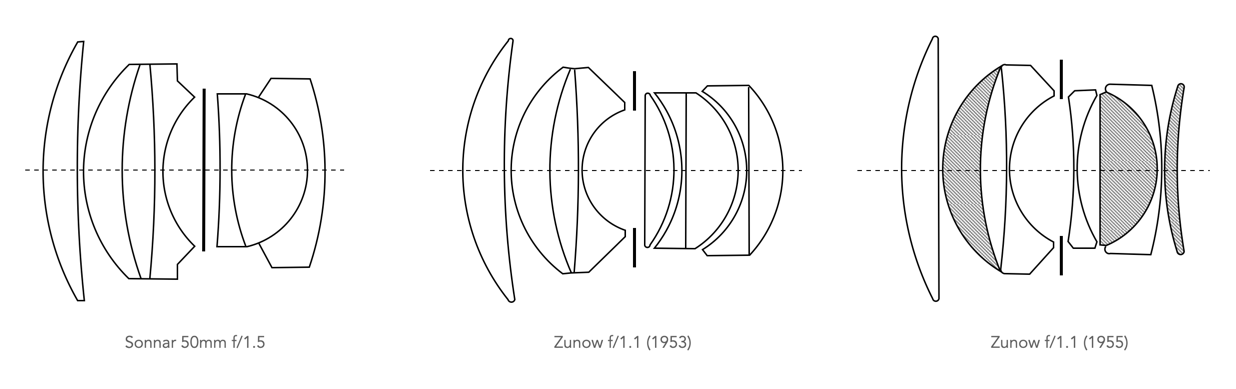
The patent for the Zunow f/1.1 lens [3] describes the lens as “an improved photographic objective suited for use with a camera that takes 36×24mm pictures”. The lens had a configuration of 9 elements in 5 groups, in a Sonnar-type design, likely derived from the Sonnar 50mm f/1.5. It was available in mounts for Contax, Nikon and Leica rangefinder cameras. The amazing thing about this lens is the fact that it was not constructed using any “rare earth” glasses.
Fig.3: Comparison of lens diagrams for Sonnar f/1.5, and the two versions of the Zunow f/1.1 (hatched lines indicate new glass) [2]
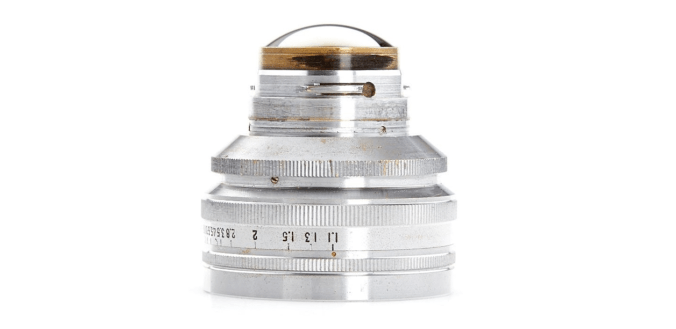
The original version earned the nickname “Ping-Pong ball” because it featured a rounded end. However it faced some issues, mostly when the aperture was wide open, e.g flare. Kenji Kunitomo and Yoshitatsu Fujioka would join the company to address these issues. This lead to the introduction of the Type 2 in 1955. The new design dealt with the protruding ball structure by redesigning the lens. It was transformed into a flat rear design with 8 elements in 5 groups, which also dealt with the flare and brightness issues when wide open. The lens elements featured a hardcoating on all air-glass surfaces to reduce internal reflections [7].
Fig.4: Specs for the original 1953 lens
Comments on the lens performance in The Truth About Superspeed Lenses (1957) [4]:
Performance: Vignetting at the widest aperture f/1.1, disappears completely at f/2.8. The lens is acceptably sharp at the centre of the negative. Detail is lost toward the edges and corners. Sharpest range is f/5.6 to f/11.
Comments: The Zunow lens mount may cut off the right corner of some camera viewfinder windows, blocking part of the image. It might be a good idea to use an accessory viewfinder with the Zunow. We found it an easy lens to focus quickly.
Fig.5: The “Ping-Pong ball” lens
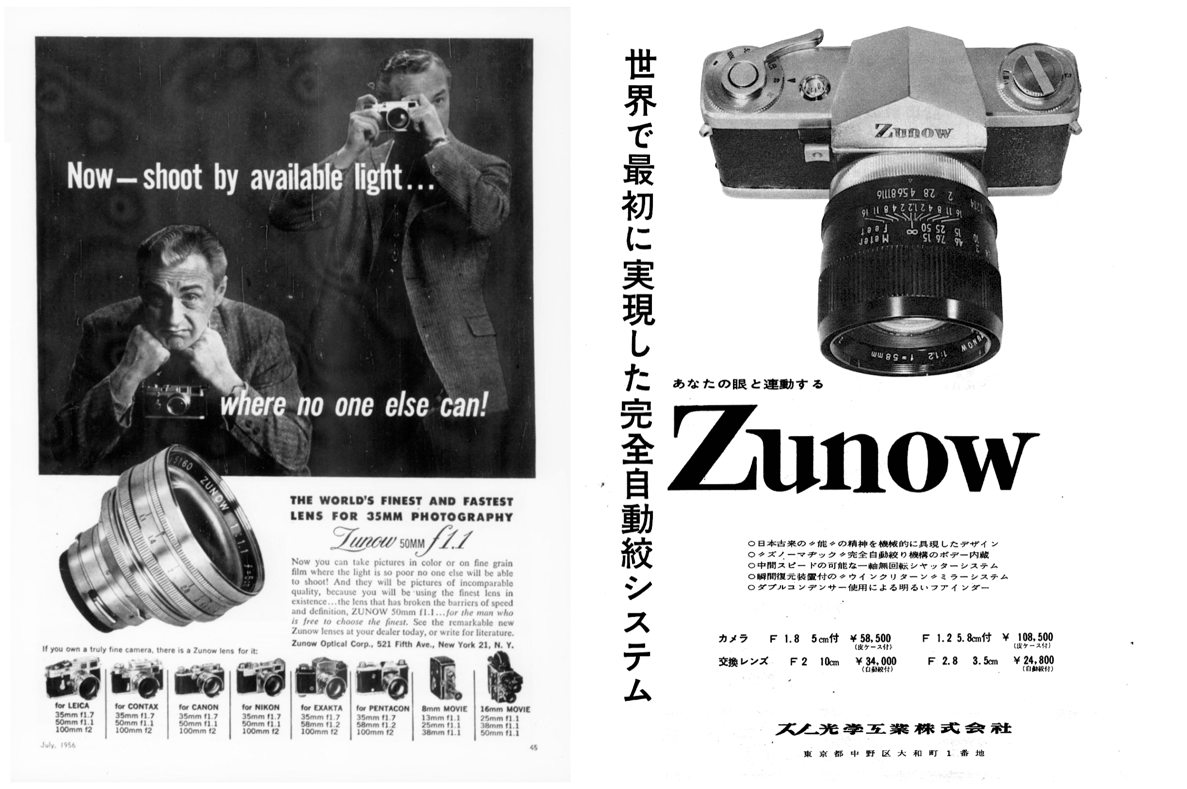
While the Zunow 50mm f/1.1 lens was the first ultrafast lens for rangefinders, there were few if any lenses of equal stature in the SLR realm. Ads at the same time showed a Zunow 58mm f/1.2 fast lens for Exakta and Pentacon SLR cameras. While very few have seen this lens in real life, and it does not appear to have been sold at any auctions in recent memory, there is a glimpse into what it looked like in the one of the ads for the Zunow camera shown in Figure 6. It was apparently a 7 element/5 group lens, of some expanded double-Gauss design [6]. The 58mm f/1.2 would have been the fastest lens offered by any camera manufacturer at that time for an SLR. In all likely so few were made that they today sit in private collections.
Fig.6: An ad for the 50mm f/1.1 lens, and a sneak peak at the 58mm f/1.2 in a Japanese ad for the Zunow SLR
Nevertheless, it would take Nippon Kogaku until early 1956 to match the Zunow lens in speed, introducing the Nikkor 50mm 1.1. Canon was not in the picture until the 50mm f/0.95 in 1961, and Leitz not until 1976 with the Noctalux 50mm f/1.0. The Zunow 50mm f/1.1 is today a vary rare lens. Sales are are US$5-10K, up to US$20K depending on condition, and mount. The price for this lens in 1956 was US$450, although it could be found for as low as US$300.
Fig.7: The Zunow SLR showing the 58mm f/1.2 lens, and its 7/5 configuration
Further reading:
Norman Rothschild, “Meet the Zunow f/1.1”, Popular Photography, pp.126/128, February (1956)
Kogoro Yamada, “Japanese Photographic Objectives for use with 35mm Cameras”, Photographic Science and Engineering, 2(1), pp.6-13 (1958)
U.S. Patent 2,715,354, Sakuta Suzuki et al., “Photographic Objective with Wide Relative Aperture”, August 16, (1955)
“The Truth About Superspeed Lenses”, Popular Photography, 21(10) pp.62-64 (1957)
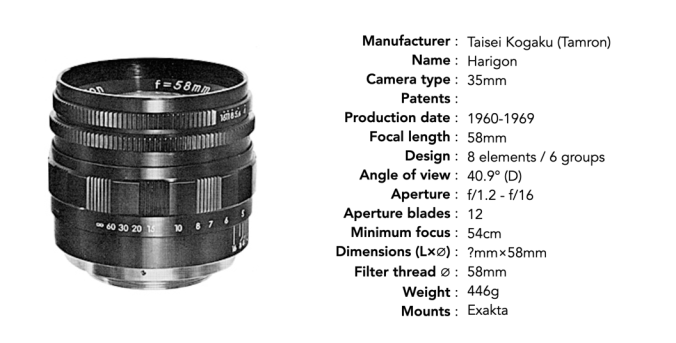
Not all fast lenses came from the lens giants. Other slipped under the radar. A good example is the Harigon 58mm f/1.2. It was made by Taika, which in reality was a export brand of Taisei Kōgaku Kōgyō K.K., the company which would later become Tamron (in all likelihood, Taika was a simpler and easier brand to remember than the company name). It was also sold as a Tamron lens.
The Harigon 58mm f/1.2
The lens was introduced in 1960, for the US market. The design was likely along the lines of the Zunow 5.8mm f/1.2, which is a itself is scarce as hen’s teeth.
Optical Science has produced this all-new Taika Rare Earth Lens, Eight hard coated complex elements of fabulous precision are responsible for its superb color correction and sharpness beyond reproach. The Taika Harigon has a dignified beauty – ebony black with colored engraved scales. A “Rolls Royce” in performance and appearance. You will be proud to own it, proud to show it and proud to exhibit its beautiful pictures.
Apparently it was available in Exakta mount, in addition to Praktica M42, and Miranda. In the early 1960s it was advertised as the standard lens on the Exa II camera for US$198.50 (from Seymour’s, NY). Interestingly the lens itself sold for US$169.50. By the time the Adapt-A-Matic Lenses appeared in the late 1960s, the 58mm lens had disappeared. There seem to be very few on the market today.
There aren’t many Swiss companies that manufacturer lenses apart from Kern, but one lens exists in the form of Volpi AG, a company based in Urdorf near Zurich. The company specialized in higher-end projection systems. In the early 1970s the company produced a lens called the Peri-Apollar 360°.
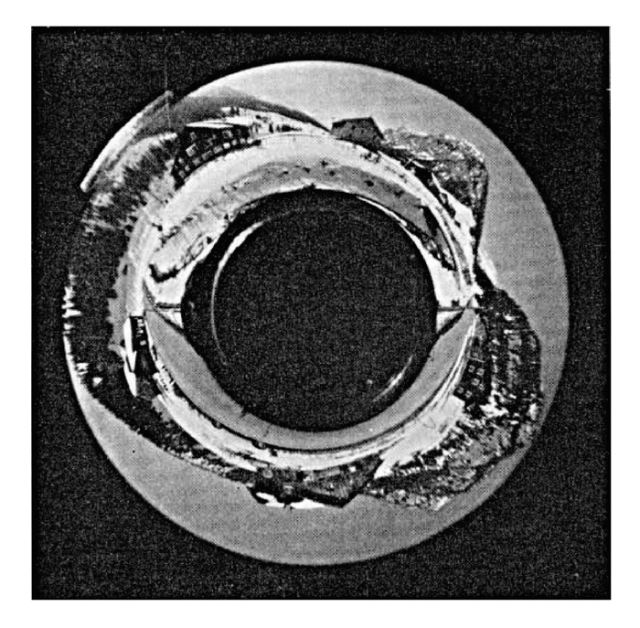
The Peri-Apollar 360°, nicknamed the “optical bell”, or “Swissorama” lens, does not use the fisheye principle or any of the other well-known panorama methods. It was developed by H. Brachvogel of Volpi AG, allowing the capture of 360° seamlessly in one image. If the camera is pointed with the lens in a vertical position, then the camera and photographer are covered by the centre of the image, which is blocked out. The inner edge of the circular ring is the lower edge of the image, the outer edge is the upper edge of the image.
Fig.1: The Volpi Peri-Apollar lens
The lens came in two focal lengths 25mm f/4, and 40mm f/5.6. The lenses could be adapted to many differing formats, including 16mm, 35mm, and 120 film (and could also be used as a periscope without a camera). The lens covers a complete circular image of 360°, without any gaps. When mounted in vertical position, the field of view has an angle of 60°, i.e. 30° above, and 30° below the horizon. The image is created according to the rules of central projection, where all verticals in the object field converge in a radially symmetric manner in the centre of the image. The lens was not actually intended for taking pictures in the horizontal direction
Fig.2: One of the few images available from the lens (somewhere in the Alps) Note that the point from which the image is taken, i.e. the lens itself in the image centre, is blacked out.
The light enters the protruding glass dome (which is an aspherical lens), and is refracted inwards at the transition between air and glass, and then totally reflected at the opposite glass-air interface. In this way the ring-shaped image is created in the front glass body. It then passes through a corrective lens and is projected onto the film by a lens of normal construction. Distance and f/stops can be set as with any normal lens.
Fig.3: A schematic of the lens configuration of the 40mm f/5.6 lens
The marketing material for the lens suggested applications in numerous fields, industrial applications, e.g. remote observation of pipes, police and military applications, recording of traffic intersections, aviation, and internal observation of nuclear reactors. The 25mm f/4 C-mount lens (with an attachable 90° periscope viewfinder sold for US$4,995 (1983); and the ALPA 40mm f/5.6 was US$3,595 (1977). In the US it was marketed by Karl Heitz. The lens is often attributed to Kinoptic because it appeared in their catalogs, however they did not produce the lens.
Lens specifications:
24mm×36mm
16mm film
lens
40mm f/5.6
25mm f/4
focal length of the peri-lens
20mm
15mm
aperture of the peri-lens
f/1
f/1
outer diameter of the image
23mm
11mm
inner diameter of the image
8mm
4mm
degrees, horizontal
360°
360°
degrees, vertical
2×30°
2×30°
number of lens elements
8
4
aperture range
f/5.6 to f/22
f/4 to f/22
close focusing distance
0.1m
0.1m
weight
900g
750g
Acknowledgement: Data for the table, and help with schematics adapted from information in “Fisheye-Objektive und verwandte Abbildungstechniken (IV)”, J. Scheibel in PHOTO-TECHNIK UND WIRTSCHAFT, No.8, pp. 225-227 (1973)
Vintage lenses of a certain era often contain air bubbles, but this by no means suggests that they are of inferior quality. A 1940 article in Minicam Photography describes this as a fallacy [1]. It seems that in early cameras, some photographers may have been weary of such imperfections. In all likelihood there are like-minded individuals today.
“They may look like undesirable blemishes, but they are much more apparent visually than photographically.” [1]
In early glass manufacturing, air bubbles were practically impossible to eliminate. At the time the rationale provided was that bubbles formed when ingredients were melted together at temperatures of 2750°F to form glass. Even first-glass lenses contained some number of bubbles.
“In the manufacture of the famous Jena glass the various elements used must be heated for a given length of time and to a certain degree, the process being stopped at just the right moment whether all the air has been driven out or not. There is no alternative.” [2]
The article goes on to provide an example of a 6-inch, f/4.5 lens with a diameter of 32mm across the front lens [1]. They count 12 bubbles, on average 0.1mm in diameter. The lens has an area of 804mm², and the bubbles an area of 0.0942mm², making up 0.012% of the surface area. So only 0.012% of the light passing through the lens is impeded by the air bubbles. The outcome? Light interference caused by bubbles is negligible.
“The actual loss of light is inappreciable, and the presence of these bubbles, even if near the surface, has no effect whatever on the optical quality of the image.” [2]
“Air bubbles will be found in most high-class lenses and are a sign of quality rather than a defect, since at present it is impossible to make certain optical glasses absolutely bubble-free; their presence doesn’t affect the quality of the image in any way. [3]
In the literature for many modern optical glass manufacturers, e.g. Schott, there are caveats on bubbles (and inclusions). Basically bubbles in glass cannot be avoided due to complicated glass compositions and manufacturing processes. The melting of raw materials produces reactions which invariably form gas bubbles in the melt (typically carbonates or hydrogen-carbonates) [4]. These bubbles are removed in the refining process, when the temperature of the glass is increased, reducing the viscosity of the glass and allowing bubbles to move up through the melt and disappear. Some residual bubbles are still left from imperfect refining. However, it is actually quite rare to see bubbles in modern lenses.
So do they make a difference in vintage glass? According to much of the literature, not at all. Besides, vintage lenses are all about character – nobody is looking for a perfect image.
Further reading:
“Fallacy: That “air” bubbles in a lens are a sign of inferior quality”, Minicam Photography, 3(8), pp.30-31 (1940)
“The Crucible – Air-Bubbles in Lenses”, Photo-Era, 31(6) p.319 (1913)
“Andreas Feininger on Lenses at Work”, Popular Photography, 18(3) p.124 (1946)
Schacht was founded by Albert Schacht in 1948 in Munich (Germany). Albert Schacht had a long pedigree of lens design. From 1913-1919 he was an operations manager at Carl Zeiss Jena, followed by seven years at ICA A.G., before it was merged into Zeiss Ikon (Dresden) where he continued until 1939. During the war years until 1946 he was a technical director at Steinheil in Munich. Schacht focused on designing and building lenses for 35mm film cameras. In 1954 production was moved to Ulm. Schacht manufactured interchangeable lenses in the range of 35-200mm for all common camera connections. Most lenses at Schacht were designed by Ludwig Bertele, who founded an optics office in Switzerland in 1946 with the help of Wild Heerbrugg.
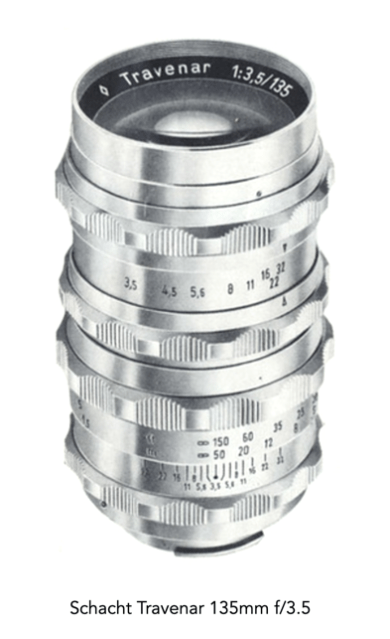
The first interchangeable SLR lens manufactured was the Albinar, 13.5cm f/4.5 in 1952. It was produced exclusively for export to the USA and with an Exakta bayonet connection. It wasn’t really a telephoto, but rather just used a simple 4-lens design. Production was then expanded to include three more common focal lengths: the Travenar 50mm f/2.8, 85mm f/2.8, and 135mm f/3.5. The Albinar was renamed Travegon in 1954. They were available in Alpa, Exakta, Praktica (M42), Pentacon, and Leica mounts. In 1956 a wide-angle Travegon 35mm f/3.5 was introduced. Schacht produced lenses in the most popular focal lengths, and was one of the first lens manufacturers to deliver SLR lenses with an automatic aperture.
Fig.1: Advertisements from Schacht
Most of its early lenses were of standard 1950s aluminum construction. In the 1960’s Schacht changed the visual appearance of their lenses to match those of other manufacturers, i.e. a black lens with a zebra-style design which initially incorporated berg-and-tal stype controls, opting eventually for a more modest raised style of grip. These are generally considered good quality lenses, however not as common as other brands. Early lenses are marked as A. Schacht Munchen, older ones A. Schacht Ulm. Brands included: Albinar, Travenar, Travegon, Travelon, Travegar, Travenon, sometimes with the prefix tele- S-, M-, or Tele-.
Fig.2: Schacht changed their design over the years from an aluminum aesthetic to black with a zebra-style look.
In 1967 the company was acquired by Constantin Rauch. In 1969 the optics division was sold on to the Wilhelm Will KG company in Wetzlar. Due to production difficulties, lens production ended in 1970.
When you look at modern lenses, there isn’t much that sets them apart. They are usually pretty plain black cylinders, partially due to the consistency of modern lens design. The same could not be said of vintage lenses. Maybe this has something to do with the fact that many vintage lenses were made by companies that focused purely on lenses, and as such tried hard to differentiate their lenses from their competitors. For example a company like Meyer Optik Gorlitz manufactured lenses for cameras using the Exakta mount had to compete for the consumer spending with lenses from a myriad of other companies (at least 25-30).
Over time the appearance of lenses naturally changed, as new materials were introduced, often for the purpose of reducing the overall cost of lenses. For example, many early 35mm lenses had a shiny, chrome-like appearance. The earliest, pre-war lenses were often made of chrome-plated brass. As the Second World War progressed, shortages or re-direction of materials like brass led some manufacturers had begun to transition towards aluminum, which was both less expensive, easier to manufacture, and produced a lighter lens. While these early aluminum lenses were aesthetically pleasing there was little that differentiated them in a world where there was an increasing number of 3rd party lens manufacturers.
Fig.1: Evolution of the aluminum design of the Zeiss Jena Biotar 58mm f/2
When it first appeared as a lens material, aluminum was chic. The 1950s was the age of aluminum, which was a symbol of modernism. Many of the largest aluminum producers pursued new markets to absorb their increased wartime production capacity, used in everything from drink cans to kitchenware and Airstream trailers (there was also extra aluminum from scrapping of war surplus aircraft etc.). These aluminum lenses were initially clear-coated to reduce the likelihood of tarnishing, but eventually anodized to provide a robust black coating. Also in the 1950s, lens manufacturers to realize changing trends in lens design – buyers had moved away from the idea of pure practicality, and focused also on design. This wasn’t really surprising considering the broad scope of modernist design during this period – design tended to favour sleek and streamlined silhouettes. It is interesting to note that most of the aesthetically pleasing lenses of the post-1950 period originated from Germany.
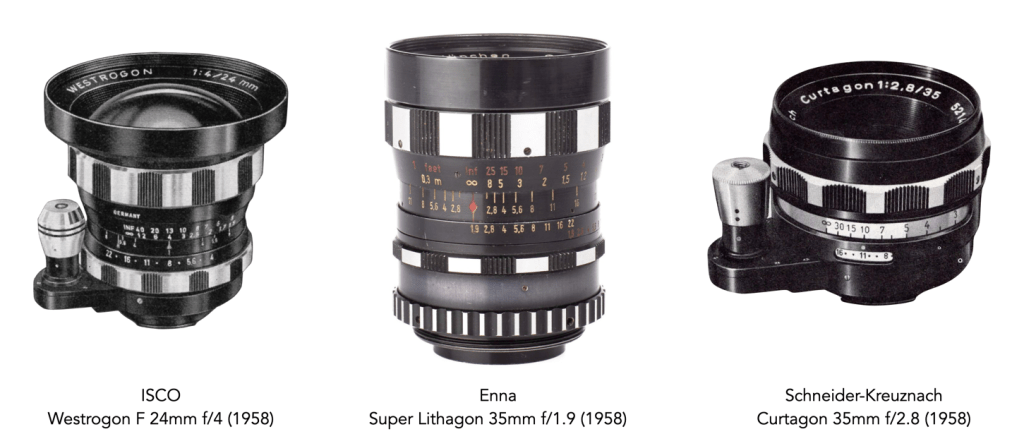
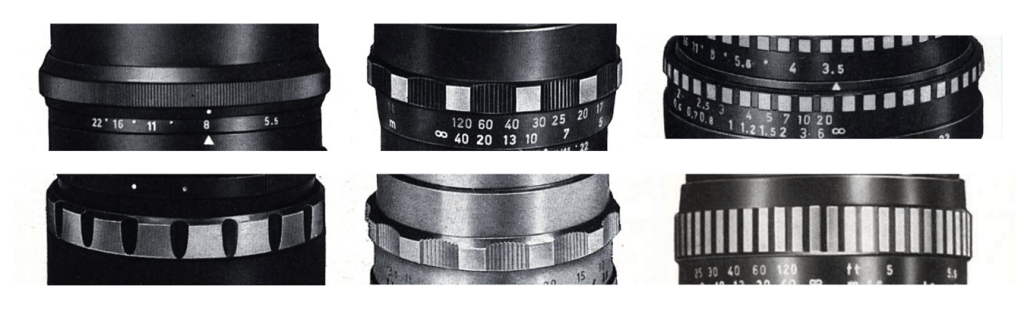
Fig.2: Every lens manufacturer had a different interpretation of both “berg-and-tal”, and the black-and-white “zebra” aesthetic
The first notable change was the gradual move towards what in German manufacturers called the “berg und tal” design, or rather “mountain and valley” design of the grips on a lens – usually knurled depressions milled into the surface of the ring (but also the opposite like the lenses of Steinheil where the depressions are smooth and the mountains are knurled). English-speaking regions often referred to this as a “knurled grip”. Appearing in the early 1950s, it was particularly common for focusing rings, making them more prominent, and likely more ergonomic, i.e. easier to grip. Some lenses started with the focusing ring, and eventually used the same design on the aperture ring. Prior to this most lenses used a simple straight knurl on the adjustment rings.
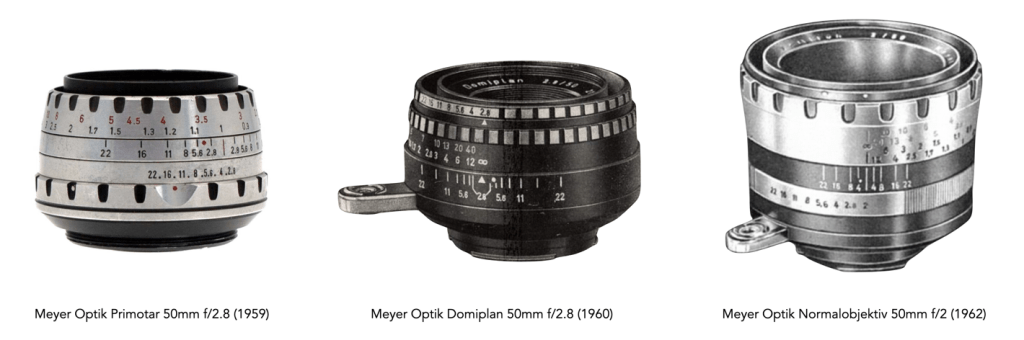
Towards the end of the 1950s, the pure-aluminum design transitioned to a combination of silver and black anodized aluminum. The lens bodies themselves were mostly black, with the “berg und tal” designs alternating between black and silver. This alternating pattern is what is colloquially known as “zebra” design. Many lens manufacturers utilized the zebra aesthetic in one form or another including Schacht, Enna, Steinheil, Schneider-Kreuznach, Meyer Optik, Rodenstock, ISCO etc..
Fig.3: Meyer Optik had an interesting twist on the zebra design. There were very few of these lenses and they are very minimalistic in design.
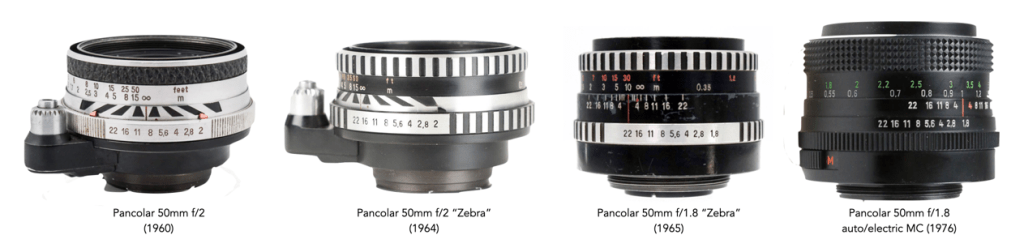
Zeiss probably produced the best known examples of the zebra aesthetic design with the Pancolar and Flektogon series of lenses. Although these lenses did not appear until the early 1960s, they bypassed the more prominent berg-und-tal in favour of a much subdued black-and-white knurled grip (which is also something Meyer Optik did with lenses like the Lydith 30mm). This design for both focusing and aperture rings replaced the rough textured rings of the earlier lenses. Some call these lenses the “Star Wars lens”. The Pancolar 50mm f/2 appeared ca. 1960 in the form of an f/2 lens with dual black-silver body encompassing a “converging-distance” depth of field range indicator, and either a textured or nubbed rubber focusing ring. This evolved a few years later to the classic “zebra” design, shortly before the release of the classic Pancolar 50mm f/1.8, which also sported the zebra design. By the 1970s, the Pancolar 50mm f/1.8 had morphed into a complete black configuration with a large rubber cross knurling focus grip and a finely knurled aperture ring.
Fig.4: Evolution of design aesthetics of the Zeiss Pancolar 50mm lens.
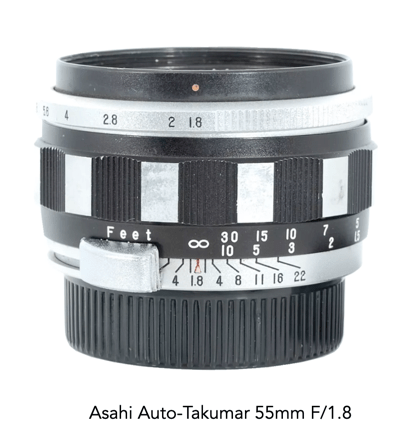
Japanese manufacturers transitioned from aluminum/chrome to black bypassing the zebra design. The one exception seems to be the Asahi Auto-Takumar 55mm F/1.8, which appeared in 1958, but is the sole example of zebra design (at least by Asahi). Japanese manufacturers did however embrace the berg-and-tal design.
Fig.5: Some lens companies couldn’t settle on a design. Here we have differing focus ring designs from the same Meyer Optik catalog in the 1960s
By the mid-1960s many camera manufacturers were producing their own lenses, particularly in Japan. As such lenses became more consistent, with little need to compete with other lens manufacturers. There were still 3rd party lens manufacturers but their perspective was to concentrate more on the manufacture of inexpensive lenses. Most lenses transitioned to using standardized, nonchalant black aluminum lenses, with the onus being more on the quality of the optics. Grips transitioned from berg-und-tal to a flatter, square-grooved style, still using a in black/chrome contrast (which likely resulted in a cost saving). By the mid-1970s focus rings were provided with a ribbed rubber coating, still common today on some lenses.
Fig.6: Berg-und-tal overkill?
Fig.7: One of the few Japanese zebra lenses.
Today, the sleek aluminum lenses are sought after because of their “retro” appeal, as too are the zebra lenses.
Vintage “normal” lenses most often range from 40mm to 58mm, although the greatest number of theses lenses fall in the range 50-58mm. A lens which satisfies the ideal of being “normal” has a focal length close to the diagonal of the film format. So, 24×36mm = 43mm. 35mm is an exception to this rule – when Oskar Barnack developed the original Leica he fitted it with a 50mm Elmax to ensure the most could be done with the small negative area. From that, the 50mm became the ubiquitous standard. With the proliferation of 35mm single lens reflex (SLR) cameras, manufacturers in the early years tended to fit 55-58mm lenses. But why was this the norm instead of 50mm?
There are a variety of reasons. Let’s start at the beginning.
When Ihagee (Dresden) released the worlds first 35mm SLR in 1936 it had a series of standard lenses, but basically there were two categories: the slow 5.0cm lenses which ranged from f/2.8 to f/3.5 (e.g. Tessar, Xenar), and the marginally faster, 5.0cm/5.8cm f/1.9-2.0 lenses, e.g. the 5.8cm f/2 Biotar (developed for the Exakta). The first post-war Exakta did not appear until 1949, the Exakta II, along with a cornucopia of standard lenses from numerous manufacturers, but the fastest 50mm lens was still the Zeiss Tessar f/2.8.
The “… to 60-mm…” was included in the normal-lens category only because such lenses are frequently supplied as standard optics on single-lens reflexes. The reason is that in many cases the designers have found it easier to meet the special requirements of through-the-lens focusing by going to a slightly longer focal lens. Fifty-eight mm is the most common choice.
Bob Schwalberg, “Interchangeable lenses by the carload”, Popular Photography, pp.36-38,197 (May, 1956)
The 35mm SLR experienced a rapid increase in popularity among amateur photographers in the 1950s, especially after manufacturers realized that the installation of a prism viewfinder made handling this type of camera much easier. With this came the need for faster lenses, for two reasons – the ability to take pictures in poor lighting conditions, and a brighter viewfinder image makes it easier to focus. Lens such as the Biotar 58mm f/2 were considered to have a long focal length – to the amateur this was less than favourable, because they would get less coverage than 50mm. Over the course of the 1950s, manufacturers worked on new lens configurations to increase the speed of 50mm lenses, however 55mm and 58mm lenses still maintained the edge in terms of speed.
Fig.1: The two fastest pre-1950 35mm normal SLR lenses. Note the angle-of-view (horizontal) between 50mm and 58mm is not that different.
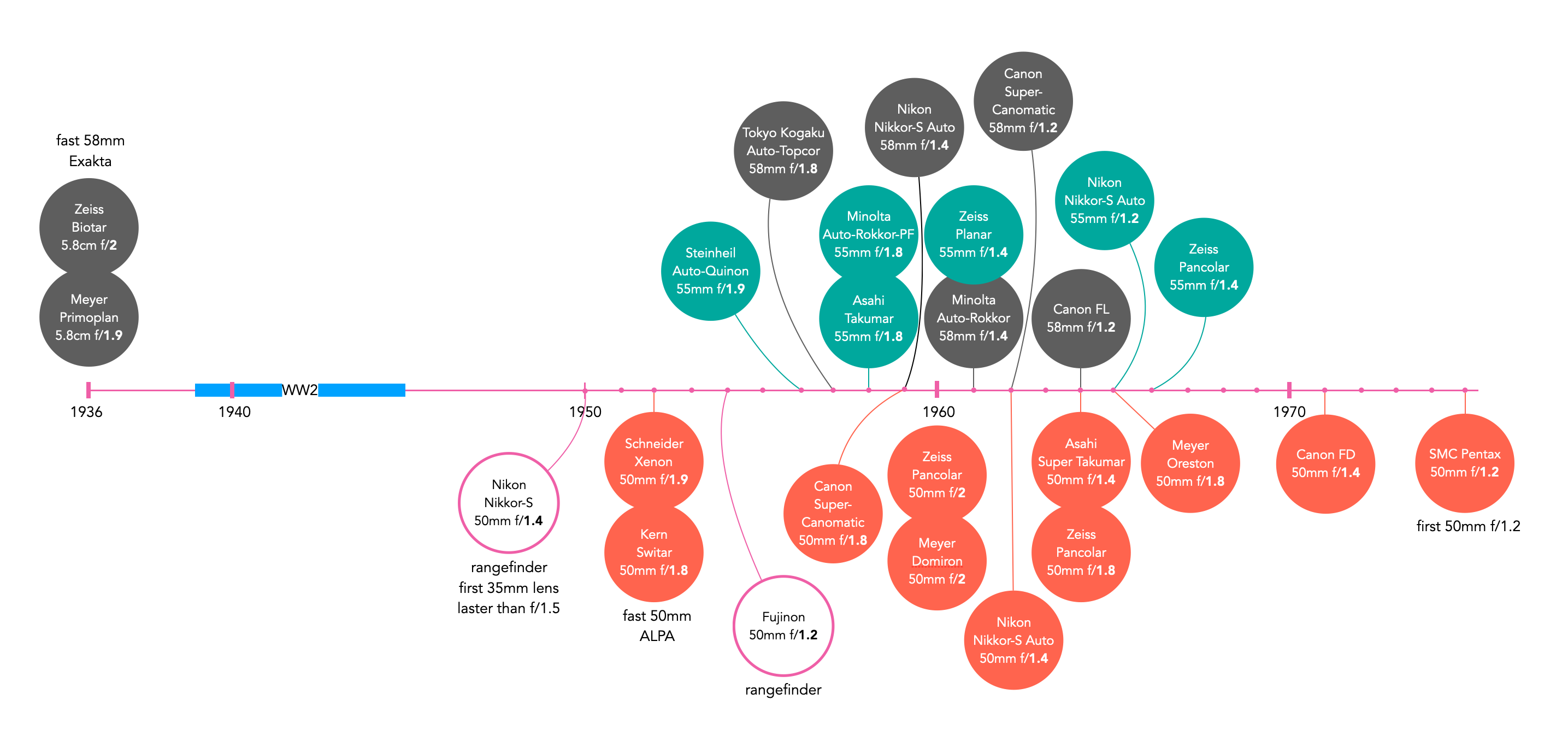
The original Asahi Takumar lenses which evolved with the 1952 Asahiflex (M37 mount), only included a single 50mm lens, with a speed of f/3.5. Both the 55mm (f/2.2) and 58mm (f/2.2,2.4) lenses had faster speeds. The 58mm f/2.4 in 1954, which became the standard lens for the Asahiflex II. The Auto Takumar’s focused on 55mm lenses with both f/1.8 and f/2.0 lenses. It was not until the Super-Takumar’s appeared in 1964, that the fast 50mm became more normal, with the f/1.4 lens. Canon didn’t produce much in the way of fast SLR lenses until the FL series lenses, introduced for the Canon FX, and FP, which debuted in 1964. Here there was a fast 50mm f/1.4, yet the f/1.2 lenses were still in 55mm and 58mm. In truth, even 50mm lenses faster then f/1.8 did not appear in Japan until the mid-1960s. many of the super-fast 50mm lenses were developed for rangefinder cameras, and never extended to SLRs.
The post-war German 50mm lenses did not really get much faster than f/1.8. This is in part because although the competition in Japan spurned a lens “speed-war”, the same was not true in Germany. The fastest lenses of the early 1950s was still the Biotar 58mm f/2, and Meyer Primoplan 58mm f/1.9. By 1960, at least for the Exakta Varex there was now a 50mm f/2 in the guise of the Zeiss Pancolar. By 1962 Exakta brochures had sidelined the Biotar 58mm, in favour of the Meyer Optik Domiron 50mm f/2. The Japanese had however established f/1.8 as the standard speed for a 50mm. The Zeiss Pancolar 50mm f/1.8 is an extremely good lens, but did not appear until 1964. Similarly the Görlitz Oreston 50mm f/1.8 did not appear until 1965. One of the reasons these “average” speed lens were produced is volume. The production of Praktica cameras in the mid-1960s reached 100,000 units per year, all of which needed a standard lens. It was all about economics.
Fig.2: Speed milestones in 55/58mm and 50mm lenses. Note that while a 50mm f/1.2 lens for rangefinder cameras existed as early as 1954, it would not be until 1975 that one appeared for 35mm SLRs.(note that the diagram may not represent every possible lens)
It was not the same in the world of 35mm rangefinder cameras. There was already a fast pre-war lens, the Zeiss Sonnar 50mm f/1.5 (7 elements/3 groups). The original Sonnar was designed with six elements in three groups, which would allow a maximum of an f/2 aperture. In 1931, a redesign with a new formula was developed with seven elements in three groups, allowing a maximum aperture of f/1.5. But the problem with the Sonnar design was that for shorter focal lengths, e.g. 50mm, it had a short back-focal-distance (BFD) which although being an advantage in rangefinder cameras, made them incompatible with most SLR cameras due to the space taken up the (retracting) mirror (which increases the flange focal distance). The set-up is illustrated in Figures 3 and 4. In Figure 3, the lens is shown how it would normally appear in a Contax rangefinder camera. However if the same lens were used in a 35mm Exakta (Figure 4), there would be an issue because the BFD would be too short because of the increase length of the flange focal distance, which is due to the clearance needed by the mirror.
Fig.3: Lens to film on a Sonnar 50mm f/1.5 lens attached to a 35mm Contax rangefinder
Fig 4: Lens to film on a Sonnar 50mm f/1.5 lens superimposed on a 35mm SLR.
This illustrates the biggest problem with making a fast 50mm lens was the fact that the addition of a mirror in the SLR meant that lenses had to be further from the film plane, requiring a redesign of the optical formula of the lenses. The easier solution was to marginally increase the focal length.
Trying to adapt the Sonnar design to 50mm was probably cost prohibitive as well. The Sonnar’s had large glass elements with massive core thickness, which required very thick sheets of raw glass, and they had strongly spherical lens surfaces. The latter issue lead to more issues when cementing lenses together, i.e. it was time consuming and required great precision. The Tessar 50mm’s on the other hand could be produced much more efficiently which made them less expensive to produce. The only real Sonnar design for SLRs was produced by Asahi, the Takumar 58mm f/2 from 1956 (6 elements/4 groups).
Partly to more easily provide clearance, for the moving mirror, and partly to produce a larger viewing image, the post-pentaprism wave of SLRs got off to a slow start in the early fifties with 58-mm standard lenses. Since physiological factors dictate an eyepiece of approximately 58mm focus, the choice of this focal length for the normal lens gave a 1-1, fully life-sized viewing image.
Bob Schwalberg, “The shifty fifty”, Popular Photography, pp.73-75,118,119 (Sep., 1970)
Some of the reasons were likely simpler than all that. When Carl Zeiss released the Contax S, the world’s first 35mm production SLR camera with an eye-level prism viewfinder and exchangeable lenses in 1949, the camera came with the Biotar 58mm f/2 as the kit lens. The popularity of the Biotar, spurned others to adopt a similar lens design. One of the reasons the Biotar had a large following was because it was felt that it provided a deeper and more three-dimensional image. There were many Biotar types of lenses, but at 58 mm the image in the prism finder had approximately the same scale as one viewed with a naked eye. Last but not least, as we have seen in a previous post, 58mm approximates the 30° central symbol recognition of the HVS, which means it quite nicely fits into the scope of focused human vision.
Aside from mechanical issues, there may have been other more aesthetic reasons for the 55mm/58mm lens frenzy. There is an experiential rule that says a portrait lens for half-body portrait should be about 1.5 times the focal length of a “normal” lens (2 times for head-shots). If we take the normal range to be about 40-55mm, this would make an appropriate lens about 60-82.5mm. So a 58mm lens is quite close to the minimum for half-body portraits. No surprise that the upper bound is also close to 85mm, a favourite with portrait photographers. Why did this matter? Because of the large market for amateur photographers in the 1950s who were interested in taking pictures of family etc.
The trend of 55/58mm lenses had reversed itself by the mid-1960s, with 50mm lenses becoming faster likely due to the advent of faster glass, and better optical formulae.
A lens that has been stored in an inappropriate environment, i.e. one that is dark and humid, may provide the perfect conditions for the growth of fungus. Fungus takes the form of tendril or web-like structures on the surface of the lens. The fungus secretes an acid that etches a lenses’ multicoating. This sort of damage can be permanent, and hard to remove. Too much fungus will lower contrast, and way too much will give darker, fuzzier images as it blocks light. Fungus is bad news – avoid lenses with it, however small the “infection”.
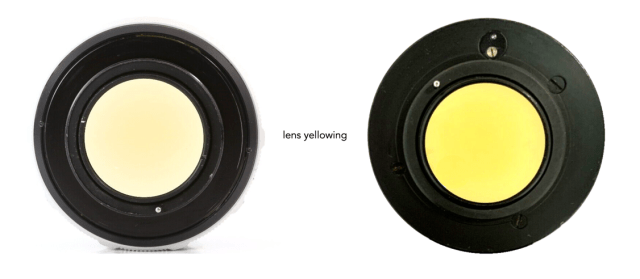
⑥ Yellowing
Coatings on lenses often yellow in time. Glass in general does not yellow, but lens coatings, or at least older ones do. This is also true of glass made with radioactive elements, e.g. Thorium, to reduce refraction.
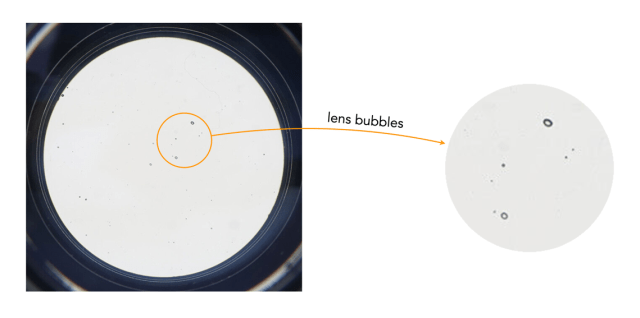
⑦ Bubbles
Some lenses pre-1970 had defects caused by the optical glass manufacturing process which left a few pin-prick sized air bubbles inside the glass. These bubbles may come from different sources, but in most cases the source is imperfect refining. They look like tiny dust specks when viewed with the naked eye, but if magnified, they are indeed bubbles.
⑧ Separation
Lens groups are most often held together with some type of glue. In modern lenses this is usually a UV-cured epoxy. Vintage lenses typically use epoxy, polyester, and urethane-based adhesives, and some pre-WW2 lenses use Canada balsam (basically a resin from balsam fir trees). The balsam was used because it has a refractive index that is similar to crown glass and is invisible when dry. Unfortunately, Canada balsam is not resistant to temperature extremes or solvents. A degradation of the adhesive will result in the lens delamination. This usually manifests itself as a multicoloured band or blobs around the edge of a lens with coatings, or a white band/blobs on lenses with few or no coatings (but it can also occur in the centre of a lens). A small amount of separation on the edges of a lens will likely have little effect on image quality. A large amount may cause a decrease in contrast, flare and ghosting, softer edges, loss of sharpness, and a difficulty in focusing.
Fixing anomalies
Is it possible to rectify these optical defects? The table below provides a quick guide, and later posts will explore some of these defects in more detail.
Defect
Repairable?
Lens disassembly required?
Notes
scratches
maybe
no
It is hard to remove scratches, especially deep scratches, although fine scratches might be able to be buffed or polished out (some people suggest toothpaste).
haze/fog
yes
yes
It might be possible to use a cleaning solution to reduce or suppress the haze.
dust
yes
yes/no
Dust on external lens surfaces is easy to clean. Internal dust is harder because it requires lens disassembly.
blemishes
no
no
Multicoating damage cannot be repaired.
fungus
maybe
yes
It is possible to repair low levels of fungal infections, but it does require lens disassembly. Heavy fungal infections are not repairable.
yellowing
yes
no
Yellowing caused by the presence of Thorium can be reduced using UV lights.
bubbles
no
no
Intrinsic to the lens glass, consider it a feature of certain older lenses.
separation
no
yes
Separated lens groups are basically not fixable. Fixing these requires lens separation, re-centering and re-cementing.
There are a number of physical anomalies that can be found on the optics of vintage lenses. Regardless of the abnormalities of the lens body, the critical part is the optics. Sometimes people classify lenses as “a little rough”, or “needs some attention”. These can be red flags. Note that when shopping for vintage lenses in person, take an LED flashlight along as it will help peer inside the lens to determine if it is fit for use.
① Scratches
Glass doesn’t scratch that easily, but coatings do. Scratches are easy to detect, because they usually occur on the visible, exposed glass elements. Scratches usually occur on the front or rear element of a lens. They signify obvious signs of wear, or possibly damage. Small scratches will have little effect on an image, but deep scratches will. A few small scratches on the front element will not impair performance significantly – the reason is the depth of field generally works to negate their impact. The exceptions are macro lenses and wide-angle lenses. A large number of tiny scratches may also reduce the contrast of a lens. Scratches on the rear lens will be more problematic (it is best to avoid lenses with scratched rear elements). Because there is less distance between the element and the sensor/film, most scratches will appear on the resulting picture. Deep scratches can be a sign of severe trauma. Also check for pitting. Sometimes lenses have light scratches which are caused by poor lens cleaning/polishing techniques.
② Haze or fog
Haze can be anything that settles out of the air inside the lens onto the inner surfaces of the glass. The lubricants on the aperture mechanism and in the focus threads can vaporize over time and then resettle onto the glass, and with enough time other things (dust, salt-air, fungus) can get in and collect on the glass, to the point that they are dense enough to refract the light themselves and spread it around as a “foggy” look to pictures. Haze actually gets worse with age. This may be an indication that the lens was poorly constructed, or poorly stored.
A smoky haze diffuses light equally over the entire image. This is generally caused by trillions of particles much smaller then the wavelengths of light, smearing the light over all areas equally, simply making blacks gray and reducing the overall contrast. Oily haze on the other hand has tiny droplets larger than the wavelengths of light. Because the oily haze diverts light, the haloes are much stronger and more visible.
③ Dust
Dust particles somehow get into lenses. A small bit of dust will make little or no difference to image quality. Larger specks or clumps of dust should be avoided. Check for dust by shining a light through the lens. Dust may be especially prevalent in vintage zoom lenses where the increased movement can result in dust infiltrating the inner components of the lens. So how does dust get inside the lens? Vintage lenses are not air sealed, i.e. weather sealed, meaning that air moves in and out, and of course it carries dust with it. Zoom lenses with barrels that extend out essentially “pump” air/dust into the core of the lens. In reality, small amounts of dust will impede very little of the light passing through a lens, and its impact on the image quality is minimal. Inexpensive and simple lenses can be easily disassembled and cleaned, however re-assembling the lens may again introduce dust (unless you have a clean room). Large amounts of dust may be indicative of poor long-term storage.
④ Blemishes
Many vintage lenses have lens elements that are coated with layers of some non-reflective optical material. These multicoatings minimize light reflection and the resulting lens flare and ghosting. Blemishes are regions on a lens where material has been smeared or removed by physical damage, a manufacturing defect, use of an incorrect solvent, or even being eaten away by fungus. A small blemish likely won’t affect image quality.
A lens with a super-deep scratch. Being on the rear element, this will effect the image.
The state of a lens can tell a lot about how it was previously treated. There are many different aspects to choosing a vintage lens. One important aspect is physical condition. There are a number of things that cause a lens to lack perfection, some you can overlook, while others could indicate a lens should be avoided. Don’t forget these vintage lenses are anywhere from 30-75 years old, and they will not be in pristine condition (or if they are you will pay a premium). A lens may be pristine from an external viewpoint, but have issues with the aperture or focusing mechanism. Or it may be completely functional, yet be aesthetically distraught.
There are several different levels of lens examination. Obviously in an ideal world you could slot the lens on a camera and take some pictures, however that isn’t always feasible, and deep testing isn’t really an option in a store. Sometimes lenses are only available in online stores, so you have to rely on the quality of the stores vetting processes. The tests described below look at the physical properties of a lens, and does not test the optical characteristics by shooting test pictures. Please note that obviously if you are buying online, you cannot physically check the lens. And therefore must rely on the lenses quality being properly described. If buying online, purchase from a reputable shop. Note the 🕸️ symbol used below refers to hints for online purchasing.
① Lens body defects – scratches and dents
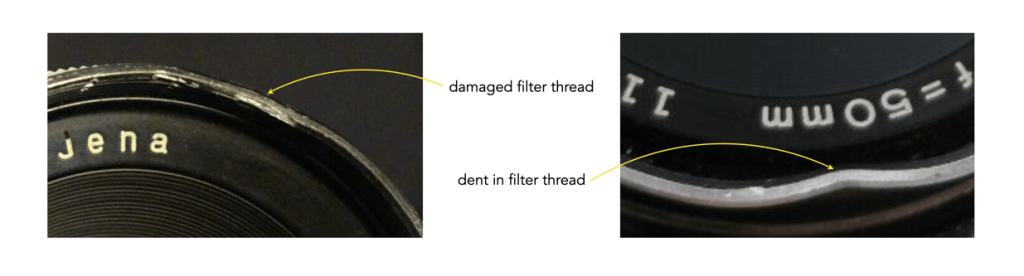
No vintage lens will be in perfect condition, unless it has sat in its box stored away somewhere and never been used (the so-called “new old-stock”). The first thing to check is what the lens looks like externally. Many vintage lens bodies are largely constructed of metal which has a tendency to scratch and dent. Scratches on the lens body are usually not that big a deal, dents are another matter altogether. Usually a dent will typically occur at either end of the lens, and can signify that the lens has been dropped. Some lenses are of course built like tanks, and can withstand a drop better than others. Damage to the lens mount will make it almost impossible to mount the lens. Conversely damage at the thread end will mean an inability to mount a filter (it means either replacing the front component, or for a minor issue using a lens vise to restore the thread).
Fig.1: Various types of physical damage to a lens
A dented filter ring is usually the result of a lens falling and landing on the front edge which could mean the lens elements have been knocked out of alignment. Lens bodies made of plastic will also scratch, however dropping them will likely cause more damage. It is also possible that a lens can lose coating, through abrasion or chipping. This is common in old chrome-plated lenses, as shown in the sample photograph in Figure 2.
Fig.2: More types of physical damage including the loss of coating on a lens body.
🕸️ A series of photos covering all aspects of the camera will help determine the shape it’s in.
② Movement of lens parts
Vintage lenses are composed of several different cylinders that move when the aperture or focus ring is activated. The first thing to do when testing a lens is to check it by gently moving the components, extending the segments, and rocking the whole lens. Basically this helps determine if any of the sections are loose, or if there are any loose components rattling around inside the lens. Next look to see if all the external screws are present, and if the front ring accepts a filter. Visible markings such as stripped screws might be indicative of disassembly/reassembly and internal issues in the past. Loss of some paint or wearing of rubber parts isn’t usually a problem.
③ Lens mount
The mount should be checked, firstly for compatibility, but also for damage. The mount can be checked by mounting it on an appropriate mount converter. It should go on easily, yet firmly, without any looseness. Does the locking pin catch properly? Check that a mount actually exists for converting the lens to a digital camera. For example some lenses such as the E. Ludwig Meritar 50mm f/2.9 were made for Altix cameras which have a breech-lock type mount, which is hard to find adapters for.
🕸️ A snapshot of the rear of the lens helps document the lens mount, which is especially important for less common lens mounts.
④ Aperture mechanism, i.e. diaphragm
Testing the aperture is a necessity, if the aperture on a lens is not performing well, it will feel loose and not well connected. An aperture that is slow to open or close may signify issues with the aperture mechanism. If the aperture mechanism does not move the aperture blades at all, there are serious issues. The number one thing to check is to make sure the aperture actually opens and closes smoothly (sometimes the aperture ring moves, but the diaphragm blades do not). Other things to check depend on the type of mechanism:
Manualmechanism – The simplest mechanism involves the aperture ring turning from the fully open position (smallest f-number) to the closed position (largest f-number).
Aperture pre-set mechanism – The pre-set ring should be set to the closed position, and then the second ring which closes the aperture should be rotated. Also make sure the pre-set ring rotates freely.
Auto-aperture mechanism – This mechanism uses a device that leaves the lens aperture open for as long as possible, and closes the aperture to a set f-stop simultaneously with shooting. In order to check the aperture, depress the pin of the mechanism, then rotate the aperture ring from open wide to closed. The diaphragm should open-close without issue.
⑤ Aperture – iris blades
Apart from the free movement of the diaphragm (iris) blades, the other thing to check for is whether they are dry or oily. Iris blades should be clean and dry – they do not require lubrication. Some aperture blades may appear oily which means it will be hard for them to open and close in a smooth manner. When oil is present on the aperture blades, there is friction from the oil’s viscosity and this impedes the quick closing action during exposure. The aperture takes too long to stop down, and as a result the shutter has already activated, and the photo can become overexposed. Where does the oil come from? An oily aperture is typically caused by exposure to heat. The focus mechanism of a lens uses lubricants, and heat can causes these lubricants break down, and to leak.
Fig.3: Oily iris blades in a Kilfitt Tele-Kilar 300mm
The best way to determine the state of the blades is to view them from the front by flashing an LED flashlight into the lens and look down on the blades. Oil will appear as a circle, or small triangular “wings”. A patterned discolouration is a sure sign of oily blades. Play with the aperture ring to check its “snappiness” – it should open and close easily without resistance or a feel of “sticking”. Dry blades are certainly better, but there are certain lenses (e.g. Helios) that are not greatly impacted by the presence of a small amount of oil. Some aperture blades may also have rust on them, this could be indicative of the lens being stored in a sub-optimal environment, e.g. one that is humid.
⑥ Lens focus mechanism
Rotate the focus ring back and forth a few times from the minimum focusing distance (MDF) position to the opposite (infinity) position. The focusing ring by itself should rotate smoothly, without hesitation or any sticking. A focus that is overly tight can lead to improper focus, whereas a loose focus means the focus can shift with the slightest move. What we are looking for here is whether or not the lens moves smoothly and doesn’t catch or have a gritty sensation. A stiff movement may be indicative of issues with the grease used to lubricate the focusing mechanism. Are there any dull spots where the focus mechanism doesn’t feel as smooth or gets slightly stuck? This might mean degrading grease and could need to be repaired. Make sure the focus doesn’t stick slightly at either extreme. If the focus ring doesn’t move at all, then it is likely the grease lubrication has solidified to the point where it is stopping movement.
⑦ Lens markings
It may seem trivial, but lens markings are important in identifying a lens. This information includes manufacturer, trademark, focal length, maximum aperture, coatings (e.g. multi-coating). See the post on lens markings. 🕸️ A snapshot of the front of the lens often means a serious reseller. A poor or unreadable picture suggests that reseller does not know how to sell the lenses and most likely an amateur.
⑧ Lens body defects – dirt, grime and corrosion
If a lens seems dirty and grimy, it may be indicative of how well the lens wasn’t cared for. Dirt and grime usually appear in textured surfaces which are subject to being hand-manipulated, such as the focus ring. Oil and sweat (from the skin) are deposited when these regions are touched and subsequently attract dirt. Failure to clean a lens will mean a built-up of grime over time. This dirt may eventually migrated to the interior of the lens by means of nearby lens openings. Sometimes vintage chrome-plated lenses appear green, and this is something commonly known as “green corrosion”. This can be the result of corrosion of the brass/copper underneath the chrome (chrome surfaces typically have a underlay). As brass contains copper, the copper reacts with oxygen, forming the greenish-blue layer, copper-oxide.
Fig.4: Dirt, grime and corrosion
If the outside of the lens looks and feels okay, then it is time to investigate the optics.















 Crafting Pixels