Vintage digital – the Olympus E-1

The Olympus E-1 was introduced in 2003, the first interchangeable lens camera designed specifically from the ground up to be digital. It would provide the beginning for what would become the “E-System”, containing the 4/3″, or “Four Thirds” sensor. The camera contained a 5-megapixel CCD sensor from Kodak. The 4/3″ sensor had a size of 17.3mm×13.0mm. The size of the film was akin to that of 110 film, with an aspect ratio of 3:2, which breaks from the traditional 35mm 4:3 format.

The E-1 had a magnesium-alloy body, which was solid, dense, and built like a proverbial tank. The camera is also weather-sealed, and offered a feature many through was revolutionary – a “Supersonic Wave Filter”, to clean off the dust on the imaging sensor. From a digital perspective, Olympus designed a lens mount that was wide in relation to the sensor or image-circle diagonal. This enabled the design of lenses to be such that they minimized the angle of light-ray incidence into the corners of the frame. Instead of starting from scratch, Canon, Konica-Minolta, Nikon and Pentax just took their film SLR mounts and installed smaller sensors in bodies based on their film models. The lens system was also designed from scratch.

The tank in guise of a camera

The E-1, with its sensor smaller that the APS-C already available had both pros and cons. A smaller sensor meant lenses could be both physically smaller and lighter. A 50mm lens would be about the same size as other 50mm lenses, but with the crop-factor, it would actually be a 100mm lens. 4/3rd’s was an incredibly good system for telephoto’s because they were half the size and shape than their full-frame counterparts.

Although quite an innovative camera, it never really seemed to take off in a professional sense. It didn’t have continuous shooting or even the auto-focus speed needed for genres like sports photography. It also fell short on the megapixel side of things, as the Canon EOS-1Ds with its full-frame 11-magapixel sensor had already appeared in 2002. A year later in 2004, the Olympus E-300 had already bypassed the 5MP with 8MP, making the E-1 somewhat obsolete from a resolution viewpoint. The E-1’s photosite pitch was also smaller than most of its APS-C rivals sporting 6MP sensors.

Further Reading

Vintage digital cameras – What is the biggest problem?

Vintage 35mm film cameras can survive for decades. You can pick up a camera from the 1960s and if its fully mechanical, there is a good chance it will still be fully functional. Vintage cameras that require batteries, e.g. for the exposure meter, or contain electronics are more of a hit and miss situation. The problem is that no one really can ascertain how well electronics age. Some age well, others don’t. Digital cameras are another thing altogether.

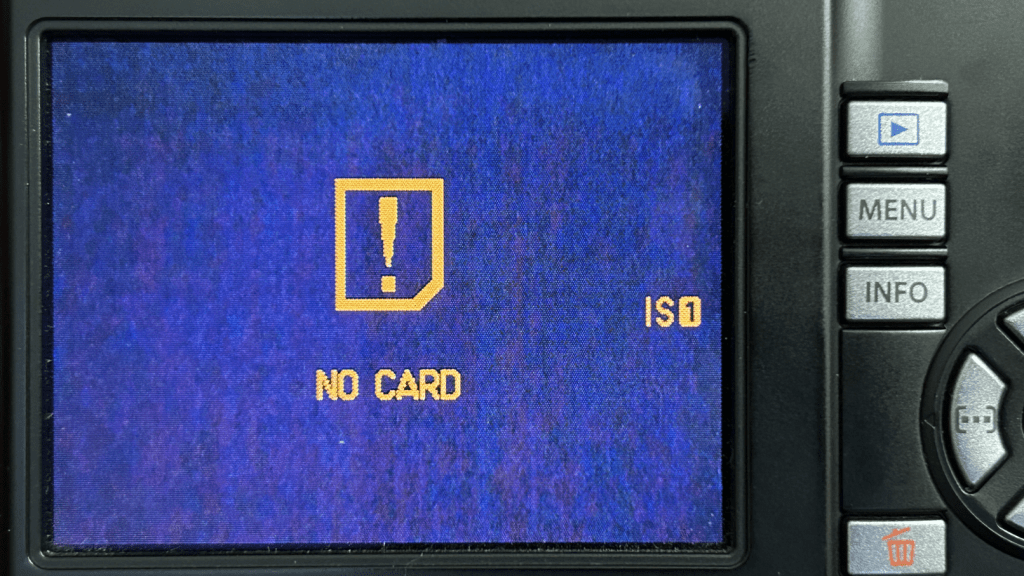
Anyone who has used digital cameras for the past 20 years likely has a few of these “zombie” cameras sitting in a cupboard somewhere. Cameras are upgraded, with their predecessors effectively “shelved”. The reality is that for the most part, digital cameras beyond a certain age just don’t hold much value (unless they are from Leica). One problem with vintage digital cameras is that things can just stop working. I have an old Olympus E-PL1 MFT camera. I haven’t used it in a while, and when I tried it today, it displayed a blinking red “IS-1” indicator. This basically means that the image stabilizer has failed (noticeable when the camera is first turned on because the anti-dust mechanism makes a rattling noise). That’s inherently an issue with electronics, things can just stop working, and fixing them on an old camera is often just not financially viable. It’s basically digital junk.

It’s dead Jim!

But the bigger problem is actually the battery. Some manufacturers have decided over the years to change the type of batteries used in their cameras (for many reasons). When a camera becomes legacy, i.e. is no longer supported, there is a good chance that the manufacturer will stop making the associated batteries. The E-PL1 was introduced in 2010, and although the battery in my camera still works, it is not possible to buy Olympus BLS-1 batteries for it anymore. It is also not really possible to determine what the status of existing batteries is – measuring the number of battery cycles is not easy or even possible (unlike laptop batteries). One way is to charge the battery, and take photographs until it drains, but tedious is an understatement. A battery will typically last between 300-500 recharge cycles.

The result is a vintage digital camera that may still work well, but ultimately needs a new battery. You could try the gambit of 3rd party batteries, but there really isn’t any way of knowing what battery will actually work, because they don’t usually come from verifiable battery makers (often resulting in slight fluctuations in the voltage provided to the camera). Yes, you can get replacement batteries from companies like Duracell (via DuracellDirect.com), however this company is not owned by Duracell, but rather PSA Parts Ltd. And these batteries are not exact replacements. For a real analysis, check out this article by Reinhard Wagner who dissects some off-brand Olympus BLN-1 batteries (it’s in German, but is easy to translate).

So what does this mean? Essentially if you want to use a camera long-term, make sure you have a good amount of spare batteries, i.e. anyways purchase at least one spare battery when purchasing a new camera. Also check the date on the batteries, as they made need replacing as they age. In all likelihood, nobody is going to be using vintage digital cameras in 50 years time, but they still might be using film ones.


P.S. The digital “age” of a camera is sometimes counted using the idea of “shutter actuation’s“. This is basically a count of how many photos have been taken. A modern mirrorless camera will have shutters rated at around 100-150K. Most cameras likely won’t come anywhere near that count, so they aren’t really a valid notion, except perhaps to indicate how much a camera has been used.

Vintage digital – the first full-frame DSLRs

The late 1990s saw a plethora of digital cameras evolve. Some were collaborations between various manufacturers such as Nikon-Fujifilm. But most of these cameras had sensor sizes which were smaller than that of a standard film camera, e.g. APS-C. The first true full-frame cameras appeared in the period 2000-2002.

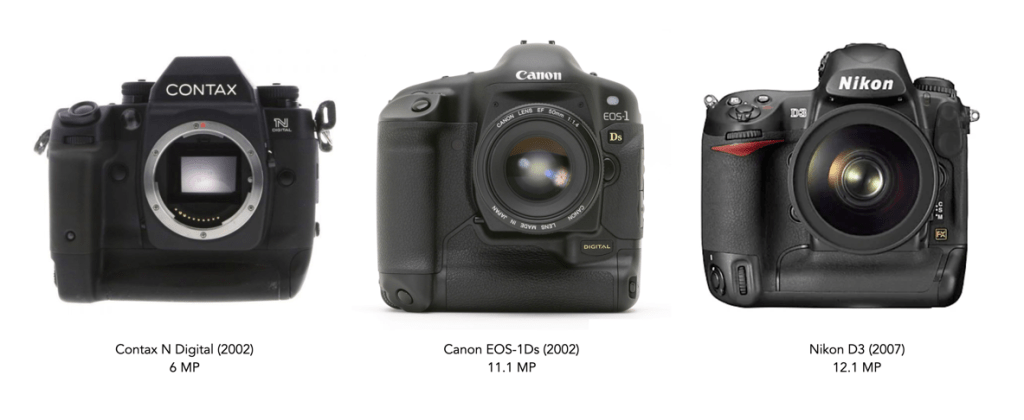
The first full-frame SLR of note was the Contax N Digital, a 6MP SLR produced by Contax in Japan. Although announced in late 2000, it didn’t actually appear until spring 2002. The sensor was a Philips FTF3020-C, and was only in production for a year before it was withdrawn from the market. Pentax also announced a full-frame camera (using the same sensor as the Contax N), the MZ-D in September 2000, but by October of the following year, the camera had been cancelled. The next full-frame was the Canon EOS-1Ds, which appeared September 2002. It was a monumental step forward, having a full-frame sensor that was 11.1 megapixels. In reality Canon dominated the full-frame market for quite a few years.

Nikon, who stayed in the APS-C for many year was relatively late to the game, not introducing a full-frame until 2007. The Nikon D3 had a modest 12.1MP sensor, but this is because Nikon opted for a low-resolution, high sensitivity sensor. Many lauded the camera for its high ISO noise control, with Popular Photography saying the D3 “will bestow an unheard of flexibility to low-light shooters, or give sports photographers the ability to crank up the shutter speed without adding flash.” To compare, the Canon 2007 equivalent was the Canon EOS-1Ds Mark III, sporting a 21.1MP sensor.

How do these stack up against a modern full-frame? If we compare the Canon 1Ds against a Canon R5C on certain charcteristics:

Canon 1Ds (2002)Canon R5 C (2022)
megapixels1145
ISO100-1250100-51200
video8K
weight1585g770g
number of focus points451053
number of shots per battery600220-320

These early full-frame DSLR’s were certainly beasts from the perspective of weight, and even megapixels, but to be honest 11MP still stacks up today for certain applications.

Further reading: