Charles G. Wynne (1911-1999) was a lens pioneer, but not in the traditional sense, i.e. his forte was not traditional photographic lenses. We presume sometimes that all advances in photography were made in the realm of cameras, but there are other fields that require lenses as well. Wynne began has optical career at Taylor, Taylor and Hobson Ltd. in 1936, after graduating from Oxford. Wynne worked for TT&H until 1943, when he moved to Wray Optical Works. Here he was not just an assistant, but a lens designer in his own right. His first job at Wray was improving the short focal length aerial reconnaissance lenses that the company made for the RAF.
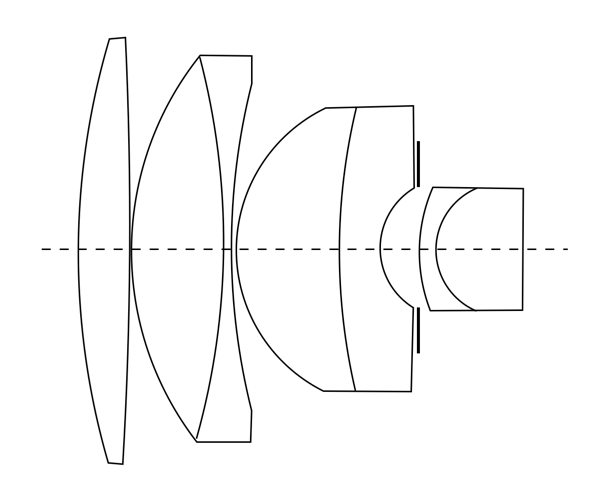
Wynne designed a series of interchangeable lenses for Wray’s 35mm SLR, the Wrayflex camera, the only British full-frame 35mm SLR camera ever made. Around 1950, there was an opportunity for developing fast lenses for use in the photography of cathode-ray tube (CRT) images and the phosphor screens that were used in X-ray machines. Wynne developed a f/0.71 lens, which although too expensive for industrial CRT photography, was ideally suited the the mobile mass screening program of the 1950s that helped eradicate TB. Wynne likely gleaned some personal satisfaction from this lens, as he had contracted tuberculosis whilst at Oxford. The f/0.71 lens used exposure times eight times shorter than a typical modern photographic lens with an aperture of f/2.0.
The Wynne 64mm f/0.7 lens
Wynne, C.G., Wray, P., “A new form of f/0.71 lens for 35 mm cine-radiography”, Journal of Scientific Instruments, 28, pp.172-173 (1951)
Maxwell, J., Wormell, P.M.J.H., “Charles Gorrie Wynne“, The Royal Society, p.499-514 (2001)
If you do a search for “German Pentax” you will likely come across a reference to a German camera. Of course the name brand Pentax is most often associated with Japan’s Asahi Optical, but it wasn’t always the case. The name Pentax started life behind the Iron Curtain at VEB Zeiss Ikon Dresden. Zeiss Ikon was one of the photographic companies formed in East Germany after the division of Germany into East and West.
Zeiss Ikon Pentax
In 1954 Zeiss Ikon, based in Dresden, began work on a new 35mm camera. It was designed to use the new Zeiss 50mm f/2.8 lens, but was quite radical from a design perspective, looking more like a 120 film camera of the period. There only seem to be prototypes of this camera, and if you want to learn more you can check out the post on Marco Kroger’s website zeissikonveb.de. He says the first version of the camera was intended to be a 6×4.5 120-film camera, with the film loaded in removable cassettes. The page includes some interesting technical drawings of the camera.
But where did the name Pentax come from? Well due to the division of a number of German camera companies, there were some issues with product naming, mostly related to trademark infringement. As East German companies wanted to sell their products in the West, they often had to come up with new names. For example the name Contax was already being used by the West German Contax company. To circumvent this, East German companies often created portmanteau words by blending two words. For example, Pentacon was derived from “PENTAprism” and “CONtax”. Therefore it is thought that the registered trademark Pentax was derived from PENaprism ConTAX.
Because Zeiss Ikon had a name but no camera, it sold the name to Asahi in 1954 who attached it to their first Pentaprism SLR in 1957 – the Asahi Pentax.
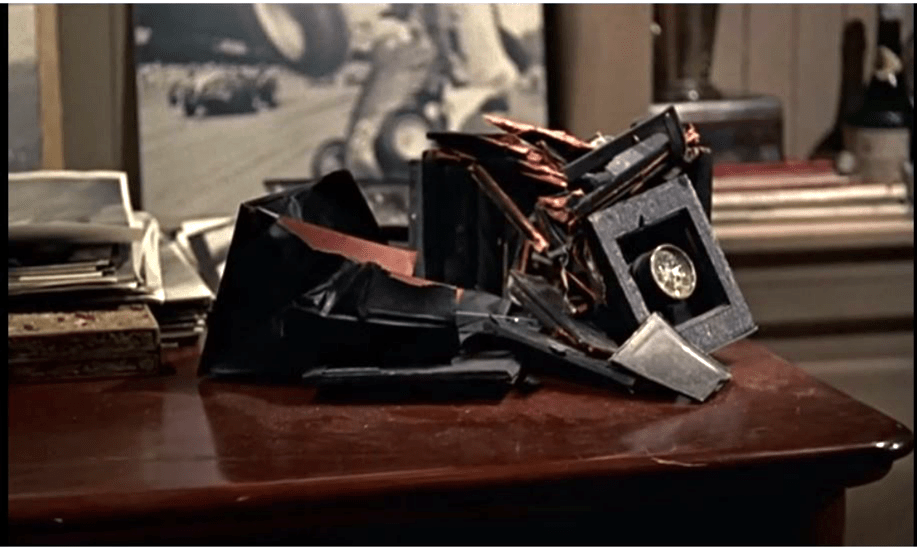
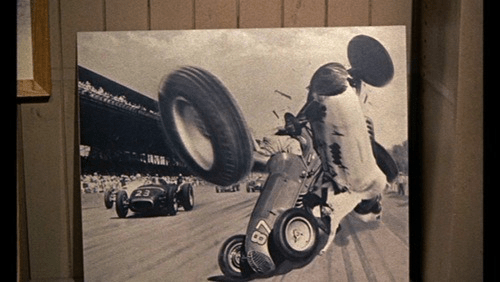
Although L.B. “Jeff” Jefferies used an Exakta camera in Hitchcock’s “Rear Window”, there were other cameras present in the room – most notably the one that took the photograph on the racetrack that lead to Jeff being in a wheelchair with a broken leg. What was that camera?
From the image shown it is clear that it is a large-format camera, most likely a Graflex Speed Graphic, a type of press cameras. As the name implies, these cameras were mainstays of press photographers until the 1960s, cumbersome but often preferred for their large negatives which allowed extensive cropping and enlargement without loss of detail. Considering the closeness of the shot taken by the camera on the track, it is a wonder Jefferies survived at all.
There are a whole lot of contemporary super-fast lenses, but that is to be expected from modern optical technology. For example the Voigtländer 50mm f/1.2 Nokton E is still a simple 8 element lens, but contains two optical elements each with two aspherical surfaces, helping to reduce lens aberrations. The Nikon Nikkor Z 50mm f/1.2 on the other hand has 17 elements in 15 groups, with three aspherical and two low-dispersion elements (but at 150mm in length, and 1090g it is a true monster). These lenses are now commonplace, but what about their vintage counterparts?
By the mid 1950s, lenses with speeds of f/2 and f/1.4 were commonplace. Lenses with large apertures such as f/1.0 were also available for applications such as radiography and motion-pictures. Sub-f/1.4 lenses for the 35mm “miniature” cameras had also started to appear. The literature of the period, such as Popular Photography, wrote a series of articles over the years, investigating these new fast lenses. Many of these technology reviews were not damning, but neither were they an acclamation of a new era in photography.
The September 1955 issue included an article “The new superspeed lenses – how useful will they be”, by Bob Schwalberg [2]. Schwalberg describes the rumours that superspeed lenses with apertures of f/1.1 and f/1.2 were in the offing from three different Japanese manufacturers. He suggested that although an f/1.4 lens should mathematically pass 100% more light than an f/2 lens, the actual results are more like 50%. Using the pretext that actual light transmission is 50% of that indicated, he surmises that an f/1.1 lens would only be 30% faster than an f/1.4 lens, but maybe even less due to more elements, and an increased number of light absorbing light-to-air surfaces. These tests were made by comparing exposures at different apertures changing nothing else. Schwalberg concedes that the lenses would be good for use with colour film, however doubted whether the same could be said for black-and-white film. One of the reasons was the reduced depth-of-field, although he concedes it is no worse than for the f/1.4 but regardless both require very close focusing for sharp pictures.
Norman Rothschild described the Zunow 50mm f/1.1 lens in a 1956 article [4], putting the lens through a series of tests, and exploring whether the addition of new optical elements would effect the speed advantage of the lens. He used an exposure meter (Norwood Model A) taped to the back of a Leica M-3 to measure light-transmission of the Zunow, and two control lenses (f/2, f/1.8). The findings indicated that the readings for the f/1.1 proportionally higher than those for the f/2. He also performed a number of practical field tests. Colour photos made with the lens were found to be ”warm, or reddish, but not displeasingly so”. Rothschild questioned the practicality of the lens, with its shallow depth of field, but concluded that while focusing was challenging, it is “no more severe than a press photographer using an f/3.5 lens on a 4×5 camera”.
When asking why these lenses weren’t more popular during the period they were developed, there are likely a number of differing factors. Foremost was cost. Lenses such as 50mm f/1.2 may have tested the limits of both manufacturing processes, and price to consumer. Making lenses with apertures larger than this may have been an act of sheer folly, as is testament to the few that were manufactured. Development costs associated with these lenses were likely steep, as was the use of optical elements containing rare-earth metals, and ultra-precise manufacturing techniques. To all but the professional photographer, these lenses were prohibitively expensive (and still are). When these fast lenses started to appear there was as much skepticism than there was praise. In a follow up article in 1956, “Another look at superspeed camera lenses”, Bob Schwalberg made the following points [3]:
The exposure gain obtained from f/1.1 and f/1.2 lenses was easier to obtain from additional development of f/1.4 and f/1.5 negatives.
Apertures larger than f/2 were seldom used for B&W work, but would be advantageous in colour work.
The reduced depth-of-field which limits the usefulness of f/1.4 and f/1.5 lenses at full aperture will further limit the usefulness of the f/1.1 and f/1.2 lenses.
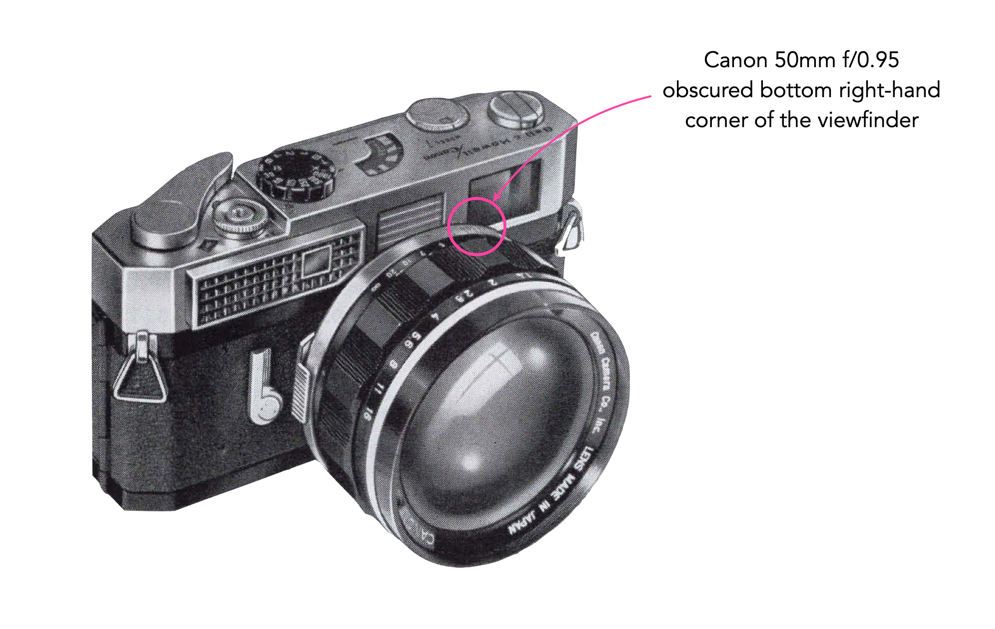
The lenses are large and heavy, sometimes obscuring the rangefinder and viewfinder windows.
The lenses are “extraordinarily” expensive. A 50mm f/1.1 lens retailed for $3 more than a Leica M-3 with aa 50mm f/2 Summicron lens.
Lens apertures greater than f/2 with a small amount of over-exposure can lead to drastic loss of definition and detail resolution. Tests shows that “at f/1.4 as little as 1/2 stop overexposure can kill sharpness”. Three times as much overexposure is required to produce the same ill-effects at f/2.
Schwalberg called it the “super-aperture problem”. He goes on to suggest that what was needed was not faster lenses, but better lenses, citing that film resolution was increasing to the point where lenses were not capable of producing.
In another Popular Photography article in 1956, it was suggested the ultimate value of f/1.1 and f/1.2 lenses was still a matter of conjecture [5]: “Speeds of f/1.4, f/1.5, and f/2, have long been with us and have proven extremely practical. Unless you are in the darkest, blackest, dingiest location, and unless every bit of shutter speed counts because of subject movement, it is highly advisable to limit black-and-white shooting to a maximum aperture of f/2.” The article cited a series of limiting factors that made photographers wary of the usefulness of sub f/2 lenses [5]:
Depth of field – this only comes apparent at close distances, but a larger opening will result in a shallower DOF. A 50mm lens focused at 4ft has 3.5” of depth at f/1.5 and 4.75” at F/2. A smaller DOF will require more precision in focusing.
The gain in light transmission is often less than can be expected. Light transmission is directly proportional to the square of the f-number. f/2 squares to 4, and f/1.4 to 1.96. Theoretically then, f/1.4 should transmit approximately 100% more light, however tests have shown that it is likely only 50-60%. The reasoning is that the more the diaphragm is opened, the more we depend upon light rays from the periphery of the lens. These rays enter at a steeper angle of incidence than those on the edges at smaller f-stops. There is therefore greater loss through internal reflection.
The other issue is that apertures greater than f/2 require exacting levels of exposure. overexposure at f/1.4 can ruin crisp detail. Errors at f/2 are more forgiving.
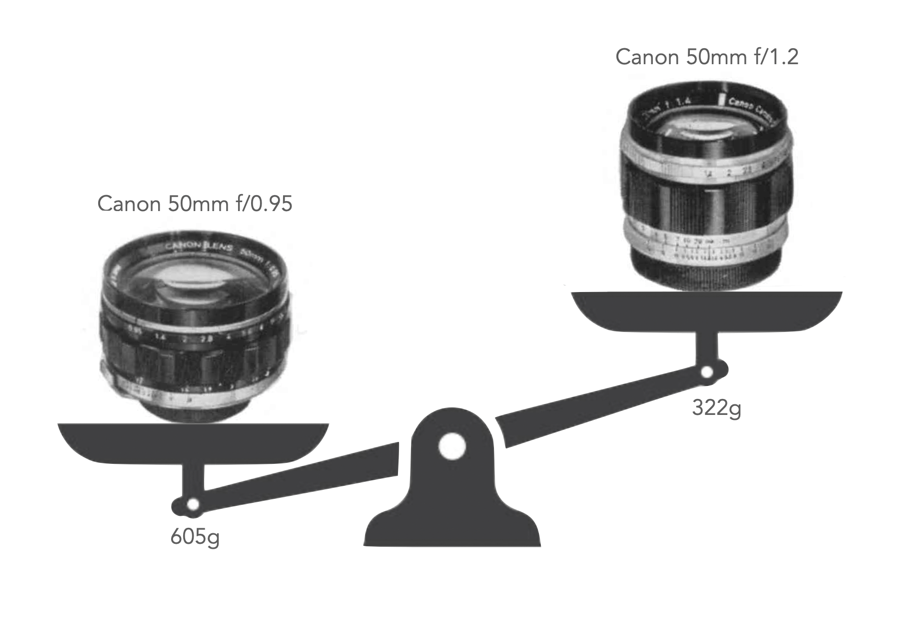
The other issue was weight – these lenses were heavy. The SMC Pentax 50mm f/1.2 (1975) was 385g, and had a maximum diameter of 65mm. The f/1.4 of the same era was only 266g, meaning the f/1.2 was a 45% increase in weight. When the Nikkor-N 50mm f/1.2 first appeared, its internal mount was problematic, with the mount not really able to support the weight of the lens, causing the mount to bend. In addition, the focusing wheel on the camera could not be used because it could not handle the weight of the lens. The weight of the lens was 425g, in comparison a comparable 50mm f/2 was around 200g.
There were many factors which contributed to the lack of interest in fast lenses. By the mid 1960s colour film was faster, and so there was less need for faster lenses. There were a number of f/1.2 options, but also many more options are f/1.4 at a much lower price point. So why bother purchasing a vintage sub-f/1.4 lens? One reason is for the character it provides, or for shooting in extreme low-light conditions. Why not to buy them? Mostly they are expensive.
Further reading:
G.H. Smith, Camera Lenses: From box camera to digital (2006)
Bob Schwalberg, “The new superspeed lenses – how useful will they be”, Popular Photography, 37(2), p.48 (September, 1955)
Bob Schwalberg, “Another look at superspeed camera lenses”, Popular Photography (April, 1956)
Norman Rothschild, “Meet the Zunow f/1.1”, Popular Photography, pp.126/128 (February, 1956)
“The Versatile 50-mm Lens”, Popular Photography, 39(2) pp.40,41,84 (August, 1956)
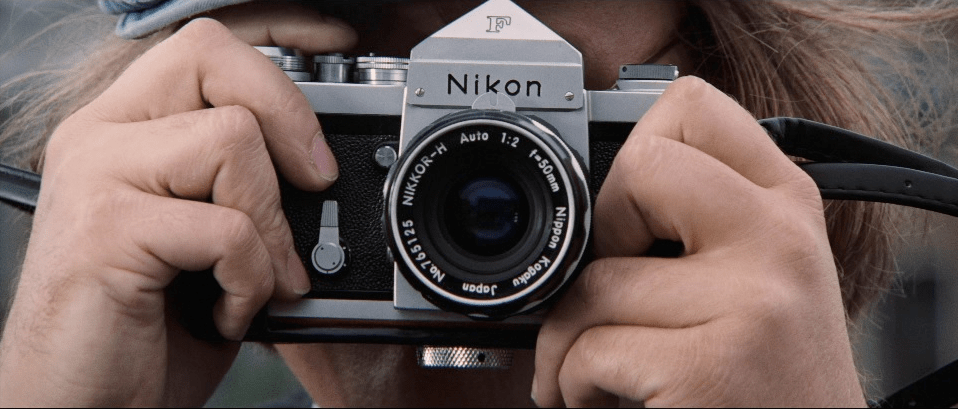
In 1971, two of the villains in the James Bond movie, Diamonds Are Forever used a Nikon F to take photos. The question is why the Nikon F? I mean it’s not like it was a new camera. First unveiled in 1959, it was no doubt an influential camera, but a decade later was it still cutting edge?
It was not the only time Nikon cameras were used in movies. The list is actually quite long, including the likes of The French Connection, Jaws, and Apocalypse Now (here’s another list of cameras in movies and TV shows). Nor was it the only camera used in Bond films – Bond used a Rolleiflex T in From Russia with Love (1963), a in Goldfinger (1964), a Nikonos Calypso in Thunderball (1965), and a Minox subminiature in On Her Majesty’s Secret Service (1969).
The Nikon F was at the forefront of SLR technology in the 1960s, and had a wide audience of users, from photojournalists covering the Vietnam War, to NASA. In March 1968 the Nikon F was laboratory tested by Popular Photography. Reviewers found little to complain about, it was an easy camera to function with, and extremely well built, except for the fact that it was heavy, “like a military tank of a camera”. It had a presence which was hard to dispute.
Choosing a camera for any movie may be a mere factor of chance. A personal preference of the director, or somebody facilitating props. Sometimes it’s product placement, although considering the Nikon F2 was released in the same year as the movie, it’s unlikely that is the case.
In a previous article, I discussed the Exakta VX camera used in Alfred Hitchcock’s “Rear Window”, suggesting that photojournalists of the period likely didn’t use super-telephoto lenses all that often (or at all). My view on this is based largely on articles I have read in magazines like Popular Photography during the 1950s.
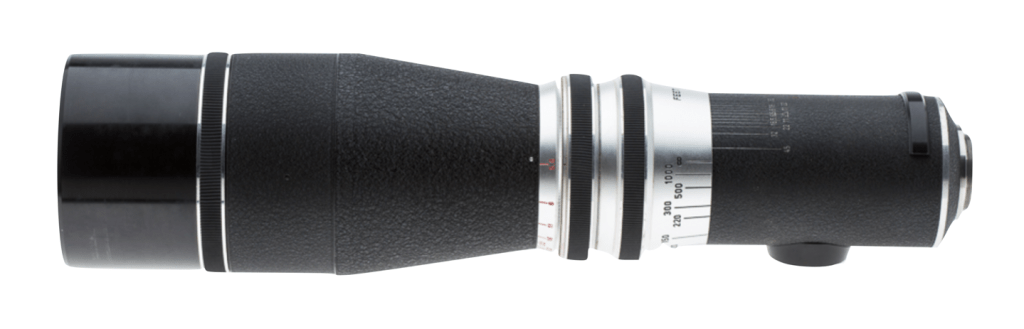
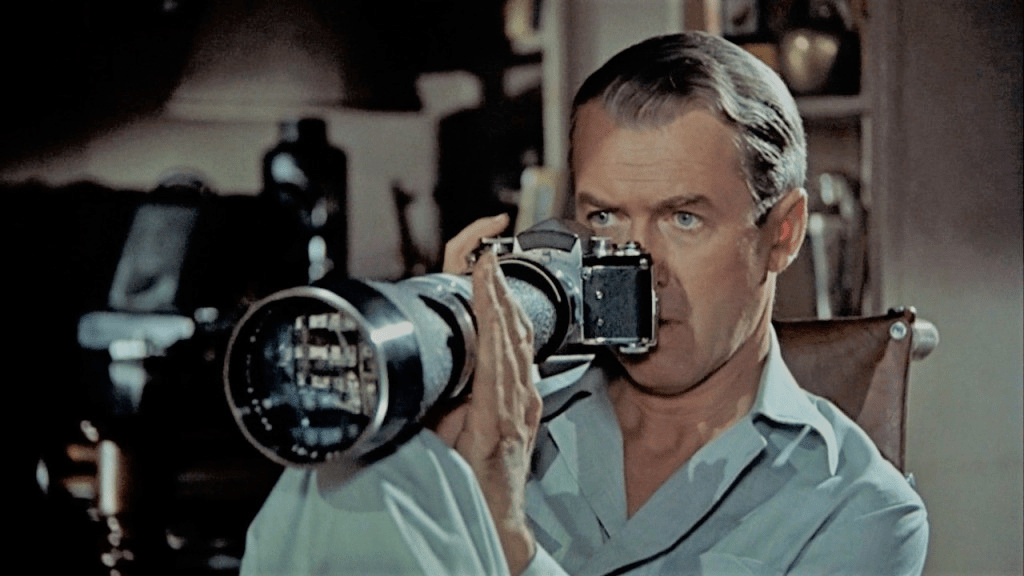
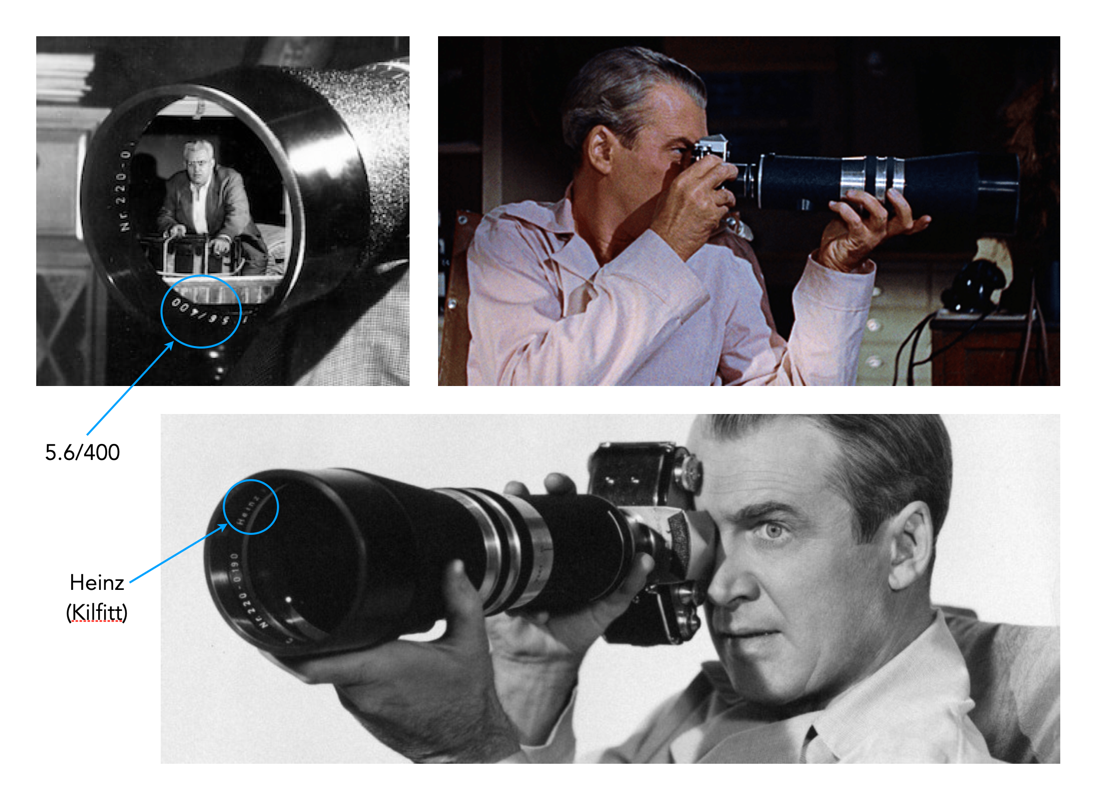
The telephoto lens used by Jefferies in the movie is the Kilfitt Fern-Kilar f/5.6 400mm lens. The lens fits into the category of super-telephoto lenses with focal lengths in the range of 300-600mm. A number of manufacturers produced these lenses, although in all likelihood they had a narrow market. One of the earliest ads for Kilfitt lenses in Popular Photography appears in 1953, advertising their KILAR lenses for “medium and long tele shots” – it includes the 300mm and 400mm lenses. A review of the ads section of Popular Photography in 1954 reveals that the Kilfitt 400mm was being sold alongside the f/5.5 Hugo Meyer-Goerlitz Tele-Megor (which was the lens promoted by Exakta as well), and the Astro f/5.
The Kilfitt-Fern-Kilar 400mm f/5.6
Literature from Heinz Kilfitt Optische Fabrik suggests the lens could be used for “nature and expedition photography“, and also for “special press and feature assignments“. It is then likely that these long lenses were used in situations where a large kit could be carried. Some may argue that Jeff used the lens for sports photography, but that is unlikely, as many photojournalists tended to focus their careers on a particular genre of photography. For example Robert Capa, upon who Jefferies character is loosely based, worked predominantly in war zones: the Spanish Civil War, WWII, Palestine, and the war in Indochina (where he was killed by a landmine). In 1951 Bruce Downes wrote an article in Popular Photography, describing David Douglas Duncan’s photo coverage of the Korean War [2]. He photographed the carnage of war using two Leica IIIc’s, “practical combat cameras” that were “…light, compact and could stand a beating.”. From the perspective of lenses, he used Nikkor lenses: a 50mm f/1.5, a 85mm f/2 and a 135mm f/3.5. No large telephoto lenses in sight.
A steady telescope
In addition, even sports-photojournalists did not generally use long-tele lenses. Jesse Alexander (1929-2021), a motor-sports photographer, reportedly did not use long telephotos lenses. At the start of his career in early 1950s (his first photographic assignment was the 1953 La Carrera road race in Mexico), he used a Leica with 35mm and 135mm lenses, and a Rolleiflex for close-ups and portraits. I would suggest that the 400mm lens was either something Jefferies used occasionally, perhaps for some hobby photography, or merely something added to meet the needs of film. The only real evidence of Jefferies taking sports shots is the motor racing shot that ended up with Jefferies stuck in his apartment with a broken leg. The camera used there was a large format camera (most likely a Graflex), as evidenced by the photo hanging on the wall, taken in the middle of the racetrack.
Identifying the lens
The biggest elephant in the room with these telephoto lenses is their weight. The f/5.6 400mm lens weighed 62oz, or 1.76kg in weight. The faster Sport-Fern-Kilar f/4 400mm lens was even heavier, at 3.1kg. These lenses were just too heavy for a photojournalist to carry and use effectively in an active situation, e.g. a war zone. Even in everyday settings, the length of the telephoto would require the use of a tripod, otherwise shake will be greatly exaggerated – “A slight jiggle that would not be noticed if the scene were filmed with a standard lens will look like something shot on a pogo stick when you use a long telephoto lens.” [1]. It might be okay to use as a de facto telescope and prop up on your knee.
The interesting thing about Exakta is that their literature touted the idea of attaching a telephoto lens to a camera and turning it into a telescope – “a telescope that gives you long-range viewing with high magnification“. A 400mm telephoto lens would provide an eight-power photo-telescope.
NB: Sometimes it is speculated that the lens was actually an Astro-Berlin, a German company that made some pretty cool lenses, especially for the super-super telephoto (we’re talking 2000mm, f/10). These telephotos were often seen on Exakta cameras, hence the association.
Herb A. Lightman, “Choosing and using lenses”, Popular Photography, 35(3), pp.107-117 (1954)
Bruce Downes, “Assignment: Korea”, Popular Photography, 28(3), pp.42-51, March (1951)
I have been buying vintage analog cameras and lenses for a few years now, and so this article offers a few tips, on where to buy them based on my experiences. Now when you’re dealing with vintage camera equipment, you will quickly realize that there is a lot of inventory around the world. This isn’t so surprising considering how the photographic industry blossomed with the expanding consumer market from 1950 onward. Analog equipment can be old, mostly dating pre-1980s, some quite common, others quite rare. I say pre-1980s because that decade heralded cameras and lenses that were bulky, ugly, made of plastic, and had clumsy auto-focus mechanisms. I will cover what to look for in vintage lenses, and cameras at a later date.
Bricks-and-mortar stores
If you are new to the buying vintage photographic equipment, then the obvious place to start is a store that focuses on vintage gear, but honestly they are few and far in between, which may be the nature of dealing with analog. Sometimes photographic retailers who sell modern camera equipment may deal with some “used” gear, but you often won’t find a really good range of gear, as they tend to deal more with used digital gear. Some people of course will comment that specialized stores tend to have higher prices, but we are talking about vintage equipment here, which may be anywhere from 40-70 years old, so if you are serious about lenses it is worth paying for the expertise to properly assess them.
In Toronto a good place to start is F-Stop Photo Accessories, which has a good amount of online information on their inventory (but does not ship). You will find a good assortment of Japanese gear, with some German and Soviet-era gear as well. The store is tiny, so best to check out the website and email to make sure the items you’re interested in are in stock, then drop by to examine them. In places like the UK, Europe and even Japan there are likely more bricks-and-mortar stores that deal predominantly with vintage. For example Tokyo abounds with used camera stores, some of which have huge inventories.
Fairs / Camera shows
If you are fortunate to live somewhere that has a photographic club, they may also have swap-meets, or auctions. In Toronto there is the Photographic Historical Society of Canada, which typically has two fairs a year, which are a good place to pick up vintage gear. The first time I went in 2019 I managed to find an 8-element Takumar 50mm f/1.4 (C$250), a Helios 58mm Version 4 ($20), a Takumar 35mm f/3.5 ($60), and a Carl Zeiss Tessar and Biotar 58mm f/2 for $140. The benefit is always that you get to examine the lens/camera, and check the functionality. There is generally a huge amount of lenses and cameras, some quite inexpensive for the person wanting to get started in analog photography.
Online stores
What about purchasing from an online reseller? This is somewhat tricky, because you are buying a physical device. I typically don’t buy any vintage electronic things off the internet because you can never be 100% certain. Thankfully the type of vintage we are looking at here, especially as it pertains to lenses, rarely involves any electronics. However it still involve moving parts, i.e. the focusing ring, and the aperture, both of which have to move freely, and are obviously hard to test online. There are a number of differing options for buying online. There are (i) physical stores which have an online presence, (ii) online retailers with a dedicated website, and (iii) online retailers on platforms such as Etsy and eBay.
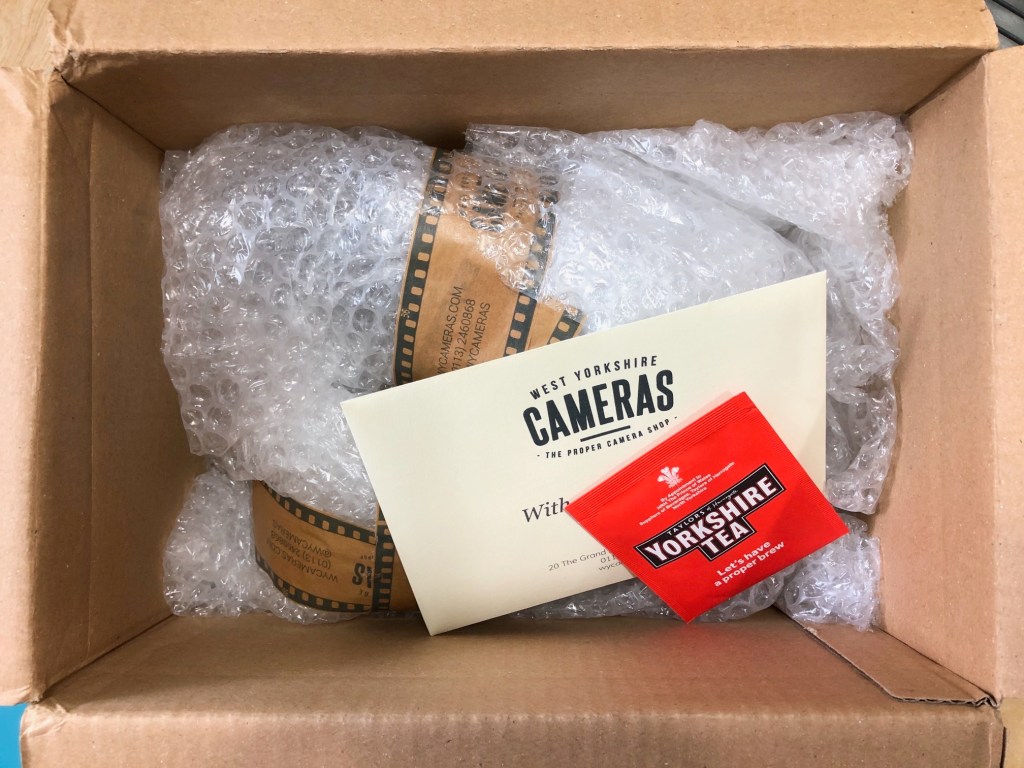
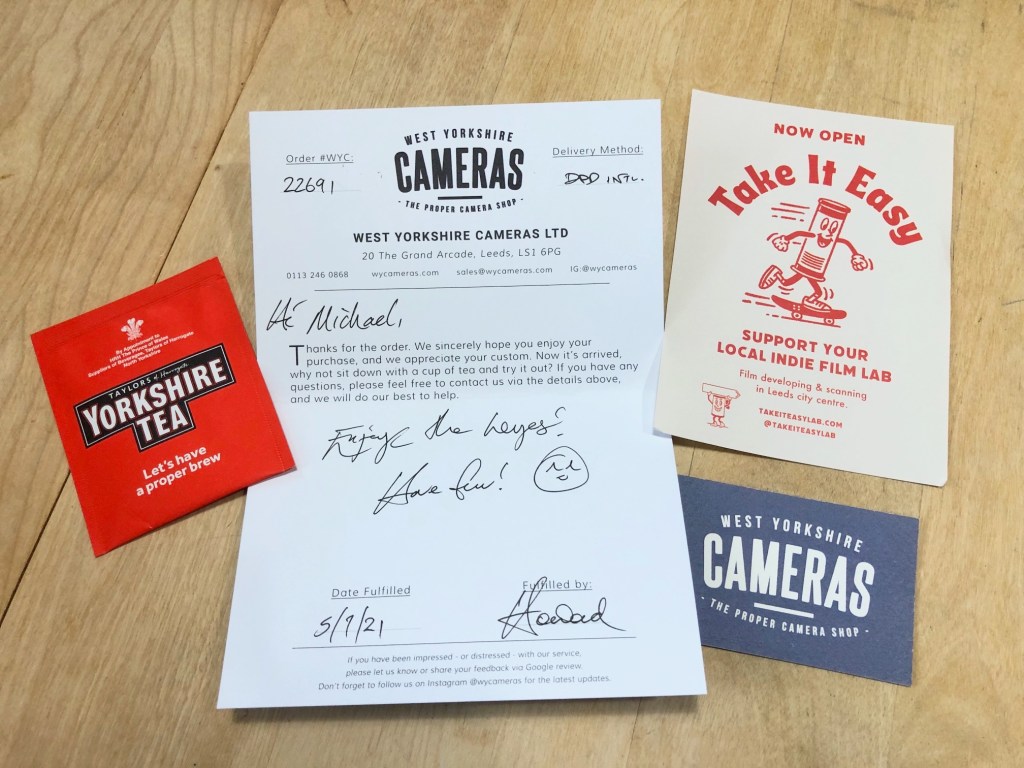
I have had a number of good experiences when shopping at online stores. The first one was with the Vintage & Classic Camera Co., on Hayling Island near Portsmouth (UK). I bought an Exakta Varex 11a, and the experience was extremely good. Listings are well described, with ample photographs and a condition reported (as a percentage). The second was a recent experience with West Yorkshire Cameras, arguably one of the premium retailers for vintage camera gear. I have also bought lenses from a number of resellers on Etsy and eBay. Etsy provides access to resellers from all over the globe, and vintage products have to be a minimum of 20 years. I have bought some Russian lenses from Aerarium (Ukraine), cameras from Coach Haus Vintage (Toronto, Canada) and Film Culture (Hamilton, Canada). If you are looking for Japanese vintage cameras, I can also recommend Japan Vintage Camera based in Tokyo, who have an Etsy store as well.
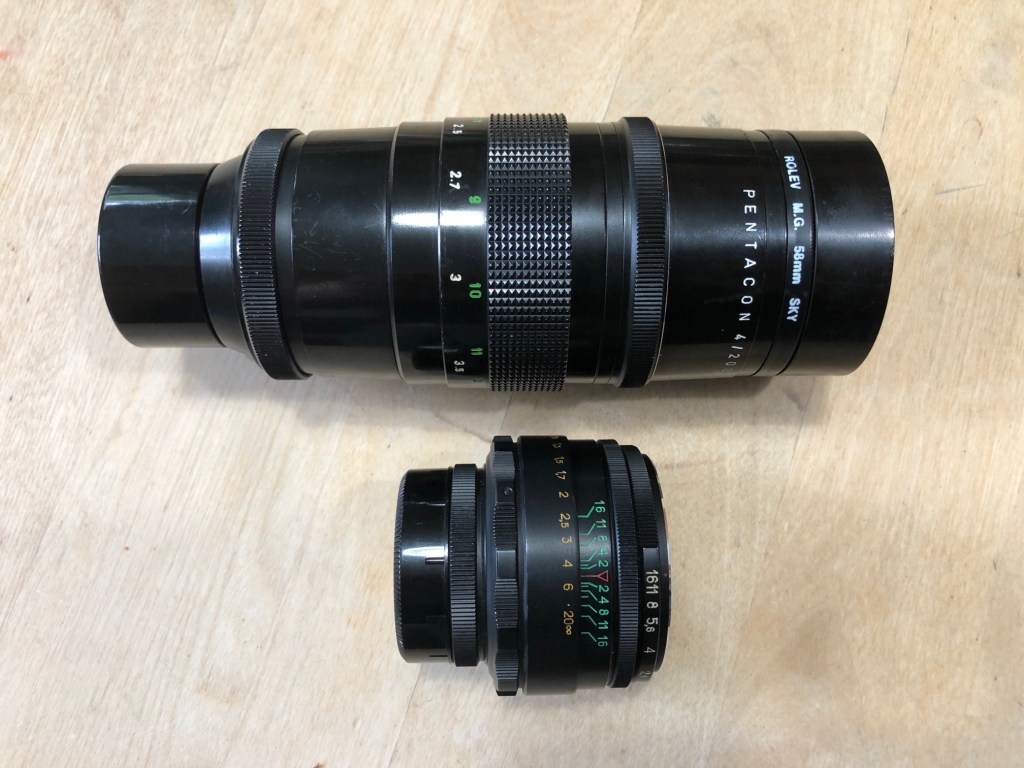
Well packaged.A personal touch.Wrapped lenses.Exceptional lenses.My purchase from West Yorkshire Cameras. It arrived incredibly well packaged, and even included a teabag of Yorkshire Tea. It is the small details that makes for a good customer experience.
What makes a good store?
A good vintage camera reseller will be one who lives and breathes vintage cameras. Typically they might have an Instagram account, offer weekly updates of new inventory, and service/inspect the equipment before even advertising it. If there should be something wrong with an item when you receive it, the reseller should make it good (I mean things do get missed). A good online store will have listings which describe the lens/camera in detail while listing any defects, provide a good series of photographs showing the camera from different angles, and some sort of grading criteria. Ideally the store should also provide some basic information on shipping costs.
Regardless of the store, always be sure to Google them and check online reviews. Don’t be swayed by a cool website, if there is a lack of customer service you won’t want to shop there. Sometimes the company has a Google review, or perhaps a review on Trustpilot. If there are enough negative reviews, then it is safe to say there is likely some truth to them. For example a company that posts 70% bad reviews is one to avoid, regardless of the amount of inventory on their site, how quickly it is updated, or how aesthetically pleasing the website looks. I had an extremely poor experience with a British online reseller that has an extremely good website with weekly updates of inventory. I had purchased a series of vintage lenses in Nov.2020. After one month they had not shipped, after two also nothing. I conversed with the owner twice during the period and each time the items were going to be “shipped tomorrow”. To no avail, after 5 months, I finally submitted a refund request with Paypal, which was duly processed. I have since written a review, which wasn’t favourable, but then neither were 90% of the reviews for that particular reseller.
The website Light Box has a whole list of places to buy film cameras and lenses in the UK, including a section named “Caution advised”, outlining those to avoid. I have created a listing of various stores in the Vintage Lenses etc. page.
Stores by region
Geographical locations do play a role in where to purchase vintage camera equipment. For example during the early decades of the post-war camera boom, there were two core epicentres of camera design and manufacture: Europe (more specifically both East and West), and Japan. So if you are interested in cameras/lenses from these regions, then stores within those geographical locales might offer a better selection. For example there are quite a few vintage camera resellers on Etsy from Ukraine and Russia. This makes sense considering cameras like FED were made in factories in Kharkov, Ukraine. Interested in Pentax or any number of Japanese vintage lenses, then resellers from Japan make sense. There are a lot of good camera stores in places that have few links to manufacturing, but may have had a good consumer base, e.g. UK and the Netherlands. The trick of course is being able to navigate the sites. Many Japanese stores have online presence, but very few provide an English-language portal.

 Crafting Pixels