Choosing a vintage SLR camera – some FAQ

This past covers more aspects of buying a vintage camera in FAQ form. When it comes to 35mm interchangeable-lens cameras there are two categories: rangefinder and single-lens-reflex (SLR). This FAQ is concerned with SLRs because they became the dominant form of SLR camera found on the used market.

What are the best vintage cameras?

Identifying the best vintage camera is very much a subjective thing. Unlike lenses though, which are often chosen for the aesthetic appeal they impart upon photographs, cameras are all about functionality. All cameras really serve the same purpose, as a vessel to hold the lens, and film, and control the process of taking a photo. So the best vintage cameras are often those that achieve this in a way that doesn’t compromise functionality. They should be simple to use, aesthetically pleasing, ergonomic, and don’t suffer from a series of maladies, e.g. shutters that could imminently fail, poor engineering or manufacture etc.

Which camera types are best?

It really depends on what sort of features are required, and perhaps what sort of lens mount (not all lens mounts are inter-compatible, and it is hard to find adapters for film cameras). Do you want fully manual, semi-automatic, or fully electronic? Do you want a built-in light meter (which is tricky because many don’t work anymore)? Then you have to figure out which ones are problematic from some functional viewpoint, e.g. problems with shutters, or flaky electronics. For example Olympus made 14 major models of manual focus SLR in the period 1972 until 2002, and two automatic models. The OM-707 was an auto-only camera, and somewhat of a disaster from a usability perspective. The Olympus OM-4Ti (1986-2002) is considered by many to be best film SLRs money can buy.

What is the most versatile camera mount?

In reality, M42 is likely the most common lens mount, at least up until the early 1970s. There were a lot of lenses made for this mount from a myriad of manufacturers. There were also a bunch of cameras that used it as the mount. Next in line might be the Exakta mount.

Can film cameras use lenses from other brands?

Unlike mirrorless digital cameras, which have a short focal flange distance, allowing for adapters to suit a bunch of 35mm film lenses, the same is not true for film cameras. Some cameras can use lenses with other mounts, many can’t. For example the Minolta cameras with an SR-mount can use M42 mount lenses, because the flange distance on the camera (43.50mm) is less than that of the lens, allowing an adapter to convert the M42 to SR-flange (MD,MC) – however the opposite is not true.

Do some people buy cameras because they are aesthetically pleasing?

Yes. Some people love how cameras look, even if they don’t function that well. Form over function is a real thing for some people, of course beauty is always in the eye of the beholder.

Why were some SLRs unsuccessful?

Sometimes cameras didn’t sell that well, and as a result weren’t that successful. This was usually down to poor choices in the design of the camera. A good example is Rollei which had its own bayonet mount lens system known as the QBM – proprietary lens mounts means a smaller choice of lenses. Poor usability, or finicky mechanical features often lead photographers to abandon a camera. Sometimes it can be poor aesthetics, as with the case of the Minolta Maxxum 7000, although to be honest requiring photographers to dump all their lenses in favour of a new system with autofocus, probably wasn’t the best idea.

What about brands?

There are three major categories of vintage camera manufacturers. The first are landmark manufacturers who got into the game early, and focused heavily on SLRs. They likely had a start in 35mm rangefinder cameras. This means manufacturers like Exakta, Asahi-Pentax, Nikon, and Canon. Pentax is the only one of the three that did not produce rangefinder cameras. Next are the companies that are second tier, i.e. they had a smaller footprint, made only SLRs or got into the game late. This includes Konica, Minolta, Fuji, Olympus, Topcon, Yashica, Petri, Mamiya, Miranda, Ricoh, Zeiss Ikon, KW, ALPA. Lastly are the companies who didn’t really do a great job with 35mm SLR – Leica, Rollei, Voigtländer. Each manufacturer produced both good and mediocre cameras, and so it really requires some investigation into the right brand.

Are Japanese SLRs better than German ones?

In all probability, yes. There are undoubtedly some good German SLRs, mostly from East Germany, produced in the 1950s and 1960s. West Germany really didn’t produce that many successful SLRs. Both countries struggled to produce SLRs that could compete with the ones produced by Japanese manufacturers. There are a few good German SLRs, e.g. the Contax S2, but the reality is there is likely better Japanese cameras that are way cheaper.

Should I buy a camera made in East Germany?

With the exception of Exakta cameras, many post-war Eastern bloc cameras suffer from lower standards of engineering, reliability, and in some cases poorer usability than West German and Japanese cameras. When they were new, this was less of an issue because these cameras were often sold for dramatically lower prices. However aging cameras can be fraught with issues. Check the reliability of any camera you are interested in.

Why are there so many Eastern-bloc cameras?

Cold hard currency. The communist-bloc countries needed currency, and one was to achieve that was to produce goods to sell in the west. Banking on Germany’s pre-war reputation for producing photographic equipment, this was a very lucrative option. Dresden, which ended up in East Germany, was once the European epicentre of photographic innovation. The cameras were often sold cheaply, thanks in part to Eastern-bloc government subsidies.

What’s are the best East German SLRs?

Anything in the Exakta range, or perhaps a Praktina, or Praktica IV.

What about the weird brand SLRS?

Oh, you’re talking about the small independent brands?

  • Rectaflex (Italy, 1949) – over-engineered, heavy yet reliable, these cameras are expensive only because of their rarity.
  • Alpa (Switzerland, 1942) – exacting, well-built cameras. Some models such as the 6c are extremely good cameras, although some are susceptible to shutter issues. Expensive, but provides a unique character, and high level of quality.
  • Wrayflex (England, 1950) – the only commercially successful, English made SLR.
  • Edixa Reflex (West Germany, mid 1950s) – moderate quality cameras made by Wirgin (Weidbaden), these cameras rarely operate for very long.

Why are there so few cameras not made in Germany or Japan?

This is in part due to a lack of interest in developing their photographic sectors. While the allies poached a lot of high-tech workers from Germany, particularly from the armaments sector, they didn’t relocate any photographic expertise, except from the Russian occupied zone in Germany to the US zone. The boom in SLRs which occurred in the 1950s was driven by cheap cameras and lenses coming out of East Germany, and the growth of the photographic sector in Japan. Countries like the US, UK, and France could not compete, or just didn’t have the ability to get into a market that was dominated pre-war by Germany.

What’s does “mint” mean?

This is a term used by some resellers to indicate that a camera is in near perfect condition, almost like it came out of the factory last week. In many cases it likely means the camera sat in its box, and was never used (if it comes with the box and instructions, even better). However just because it’s mint doesn’t always mean that everything will function the same as it did when it came out of the factory 60 years ago. Materials still may degrade, grease solidifies, and gears seize up.

What about electronically-controlled 35mm SLRs?

This is often a choice for people who don’t want to deal with a fully manual camera. This means any 35mm SLR where electronics aid in calculating things like exposure. This could range from something like an aperture-priority-only camera to an autofocus equipped, completely automatic SLR. The only problem with these cameras can be aging electronics. If the electronics stop working, you basically have a paper weight. Choose a camera that is well reviewed and barely ever gets negative reviews. Note that manual cameras often had light meters, but that doesn’t make them electronic cameras (a camera with a light meter can generally be used even if the light meter doesn’t work.)

Who had the first 35mm SLR with a pentaprism?

Which 35mm SLR camera had the first pentaprism? Was it the Rectaflex or the Contax S? This question has turned into a bit of a conundrum over the years – many sources cite the Contax S as the first, with just as many opting for the Rectaflex. This discussion tries to provide some insight into the timeline of pentaprism use by looking at both the patents for cameras containing pentaprisms, and the cameras actually produced. Note that some original historical patents are hard to find, e.g. those from Italy.

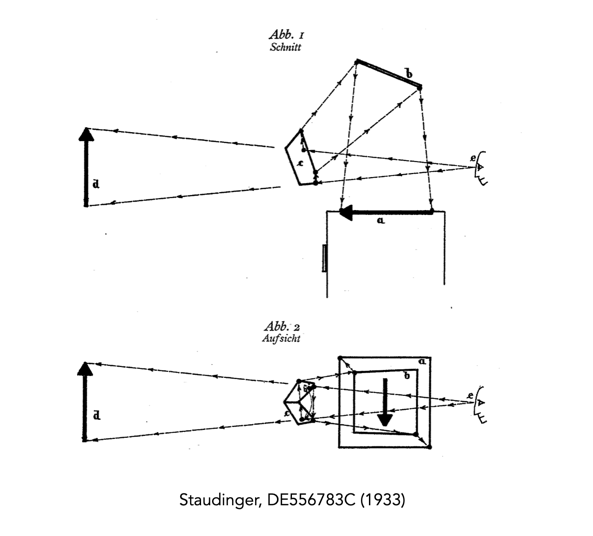
In all probability the idea of using a pentaprism in a camera had been floating around for a while. On 28 January 1933, German architect Kurt Staudinger was issued a patent for a reflex device with eye level vision, which used a pentaprism-like system (DE556783A, “Vorrichtung fuer Reflexkameras” (Device for reflex cameras). The invention related to a device which “…is intended to convert the horizontal and reversed image projected into the screen into a vertical, upright and reversed image.” However instead of using a prism, this was actually a series of mirrors, i.e. a penta-mirror. Although he tried to interest German camera makers, none were seemingly that eager. At the time there was likely was too much invested in rangefinder cameras to think that an alternative was worthwhile. The only German patent to cite this work was that of Arno Rothe (DE741844A, sub. May 5, 1939) who proposed a reflex camera using mirrors which allowed for both waist level, and eye-level viewing.

Fig.1: The concept of Kurt Staudinger

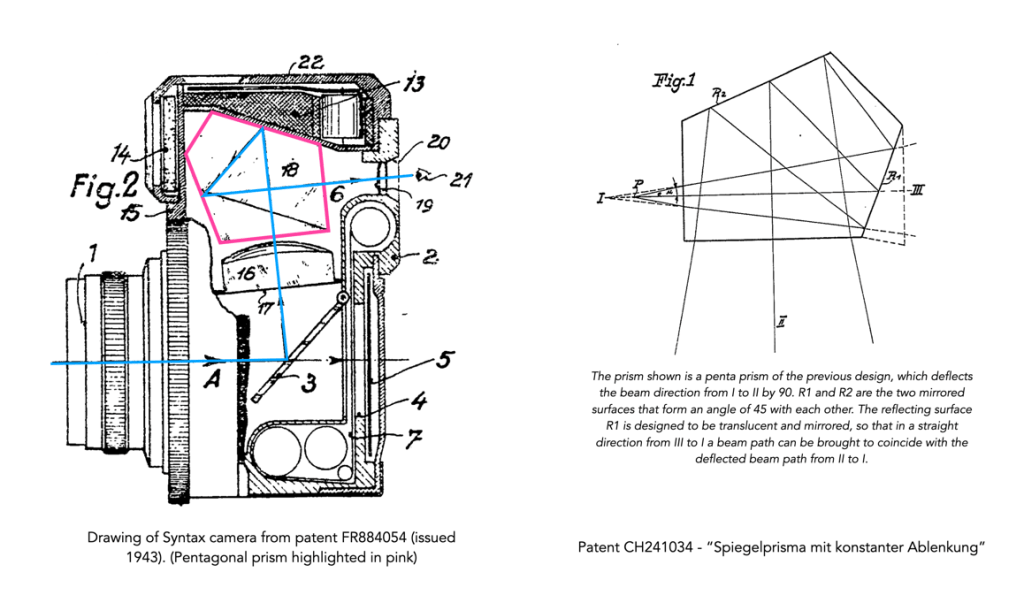
From about 1937 Zeiss Ikon began work on a 35mm reflex camera with a pentaprism eye-level viewfinder in the Camera Development Department. The camera was named the Syntax, and on September 2, 1940 Zeiss Ikon applied for a utility patent in Germany. Research has failed to find the German patent, but two patents associated with the camera were filed in France: FR884054 (sub. August 9, 1941) “Photographic apparatus constructed in particular in the form of a monocular mirror reflex camera”, and FR875596 (sub. August 9, 1941) “Mirror camera with photoelectric exposure meter forming part of the camera”. Both applications cite the filing of associated German utility patents on August 23, 1940. There is another Swiss patent submitted by Zeiss Ikon on 18 January 1943 (CH241034) – “Spiegelprisma mit konstanter Ablenkung” or “Mirror prism with constant deflection”. This gives further credence to the fact that Zeiss Ikon was working on a pentaprism for a camera.

Fig.2: Drawing of Zeiss’s Syntax camera from the French patent and a drawing of a “spiegelprisma” from the Swiss patent.

Work was slow, but it has been suggested that there was a working model by 1944, supposedly a Contax II body with its metal vertical focal-plane shutter, however having its view/rangefinder replaced by a reflex mirror, delivering an upright and right-way-round image via a roof pentaprism to the eyepiece [1]. However the viewfinder image was too dark, and required f/2 and faster lenses. A diagram of the Syntax from the French patent is shown in Figure 2. According to Siegfried Böhm, design engineer with Zeiss Ikon, there were a series of issues with the Syntax [1]. The camera was complex, and would have required 750 parts to produce, in part due to the vertical shutter, and external bayonet lens mount of the Contax II. Böhm was working on the design for a horizontal focal-plane shutter, however on February 13, 1945, everything related to the project was destroyed by Allied air raids.

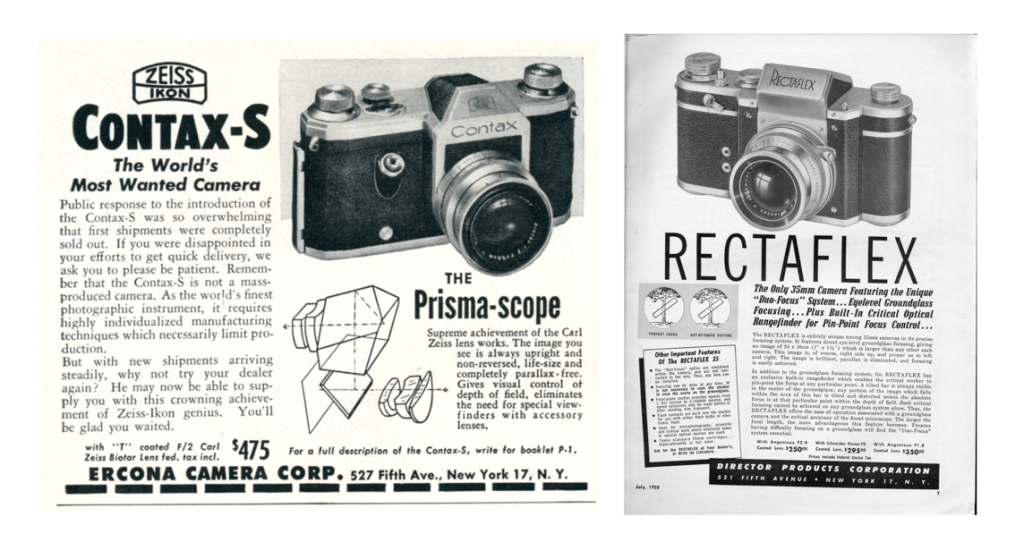
Fig.3: Advertisements for the first two pentaprism cameras

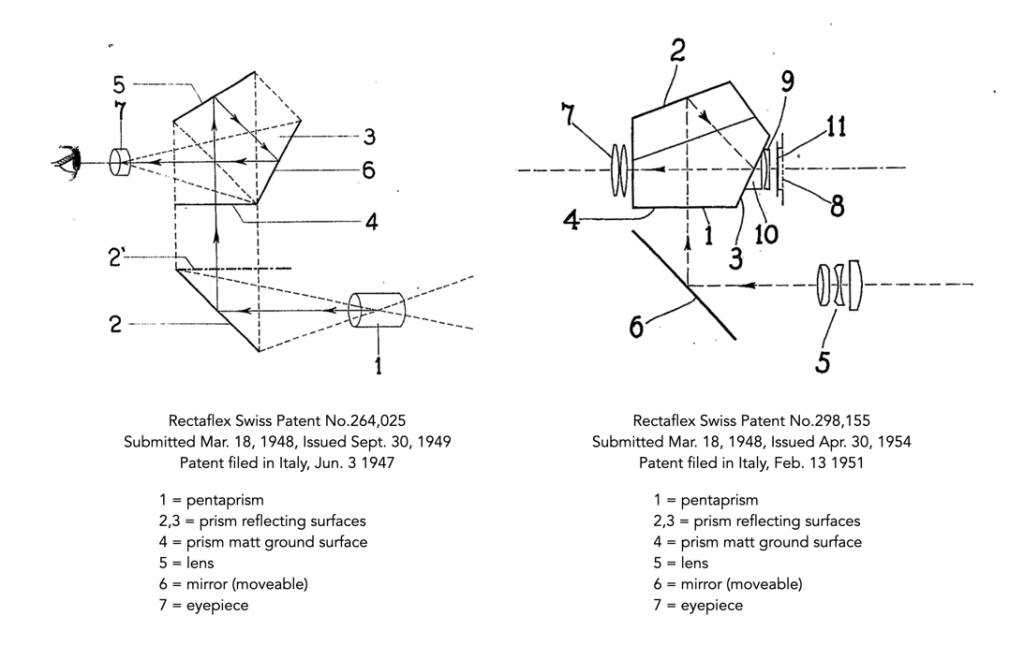
The first SLR manufactured with a pentaprism was the Rectaflex. It was the brainchild of Italian lawyer and camera enthusiast Telemaco Corsi (1899-1974), and was the only Italian SLR ever produced. Work began in 1946, and a prototype was shown at the Milan Fair in 1947 (this model used a flat pentaprism instead of a roof-pentaprism). This system seems to be described in a Swiss patent issued in 1949 (CH264025 based on an Italian patent filed in 1947). At the same fair a year later, a working prototype called the Standard 947 was introduced, with the production model A.1000 for sale in September 1948. Only 1150-odd copies were produced, with Rectaflex introducing the B.2000 in April of 1949, and the B.3000 in September. A patent for this pentaprism system is also described in a Swiss patent issued 1954 (CH298155, filed Jul.5/1951) – “Complementary sighting device in a photographic camera equipped with a reflector mirror viewfinder.”, and a West German patent (DE938764) filed the same month.

Fig.4: The Rectaflex pentaprism patents

The Wrayflex was England’s only attempt at developing a 35mm SLR. On Sept. 2, 1952 Wray (Cameras) Limited received a patent for “Reflex Camera with Curtain Shutter” (US2,608.921, filed on 21 May 1948). It matched a UK patent applied for on May 21, 1947 (GB2608921X), describing an SLR which contains a “pentagonal prism”, which appeared at the bottom of the camera, basically upside-down. However this “prototype” never seems to have been put into production.

Fig.5: The patent for the Wray Optical

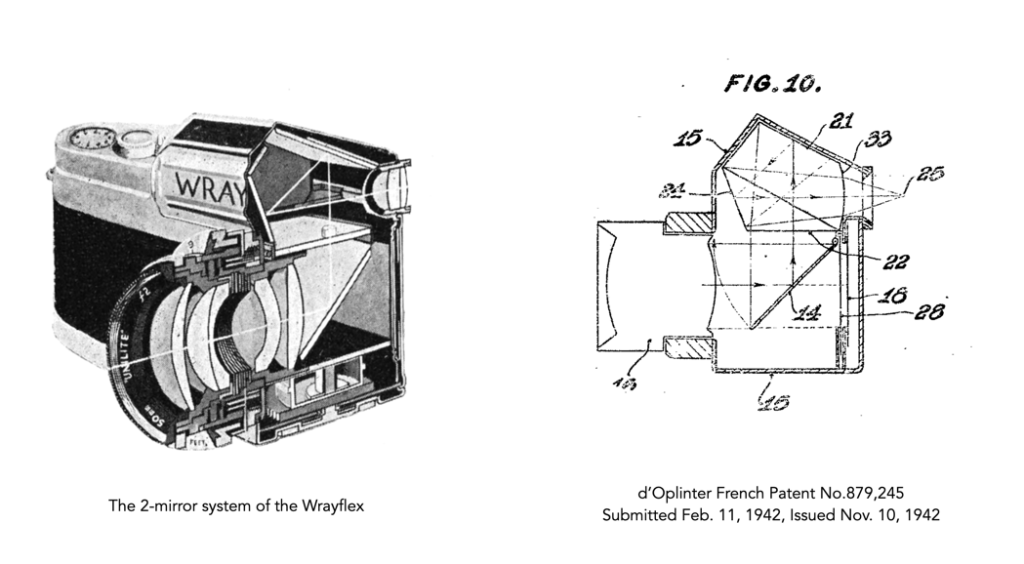
Instead the Wrayflex production model used a mirror which folds backwards and upwards when the shutter is released. This means there was no space for installing a roof prism – instead the Wrayflex used two mirrors, arranged so as to reflect the ground-glass image twice – this arrangement provides an image which is laterally reversed, but the right way up. The two mirrors must be accurately positioned so that there is no possibility of misalignment. The Wrayflex I and Ia both used mirrors, it wasn’t until the Wrayflex II in 1959 that a pentaprism was incorporated. In addition to the Wrayflex, there is also a patents by Belgian Jean de Wouters d’Oplinter (1905-1973), applied for in Belgium on February 11, and May 29, 1941. The French version of the patent, “Improvements to photographic cameras and similar devices”, was issued on November 10, 1942 (FR879245), however this camera was never produced.

Fig.5: The mirror system of the Wrayflex and the patent for the d’Oplinter camera

In September 1949, Rectaflex was to received some competition in the form of the Contax S from VEB Zeiss Ikon. The development of the Contax S (also known as the Spiegel-Contax) basically involved recycling the wartime Syntax project. The camera was introduced in 1949. The prism on the Contax S was built into the camera body. The view was life-sized, a result of three factors: the focal length of the lens, the prism itself, and the small magnifying eyepiece behind the prism. Many early prisms were bright in the centre, but susceptible to fall-off in the corners. Later SLRs used systems to overcome this problem – e.g. condensing lenses underneath the ground glass, a flat fresnel lens which spreads out the light, and increases brightness in the corners. While there were a number of patents filed for this camera, most had to do with the shutter mechanism, and shutter release [2]. There don’t seem to be any patents that relate specifically to the pentaprism mechanism (there are war-era patents but that’s another story). Zeiss Ikon certainly marketed their camera in the light that this was the most significant advance since the SLR itself.

Here is the camera being hailed as the most significant advance in camera design since the first miniature itself. The twin-image, coupled range-finder has given way to a single viewer, the Prisma-Scope which enables you to sight directly through the camera lens. You see a life-size image, always upright and non-reversed, that spins into sharp focus with a twist of the lens barrel. For the first time in a single lens reflex, all focusing and viewing takes place at direct eye level. Without sacrificing the compact qualities of the miniature, the nuisance of parallax is forever eliminated … accessory lenses require no coupling with special and costly range-finders … close-up photography requires only the addition of extension tubes. Here is the most versatile camera ever created!

The third pentaprism 35mm SLR was by Swiss company ALPA. However they went in another direction, choosing a prism derived from an Abbe prism, the Kern prism. The main difference between this and a pentaprism prism is the fact that the latter provides a 90° image, while the former is only 45°. So the early ALPA-Prisma Reflex cameras (introduced in 1949) offered an oblique view, not a perpendicular view. This feature continued until the Model 6c of 1960.

What about the Ihagee Exakta? Well the company that basically created the 35mm SLR was slower to adopt the pentaprism. It was not until 1949 that they incorporated the use of an auxiliary prism, the “Prismenaufsatz”, which provided a corrected right to left image (however it did make the camera top-heavy). Finally in 1950 Ihagee, introduced the Exakta Varex. As ALPA’s system did not produce an eye-level image, this really makes the Varex the third camera with an eye-level pentaprism. It was also the first SLR with an interchangeable viewfinder, as the waist-level viewfinder was still the most common of the period. The first Japanese pentaprism SLR did not appear until the Miranda T in 1955, followed by the Asahi Pentax, Minolta SR-2, Zunow, Nikon F and the Yashica Pentamatic.

So who was first? From a practical viewpoint of a manufactured camera, it was the Rectaflex. But I guess it depends on how you interpret history.

Notes:

  • The Gamma Duflex, designed by Hungarian Jenő Dulovits, was being sold by 1948, however despite some reports, it did not have a pentaprism. The patent for the optical viewfinder system incorporated a Porro-prism, but due to financial constraints only a Porro-mirror was implemented. It was however the first eye-level SLR, and had the first instant-return mirror. A design apparently existed for a ‘Duflex System Reflex S’ which did have a roof pentaprism, but it was never put into production.

Further reading

  1. Schulz, A., “From Syntax to Praktina”, Zeiss Historica, 30(1) pp.7-16 (2008)
  2. Contax S und Pentacon – History, patents, and design issues with the Spiegel-Contax

Vintage camera makers – The origins of Zeiss Ikon

Zeiss Ikon was a part of the Zeiss empire emerging in Dresden in the 1920s as the conglomeration of six German optical companies. But its origins were likely in 1909 with the creation of the Internationale Camera A.-G. (ICA) in Dresden. It was initiated by Carl Zeiss and resulted in the merging of four companies: Hüttig, Krügener, Carl Zeiss Palmos, and Wünsche. This was likely precipitated by overproduction in the photographic industry in 1908.

  • Hüttig AG (1862) − One of the larger camera makers of the period. Produced the first single-lens-reflex camera, the Zeus-Spiegel-Kamera.
  • Krügener − Maker of cameras with magazines.
  • Wünsche AG (1887) − Camera maker: roll film, sheet film, plate film. Notable cameras included the “Bosco” and “Ada” mirror cameras, and the Mars detective camera
  • Carl Zeiss Palmos (1902) − Founded in 1900 as an independent camera company, then absorbed by CZJ.

In 1912 the small Swiss camera maker Zulauf joined the group. After rationalization, ICA produced a number of cameras continuing some of the lines of the founding companies. New products were also added. In 1926 Zeiss Ikon was formed. It was comprised of four companies:

  • ICA – Internationale Camera A.-G. (Dresden, 1909)
  • Optical Institute CP Goerz A.-G. (Berlin, 1888) − Camera and lens manufacturer
  • Contessa-Nettel A.-G. (Stuttgart, 1919) − Camera manufacturer created from the merger of Contessa Camerawerke Drexler & Nagel and Nettel Camerawerk.
  • Ernemann-Werke A.-G. (Dresden, 1889) − Camera maker
The evolution of Zeiss Ikon

To emphasize the focus on photography, the word Ikon was used, the German word for the Greek εἰκών meaning image. The use of Zeiss indicated an affiliation with the parent company in Jena. In 1927/28 two others companies joined the fold:

  • AG Hahn für Optik und Mechanik (Ihringshausen)
  • Goerz Photochemisches Werk GmbH (Berlin)

Over the years, a lot of streamlining was done, slimming down the company from 100 basic camera models in 1927 to 14 basic models in 1938. One of the most important products to come out of Zeiss Ikon was the Contax system, which appeared in 1932. This was followed by the Contax II in 1936. There were many cameras in the 1930s – Ikonta folding cameras, Baldur (a box camera), Contaflex (twin-lens reflex). From 1940 the German economy pivoted to a war economy. The end of the war brought damage to many of the factories, and in 1948 the company was expropriated and converted into a state company (using the designation VEB, meaning Volkseigener Betrieb or publicly owned enterprise). In the same year, the new western headquarters of Zeiss Ikon was established in Stuttgart.

Over the next few years Zeiss Ikon in East Germany changed its name quite a lot:

  • 1945 − VEB Zeiss Ikon Dresden
  • 1948 − VEB Mechanik Zeiss Ikon
  • 1951 − VEB Optik Zeiss Ikon
  • 1955 − VEB Zeiss Ikon
  • 1958 − VEB Kinowerke

In 1959 of course, VEB Kinowerke was folded into VEB Kamera-und Kinowerk Dresden, the precursor to VEB Pentacon Dresden.

In West Germany, the company continued to be known as Zeiss Ikon. In 1956 the Carl Zeiss Stifung, (the parent company of Zeiss Ikon), bought Voigtlander. It continued to be operated as a separate company until 1965, when it was merged with Zeiss Ikon to form Zeiss Ikon-Voigtlander. It produced mostly different products to its eastern brethren, although there were similarities. For example both companies made renditions of the Contax camera. In 1972, Zeiss Ikon-Voigtlander ceased production of cameras.

❖ Zeiss Ikon in West Germany was established at the Contessa-Nettel factory in Stuttgart, the only one of Zeiss’s major facilities not under Soviet control.

What is a pentaprism?

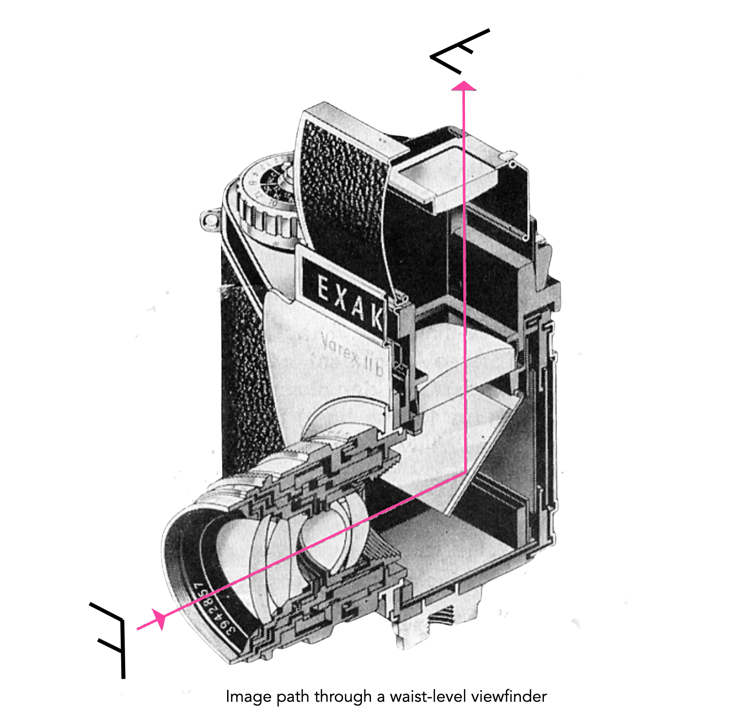
The first 35mm SLR camera, the Ihagee Kine Exakta, used a horizontal waist-level viewfinder. This was not unusual for the period, as there was no other means to view a picture through the camera at an eye-level (that wasn’t a rangefinder camera). The problem is that the image viewed would be flipped left-to-right. This would be rectified by the introduction of the first production pentaprism camera in 1947, in the guise of the Italian Rectaflex. The technology became more mainstream with the introduction of the Zeiss Ikon Contax S in 1949 (although waist-level viewfinders would still be dominant until the mid-1950s).

Fig.1: Early SLRs did not have a pentaprism, but instead required the photographer to look through a waist-level viewfinder

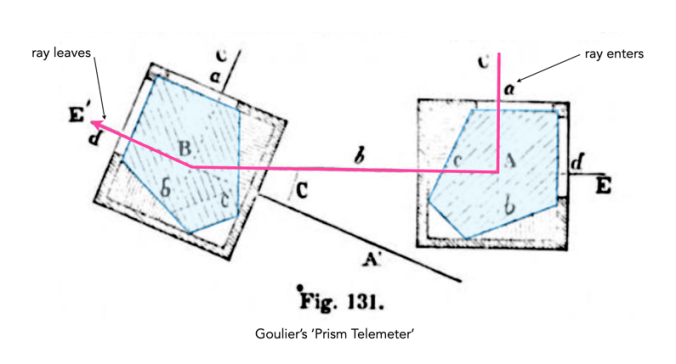
A pentaprism or pentagonal prism is a five-sided glass prism (although technically while the cross-section of a pentaprism is bound by five sides, it actually has seven or eight). Prisms were already being using in the Victorian era to design telescopes and binoculars. The use of a pentaprism in optics stems from an invention by a Captain Charles-Moÿse Goulier (1818–1891) of the French engineer corps in 1864, a “triangulation prism telemeter” [1]. It was a device with twin sighting paddles, connected by wire 40 meters long to establish a fixed baseline. Each paddle contains a five sided prism to give simultaneous orthogonal views. It may have been the first use of pentagonal prism in optics.

Fig.2: The pentaprisms used in Goulier’s 1964 invention (adapted from [1]).

This form of conventional pentaprism, sometimes referred to as a flat-roof or Goulier prism, is characterized by a 90° deviation angle (Fig.3(1)), i.e. it deviates a beam of light by 90°, reflecting the beam inside the prism twice. It is comprised of two reflective faces (Fig.3(1)b,c), arranged at 45° between them and two faces orthogonal to each other (Fig.3(1)a,d). The two surfaces performing the reflections are coated to provide mirror surfaces (e.g. silvered). The two opposite transmitting faces are often coated with an anti-reflective coating. In imaging applications this pentaprism will neither invert nor reverse an image, e.g. Fig.3(1). In the context of an SLR this still holds true, because the image is flipped as it passes through the lens and it is this flipped image that passes through the prism. So in the context of the ‘flippedi image, it is neither inverted or reversed. However, compared to the original object in front of the lens, the image viewed at the eyepiece is reversed left-to-right. Prior to the end of WW2, conventional pentaprisms were commonly used in telescopes, binoculars, and military equipment such as rangefinders.

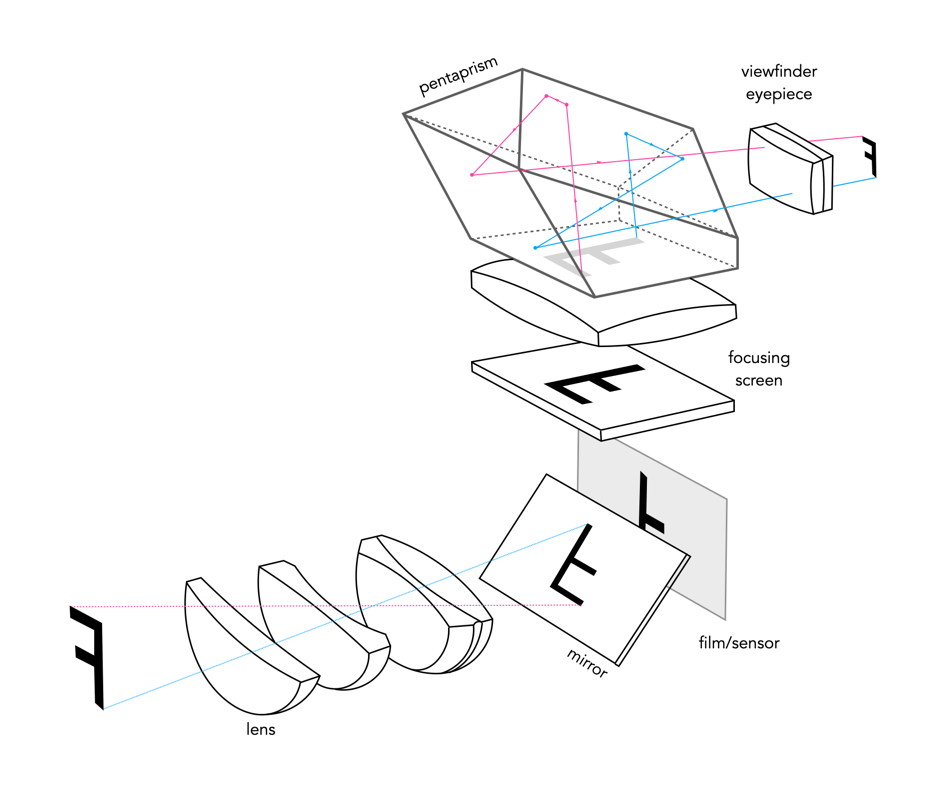
This is illustrated in Fig.3(3) where the object F passes through the optical system of an SLR. The F is flipped by the lens and this flipped version of the F passes through the prism. The image viewed at the eyepiece is neither inverted nor reversed from that projected on the mirror. However compared to the original F, the image is reversed left to right.

Fig.3: The flat-roofed (conventional) pentaprism: (1) a simple optical path, (2) a breakdown of the angles, and (3) used in the context of an SLR optical system.

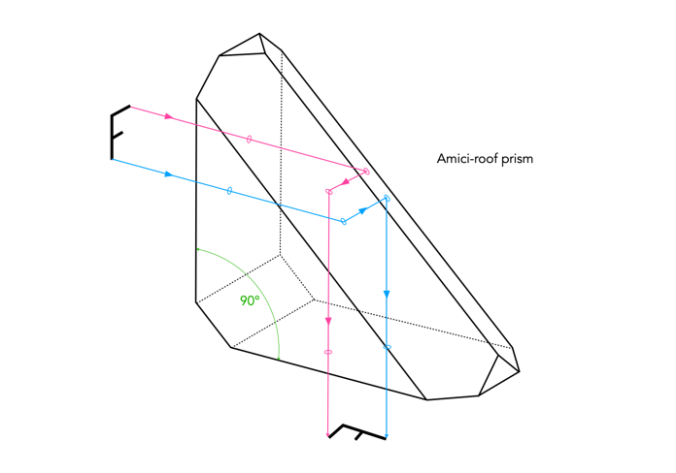
The more complex pentaprism found in the majority of SLR cameras is the roof pentaprism which reverses an image from left-to-right. It is similar to a conventional prism, but with the addition of two silvered “roof” surfaces. The concept of a roof prism was created by Italian astronomer Giovanni Battista Amici (1786-1863) in the mid-1800s. His Amici-roof prism, also known as a right-angle roof prism, was capable of reverting and inverting the image of an object while bending the line of sight through a 90° angle (Figure 4). It was used in various types of telescopes.

Fig.4: The Amici-roof prism.

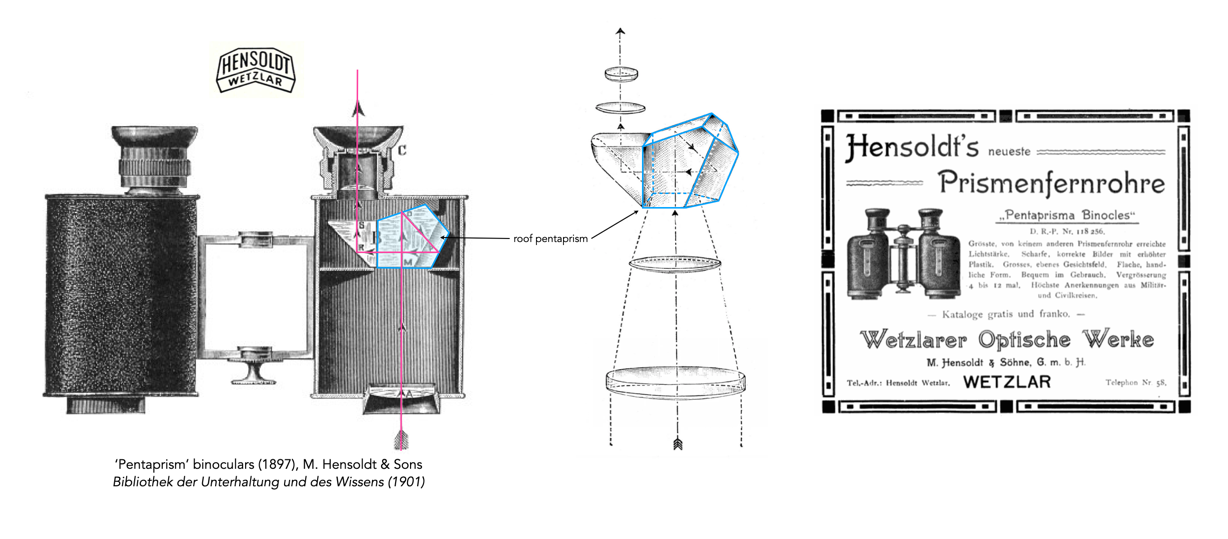
A roof prism is a prism containing a section where two faces meet at a 90° angle, resembling the roof of a building. Reflection from the two 90° faces returns an image that is flipped laterally across the axis where the faces meet. The first large scale use of a roof pentaprism may have been in binoculars, like the Pentaprisma Binocle 7×24 made by Hensoldt & Söhne (Wetzlar) introduced in 1900. An earlier version of the binoculars (1897) used a flat pentaprism attached to a right-angle prism with a roof (like an Amici-roof prism). This arrangement was denied a patent in Germany, due to a conflict with a Zeiss patent (DE77086, which used a Porro-prism), however was granted a patent in Great Britain (GB15806, 1898). The newer version of 1900 had a dialytic (split) optical system where the pentaprism had a roof edge (Figure 5).

Fig.5: Hensoldt & Söhne’s ‘Pentaprism binoculars’ (1900)

In an eye-level SLR, the roof pentaprism is inserted between the focusing screen and the viewing eyepiece. The roof pentaprism, by introducing extra reflecting surfaces, shows the object both upright and with the right and left sides in their proper place. The bottom surface of the pentaprism may form the focusing screen, or the latter may be positioned directly below the prism. The focusing screen may be of several different kinds, including plain ground glass, to various combinations of clear glass, ground glass, or micro-prism focus finder.

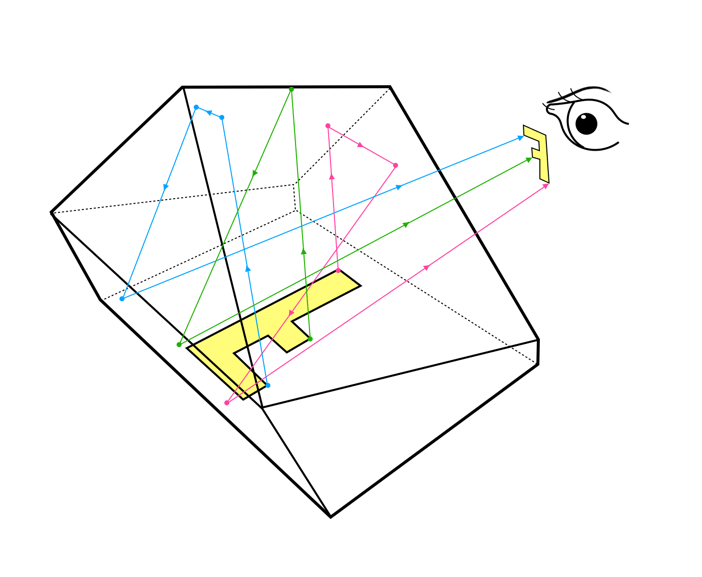
Fig.6: An example of light passing through a roof-pentaprism

The light passing through a roof-pentaprism undergoes three separate reflections in order that the image is seen both right way up and right way round. The image enters the prism right way up, but laterally reversed, so that as the image must be turned again through 90° to allow it to be viewed at eye level, it must be reflected twice to keep it right way up. The third reflection has no effect on the vertical aspect of the image but it merely used to reverse the image laterally so that it is seen right way round.

Fig.7: Image passage through an SLR camera using a roof-pentaprism

The basic history of the pentaprism as it relates to the SLR can be found in a separate post. But a summary is provided below. A timeline of early SLR pentaprisms:

  • 1933 − Kurt Staudinger issued a patent for a reflex device, i.e. a penta-mirror
  • 1937 − Zeiss Ikon (Germany) begins work on the Syntax, a camera with a pentaprism. Patents exist for the concept, but the prototypes, ca. 1944 were destroyed during the war.
  • 1948 (Sept) − First commercially produced SLR with a roofed pentaprism, the Rectaflex (Italy). An earlier 1947 prototype used a flat pentaprism.
  • 1949 (Sept) − Zeiss Ikon (GDR) introduces the Contax S, the second SLR with a pentaprism, essentially recycling the Syntax.
  • 1949 − ALPA introduces the ALPA Prisma Reflex, a pentaprism with a 45° view. ALPA would not introduce a normal perpendicular view until the Model 6c (1960).
  • 1952 (Sept) − Wrayflex receive a patent for an SLR with a “pentagonal prism” which was never produced. The first Wrayflex with a pentaprism was the Wrayflex II (1959).
  • 1955 − The first Japanese SLR with a pentaprism, the Miranda T.

Note that a pentaprism is different to a penta-mirror, which instead of a glass prism uses three mirrors to perform the same task. Using a glass prism has definite benefits over mirrors. Changes in light direction in a prism is based on the notion of total reflection, which means reflectances of close to 100% can be achieved, while silver mirrors lose at least 10% to absorption losses. A glass prism is also better because the refractive index of glass causes a shortening of the light path.

Notes:

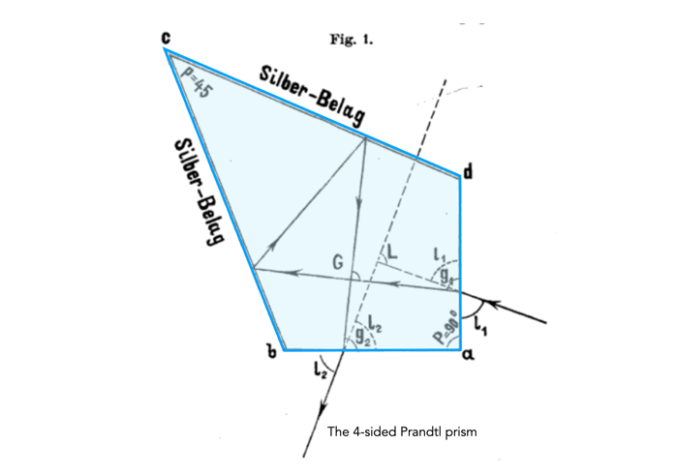
  • Goulier’s prism is sometimes known as the Prandl prism (or even the Goulier-Prandl prism), and is often cited as such, particularly in German literature. Now a cursory search will find very little, but digging a little deeper finds a paper published in the German journal Zeitschrift für Vermessungswesen (Journal of Surveying) in 1890, by an Alexander Prandtl [2]. Prandtl (1840-1896) was a professor at the Royal Bavarian Central Agricultural School in Weihenstephan specializing in dairy farming. But the paper describes a 4-sided prism, similar to Goulier’s prism except the extra side between the two surfaces meeting at 45° is missing. The other issue is the fact that Goulier’s prism was described 26 years previously. Prandtl’s real claim to fame was developing the first continuously operating milk centrifuge.
  • Hensoldt & Söhne created their first product, a rangefinder using a roof prism in 1892. The company would go on to develop the Hensoldt roof prism (DE180644, 1905) which required no mirroring, and had no axis offset, allowing for straight binoculars. In 1938 the Carl Zeiss Foundation would take a majority share in Hensoldt. It is entirely possible that this mechanism formed the basis of the work done on the Zeiss Syntax SLR in the late 1930s and early 1940s.
Fig.8: A depiction of the Prandtl prism (adapted from [2]).

Further reading:

  1. Barnard, F.A.P/, “Prism Telemeter”, Report on Machinery and Processes of The Industrial Arts and Apparatus of the Exact Science, p.589-592 (1869)
  2. Prandtl, A., “Ein neues Instrument zum Abstecken von rechten Winkeln” (A new instrument for marking out right angles), Zeitschrift für Vermessungswesen, 19, pp.462-467 (1890)

Updated: November 27, 2025.

Vintage camera makers – The origins of Pentacon

Post-WW2 there were still a lot of camera companies in Germany, and particularly in East Germany. In fact the heart of the German camera industry lay in Dresden, Jena and the surround area. Over the next decade, many of the companies were merged into a series of VEBs (Volkseigener Betrieb or Publicly Owned Enterprise) culminating with VEB Pentacon.

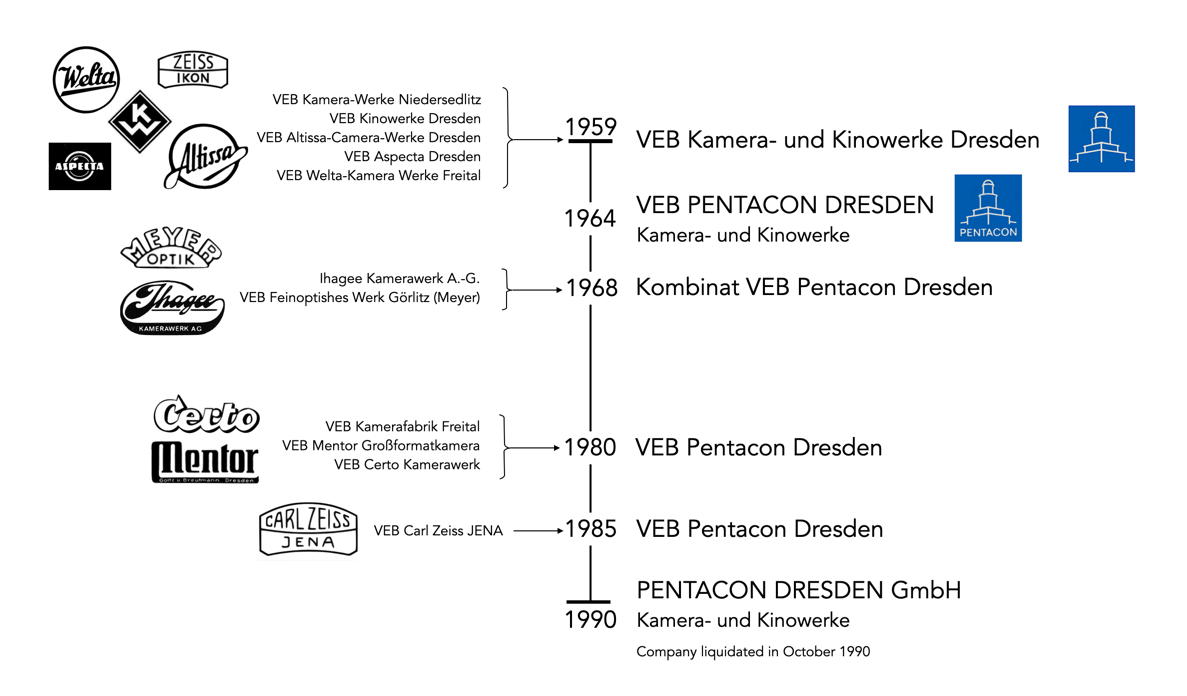
On January 1, 1959 a series of Dresden camera manufacturers were merged to create the large state-owned VEB Kamera und Kinowerke Dresden (KKWD). The company was a conglomerate of existing companies which produced a broad range of products and had numerous production sites. Joining them together meant production could be rationalized, yet cameras were still produced under their brands names, e.g. Contax, Welta, Altissa, Reflekta, Belfoca.

  • VEB Kinowerke Dresden − Formerly VEB Zeiss Ikon
  • VEB Kamera-Werke Niedersedlitz − This is where the Praktiflex, precursor of the Praktica, was invented; it included VEB Belca-Werk absorbed in 1957.
  • VEB Welta-Kamera Werke Freital − This included the VEB Reflekta-Kamerawerk Tharandt and Welta-Kamera-Werk Freital (Reflekta II, Weltaflex und Penti).
  • VEB Altissa Kamerawerke Dresden − Formerly Altissa-Camera-Werk Berthold Altmann, (including Altissa, Altiflex and Altix cameras).
  • VEB Aspecta Dresden − Formerly Filmosto-Projektoren Johannes (including projectors, enlargers, lenses).

In 1964 the company was renamed to VEB Pentacon Dresden Kamera-und Kinowerke. This was intended to provide a catchy name for the company (not forgetting that a lot of its products were intended for Western markets). Pentacon was already being used as the export name for the mirror Contax D, and was derived from PENTAprisma and CONtax. Pentacon used the stylized silhouette of the Ernemann Tower (on the old Ernemann camera factory site, which belonged to the former Zeiss Ikon) as its corporate logo. The company continued to produce good SLRs: Praktica V (1964), Praktica Nova with return mirror (1964), Praktica Nova B with uncoupled light meter (1965), Praktica Mat for the first time with TTL interior light metering (1965). In 1966 the 6×6 format Pentacon Six appeared, with the Praktica PL Nova I in 1967.

The evolution of Pentacon

On January 2, 1968, the VEB was restructured, and more companies were added into the fold, including Ihagee Kamerawerk (which had remained independent until this point), and VEB Feinoptisches Werk Görlitz. The name became Kombinat VEB Pentacon Dresden.

  • Ihagee Kamerawerk AG i.V. − Produced Exakta and Exa cameras.
  • VEB Feinoptisches Werk Görlitz − Formerly Meyer-Optik Görlitz

The continuous expansion and bundling of technical expertise and concentration of the production capacities of the Pentacon, led to the incorporation of three more companies in 1980.

  • VEB Kameratechnik Freital − Formerly Freitaler camera industry Beier & Co., including Beirette cameras.
  • VEB Mentor Großformatkamera − large format cameras
  • VEB Certo Kamerawerk Dresden − folding cameras

Finally in 1985, VEB Carl Zeiss JENA was added. Unfortunately it was likely all too late. There were scarce few years between this and the reunification of Germany. In July 1990 the company was renamed PENTACON DRESDEN GmbH, but by October it was being liquidated.

Choosing a vintage lens – things to consider

After looking at the basics of vintage interchangeable lenses, there is a point when you will have to make some decisions about choosing a lens. There are literally millions of vintage lenses out there in the ether. Some are exceptional, most are good, some are mediocre. But even mediocre lenses can be interesting if they are cheap enough, and you want to experiment (even if that involves taking a lens apart and putting it back together again).

Choosing a lens is often quite a daunting experience, because there are so many possibilities, and it can be hard to narrow things down. Some people only buy lenses from a single manufacturer, others only buy lenses of a single focal length, others only buy lenses from a specific time period, and still others buy lenses that have a cool bokeh effect. The type of vintage lens you buy is a very individualistic thing. You can read the reviews about particular lenses, and formulate your own opinion about buying a lens, but you never really know what you get until you use it. Lenses come in different versions, and sometimes from different factories. Choosing a lens is also more than just looking at quantitative data such as lens sharpness, it is often more about the aesthetic appeal of the image produced, than the exactness of the MFT (Modulation Transfer Function) diagrams.

The best place to start is to decide what the lens will be used for. This aids in determining the focal length and lens characteristics, helping to constrain the search. For example someone who takes architectural photographs may be interested in a shift perspective lens such as the Olympus OM 35mm f/2.8 Shift lens. For astrophotographers, a sharp lens that is well corrected for coma is important. Those who take portraits may opt for a 85mm lens. If you have no specific needs, then start with a 50mm lens – it is by far the most common vintage focal length (and every manufacturer produced various models). Don’t forget that a lens behaviour will depend on the size of the camera’s sensor it is used on. For example a 50mm lens with a standard 46° diagonal angle-of-view, will behave like a “full-frame” 75mm lens on an APS-C sensor (with a diagonal AOV of 32°), i.e. the 50mm lens will be “the equivalent of” a 75mm FF lens.

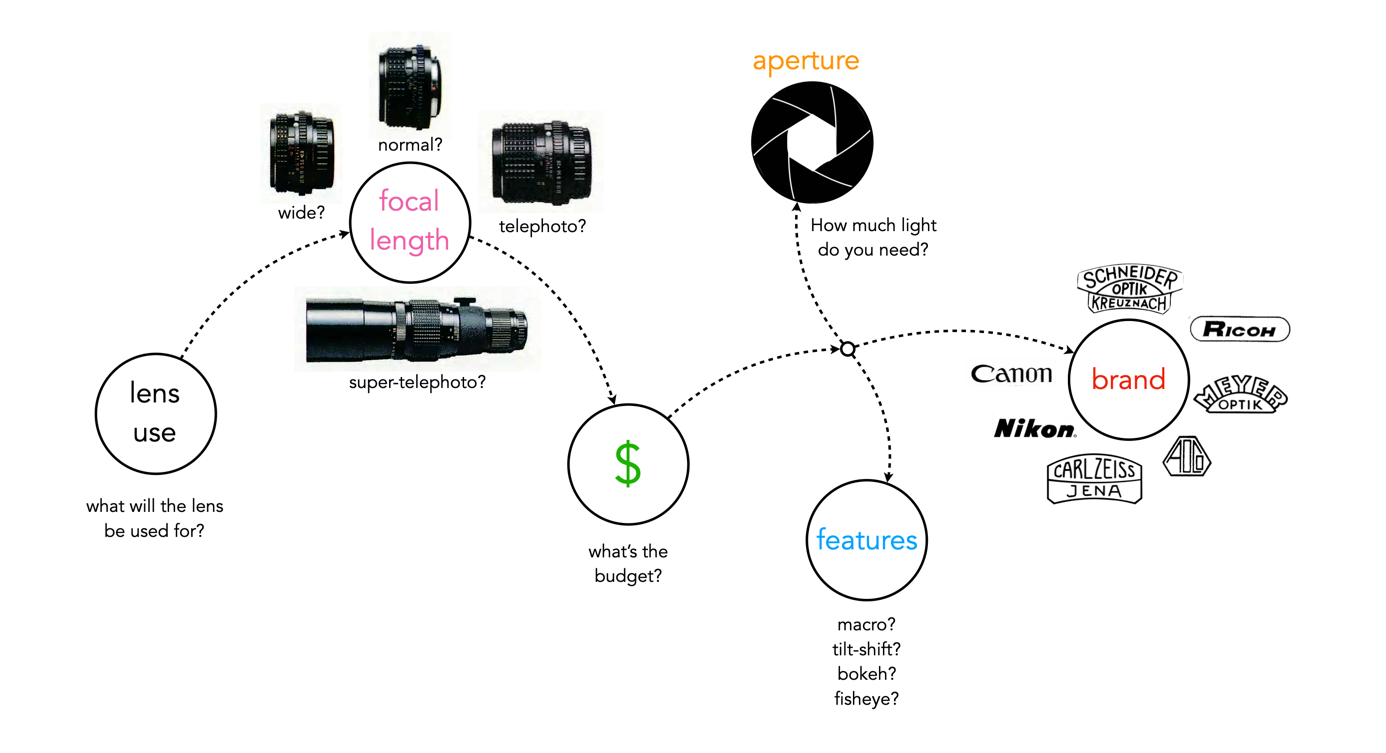
Things to consider when choosing a vintage lens: lens use, focal length, budget, features, aperture, brand
Things to consider when choosing a vintage lens

Once you have an idea of the focal length, then you need to decide what features you want: must-haves, nice-to-haves, and things-not-needed – and of course how much you want to spend. Choosing a focal length is of course the easy part. Now you have to choose a brand, and a configuration (aperture, number of aperture blades, mount). This is harder because there are a lot of choices. Sometimes the best approach is to take the lead from someone who has done some of the hard work for you. For the beginner, there is very little difference between any 50mm lenses from the core camera manufacturers: Pentax, Canon, Nikon, Minolta, Zeiss, etc., they are all pretty good. Of course the “elephant in the room” is often budget. Choosing an upper limit on how much you are willing to spend on a lens will help constrain your search from the get-go, which helps avoid pursuing lenses that are nice, but just ooh too expensive. it you can’t afford it, don’t go there.

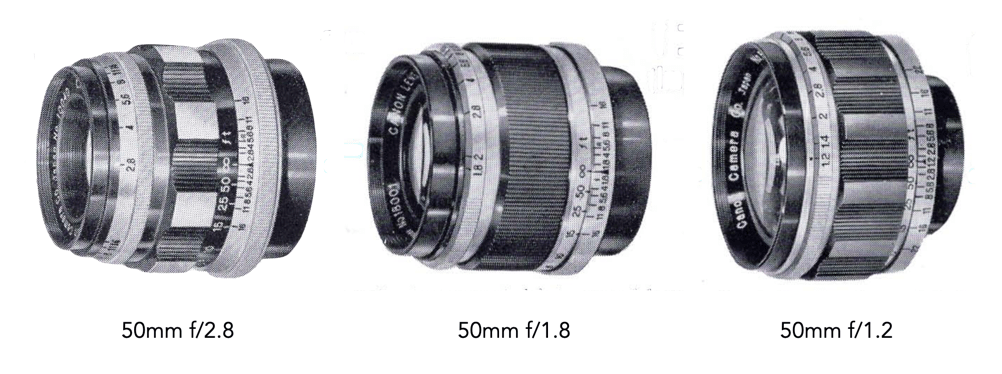
Now with a focal length, and a budget, it’s time to explore aperture, or lens speed, i.e. when the aperture of a lens is completely open, how much light comes in. In situations where you are shooting in broad daylight, then is there any need for a 50mm f/1.4 lens, or would a f/2 suffice? For example, Canon 50mm rangefinder lenses were produced in three different types: f/2.8, f/1.8, and f/1.2. The f/2.8 is 128g, the f/1.8 is 270g, and the f/1.2 is 322g. The f/1.2 lens will provide a lot of light, but at 2.5 times the weight. A lot of effort can be put into deciding the speed of the lens. However the faster the lens, i.e. the larger the aperture, the more expensive the lens will be. Don’t spend a lot of money on your first few of lenses. You can experiment with these lenses and decide whether using vintage lenses is for you.

Canon rangefinder 50mm lenses

Once you have chosen a lens, it is good to review some of the literature on the lens. How expensive is it? What about availability – is it common or rare? Is the lens generally found in good stead, or is it susceptible to abnormalities such as fogging/hazing, or has a front lens which is easily scratched? For example it is common knowledge that some of the Canon rangefinder LTM mount lenses are very susceptible to fogging. Is it easy to repair if there are issues?

Then it helps to look at some reviews, either on blogs, or videos. Just remember that reviews are a subjective viewpoint from someone with similar or differing circumstances to your own. Try and stick to reviewers that have a long history of reviewing vintage lenses. If their lens review, how did they evaluate the lens? Did they show actual photographs taken using the lens, in a good variety of situations? Did they take the shots using the same sensor size as your camera has? Was it a review performed with the lens on a film camera? It’s best to look at several different views, but always keep in mind that the lens you might buy will be different to the one they are reviewing. It could be a newer model of a lens which uses the same optical formula, but is housed differently, or uses a different aperture mechanism, e.g. number of blades; or perhaps it uses a different type of glass in some of the lens elements, e.g. thoriated versus regular glass. There is never a guarantee that the lens you buy will behave in exactly the same manner.

Don’t choose a lens solely on its specifications. Just because a 50mm f/1.2 lens seems like a good idea because it is rare, and some people proclaim it as the “best” lens, does not mean it will work properly for what you want it to do. Don’t be swayed by the large collections of some photographers. Some people take photographs for a living, and so may have more requirements, and also more ability to sustain large collections. Having dozens of 50mm lenses is fine, if you can afford them, and if you are actually going to use them (and it’s easy to fall down this rabbit hole). You may decide after some investigation that the lens you had coveted it really not something you need – for various reasons. Maybe it’s too expensive? Maybe it’s too hard to find? Maybe it is notorious for needing repairs?

Vintage lenses – some general FAQ

Here are some questions relating to vintage lenses, things that people might like to know before they dive into the world of vintage lenses (and how to choose them).

Can any vintage lens be used on a digital camera?

Just about. Most mirrorless full-frame and crop-sensor cameras can be used with vintage lenses, but there are some lenses which don’t work, either because they have a strange lens-mount, or the lens itself projects too far beyond the mount into the camera.

Are vintage lenses affordable?

Vintage lenses were once quite inexpensive, but as more people discover them, some are increasing in price – well the popular ones are. That being said, they are still often cheaper than modern glass, especially the faster lenses. For example, the Super-Multi-Coated Takumar 50mm f/1.4 sells for around C$100-150. The 8-element version of the lens, the Super-Takumar, in good condition usually sells for C$300-500 (which is still pretty affordable). The most affordable vintage lenses, are often those mass-produced kit-lenses that don’t get a second look at. Leica lenses are nearly always expensive.

What is the best vintage lens?

There is really no such thing, because the inherent character of a lens is very subjective. Many people swear by the Carl Zeiss Jena lenses, others prefer the Asahi Pentax Takumar series, and yet others gravitate towards Nikon. There are a lot of “best vintage lenses” lists out there, but it is best to look at reviews of people who use a lot of vintage lenses. For example Zenography, Simon’s utak, or Mark Holtze all have great vintage lens reviews on their respective YouTube channels.

Is there such a thing as a perfect vintage lens?

No, even the most sought-after lenses can have limitations. For example the 8-element Takumar 50mm f/1.4 does not outperform other legacy lenses in certain situations. It can be quite soft when the lens is shot wide open in some circumstances, and is a heavy lens. Yet people are still charmed by the lens because it does a really good job with colour rendering. It produces warm colours with very little vignetting. The Takumar lenses also have good ergonomics.

What about vintage zooms?

Some people like them, others don’t. The reality is that there are many really good, well-built early zoom lenses out there, and because they are often so underrated, they are really quite inexpensive.

Aren’t newer lenses better?

Newer lenses are more technologically savvy, and the glass is likely to be near perfect (although truthfully there is no such thing as a perfect lens). Modern lenses built for digital cameras try very hard to remove abnormalities, which is the very reason most people gravitate towards vintage lenses. Modern lenses are also inherently more complex. For example the Olympus Zuiko 25mm f1.2 Pro (MFT 50mm FF equivalent) has 19 lens elements in 14 groups, including low dispersion, high-refractive, and aspherical elements. The vintage equivalent, the Olympus OM Zuiko AUTO-S 50mm f1.2 has 7 elements in 6 groups. Vintage lenses often use a very simple optical designs that have been around for a hundred years. Do you really need a lens with 15 lens elements, or will 6 do?

Are all vintage lenses manual?

Practically all vintage lenses require manual focus, and manually setting the aperture. Manual focusing is slower than autofocus, but most mirrorless cameras provide tools, e.g. focus peaking, to help with the process of manual focusing. Manual focus lenses might not be an optimal choice for activities such as travel involving fast-paced tourism, but it brings you closer to understanding the subtleties how a camera-lens combination works.

Is there a good range of focal lengths?

Brands aside, there is usually a good selection of focal lengths available. The most common focal length is 50mm, because of it’s “normal” status, and the fact that it came as the standard “kit” lens on most cameras. After that there is a good range of wide-angles (28mm, 35mm), and short telephotos (85-135mm). Ultra-wide angle lenses are rarer, yet there seems to be a wide range of telephotos (possibly because they aren’t as popular).

What about the build quality of lenses?

Many of these lenses were built tough. They featured solidly build body’s with aluminum lens barrels and stainless steel mounts. Without a bunch of electronic and motors inside to facilitate things like auto-focus, vintage lenses can often be quite compact, and light. They are robust, easy to fix, and lack the complex electronics of modern lenses (meaning they will last for decades).

How does adapting a vintage lens to a crop-sensor affect it?

Most vintage lenses were designed for 35mm film cameras, and their equivalent is full-frame digital cameras. So a vintage lens put on a crop-sensor camera will behave the same way as any other lens on a crop sensor, i.e. its angle-of-view will be modified. For example you could choose any vintage 50mm lens, and when added to an APS-C camera it would behave like a 75mm lens in “full-frame equivalency”. Used on a camera with a MFT sensor, it would behave like a 100mm FF equivalent.

Can vintage lenses be used to create retro-looking images?

Possibly, it really all depends on the type of lens, and the type of digital camera it is used upon. There are many more variables involved with using digital cameras, as opposed to film cameras. It is possible to try and replicate the “look” of old photos, but digital cameras will not replicate film 100%.

Where is the best place to buy vintage lenses?

I have covered this in a separate post. I also maintain a list of “Where to buy what”.

So mechanical cameras were simple right?

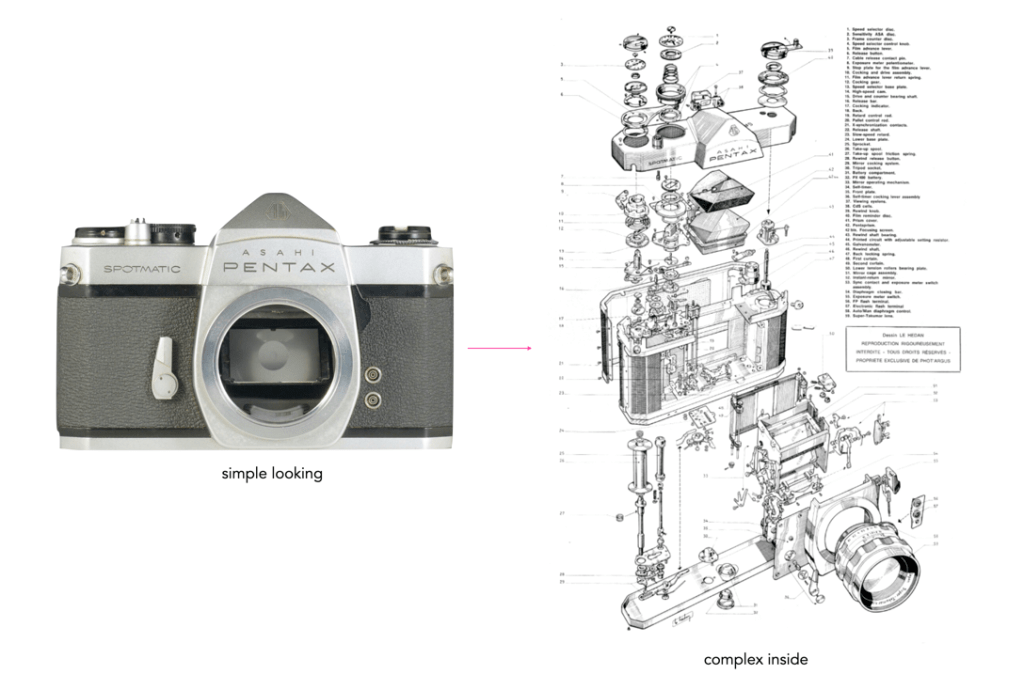
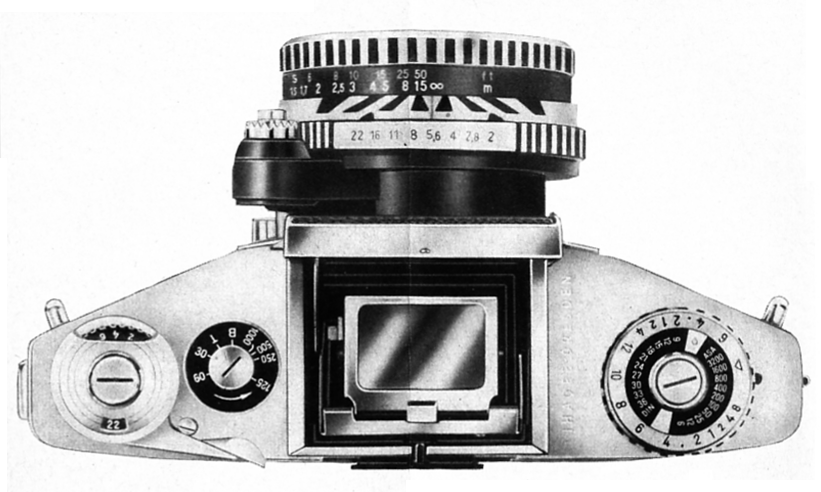
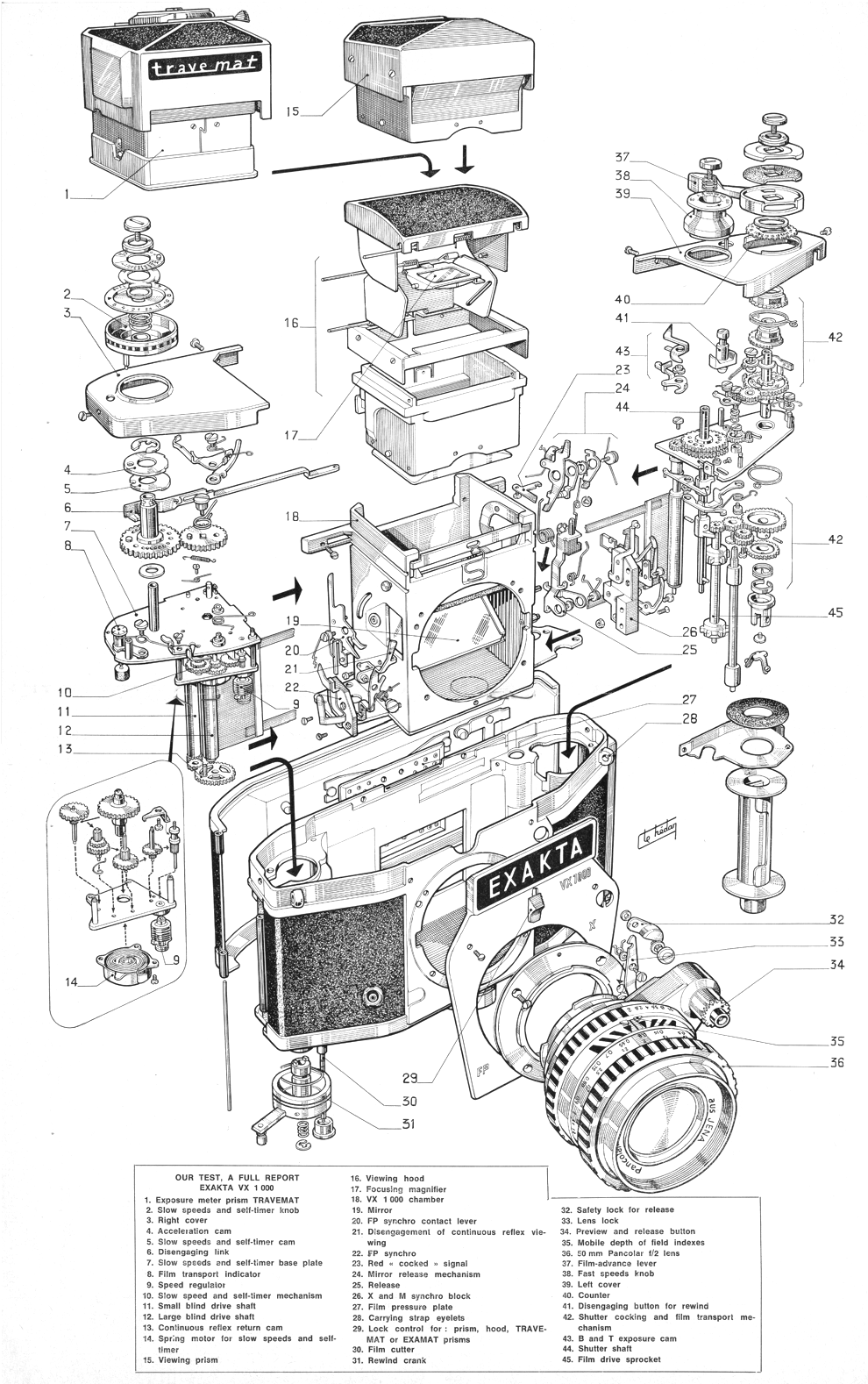
There were various types of analog cameras, but the simplest were mechanical cameras, that contained no electronics at all. That means everything that happened inside was mechanical in nature. Not that much really happened, I mean the mechanisms basically moved the film forward, set the film and shutter speeds, and set/activated the shutter mechanism (and move the mirror). But these mechanisms were inherently complex, and the cameras themselves were typically built by hand. A plan view of an Exakta VX1000 camera shows how simple it was…

… but the workings inside were another matter altogether – which was basically comprised of a whole lot of sprockets, rods, and some levers. Things got even more complicated once electronics were introduced.

How a f/0.71 lens helped advance TB screening

Charles G. Wynne (1911-1999) was a lens pioneer, but not in the traditional sense, i.e. his forte was not traditional photographic lenses. We presume sometimes that all advances in photography were made in the realm of cameras, but there are other fields that require lenses as well. Wynne began has optical career at Taylor, Taylor and Hobson Ltd. in 1936, after graduating from Oxford. Wynne worked for TT&H until 1943, when he moved to Wray Optical Works. Here he was not just an assistant, but a lens designer in his own right. His first job at Wray was improving the short focal length aerial reconnaissance lenses that the company made for the RAF.

Wynne designed a series of interchangeable lenses for Wray’s 35mm SLR, the Wrayflex camera, the only British full-frame 35mm SLR camera ever made. Around 1950, there was an opportunity for developing fast lenses for use in the photography of cathode-ray tube (CRT) images and the phosphor screens that were used in X-ray machines. Wynne developed a f/0.71 lens, which although too expensive for industrial CRT photography, was ideally suited the the mobile mass screening program of the 1950s that helped eradicate TB. Wynne likely gleaned some personal satisfaction from this lens, as he had contracted tuberculosis whilst at Oxford. The f/0.71 lens used exposure times eight times shorter than a typical modern photographic lens with an aperture of f/2.0.

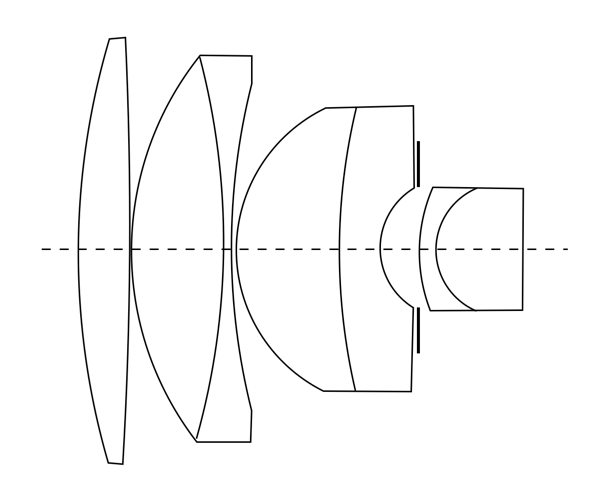
The Wynne 64mm f/0.7 lens
  1. Wynne, C.G., Wray, P., “A new form of f/0.71 lens for 35 mm cine-radiography”, Journal of Scientific Instruments, 28, pp.172-173 (1951)
  2. Maxwell, J., Wormell, P.M.J.H., “Charles Gorrie Wynne“, The Royal Society, p.499-514 (2001)

Asahi and the Pentax name

If you do a search for “German Pentax” you will likely come across a reference to a German camera. Of course the name brand Pentax is most often associated with Japan’s Asahi Optical, but it wasn’t always the case. The name Pentax started life behind the Iron Curtain at VEB Zeiss Ikon Dresden. Zeiss Ikon was one of the photographic companies formed in East Germany after the division of Germany into East and West.

Zeiss Ikon Pentax

In 1954 Zeiss Ikon, based in Dresden, began work on a new 35mm camera. It was designed to use the new Zeiss 50mm f/2.8 lens, but was quite radical from a design perspective, looking more like a 120 film camera of the period. There only seem to be prototypes of this camera, and if you want to learn more you can check out the post on Marco Kroger’s website zeissikonveb.de. He says the first version of the camera was intended to be a 6×4.5 120-film camera, with the film loaded in removable cassettes. The page includes some interesting technical drawings of the camera.

But where did the name Pentax come from? Well due to the division of a number of German camera companies, there were some issues with product naming, mostly related to trademark infringement. As East German companies wanted to sell their products in the West, they often had to come up with new names. For example the name Contax was already being used by the West German Contax company. To circumvent this, East German companies often created portmanteau words by blending two words. For example, Pentacon was derived from “PENTAprism” and “CONtax”. Therefore it is thought that the registered trademark Pentax was derived from PENaprism ConTAX.

Because Zeiss Ikon had a name but no camera, it sold the name to Asahi in 1954 who attached it to their first Pentaprism SLR in 1957 – the Asahi Pentax.