Vintage SLR cameras – the Mecaflex

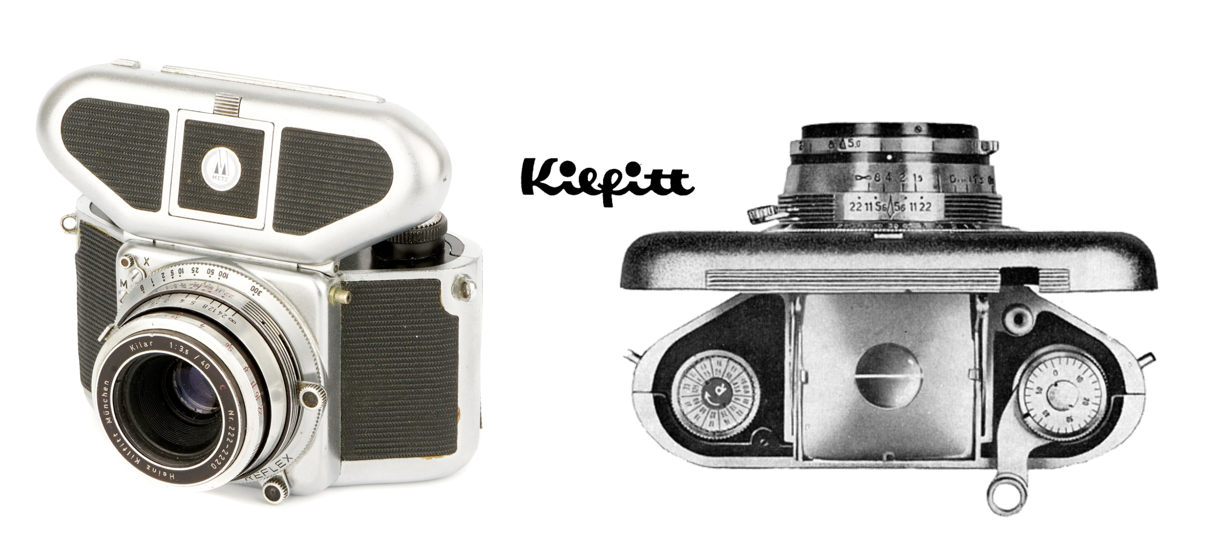
The Mecaflex is a 35mm SLR made by German designer Heinz Kilfitt, who is better known for having designed the successful Robot camera, and high precision lenses such as the Macro Kilar, and Voigtländer Zoomar (the first 35mm zoom lens). Presented at Photokina in 1951, it was first sold in 1953, they were manufactured for Kilfitt by Metz Apparatefabrik located in Fürth, Bavaria (West Germany). Production by Metz continued until 1958 but few units were actually built. Metz, dissatisfied with the collaboration withdrew from the partnership shortly afterwards. Production then shifted to Société d’Etude et Recherche Optique et Acoustique (S.E.R.O.A.) a camera maker in Monaco. This camera is better known as the Kilfitt Mecaflex, with the lenses also produced by Kilfitt.

Fig.1: The Mecaflex camera

It was a very aesthetically pleasing and compact camera at 9×6.5×6.5cm. However it was quite heavy at 700g. It had a flip-top cover which gave it very clean lines when closed. When opened to 90 degrees, the cover revealed the waist-level viewfinder and top-plate controls. The size of its exposures was a smaller 24×24mm, providing for more images on a film roll (some 50). One of interesting features was an early spring-loaded diaphragm. When the shutter and spring-loaded diaphragm mechanism of the Mecaflex are cocked, a bright, parallax-free ground-glass image appears, and this remains bright until the shutter is released. A push-up finder was also provided as an accessory. which could be inserted into the viewfinder

Like many other West German cameras, it too incorporated a Prontor behind-the-lens leaf shutter with speeds of 1 to 1/300s (+B). The camera had a bayonet mount, and used lenses designed by Kilfitt, and it was usually paired with a Kilar 40mm f/3.5 or f/2.8. The other lenses were the 40mm Makro-Kilar’s and Tele-Kilar 105mm f/4.5. Some additional lenses were made under license by SOM Berthiot (Paris). The camera was produced until 1958. It is possible to still find these for around C$1300-2000.

Specifications:

Type: 35mm SLR camera
Manufacturer: Metz (West Germany) ver.1, Kilfitt ver.2
Model: Mecaflex
Production period: 1953−1958
Format: 24×24mm on 135 film
Lens mount: bayonet
Standard lens: Kilar 40mm f/3.5
Shutter: leaf-shutter, Prontor-Reflex behind-the-lens
Shutter speeds: 1 to 1/300 sec., B (1 to 1/250s, B in the SEROA camera)
Viewfinder: waist-level viewfinder + central split-image rangefinder
Mirror: yes
Exposure meter: −
Flash synchronization: X, M
Self-timer: −
Aperture control: −
Film advance: lever wind
Weight/dimensions: 700 grams / 900×650×650mm

Vintage SLR cameras – the phantom Zunowflex

Zunow was a Japanese company best known for it’s innovation in superfast lenses. During the last few years of its existence, the company designed a couple of camera’s including a prototype of a Leica copy, the Teica, and their first 35mm SLR, the Zunow Pentaflex or ‘Zunowflex’. Work on the camera supposedly began around 1956, but it was only produced for a short time, from 1958-1959). The Zunowflex had a compact design, inspired by the likes of the Miranda T, or even the Praktina.

The design of the Zunow Pentaflex was initiated by Kiyoshi Arao, the managing director in charge of technology who had been transferred from Chiyoda Kogaku Seiko Co., Ltd. Zunow Optical was originally a lens factory with no experience in camera bodies, and Arao himself had little experience with 35mm SLRs, so went on to study the Miranda. Arao would leave the company due to conflicts around the time of the camera’s release (joining Mamiya Optical). The camera was first announced in the April 1958 issue of the monthly magazine Shashin Kōgyō.

This camera brought solutions to many of the issues outstanding with SLRs together into one camera. It was a very aesthetically pleasing camera, with a streamlined look, that would become normal for cameras in the 1960s. The elegant look was designed by Kenji Ekuan from GK Industrial Research Institute. Ekuan was an industrial designed best known for designing Kikkoman’s iconic soy sauce bottle, and a series of Japanese trains. The design was started from a completely new idea, taking the spirit of ancient Japanese “Noh” as its model, combining complex mechanisms into a simple and concise form.

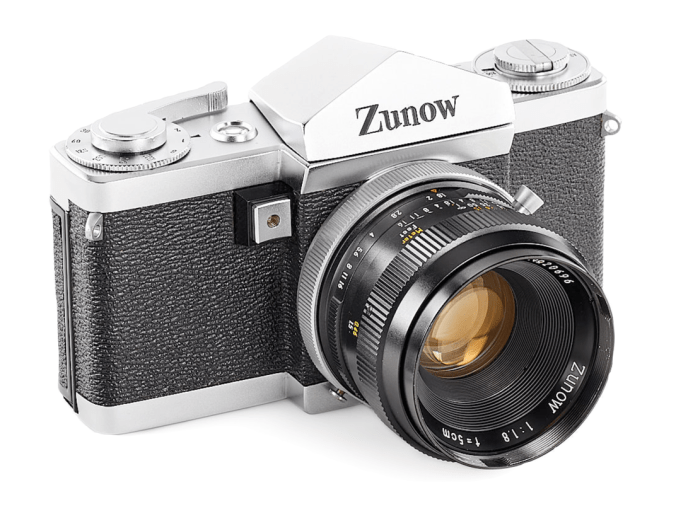
Fig.1: The Zunow SLR with a Zunow 5cm f/1.8 lens

Where it broke from convention was the fact that the shutter release was front mounted, similar to how the Exakta and Miranda cameras were laid out, and the speed dial was situated beneath the wind lever, a concept which didn’t appear until much later on the Canon AE-1. It had a removable pentaprism, and interchangeable focusing screens. Supposedly a waist-level viewfinder was also available. It also had a right-hand front shutter release, and a lever wind, not found on many SLRs of the period (except for the Exakta which was left-handed, the Mecaflex, and the Asahi Pentax). The camera had a focal-plane shutter with speeds from 1 to 1/1000 sec, plus B.

It was the first Japanese camera to have an internally coupled automatic lens diaphragm, the “ZUNOWmatic” diaphragm system, when most cameras of the era had a pre-set system, meaning a lever had to be moved to open the diaphragm after the photograph had been taken. It worked like this: when the shutter release is triggered, “the automatic diaphragm actuating ring revolves and trips the auto-diaphragm “tail” of the lens mount, diaphragm closes down to previously determined aperture, mirror springs up out of the way, Shutter operates, mirror then returns to normal “seeing” position, diaphragm actuating ring revolves again, kicks the pin back into position and reopens diaphragm to maximum aperture” [1].

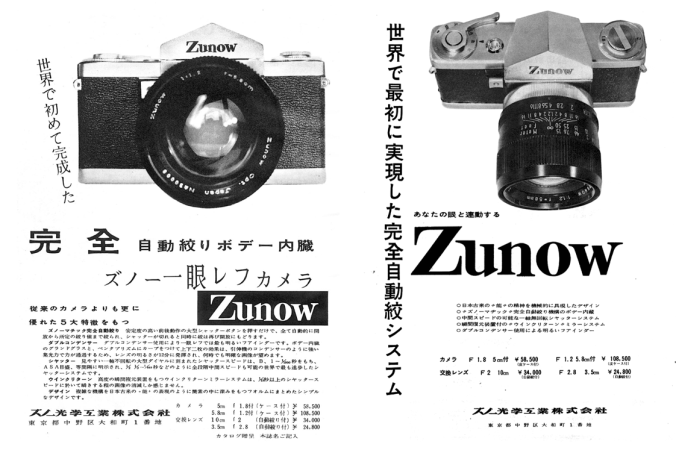
Fig.2: Japanese ads for the Zunow

The instant return mirror, was something Zunow called the “Wink Return”, which supposedly was quiet, or put another way – “quiet it is, silent it is not” [1]. In its marketing material the company suggested that traditional SLRs had issues with mirror return, i.e. there is a shock, and the sound of the shutter is loud. The “wink Return” was suppose to eliminate unpleasant noise and shock with almost no blackout effect. The lever was considered by some to be “heavy”, but the shutter release is “surprising light” [1]. There is a single shutter speed dial, with equally spaced speeds (which few SLRs had), which allowed for the choice of intermediary speeds. Another unique feature is an internal synchro-switch which automatically sets FP or X sync as shutter speeds are changed from fast to slow. The downside is that the camera was heavy at 620g.

Fig.2: The minimalistic clean lines of lines of the camera gave it a very aesthetically appealing feel.

One potential limitation of the camera was its proprietary breech mount, and a range of only six lenses: 35mm f/2.8, 50mm f/1.8, 58mm f/1.2, 100mm f/2, 200mm f/4, 400mm f/5.6, and 800mm f/8. Only the lenses 100mm and shorter had auto diaphragms. There were lens mount adapters to allow the use of M42, Exakta and L39 lenses, likely reducing the need to produce an entire range of lenses. Supposedly the lens provided with the camera was the Zunow 58mm f/1.2, which would have been the fastest SLR lens of the period (the only evidence of its existence seem to be the ads in Figure 2).

However in all reality there were issues with the camera. Adding new features to a camera implies that a substantial amount of testing must be performed before mass production commences. It has been suggested that hundreds of cameras were sold, however a lack of quality control meant many were returned [2] (this may be in part because most of the parts were outsourced, with the factory only doing assembly [3]). Other parts of the system, such as other interchangeable viewfinders were also lacking. There were also functional problems with the camera, for example the fully automatic aperture was slow, resulting in incidents of the aperture lagging behind the shutter [2]. Of the cameras existing today apparently few work perfectly [2].

The camera was only sold in Japan, and in total only about 500 were produced (at the rate of 8 cameras per day [1]). In 1959 the speculation was that it would be expensive in the US, as the Zunow + 58mm f/1.2 lens sold for US$300 in Japan. However Zunow was in a poor financial situation and was not able to capitalize on the design, closing the company in 1961. These cameras are now extremely rare. Auctions, where they occur then to suggest prices of around the US$20,000 mark.

Specifications:

Type: 35mm SLR camera
Manufacturer: Zunow (Japan)
Model: Zunowflex
Production period: 1958−1959
Format: 24×36mm on 135 film
Lens mount: breech
Standard lens: 5.8cm f/1.2, 5cm f/1.8
Shutter: focal-plane, single-axis non-rotating dial type
Shutter speeds: 1 to 1/1000 sec., B
Viewfinder: SLR with non-removable pentaprism
Mirror: “Wink return” system
Exposure meter:
Flash synchronization: FP, X automatic switching
Self-timer:
Aperture control: Instant opening and closing type built into the body, fully-automatic
Film advance: 180° operation lever wind, prevention of double exposures, automatic frame counter
Weight/dimensions: 615 grams / 144×88×56mm

Further reading:

  1. Tsuneo Baba, “Zunow: Indication of things to come in 35mm single-lens reflexes?”, Modern Photography, 23(4), p.110 (1959)
  2. Kosho Miura, “Systematic Survey on 35 mm High End Camera – History from Leica to SLR”, National Museum of Nature and Science Survey Reports of Systematization of Technology, 25, pp.55-56 (Mar. 2018)
  3. Interview with Suzuki Takeo, CEO of Ace Optical (son of Zunow’s president), May 2006 (PDF)

Vintage SLR cameras – the alternate mirror system of the Konica Domirex

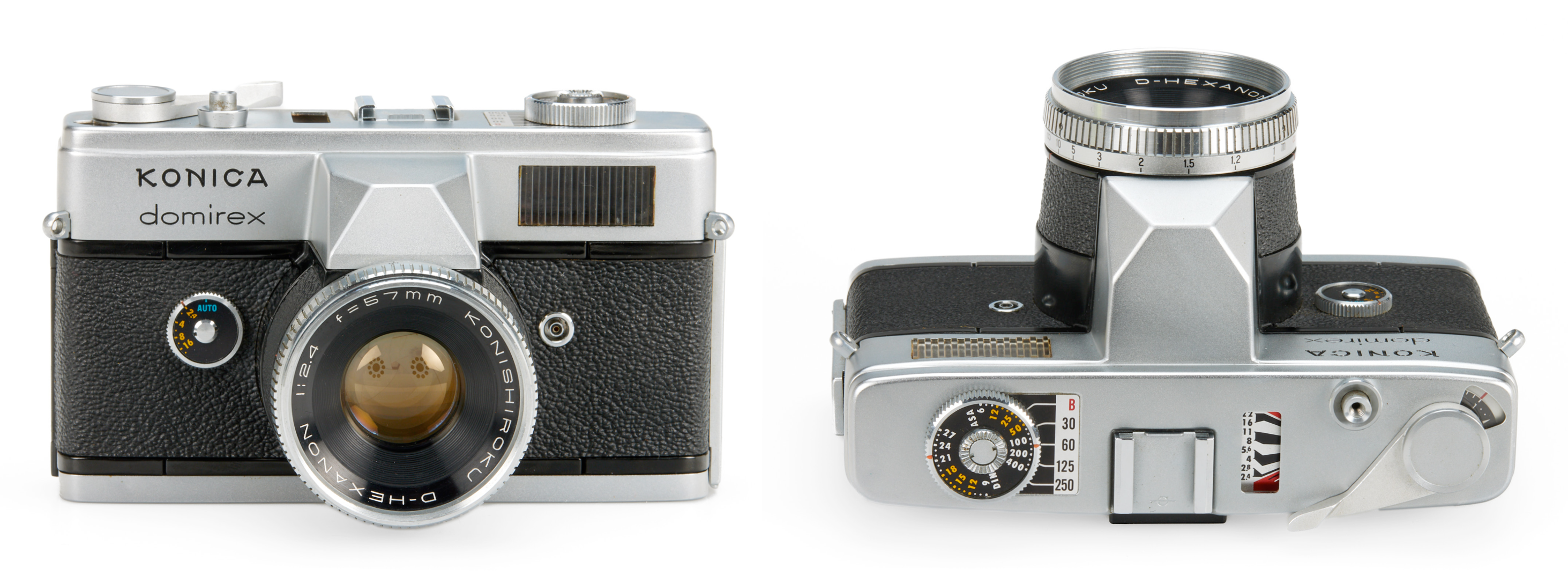
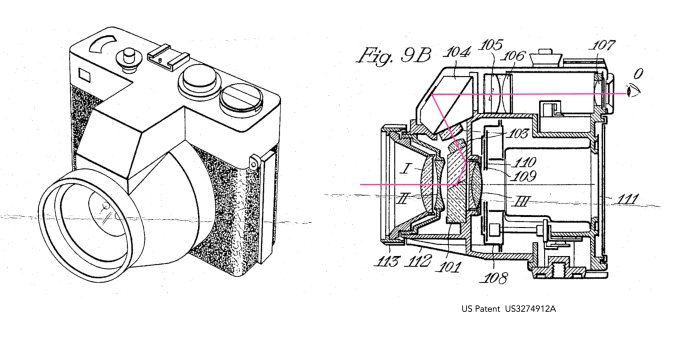
The Konica Domirex was a prototype SLR camera which made its debut at Photokina in 1963. It had a very unique mirror mechanism, that effectively eliminated the need for the mirror to flip-up when the shutter release was triggered. The Domirex was a fixed-lens SLR with a 4-speed Seiko leaf shutter, and a Hexanon 57mm f/2.4 lens (but it actually looked like a rangefinder camera). The camera was described in US patent US3274912A, ‘Single-Lens Reflex Camera’, (1966, submitted 1962).

The concept was based on the idea of a beam-splitter reflex (BSR) which appeared in the mid 1960s [1]. Unlike an SLR which uses a mirror to reflect incoming light from the lens up through a pentaprism or waist-level viewfinder, the BSR deflects only a small portion of the light up through the viewfinder, with the remainder continuing on to the image plane. This was by no means a new concept, a similar idea had been used for a number of years in 16mm cine cameras – Bolex-REX and Arriflex 16.

Fig.1: The Konica Domirex

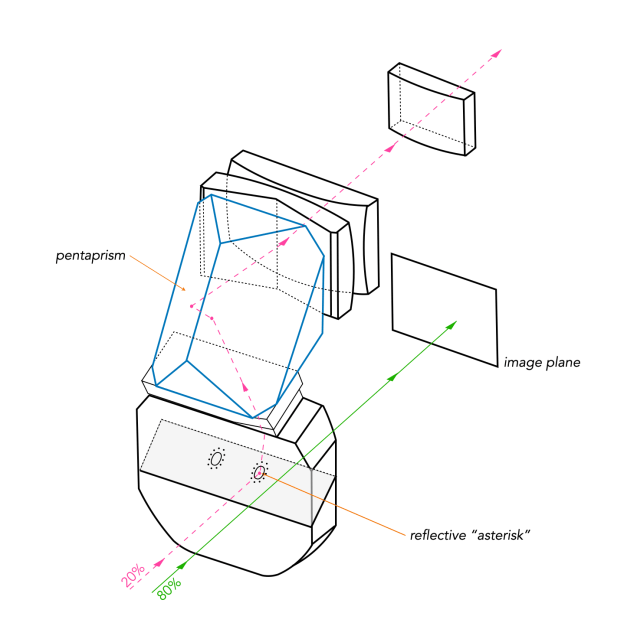
In the case of the Domirex it works in the following manner. Between the lens elements is a small optical block containing two small “asterisk-shaped” semi-reflective silvered surfaces, placed in the path of the light rays. These “mirrors” are fixed and inclined at 45° (these are off-axis, one to the left and one to the right), and carefully positioned so not as to cause issues with the exposed image. They send a portion of light from the lens to the roof prism, while the remaining light continues its trajectory towards the film. The roof prism takes up less space in the top of the housing but protrudes slightly towards the front, covering the upper part of the optical block. The camera also had both horizontal and vertical split-image rangefinders for focusing, and did not use ground-glass for focusing (which might have hindered the minimal amount of light passing through the viewfinder).

Fig.2: The beam-split reflex mechanism of the Domirex

Norman Rothschild reviewed the prototype in 1965 in Popular Photography [2]. The first thing he noted was “the one thing you’d expect to hear, is absolutely missing”, of course he is referring to the sound of the mirror. This design has the distinct advantage of not needing a large mirror that has to flip up in order for the light to pass through to the image plane during exposure. A large mirror causes mirror-black out, even if only for an instant, vibration, and of course noise. Get rid of the moving mirror, and there is no black-out, no vibration, and very little noise.

There were of course some inherent downsides to the design. As only a small amount of light is sent to the viewfinder, the viewfinder image would be much darker, than when 100% of light is reflected by means of a mirror. Could this loss of light have been a problem? Rothschild [2] suggested that the light loss was around 20%, meaning 80% of the light passed through to the image plane. But he seems to have had no problem focusing the camera, even in “relatively dim light”. This may be been due to the quality of the pentaprism, the lack of ground-glass, and split-rangefinder.

Fig.3: The Konica patent precursor to the Domirex

Perhaps the greatest problem would be the lack of interchangeable lenses. The prototype would have had to be modified to allow for interchangeable lenses. This could be accomplished by creating lenses incorporating the 45° reflective surfaces – but this would ultimately make them more expensive than traditional lenses. The camera also used a leaf-type shutter, which was certainly on the way out in the early 1960s, supplanted by the focal-plane shutter. By 1963 there was likely too much influence from existing SLR technologies to attempt to release a new technology. It is distinctly possible that as Mike Eckman suggests [3], the Canon Pellix, released in 1965, was a better option. It was a more conventional 35mm SLR, but with a semi-reflective mirror that accomplished the same aim as the BSR. But it offered a ground-glass, fully interchangeable lenses and a focal-plane shutter.

Rothschild though that the beam-splitting reflex design would eventually succeed in becoming part of the overall SLR market [2]. Rothschild’s final comment in the article was “the Dominex is worth waiting for, even if this takes a while.”. Sadly he would be wrong. Having likely made only prototypes, there aren’t many of these cameras about, however one of the original prototypes sold in spring 2024 for €12,000.

Further reading:

  1. Bill Pierce, “SLR’s Without Moving Mirrors: The Split-Beam System”, Popular Photography, 55, pp.64, 126 (June, 1964)
  2. Norman Rothschild, “Konica Domirex – A prototype”, Popular Photography, 54, pp.65-67 (June, 1965)
  3. Keppler’s Vault 47: Konica Domirex, Mike Eckman (2019)
  4. Konica Domirex

Vintage SLR cameras – the Alsaflex, a French SLR

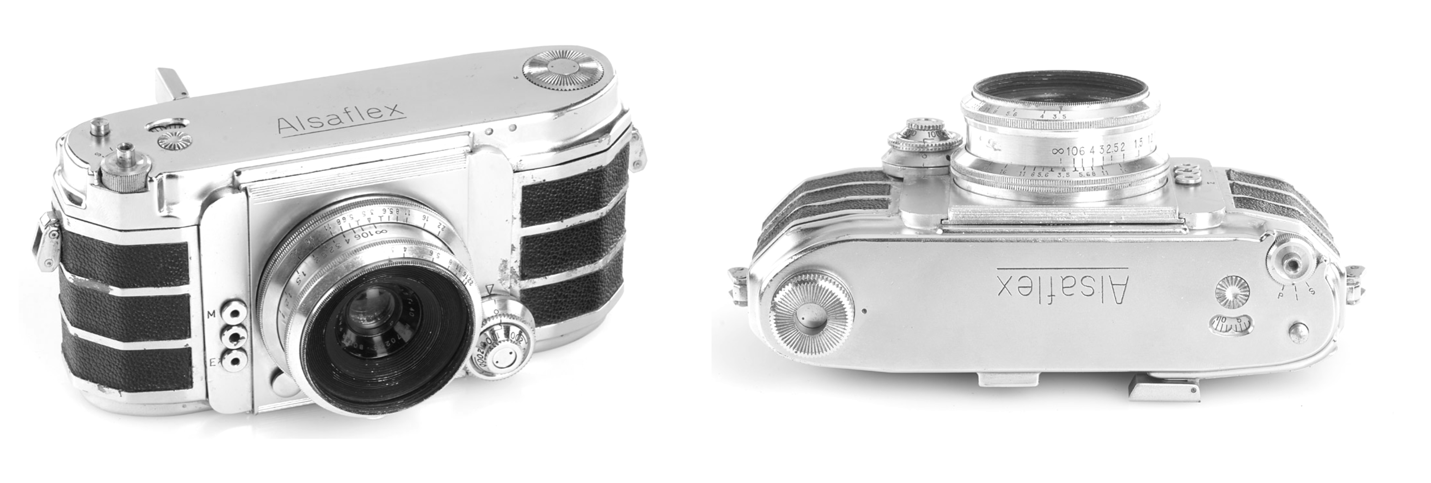
This is a story of another camera that could have been quite successful, but unfortunately didn’t make it past the initial batch of cameras. Alsaphot was the photographic department of a French company called Alsetex, and produced cameras from 1949 to 1970. Using a brand logo which incorporated an Alsatian stork, the company produced a broad range of cameras. This included the Dauphin I, II and III, small 6×6 reflex cameras in the style of the Voigtländer Brilliant and the Cima (4×6), Ajax (6×6), and D’Assas (6×6) viewfindser cameras.

In 1947 the company hired French inventor Lucien Dodin (1900-1989) as technical director. Dodin designed two cameras, the Cyclops, and Alsaflex. The Cyclops, which appeared in 1950 was a 6×9cm format camera. Dodin’s claim to fame was the design of the “stigmometer”, or Dodin telemeter, more commonly known as the split-image rangefinder, something found in many SLRs.

Fig.1: The aesthetically pleasing Alsaflex

The Alsaflex was an SLR camera which used the 24×24mm format on 35mm film, and incorporated Dodin’s stigmometer. The viewfinder was reduced in size by using lateral reflection, the retractable mirror pivoting around a vertical axis – essentially a Porro prism. The camera was innovative because it was quite compact for an SLR. It sported a bayonet mount with interchangeable lenses, with a Saphir Boyer 40mm f/3.5 (with automatic aperture selection) as the standard lens. The shutter was of a new design, made of metal and in the shape of a fan, with speeds from 1 to 1/2400 sec. The body of the camera was die-cast (150mm×70mm×42mm) with a back that could open to accommodate carious accessories. The camera has a rapid lever actuation which causes the film to advance, the mirror and the frame counter to be set up, and the shutter to cock in a single movement. When activated during shutter release, the mirror retracts without vibration.

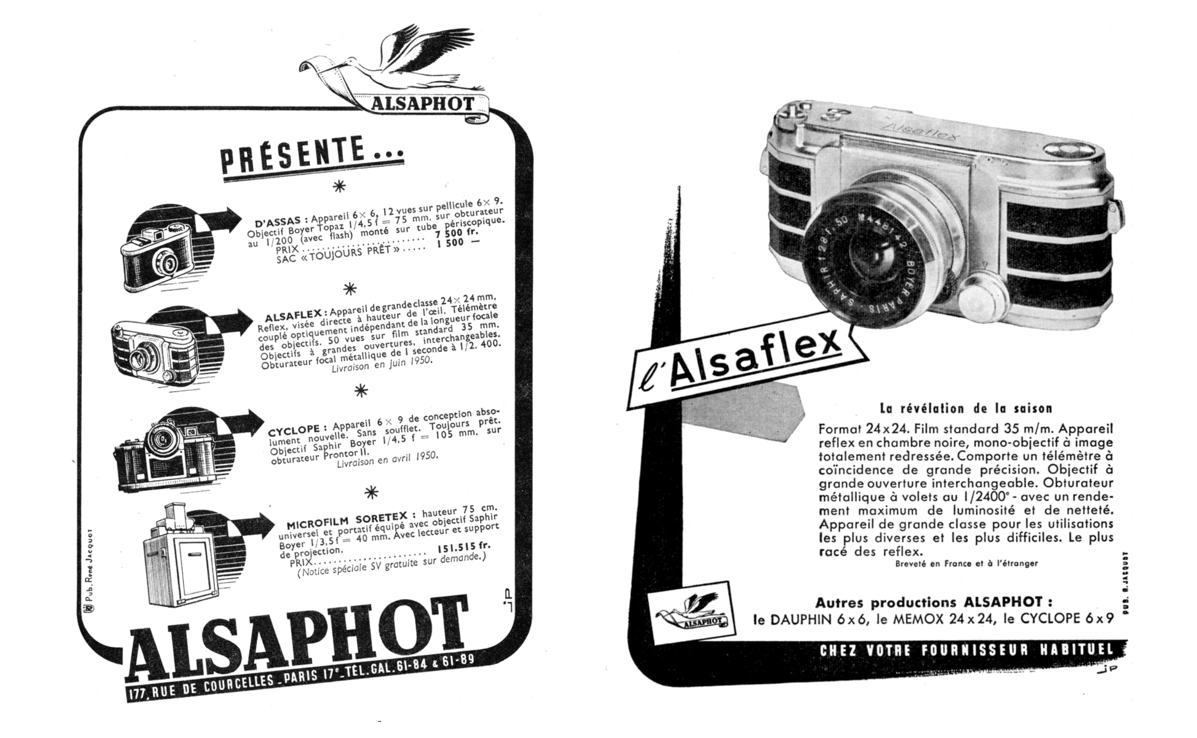
Fig.2: Advertising the camera that never really made it big

A second variant, the Dudragne is a special, much simpler model of the Alsaflex, without a horizontal viewfinder eyepiece, X-sync and 1/100 speeds, and made to be used with a retinograph (instrument for examining the retina of the eye) made by Dudragne. Interestingly, the license for the viewfinder using the Porro prism would be taken over in 1963 by Olympus for the Pen F series. The camera appeared in advertising in early 1950, suggesting it would be released in May 1950, but in reality it would be 1952, and very few would be produced. It was advertised as having an “optically coupled rangefinder independent of the focal length of the lens”.

Alsaphot itself declined in the 1960s with the rise of both German and Japanese imports. In 1954 the Alsaflex with a Saphir Boyer 50mm f/2.8 was advertised for 138,000 Frs or about C$384 [1]. When the occasional camera go on sale, the price is generally in the range of €3000-5000.

  1. In January 1954, 1 Canadian $ equals about 360 Old French Francs.

Vintage SLR cameras – The mythical Malik Reflex

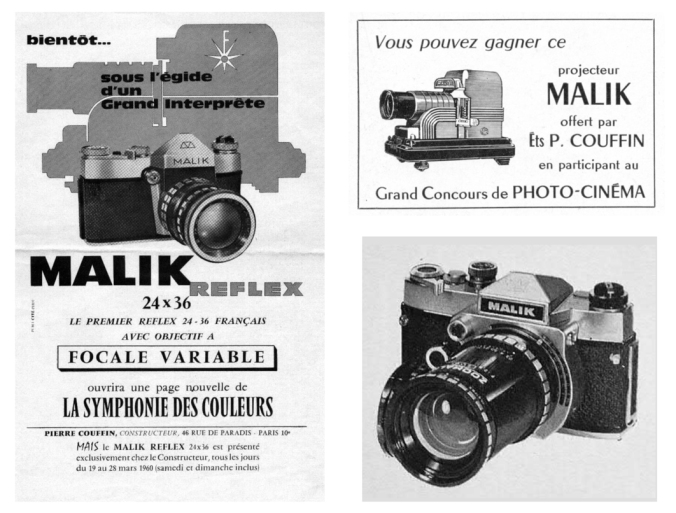
Some cameras were designed to be rare. They were often prototypes, or cameras that were just made in small quantities that very rarely come on the market. Such is the SLR produced by French company Malik. Malik was a company who produced included projectors, enlargers, a 9×12 camera (pre-WW2) and tripods, all made in France. Pierre Couffin was the sister company which was a distributor of cameras, like the Robot, and Leidox. Both were founded by Ets Pierre Couffin.

Fig.1: Some of the advertising for Malik and the Malik Reflex

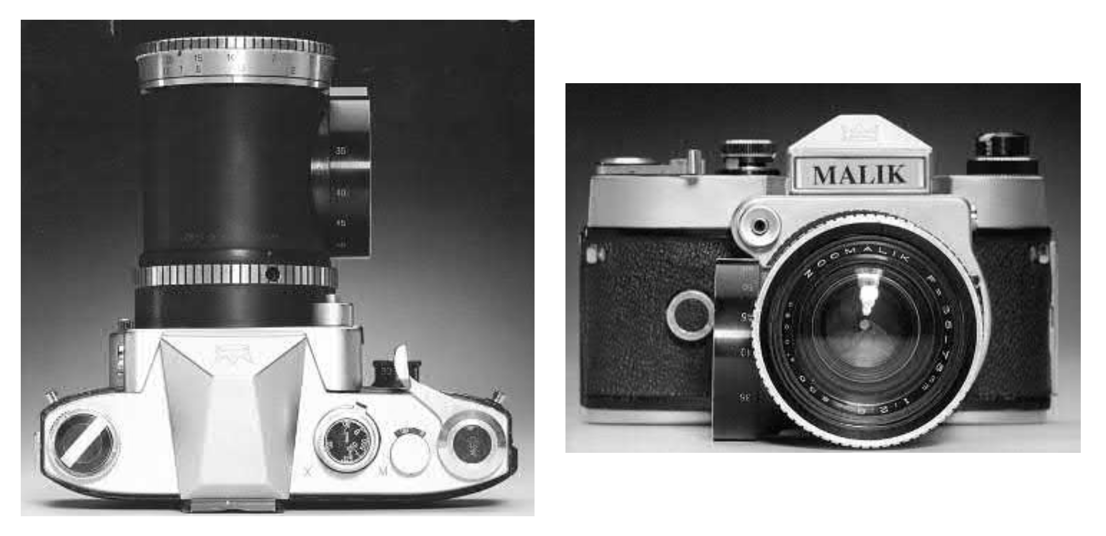
The Reflex Zoomalik was presented at Photokina in 1960. It was an SLR that came standard with a zoom lens, which was unusual for the time period. It was a 35-75mm f/2.8 (preset, 16 elements, although some reports note 14 or even 17). The literature seems to talk more about the lens than the camera – the fact that it is “only 75mm in length for a diameter of 55mm, hardly larger than a classic 90mm lens”. Changing the focal length on the lens was done by means of a large side wheel. The camera had a series of features: focal-plane shutter, five speeds (1/30, 1/60, 1/120, 1/250, and 1/500), crank rewind, removable rear, die-cast metal body. One curious feature was that the film-winding lever was in the front of the camera, which did not allow fast wind-on using the thumb. It was a well advertised camera, appearing in numerous industry magazines, and even a journal, The French Review [1].

Fig.2: Some of the few pictures of the camera

A press release in L’Express (June 16, 1960) suggested it would be the first SLR manufactured in France. It also said the camera was design in consultation with American company Bell & Howell of which Couffin was the French agent. It was suggested the camera would be provide serious competition for the Bessamatic from Voigtlander.

Modern Photography described the camera in the following way [2]:

The picture of the camera is an excellent example of French retouching and airbrush work. Production? By the time you are reading this, Maliks should be flowing from the production line like champagne. At the price of $200 for camera and lens, it’s a bargain even if the camera is never made.

But it was only ever produced as a pilot series, and abandoned before production began. It’s hard to know why it fell apart, possibly because the company had little experience in actual producing cameras (other Malik cameras, like the Malik, Auto Malik, and Super Auto Malik were manufactured by German company Leidorf). Or perhaps the idea of a zoom lens as the main lens of a camera was just too radical for the time – the Zoomar 36-82mm had only appeared in 1959, and many photographers were still sceptical. Likely it was a combination of events, not least of which would have been increased competition from Japanese camera companies.

Further reading:

  1. “Smallest-Best of its Type”, The French Review, 34(5) p.513 (Apr. 1961)
  2. “The French Touch”, Modern Photography, 24(9) pp.18,28 (1960)
  3. Couffin – Malik – Appareils photo

Tips for inspecting vintage SLR cameras

Examining vintage cameras is a little bit trickier than lenses, largely because of the variability found in camera bodies. For example there are rangefinders, SLRs, and compacts, some with interchangeable lenses, other with fixed lenses. Below is a list of things to look for. Ultimately a vintage camera can only really be tested by running a couple of films through it. Some online resellers do this, especially if the camera has some value.

① Overall appearance

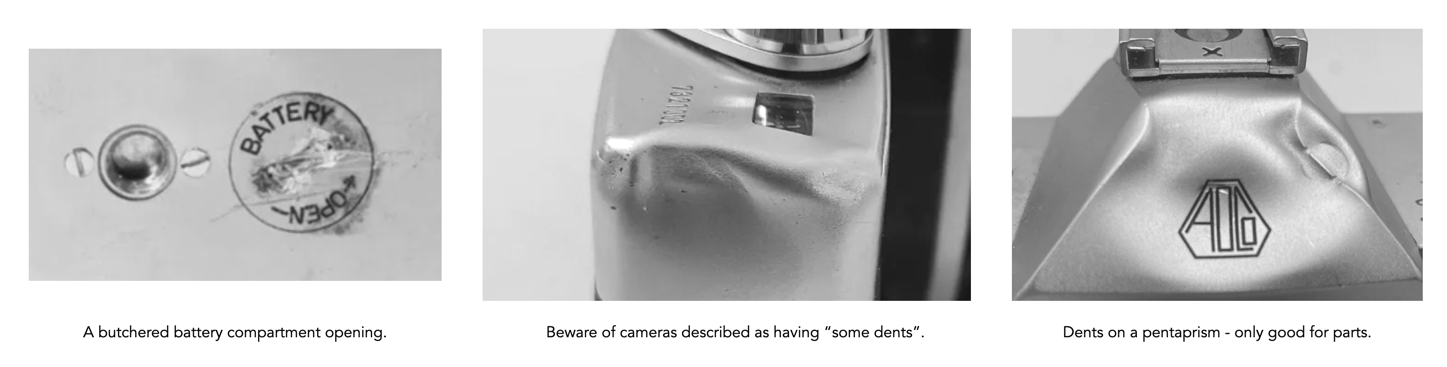
Start with what the camera looks like. Are there any indicators of DIY repairs, glue or tape residue? Then check the camera body for major dents and dings. These will stand out on vintage camera bodies as many were made of metal. Visible dents are likely are indication that the camera has been dropped, and potentially damaged things inside. The presence of small dings, dents, and scratches are probably just signs of normal use. Vintage camera bodies were often covered with a leatherette, so it is good to check if it is lifting from the camera body. This is more of a cosmetic issue, and is relatively easy to either re-glue, or replace. If the exterior of the camera is grimy, or has green corrosion, there may be further issues inside, indicative of improper storage.

Fig.1: Some red flags on damaged cameras (if they are cheap, they may be fine for parts)

If you are physically examining the camera, as opposed to buying it online, then I would also give the camera a good smell. If it has any sort of musty smell, then it might indicate it was stored somewhere with less than optimal conditions, e.g. an attic or basement. This might be indicative of problems inside the camera that you can’t see – avoid it.

② Functionality

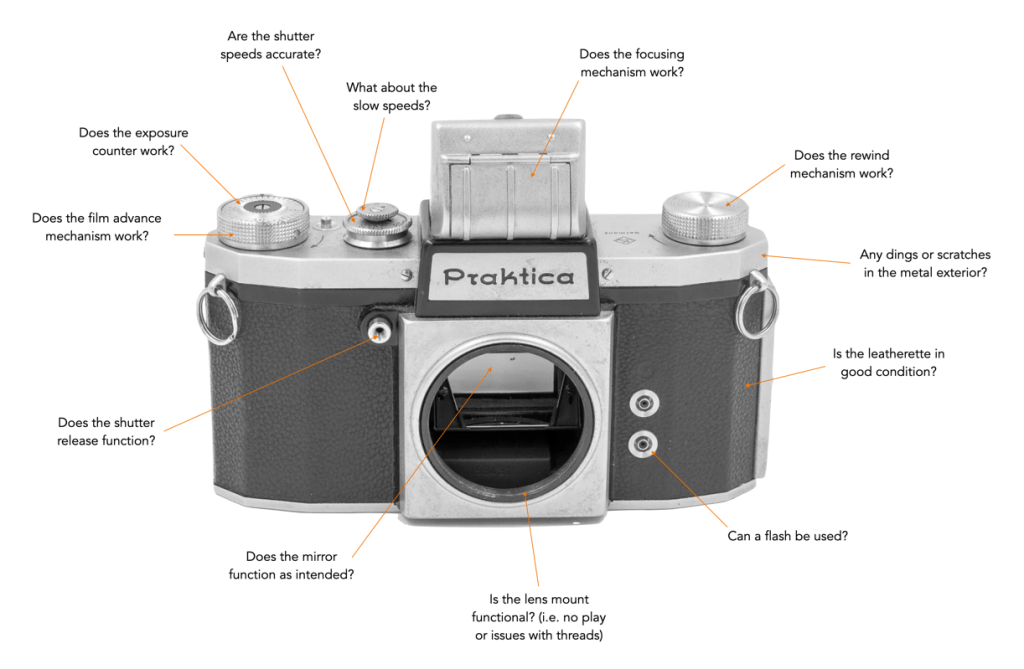
The first thing to check is that there isn’t anything missing from the camera, e.g. buttons, levers, etc, and that there isn’t anything broken, e.g. film advance lever. Check that the external controls (shutter speed selector, aperture selector, ISO selector, etc.) all work properly. Does the film advance lever or knob work? Is it smooth? It should be possible to engage the film advance lever, and then fire off the shutter – there shouldn’t be any weird noises, or lagging when the lever is engaged. Also make sure the film counter is advancing with every frame advance. It is often suggested not to touch the self-timer on old mechanical cameras, as they can be problematic.

Fig.2: Some of the things to consider on a fully manual camera (no light meter, or battery)

③ Camera optics

This refers to the viewfinder and focusing screen. The viewfinder should be clear, not cloudy, and not infected by fungus. A small bit of dust isn’t going to be a bother, because it won’t show up on any photographs, but scratches and cloudiness may interfere with focusing. Also do a visual check of the mirror. Some mirrors can have scratches, corrosion, fungus, or even de-silver over time. Mirrors can also get stuck when the shutter is released, and not return to the proper position. In cameras with batteries, mirror lock-up can occur because of no battery (or it has a low charge), where the mirror remains in the locked position once the shutter is fired.

④ Shutter

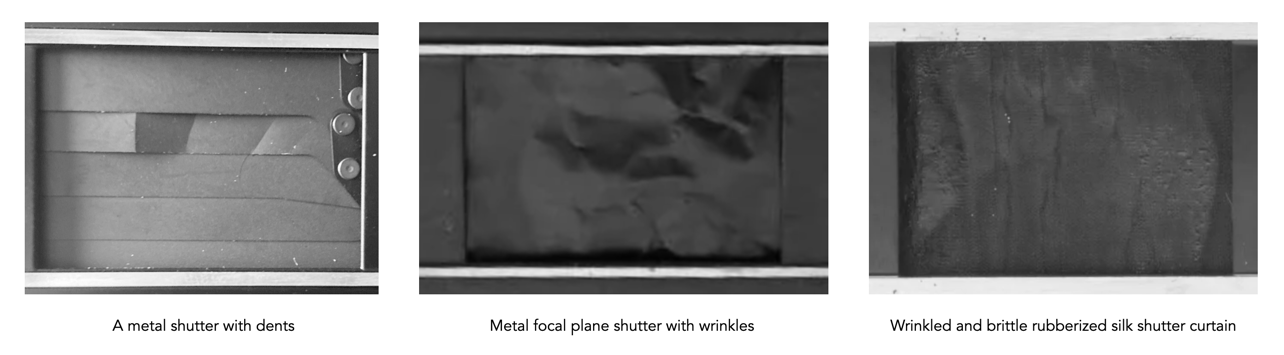
Check the physical condition of the shutter, e.g. tears, creases, pinholes, or mould/degradation (cloth), or dents (metal). Does the shutter work? Press the shutter button – can you hear the shutter open and close? Look through the lens (on a fixed lens), through the front camera opening, or via the open back of the camera to watch the shutter open and close. Sometimes a camera might have fairly accurate high speeds, but not actually fire on speeds slower than 1/125s. The shutter speed is one of the most critical components of a vintage camera body, and honestly the hardest to test without proper equipment. The best way in-situ might be to test the camera side-by-side with a camera known to be accurate. There are distinct differences in sound from a fast (1/1000) to slow (1/30) speed. Very few places have the equipment to accurately test a cameras shutter speeds.

Fig.3: Examples of types of shutter curtain damage

⑤ Light seals

Older cameras have light seals that fail – the foam strips across the back of the camera with the film door is opened. They often aren’t apparent until a film is run through the camera. They are honestly one of the easier things to repair, so it is not a big issue.

⑥ Light meters

If the camera has a light meter, make sure it is working. There are a wide variety of exposure meters fitted to vintage cameras, from simple uncoupled ones that just measure the amount of light to complex systems which set the exposure on the camera automatically. If the meter is not functioning, the camera can often still be used in manual mode using an external light meter and transferring the settings to the camera. Typically selenium cell meters are the most common inoperable meter – they don’t need a battery to operate, however the selenium does delete over time (note that cameras with meters that have not been exposed to light may still function well).

Many of the uncoupled light meters are recognizable as a light cell on the camera body, and a meter (typically on the top plate). The best way to check these is to test how the meter responds to light – point it at dark and light areas, and compare the readings. Does the meter needle move when the light level changes? If not then check the battery if there is one. Online, many resellers will describe the light meter as not being tested. As long as you are comfortable not using a light meter, it shouldn’t matter.

⑦ Batteries

This is the one thing people tend to forget about. If there is no battery, then the camera is much simpler, and there is much less to go wrong. Firstly see if there is any damage to the battery compartment, e.g. corrosion, caused by leaking batteries. Ideally the camera will contain a battery already (if it doesn’t have one it can be a red-flag, because it makes it harder to test the camera). It is also good to check the type of battery. Is it still possible to get the required battery? For example many old cameras used mercury oxide batteries, such as the PX13 and PX625, for their CdS (cadmium sulfide) metering systems. Mercuric oxide batteries provide a constant and stable 1.35 volts over most of their life. However they were outlawed in many places in the 1980s and so an alternative has to be found (which isn’t as problematic as it may sound). If there are markings on the compartment door (or it is hard to open), or there is green/white build-up in the compartment itself, this might indicate the camera suffered from battery leakage at some point.

Note: Many cameras with serious maladies are usually sold for parts only or repairs. Given that the cost of many repairs these days is prohibitive, e.g. changing a shutter curtain or fixing shutter speeds, it is best to avoid damaged cameras.

Choosing a vintage SLR camera – buying FAQ

This FAQ deals more with the purchasing side of things of SLR cameras.

What is the average price of a vintage SLR?

There is no such thing. See below.

What sort of things impact price?

The cost of a vintage SLR is directly associated with a number of differing things. Firstly things like brand and rarity. Rare cameras cost a lot, sometimes it doesn’t even matter that their condition is somewhat mediocre. Next there is the brand, specific type, year of manufacture, condition, i.e. what works, and what doesn’t, and of course the spec of the lens attached to the camera. Some cameras will sell just as bodies, and others will be coupled together with a lens of some sort – it might be the stock lens the camera camera with, or perhaps something similar.

Why are some cameras so expensive?

Some cameras are expensive, either because the camera is rare, or has some attribute that makes it more expensive, or a review by someone with a lot of followers has pushed prices up. It also depends on the condition of a camera, those in pristine condition will have a greater value associated with them.

Are prices sometimes overinflated?

Basically yes. Sometimes this is due to someone’s belief that a camera (or lens) is worth far more than it actually is. Sometimes it is because of availability – there may have been 10,000 copies of a camera manufactured, but if only two are currently available on the market, it will invariably push up the price. Desirability also helps over-inflate prices.

Is price equitable with value?

Not always. Someone might advertise a camera for $4000, even though it’s value may only be $2500 – this may be related to availability (or possibly the camera is just overpriced).

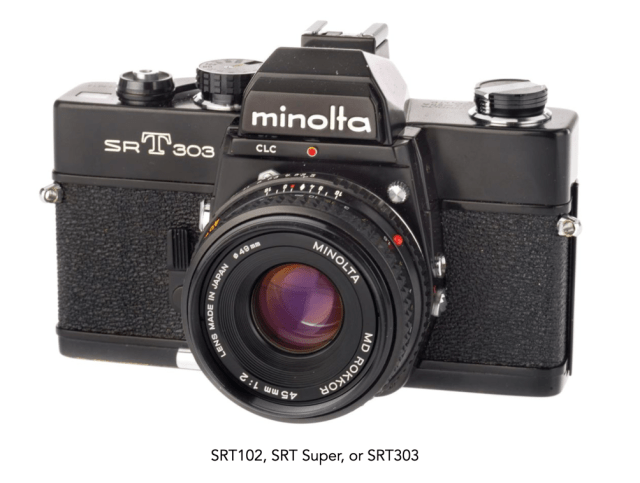
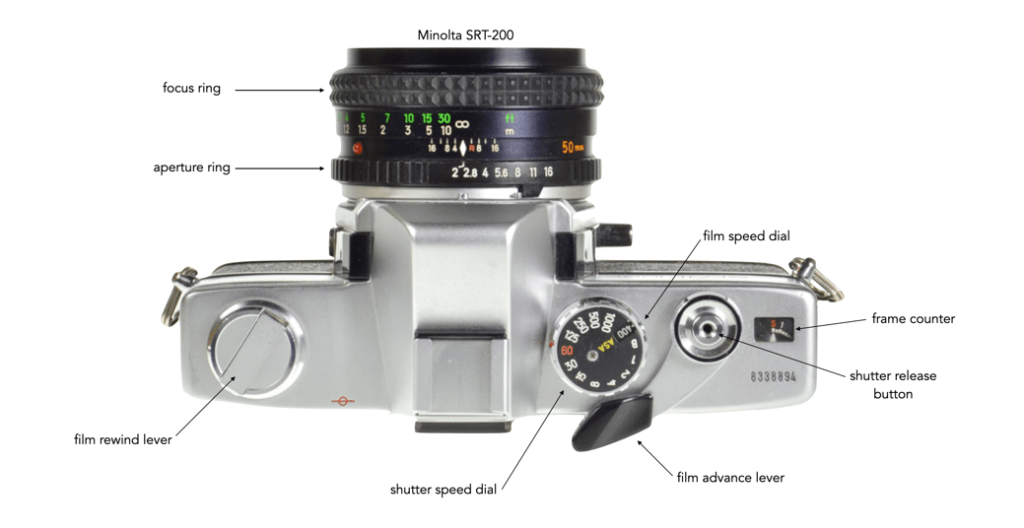
This is an extremely inexpensive manual SLR, usually around $100-250 (with lens). It has three different designations, for the markets it was sold in: SRT102 (North America), SRT330 (Europe), and SRT Super (Asia)

What is the cheapest SLR?

There are quite a few cheap SLRs on the market. For example Asahi Pentax sold over 4 million Spotmatic cameras between 1960 and 1977 – a Spotmatic SP1000 can go as cheap as C$150, whereas a Spotmatic F might go for C$350. Generally lesser-known brands are always less expensive, e.g. Konica, Miranda, Yashica.

Is the market for vintage cameras the same as that for vintage lenses?

No, largely because there is one end-user for cameras, and two for lenses. Lenses will be bought by people who (i) want to use them on a film camera, or (ii) want to use them on a digital camera. Photographers purchasing vintage cameras will only use them for film, and may only purchase one or two film cameras (useless they have GAP), whereas lens purchasers may buy many.

Should I take a risk on a cheap camera?

Sometimes there are sellers who are selling a camera without knowing what they have, usually because it was part of an estate, and not something they normally deal with. If the item is cheap enough, there is likely very little risk, but if it seems too expensive (or seems to have excessive shipping), avoid it. This is especially true if the item is marked “rare”.

How do you know a camera will be in good condition?

You don’t, unless you buy it from a reputable dealer. Someone who has been dealing in vintage photographic equipment for a long time, and sells a good amount of it will provide a good insight into a particular camera body, including providing a quality rating. Otherwise, without a full evaluation it is difficult to know exactly how well a camera will function. For example, unless shutter speeds are tested, there is no way to properly determine that they function accurately. The word “functioning” is pretty vague if there aren’t any qualifying statements. It could just mean the person has played with all the knobs and levers, and they work. Whether the shutter speeds are accurate is another thing altogether.

Are there red-flags for purchasing cameras online?

Yes – if a listing somewhere only has 1-2 images, and offers no real description, then stay well clear – unless of course it is a $500 camera selling for $20, and even then you have to wonder if there is anything wrong with it.

Is eBay any good?

Like anything, it really depends on the seller. Some sell only camera gear, and have been doing it for a while, or have a physical shop and use eBay as their storefront. Always check the resellers ratings, and review comments.

There are a lot of vintage cameras available on eBay from Japan – are they trustworthy?

In most circumstances yes. There are a lot of physical camera stores in Japan, so its no surprise that there are a lot of online stores. Japanese resellers are amongst the best around, because nearly all of them rate every aspect of a camera, cosmetic and functional. If something seems like a bargain it is likely because there are a lot of vintage cameras in Japan.

What should camera ratings include?

If we take the example of Japanese resellers, there are normally four categories: overall condition, appearance, optics, and functionality (body and lens). Appearance deals with aesthetics of the lens, and indicates any defects present on the lens body, e.g. scratches or scuffs. Optics deals with the presence of absence of optical issues: haze, fungus, balsam separation, scratches, dust. Finally functionality deals with the operation of the lens, and camera (e.g. shutter speeds).

What does “untested” mean?

If a posting is marked as untested, it basically means exactly that, you are buying the camera “as is”. There is usually some basic information on condition, but the camera functions haven’t been tested in any manner, i.e. shutter speeds, or with film. If a camera is marked as “parts-only”, it means exactly that, i.e. it does not function properly.

Why choose a vintage SLR?

There are generally two camps when looking at vintage photographic gear: those interested in using vintage lenses on digital cameras, and those interested in shooting with a vintage camera. The first have little or no interest in shooting with film, the latter likely focus on it. There is also a third category – the collector, and their needs might be distinctly different from active users of vintage gear. People choose vintage SLR cameras for a number of reasons (an SLR is just one choice amongst 35mm cameras, people also opt for rangefinder cameras, or point-and-shoot). Perhaps they want to get back to basics, and use with a system that has complete manual functionality, or perhaps they are interested in experimenting with film. It could be they just like the feel and process of using a film camera, or even for nostalgic reasons. It is in many respects a much more fundamental, slow form of photography, even though it requires much more participation from the perspective of calculating the right exposure, choosing the appropriate film etc.

There are a number of choices

Vintage SLR’s come in many different forms – fully manual to some level of automation can be accommodated in some manner. For example the cameras produced in the 1950s to the mid 1960s are all-metal, and all-mechanical (manual focusing, exposure and film advance). They are often very aesthetically pleasing and have lens options which often produce artistic renderings. After this came the first auto exposure SLRs, which meant shutter-priority followed by aperture-priority. These cameras still had a lot of mechanical parts, but some of the functionality was taken over by solid-state electronics. The introduction of electronic SLRs pushed automation ever further. From the mid-1970s until the late 1980s came the electronic SLRs became the norm mostly to cut both costs and mechanical complexity. These camera bodies contain more plastic, and the first program-auto exposure settings.

SLRs are good for many photographic genres

Of course another motive focuses on the type of photography the camera is going to be used for. This is important because it allows a set minimum requirements to be established. There are some genres of photography that are better suited to the use of vintage cameras than others. General everyday or travel photography, landscapes, street or portrait photography are ideally suited to vintage cameras. This is because these genres are suited to manual focusing, and adjustment of exposure settings on the fly. Alternatively, wildlife or sports photography are not the best genres for a vintage camera (despite the plethora of telephoto lenses on the market). Both these genres generally require telephoto lenses, which with manual focusing isn’t optimal. Some people likely chose a mechanical SLR in order to experiment with street-photography at the most basic level, or an electronic SLR for travel photography.

Fig 1: Many SLRs offer a very simple tactile experience

The tactile experience is often better than with digital

Although there are many differing forms of 35mm cameras, SLRs do stand out for their tactile experience. Early SLRs were entirely manual, meaning that there were many differing parameters which had to be manually modified in order to obtain the correct exposure. This means cameras had various lever and knobs which had to be adjusted – there is the shutter button, adjustments for film speed, shutter speed, and on the lens, aperture and focus mechanisms. There is a level of interaction which is a vastly more tactile experience than pushing a button, or setting a menu item on a digital camera.

Analog is nostalgic

Analog photography can be somewhat limiting, in that there isn’t a memory card with limitless capability to store photographs. Film will limit the number of pictures able to be taken, so every shot has to count. This amps up the level of creativity, forcing the photographer to slow down, observe the surrounding world, and think about the picture being taken. Choosing a vintage 35mm SLR, or even a rangefinder for that matter, means embarking on a more participatory experience, where the level of self expressiveness is determined by the complexity of the camera itself. The physical nature of film – loading it, winding it on, hearing the shutter open and close – combine to provide a more natural [pure] experience.

Fig 2: Price points (Cad$) of various SLRs (in good+ condition)

SLRs are available at a good price

Vintage SLRs are available at many different price ranges. Yes there are expensive SLRs – usually this has to do with scarceness. For example someone might be interested in a 1936 Exakta Kine 35mm SLR, the first SLR, which could be worth anywhere from C$3000-4000. Or perhaps an ALPA camera, which are generally upwards of C$1200. But there are plenty of relatively inexpensive cameras, partially because there were so many manufacturers in the 1960s, and so many cameras were produced. You can find an Olympus, Pentax, or Minolta camera (body only) for between C$300 and C$500 (certified/restored). Less well-known brands of the period are even cheaper, e.g. Konica, Petri, Ricoh, Yashica, Miranda, Fujica etc, often including a 50mm lens.

SLRs are well built

Before the more extensive use of plastics in the 1970s, metal was king. Many cameras up until this period (and even beyond) used a die-cast metal body, which means the cameras were built tough.

SLRs are educational

One of the issues with digital cameras is that so much is automated. That’s not a bad thing in a lot of situations because it allows you to concentrate on framing the shot. However because of this, the inner workings of the camera are sometimes lost to the photographer. An SLR will also help the novice learn the fundamentals of photography – the hard way. This means you have to gain a more intimate understanding of how things like shutter speeds, apertures, and exposure works. However on the flip-side you do gain better control of the photographic process.

Choosing a vintage SLR camera – technical FAQ

This FAQ deals more with the “tech” side of things. Vintage cameras are mostly mechanical, i.e. they are filled with gears and doohickeys of all sorts.

How complex are vintage cameras?

Quite complex, at least from a mechanical perspective. The earlier rangefinders may have been somewhat less complex, but as cameras attained more features, the mechanical complexity increased. They are a world away from the early plate cameras with very moving parts. In some respects electronically controlled cameras can often have simpler designs.

Which brands are most dependable?

This is really hard to pinpoint. You really have to go off reliability, popularity, and reviews. Every manufacturer created good SLRs, and ones that were less that stellar. The less dependable cameras are often those that have known mechanical issues, obscure mechanisms (e.g. “new” shutter mechanisms, or materials that just didn’t work), or have poor usability. If this question is asked on some forum, everyone will have a different answer.

Which brands to avoid?

I don’t like to pigeonhole brands, but for the novice I would honestly avoid East German and Russian SLRs. There should be a lot of these cameras, but in reality there often aren’t, perhaps because they haven’t stood the test of time. The exception is the manual Ihagee Exakta cameras, which generally are quite good from a mechanical viewpoint.

What’s the most important technical issue with vintage cameras?

Arguably the most critical things have to do with the shutter. Shutters are generally constructed of light-tight cloth, metal, or plastic curtains, all of which can be damaged. Does the shutter actually work properly on all shutter speeds, i.e. does it open and close, and not get hung up somewhere? In some cameras the shutter will work fine for fast speeds and perhaps get hung up on one or two of the slower speeds. You can usually test this by opening up the back of the camera and checking the shutter at each speed setting. More critical may be whether or not the shutter speeds are accurate. Again some may be, others may not be.

Are batteries an issue?

There are vintage cameras that use batteries, mostly those that use meters of some sort, or contain electronics. Some vintage cameras use Mercury-oxide batteries which are a problem, because sometimes can’t often be satisfactorily replaced (they were banned in the late 1990s). Also, sometimes even when you find a battery, aging electronics can lead to issues. I have a Minolta X11 (specified to use S76 1.5V “silver-oxide” batteries) which works well, except for one thing – the batteries drain really quickly. This was a quick fix though, only add the batteries when the camera is actually being used.

Are SLR cameras repairable?

Yes, but these days it is sometimes hard to find people that fix them, and it can be expensive. Some repair specialists just remedy specific camera brands. It is also an issue of how readily parts are available – if you have a camera where a lot were made, (say 500,000) it is obviously easier to find donor cameras to provide parts than it is a vintage camera where very few were made. A film camera CLA (Clean, Lube, Adjust) can cost anywhere from C$150-300. In some cases it may be preferable to pay more for a certified camera rather than go through the hassle of repairing an inexpensive one.

Manual cameras are pretty complex inside (Asahi Spotmatic, 1964)

Can I fix a camera myself?

Hmmm… yes and no. Let me put it into context. If a camera is cheap you could try and fix it, depending of course on the complexity of the issue. To do this, you need to have the right tools, and probably a camera manual. The problem is that sometimes the sheer age (50-80 years) can mean things are seized up, and un-seizing can sometimes lead to things breaking. I would honestly not go down that path (having tried fixing something simple, it just broke something else). It takes a lot of patience and quite a bit of knowledge to pull things apart and put them back together in working order. Even manual cameras are complex – the innards are a haven of interwoven mechanical things. Open a camera at your own peril.

Are light meters an issue?

Invariably yes. Some of the meters, like the early selenium meters can often work quite well, whereas the Cadmium Sulfide (CdS) meters may not work as well. Sometimes cameras will be advertised as “meter not functioning”. Sometimes due to age, the light meter may not be that accurate anyway, so it might be best to use an external light meter, or even a digital one.

Are there issues with electronic 35mm SLRs?

Yes, electronics don’t always stand the test of time well. Electronics tend to be adverse towards moisture, and dust, which will find their way into a camera and cause issues. It may be possible to find (or even manufacture) mechanical part replacements, electronics are another thing altogether. That being said, electronic cameras are usually quite reliable.

Choosing a vintage SLR camera – some FAQ

This past covers more aspects of buying a vintage camera in FAQ form. When it comes to 35mm interchangeable-lens cameras there are two categories: rangefinder and single-lens-reflex (SLR). This FAQ is concerned with SLRs because they became the dominant form of SLR camera found on the used market.

What are the best vintage cameras?

Identifying the best vintage camera is very much a subjective thing. Unlike lenses though, which are often chosen for the aesthetic appeal they impart upon photographs, cameras are all about functionality. All cameras really serve the same purpose, as a vessel to hold the lens, and film, and control the process of taking a photo. So the best vintage cameras are often those that achieve this in a way that doesn’t compromise functionality. They should be simple to use, aesthetically pleasing, ergonomic, and don’t suffer from a series of maladies, e.g. shutters that could imminently fail, poor engineering or manufacture etc.

Which camera types are best?

It really depends on what sort of features are required, and perhaps what sort of lens mount (not all lens mounts are inter-compatible, and it is hard to find adapters for film cameras). Do you want fully manual, semi-automatic, or fully electronic? Do you want a built-in light meter (which is tricky because many don’t work anymore)? Then you have to figure out which ones are problematic from some functional viewpoint, e.g. problems with shutters, or flaky electronics. For example Olympus made 14 major models of manual focus SLR in the period 1972 until 2002, and two automatic models. The OM-707 was an auto-only camera, and somewhat of a disaster from a usability perspective. The Olympus OM-4Ti (1986-2002) is considered by many to be best film SLRs money can buy.

What is the most versatile camera mount?

In reality, M42 is likely the most common lens mount, at least up until the early 1970s. There were a lot of lenses made for this mount from a myriad of manufacturers. There were also a bunch of cameras that used it as the mount. Next in line might be the Exakta mount.

Can film cameras use lenses from other brands?

Unlike mirrorless digital cameras, which have a short focal flange distance, allowing for adapters to suit a bunch of 35mm film lenses, the same is not true for film cameras. Some cameras can use lenses with other mounts, many can’t. For example the Minolta cameras with an SR-mount can use M42 mount lenses, because the flange distance on the camera (43.50mm) is less than that of the lens, allowing an adapter to convert the M42 to SR-flange (MD,MC) – however the opposite is not true.

Do some people buy cameras because they are aesthetically pleasing?

Yes. Some people love how cameras look, even if they don’t function that well. Form over function is a real thing for some people, of course beauty is always in the eye of the beholder.

Why were some SLRs unsuccessful?

Sometimes cameras didn’t sell that well, and as a result weren’t that successful. This was usually down to poor choices in the design of the camera. A good example is Rollei which had its own bayonet mount lens system known as the QBM – proprietary lens mounts means a smaller choice of lenses. Poor usability, or finicky mechanical features often lead photographers to abandon a camera. Sometimes it can be poor aesthetics, as with the case of the Minolta Maxxum 7000, although to be honest requiring photographers to dump all their lenses in favour of a new system with autofocus, probably wasn’t the best idea.

What about brands?

There are three major categories of vintage camera manufacturers. The first are landmark manufacturers who got into the game early, and focused heavily on SLRs. They likely had a start in 35mm rangefinder cameras. This means manufacturers like Exakta, Asahi-Pentax, Nikon, and Canon. Pentax is the only one of the three that did not produce rangefinder cameras. Next are the companies that are second tier, i.e. they had a smaller footprint, made only SLRs or got into the game late. This includes Konica, Minolta, Fuji, Olympus, Topcon, Yashica, Petri, Mamiya, Miranda, Ricoh, Zeiss Ikon, KW, ALPA. Lastly are the companies who didn’t really do a great job with 35mm SLR – Leica, Rollei, Voigtländer. Each manufacturer produced both good and mediocre cameras, and so it really requires some investigation into the right brand.

Are Japanese SLRs better than German ones?

In all probability, yes. There are undoubtedly some good German SLRs, mostly from East Germany, produced in the 1950s and 1960s. West Germany really didn’t produce that many successful SLRs. Both countries struggled to produce SLRs that could compete with the ones produced by Japanese manufacturers. There are a few good German SLRs, e.g. the Contax S2, but the reality is there is likely better Japanese cameras that are way cheaper.

Should I buy a camera made in East Germany?

With the exception of Exakta cameras, many post-war Eastern bloc cameras suffer from lower standards of engineering, reliability, and in some cases poorer usability than West German and Japanese cameras. When they were new, this was less of an issue because these cameras were often sold for dramatically lower prices. However aging cameras can be fraught with issues. Check the reliability of any camera you are interested in.

Why are there so many Eastern-bloc cameras?

Cold hard currency. The communist-bloc countries needed currency, and one was to achieve that was to produce goods to sell in the west. Banking on Germany’s pre-war reputation for producing photographic equipment, this was a very lucrative option. Dresden, which ended up in East Germany, was once the European epicentre of photographic innovation. The cameras were often sold cheaply, thanks in part to Eastern-bloc government subsidies.

What’s are the best East German SLRs?

Anything in the Exakta range, or perhaps a Praktina, or Praktica IV.

What about the weird brand SLRS?

Oh, you’re talking about the small independent brands?

  • Rectaflex (Italy, 1949) – over-engineered, heavy yet reliable, these cameras are expensive only because of their rarity.
  • Alpa (Switzerland, 1942) – exacting, well-built cameras. Some models such as the 6c are extremely good cameras, although some are susceptible to shutter issues. Expensive, but provides a unique character, and high level of quality.
  • Wrayflex (England, 1950) – the only commercially successful, English made SLR.
  • Edixa Reflex (West Germany, mid 1950s) – moderate quality cameras made by Wirgin (Weidbaden), these cameras rarely operate for very long.

Why are there so few cameras not made in Germany or Japan?

This is in part due to a lack of interest in developing their photographic sectors. While the allies poached a lot of high-tech workers from Germany, particularly from the armaments sector, they didn’t relocate any photographic expertise, except from the Russian occupied zone in Germany to the US zone. The boom in SLRs which occurred in the 1950s was driven by cheap cameras and lenses coming out of East Germany, and the growth of the photographic sector in Japan. Countries like the US, UK, and France could not compete, or just didn’t have the ability to get into a market that was dominated pre-war by Germany.

What’s does “mint” mean?

This is a term used by some resellers to indicate that a camera is in near perfect condition, almost like it came out of the factory last week. In many cases it likely means the camera sat in its box, and was never used (if it comes with the box and instructions, even better). However just because it’s mint doesn’t always mean that everything will function the same as it did when it came out of the factory 60 years ago. Materials still may degrade, grease solidifies, and gears seize up.

What about electronically-controlled 35mm SLRs?

This is often a choice for people who don’t want to deal with a fully manual camera. This means any 35mm SLR where electronics aid in calculating things like exposure. This could range from something like an aperture-priority-only camera to an autofocus equipped, completely automatic SLR. The only problem with these cameras can be aging electronics. If the electronics stop working, you basically have a paper weight. Choose a camera that is well reviewed and barely ever gets negative reviews. Note that manual cameras often had light meters, but that doesn’t make them electronic cameras (a camera with a light meter can generally be used even if the light meter doesn’t work.)