Zeiss Ikon was a part of the Zeiss empire emerging in Dresden in the 1920s as the conglomeration of six German optical companies. But its origins were likely in 1909 with the creation of the Internationale Camera A.-G. (ICA) in Dresden. It was initiated by Carl Zeiss and resulted in the merging of four companies: Hüttig, Krügener, Carl Zeiss Palmos, and Wünsche. This was likely precipitated by overproduction in the photographic industry in 1908.
- Hüttig AG (1862) − One of the larger camera makers of the period. Produced the first single-lens-reflex camera, the Zeus-Spiegel-Kamera.
- Krügener − Maker of cameras with magazines.
- Wünsche AG (1887) − Camera maker: roll film, sheet film, plate film. Notable cameras included the “Bosco” and “Ada” mirror cameras, and the Mars detective camera
- Carl Zeiss Palmos (1902) − Founded in 1900 as an independent camera company, then absorbed by CZJ.
In 1912 the small Swiss camera maker Zulauf joined the group. After rationalization, ICA produced a number of cameras continuing some of the lines of the founding companies. New products were also added. In 1926 Zeiss Ikon was formed. It was comprised of four companies:
- ICA – Internationale Camera A.-G. (Dresden, 1909)
- Optical Institute CP Goerz A.-G. (Berlin, 1888) − Camera and lens manufacturer
- Contessa-Nettel A.-G. (Stuttgart, 1919) − Camera manufacturer created from the merger of Contessa Camerawerke Drexler & Nagel and Nettel Camerawerk.
- Ernemann-Werke A.-G. (Dresden, 1889) − Camera maker

To emphasize the focus on photography, the word Ikon was used, the German word for the Greek εἰκών meaning image. The use of Zeiss indicated an affiliation with the parent company in Jena. In 1927/28 two others companies joined the fold:
- AG Hahn für Optik und Mechanik (Ihringshausen)
- Goerz Photochemisches Werk GmbH (Berlin)
Over the years, a lot of streamlining was done, slimming down the company from 100 basic camera models in 1927 to 14 basic models in 1938. One of the most important products to come out of Zeiss Ikon was the Contax system, which appeared in 1932. This was followed by the Contax II in 1936. There were many cameras in the 1930s – Ikonta folding cameras, Baldur (a box camera), Contaflex (twin-lens reflex). From 1940 the German economy pivoted to a war economy. The end of the war brought damage to many of the factories, and in 1948 the company was expropriated and converted into a state company (using the designation VEB, meaning Volkseigener Betrieb or publicly owned enterprise). In the same year, the new western headquarters of Zeiss Ikon was established in Stuttgart.
Over the next few years Zeiss Ikon in East Germany changed its name quite a lot:
- 1945 − VEB Zeiss Ikon Dresden
- 1948 − VEB Mechanik Zeiss Ikon
- 1951 − VEB Optik Zeiss Ikon
- 1955 − VEB Zeiss Ikon
- 1958 − VEB Kinowerke
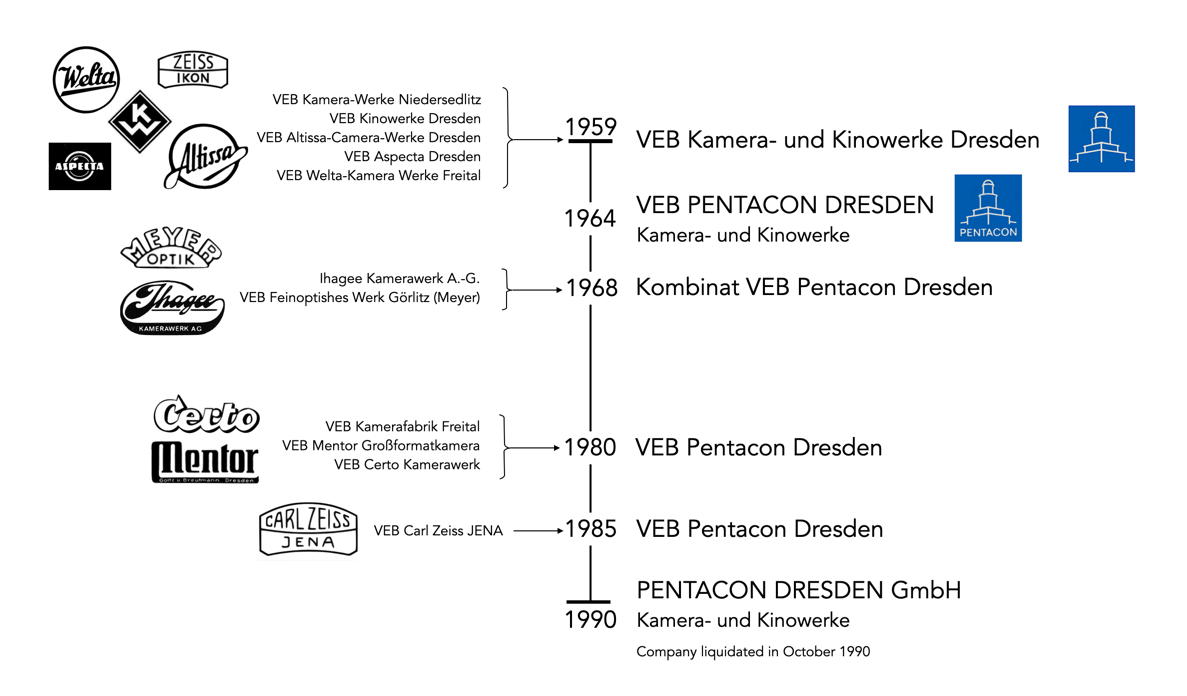
In 1959 of course, VEB Kinowerke was folded into VEB Kamera-und Kinowerk Dresden, the precursor to VEB Pentacon Dresden.
In West Germany, the company continued to be known as Zeiss Ikon. In 1956 the Carl Zeiss Stifung, (the parent company of Zeiss Ikon), bought Voigtlander. It continued to be operated as a separate company until 1965, when it was merged with Zeiss Ikon to form Zeiss Ikon-Voigtlander. It produced mostly different products to its eastern brethren, although there were similarities. For example both companies made renditions of the Contax camera. In 1972, Zeiss Ikon-Voigtlander ceased production of cameras.
❖ Zeiss Ikon in West Germany was established at the Contessa-Nettel factory in Stuttgart, the only one of Zeiss’s major facilities not under Soviet control.
 Crafting Pixels