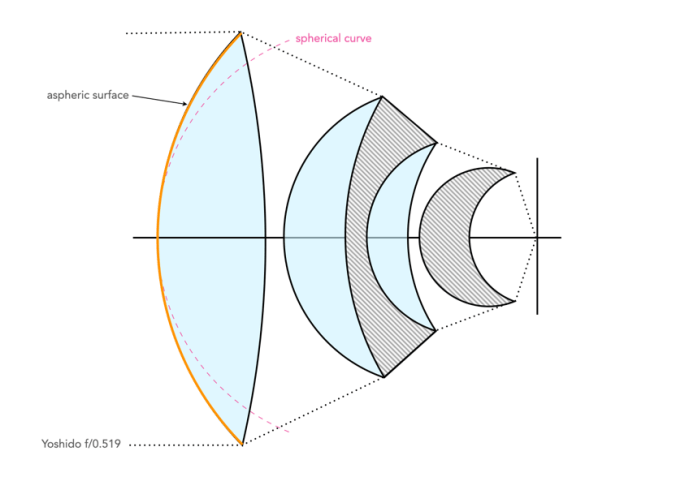
There is a lens described in a classified CIA briefing, which was never built [1]. The lens was designed by Shoroto Yoshido, a lens designer from the Sendai Science Laboratory, who supposedly achieved a relative aperture of f/0.519 using 5 elements. The lens only had one aspheric surface. But its design was somewhat crazy, the focal plane almost touches the the extremely curved rear lens. There is very little else written about this lens.
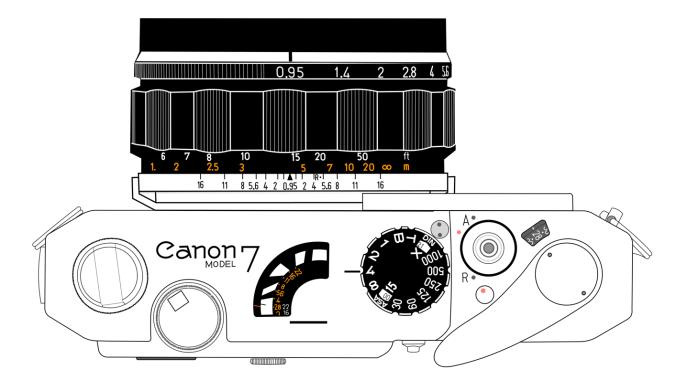
In August 1961, Canon released the 50mm f/0.95, designed as a standard lens for the Canon 7 rangefinder camera. At below f/1.0, it was the world’s fastest 35mm lens. It was created by lens designer Mukai Jirou, who also created several other rangefinder lenses for Canon (35mm f/1.5, 35mm f/1.8, 85mm f/1.8, and 100mm f/2). The Canon f/0.95 was often advertised attached to the Model 7, the first rangefinder Canon with four projected, parallax-compensating field frame lines.
Fig.1: The Canon 7 and the f/0.95
It was supposedly given the name “Dream Lens”, by British photojournalists, a term soon picked up by Canon’s astute marketing department (the exact source of the term is a mystery). The advertising generally touted the fact that it was “the world’s fastest lens, four times brighter than the human eye” (how this could be measured is questionable). In addition it was advertised as giving “least-flare edge-to-edge sharpness, and is ideally corrected for aberration”. Despite the hype, there are no reviews in photographic magazines of the period beyond a quick summary paragraph of the camera.
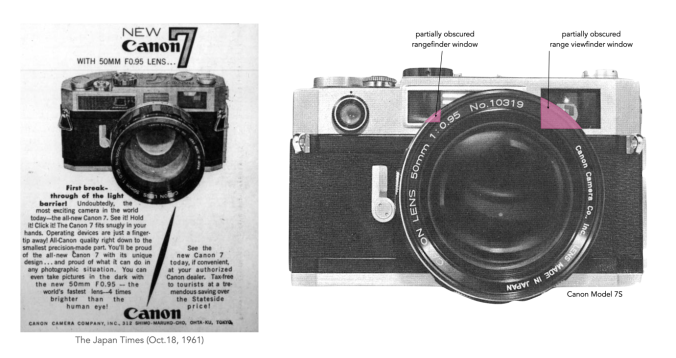
Fig.2: An ad for the Canon 7, and illustrating the obscured windows.
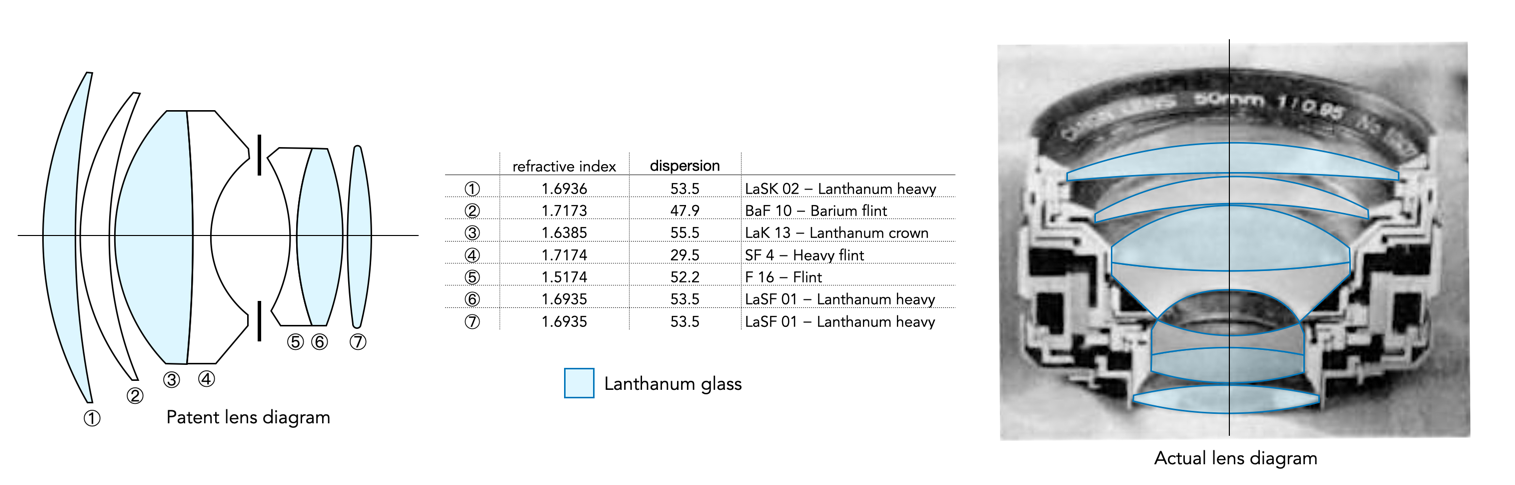
The lens incorporated rare-earth Lanthanum glass in four of the seven lens elements (there were no elements containing Thorium). However the entire lens design took some compromises. This chunky 605g, 79mm diameter lens was so large on the Canon 7 that it obscured a good part of the view in the bottom right-hand corner of the viewfinder, and partially obscured the field-of-view. However the rear lens element had to have about 10mm removed from the top to clear the interlocking roller associated with the rangefinder coupling mechanism, and a metal collar with four protruding feet had to be added to the back section to protect the rear element if the lens was placed on a flat surface with the front element facing up.
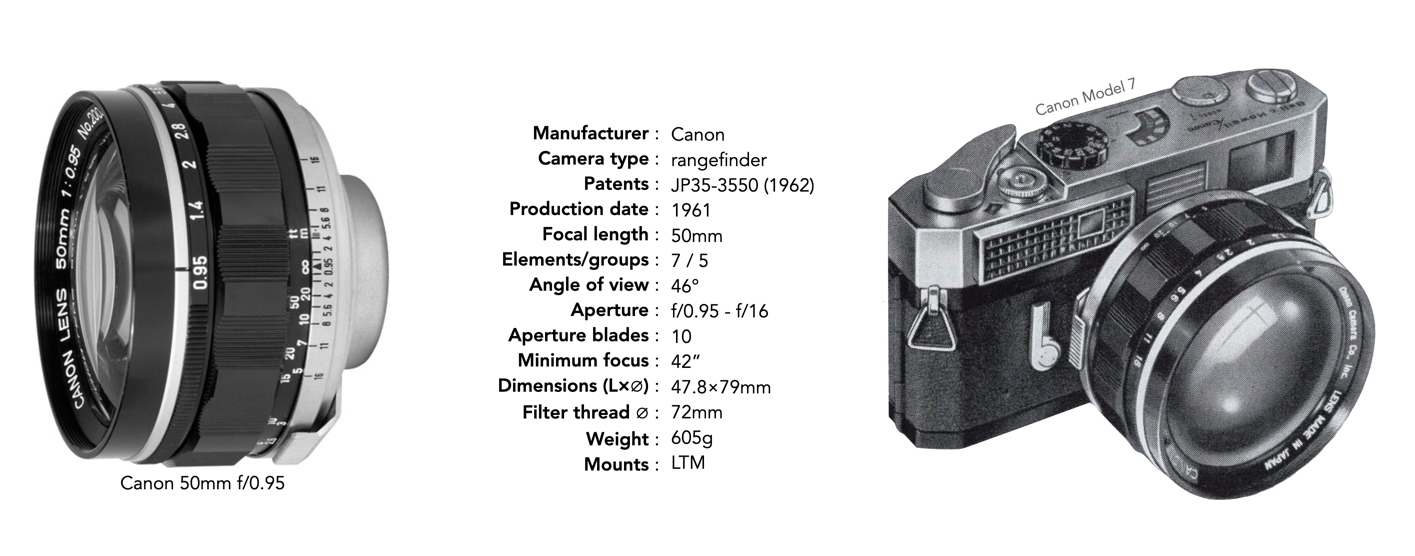
Fig.3: Lens specifications
It is Gauss type lens with 7 elements in 5 groups. In it is suggested that while there are many six-element Gaussian lenses, most suffer from some degree of oblique spherical aberration, with significant flare when used at maximum aperture.
There seems to be one Japanese patent of 1962, No.35-3550, [1] that may form the basis of this lens, although the lens diagram in the patent is not the same as that portrayed for the actual lens. The lens described also appears in a U.S. patent [2] where it is specified as an f/1.2 lens. The work has its underpinnings in an earlier Japanese patent, No.205,109 (Publication No.6,685/1953 corresponding to a US patent of 1954 [3]) which showed that spherical aberration could be reduced by selecting the appropriate arrangement of the refractive indices and radii of curvature at the cemented surfaces of each element. The purpose of the design was to create a lens that produced a high quality image.
How do users view the lens today? Overall it could be described as having a lot of vignetting, spherical aberration and quite a bit of softness [7]. Some suggest the soft-focus effect contributes to the lens’ ‘ethereal quality’, and the rendering has an impressionistic quality [4]. Some suggest that it isn’t very sharp wide open [7], having a ‘razor thin depth of field’ [7]. Bokeh is described as ‘Nisen-bokeh’ [5], and a ‘very retro, swirly’ bokeh [7].
Fig.4: Original lens diagram specifications from the Japanese patent [1], and the actual lens diagram (right)
Some 20,000 copies of this rangefinder-coupled lens were produced between May 1961 and September 1970. Between 1970 and 1984, Canon continued to manufacture a version of this lens for TV cameras and cinematography which had no rangefinder coupling. Of these, about 7,000 copies were produced. When released the lens cost 57,000 yen. The average yearly salary in Japan in 1961 was ¥294,000, so this lens was the equivalent of one-fifth of a years salary. In the US the Canon 7 was sold under the guise of Bell & Howell/Canon, and in 1962, with the body and lens retailing for $499.95, and the 50mm f/0.95 lens by itself for $320, with the f/1.2 at $210. To put this into context, $320 in 1962 is worth about $3430 today, and a Canon 7 with a f/0.95 lens in average condition sells for around this value. Lenses in mint condition are valued at around C$2200-5000.
Note: The lens is also often rehoused as a cine lens by companies such as Whitehouse Optics (the cost is €6,500, not including the cost of the optics).
The 1950s photographic industry in Japan was marked by a race to develop the fastest lens. In December 1950, Nippon Kogaku, maker of the Nikon, would introduce the Nikkor 50mm f/1.4, the fastest normal lens produced. But the victory was short lived, as in 1953 an even faster f/1.1 lens was introduced by a little known company – Zunow.
Fig.1: Literature in Japanese news announcing the f/1.1 lens
The development of the Zunow 5cm f/1.1 began in 1943 at the Teikoku Optical Co. to meet the high-speed optical needs of the Japanese Navy [2]. There was a requirement for a fast lens in low-level light situations such as aerial surveillance at dawn and dusk. The design was spearheaded by Sakuo Suzuki, and Michisaburo Hamano (NY Times, Nov.21 1953), and managed to produce three prototypes, but the factory was destroyed in a raid late in the war. It would take ten years to complete the lens. The first prototypes were completed in 1950, and the 50mm f/1.1 was Zunow released in 1953.
Fig.2: Lens diagram from the patent with associated optical glass types
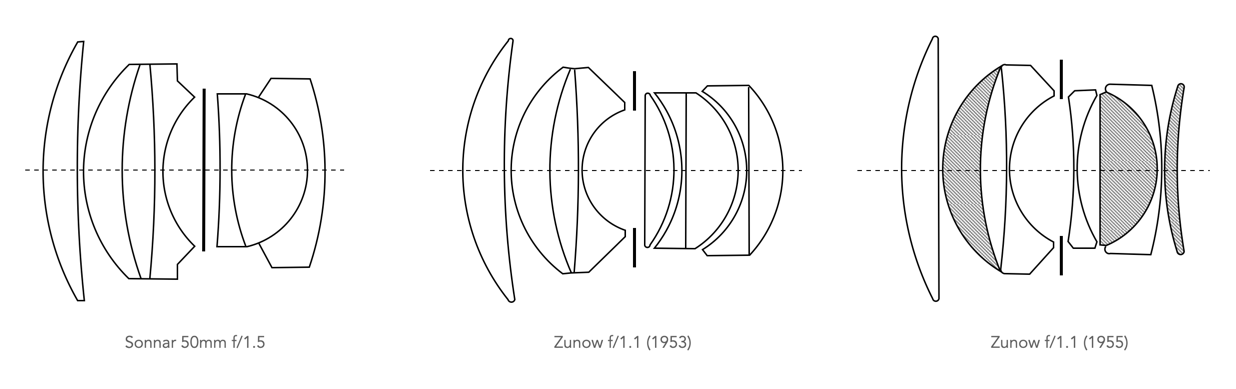
The patent for the Zunow f/1.1 lens [3] describes the lens as “an improved photographic objective suited for use with a camera that takes 36×24mm pictures”. The lens had a configuration of 9 elements in 5 groups, in a Sonnar-type design, likely derived from the Sonnar 50mm f/1.5. It was available in mounts for Contax, Nikon and Leica rangefinder cameras. The amazing thing about this lens is the fact that it was not constructed using any “rare earth” glasses.
Fig.3: Comparison of lens diagrams for Sonnar f/1.5, and the two versions of the Zunow f/1.1 (hatched lines indicate new glass) [2]
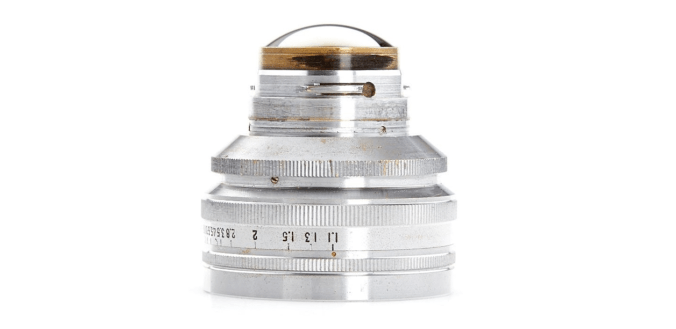
The original version earned the nickname “Ping-Pong ball” because it featured a rounded end. However it faced some issues, mostly when the aperture was wide open, e.g flare. Kenji Kunitomo and Yoshitatsu Fujioka would join the company to address these issues. This lead to the introduction of the Type 2 in 1955. The new design dealt with the protruding ball structure by redesigning the lens. It was transformed into a flat rear design with 8 elements in 5 groups, which also dealt with the flare and brightness issues when wide open. The lens elements featured a hardcoating on all air-glass surfaces to reduce internal reflections [7].
Fig.4: Specs for the original 1953 lens
Comments on the lens performance in The Truth About Superspeed Lenses (1957) [4]:
Performance: Vignetting at the widest aperture f/1.1, disappears completely at f/2.8. The lens is acceptably sharp at the centre of the negative. Detail is lost toward the edges and corners. Sharpest range is f/5.6 to f/11.
Comments: The Zunow lens mount may cut off the right corner of some camera viewfinder windows, blocking part of the image. It might be a good idea to use an accessory viewfinder with the Zunow. We found it an easy lens to focus quickly.
Fig.5: The “Ping-Pong ball” lens
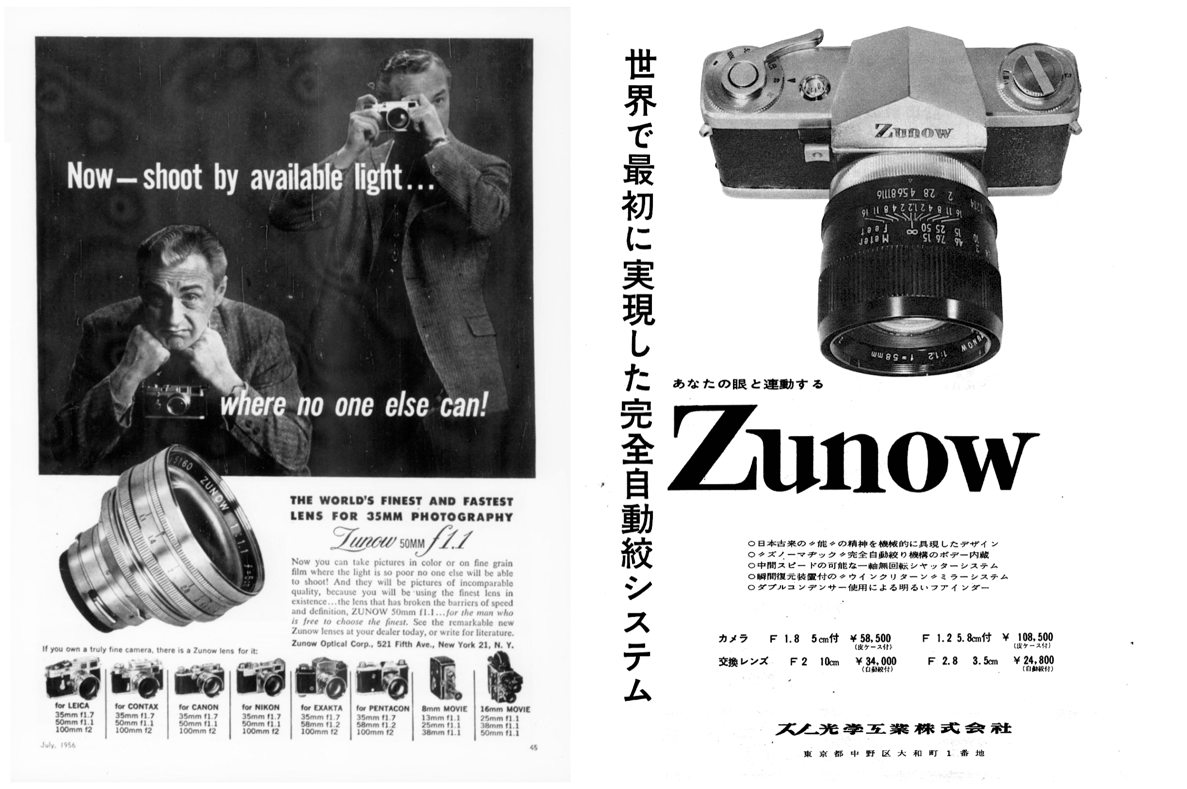
While the Zunow 50mm f/1.1 lens was the first ultrafast lens for rangefinders, there were few if any lenses of equal stature in the SLR realm. Ads at the same time showed a Zunow 58mm f/1.2 fast lens for Exakta and Pentacon SLR cameras. While very few have seen this lens in real life, and it does not appear to have been sold at any auctions in recent memory, there is a glimpse into what it looked like in the one of the ads for the Zunow camera shown in Figure 6. It was apparently a 7 element/5 group lens, of some expanded double-Gauss design [6]. The 58mm f/1.2 would have been the fastest lens offered by any camera manufacturer at that time for an SLR. In all likely so few were made that they today sit in private collections.
Fig.6: An ad for the 50mm f/1.1 lens, and a sneak peak at the 58mm f/1.2 in a Japanese ad for the Zunow SLR
Nevertheless, it would take Nippon Kogaku until early 1956 to match the Zunow lens in speed, introducing the Nikkor 50mm 1.1. Canon was not in the picture until the 50mm f/0.95 in 1961, and Leitz not until 1976 with the Noctalux 50mm f/1.0. The Zunow 50mm f/1.1 is today a vary rare lens. Sales are are US$5-10K, up to US$20K depending on condition, and mount. The price for this lens in 1956 was US$450, although it could be found for as low as US$300.
Fig.7: The Zunow SLR showing the 58mm f/1.2 lens, and its 7/5 configuration
Further reading:
Norman Rothschild, “Meet the Zunow f/1.1”, Popular Photography, pp.126/128, February (1956)
Kogoro Yamada, “Japanese Photographic Objectives for use with 35mm Cameras”, Photographic Science and Engineering, 2(1), pp.6-13 (1958)
U.S. Patent 2,715,354, Sakuta Suzuki et al., “Photographic Objective with Wide Relative Aperture”, August 16, (1955)
“The Truth About Superspeed Lenses”, Popular Photography, 21(10) pp.62-64 (1957)
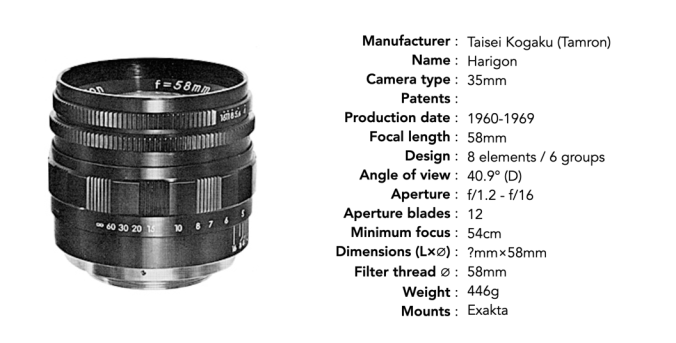
Not all fast lenses came from the lens giants. Other slipped under the radar. A good example is the Harigon 58mm f/1.2. It was made by Taika, which in reality was a export brand of Taisei Kōgaku Kōgyō K.K., the company which would later become Tamron (in all likelihood, Taika was a simpler and easier brand to remember than the company name). It was also sold as a Tamron lens.
The Harigon 58mm f/1.2
The lens was introduced in 1960, for the US market. The design was likely along the lines of the Zunow 5.8mm f/1.2, which is a itself is scarce as hen’s teeth.
Optical Science has produced this all-new Taika Rare Earth Lens, Eight hard coated complex elements of fabulous precision are responsible for its superb color correction and sharpness beyond reproach. The Taika Harigon has a dignified beauty – ebony black with colored engraved scales. A “Rolls Royce” in performance and appearance. You will be proud to own it, proud to show it and proud to exhibit its beautiful pictures.
Apparently it was available in Exakta mount, in addition to Praktica M42, and Miranda. In the early 1960s it was advertised as the standard lens on the Exa II camera for US$198.50 (from Seymour’s, NY). Interestingly the lens itself sold for US$169.50. By the time the Adapt-A-Matic Lenses appeared in the late 1960s, the 58mm lens had disappeared. There seem to be very few on the market today.
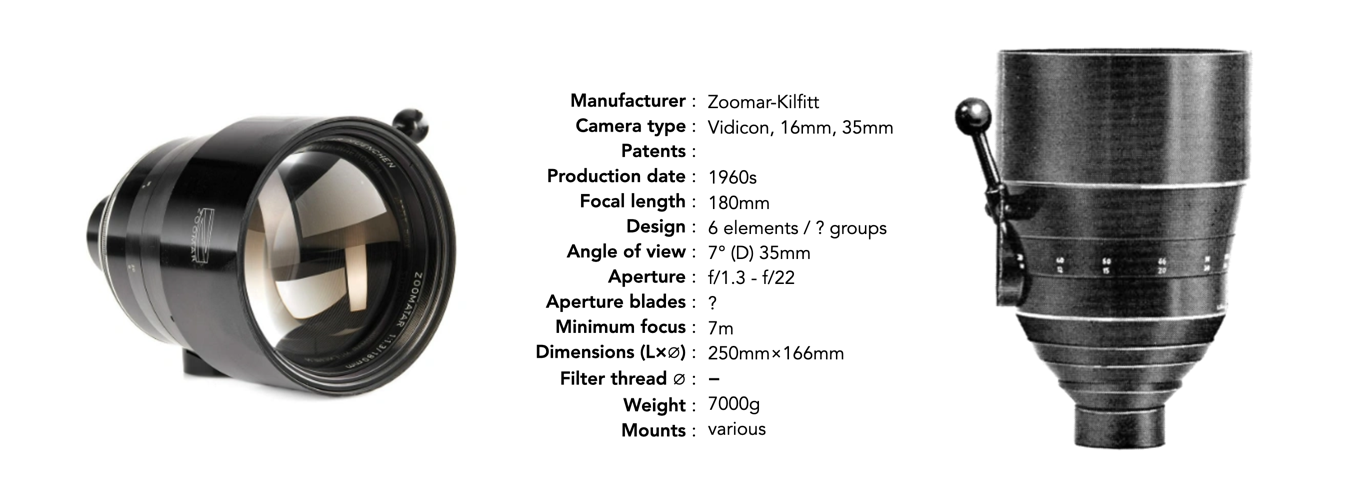
We now look at a fast telephoto lens – the Zoomatar 180mm f/1.3. This lens may have been a natural successor to the Grand-Kilar, the lens that seemingly never was. It was produced in the period after Zoomar Inc. took over Heinz Kilfitt. It is one of the fastest lenses above 100mm.
It was one of two super-fast telephoto lenses produced by Kilfitt in the 1960s, the other being the Zoomatar 75mm f/1.3. Both were intended for use in cinematography, with the 180mm also able to cover the 36×24mm area of normal SLRs. It seems like the 180mm lens was designed with the sole purpose to allow a maximum amount of light in, and it had the proportions to justify this – it was 250mm in length, had a diameter of 166mm, and weighed an astonishing 7kg – heavier than their Reflectar 1000mm f/8.
Kilfitt Zoomatar 180mm f/1.3
It has an optical scheme with six lenses, with a large difference between the diameter of the front (140mm) and rear (31mm) elements. Interestingly, because this lens was a cinematographic lenses, there is also some data on light transmission. Supposedly the light transmission was 80%, giving a T-stop of 1.5. Unlike the 75mm lens which was only supplied in C-mount, the 180mm lens came in various film formats (16mm and 35mm cine), in addition to 35mm. This means the angle-of-view could range from 3° on 16mm film to 7° on 35mm film. In 2011, one of these lenses sold on eBay for US$10,480.
Super Zoomatar 240mm f/1.2
Considering it sold in the mid-$2000’s in the 1970s, I don’t imagine many were actually manufactured (I have seen estimates of between 50-70). Zoomar did however create an even faster lens, relative to focal length – the Super Zoomatar 240mm f/1.2 – it was a behemoth at 11kg. It was originally developed for instrumentation cameras and for use with image intensifier tubes.
Not every fast vintage lens is a 50mm. Sometimes others are fast in relation to their focal length, like the Carl Zeiss BIotar 75mm f/1.5, considered by some to be the original ‘King of Bokeh’. The lens has a reputation for creating an incredible picture, which can be partially attributed to its ability to produce amazing bokeh, which was not exactly something that was mainstream in the mid-decades of the 20th century.
The Biotar lenses were designed in 1927 by Willi Merté (1889-1948) for cine cameras (Patent No. DE485,798). Merté continued developing the Biotar lenses, and in 1938 introduced the Biotar 75. Construction was complete by April 1938, and the lens went into production in February 1939. It was quite radical for the time, especially considering that all calculations for these systems were performed manually, i.e. by humans. It is often the reason very few of these lenses changed their specifications. The lens is a 6-element, 4-group, Double-Gauss optical design.
The first copies were made for cinematography, followed shortly after for Ihagee’s 35mm Kine Exakta. The advent of WWII meant that few lenses were sold, and those sales were likely restricted to lens enthusiasts who could afford them. Based on the available literature, it doesn’t seem like any were exported from Germany. In 1943, competition arrived in the form of the Leitz Summarex 85mm f/1.5. The design was a 7/6, but was prone to flaring, and heavier, at 700g to the Zeiss’s 500g. Post-war more competition in the German market resulted in the Meyer-Optik Görlitz Primoplan 75mm f/1.9; the Enna-Werke Ennaston-Lithagon 85mm f/1.5, and the Carl Zeiss Jena 85mm f/2 Sonnar. By the mid 1950s there was also competition originating from Japan.
“The ultra-light intensity of the 75mm ‘Night Lens’ ensures adequate exposures even under the most adverse lighting conditions, i.e. theatre, circus, cabaret, and night life. As this particular lens is more than three times as fast as the 2.8 lens, successful pictures can be obtained in towns and cities, illuminated only by normal street lighting.”
Exakta Varex IIa brochure, 1958
The three Biotar 75mm variants
There are three known variants of this lens. The first pre-war variant is known as the “skinny” Biotar 75. Introduced in 1938, this version has a thin, compact barrel. It was supposedly made of brass with a chrome-plated finish (although it is likely this changed to aluminum during the war). This lens were predominantly made for the EXA mount (not surprising considering the Exakta was the prominent 35mm SLR of the period). Early versions did not have an anti-reflection coating on the glass surface, which could cause flare when shooting against the light. Coatings, marked with a red “T”, began to be applied during the war (possibly for the military).
Carl Zeiss Jena Biotar 75mm f/1.5 Ver.1
After the war, Zeiss-Ikon was to release the Contax S, which used the M42 screw mount. Zeiss redesigned many of their lenses to take on the M42 mount. This resulted in the second version of the lens, produced between 1946 and 1952. This lens made use of lanthanum-containing Schott glass for its lens elements. This version was made in East Germany. Starting with this model, aluminum was used for the lens barrel to reduce weight. Additionally, the minimum aperture has been changed to allow up to f/22. In this variant, mounts for M42, Leica (L39), and Praktina were added, and it was compatible with at least five types of mounts, including those for Exakta and Contax. All have the “T” coating, although it may not be marked with a red “T”. Around 1950 markings were changed from 7.5cm to 75mm. The distance scale is a single one, which is very easy to read.
Carl Zeiss Jena Biotar 75mm f/1.5 Ver.2
The third version of the lens was produced from 1952-1968, as is known as the “fat” Biotar 75. This version has a solid barrel with a knurled/scalloped focus ring, a double distance scale, i.e. numbers on either side. The diaphragm is now preset, and the minimum aperture is back to f/16.
Carl Zeiss Jena Biotar 75mm f/1.5 Ver.3
The lens had various names over the 1950’s based on where it was sold. The lens was known as Nachtobjektiv Jena B (Night-lines Jena B), Zeiss-Biotar, “Jena B”, or just Biotar.
The lens is truly a pivotal design, it was not until new types of glass were designed, and the advent of computer-aided optical development that further progress could be achieved, ultimately leading to the Zeiss Pancolar 75mm f/1.4 in the mid-1960s. The 75mm lens itself would not really feature in the future of lenses, supplanted by the 80mm and 85mm focal lengths. Over its 30 years in existence, only roughly 20,000 copies were made. Supposedly they were made in very small batches (100-200) due to the nature of the lens – the optical elements required large pieces of flawless glass.
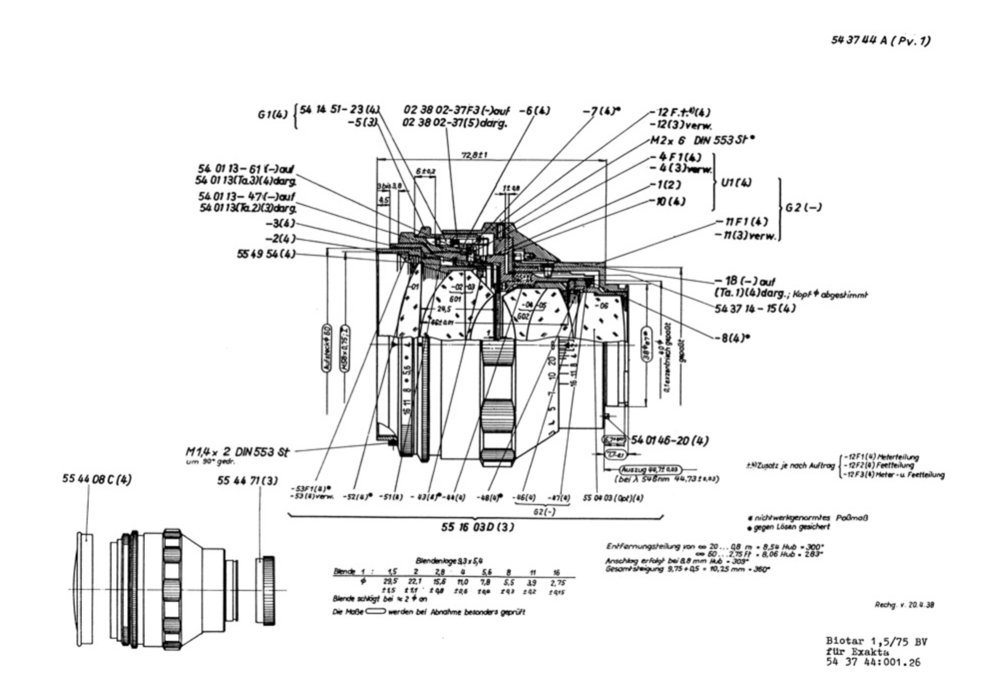
Zeiss specs for the “fat” version
In the early 1950s, the lens sold in the USA as a “high speed lens”, for around US$216, which is US$2,500 in 2023 based on inflation. In Germany in 1953, this lens sold for DM596 (which when converted was cheaper than in the USA (US$141). Today these lenses sell anywhere from US$2000-6000+ depending on condition, and variant. An alternative, which honestly costs a whole lot less, is the modern Biotar 75 f1.5 II, from Meyer Optik Görlitz (it sells for €1400, ca. C$2000).
NB: You can always tell when a Zeiss lens was manufactured from the serial number.
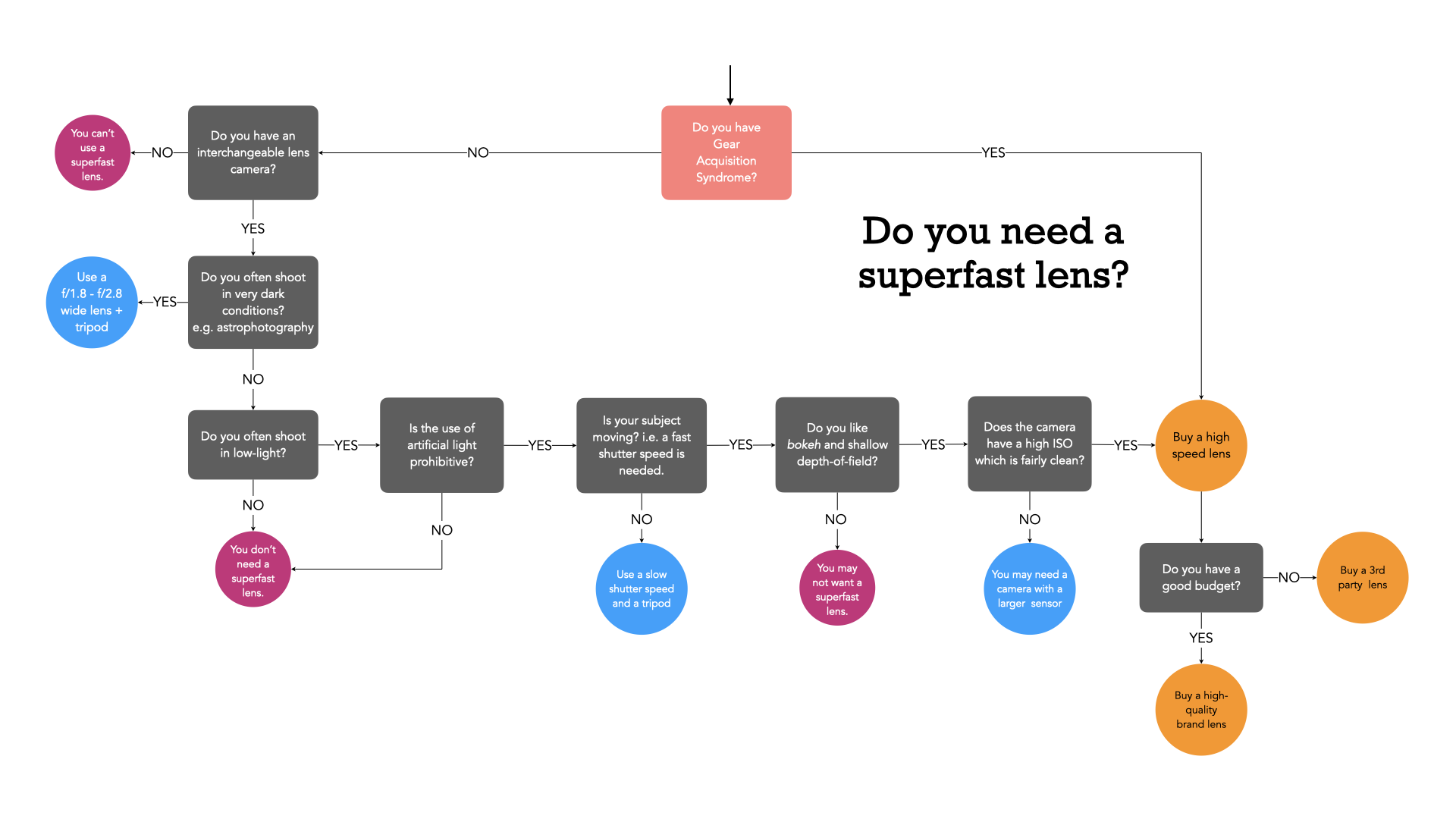
A superfast lens, is one with a very large aperture, say f/1.2 to f/1.0 (whereas an ultrafast is typically sub-f/1.0). The craze for super-fast lenses began in Japan in the 1950s, with the Zunow 50mm f/1.1 appearing in 1953. There was a lull in the latter decades of the 20th century, but the last ten years has seen a resurgence of these uber-fast f/1.2 and larger aperture lenses. There is always a lot of hype about these lenses – they are expensive, and supposedly offer some sort of nirvanic photographic experience. The question is, should you spend the money to indulge in super-fastness? First let’s look at some aspects of super-fast lenses that make them attractive.
“Do you need a superfast lens” ?
The faster the lens is, the more light it lets in
The larger the aperture, the more light that is let into the lens, and in photography, light is good. Moving from a f/1.8 to a f/1.2 lens provides 1.17 stops more light (where one stop doubles the light). For example a 50mm lens with a speed of f/1.8 has an effective aperture of 606mm2. Another 50mm lens with a speed of f/1.2 has an effective aperture of 1363mm2.
If we consider shooting at f/1.8 versus f/1.2, the larger aperture will mean the ability to shoot at faster shutter speeds – if we assume a constant ISO, then increasing the aperture by 1.17 stops means the difference between shooting at 1/500 at f/1.8 and 1/1250 at f/1.2. The second thing is that assuming the shutter speed is fixed, you can shoot at a lower ISO setting – e.g. at a shutter speed of 1/500 it means it means an ISO difference between 400 and 160. However modern sensors work really well at high ISO settings, so perhaps the advantage of a fast lens isn’t as critical?
Faster lenses produce better aesthetics
If it’s one thing that large aperture lenses are good at, it’s aesthetics. This is because the lower the f-number, the shallower the depth of field (DOF). Shallow DOF means a blurrier background, and theoretically better bokeh. However bokeh is a natural phenomena, and relies on the optical nature of the lens, the scene, the type of light, and distance to subject. In addition, a shallow DOF also means less of the image is in focus. It’s a double-edged sword.
Not all that glitters is gold
Of course super-fast lenses are not perfect. They have three things going against them – they are large, heavy, and expensive. They are large and heavy because of the increased amount of glass, and in auto-focus lenses, a larger focusing mechanism is required to deal with the extra glass. I have talked previously about why vintage super-fast lenses were so expensive, and in reality the same basic reasons can be attributed to super-fast digital lenses. For example the Fujifilm XF 50mm f/1.0 R WR lens sells for C$2,000, and is a whopping 845g in weight, almost dwarfing any Fuji camera it is attached to. The other issue with super-fast lenses has always been that they aren’t really that sharp until they are stopped down somewhat. The Fuji 50mm f/1.0 reviews well, but even then some reviewers note that it isn’t that sharp until stopped down to f/2.8 or smaller. But reviews are subjective, and so you really have to test the lens to see if it fits your needs.
Brand or third-party lens?
There is also the dilemma of which super/ultra fast lens to buy. There are a lot of 3rd-party lens manufacturers that produce these lenses at a reasonable cost. I mean you can buy the Meike 50mm f/0.95 for about C$400, or the TTArtisan 50mm f/1.2 for about C$140. The Meike actually gets really good reviews. The reality is that 3rd-party lenses offer a good quality for the price, even better than could be found on the vintage market. Of course the Fuji 50mm f/1.0 is in a class of its own, offering autofocus for a f/1.0 (most lenses of this speed are manual focus), and exceptional bokeh.
So should you buy a super-fast lens? Well, perhaps it boils down to whether you really need more light? This may mean you shoot a lot in low-light conditions, or in a case of the Fuji 50mm f/1.0, a superlative lens for portraiture. For a further foray into these lenses, check out “Are modern ultrafast lenses useful?“.
✿ The number of stops difference between two apertures A and B can be calculated by first finding C=A/B. The number of stops difference is then log(C)/log(sqrt(2)). So the difference between f/1.8 and f/1.2 is 1.17 stops.
A 50mm lens is always a 50mm right? They are in terms of focal length, but shouldn’t they all have similar dimensions? So why are lenses with super/ultra-wide apertures sometimes so much larger, and hence so much more expensive?
If there has been one notable change in the evolution of lenses, it has been the gradual move towards larger (faster) apertures. The craze for superfast lenses began in Japan in the 1950s, with Fujinon introducing the first f/1.2 5cm lens in 1954. After the initial fervour, it seems like the need for these lenses with large apertures disappeared, only reappearing in the past decade while at the same time moving into the realm of sub-f/1 ultrafasts. There are many advantages to ultra wide aperture lenses, but basically fast lenses let in a lot of light, and more light is good. The simple reason why bigger aperture equals bigger lens is more often than not to do with the need for moreglass. It was no different with historical superfast lenses. The Canon 50mm f/0.95 which debuted in 1961 was 605g.
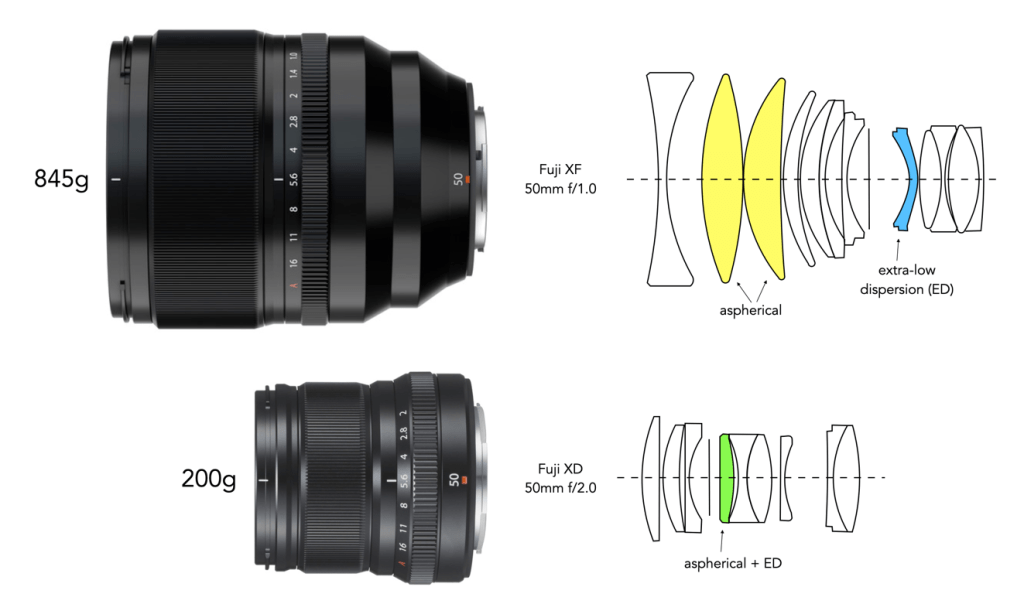
A comparison of the two Fujifilm 50mm lenses – f/1.0 versus f/2.0 showing the physical differences
Lenses are designed with the maximum aperture in mind. For example, a 50mm f/2.8 lens only needs an aperture with a maximum opening of 17.8mm (50/2.8), however a 50mm f/1.4 will need a maximum aperture opening of 35.7mm (note that these apertures are based on the diameter of the entrance pupil). For example consider the following two Fujifilm 50mm lenses – the “average” f/2.0 and the 2-stop faster f/1.0:
Fujifilm XF 50mm f/1.0 R WR – 845g, L103.5mm, ⌀87mm, 12/9 elements
Fujifilm XD 50mm f/2.0 R WR – 200g, L59mm, ⌀60mm, 9/6 elements
The f/1.0 is over four times as heavy as the f/2.0, and almost double the length. To get an f/2.0 on a 50mm lens you only need a 25mm aperture opening, however with a f/1.0 lens, you theoretically need a 50mm opening (aperture of the entrance pupil). Now some basic math of the surface area (SA) of an aperture circle will provide a SA of 491mm2 for the f/2.0, but a whopping 1963mm2 for the f/1.0, so roughly four times as much area which allows light to pass through fully open. Equating this to glass probably means that at least four times as much glass is needed for some of the elements in the f/1.0 lens. There is no way around this – large apertures need large glass. As the aperture of a lens increases, all of the lenses have to be scaled up to achieve the desired optical outcome.
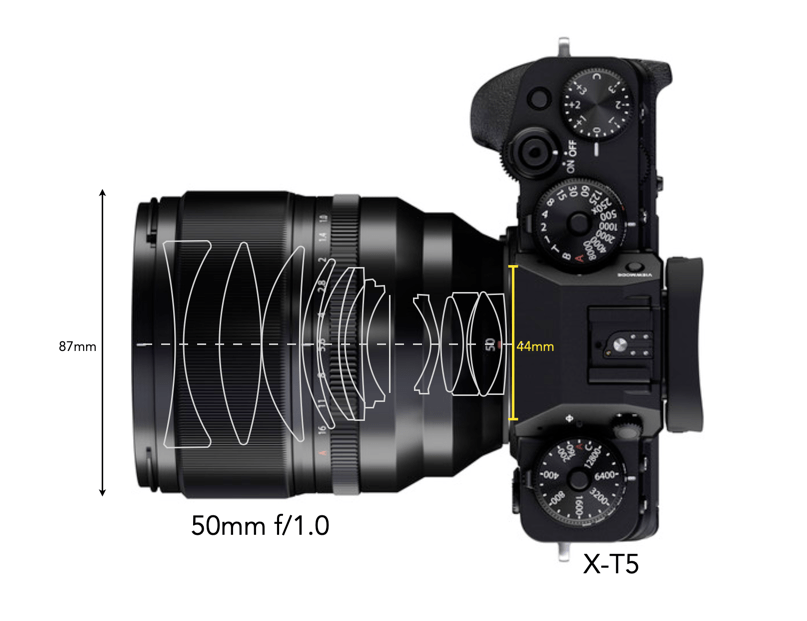
The massive scale of the Fujifilm XF 50mm on a camera (the X-T5). The lens has a diameter of 87mm, and the inner opening of the mount is only 44mm.
Larger aperture lenses also have more specialized glass in them, like with aspheric and lowdispersion elements. But companies don’t just add more glass to make money – complex designs are supposed to overcome many of the limitations that are present in ultra-wide aperture lenses. Unlike their historical predecessors, modern superfast lenses have overcome many of the earlier lens deficiencies. For example in vintage superfast lenses, the lens wide-open was never as sharp as could be expected. Newer lens on the other hand are just as sharp wide open as they are stopped down to a smaller aperture.
Now not all super/ultra-wide aperture lenses are heavy and large. There are a number of 3rd-party lenses that are quite the opposite – reasonable size, and not too heavy (and invariably cheaper). But there is no such thing as a free lunch – there is always some sort of trade-off between price, size and optical quality. For example the Meike 50mm f/0.95 is only 420g, and it’s lens configuration is 7 elements in 5 groups. However fully open it is said to exhibit a good amount of chromatic aberration, some barrel distortion, and some vignetting. There is no perfect lens (but the Fuji f/1.0 comes pretty close).
✿ A fast lens is one with a wide maximum aperture. Superfast lenses are typically f/1.0-1.2, and ultrafast lenses are sub-f/1.0.
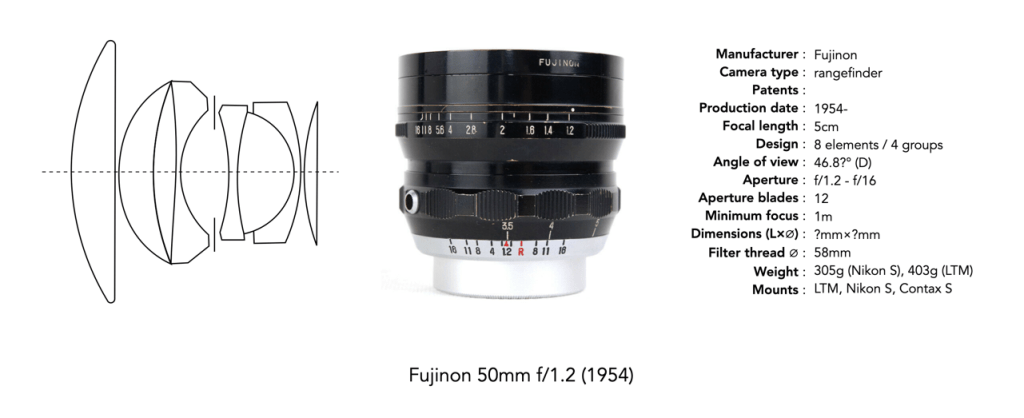
In the 1950s, the Japanese camera industry was at war, and the prize was super-fast lenses. There were several manufacturers involved in this race – Zunow, Nippon Kogaku, Konishiroku and Fujinon. Although the ultimate target was likely the German optical industry. The Fujinon 5cm f/1.2 was to appear in 1954. It was built in the Leica LTM screw mount (800 pieces), the Nikon S rangefinder mount (50 pieces) and the Contax S mount.
The lens was designed by Fuji designer Ryoichi Doi. The lens is said to have been based on the Solinon 5cm f/1.5, which was also designed by Doi and patented in 1948 (J#191,452). The lens was based on Sonnar design, and the next step was to push it to f/1.3 using conventional glass. This was followed by a prototype f/1.2 with 9 elements, and finally the production 8-element design. Six of the eight lens optics were high speed lenses. These lenses used four types of new types of glass with low refractive index and high dispersion, the aim being to minimize flare caused by aberrations and achieve high-contrast imaging. The lens was designed to ensure ample light reached the edges of the frame, having a front lens diameter was 51.5mm, and the rear lens diameter was 28mm.
A 1959 price list shows that this lens sold for US$299.50. Today the price of this lens is anywhere north of $20K. Too few were manufactured to make this lens the least bit affordable.
Very few high-end camera companies have delved into the sub-f/1.2 genre of lenses, even for digital. The likes of Canon and Nikon have played that game before, in the 1960s, and are too practical to make that mistake again. The only ultrafast lens produced by a camera manufacturer is the Leica Noctilux-M 50mm f/0.95 Asph. Made for digital cameras, it has been in production since 2008. But at US$13K it is hardly a lens for the masses.
“The reason to buy a high-speed lens is to allow shooting in low-light situations or with short shutter speeds. Your photos may not be super-sharp, but at least you get a picture. If you need the high speed, then this f/1.4 lens or an f/1.2 version are the ones to have. However, if you can accept a speed of f/2, which is still plenty fast, then the slower lens is sharper. As an added benefit, the f/2 lens will be less costly than a faster one.”
G.H. Smith, Camera Lenses: From box camera to digital, SPIE (2006)
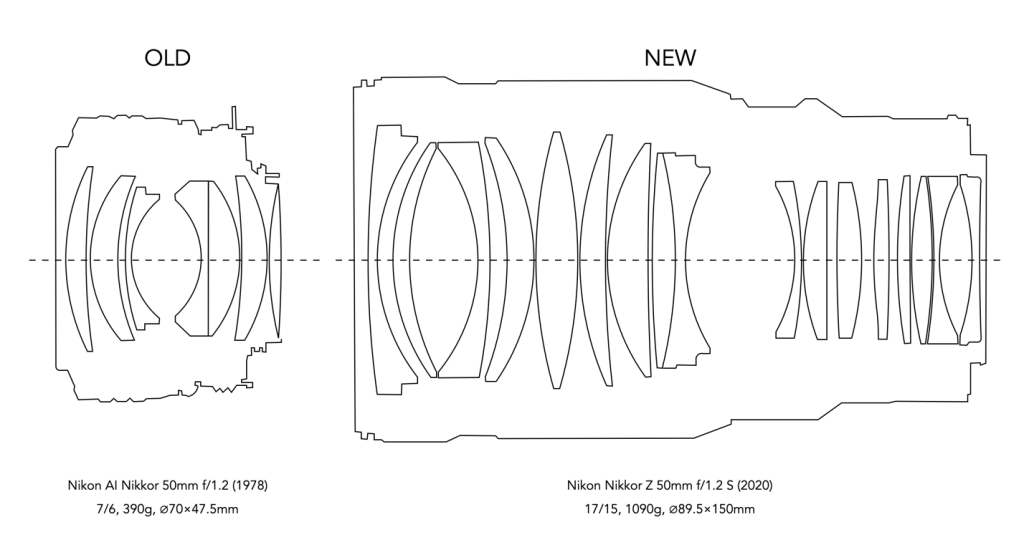
If you compare the inside of a modern digital lens versus its vintage analog compatriot, the first thing you might notice it the extreme complexity found in the modern lens. Consider the two lenses shown below. The Nikon AI Nikkor 50mm f/1.2 hailing from 1978 has 7 elements in 6 groups. Spring forward to 2020, and the Nikon Nikkor X 50mm f/1.2 S has a mind-blowing 17 elements in 15 groups. It’s also almost three times the weight of its predecessor. Is the image better? That is really in the eyes of the beholder.
Of the dedicated, high-end, lens companies only Voigtländer really stands out. They make lenses for a number of varied camera mounts. For Micro-Four Thirds (MFT) they actually offer a range of f/0.95 aspherical lenses, 10.5mm (21mm), 17.5mm (35mm), 25mm (50mm), 42.5mm (85mm), and 60mm (120mm). There is even a faster f/0.8 29mm (58mm) lens. These in reality are made for crop-sensors, with their full-frame equivalents more in the line of f/1.9. If one were to create a MFT equivalent of the Noctilux-M 50mm f/0.95, you would need something along the lines of a f/0.5. There are also third-party companies producing “inexpensive” ultrafast lenses (often by means of innovative lens designs). For example the Venus Optics Laowa, TTArtisan, Mitakon Zhongyi Speedmaster, Meike, 7artisans all have f/0.95 optics in various focal lengths, and sensors sizes. In 2022 TTArtisan introduced an f/0.95 35mm lens for APS-C for US$200.
But I do wonder why there is such interest in f/0.95 lenses? Dreamy bokeh? Why not just make f/1.0 lenses? I mean there isn’t that much difference between f/0.95 and f/1.0 – like 1/7th of a stop. I imagine it’s a marketing spiel, just like I imagine it was for Canon when they introduced their 50mm f/0.95 lens back in 1961. It’s a gimmick in the same way that items that cost $1.99 are perceived as cheaper than those marked $2. Why not go even further? I mean Voigtländer do have their f/0.8 29mm (58mm) super aspherical for MFT, which they toute as a world first (as of 2021), and introduce in their literature as the “conqueror of the night”. It’s not the fastest 35mm lens every made either, that honour goes to the Carl Zeiss Planar 50mm f/0.7.
There are limits to what lens speed will do for photography. An f/0.95 lens already has a very small depth of field, so small it makes it hard to focus. Many of these lenses may not even be that usable fully open, requiring them to be stopped down to f/2 before any semblance of usability is invoked. Sure, great for low-light but how often does anyone need that? Too many people use these lenses just for the bokeh effect, but that’s another story altogether. Somebody must be buying the Leica lens, as they are still making it. Likely more people are buying the cheaper lenses, just to experiment with. Check out this review of the TTArtisan 50mm f/0.95 by Dustin Abbott, who describes one of the pros as being “fun in low light”, and ultimately maybe that’s how we should view these ultrafast lenses, for fun, creative photography.
P.S. I do own a MFT f/0.95, more by happenstance than anything else. A few years back I bought the original Voigtländer 25mm f/0.95 (used, not new) for my Olympus MFT camera. It’s an incredibly solid lens, but it’s shallow DOF does make it tricky to focus.







 Crafting Pixels