Q&A: Limitations of smartphone cameras (ii)

The remainder of the Q&A.

Is battery life a big issue?

Smartphones have an extremely limited battery life. The newer smartphones like the iPhone have exceptional battery life, for a phone, but not for a camera. Batteries just don’t last that long with smartphones, requiring a battery pack of some sort to keep them going. It is hard to pin down exactly how many photos you can take off a charge, because a smartphone is not a dedicated camera, and therefore uses power for things apart from taking photos. For average use, smartphone batteries are more than adequate, however when used when travelling it could become an issue, largely due to the number of photographs taken. It is easy to have multiple spare batteries for a camera.

Are smartphones limited by storage?

Smartphones differ on whether they just offer on-board storage (Apple) or offer access to a removable microSD card slot (Android). Choosing a smartphone with no expandable storage means things will fill up very quickly.

Are smartphones easy to use as cameras?

Smartphones tend to lack what I like to call tactile awareness. They aren’t really that ergonomic from the point of holding them, let alone using features. There are some apps that allow better creative control, but all have to be manipulated by means of the touchscreen. And even then they have somewhat poor creative control. Although cameras often suffer from poorly designed menus, the problem with smartphones is that even the best photography software suffers from having a lot of features in a small space. This is sometimes balanced by the amount of post-processing techniques available, but editing a photograph on a small screen is severely limiting. Sure, these smartphones do have fancy AI software to reduce issues, and make “nice” looking photographs, but there is one inherent limitation with this – a loss of character. Smartphone displays, however good aren’t really ideal for photography. Sometimes its hard to see what you are shooting due to glare. Cameras have an EVF which is shielded from the sun.

Can smartphones produce the same aesthetics?

Aesthetics on a camera is really down to the quality and type of lenses. Most cameras, except for compacts, have interchangeable lenses which makes it easier to achieve a certain aesthetic. For example smartphone cameras can generally not produce bokeh naturally. Smartphone cameras are not exactly designed to have narrow depth-of-field areas, without which it is impossible to naturally create bokeh. Bokeh is typically found in portrait-style photographs where it is added algorithmically by means of computational photography and machine learning (it basically delineates a subject, and then artificially adds blur to the background).

What things do DSLR/mirrorless cameras do better?

  1. Real cameras have larger sensors. Larger sensors mean better quality images.
  2. Real cameras have better lenses – high quality optical glass, and faster apertures.
  3. Real cameras offer more control – shutter speed, ISO, aperture
  4. Real cameras shoot in RAW
  5. Real cameras are dedicated to one job, and last longer.

Can smartphone cameras handle climate extremes?

This is a important, because smartphones use Lithium-Ion batteries which are effected by temperature extremes. For example Apple suggests keeping their devices between zero and 35°C. Cold batteries can slow down the function of a smartphone. Cameras on the other hand have a broader working range of temperatures, from 0 to 40°C, and some are designed for temperatures as low as -10°C (e.g. Fujifilm X-T4). Smartphone batteries are also not removable, versus camera batteries which can be removed and kept warm while they are not being used in the cold. Smartphones and freezing temperatures do not mix well. Professional cameras can shoot through everything.

Are smartphone zoom lenses useful?

Smartphones can have either digital or optical zoom, or both. Optical zoom provides high-quality, lossless magnification. Digital zoom however enlarges the captured image, and does not involve movement of the camera lens. Digital zoom just zooms in on the pixels, and may result in a loss of image quality. It is achieved by magnifying and interpolating pixels, which can lead to a loss of sharpness and detail. When used on smartphones, digital zoom is often used when the physical limitations of the lens prevent further optical zoom. Some, like the plain iPhone 14, only have digital zoom (5× in this case). The main pros of digital zoom are related to smartphone form-factor: convenience, compact design and cost effectiveness. But the cons somewhat outweigh the pros: loss of image quality, no true magnification, interpolation artifacts, and inferior performance in low light.

Q&A: Limitations of smartphone cameras (i)

Here I’m going to explain a bit more about the caveats of smartphone cameras in the form of a FAQ. I will add that for all their compactness, smartphone cameras produce incredible images, they just have the same limitations all small devices have.

Is the image quality as good as a dedicated digital camera?

Image quality is partially reliant on the size of photosites, the building blocks of digital images. The larger the photosite, the better it is for low-light conditions. Smartphones have relatively small sensors, and therefore are constrained by the size of their photosites. They still produce images with exceptional quality, but there is a reason people choose full-frame and medium sized sensors for professional work.

Regardless of what companies say, image quality on a smartphone will never be as good as those on a camera. The iPhone 14 Pro has a 1/1.28” sensor on the wide camera with a sensor area of 75mm2, and a pixel pitch of 1.22μm in 48MP mode (2.44μm in 12MP mode). Don’t get me wrong, the technology is amazing – squeezing a camera with a 7-element, 24mm focal length equivalent lens with optical sensor shift. But those pixels are small, and there is only so far you can scale up a 12MP image. In comparison, a 26MP APS-C camera sensor has photosites that have nearly four times the area of the 14 Pro, which means more light can be captured. It also has twice the number of photosites, more photosites amounts to better resolution.

Are lens elements made of plastic?

Cameras are all about the glass, or in the case of smartphones – plastic. Most smartphone cameras are comprised of lens elements made out of injection molded optical plastic. Now plastic lenses have been around for a long while, and they have benefits and drawbacks. There are many reasons for this, most notably the fact that plastic elements can be molded into much more extreme aspheric shapes, something not possible in optical glass (aspherical lenses are used in high-end optics to create sharper images and reduce or eliminate some types of optical imperfections). Plastic also allows for thinner lenses that have more complex flange geometries.

An example of a plastic 5-element smartphone lens.Made of injection-molded optical plastic, they are extremely cheap to produce.

Are lens apertures limited?

The aperture of a lens controls how much light makes its way through to the sensor, controlling things like depth-of-field (or how much of the scene is in focus). Smartphones that work well in low-light situations, without the use of a flash, have large apertures. The wide lens on the iPhone 14 Pro has an aperture of f/1.78, which allows for good low-light performance, but taken into context, an aperture of f/1.78 has the DOF equivalent of an f/6.1 aperture on a full-frame camera. That makes it hard to produce blurry effects naturally – they are usually added artificially in post-processing. These lenses are stuck with a single fixed aperture, providing limited control of exposure. It may seem like you can change the aperture, but apps that allow the aperture to be changed to increase the amount of background blur are really just adding a certain amount of artificial background blur. Camera lenses can change the aperture, and hence the depth of field, facilitating natural blur, i.e. bokeh.

Do smartphones create natural Bokeh?

Bokeh has to do with unfocused regions in an image, and relies heavily on a shallow depth-of-field. Many smartphones use wide-angle lenses, and as a result, have quite a large depth-of-field (DOF), the distance between the nearest and farthest elements in a scene that are in acceptably sharp focus. The available depth of field increases as the sensor size and lens focal length decrease, which is why smartphone photographs tend to have very large DOFs. Landscapes, everyday shots, even close-ups have very little out-of-focus. How is bokeh created? Through the power of algorithms. The iPhone uses both cameras to create a DOF-effect in Portrait Mode. It combines the photographs taken by the wide-angle and telephoto lenses, and after applying some computational magic, produces a blurred background. There is even a Depth Control feature which allows the bokeh, to be tailored, between an aperture of f/1.4 and f/16. But it is computationally created, and bokeh is a natural phenomena which occurs in part because of lens optics.

Are different lens focal lengths useful?

While these lenses are exceptionally designed for the small space they are required to inhabit, they can not really be compared to the larger glass available in dedicated cameras. Photography is about light, and smartphone lenses are extremely small and so don’t really let in the same amount of light. The 24mm equivalent wide angle lens of the iPhone 14 Pro has an actual focal length of 6.9mm (35mm equivalent), the 13mm is actually only 2.2mm, and the 77mm is only 9mm. Basically the focal lengths often used to described in lenses are in terms of their 35mm equivalents, likely to create better associations. For example a 77mm telephoto lens seems easier to understand than a 9mm telephoto.

To get a bit technical, this means the effective diameter of the entrance pupil (DEP) of the wide-angle 6.9mm lens with a max aperture of f/1.78 is 6.9/1.78 = 3.88mm. Comparing this to the equivalent 24mm full-frame lens, say the Sony FE 24mm f/1.4, and the DEP is 17.14mm, much larger. More area equals more light. Apart from the fixed aperture, and compactness of the lenses, there is another big issue. Smartphone lenses, regardless of how many of them are on a phone, can only cover a finite number of focal lengths. Cameras, especially those with interchangeable lenses, can use optical zoom lenses that cover a very broad range of focal lengths. For example the APS-C lens Fujifilm XF 18-135mm (f/3.5-5.6) covers the full-frame equivalent of 36 to 270mm.

Why smartphone cameras will never replace digital cameras

Don’t believe the hype: a smartphone will never completely replace a traditional camera.

There is no doubt that smartphones have closed the gap on image quality, and they are popular for their convenience and ease-of-use. But they are not the same as digital cameras. Photography is a craft – it’s not just about capturing reality, which smartphones do really well. It’s about telling stories, and to do that you need some level of creative freedom, which is only available with a versatile camera. Cameras are ergonomically designed for taking photographs, that is their only job.

Cameras are a ubiquitous tool now, as everyone has one in the guise of a smartphone. In 2022 some 1.5 trillion photographs were taken, of which up to 90% originated from smartphones. The quality of the images produced by smartphone cameras is really very good, and why shouldn’t they be, as there is a crazy amount of technology that is incorporated into them. Smartphones of course have many functions, although I am increasingly convinced that their major roles are as a camera, a visual social media device, and a communications device that involves using the phone, or texting. I use mine as a translator with the Google Translate app because it conveniently takes a snapshot of the text I want to translate, and provides me with a quite accurate rendition of the text in English – useful because of the camera. A smartphone is inherently convenient, because it has a small form factor, and is convenient to travel with, allowing us to take pictures of whatever we want. It almost turns the phone into a form of visual record. Then of course there is social media like Instagram, which we use to take photos of things we like to share, like food. Where would we be without the smartphone camera?

However there are natural limits to the effectiveness of a smartphone camera. The first caveat is that while a smartphone is a jack-of-all-trades, a camera is dedicated to just one task – taking pictures. A camera is not a GPS, nor a social media device, nor a music player. But let’s look at some of the core issues. Smartphone cameras are small. As much as that plays as a strength to their overall usefulness, it is a deficit when it comes to being a platform for photography. There is only so much space in a smartphone, and the quality of the images produced is truly magical considering these constraints. The sensors are small, and are therefore limited in their versatility. Photography is all about light, and the more light that can be captured the better. To make up for their compactness, smartphones rely on software to improve the image quality of pictures that are captured.

The biggest elephant in the room with smartphone cameras may be image resolution. Most smartphones have restrained the megapixel count to around 12. The iPhone 14 Pro has a 48MP quad-sensor main camera, which seems quite spectacular, but in actuality the sensor defaults to 12MP – the quad-pixel sensor combines every four pixels into one large quad pixel. To create 48MP images ProRAW mode has to be activated, but the images produced are anywhere from 75-100MB in size. The 1/1.28” sensor is 10×7.5mm in size, giving it a crop-factor of 3.46. The crop-factor of APS-C is only 1.5 in comparison. Of course comparing a smartphone camera to a full-frame at the opposite end of the spectrum is hardly fair, they are really designed for different types of photographers.

There are situations where smartphone cameras perform extremely well, and there are others where they don’t. Convenience may be the key factor to their popularity. There is no need to worry about a memory card, and you always have a camera on you. But dig a little deeper, and for the photographer there are some issues. Foremost is the lens itself. It’s compact, small, has a fixed focal length, and usually made of plastic. They are usually good lenses, and continuously evolving, but you can never replicate the same quality as in a larger format camera lens – it just isn’t possible. Then how do smartphones produce images as good as those from full-frame cameras? The reason for the exceptional quality of photos from smartphones is the amalgam of post-processing that is achieved using fancy algorithms. Instagram filters are simple in comparison. Smartphone photo apps are full of “intelligent” computational photography algorithms capable of overcoming the limitations of small sensors and lenses. For example artifacts like geometric distortion, and vignetting, can be easily corrected in-situ. There are even high-end noise reduction algorithms to deal with the fact that smartphones contain small sensors with small photosites.

Then there are the physical things you can do with a camera, even a compact, that just aren’t possible with a smartphone. Case in point, focusing. I know most people never think twice about this because smartphone cameras auto-focus, but what if you don’t want that, what if you want to wrestle some control back? It’s hard. Even with apps like Halide, it isn’t exactly a trivial experience. Part of that has to do with the lack of tactile physical controls. It just isn’t the same trying to control some parameters using a touch-screen interface. There are other neat features on phones, to correct for various artifacts, or add artifacts, but it isn’t exactly easy trying to edit a photograph on a small screen. It’s hard to do things like play with DOF, or heaven forbid bokeh – the device just isn’t set up for that. I find phone cameras great for Instagram, or in situations where I need to copy a document – those apps are awesome. But otherwise, there is just something lacking. Smartphones cameras offer a record of events, places, and things. You can use them to take photos in places where cameras are shunned. In many ways they have created disposable images.

There are a myriad of articles pertaining to the death of cameras, but for true photographers, smartphone cameras will never be a replacement. The basic truth underpinning this is that regardless of the technology, smartphone cameras are limited by their form factor. Yes, smartphone cameras have high resolution, even 12MP is still impressive, but there are more components to the aesthetics of a photograph than just resolution. Even with some manufacturers breaking into uber-pixel smartphone camera, for example the Samsung Galaxy S23 Ultra can take 200MP images, but in reality these are often just more marketing hype than anything else. Yes, you can take a 200MP image, however perhaps not in low-light situations.

Now smartphone cameras can’t replace traditional cameras, but they can help augment your photography. I love my smartphone for the convenience it offers me, 12 megapixels, portability, basic in-app image processing, Instagram, and even being able to translate documents. Smartphones have completely automated photography, but one has to question what happened to the aesthetics of taking photographs? For photography is not just about recording events, it is about capturing a moment in time in such a way that it is memorable.

Smartphone cameras, pixel-binning, and the art of megapixel hype

Many smartphones are now marketed as having at least one camera with a ridiculous amount of megapixels. The iPhone 14 Pro has 48MP, the Samsung Galaxy S23 has 200MP. Is it just too much? The answers is yes, and some would argue it’s more of a marketing hype than anything else. I mean who doesn’t want to take a 48MP or 200MP image? Well, most people may try it once, but many won’t routinely use it, and the reasons why are varied. First, let’s look at the technology.

Smartphone sensors are no different to any other sensors, they are just usually smaller than many conventional digital camera sensors. The sensors contain a bunch of photosites, so no different there. But there are limits to the size of sensor that can be used inside a smartphone, made more restrictive by the fact that many smartphones now have 2-3 rear-facing cameras. Higher resolution means that more photosites need to be crammed into the sensor’s surface area. The iPhone 14 Pro has a wide angle camera with a 48MP resolution. It uses a 1/1.28” sensor, which is 10×7.5mm in size with a photosite pitch of 1.22µm, which is extremely small. Typically smaller pixels have a harder time getting light than larger ones, leading to some issues in low-light situations. So smartphones typically get around this by creating reduced resolution images with “bigger” pixels that are created by means of photosite binning (or pixel binning if you like).

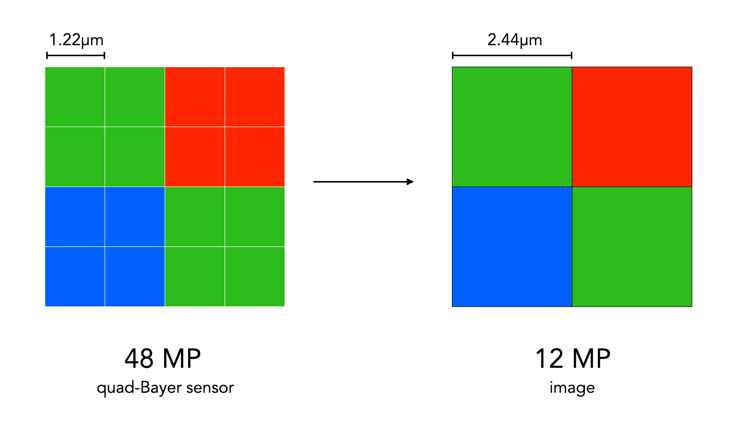
Fig.1: Pixel binning (2×2) with the iPhone 14 Pro – converting 48MP to 12MP by merging

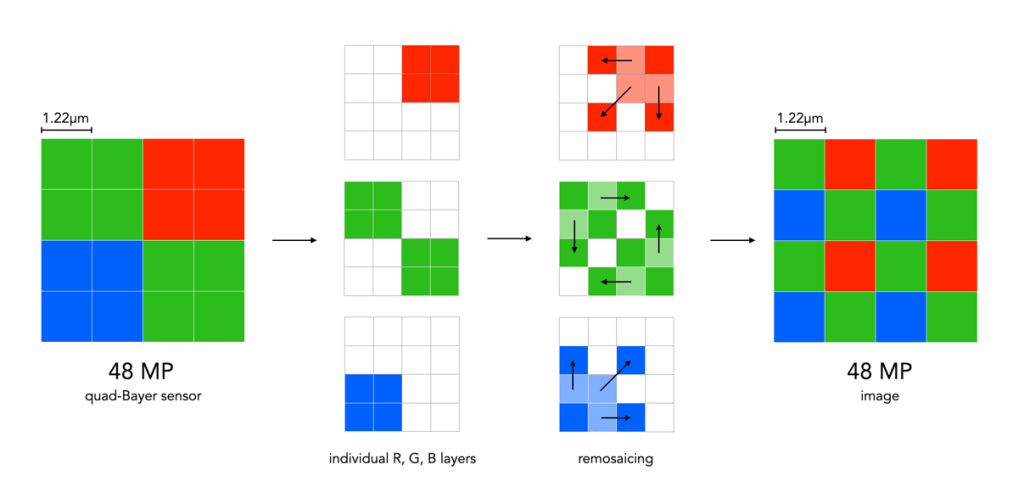
Photosite binning artificially groups smaller pixels into larger ones, potentially boosting the amount of light that can be gathered. The example in Figure 1 shows part of the quad-Bayer sensor of the iPhone 14 Pro. It illustrates how a 12MP is generated from a 48MP sensor. Here four photosites (2×2) are binned from the sensor, producing a 12 megapixel image, i.e. 48÷4=12. The Samsung Galaxy S22 Ultra takes 108MP images, and also defaults to 12MP, but instead of using a 2×2 binning, it uses what Samsung calls “Nonacell” technology”, merging 3×3 photosites into a super pixel. So the photosites, which have a pitch of 0.8µm, are merged to form a 2.4µm super-pixel. Figure 2 shows how a true 48MP images is create via some sort of remosaicing algorithm (pixel rearrangement algorithm).

Fig.2: The iPhone 14 Pro Quad—48MP bayer sensor to 48MP image via a simple remosaicing algorithm

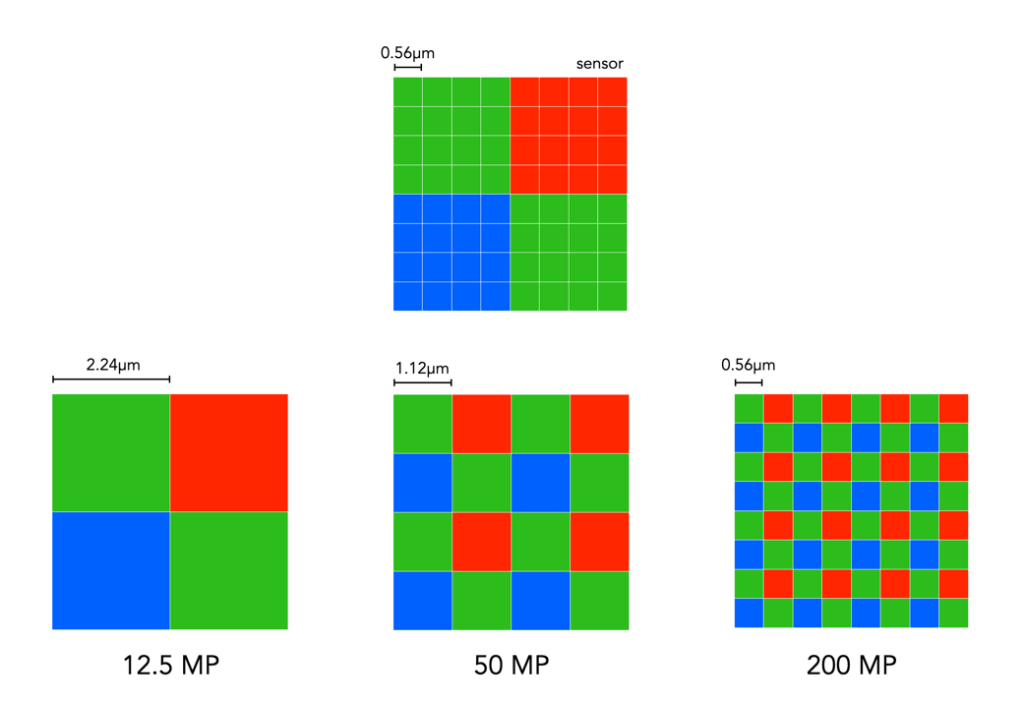
The 200MP Samsung ISOCELL HP-3 1/1.14” sensor takes it a step further. It uses a new “Tetra2” binning mechanism, with 0.56µm photosites. It can produce 200MP, 50MP, and 12.5MP images (shown in Figure 3). In the first stage 2×2 binning is used on the sensors 0.56µm photosites, producing a 1.12µm “super-photosite”, and a 50MP image. Then another round of 2×2 binning is performed, creating a 2.24µm “super-super-photosite”, and a 12.5MP image.

These high resolution sensors are typically only used at full-resolution in bright scenes, reducing to a lower resolution in dark conditions. The idea of binning is to allow smartphone cameras to become more intelligent, choosing the optimal resolution based on the photographic conditions. Of course the question is, does anyone need 50 or 200MP images? As with all technology, there are drawbacks.

Fig.3: Conversion between the ISOCELL HP-3 sensor and 200MP, 50MP, 12MP

Firstly, in the world of digital cameras, 100MP or thereabouts is usually found on a medium format camera with a sensor size of about 44×33mm, e.g. Fujifilm GFX 100S. These cameras are designed to take high resolution images, with sensors containing photosites of a reasonable light-gathering size (e.g. 3.76µm). Now compare the photosite area of this medium format camera, at 14µm2, with that of the Samsung Galaxy S22 at 0.64µm2 – 22 times more light gathering surface area. There is no comparison. Digital cameras also generally use high-quality lenses, with a lot more light gathering potential than those found on smartphones – when it comes to optics, smaller is always marred in compromises.

The process of binning pixels may also introduce artifacts, whether it be a small change in the overall colour of the image, or perhaps blurring artifacts – it really depends on the technology, algorithms, etc. Even remosaicing is a little more challenging, primarily because the different colours are further apart. So there isn’t really 4× more detail in 48MP mode than there is in 12MP mode. Then there is storage. 200MP image files should be large, but due to some sort of compression wizardry, the 12240×16320 images are reduced to files about 30MB in size, which is quite reasonable. Supposedly RAW (DNG) images can take up to 120MB. So storage is an issue. Also, what do you really need a 200MP camera for?

So if the mainstay is a quasi-12 megapixels why do manufacturers waste effort in creating hyper-megapixel smartphones? Perhaps for that one ideal 200MP shot? That perfect sunset while on vacation in Iceland. But what would you do with a 200MP image? Make a print to hang up on the wall? More megapixels does allow for better digital zooming, but the more likely case is that manufacturers know that megapixels matter to consumers, a situation they themselves have hyped up over the past two decades.

Further reading:

Quad Bayer sensors: what they are and what they are not (2019)

Smartphones and digital cameras are like chalk and cheese

The internet is full of articles suggesting smartphone cameras are better than actual digital cameras. Sure the smartphone market is booming, and they do take good pictures, but it’s really not possible to accurately compare them to digital cameras. It’s like saying to an astronomer that they could get the same quality astronomical image using a full-frame or medium format camera?

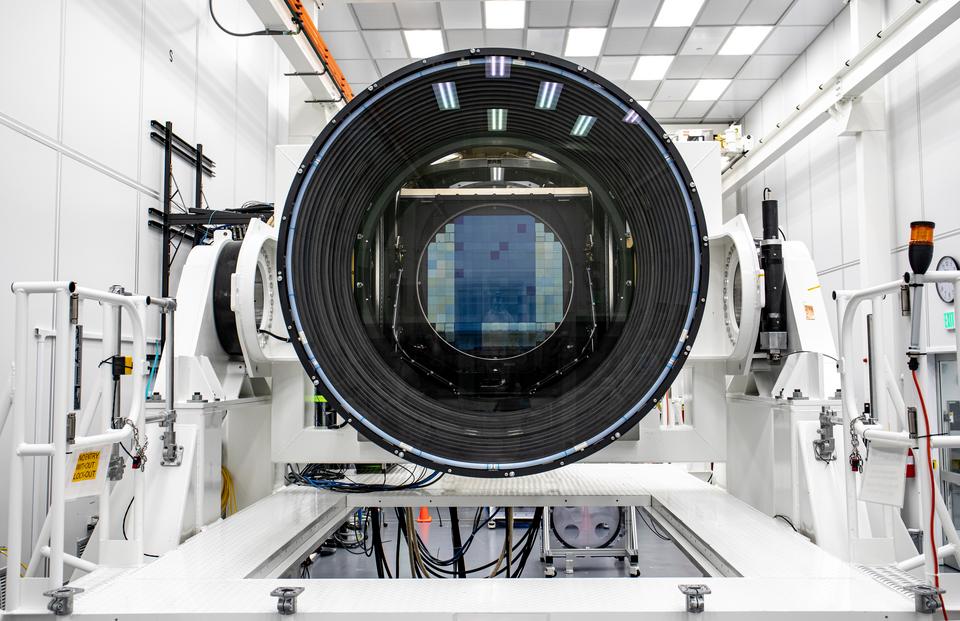
In late 2022 the worlds largest digital camera was unveiled at SLAC National Accelerator Laboratory in California. By the end of 2024 it will be installed at the Vera C. Rubin Observatory in Chile, and will be used in a 10-year project called the Legacy Survey of Space and Time to help unlock the mysteries of the universe. The composite sensor is comprised of 189 individual 16MP sensors, each 42mm2 in size, for a total resolution of 3.2 gigapixels. It’s largest lens has a diameter of 1.57m. Overall the focal length is 10.31m, with a speed of f/1.23. The camera will take 200,000 pictures per year.

This camera is massive. The individual photosites are 10×10μm in size – and large photosites mean that an abundance of light can be captured in such a ultra-low light environment (the sensors will be able to spot objects 100 million times dimmer than those visible to the naked eye). You could never achieve this with any sort of medium format 100MP 44×33mm camera… it’s just not possible. So why then do people still harp on about 12MP smartphone cameras being able to produce the same quality image as a 46MP DSLR?

Researchers at SLAC National Accelerator Laboratory are nearly done with the LSST Camera, the world’s largest digital camera ever built for astronomy. Roughly the size of a small car and weighing in at three tons, the camera features a five foot wide front lens and a 3,200 megapixel sensor that will be cooled to 100°C to reduce noise. Once complete and in place atop the Vera C. Rubin Observatory’s Simonyi Survey Telescope in Chile, the camera will survey the southern night sky for a decade, creating a trove of data that scientists will pore over to better understand some of the universe’s biggest mysteries, including the nature of dark energy and dark matter. (Jacqueline Ramseyer Orrell/SLAC National Accelerator Laboratory)

✽ Note that the size of the effective aperture on a smartphone lens such as the wide-angle 6.86mm (f/1.78) on the iPhone 14 Pro Max is 3.85mm. From a full-frame equivalency point-of-view, this is a 24mm lens with a speed of f/6.3. No one produces 24mm FF lenses with such a slow speed, but as an example, a Sony 24mm f/2.8 has an effective aperture of 8.57mm. Small lenses just aren’t as effective at capturing light – it’s basic physics. Of course the other big issue with smartphone cameras is that the lens elements are mostly constructed of moulded plastic (as opposed to glass).

So you want to upgrade from a smartphone camera?

Most people who use smartphones have little, if any, idea about things like aperture and shutter speed. They just use their smartphone camera to take pictures, and tend to ignore functional specifics. Settings are whatever the smartphone deems appropriate for the situation. For example clicking on ×0.5 in the Camera app on a modern iPhone will get you an image automatically taken with the ultra-wide camera. Yes you have some control over things, or more control when using a 3rd-party app, but generally these things don’t matter to most people. The future will bring more AI to smartphone cameras to produce so-called “perfect” photos – and if you like point-and-click photography, that’s fine. But sometimes that’s just not enough.

So what happens when you are intrigued enough to upgrade from a smartphone to a “real” digital camera? Should you run out and buy a full-frame (FF), or should you opt instead for a compact camera? To figure out what you really need, you have to first determine why you want to upgrade. Is it because you want to learn more about photography, or perhaps you want better control of the pictures you take? Or because you feel hamstrung using smartphone a camera and want more megapixels, better optics, or just a better way of taking pictures. Regardless of what people say, a smartphone camera will never provide the same sort of control, or image quality of a dedicated camera. There are many reasons for this, but the big ones are optics, storage space, and battery life. But this isn’t a post about that, here I want to consider options for “upgrading” from a smartphone camera (I’ll cover those in a separate post).

Upgrading from a smartphone to a compactsome specs.

Once you have figured out why, then we move onto what sort of photography you will be focusing on. Do you just want a camera for better travel photographs, or are you interested in landscapes? Or perhaps macro-photography? At this stage it is best to make a list of things you would like to achieve with a digital camera. Some of these things will help you narrow down the type of camera is best for you. For instance if you like street photography, then the best camera might be a compact camera like the Ricoh GRIII/IIIx, or the Fujifilm X100V. Compact cameras offer several advantages over smartphones – a larger sensor is the most obvious benefit, while physical controls and ergonomics offer a more tactile shooting experience. Most compact cameras now also use touchscreen interfaces, making them very accessible. These cameras generally have a fixed focal length lens, and a sensor somewhere between 20-24MP (which is more than adequate). Compact and inconspicuous cameras are perfect for street photography – the last thing you want as a street photographer is lugging around a huge hunk of a camera – it makes you stick out like a sore thumb.

Some of the benefits of digital cameras

If you want a better camera for travel, then a compact is good as well, as are crop-sensor cameras. Here cameras with mirrorless APS-C sensors have become popular, like the Fuji-series of cameras. Cameras for travel have to be versatile, compact and light – the new Fujifilm X-S20 weighs only 491g (without lens) – add a general purpose Fujifilm XF 23mm lens at 180g, and you get a total of 671g (and frankly you don’t need to travel with a cornucopia of lenses). You could also go for a smaller Micro-Four-Thirds sized sensor, which provides a camera with an even smaller form-factor. Now you could even go for a full-frame (FF) sensor, but I would not really recommend it for people upgrading from a smartphone. They are generally heavy, ostentatious (for travel anyway), and are not a good fit for novice photographers. Learn on something smaller before deciding on whether you really need a FF (or buy an inexpensive, older FF camera). Then there are those that want a more specialized set-up for landscapes, macro, sport or wildlife. As these types of photography are much more specialized, requiring specialized lenses, I would not jump straight into them. They can be expensive, and often need a good amount of experience to be used in an effective manner.

Choosing a camera is about what you are interested in photographing, budget, future expandability (if that is important), camera ergonomics (it has to feel right to use, or you will hate using it), diversity of lenses, and a myriad of other things. Decisions on choosing a camera are often made based on sensor size, or ultimately megapixels, but upgrading should not be purely about megapixels. Most good cameras have around 24-26 megapixels, which is more than adequate. You don’t need 40 megapixels – really, you don’t. Choice of sensor size, Micro-Four-Thirds (MFT)/APS-C/FF, is often a factor of the type of photography a person is interested in. Every different camera sensor has its own advantages and disadvantages.

If you want to delve into the world of real cameras, it doesn’t have to be expensive. Start with a used camera, with a single, versatile lens. You can add other lenses as required, and even add vintage lenses from 35mm film cameras. For instance you can readily purchase vintage telephoto lenses for very little $. There are an abundance of them out there. They require manual focusing (that’s a good skill to learn), but it’s a good way to find out if you like wildlife photography before going out and spending thousands of $. There is no need to run out and buy the latest and greatest. When everything is taken into consideration, upgrading from a smartphone camera to an actual digital camera allows for increased flexibility and enhanced artistic opportunities.