Optical Anomalies – Are air bubbles problematic?

Vintage lenses of a certain era often contain air bubbles, but this by no means suggests that they are of inferior quality. A 1940 article in Minicam Photography describes this as a fallacy [1]. It seems that in early cameras, some photographers may have been weary of such imperfections. In all likelihood there are like-minded individuals today.

“They may look like undesirable blemishes, but they are much more apparent visually than photographically.” [1]

In early glass manufacturing, air bubbles were practically impossible to eliminate. At the time the rationale provided was that bubbles formed when ingredients were melted together at temperatures of 2750°F to form glass. Even first-glass lenses contained some number of bubbles.

“In the manufacture of the famous Jena glass the various elements used must be heated for a given length of time and to a certain degree, the process being stopped at just the right moment whether all the air has been driven out or not. There is no alternative.” [2]

The article goes on to provide an example of a 6-inch, f/4.5 lens with a diameter of 32mm across the front lens [1]. They count 12 bubbles, on average 0.1mm in diameter. The lens has an area of 804mm², and the bubbles an area of 0.0942mm², making up 0.012% of the surface area. So only 0.012% of the light passing through the lens is impeded by the air bubbles. The outcome? Light interference caused by bubbles is negligible.

“The actual loss of light is inappreciable, and the presence of these bubbles, even if near the surface, has no effect whatever on the optical quality of the image.” [2]

“Air bubbles will be found in most high-class lenses and are a sign of quality rather than a defect, since at present it is impossible to make certain optical glasses absolutely bubble-free; their presence doesn’t affect the quality of the image in any way. [3]

In the literature for many modern optical glass manufacturers, e.g. Schott, there are caveats on bubbles (and inclusions). Basically bubbles in glass cannot be avoided due to complicated glass compositions and manufacturing processes. The melting of raw materials produces reactions which invariably form gas bubbles in the melt (typically carbonates or hydrogen-carbonates) [4]. These bubbles are removed in the refining process, when the temperature of the glass is increased, reducing the viscosity of the glass and allowing bubbles to move up through the melt and disappear. Some residual bubbles are still left from imperfect refining. However, it is actually quite rare to see bubbles in modern lenses.

So do they make a difference in vintage glass? According to much of the literature, not at all. Besides, vintage lenses are all about character – nobody is looking for a perfect image.

Further reading:

  1. “Fallacy: That “air” bubbles in a lens are a sign of inferior quality”, Minicam Photography, 3(8), pp.30-31 (1940)
  2. “The Crucible – Air-Bubbles in Lenses”, Photo-Era, 31(6) p.319 (1913)
  3. “Andreas Feininger on Lenses at Work”, Popular Photography, 18(3) p.124 (1946)
  4. TIE-28: Bubbles and Inclusions in Optical Glass, Schott Technical Information (2016)
  5. The Impact of Air Bubbles in the Optics of Old Lenses”, Jordi Fradera (2020)

Examining a vintage lens - optical anomalies (ii)

Let’s continue with optical anomalies.

⑤ Fungus

A lens that has been stored in an inappropriate environment, i.e. one that is dark and humid, may provide the perfect conditions for the growth of fungus. Fungus takes the form of tendril or web-like structures on the surface of the lens. The fungus secretes an acid that etches a lenses’ multicoating. This sort of damage can be permanent, and hard to remove. Too much fungus will lower contrast, and way too much will give darker, fuzzier images as it blocks light. Fungus is bad news – avoid lenses with it, however small the “infection”.

⑥ Yellowing

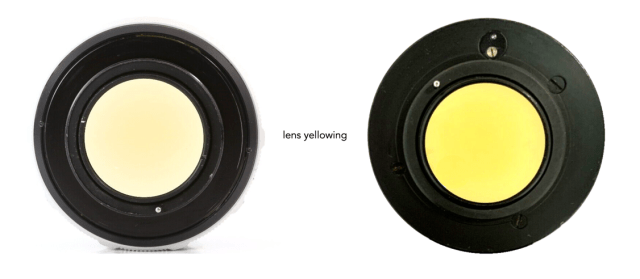
Coatings on lenses often yellow in time. Glass in general does not yellow, but lens coatings, or at least older ones do. This is also true of glass made with radioactive elements, e.g. Thorium, to reduce refraction.

⑦ Bubbles

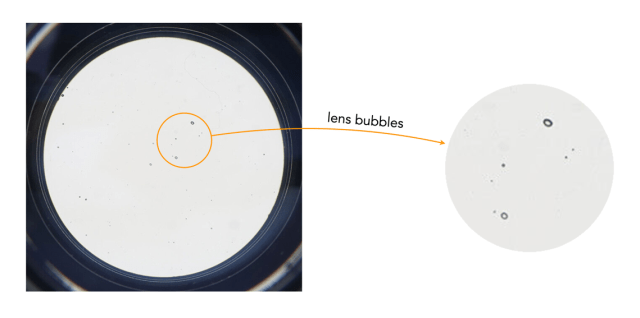
Some lenses pre-1970 had defects caused by the optical glass manufacturing process which left a few pin-prick sized air bubbles inside the glass. These bubbles may come from different sources, but in most cases the source is imperfect refining. They look like tiny dust specks when viewed with the naked eye, but if magnified, they are indeed bubbles.

⑧ Separation

Lens groups are most often held together with some type of glue. In modern lenses this is usually a UV-cured epoxy. Vintage lenses typically use epoxy, polyester, and urethane-based adhesives, and some pre-WW2 lenses use Canada balsam (basically a resin from balsam fir trees). The balsam was used because it has a refractive index that is similar to crown glass and is invisible when dry. Unfortunately, Canada balsam is not resistant to temperature extremes or solvents. A degradation of the adhesive will result in the lens delamination. This usually manifests itself as a multicoloured band or blobs around the edge of a lens with coatings, or a white band/blobs on lenses with few or no coatings (but it can also occur in the centre of a lens). A small amount of separation on the edges of a lens will likely have little effect on image quality. A large amount may cause a decrease in contrast, flare and ghosting, softer edges, loss of sharpness, and a difficulty in focusing.

Fixing anomalies

Is it possible to rectify these optical defects? The table below provides a quick guide, and later posts will explore some of these defects in more detail.

DefectRepairable?Lens disassembly required?Notes
scratchesmaybenoIt is hard to remove scratches, especially deep scratches, although fine scratches might be able to be buffed or polished out (some people suggest toothpaste).
haze/fogyesyesIt might be possible to use a cleaning solution to reduce or suppress the haze.
dustyesyes/noDust on external lens surfaces is easy to clean. Internal dust is harder because it requires lens disassembly.
blemishesnonoMulticoating damage cannot be repaired.
fungusmaybeyesIt is possible to repair low levels of fungal infections, but it does require lens disassembly. Heavy fungal infections are not repairable.
yellowingyesnoYellowing caused by the presence of Thorium can be reduced using UV lights.
bubblesnonoIntrinsic to the lens glass, consider it a feature of certain older lenses.
separationnoyesSeparated lens groups are basically not fixable. Fixing these requires lens separation, re-centering and re-cementing.

Examining a vintage lens - optical anomalies (i)

There are a number of physical anomalies that can be found on the optics of vintage lenses. Regardless of the abnormalities of the lens body, the critical part is the optics. Sometimes people classify lenses as “a little rough”, or “needs some attention”. These can be red flags. Note that when shopping for vintage lenses in person, take an LED flashlight along as it will help peer inside the lens to determine if it is fit for use.

① Scratches

Glass doesn’t scratch that easily, but coatings do. Scratches are easy to detect, because they usually occur on the visible, exposed glass elements. Scratches usually occur on the front or rear element of a lens. They signify obvious signs of wear, or possibly damage. Small scratches will have little effect on an image, but deep scratches will. A few small scratches on the front element will not impair performance significantly – the reason is the depth of field generally works to negate their impact. The exceptions are macro lenses and wide-angle lenses. A large number of tiny scratches may also reduce the contrast of a lens. Scratches on the rear lens will be more problematic (it is best to avoid lenses with scratched rear elements). Because there is less distance between the element and the sensor/film, most scratches will appear on the resulting picture. Deep scratches can be a sign of severe trauma. Also check for pitting. Sometimes lenses have light scratches which are caused by poor lens cleaning/polishing techniques.

② Haze or fog

Haze can be anything that settles out of the air inside the lens onto the inner surfaces of the glass. The lubricants on the aperture mechanism and in the focus threads can vaporize over time and then resettle onto the glass, and with enough time other things (dust, salt-air, fungus) can get in and collect on the glass, to the point that they are dense enough to refract the light themselves and spread it around as a “foggy” look to pictures. Haze actually gets worse with age. This may be an indication that the lens was poorly constructed, or poorly stored.

A smoky haze diffuses light equally over the entire image. This is generally caused by trillions of particles much smaller then the wavelengths of light, smearing the light over all areas equally, simply making blacks gray and reducing the overall contrast. Oily haze on the other hand has tiny droplets larger than the wavelengths of light. Because the oily haze diverts light, the haloes are much stronger and more visible.

③ Dust

Dust particles somehow get into lenses. A small bit of dust will make little or no difference to image quality. Larger specks or clumps of dust should be avoided. Check for dust by shining a light through the lens. Dust may be especially prevalent in vintage zoom lenses where the increased movement can result in dust infiltrating the inner components of the lens. So how does dust get inside the lens? Vintage lenses are not air sealed, i.e. weather sealed, meaning that air moves in and out, and of course it carries dust with it. Zoom lenses with barrels that extend out essentially “pump” air/dust into the core of the lens. In reality, small amounts of dust will impede very little of the light passing through a lens, and its impact on the image quality is minimal. Inexpensive and simple lenses can be easily disassembled and cleaned, however re-assembling the lens may again introduce dust (unless you have a clean room). Large amounts of dust may be indicative of poor long-term storage.

④ Blemishes

Many vintage lenses have lens elements that are coated with layers of some non-reflective optical material. These multicoatings minimize light reflection and the resulting lens flare and ghosting. Blemishes are regions on a lens where material has been smeared or removed by physical damage, a manufacturing defect, use of an incorrect solvent, or even being eaten away by fungus. A small blemish likely won’t affect image quality.

A lens with a super-deep scratch. Being on the rear element, this will effect the image.