Have you ever noticed how often camera companies release new camera bodies? There is always a lot of fanfare about the fantastic new things these cameras do – but here’s the thing, nothing much has changed with digital cameras in the past decade. In the era of film companies produced new camera bodies as well, but usually only when they heralded the addition of new technology such as the transition to 35mm SLR, or through-the-lens metering. For the most part, analog cameras are just simply a light box which has a lens attached and is loaded with film. The lens deals with the aperture, the camera controls the shutter, and film deals with the fixed ISO.
Camera manufacturers try and make people believe that they need a new camera by flaunting its bells and whistles, to which there are rarely many new ones. More megapixels? Been there, done that. What else is there? Better processing power, more AI? The reality is the things that matter – aperture, shutter-speed, ISO – don’t really change that much. As I have mentioned before there is a point where more megapixels produced diminishing returns.
What really matters in digital photography is lenses. Good quality optics will make the difference between good and mediocre pictures – and lens technology has vastly improved over the past decade. To the point where maybe lenses are a little too complex, but that’s just my personal opinion. There will likely never be a “perfect” lens, but then again neither should there be – from the sheer perspective of character. But even more important than the lens is the ability of the photographer. So if you have a good digital camera, there is no real need to buy a new one. A 24 megapixel camera will be more than adequate for the foreseeable future. Features are nice, but in all likelihood don’t really contribute a great deal to good pictures.
Once you have chosen a particular camera, (and manufacturer) it is time to think about lenses. Most people will buy a camera with some sort of kit lens attached, usually because it is cheaper. Others buy just the camera body, and outfit it accordingly, but it often a vast maw of choices. Lens choice is usually foremost about need, and ultimately focal length. What are you going to be shooting – portraits, landscapes, architecture? Then it becomes a balancing act of lens characteristics. If you choose, say a 35mm lens on an APS-C sensor, so 50mm equivalent, then it’s about things like size/weight (e.g. for travelling), weatherproofing, maximum aperture, build (metal/plastic), and of course cost.
This leads us to the question some people end up pondering – do you buy a lens from the camera manufacturer or a third-party? Firstly, let’s consider each type of lens. Lenses produced by the camera manufacturer are often considered the creme-de-la-creme. They are designed from the bottom up, as integral components of the system. Quality and compatibility are the reasons why professional photographers stick with first-party lenses. These particular lenses are made specifically for the camera brands that they carry, so they are not compatible with any other manufacturers or brands.
Third-party lenses on the other hand, are often designed by lens companies from the perspective of creating a variety of lenses that will fit cameras from multiple manufacturers with the simple change of a mount (and tweaking some other specs). For example Sigma produces a 28mm f/1.4 lens that is available in Canon (EF), Nikon (F), Sony (E), and Leica (L) mounts. As with many manufactured items there are different levels of third-party lens manufacturers, from precision, high-priced lenses to mass-produced budget-oriented lenses. Third-party lenses can also be differentiated into long-established ”old-school”, and newer lens manufacturers. Voigtländer and Zeiss are good examples of well-established 3rd party lens makers who produce higher-end “boutique” glass.
Manufacturer versus third-party lenses
So why choose a 3rd party lens? There are many reasons. I suspect most people go that route because of the general affordability of the lenses. This also makes sense if someone wants to experiment with a particular lens, but doesn’t want to pay a small fortune. Affordability is often perceived as a sign that the lenses are inferior from the viewpoint of capabilities or build, but this isn’t always the case. Sometimes the lower price is a factor of trades-offs: manual focus instead of auto-focus capabilities, polycarbonate lens body instead of metal, etc. Some third-party lenses offer functionalities such as large apertures, e.g. f/1.0, or a smaller, lighter build, or even a lens not offered by a camera manufacturer, e.g. fish-eye lenses. For example the shortest focal length produced by Fuji is 8mm f/3.5 (12mm eq.), however it is US$800. An alternative for the photographer wishing to experiment with fish-eye lenses is the Tokina SZ 8mm f/2.8 (US$300).
What about disadvantages? Well the flip-side of 3rd party lenses is the lower-cost is that the lenses are sometimes optimized for lower cost. There may be some manufacturers that sacrifice the quality of materials used in lens manufacturing, and hence lens durability for a lower price. There is also the chance that the lens will not be 100% compatible with every one of the cameras it fits on. This goes back to the materials/build sacrifices made in construction. Another “disadvantage” for some is that many third-party lenses is manual focus. This is partially because it is cheaper and easier to produce a lens without focusing mechanisms, and electronic connections to the camera. However manual focusing is not a huge issue, because of functions built-into many cameras these days which assist with manual focusing, e.g. focus-peaking.
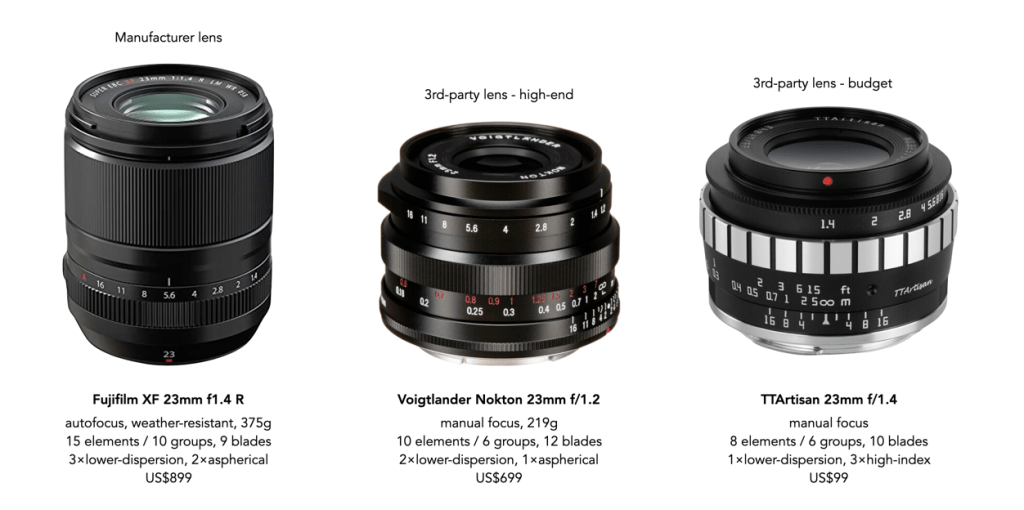
Actually the main problem in choosing lenses from 3rd-party manufacturers is differentiating between them. Because apart from the price differential, the specs of many lenses look quite similar. Below are five third-party 12mm lenses for the Fuji-X system (Fuji does not make a 12mm, the closest is a 14mm f2.8).
Aperture range
Elements/group
Weight
Barrel material
Cost (US$)
Zeiss Touit
f/2.8 − 22
11/8
260g
metal
$999
Rokinson
f/2.0 − 22
12/10
260g
metal + plastic
$399
Meike
f/2.8 − 22
12/10
326g
metal
$230
Pergear
f/2.0 − 22
12/9
300g
metal
$165
7Artisans
f/2.8 − 16
8/10
265g
metal
$149
Table: The gamut of 12mm lenses for Fuji-X
So when you get to choosing a lens, you may be swayed by the extremely reasonable prices of some of the 3rd party lenses. So what to do? Well the first thing to do is to find a website that maintains an updated list of lenses for a particular system. I’ll give examples of Fuji-X, because that has become my core system. Here is a good list from Alik Griffin. Third party lens manufacturers can be separated based partially on the quality of optics (and let’s face it, cost). At the end of the day, the actual lens you choose will depend on budget and individual requirements. If you decide to buy a third-party lens, make sure you do a good amount of research into the lens. Check out independent reviews from photographers, both professional and hobbiest, that have used the lens.
“Say what you will about the undoubted advantages of other focal lengths, no lens can handle so many different subjects and situations as satisfactorily as the good old reliable 50-mm. Unless the photographer is working on a specific idea, or is faced with some special problem demanding something markedly longer or shorter, the 50 gives a frame that’s neither too tight for most indoor work, nor too loose for general outdoor shooting. If there is no lens for all seasons, at least there is one for most situations, and this is the versatile 50.”
Bob Schwalberg, “The shifty fifty”, Popular Photography, pp.73-75,118,119 (Sep., 1970)
Having a hard time trying to decide on a focal length? Below is an easy visual guide to the most common focal lengths, displaying the amount of a scene captured. Note these are full-frame/35mm focal lengths, so smaller sensors will require calculating equivalencies. For example the view shown for the 50mm lens below would be equivalent to what is seen by a 33mm lens on an APS-C camera, or a 25mm lens on a Micro-Four-Thirds camera. The 135mm lens view would be equivalent to a 90mm APS-C or a 68mm MFT lens.
Focal length views for classic 35mm lens (+DSLR) cameras.
A 50mm lens is always a 50mm right? They are in terms of focal length, but shouldn’t they all have similar dimensions? So why are lenses with super/ultra-wide apertures sometimes so much larger, and hence so much more expensive?
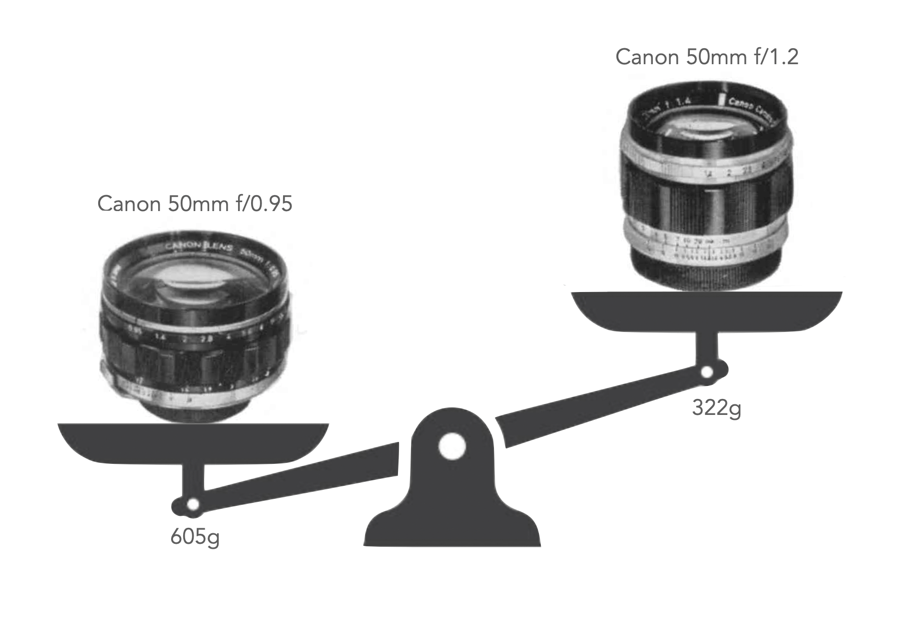
If there has been one notable change in the evolution of lenses, it has been the gradual move towards larger (faster) apertures. The craze for superfast lenses began in Japan in the 1950s, with Fujinon introducing the first f/1.2 5cm lens in 1954. After the initial fervour, it seems like the need for these lenses with large apertures disappeared, only reappearing in the past decade while at the same time moving into the realm of sub-f/1 ultrafasts. There are many advantages to ultra wide aperture lenses, but basically fast lenses let in a lot of light, and more light is good. The simple reason why bigger aperture equals bigger lens is more often than not to do with the need for moreglass. It was no different with historical superfast lenses. The Canon 50mm f/0.95 which debuted in 1961 was 605g.
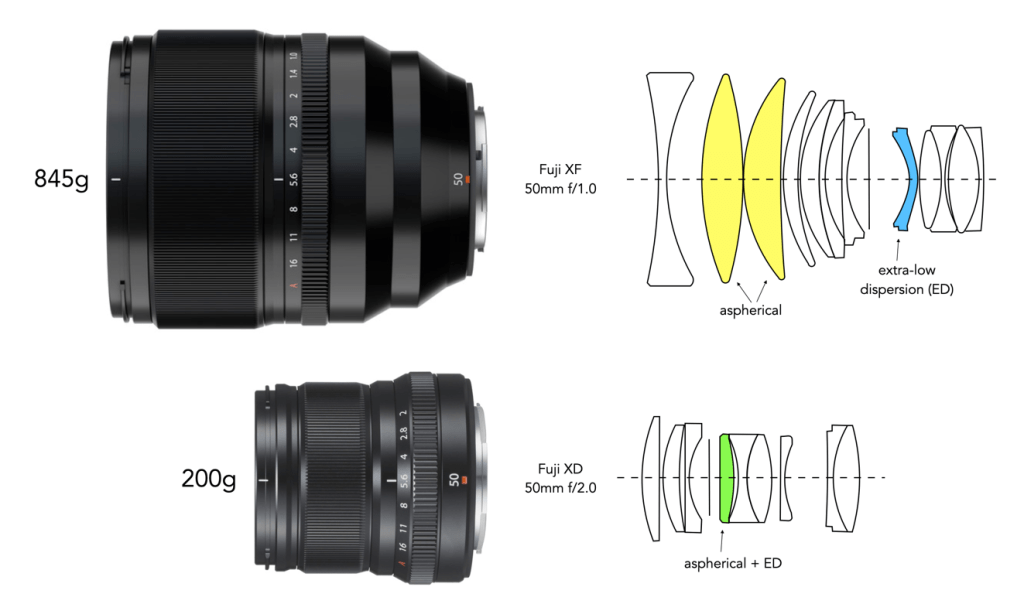
A comparison of the two Fujifilm 50mm lenses – f/1.0 versus f/2.0 showing the physical differences
Lenses are designed with the maximum aperture in mind. For example, a 50mm f/2.8 lens only needs an aperture with a maximum opening of 17.8mm (50/2.8), however a 50mm f/1.4 will need a maximum aperture opening of 35.7mm (note that these apertures are based on the diameter of the entrance pupil). For example consider the following two Fujifilm 50mm lenses – the “average” f/2.0 and the 2-stop faster f/1.0:
Fujifilm XF 50mm f/1.0 R WR – 845g, L103.5mm, ⌀87mm, 12/9 elements
Fujifilm XD 50mm f/2.0 R WR – 200g, L59mm, ⌀60mm, 9/6 elements
The f/1.0 is over four times as heavy as the f/2.0, and almost double the length. To get an f/2.0 on a 50mm lens you only need a 25mm aperture opening, however with a f/1.0 lens, you theoretically need a 50mm opening (aperture of the entrance pupil). Now some basic math of the surface area (SA) of an aperture circle will provide a SA of 491mm2 for the f/2.0, but a whopping 1963mm2 for the f/1.0, so roughly four times as much area which allows light to pass through fully open. Equating this to glass probably means that at least four times as much glass is needed for some of the elements in the f/1.0 lens. There is no way around this – large apertures need large glass. As the aperture of a lens increases, all of the lenses have to be scaled up to achieve the desired optical outcome.
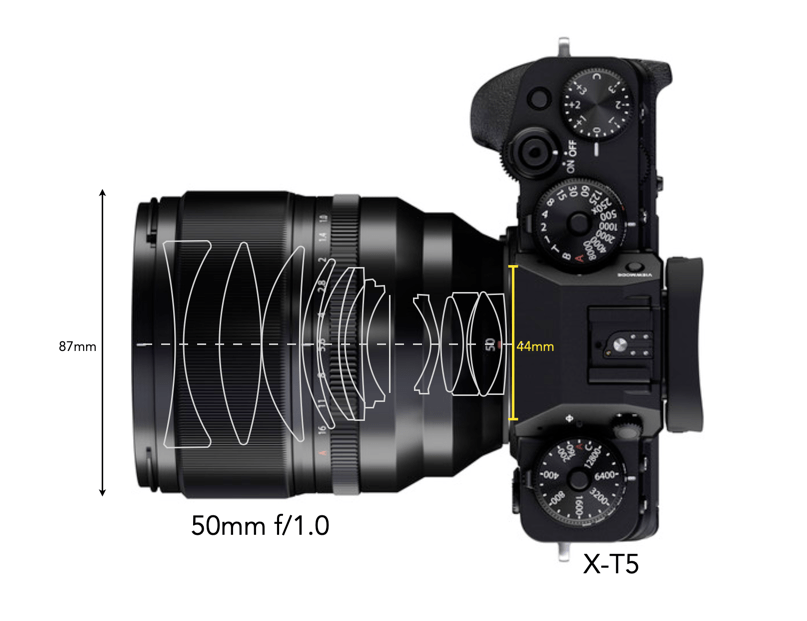
The massive scale of the Fujifilm XF 50mm on a camera (the X-T5). The lens has a diameter of 87mm, and the inner opening of the mount is only 44mm.
Larger aperture lenses also have more specialized glass in them, like with aspheric and lowdispersion elements. But companies don’t just add more glass to make money – complex designs are supposed to overcome many of the limitations that are present in ultra-wide aperture lenses. Unlike their historical predecessors, modern superfast lenses have overcome many of the earlier lens deficiencies. For example in vintage superfast lenses, the lens wide-open was never as sharp as could be expected. Newer lens on the other hand are just as sharp wide open as they are stopped down to a smaller aperture.
Now not all super/ultra-wide aperture lenses are heavy and large. There are a number of 3rd-party lenses that are quite the opposite – reasonable size, and not too heavy (and invariably cheaper). But there is no such thing as a free lunch – there is always some sort of trade-off between price, size and optical quality. For example the Meike 50mm f/0.95 is only 420g, and it’s lens configuration is 7 elements in 5 groups. However fully open it is said to exhibit a good amount of chromatic aberration, some barrel distortion, and some vignetting. There is no perfect lens (but the Fuji f/1.0 comes pretty close).
✿ A fast lens is one with a wide maximum aperture. Superfast lenses are typically f/1.0-1.2, and ultrafast lenses are sub-f/1.0.
As I have mentioned before, the standard Angle-of-View (AOV) of the human visual system (HVS) is about 60° (horizontally) – the central field of vision, so to speak. So why do companies still tout 50mm lenses as being “close to the angle of view of the human eye”? It’s honestly hard to know. Zeiss still describes its Touit 32mm f/1.8 as offering “…the same angle of view as the human eye.“, with a horizontal AOV of 40°. The dominant “standard” lens for full-frame has been the 50mm since the introduction of the Leica by Barnack in 1925. That’s nearly a century of using a lens that doesn’t really duplicate the AOV of human vision, mostly because it simplifies human vision far too much. It doesn’t even match the 43.3mm diagonal of the 36×24mm frame – which is normally the golden standard of a “normal” lens.
A 50mm lens has a horizontal AOV of 39.6°, which only comes close to representing the region of the HVS that deals with symbol recognition, which is a somewhat narrow scope. In fact, most people aren’t really concerned about whether they are using a lens that “approximates human vision”. One of the most talked about lenses in the Fuji-X environment is the 23mm lens, which is close to a 35mm in full-frame land. In all likelihood, there has probably been a gradual move away from 50mm towards the wider focal lengths. For example the iPhone 14 has two rear facing cameras: a 13mm ultra-wide, and a 26mm wide (equiv). No 50mm at all. With a wider AOV it is possible to crop from within the frame.
What a 28mm iPhone camera lens sees (orange) versus the smaller AOV of a 50mm lens (blue)
Some would probably advocate for the actual diagonal of a full-frame, i.e. 43mm. This would give an AOV of 45°, midway between 30 and 60 degrees. But is this optimal? I think it comes down to personal preference. I personally think that a 60° is likely a better approximation for a lens. So which lens better represents the 60°? For full-frame it is likely around 31mm, or around 20-21mm for APS-C. So we end up in the spectrum of wide lenses, and that’s not necessarily a bad thing. Humans visualize the world around them in terms of a wide lens – yes not all of it is in complete focus, but then the HVS works in much different ways to a camera lens.
There are a whole lot of contemporary super-fast lenses, but that is to be expected from modern optical technology. For example the Voigtländer 50mm f/1.2 Nokton E is still a simple 8 element lens, but contains two optical elements each with two aspherical surfaces, helping to reduce lens aberrations. The Nikon Nikkor Z 50mm f/1.2 on the other hand has 17 elements in 15 groups, with three aspherical and two low-dispersion elements (but at 150mm in length, and 1090g it is a true monster). These lenses are now commonplace, but what about their vintage counterparts?
By the mid 1950s, lenses with speeds of f/2 and f/1.4 were commonplace. Lenses with large apertures such as f/1.0 were also available for applications such as radiography and motion-pictures. Sub-f/1.4 lenses for the 35mm “miniature” cameras had also started to appear. The literature of the period, such as Popular Photography, wrote a series of articles over the years, investigating these new fast lenses. Many of these technology reviews were not damning, but neither were they an acclamation of a new era in photography.
The September 1955 issue included an article “The new superspeed lenses – how useful will they be”, by Bob Schwalberg [2]. Schwalberg describes the rumours that superspeed lenses with apertures of f/1.1 and f/1.2 were in the offing from three different Japanese manufacturers. He suggested that although an f/1.4 lens should mathematically pass 100% more light than an f/2 lens, the actual results are more like 50%. Using the pretext that actual light transmission is 50% of that indicated, he surmises that an f/1.1 lens would only be 30% faster than an f/1.4 lens, but maybe even less due to more elements, and an increased number of light absorbing light-to-air surfaces. These tests were made by comparing exposures at different apertures changing nothing else. Schwalberg concedes that the lenses would be good for use with colour film, however doubted whether the same could be said for black-and-white film. One of the reasons was the reduced depth-of-field, although he concedes it is no worse than for the f/1.4 but regardless both require very close focusing for sharp pictures.
Norman Rothschild described the Zunow 50mm f/1.1 lens in a 1956 article [4], putting the lens through a series of tests, and exploring whether the addition of new optical elements would effect the speed advantage of the lens. He used an exposure meter (Norwood Model A) taped to the back of a Leica M-3 to measure light-transmission of the Zunow, and two control lenses (f/2, f/1.8). The findings indicated that the readings for the f/1.1 proportionally higher than those for the f/2. He also performed a number of practical field tests. Colour photos made with the lens were found to be ”warm, or reddish, but not displeasingly so”. Rothschild questioned the practicality of the lens, with its shallow depth of field, but concluded that while focusing was challenging, it is “no more severe than a press photographer using an f/3.5 lens on a 4×5 camera”.
When asking why these lenses weren’t more popular during the period they were developed, there are likely a number of differing factors. Foremost was cost. Lenses such as 50mm f/1.2 may have tested the limits of both manufacturing processes, and price to consumer. Making lenses with apertures larger than this may have been an act of sheer folly, as is testament to the few that were manufactured. Development costs associated with these lenses were likely steep, as was the use of optical elements containing rare-earth metals, and ultra-precise manufacturing techniques. To all but the professional photographer, these lenses were prohibitively expensive (and still are). When these fast lenses started to appear there was as much skepticism than there was praise. In a follow up article in 1956, “Another look at superspeed camera lenses”, Bob Schwalberg made the following points [3]:
The exposure gain obtained from f/1.1 and f/1.2 lenses was easier to obtain from additional development of f/1.4 and f/1.5 negatives.
Apertures larger than f/2 were seldom used for B&W work, but would be advantageous in colour work.
The reduced depth-of-field which limits the usefulness of f/1.4 and f/1.5 lenses at full aperture will further limit the usefulness of the f/1.1 and f/1.2 lenses.
The lenses are large and heavy, sometimes obscuring the rangefinder and viewfinder windows.
The lenses are “extraordinarily” expensive. A 50mm f/1.1 lens retailed for $3 more than a Leica M-3 with aa 50mm f/2 Summicron lens.
Lens apertures greater than f/2 with a small amount of over-exposure can lead to drastic loss of definition and detail resolution. Tests shows that “at f/1.4 as little as 1/2 stop overexposure can kill sharpness”. Three times as much overexposure is required to produce the same ill-effects at f/2.
Schwalberg called it the “super-aperture problem”. He goes on to suggest that what was needed was not faster lenses, but better lenses, citing that film resolution was increasing to the point where lenses were not capable of producing.
In another Popular Photography article in 1956, it was suggested the ultimate value of f/1.1 and f/1.2 lenses was still a matter of conjecture [5]: “Speeds of f/1.4, f/1.5, and f/2, have long been with us and have proven extremely practical. Unless you are in the darkest, blackest, dingiest location, and unless every bit of shutter speed counts because of subject movement, it is highly advisable to limit black-and-white shooting to a maximum aperture of f/2.” The article cited a series of limiting factors that made photographers wary of the usefulness of sub f/2 lenses [5]:
Depth of field – this only comes apparent at close distances, but a larger opening will result in a shallower DOF. A 50mm lens focused at 4ft has 3.5” of depth at f/1.5 and 4.75” at F/2. A smaller DOF will require more precision in focusing.
The gain in light transmission is often less than can be expected. Light transmission is directly proportional to the square of the f-number. f/2 squares to 4, and f/1.4 to 1.96. Theoretically then, f/1.4 should transmit approximately 100% more light, however tests have shown that it is likely only 50-60%. The reasoning is that the more the diaphragm is opened, the more we depend upon light rays from the periphery of the lens. These rays enter at a steeper angle of incidence than those on the edges at smaller f-stops. There is therefore greater loss through internal reflection.
The other issue is that apertures greater than f/2 require exacting levels of exposure. overexposure at f/1.4 can ruin crisp detail. Errors at f/2 are more forgiving.
The other issue was weight – these lenses were heavy. The SMC Pentax 50mm f/1.2 (1975) was 385g, and had a maximum diameter of 65mm. The f/1.4 of the same era was only 266g, meaning the f/1.2 was a 45% increase in weight. When the Nikkor-N 50mm f/1.2 first appeared, its internal mount was problematic, with the mount not really able to support the weight of the lens, causing the mount to bend. In addition, the focusing wheel on the camera could not be used because it could not handle the weight of the lens. The weight of the lens was 425g, in comparison a comparable 50mm f/2 was around 200g.
There were many factors which contributed to the lack of interest in fast lenses. By the mid 1960s colour film was faster, and so there was less need for faster lenses. There were a number of f/1.2 options, but also many more options are f/1.4 at a much lower price point. So why bother purchasing a vintage sub-f/1.4 lens? One reason is for the character it provides, or for shooting in extreme low-light conditions. Why not to buy them? Mostly they are expensive.
Further reading:
G.H. Smith, Camera Lenses: From box camera to digital (2006)
Bob Schwalberg, “The new superspeed lenses – how useful will they be”, Popular Photography, 37(2), p.48 (September, 1955)
Bob Schwalberg, “Another look at superspeed camera lenses”, Popular Photography (April, 1956)
Norman Rothschild, “Meet the Zunow f/1.1”, Popular Photography, pp.126/128 (February, 1956)
“The Versatile 50-mm Lens”, Popular Photography, 39(2) pp.40,41,84 (August, 1956)
Some of the most interesting vintage lenses are the sub-f/1.2 lenses, of which there are very few. In the 1950s Japanese lens makers wanted to push the envelope, racing to construct the fastest lenses possible. There were four contenders: the Zunow 50mm f/1.1, the Nippon Kogaku’s Nikkor-N.C 50mm f/1.1, Konishiroku (Konica’s predecessor) Hexanon 60mm f/1.2 and the Fujinon 50mm f1.2 LTM. This spurned research which led to the development of the Canon 50mm f/0.95 (1961), which at the time was the largest aperture of any cameras lens in the world. The other, which did not appear until 1976 was the Leitz (Canada) Noctilux-M 50mm f/1.0.
(Note that these lenses were made for 35mm rangefinder cameras.)
Why were these lenses developed?
The most obvious reason was the race to produce fast lenses. An article in the February 1956 issue of Popular Photography sheds more light on the issue. The article, titled “Meet the Zunow f/1.1” [1], by Norman Rothschild, described the virtues of the Zunow lens (more on that below), and concluded with one of the reasons these lenses were of interest, namely that it opened up new areas for the “available-light man”, i.e. the person who wanted to use only natural light, especially with slow colour films. This makes sense, as Kodachrome had an ASA speed of 10, and Type A’s speed was ASA 16. Even Kodachrome II released in 1961 only had a speed of 25 ISO. Conversely, black and white film of the period was much faster: Kodak Super-XX was 200 ISO, and Ilford FP3 was 125 ISO. Ilford HPS, introduced in 1954 pushed the ISO to 800. The newer Ektachrome and Anscochrome colour films were rated at ASA 32. In the patent for the Zunow f/1.1 lens [3], the authors claimed that objectives with apertures wider than f/1.4 were in more demand. In reality, the race to make even faster lenses was little different to the race to get to the moon.
Zunow 50mm f/1.1
The first of the sub-5/1.2 lenses was the Zunow 50mm f/1.1. Teikoku Kōgaku Kenkyūjo was founded by Suzuki Sakuta circa 1930 and worked for other companies grinding lenses. The company started working on fast lens around 1948, with the first prototypes completed in 1950, and the 50mm f/1.1 Zunow released in 1953. It made a number of lenses for rangefinder cameras, including slower 50mm lenses in f/1.3, and f/1.9, a f/1.7 35mm, and a 100mm f/2 lenses. In 1956 it became the Zunow Kōgaku Kōgyō K.K., or Zunow Optical Industry Co., Ltd., but closed its doors in early 1961. During the last years the company designed a couple of camera’s including a prototype of a Leica copy, the Teica, and the Zunow SLR, the first 35mm SLR camera with auto diaphragm, instant-return mirror, and bayonet mount interchangeable lenses (only about 500 were ever produced).
The Zunow 50mm f/1.1 was derived from the Sonnar-type f/1.5 lens. The patent for the Zunow f/1.1 lens [3] describes the lens as “an improved photographic objective suited for use with a camera that takes 36×24mm pictures”. Many of these fast lenses were actually manufactured for the cine industry. For example the company produced Zunow-Elmo Cine f/1.1 lenses for D-mount in 38mm and 6.5mm (and these lenses are reasonably priced, circa US$500, however not very useful for 35mm). The Zunow 50mm f/1.1 is today a vary rare lens. Sales are are US$5-10K depending on condition. The price for this lens in 1956 was US$450.
1953 – Zunow f/1.1 5cm, Leica M39 mount/Nikon S, 9 elements in 5 groups.
1955 – Zunow f/1.1 50mm, Leica M39 mount/Nikon S, 8 elements in 5 groups.
Nikkor-N 50mm f/1.1
Hot on the heals of Zunow was the Nikkor-N 5cm f/1.1 developed by Nippon Kogaku. Introduced in 1956, it was the second sub-f/1.2 lens produced. The lens was designed by Saburo Murakami, who received a patent for it in 1958 [5]. While the Zunow was an extension of the Sonnar-type lens, the Nikkor lens was of a gaussian type. It was also made using an optical glass made using the rare earth element Lanthanum in three of its optical elements. The lens was made in three differing mounts: the original internal Nikon mount (for use on Nikon S2, SP/S3 cameras), the external Nikon mount, and the Leica M39 mount. The original lens mount was an internal mount, and the heavy weight of the lens (425g) could damage the focusing mount, so it was redesigned in 1959 with an external mount. The lens had a gigantic lens hood with cut-outs for setting the focus with the rangefinder through the viewfinder.
1956 – Nikon Nikkor-N[.C] 50mm f/1.1, Leica screw mount/Nikon S, 9 elements in 6 groups (Nikon, 1200 units; M39, 300 units)
1959 – Nikon Nikkor-N 50mm f/1.1, Leica screw mount/Nikon S, 9 elements in 6 groups (1800 units)
A 1959 price list shows that this lens sold for US$299.50. Today the price of this lens is anywhere in the range $5-10K. Too few were manufactured to make this lens the least bit affordable. Nippon Kogaku also supposedly developed an experimental f/1.0 lens for the Nikon S, but it never went into production.
Canon 50mm f/0.95
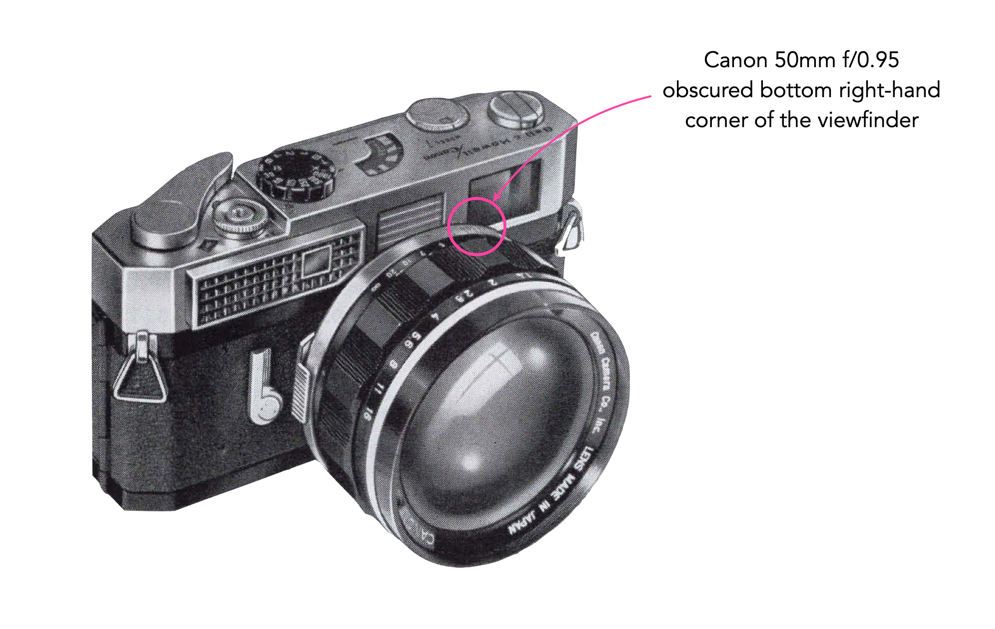
In August 1961, Canon released the 50mm f/0.95, designed as a standard lens for the Canon 7 rangefinder camera. It was the world’s fastest lens. The Canon f/0.95 was often advertised attached to the Model 7 camera – the Canon “dream” lens. The advertising generally touted the fact that it was “the world’s fastest lens, four times brighter than the human eye” (how this could be measured is questionable). It is Gauss type lens with 7 elements in 5 groups. The lens was so large on the Canon 7 that it obscured a good part of the view in the bottom right-hand corner of the viewfinder, and partially obscured the field-of-view.
In a 1970 Canon price list, the 50mm f/0.95 rangefinder lens sold for $320, with the f/1.2 at $220. To put this into context, $320 in 1970 is worth about $2320 today, and a Canon 7 with a f/0.95 lens in average condition sells for around this value. Lenses in mint condition are valued at around $5K.
The verdict?
So why did these lenses not catch on? Cost for one. While f/1.2 lenses were expensive, faster lenses were even more expensive. For specialist applications, the development of these lenses likely made sense, but for the average photographer likely not. There were a number of articles circa 1950 in magazines like Poplular Photography which seemed to downplay their value, which likely contributed to their decline. It is notable that by the the early 1960s, Nikon stopped advertising its 50mm f/1.1 lens, and never produced another sub-f/1.2 lens. By the late 1960s even Canon had ceased production of the f/0.95.
There were probably more sub f/1.2 lenses created for non-photographic applications, in many different focal lengths. For example x-ray machines (Leitz 50mm f/0.75), D-mount film cameras (e.g. Kern Switar 13mm f/0.9), C-mount for film, medical and scientific imaging (e.g. Angenieux 35mm f/0.95), and aerial photography lenses (e.g. Zeiss Planar 50mm f/0.7). Not until recently have super-fast lenses once again appeared, likely because they are technologically better lenses, made much cheaper than they ever could have been in the 1950s and 60s.
References:
Norman Rothschild, “Meet the Zunow f/1.1”, Popular Photography, pp.126/128, February (1956)
Kogoro Yamada, “Japanese photographic objectives for use with 35mm cameras”, Photographic Science and Engineering 2(1), p.6-13 (1958)
U.S. Patent 2,715,354, Sakuta Suzuki et al., “Photographic Objective with Wide Relative Aperture”, August 16, (1955)
Hagiya Takeshi, Zunō kamera tanjō: Sengo kokusan kamera jū monogatari (The birth of the Zunow camera: Ten stories of postwar Japanese camera makers) Japanese only (1999)
U.S. Patent 2,828,671, “Wide Aperture Photographic Objectives”, April 1, 1958.
Why was the 50mm lens considered the “normal” lens used on 35mm cameras? Why not 40mm or 60mm? When Barnack introduced his revolutionary Leica camera, he used a traditional method of selecting the lens – the most commonly used lens has a focal length should be approximately equal to the diagonal of the negative, which is how the 50mm likely evolved. The Leica I came with a fixed 50mm lens, and even when the Leica II appeared in 1932 with interchangeable lenses, the viewfinder was designed to work with 50mm lenses. Zeiss Contax lens brochures from the 1930s mark 50mm lenses as “universal lenses”, “For all-round use and subjects which occur in every-day photography…”. Nikon also made the point that “Nikkor normal lenses cover a picture angle of approximately 45°, corresponding closely to the angle of view of the human eye”.
It is then no surprise that 50mm is the most ubiquitous analog lens. By the 1950s, most interchangeable lens cameras came standard with a 50mm lens, ensuring that novice photographers could capture sharp photographs in a variety of conditions without requiring a books worth of knowledge. Nikon in one of their lens brochures suggested “the 50mm focal length has become the standard lens for all around work”. This deep-seeded ideology is probably why 50mm lenses came in so many speeds – the same Nikon brochure provides an f/3.5, f/2, f/1.4, and f/1.1 50mm lenses. Many camera manufacturers followed suit. The late 1970s “standard” line-up for Asahi Pentax included four 50mm lenses (f/1.2, f/1.4, f/1.7, f/2) and a 40mm f/2.8 which they touted as being “extremely versatile”.
Fig.1: How many normal’s is too many normal’s? (Pentax SMC lenses)
There are a number of arguments that have traditionally been made as to why 50mm is “normal”. The most common argument of course is that the 50mm lens has a diagonal angle-of-view (AOV) of about 45° which approximates the AOV of the human eye. But in reality it makes assumptions about what “normal vision” is , and the ability of a 50mm lens to reproduce it. The idea that 50mm best approximates human vision has more to do with the evolution of lenses than it has to do with any correspondence between the human eye and a lens. There are other arguments, for instance that 50mm reproduces facial proportions, depth and perspective roughly as how our eyes perceive them. Many manufacturers drove this point home by saying 50mm lenses “give pictures of natural, i.e. normal, perspective”.
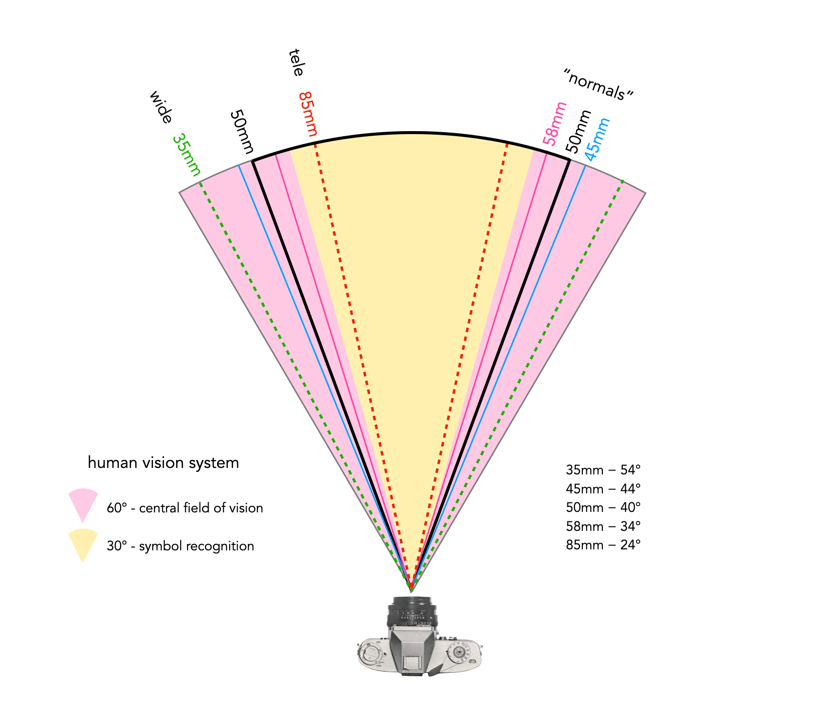
Fig.2: Angle of views of the human vision system
Firstly we should remember that “normal” human vision is binocular, while camera lenses are not. The eye is also composed of a gel-like material, versus the glass of lens elements. So there are already fundamental structural and functional differences. There is also the matter of AOV. A lens generally has one AOV, whereas the human visual system (HVS) has a series, based on differing abilities to focus – binocular vision is approximately 120° of view, of which only 60° is the central field of vision (the remainder is peripheral vision), and only 30° of that is vision capable of symbol recognition (even less is capable of sharp focusing, perhaps 5°?). Note that I use horizontal AOV in comparisons, because it is easier for people to conceptualize than diagonal AOV.
Fig.3: AOV of various lens focal lengths against the AOV of the human vision system
In reference to Figure 3, for the hard limits, a 67mm lens would likely best approximate the 30° region of the HVS that deals with symbol recognition, whereas a 31mm would best approximate the 60° central field of vision. If we were simply to take the middle ground, at 45°, we get a 43mm lens, which actually matches the diagonal of the 24×36mm frame.
But how closely does the 50mm AOV resembles that of the human visual system (HVS)? In terms of horizontal vision, a 50mm lens has a 40° AOV, so it’s not that far removed from that of the 43mm lens. Part of the problem lies with the fact that it is hard to establish an exact value that represents the “normal viewing angle” of the HVS. This is why other lens fit into this “normal” category – the 40mm (48°), the 45mm (44°), the 55mm (36°) and the 58mm (34°). Herbert Keppler may have put it best in his book The Asahi Pentax Way (1966):
“A normal focal length lens on any camera is considered to be a lens whose focal length closely approximates the diagonal of the picture area produced on the film. With 35mm cameras, this actually works out to be about 43mm, generally considered a little too short to produce the best angle of coverage and most pleasing perspective. Consequently, makers of 35mm cameras have varied their “normal” focal lengths between 50 and 58mm. With early single lens reflexes the longer 58mm length was in general use. However, in recent years there seems to be a trend to slightly shorter focal lengths which produce a greater angle of view. Current Pentax models use both 50 and 55mm focal length lenses.”
In some respects it seems like 50mm was chosen because it is close to what could be perceived as the AOV of the HVS, such that it is, and provided a nice rounded focal length value. By the 1950s, the 50mm had become “the standard” lens, with 35mm and 85mm lenses providing wide and telephoto capabilities respectively (a 35mm lens has an AOV of 54°, and the 85mm lens has an AOV of 24°, and surprisingly, 50mm sits smack dab in the middle of these). Many brochures simply identified it as an “all-round” lens. It is difficult to pinpoint where the reference of 50mm approximating the AOV of the human eye may have first appeared.
With the move to digital, the exact notion of a 50mm “normal” lens has not exactly persevered. This is primarily because the industry has moved away from 36×24mm being the normal film/sensor size, even though we hang onto the idea of 35mm equivalency. While a 50mm lens might be considered “normal” on a full-frame sensor, on an APS-C sensor a “normal” lens would be 35mm, because it is “equivalent” to a 50mm full-frame lens, from the perspective of focal length and more importantly AOV. Note that Zeiss still allude to the fact that the “focal length of the ZEISS Planar T* 1.4/50 is equal to the perspective of the human eye.”
So who made f/1.2 lenses? The answer is that most manufacturers had some lenses with this large aperture, usually in the 50-60mm range. Most of these lenses came from Japanese manufacturers, who led the way in fast lenses. The only real exception is the Leitz Wetzlar Noctilux 50mm, and they are expensive, to the point where it is cheaper to buy a new Noctilux-M 50mm f/1.2 ASPH (for US$8k).
These lenses are sorted by focal length and years up to 1985. Up until 1975, there were few if any 50mm f/1.2 lenses for SLR cameras, but there were a range of 55/58mm f/1.2 lenses. Note R indicates a lens for a rangefinder camera.






 Crafting Pixels