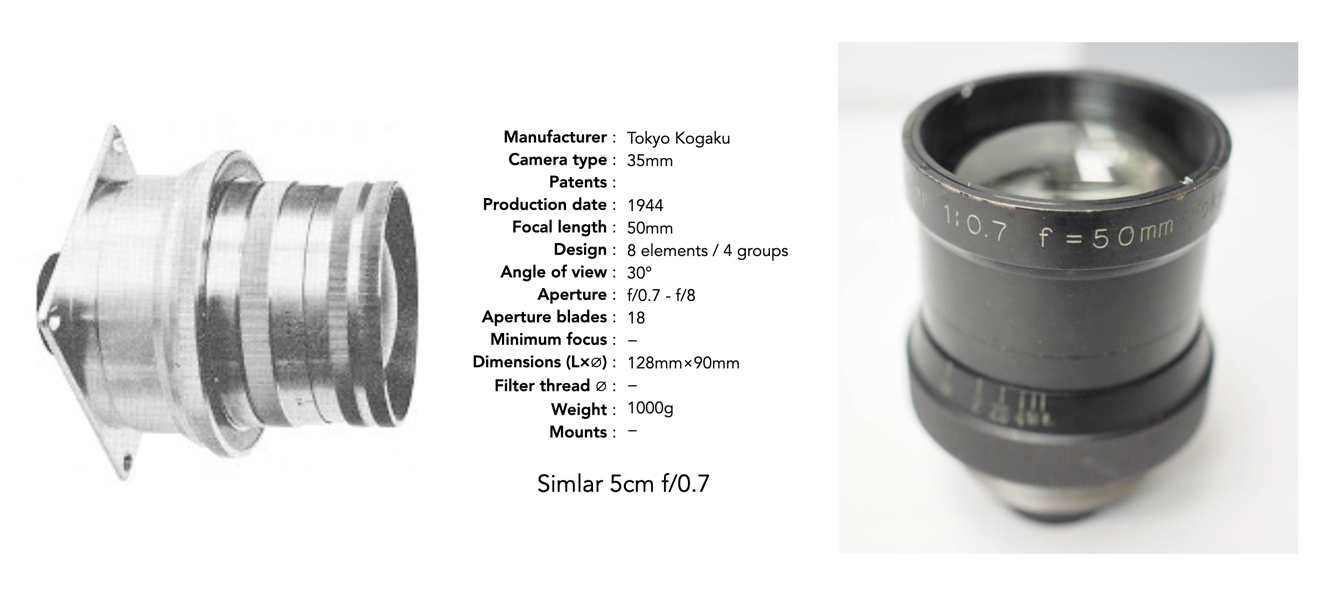
The Zeiss 50mm f/0.7 Planar was not the only f/0.7 lens of the period. There was also the Simlar 50mm f/0.7. The Simlar lenses were made by Tokyo Kogaku, which would eventually become Topcon (Japan). The original lens was designed by Maruyama Shūji. The story of the lens originates from the December 1951 issue of Asahi Camera [1]. It was ordered by the Japanese Army for use in nighttime reconnaissance photography, and was completed in 1944. Before it could be used for its intended purpose, the copies of the lens were claimed by the Aeronautical Engineering Institute of Tachikawa for X-ray medical photography. The article suggests ten copies were made by wars end, but their fate is unknown except for one lens kept by Maruyama Shūji.
A second, postwar version of the camera was produced in 1951 – the dimensions and the weight had both changed (123.7mm×105mm ∅, 2.5kg). Only three copies of the lens were made, of which two were supposedly used on a Antarctic expedition by the Mainichi Newspaper. The Trade and Industry of Japan publication from 1955 shows the lens.
The strange thing about the second series is that the weight of the lens changed from 1kg to 2.5kg, which is a substantial increase. I would beckon to suggest that the design of the original series was copied from either the wartime Zeiss objective, or perhaps the Herzberger objective. When the war was over, there was either issues with using the patent, or an inability to obtain the proper glass, adding extra weight. However there does not seem to be any surviving pictures of the second series.
For those interested, here is a link to another lens, the Simlar-F 180mm f/1.5 produced in 1942. It provides a sense of the aesthetics of the Simlar lenses.
Further reading:
Asahi Camera December 1951. “Toki no wadai: Hachi-nen mae ni Nihon de dekite ita F0.7 no renzu” (時の話題・八年前に日本で出来ていたF0.7のレンズ, Topic of the time: An f/0.7 lens made in Japan eight years ago). P.84.
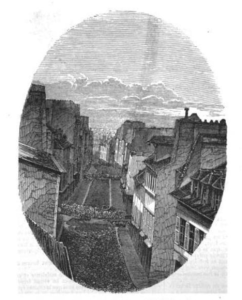
Photojournalism had its origins in the photography of war. Photojournalists are photographers who take pictures that illustrate or tell a story. The first photograph used as an “illustration of a newspaper report”, was a daguerreotype taken by Charles-François Thibault in Paris during the bloody June Days uprising in 1848. Two images were taken at Rue du Faubourg-du-Temple : the scene depicts a barricade on a empty street, at 7.30am on June 25th. On July 8th, the newspaper L’Illustration reproduced the images as woodcuts. Photographic coverage of the Crimean War (1853-1856), and the American Civil War in the 1860s required cumbersome cameras taking long exposures on plates – shots were taken before or after battles because combat coverage was impossible. WW1 brought medium format cameras with glass-plate negatives (these were used by “official” photographers, soldiers used the Vest Pocket Kodak).
Barricades in the Rue Saint-Maur (daguerreotype)
The woodcut from L’Illustration
The Golden Age of photojournalism was considered to be the period of the 1930s through the 1950s, largely due to the introduction of the Leica 35mm camera in 1925. But what sort of kit did the average photojournalist (not including army combat photographers) use in the mid-century period? Being a photojournalist was a demanding occupation. Consider the words of Boris Spremo (1935-2017): “
“I have walked through the wreckage’s of plane crashes and smashed cars . . . knelt beside dying people in Central Africa . . . faced bullets . . . run from tear gas bombs, been chased by angry mobs . . . ridden in a dug out canoe in the sweltering jungles of South America and on dog sleds at 50°C below zero in the Canadian far north . . . ”
Spremo, Boris. Boris Spremo: Twenty Years of Photojournalism. Toronto: McClelland, 1983.
So it is imaginable that a typical photojournalist would want to carry as little gear as possible. In the 1930s, while 35mm had followers, many photojournalists still used large format press cameras. For example Charles Kerlee (1907-1981) in his 1939 book “Pictures With a Purpose – How They Are Made” describes using a 4×5 series D Graflex with a 8¼” Steinheil Cassar lens, or a 40cm Tele-Tessar lens (400mm=135mm, 8¼”=65mm in 35mm equivalency).
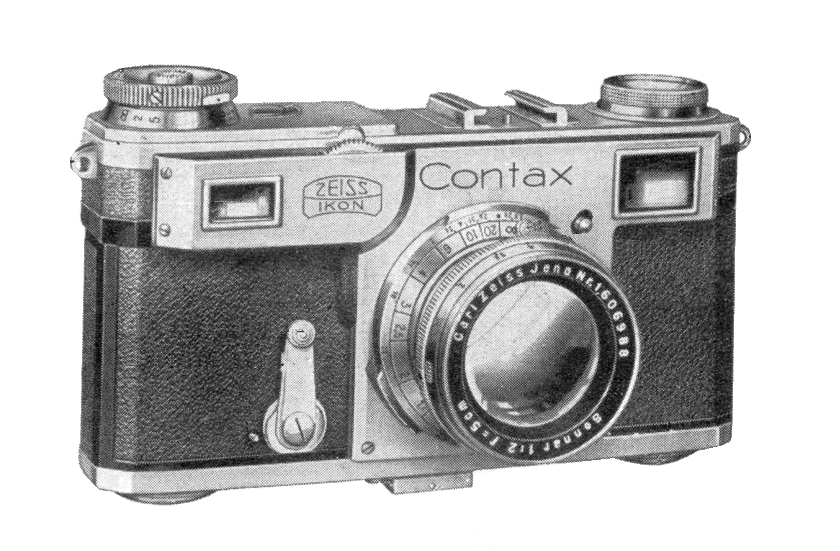
Robert Capa (1913-1954), who it is rumoured photojournalist, L.B. “Jeff” Jefferies is based on in the movie “Rear Window” was an icon of photojournalism, covering the Spanish Civil War and WW2. Capa is known for using a Leica at the beginning of his career, including for one of his most famous works, Falling Soldier taken during the Spanish Civil War. But by his coverage of the Chinese resistance to the Japanese invasion in the late 1930s, he had switched to the Contax II series of cameras. In 1944 as he followed allied troops onto the beaches at Normandy (the “Easy Red” sector of Omaha Beach), he carried two Contax cameras. His preference was for 50mm lenses, with a certain liking of the Zeiss 50mm Sonnar f/1.5. When he left on that ill-fated assignment to Indochina in 1954 he carried a Nikon S to complement his Contax.
A Contax II
Horace Bristol (1908-1997) was another American photographer who was best known for his work in Life. After WW2, Bristol settled in Japan, publishing “Tokyo on a five day pass with candid camera” in 1951. Although photographing for a photo-book he describes in detail the type of gear used through the process. It seems Bristol largely used 35mm cameras, typically still known as the “candid camera”. He states that while a telephoto and wide-angle are needed, the workhorse is the 50mm, it will “do almost anything any lens will do”. Photographing for the book, Bristol used an array of cameras, but typically carried a Canon III and Leica IIIc for candid work (likely what we would today term street photography). As to lenses, Bristol carried the following array: Serenar 135mm f/4, Serenar 85mm f/2, Nikkor 50mm f/1.4, Serenar 50mm f/1.8, Serenar 35mm f/3.2 and a Serenar 38mm f/3.5. Of course this sort of photography allowed for greater flexibility (Serenar = Canon).
Photojournalists also typically did not carry the full gamut of lenses. As suggested by Bristol:
“Don’t, however, be lead into the error of thinking that the answer to good pictures is to be found in a complete set of matched lenses. just the opposite is true, for there is a very definite correlation between the number of lenses the average photographer carries, and the worth-while pictures he produces. Unfortunately, this varies in inverse order; in other words, the more equipment to worry about, the fewer pictures of merit!”
Horace Bristol, Tokyo on a five day pass with candid camera (1951)
Many photographers adopted “candid cameras” because they were compact and convenient. W. Eugene Smith (1918-1978) supposedly left Newsweek in 1938 because they wanted him to work with a larger format, but he preferred his Leica. After that he secured a job at Life. Over his career he used many different 35mm cameras, Leica, Contax, Pentax, Nikon. His preference was for 21mm, 28mm, 35mm, 85mm and 135mm lenses. Yevgeny Khaldei (1917-1997), the Ukranian photographer who captured one of the most iconic WW2 photographs of a Soviet soldier raising a flag over the Reichstag in Berlin, used a Leica III throughout his career.
In the end, it is likely that 35mm cameras took over from larger format because they were practical. Practical and efficient, in the fast-paced world that photojournalism was becoming.
In a previous article, I discussed the Exakta VX camera used in Alfred Hitchcock’s “Rear Window”, suggesting that photojournalists of the period likely didn’t use super-telephoto lenses all that often (or at all). My view on this is based largely on articles I have read in magazines like Popular Photography during the 1950s.
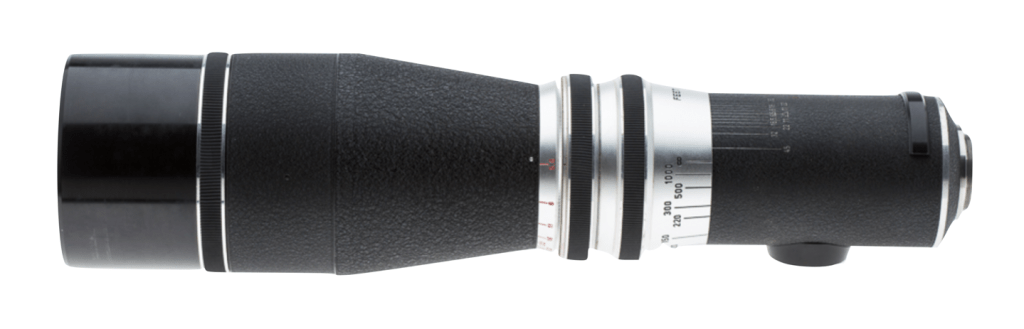
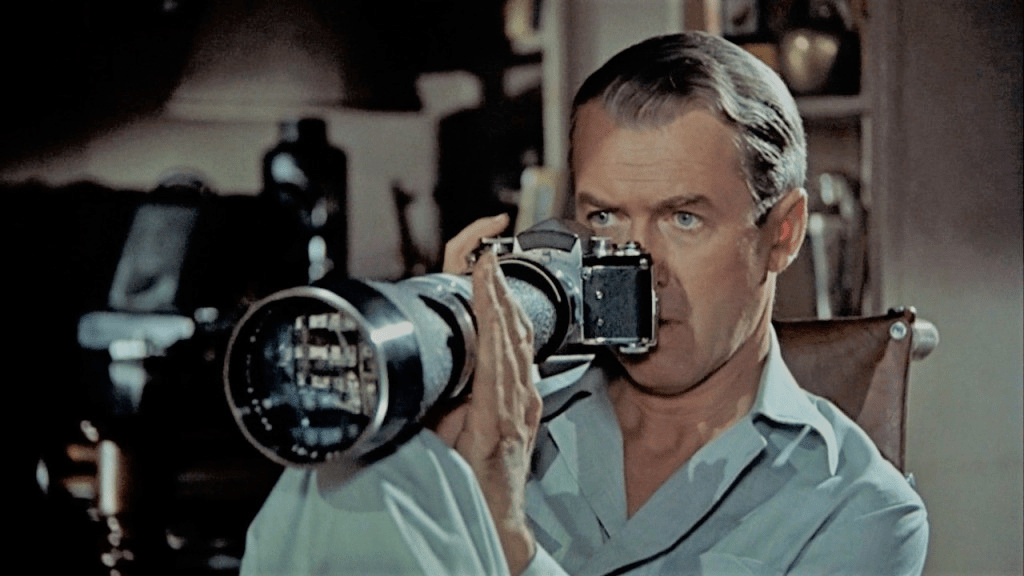
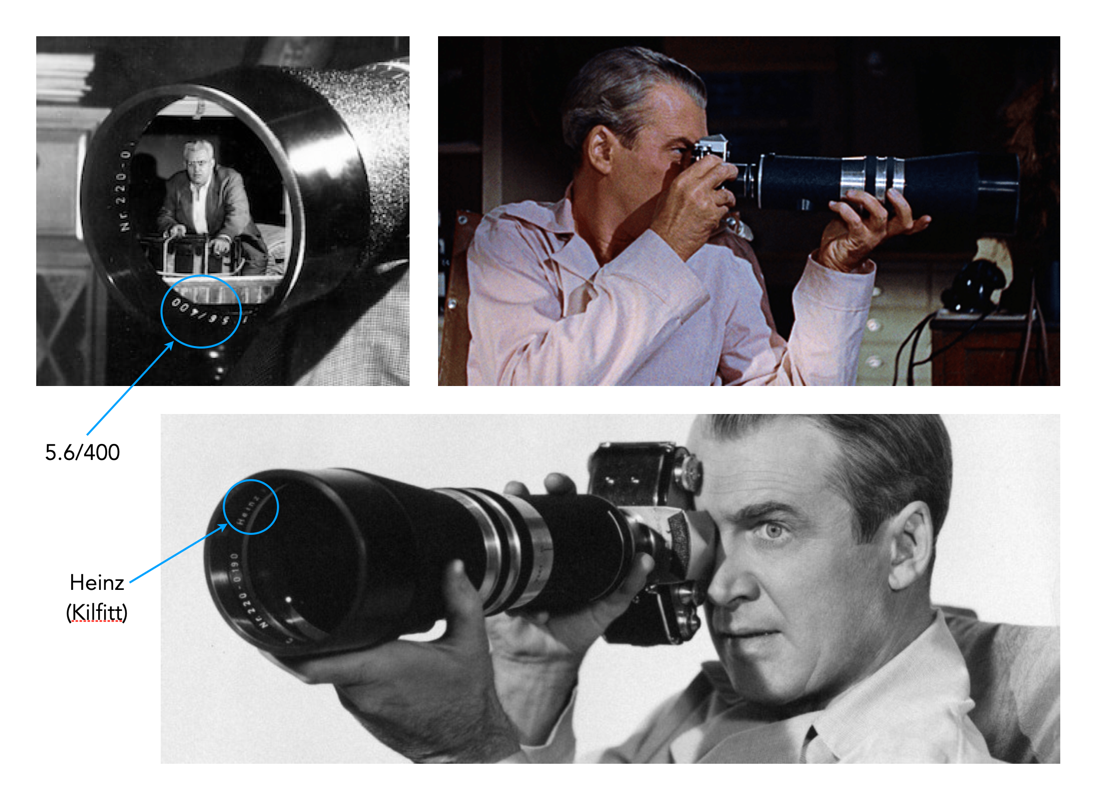
The telephoto lens used by Jefferies in the movie is the Kilfitt Fern-Kilar f/5.6 400mm lens. The lens fits into the category of super-telephoto lenses with focal lengths in the range of 300-600mm. A number of manufacturers produced these lenses, although in all likelihood they had a narrow market. One of the earliest ads for Kilfitt lenses in Popular Photography appears in 1953, advertising their KILAR lenses for “medium and long tele shots” – it includes the 300mm and 400mm lenses. A review of the ads section of Popular Photography in 1954 reveals that the Kilfitt 400mm was being sold alongside the f/5.5 Hugo Meyer-Goerlitz Tele-Megor (which was the lens promoted by Exakta as well), and the Astro f/5.
The Kilfitt-Fern-Kilar 400mm f/5.6
Literature from Heinz Kilfitt Optische Fabrik suggests the lens could be used for “nature and expedition photography“, and also for “special press and feature assignments“. It is then likely that these long lenses were used in situations where a large kit could be carried. Some may argue that Jeff used the lens for sports photography, but that is unlikely, as many photojournalists tended to focus their careers on a particular genre of photography. For example Robert Capa, upon who Jefferies character is loosely based, worked predominantly in war zones: the Spanish Civil War, WWII, Palestine, and the war in Indochina (where he was killed by a landmine). In 1951 Bruce Downes wrote an article in Popular Photography, describing David Douglas Duncan’s photo coverage of the Korean War [2]. He photographed the carnage of war using two Leica IIIc’s, “practical combat cameras” that were “…light, compact and could stand a beating.”. From the perspective of lenses, he used Nikkor lenses: a 50mm f/1.5, a 85mm f/2 and a 135mm f/3.5. No large telephoto lenses in sight.
A steady telescope
In addition, even sports-photojournalists did not generally use long-tele lenses. Jesse Alexander (1929-2021), a motor-sports photographer, reportedly did not use long telephotos lenses. At the start of his career in early 1950s (his first photographic assignment was the 1953 La Carrera road race in Mexico), he used a Leica with 35mm and 135mm lenses, and a Rolleiflex for close-ups and portraits. I would suggest that the 400mm lens was either something Jefferies used occasionally, perhaps for some hobby photography, or merely something added to meet the needs of film. The only real evidence of Jefferies taking sports shots is the motor racing shot that ended up with Jefferies stuck in his apartment with a broken leg. The camera used there was a large format camera (most likely a Graflex), as evidenced by the photo hanging on the wall, taken in the middle of the racetrack.
Identifying the lens
The biggest elephant in the room with these telephoto lenses is their weight. The f/5.6 400mm lens weighed 62oz, or 1.76kg in weight. The faster Sport-Fern-Kilar f/4 400mm lens was even heavier, at 3.1kg. These lenses were just too heavy for a photojournalist to carry and use effectively in an active situation, e.g. a war zone. Even in everyday settings, the length of the telephoto would require the use of a tripod, otherwise shake will be greatly exaggerated – “A slight jiggle that would not be noticed if the scene were filmed with a standard lens will look like something shot on a pogo stick when you use a long telephoto lens.” [1]. It might be okay to use as a de facto telescope and prop up on your knee.
The interesting thing about Exakta is that their literature touted the idea of attaching a telephoto lens to a camera and turning it into a telescope – “a telescope that gives you long-range viewing with high magnification“. A 400mm telephoto lens would provide an eight-power photo-telescope.
NB: Sometimes it is speculated that the lens was actually an Astro-Berlin, a German company that made some pretty cool lenses, especially for the super-super telephoto (we’re talking 2000mm, f/10). These telephotos were often seen on Exakta cameras, hence the association.
Herb A. Lightman, “Choosing and using lenses”, Popular Photography, 35(3), pp.107-117 (1954)
Bruce Downes, “Assignment: Korea”, Popular Photography, 28(3), pp.42-51, March (1951)
When lenses first appeared they had a particular shape, a double convex lens, that was very similar to a certain pulse, namely the lentil. The name lens derived from the Latin name for the plant, lens culinaris.
“LENS (Latin , lens, a small bean or lentil). A lens is a piece of transparent material (usually glass) bounded by curved surfaces (generally spherical, including flat).
An English dictionary of the early 18th century [1] describes a lens as related to optics to be a “small concave or convex glass”. By 1768 [2] it was described as “a glass, spherically convex on both sides”.
The word lentil comes from the Old French lentille, which in turn comes from Latin lenticula. When lenses first appeared, they looked like the lentil seed, and likely due to the fact that technical terms were derived from Greek or Latin, simply named them lens. In German, one term used is Linse, but it is more common to use the term Objektiv. The term Linse is from the Old High German linsa, from a Proto-Indo-European root.
Dictionarium Anglo-Britannicum, John Kersey (1708)
A Dictionary of the English Language, Samuel Johnson (1768)
Artistic movements don’t arise out of a void. There are many factors which have contributed to the changes in Japanese society. Following World War 2 Japan was occupied by the United States, leading to the introduction of Western popular culture and consumerism, which was aptly termed Americanization. The blend of modernity and tradition was likely to lead to some waves, which was magnified by the turbulent changes occurring in Western society in the late 1960s, e.g. the demonstrations against the Vietnam War. In the late 1960s, Japan’s rapid economic growth began to falter, exposing a fundamental opposition to Japan’s postwar political, economic and cultural structure, which lead to a storm of protests by the likes of students and farmers.
It had a long-term effect on photography, forcing a rethink on how it was perceived. In November 1968 a small magazine called Provoke was published, conceived by art critic Koji Taki (1928-2011) and photographer Takuma Nakahira, with poet Takahiko Okada (1939-1997) and photographer Yutaka Takanashi as dojin members. Daido Moriyama joined a for the second and third issues, bringing with him his early influences of Cartier-Bresson. The subtitle for the magazine was “Provocative Materials for Thought”, and each issue was composed of photographs, essays and poems. The magazine had a lifespan of three issues, the Provoke members disbanding due to a lack of cohesion in their ideals.
The ambitious mission of Provoke to create a new photographic language that could transcend the limitations of the written word was declared with the launch of the magazine’s first issue. The year was 1968 and Japan, like America, was undergoing sweeping changes in its social structure.
Russet Lederman, 2012
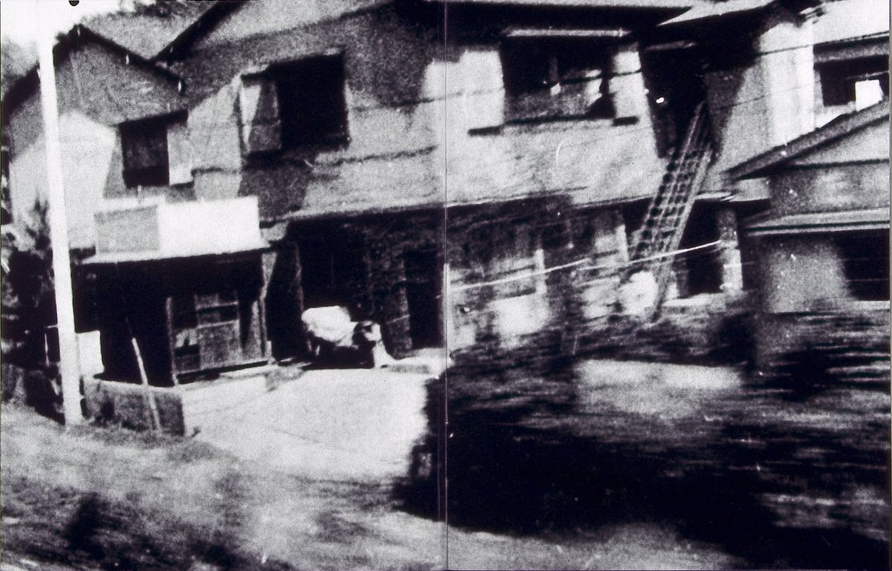
The aim of Provoke was to rethink the relationship between word and image, in essence to create a new language. It was to challenge the traditional view of the beauty of photographs, and their function as narrative, pictorial entities. The photographs were fragmented images that rethought the established aesthetic of photography. The photographs they published were an collection of “coarse, blurred and out-of-focus” images, characterized by the phrase Are‑Bure‑Boke (pronounced ah-reh bu-reh bo-keh). It roughly translates to “rough, blurred and out-of-focus”, i.e. grainy (Are), blurry (Bure) and out-of-focus (Boke).
An example of Daido Moriyama’s work.
They tried random triggering, they shot into the light, they prized miss-shots and even no-finder shots (in which no reference is made to the viewfinder). This represented not just a new attitude towards the medium, but a fundamental new outlook toward reality itself. Of course that is not to say that every photograph had the same characteristics, because there are many different ways of taking a picture. The unifying characteristic is the ability to push beyond the static boundaries of traditional photographic aesthetics. Provoke provided an alternative understanding of the post-war years, one that had traditionally been quite Western centric.
Further reading:
As the three volumes of Provoke became very rare (and expensive), they were recently reprinted and can be found on the Shashasha website.

 Crafting Pixels