A short introduction to the film slide

A “slide” in the more common use of the word refers to a translucent positive image which is held inside a cardboard sleeve, or plastic frame (or mount). A positive image is created using reversal film, whereas negative film produces an inverted or reversed image (which in turn is used to make a paper photo). When a slide is held up to the light, it is possible to see the scene as it was shot rather than the “negative” of the scene. Slides are typically viewed using a slide projector which projects the image against a white screen. Without the mount, the film would not be able to “slide” from one image to another when inside the magazine of a projector.
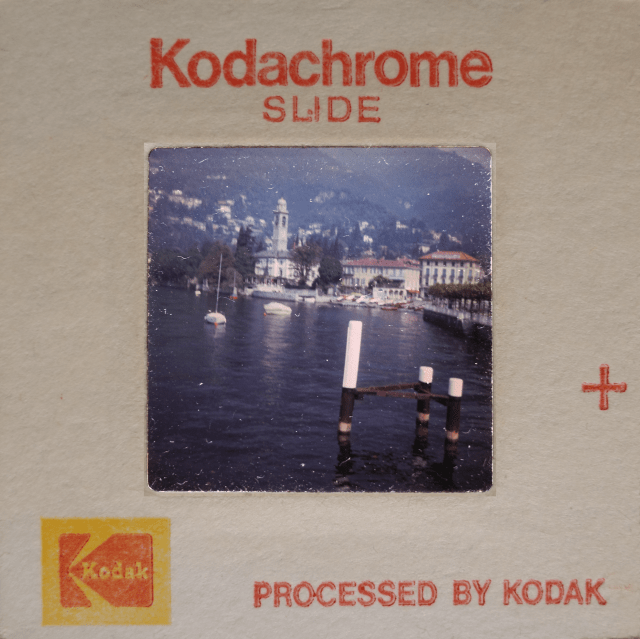
The classic Kodachrome slide

The slide is not a modern phenomena. The earliest was likely the Lantern slide, also known as the “magic lantern”. It was an early type of image projector which appeared in the 17th century which projected glass slides onto various surfaces. With the advent of photographic processes in the mid-19th century, magic lantern slides were black-and-white positive images, created with the wet collodion or a dry gelatine process on glass. Slide shows became a popular pastime in the Victorian period, but they were not the same as modern film slides.
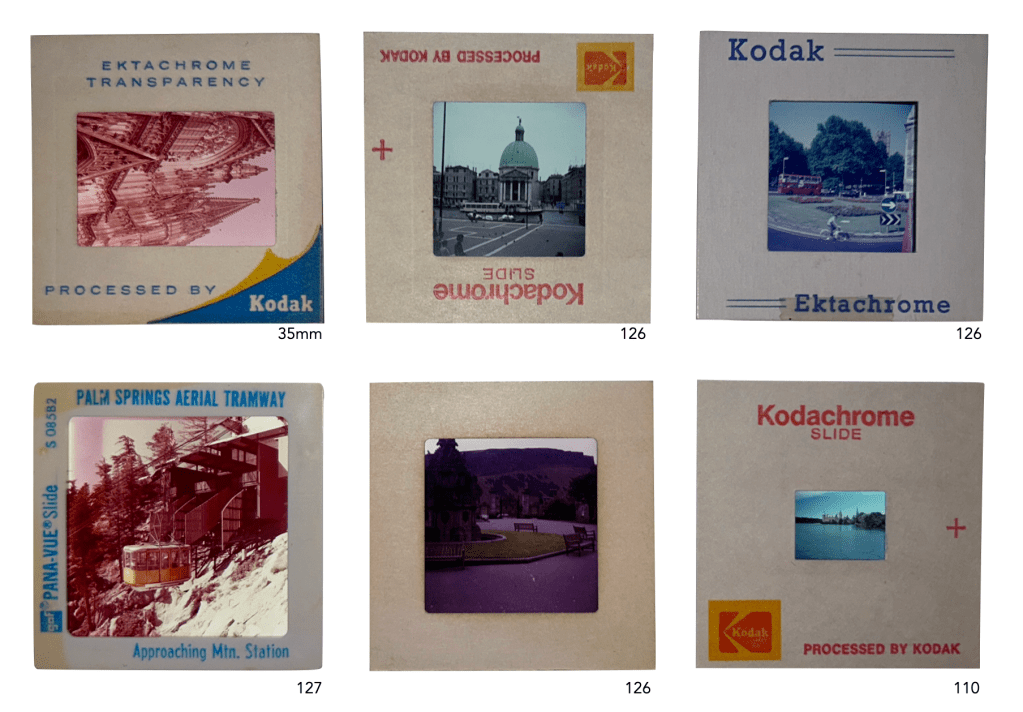
Examples of colour slides

It 1826 Nicéphore Niépce invented the first form of negative photography, but it would take nearly a century before its use in flexible celluloid film became a reality. The earliest commercially successful reversal process came into being in 1907 with the Lumière Autochrome. It was an additive screen-plate method using a panchromatic emulsion on a thin glass plate coated with a layer of dyed potato starch grains. It was Leopold Godowsky Jr., and Leopold Mannes working with Kodak Research Laboratories who in April 1935 produced the first commercially successful reversal film – Kodachrome (first as a 16mm movie film, and in May 1936 as 8mm, 135 and 828 film formats). Based on the subtractive method, the Kodachrome films contained no colour dye couplers, these were added during processing. In 1936 Agfa introduced Agfa Neu, which had the dye couplers integrated into the emulsion, making processing somewhat easier than Kodachrome.

For sparkling pictures big as life. . . . Kodak 35 mm color slides.

Kodak’s commercial slogan during the 1950s

There are different types of reversal film, based on the type of processing. The first, which includes films like Kodachrome, uses the K-14 process. Kodachrome is essentially a B&W stock film, with the colour added during the 14-step development process. That means it has no integrated colour couplers. Kodachrome was an incredible film from the perspective of the richness and vibrancy of the colours it produced – from muted greens and blues to bold reds and yellows. However developing Kodachrome was both complex and expensive, which would eventually see the rise of films like Ektachrome, which used the E-6 development process (a 6-step process). Films like Ektachome have different emulsion layers, each of which is sensitive to a different colour of light. There are also chemicals called dye couplers present in the film. After slide film is developed, the image that results from the interaction of the emulsion with the developer is positive.
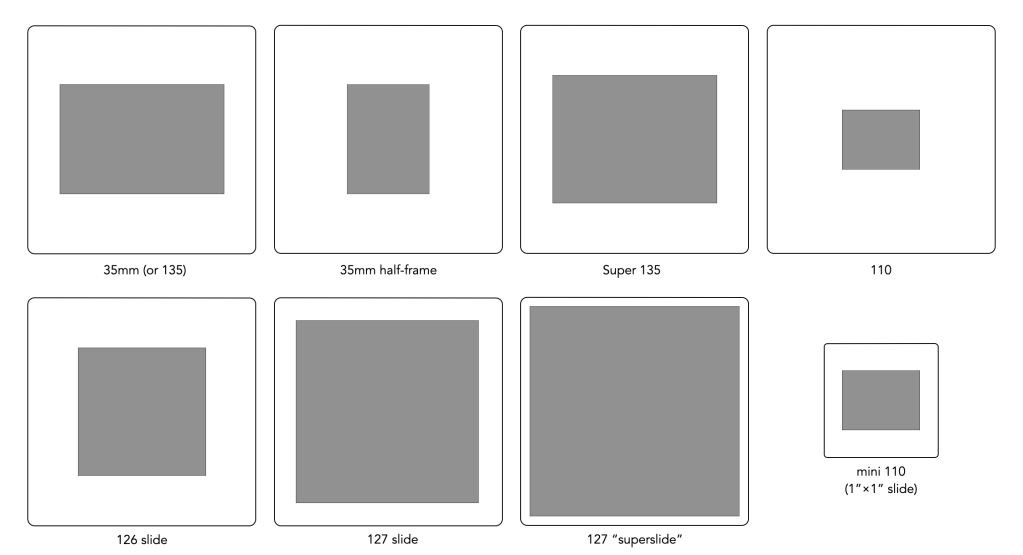
Common slide mount sizes

Many companies made reversal films, typically acknowledged through the use of the “chrome” synonym – e.g. Agfachrome (Agfa), Fujichrome (Fuji), Ektachrome (Kodak), Scotchchrome (3M, after buying Italian filmmaker Ferrania), Ilfochrome (Ilford), Peruchrome (Perutz), and Anscochrome (the US arm of Agfa). The initial Kodachrome had a very slow speed (10 ASA), this was replaced in 1961 by Kodachrome II (1961) which produced sharper images, and had a faster speed (25 ASA). In 1962 Kodak introduced Kodachrome X (ASA 64). Kodak’s other transparency film was Ektachrome, which was much faster than Kodachrome. In 1959 High Speed Ektachrome was introduced, providing a ASA 160 colour film (by 1968 this had been pushed to ASA 400).

FormatYear it appearedTransparency size (w×h)Notes
35mm /135193536mm × 24mmvery common
Super 13536mm × 28mm
110197217mm × 13mmalso on 1”×1” slides (mini 110)
Half-frame1950s24mm × 18mm
126196328mm × 28mm
1271912-199540mm × 40mm
Super 1271912-1995rare
Table 1: Characteristics of slide sizes

What about the “slide” side of things? A patent for a “Transparency Mount” was submitted by Henry C. Staehle of Eastman Kodak in October 1938, and received it in December 1939. Its was described as “a pair of overlapping flaps formed from a single strip of sheet material such, for example, as paper.”. Early slide mounts were mostly made of cardboard, but as plastic became more common, various designs appeared. Most cardboard mounts were either hinged on one side or two separate pieces, glued together after the emulsion was sandwiched between the two sides of the frame. There were also systems for the DIYer, where the emulsion could simply be inserted to the slide frame. Plastic frames were either welded together or designed in an adjustable format, i.e. the film frame could be inserted and removed. The exterior dimension of most common slide formats is 2 inches by 2 inches. There were many different sizes of slides, all on a standard 2″×2″ mount, to encompass the myriad of differing films formats during the period. Slides are usually colour – interestingly, black-and-white reversal film does exist but is relatively uncommon.
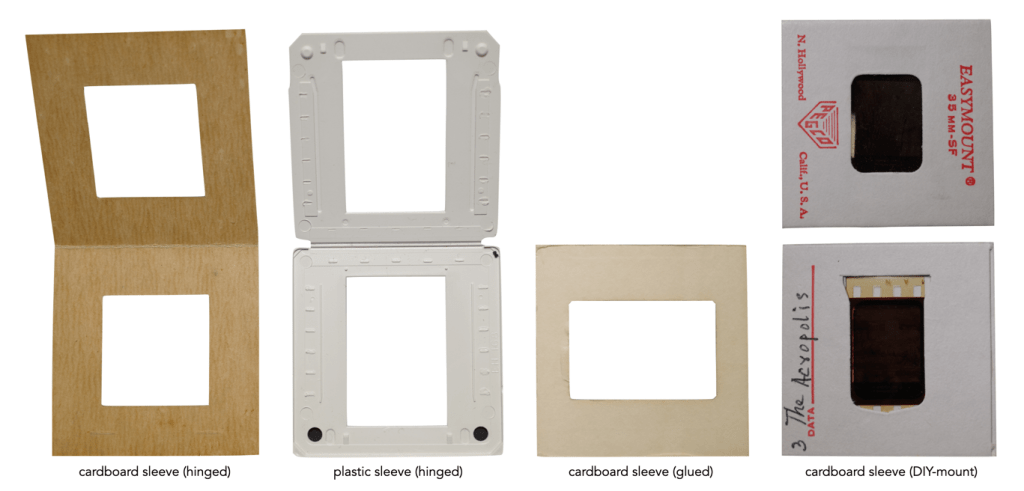
Some different types of slide frames

Slides were popular from the 1960’s probably up until the early 1990’s. It was an easy way to get a high-quality projected image in a pre-digital era. Slides were a popular medium for tourists to take pictures with, and then beguile visitors with a carousel of slides depicting tales of their travels. Slide film is still available today, all of which uses the E-6 process. E-6 slide film is a lot less forgiving as it has a lower ISO value but produces vivid colour with evidence of finer grain. Modern slide films include Kodak Ektachrome 100, Fujifilm Velvia 50, and Fujifilm Fujichrome Provia 100.

Further reading:

A brief note on historical photographic patents in Germany

When it comes to “who invented what first” in the photographic industry, there is always a lot of discussion when it comes to German patents. For example the idea that the Contax S had the first pentaprism for 35mm SLRs is based on a early patent. But just because a patent existed somewhere didn’t mean that similar technology wasn’t being developed elsewhere in parallel. And concepts don’t always make it to reality.

During the Second World War, German companies often applied for patents in other European countries, such as France and Switzerland. France made somewhat sense, considering it was mostly occupied by Germany during the war. Why this was done is still up for debate, but the end result is that there are often patents for photographic objects which exist outside Germany, but no longer have an associated German patent (for whatever reason). For example, information on the the precursor to the Spiegel-Contax (Contax S) camera, the Syntax, which was designed during the war, is available by means of a French patent FR884054 filed on August 9, 1941. The patent is supposedly based on a German utility patent filed on August 23, 1940, however a search of German patents finds nothing. Is that because it never existed, was never processed, or was lost? (The non-German patents normally identify that they are based on a German patent, however no German patent numbers are provided). It was also possible that during a war economy, only inventions that were important to the war effort were granted, many as so-called “secret” patents.

A patent is only effective within the scope of the respective patent law. Companies therefore register patents abroad in order to protect their inventions there from unauthorized imitation. In most cases during the war, these patents were confiscated. For example with the “Patents, Designs, Copyright and Trade Marks (Emergency) Act, 1939” of September 21, 1939, the British began confiscating enemy patents. Other Allied countries undoubtedly enacted similar laws.

The fate of German patents in the period 1945-1950 is somewhat interesting. According to the German Patent and Trademark Office, in 1944 due to the bombings, large portions of the patent office in Berlin (some 250-320K volumes were moved to the town of Heringen, and stored in a 500m deep potash mine shaft. The town was occupied by U.S. troops on 3 April 1945, and the shaft was located, although the patents were not exactly in great shape, and likely would have disintegrated if brought to the surface. So a team was sent down the mineshaft to microfiche the patents. Other patents were dispersed throughout Germany, and supposedly one set of copies of 180,000 patent applications were taken into eastern Germany where they were later lost by fire. Now the U.S. were actively engaged in tracking down secret documents from the industrial and research community. This involved 17 U.S. industries, and hundreds of civilian investigators. They discovered vacuum tubes made of heavy porcelain, magnetophone tape, and infrared technologies.

Starting in July 1945, U.S. troops seized some 145,000 “non-concluded” patent files. Essentially nearly all the German patents ended up in West Germany, meaning that the companies in East Germany likely no longer had access to the protection of these patents. Quite a number of the patents seized were used to help industries in allied countries. Why were not more photographic patents used? The allied countries really didn’t have the same level of photographic industry as Germany. Most German camera/lens companies actually ended up in the Soviet occupation zone. In addition, it is likely the main company in the Western zone, Leitz, had enough pull to allow it to continue operating.

In addition, from the end of April 1945 until 1 October 1948 there was no facility to file patents, aka the “patent-office-free-period” when no patents could be filed. Germans in the western zones were able to file patents again on 1 October 1948 and the German Patent Office began operations on 1 October 1949. In East Germany, patents could be submitted again on 15 September 1948, and on 6 September 1950, the Office for Inventions and Patents of the GDR was established.

What about the old patents which had basically been neutralized? Well in West Germany, the provisions on the maintenance of old IP rights were covered by the “First Act on the Amendment and Transition of the Provisions in the Field of Industrial Property Protection” of 8 July 1949. A request to maintain the IP rights had to be filed by 30 September 1950. A similar act appeared in East Germany in 1950. An example is one of Zeiss’s patents for pentaprisms from 15.4.1942: “Z 679 IXa/42 h ‘Spiegelprisma mit konstanter Ablenkung’ ” – basically a version of the 1946 Swiss patent, CH241034. It was reapproved on 14 June, 1951 (DE000Z0000679MAZ). Note that the 1942 patent does not appear in the German Patent Office searchable database.

It is therefore possible to find some patents, but others were likely lost in the attempt to save them during the tail end of the war. So the idea of defining who invented something first during the 1940s in Europe, but in particular Germany is very challenging, as noted in my post on Who had the first 35mm SLR with a pentaprism? Having said that it is generally easy to find historic patents from countries like Germany, Switzerland, and France. It is much harder to find them from Italy, or even Belgium.

Further reading:

Vintage digital – the Olympus E-1

The Olympus E-1 was introduced in 2003, the first interchangeable lens camera designed specifically from the ground up to be digital. It would provide the beginning for what would become the “E-System”, containing the 4/3″, or “Four Thirds” sensor. The camera contained a 5-megapixel CCD sensor from Kodak. The 4/3″ sensor had a size of 17.3mm×13.0mm. The size of the film was akin to that of 110 film, with an aspect ratio of 3:2, which breaks from the traditional 35mm 4:3 format.

The E-1 had a magnesium-alloy body, which was solid, dense, and built like a proverbial tank. The camera is also weather-sealed, and offered a feature many through was revolutionary – a “Supersonic Wave Filter”, to clean off the dust on the imaging sensor. From a digital perspective, Olympus designed a lens mount that was wide in relation to the sensor or image-circle diagonal. This enabled the design of lenses to be such that they minimized the angle of light-ray incidence into the corners of the frame. Instead of starting from scratch, Canon, Konica-Minolta, Nikon and Pentax just took their film SLR mounts and installed smaller sensors in bodies based on their film models. The lens system was also designed from scratch.

The tank in guise of a camera

The E-1, with its sensor smaller that the APS-C already available had both pros and cons. A smaller sensor meant lenses could be both physically smaller and lighter. A 50mm lens would be about the same size as other 50mm lenses, but with the crop-factor, it would actually be a 100mm lens. 4/3rd’s was an incredibly good system for telephoto’s because they were half the size and shape than their full-frame counterparts.

Although quite an innovative camera, it never really seemed to take off in a professional sense. It didn’t have continuous shooting or even the auto-focus speed needed for genres like sports photography. It also fell short on the megapixel side of things, as the Canon EOS-1Ds with its full-frame 11-magapixel sensor had already appeared in 2002. A year later in 2004, the Olympus E-300 had already bypassed the 5MP with 8MP, making the E-1 somewhat obsolete from a resolution viewpoint. The E-1’s photosite pitch was also smaller than most of its APS-C rivals sporting 6MP sensors.

Further Reading

War reparations at Carl Zeiss Jena – where did the dismantled equipment go?

The Soviets reportedly stripped Carl Zeiss Jena of 93% of its equipment, most of which was redistributed throughout factories in the USSR. This included 14 of the 16 glass furnaces at Zeiss [4], machines, office supplies and equipment, stocks and raw materials, boilers, elevators, switchboards etc. [5]. So what happened to the equipment taken by the Soviets as war reparations from the Jena plant from October 1946 to April 1947?

The majority of the dismantled equipment was transferred to three cities in the USSR – Moscow, Leningrad, and Kiev [8]. To Moscow went the rangefinder equipment, to Leningrad the equipment for the production of microscopes, micrometers and fine measuring devices, and to Kiev the geodetic equipment and the Contax Camera section [8]. Most of it seems to have been transferred to two factories in Russia: No.349, and No.393.

The Optical-Mechanical Plant No.349 near Leningrad (now St. Petersburg) was founded in 1914 in Petrograd. In 1919 it was nationalized, and in 1921 it was renamed the Factory of State Optics. Further reorganizations resulted in the factory in Leningrad becoming Gosudarstvennyy Opticheskiy Mekhanicheskiy Zavod (GOMZ), or State Optical-Mechanical Factory, in 1932. In 1965 GOMZ changed its name to LOMO (Leningradskoe Optiko Mekhanichesko Obedinenie), or Leningrad Optical-Mechanical Union. They produced optics for the Soviet military and space programs, as well as consumer cameras. Seventy-nine of the Zeiss experts from Jena were assigned to GOMZ, and the existing equipment in various parts of the factory was replaced by equipment dismantled from Jena [2]. By mid-1947 the process was completed, and the Soviet personnel were trained on using the equipment. A CIA report on the facility [2] suggests that much of the dismantled equipment stored in the open, or spoiled by mishandling, and the Soviets gained very little from the seized equipment [2].

Zavod (factory) No.393 is located in the small town of Krasnogorsk, a few kilometers from Moscow. Krasnogorsky Zavod was founded in 1942. During the Soviet era it became known as Krasnogorskiy Mechanicheskiy Zavod (Krasnogorskiy Mechanical Works), or KMZ for short. After 1945 it began producing lenses to Carl Zeiss specifications. The machinery at No.393 seems to be almost entirely made up of machines dismantled from Zeiss, Jena [6]. All the grinding and polishing machines at No.393 were transferred from Jena, amounting to one-third of the entire Zeiss plant as it existed prior to dismantling (100 lens grinding machines, 300 milling machines, and 100 metal grinding machines) [3]. The largest segment of machines was the 400 lathes of various sizes. All optical glass used at No.393 from 1946 to 1952 was from Jena, and of good quality [3].

No.393 produced a lot of optical items, including the Zorky camera, designated “FED”, and associated 5cm lenses. The Zorky was essentially a copy of the Leica IIc manufactured during the period 1940-1944. By 1951, about 400 cameras per month were being produced [6]. By 1947 the plant also made Moscow II 6×9cm camera, aerial cameras, photo-rectifiers, phototheodolites, 16mm motion picture cameras, and a series of military items.

The Contax camera section went to Arsenal No.1 in Kiev, Ukraine [8]. By the later 1940s this plant was making reproductions of the Contax II and Contax III cameras. These would morph into Kiev II and III cameras, eventually modified into the Kiev and 4A and 4AM. Some of the equipment also made it to smaller factories in the USSR. A good example of this is Optical Plant No.230 near the small town of Lytkarino (not far from Moscow). They received 50-60 grinding and polishing machines from Jena [7], although the CIA reports this as “bad and uncared-for equipment”. Some of the equipment was used to outfit a vacant optical plant in Zagorsk. Zeiss specialists installed the machinery, and trained Soviet workers [1].

The dismantling was in many ways not considered to be optimally successful, in all likelihood because insufficient care was taken with the sensitive equipment [4].

✽ Please note that while some people seem to regard the Soviet dismantling of equipment in East Germany to be looting, it was actually part of the reparation payments agreed upon in the Potsdam Agreement.

Further reading:

Please note that the CIA links don’t seem to work sometimes (since the issues with the US government websites began).

  1. Zeiss Specialists in the USSR”, Central Intelligence Agency, Information Report, 17 December (1952)
  2. Optical-Mechanical Factory No.349 GOMZ in Leningrad”, Central Intelligence Agency, Information Report, 23 June (1954)
  3. Quantity and Types of Optical Machinery and Equipment at Zavod 393 in Krasnogorsk and at Zeiss in Jena”, Central Intelligence Agency, Information Report, 25 August (1953)
  4. Zeiss and Schott and Genossen, Jena”, Central Intelligence Agency, Information Report, 1 April (1947)
  5. Organization and Production of the Carl Zeiss Plant at Jena”, Central Intelligence Agency, Information Report, 31 August (1953)
  6. Production at Factory 393 at Krasnogorsk”, Central Intelligence Agency, Information Report, 20 August (1953)
  7. Optical Plant in Lytkarino”, Central Intelligence Agency, Information Report, 19 January (1950)
  8. Activities and Production at Arsenal No.1 Kiev”, Central Intelligence Agency, Information Report, 6 February (1953)

Vintage cameras – The mirror returns!

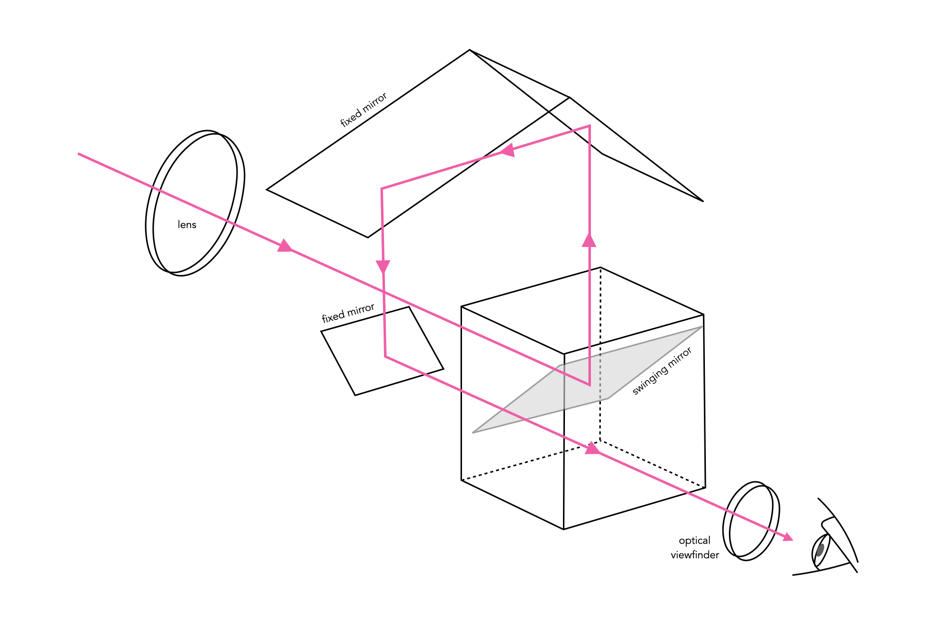
One of the biggest problems with early SLR camera’s was the fact that the mirror did not return to it’s position after the shutter was released, leaving a black void in the viewfinder. To facilitate this one had to wind on the next frame. Consider the pre-WW2 Exakta Kine, a purely waist-level camera. When the shutter release was pressed, spring action caused the mirror to fly upwards just before the shutter travelled. The Contax S used the same system. There were two issues with this: (i) the potential for the mirror action to cause jarring, making sharp images problematic, and (ii) once the shutter-release was pressed, the finder goes black, the the image disappeared (preventing the photographer from seeing the scene at the instant of the exposure, or after it). All this changed with the appearance of the instant return mirror. Many attribute this to the Asahi Asahiflex IIb camera in 1954.

However in reality the instant return mirror was the brainchild of Hungarian inventor and photographer Jenő Dulovits (1903-1972). He patented the worlds first eye-level SLR viewfinder in Hungary on August 23, 1943 [1]. The lead to the first camera sporting this new feature, the Duflex (DUlovits reFLEX). Because at the time the use of a pentaprism was deemed too expensive, the camera used a Porro prism – an arrangement of mirrors that would bring the light beams in through the lens, then reflected via mirrors upwards to meet the eye. Working prototypes were built at Gamma in Budapest in 1944, with the first camera put on the market in 1949 (hence why the camera is known as the Gamma Duflex).

Fig.1: The Duflex mirror system (Porro prism) and the instant return mirror

Production lasted roughly a year with circa 550 units being produced (according to historian Zoltan Fejer – Hungarian Cameras, Budapest 2001). In all likelihood production ceased due to pressure from the Soviets – manufacture of Exaktas, Practicas etc. in East Germany, and Russian Zeniths likely meant that competition from a Hungarian camera maker was not wanted. However this decision likely set back their own camera designs by a decade. However Dulovits invention likely paved the way for future enhancement that would lead to Asahi’s commercially successful cameras, starting with the Asahi Asahiflex IIb. As Bob Schwalberg put it:

“A single-lens reflex innovation deserving special applause is the Asahi Optical Co.’s instant-return mirror, which flips up and out of the way just before exposure, and immediately snaps back to focusing position after the shutter has closed. … By eliminating the characteristic reflex blackout, the doubly-sprung Asahi mirror permits the photographer to continue focusing and/or framing without the interruption of having first to transport the film as in traditional reflex-cameras.”

Bob Schwalberg, “35-mm Today: Onward and Upward! Part II”, 42(2) pp.12 (Feb.1958)

✽ Dulovits camera patents appear on the website of the Hungarian Intellectual Property Office. Outside of Hungary, the only patents available are for his soft effect lenses. The camera actually heralded other firsts, including internal automatic diaphragm control, and a metal focal plane curtain shutter.

Note: The first quick return reflex mirror is sometimes attributed to the KW Praktiflex, which debuted in 1939. However in the Praktiflex the mirror is raised as the shutter release is pressed, and falls back under gravity when the button is released, i.e. not really an instant return mirror, more of a shutter-release-actuated mirror.

Further reading:

  1. Jenő Dulovits, No.167464 (D-5859), “Eye-level SLR camera”, (Aug.23, 1943)

    Vintage camera makers – The origins of Pentacon

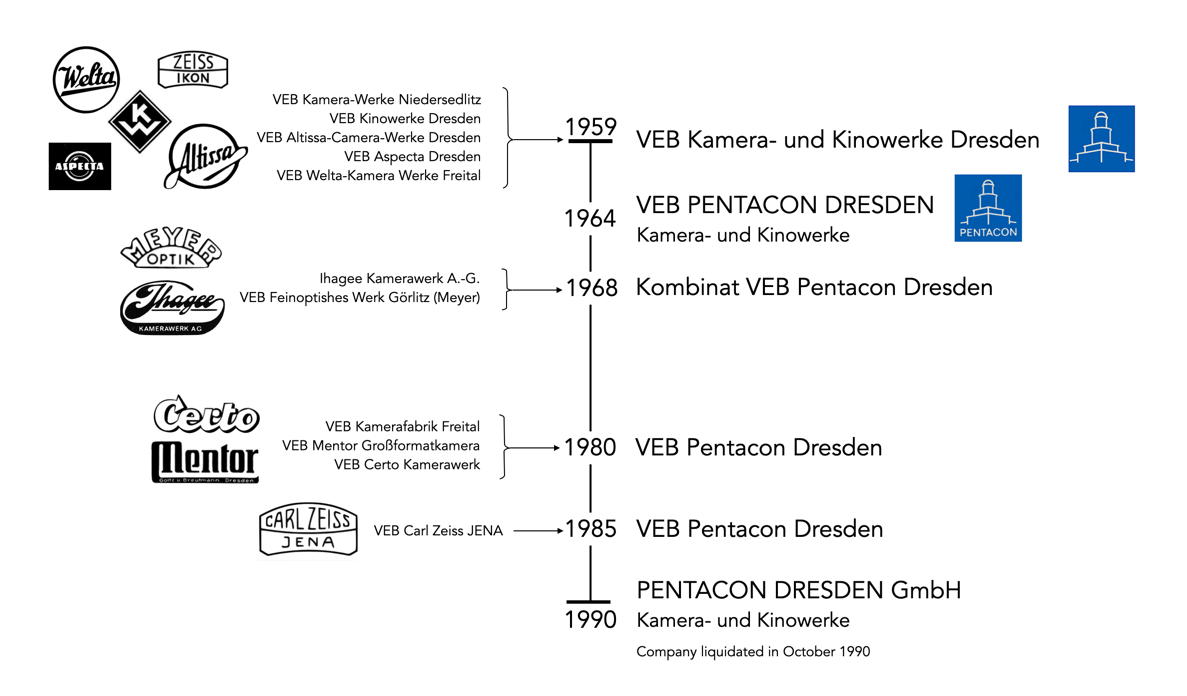
    Post-WW2 there were still a lot of camera companies in Germany, and particularly in East Germany. In fact the heart of the German camera industry lay in Dresden, Jena and the surround area. Over the next decade, many of the companies were merged into a series of VEBs (Volkseigener Betrieb or Publicly Owned Enterprise) culminating with VEB Pentacon.

    On January 1, 1959 a series of Dresden camera manufacturers were merged to create the large state-owned VEB Kamera und Kinowerke Dresden (KKWD). The company was a conglomerate of existing companies which produced a broad range of products and had numerous production sites. Joining them together meant production could be rationalized, yet cameras were still produced under their brands names, e.g. Contax, Welta, Altissa, Reflekta, Belfoca.

    • VEB Kinowerke Dresden − Formerly VEB Zeiss Ikon
    • VEB Kamera-Werke Niedersedlitz − This is where the Praktiflex, precursor of the Praktica, was invented; it included VEB Belca-Werk absorbed in 1957.
    • VEB Welta-Kamera Werke Freital − This included the VEB Reflekta-Kamerawerk Tharandt and Welta-Kamera-Werk Freital (Reflekta II, Weltaflex und Penti).
    • VEB Altissa Kamerawerke Dresden − Formerly Altissa-Camera-Werk Berthold Altmann, (including Altissa, Altiflex and Altix cameras).
    • VEB Aspecta Dresden − Formerly Filmosto-Projektoren Johannes (including projectors, enlargers, lenses).

    In 1964 the company was renamed to VEB Pentacon Dresden Kamera-und Kinowerke. This was intended to provide a catchy name for the company (not forgetting that a lot of its products were intended for Western markets). Pentacon was already being used as the export name for the mirror Contax D, and was derived from PENTAprisma and CONtax. Pentacon used the stylized silhouette of the Ernemann Tower (on the old Ernemann camera factory site, which belonged to the former Zeiss Ikon) as its corporate logo. The company continued to produce good SLRs: Praktica V (1964), Praktica Nova with return mirror (1964), Praktica Nova B with uncoupled light meter (1965), Praktica Mat for the first time with TTL interior light metering (1965). In 1966 the 6×6 format Pentacon Six appeared, with the Praktica PL Nova I in 1967.

    The evolution of Pentacon

    On January 2, 1968, the VEB was restructured, and more companies were added into the fold, including Ihagee Kamerawerk (which had remained independent until this point), and VEB Feinoptisches Werk Görlitz. The name became Kombinat VEB Pentacon Dresden.

    • Ihagee Kamerawerk AG i.V. − Produced Exakta and Exa cameras.
    • VEB Feinoptisches Werk Görlitz − Formerly Meyer-Optik Görlitz

    The continuous expansion and bundling of technical expertise and concentration of the production capacities of the Pentacon, led to the incorporation of three more companies in 1980.

    • VEB Kameratechnik Freital − Formerly Freitaler camera industry Beier & Co., including Beirette cameras.
    • VEB Mentor Großformatkamera − large format cameras
    • VEB Certo Kamerawerk Dresden − folding cameras

    Finally in 1985, VEB Carl Zeiss JENA was added. Unfortunately it was likely all too late. There were scarce few years between this and the reunification of Germany. In July 1990 the company was renamed PENTACON DRESDEN GmbH, but by October it was being liquidated.

    Glass from the past, aka vintage lenses

    When digital cameras started to supplant analog ones, everyone likely thought that the manual focus interchangeable lenses of yore would be relegated to dark closets, attics, and the few who still used film. It became rare to find these lenses, except perhaps languishing in the “used” section of a camera store, often gathering dust. Digital cameras used digital lenses, and as such there was very little need for analog lenses. There were also few means of adapting these lenses for use on DSLR’s, largely because of the lack of mount adapters, but also because of compatibility issues with mirror-based cameras, both full frame and crop-sensor. This changed with the advent of the mirrorless camera which having a shorter distance to the sensor allowed the adoption of lens adapters.

    So what is a vintage lens? This is somewhat of a loaded question because there is no definitive answer. One of the defining characteristics of a vintage lens is that it is manual, i.e. it relies on both manual focus, and aperture setting. But there are a lot of manual lenses available. There are lenses available from the 1930’s, 40’s and even the 19th century. But many of these suffer from not being easy to adapt to digital cameras. In all likelihood, anything pre-digital could be construed as vintage, however I hesitate to include the pre-digital lenses with electronic components in them, e.g. auto-focus, because most cannot be easily converted for use on a digital camera. But in the end, vintage really means interchangeable lenses made for cameras that used film, and specifically 35mm film cameras, either SLR or rangefinders.

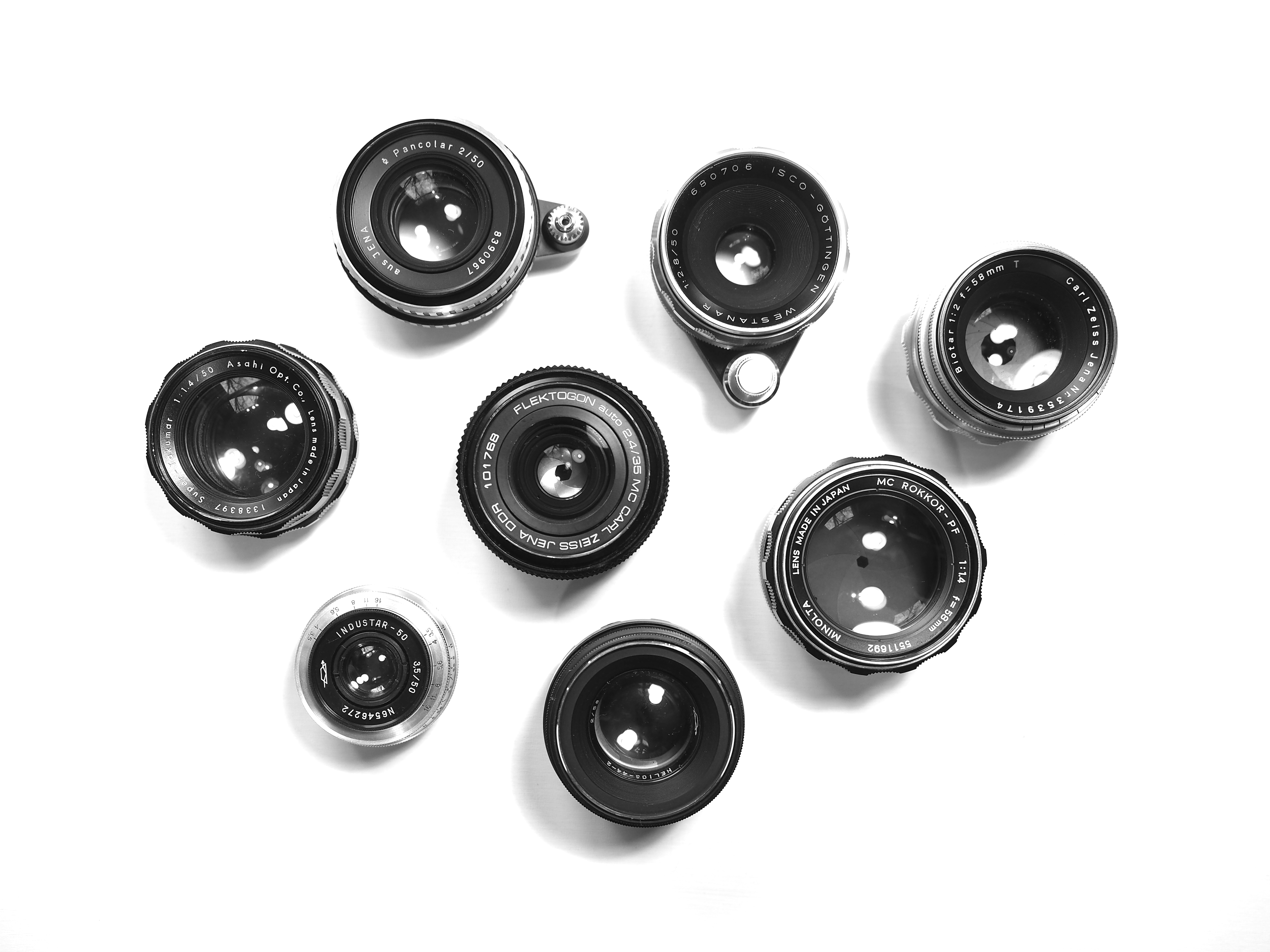
    There are millions of vintage lenses in the world today, the majority of these interchangeable lenses hail from the period 1950-1985, predominantly made in Japan and Europe. Some brands have a large ubiquity in the world of vintage lenses, such as Asahi Takumar, while others such as Minolta’s Rokkor have a more subdued presence, e.g. the Rokkor 58mm f/1.4 lens an example of a star performer. Vintage lenses come in various focal lengths, but many are in the “normal” range 45-58mm. They can be fast, i.e. have a large aperture, aesthetically pleasing, e.g. made of chrome, or just come from a company with an exceptional optical reputation. All vintage lenses have their own character, from optical anomalies and aberrations, to colour rendering, and boken, and the out-of-focus qualities. Many of the Carl Zeiss Jena lenses such as the Flektogon 35mm f/2.4 is renowned for how it renders out-of-focus regions. At the opposite end of the spectrum, is the Jupiter 9, an 85mm f/2 lens made in the USSR – it has a wonderful 15 blade aperture, and what some people call “dreamy bokeh”.

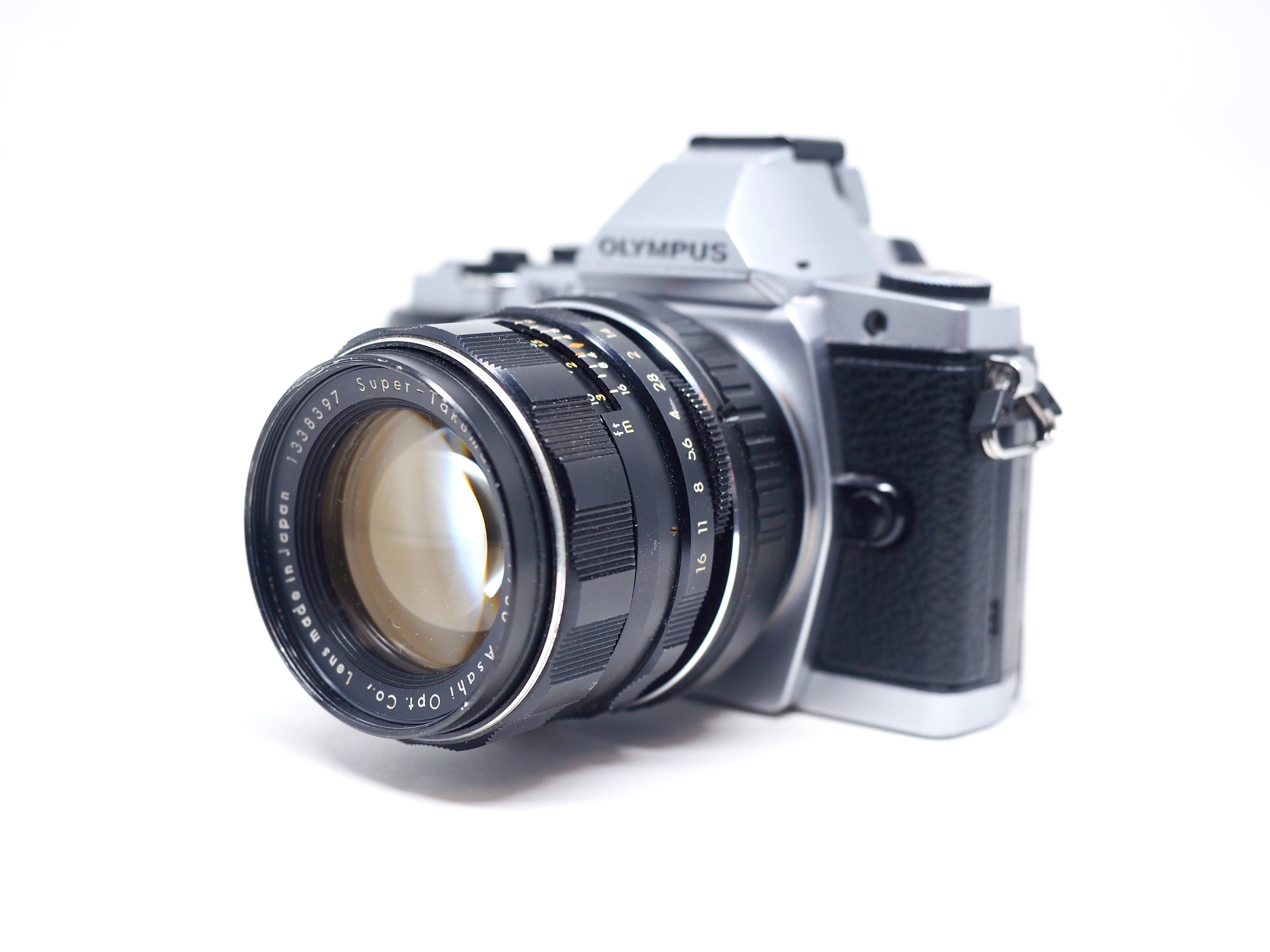
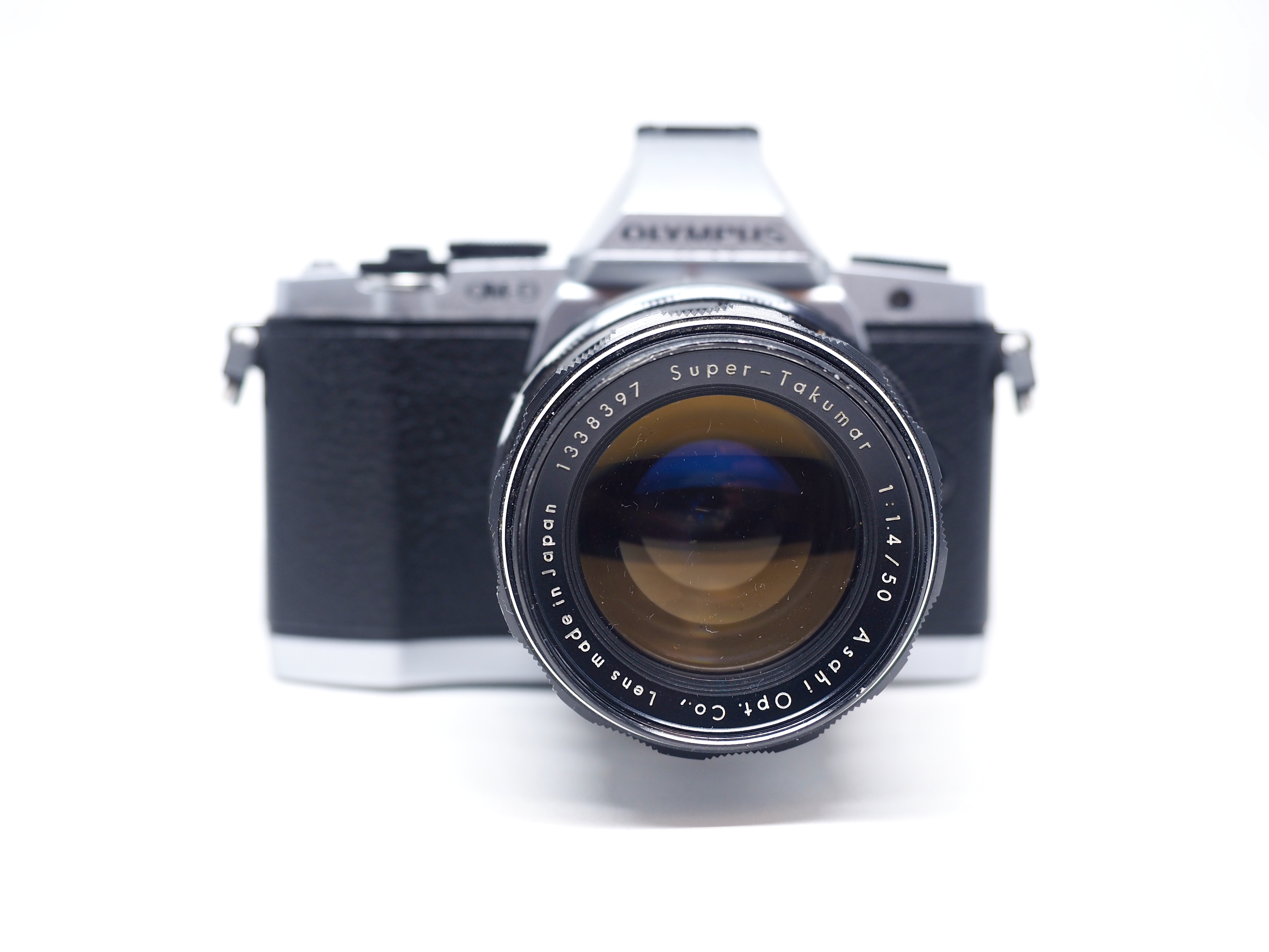
    In some cases a particular lens may have been made for only a couple of years, in limited quantities, and in other cases a lens may have evolved over a dozen or more years, with slight changes in lens formulae, glass composition, and mounts. For example Asahi Pentax produced a huge number of Takumar branded lenses in the 1960s. Some like the 8-bladed Super-Takumar 50mm f/1.4, a Planar-type lens, almost have legendary status, the optics are that good. The lens evolved over the years from the legendary 8-element Super-Takumar (1964-65) to the thoriated 7-element Super-Takumar (1965-71), Super-Multi-Coated Takumar (1971-72) and SMC Takumar (1972-75). At more than 50 years old, many of these lenses still pass muster. So why choose a vintage lens?

    This series will focus on vintage lenses. Over the course of the next few months we will explore various aspects of vintage lenses, from questioning why they are of interest to digging down into the intricacies of choosing a lens, adapters, and how to examine a lens prior to purchase. This won’t be a review of specific lenses (that may come later), but more of a broad overview, providing links to extra information that might be of interest.

    Vintage digital – The Fuji camera with a weird sensor

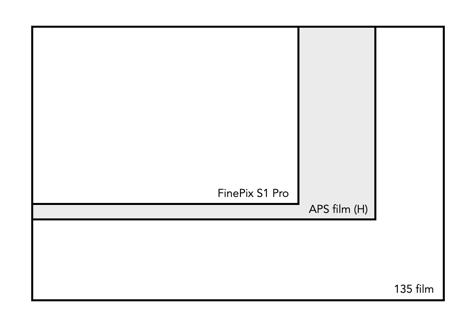
    The Fujifilm FinePix S1 Pro was a somewhat strange, yet innovative camera. Released in January 2000, it sported a 1.1 inch Super CCD sensor (23.3×15.6mm) producing 3.4 physical MP, but after processing would produce an image with a resolution of 3040×2016 pixels (6MP). But it wasn’t exactly built from the ground up. It was a mash-up of a Nikon N60 film camera body, and Fujifilm electronics. At this stage it was considered a “digital SLR”, because true 35mm DSLR had yet to appear. It used Nikon lenses, sporting an Nikon-F mount. It’s actually a bit weird discussing a digital camera, but at 22 years old, these early digital cameras are likely in the realm of vintage.

    The photosites on the sensor took the form of a honeycomb tessellation, oriented in a zig-zag pattern rather than the traditional row/column array. This resulted in the distance between cells being smaller allowing for more photosites than a regular Bayer sensor. The camera then processed the data to produce the equivalent of a 6.2 MP Bayer sensor. A conventional CCD has rectangular photosites arranged in columns and rows. The SuperCCD has octagonal photosites in a honeycomb configuration. By rotating the photosites 45° to form this interwoven layout, the CCD’s photosite pitch in the horizontal and vertical directions is narrower than in the diagonal direction. This provides a larger relative area of the photosites per total size of the CCD than possible with the conventional CCD structure. In high resolution mode, virtual pixels are created within the spatially interleaved real pixels.

    Sensor size
    Super CCD photosites (physical and virtual pixels)

    In comparison to other cameras of 2000, the Canon EOS D30, Canon’s first “home grown” digital SLR produced 3.1 MP, and Nikon’s D1 (1999) produced 2.7MP. The Super CCD sensor evolved through a succession of designs and cameras until the final 12MP SuperCCD EXR sensor in 2010. The FinePix Pro series continued until the S5 finished production in 2009, still using the Nikon-F mount.

    Further reading:

    Now that’s a camera!

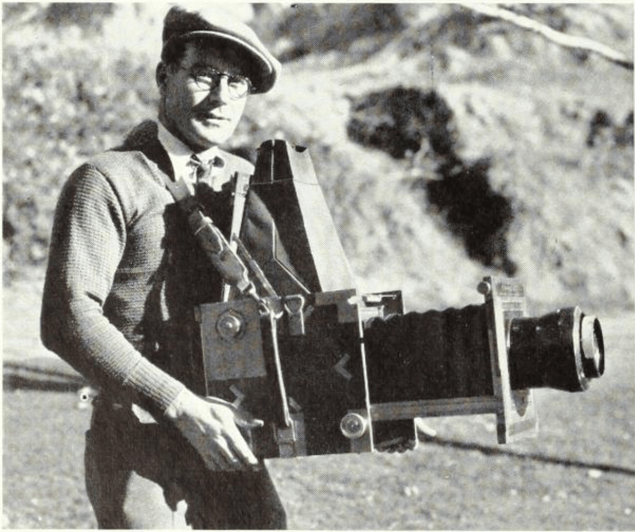
    An 8×10 still camera operated by photographer Neal Harburger used to capture stills on Paramount westerns c.1930s. The camera was a Minex, designed by A. Adams & Co. of London. The camera was 18 inches high, 30 inches long (with the bellows extended) and weighed 34 pounds. From the literature it looks to be the “Tropical” model made of brass, teak, and Russian leather bellows.

    Ultrafast lenses – the Noctilux 50mm f/1

    After Canon and Nikon gave up on their sub-f/1.1 lenses, there was a lull for a while. In all possibility it was likely considered that film would just get so fast there would be little need for these light behemoths. But high ISO film was only introduced in the mid to late 1970s – Fujicolor 400 (1976), Kodakcolor 400 (1977). Indeed faster films begat faster lenses.

    The Leitz 50mm Noctilux f/1 for Leica M cameras appeared in 1976, designed by Walter Mandler (1922-2005) and produced by Ernst Leitz Canada. It was a successor to the earlier Noctilux f/1.2. Bob Schwalberg reviewed the lens in 1976 [1]. His observation was that it had a high optical contrast and almost no flare at f/1, “outimaging” its compatriots the Noctilux f/1.2 and the Summilux f/1.4.

    The lens was manufactured for a long time, from 1976-2007. The name Noctilux, was designated for three lenses with differing apertures:

    • Leitz Noctilux 50mm f/1.2 aspherical (1966-1976).
    • Leitz/Leica Noctilux-M 50mm f/1.0 (1976-2007).
    • Leica Noctilux 50mm f/0.95/50mm ASPH (2008- )

    The lens was constructed using only spherical curvatures, as opposed to the f/1.2 which used two aspherical surfaces with a 6/4 design. The earlier design was likely changed because the aspherical lenses were too expensive to manufacture. The f/1 uses a modified Gauss design of seven elements in six groups with an “air-lens” between the second and third elements. The second and fifth elements were made using Noctilux 900403 glass. The 1st, 6th, and 7th elements were made with Lanthanum glass (LaK12, LaF21). The 900403 glass, developed at the Leitz Glass Laboratory had a higher zirconium oxide content giving it a refractive index of 1.9005 and a dispersion value of 40. (This glass had a melting point of 1600°C, and had to be cooled in a controlled manner over 10-12 days).

    But it was no light lens. It was 63mm in diameter, and weighed about 600g. It still suffered from the one thing all ultrafast lenses suffer from – a narrow DOF (2” at 5 feet). When released it sold for US$855. They now routinely sell for C$8,000-11,000.

    References:

    1. Bob Schwalberg, “50-mm Noctilux f/1: Sharpest superspeed lens yet?”, Popular Photography, 78(2), pp. 80,81,105 (1976) Dominique Guebey Jungle, “Leitz Noctilux 50mm f:1.0”

    Further reading: