Should you fix your own film camera?

Certain vintage cameras can be expensive, but there are sometimes opportunities to buy these cameras in a malfunctioning or “non-working” form for a reasonable price. A good store will tell you what is wrong with the camera, but the problem is that there aren’t exactly a lot of places where you can get film cameras fixed, and of those, they are often focused on a particular brand of camera. Fixes that involve digging into the guts of a camera are inherently marred with problems. A while back I bought an Exakta TL VX1000 camera, because it was cheap, but mostly for the lens. When it arrived it seemed to work, except the film-transport lever had been snapped in half. So I bought a replacement lever, and thought it would be a simple process to fix it. It wasn’t and although I replaced the lever, something else broke (a spring). I should have had a better understanding of the inner workings of Exakta cameras.

The Nikon F, a fully mechanical camera (and Nikon’s first SLR) has 918 mechanical pieces.

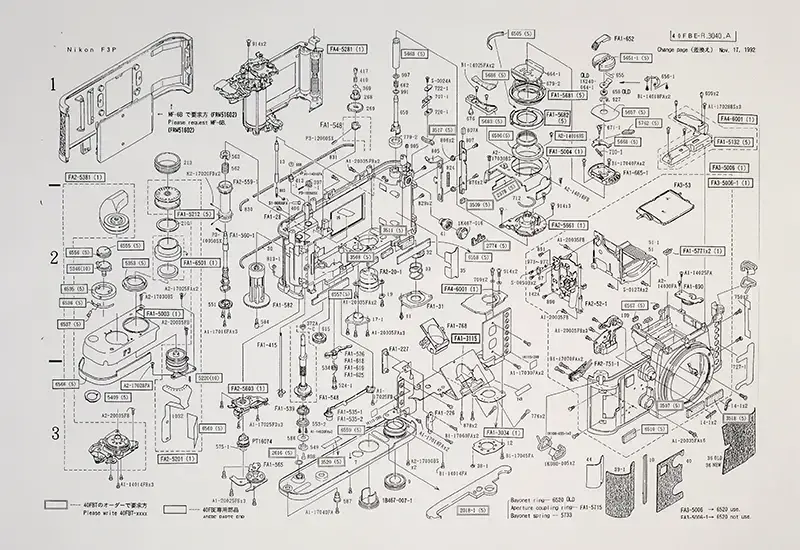
In reality, very few cameras are easy to fix. Fully mechanical cameras are filled with parts, and cameras with electronics are even trickier – i.e. it may be possible to source a donor part, or even 3D print a part, but recreating 50 year-old electronics is another thing altogether. You need the appropriate tools, and access to parts and assembly diagrams, e.g. the Nikon F3-P parts diagram posted on Japan Camera Hunter. The easiest repairs are obviously cosmetic issues – replacement of leatherette, battery covers, etc. or replacing light seals. There is also the issue of cost – fixing a vintage camera can often become expensive, especially as parts often have to be salvaged from a “donor” camera. Even the simplest parts, like springs, can be challenging to find, considering they may be decades old (springs have to be the right size and have the right tension).
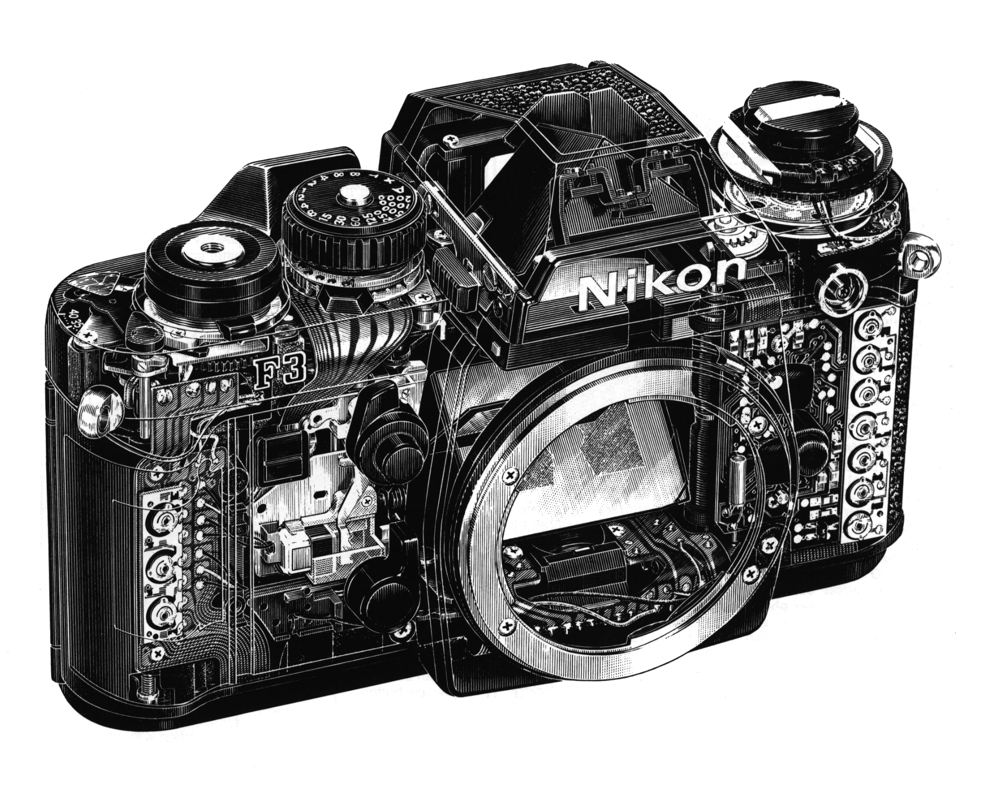
The Nikon F3, with semi-automatic exposure control, was not any less complex than film cameras.

If you are really interested in doing your own internal camera repairs, I suggest reading though the information below. For cameras that are rare, I would recommend having them fixed at an experienced repair facility. In Canada, probably one of the best known camera repair spots is Paramount Camera Repair, in Saskatoon. There is also Factory Cameras in Vancouver.

DIY Camera/Lens Fixing Resources:

Vintage cameras – The mirror returns!

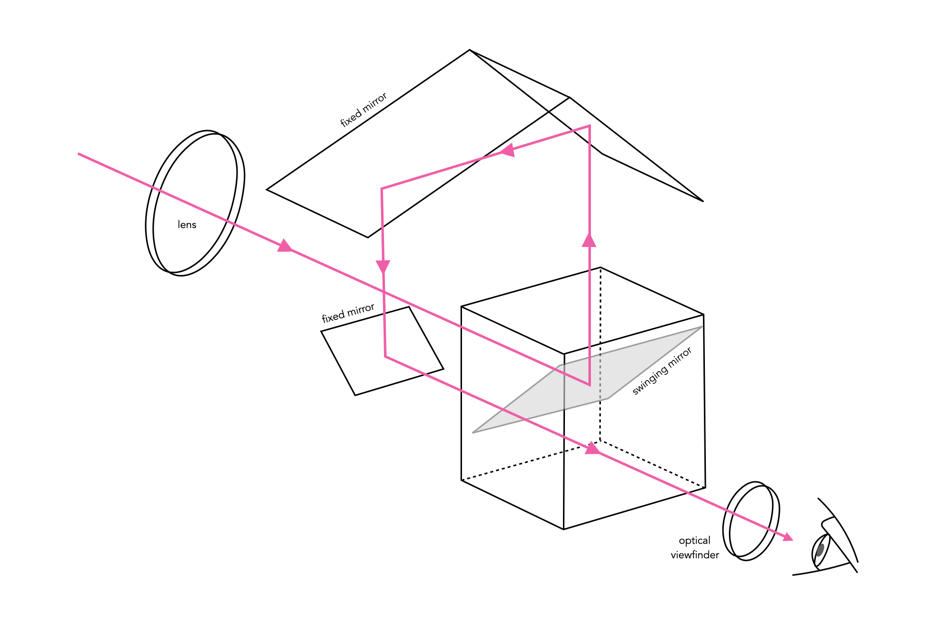
One of the biggest problems with early SLR camera’s was the fact that the mirror did not return to it’s position after the shutter was released, leaving a black void in the viewfinder. To facilitate this one had to wind on the next frame. Consider the pre-WW2 Exakta Kine, a purely waist-level camera. When the shutter release was pressed, spring action caused the mirror to fly upwards just before the shutter travelled. The Contax S used the same system. There were two issues with this: (i) the potential for the mirror action to cause jarring, making sharp images problematic, and (ii) once the shutter-release was pressed, the finder goes black, the the image disappeared (preventing the photographer from seeing the scene at the instant of the exposure, or after it). All this changed with the appearance of the instant return mirror. Many attribute this to the Asahi Asahiflex IIb camera in 1954.

However in reality the instant return mirror was the brainchild of Hungarian inventor and photographer Jenő Dulovits (1903-1972). He patented the worlds first eye-level SLR viewfinder in Hungary on August 23, 1943 [1]. The lead to the first camera sporting this new feature, the Duflex (DUlovits reFLEX). Because at the time the use of a pentaprism was deemed too expensive, the camera used a Porro prism – an arrangement of mirrors that would bring the light beams in through the lens, then reflected via mirrors upwards to meet the eye. Working prototypes were built at Gamma in Budapest in 1944, with the first camera put on the market in 1949 (hence why the camera is known as the Gamma Duflex).

Fig.1: The Duflex mirror system (Porro prism) and the instant return mirror

Production lasted roughly a year with circa 550 units being produced (according to historian Zoltan Fejer – Hungarian Cameras, Budapest 2001). In all likelihood production ceased due to pressure from the Soviets – manufacture of Exaktas, Practicas etc. in East Germany, and Russian Zeniths likely meant that competition from a Hungarian camera maker was not wanted. However this decision likely set back their own camera designs by a decade. However Dulovits invention likely paved the way for future enhancement that would lead to Asahi’s commercially successful cameras, starting with the Asahi Asahiflex IIb. As Bob Schwalberg put it:

“A single-lens reflex innovation deserving special applause is the Asahi Optical Co.’s instant-return mirror, which flips up and out of the way just before exposure, and immediately snaps back to focusing position after the shutter has closed. … By eliminating the characteristic reflex blackout, the doubly-sprung Asahi mirror permits the photographer to continue focusing and/or framing without the interruption of having first to transport the film as in traditional reflex-cameras.”

Bob Schwalberg, “35-mm Today: Onward and Upward! Part II”, 42(2) pp.12 (Feb.1958)

✽ Dulovits camera patents appear on the website of the Hungarian Intellectual Property Office. Outside of Hungary, the only patents available are for his soft effect lenses. The camera actually heralded other firsts, including internal automatic diaphragm control, and a metal focal plane curtain shutter.

Note: The first quick return reflex mirror is sometimes attributed to the KW Praktiflex, which debuted in 1939. However in the Praktiflex the mirror is raised as the shutter release is pressed, and falls back under gravity when the button is released, i.e. not really an instant return mirror, more of a shutter-release-actuated mirror.

Further reading:

  1. Jenő Dulovits, No.167464 (D-5859), “Eye-level SLR camera”, (Aug.23, 1943)

    A new film camera – Is Ricoh bonkers?

    If you haven’t heard the news, Ricoh is considering developing a series of new “Pentax” film cameras, by means of its “Film Camera Project“. Pentax of course has a long and proud history of film camera development, but hasn’t really made huge inroads into the digital world. It was bought by Ricoh in 2011, becoming Ricoh Imaging Company Ltd. Still, the most successful digital camera coming out of the combined company is the Ricoh GR series.The company apparently surveyed 3,000 people in Japan and concluded that 20% of camera owners also owned film cameras. So in all likelihood, I imagine developing a series of film cameras is not a bad idea.

    The trick of course is what route do you take? Do you go for a fully manual camera with no electronics aboard, or do you go with the opposite end of the spectrum and go fully electronic? I mean if you are going to start somewhere, why not reproduce the famed Ricoh GR1? It was introduced in 1996, so there wouldn’t be a huge curve in getting it back into production – update the lens, and the inner workings a bit. A fixed lens is fine – keep it simple, and I imagine there would be a bunch of Ricoh GR digital users that would spring for a film version. Small and compact is ideal.

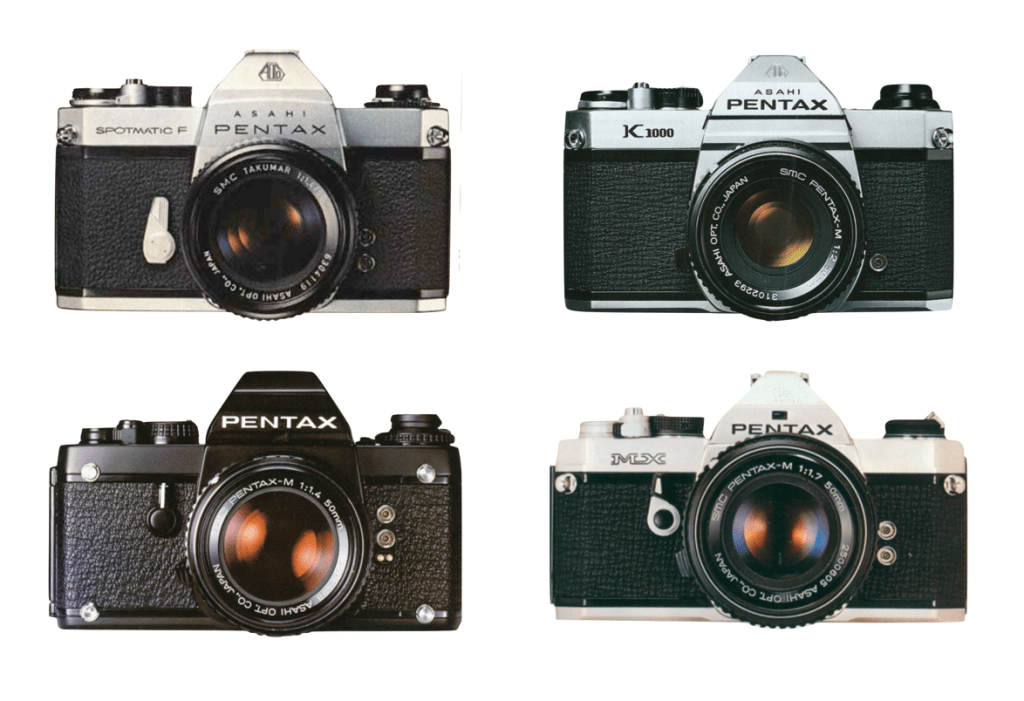
    Or perhaps rejig a Pentax Espio? The reality is that it shouldn’t be too hard to “develop” new cameras. You don’t need to add anything “fancy”, i.e. digital. And picking the best camera to replicate is as easy as determining which vintage cameras sell the best. They could build one from scratch, but would this be worthwhile? Could they replicate some other camera? What about full-frame cameras? Do you go with a Spotmatic type camera for an entry level, fully-manual? Or perhaps the diminutively sized MX series? Do you offer a manual and semi-automatic camera? Then there are the lenses – do you allow the use of vintage M42 mount lenses, or do you conform to the K-mount? Making a film camera without taking into consideration the legacy lenses is problematic. Then of course there are the lenses themselves – new digital-like lenses, or re-manufactured manual legacy lenses.

    Done properly these film cameras could be very successful. Poorly done, and it will be a disaster. The best way to test the market would be simply to reintroduce an existing design like the GR1. But Ricoh needs to look beyond the Japanese market, and explore the needs of film users worldwide. At the same time, introducing a film camera requires some level of sustainability. A camera low in electronics, would of course reduce a camera’s footprint, and perhaps using a rechargeable battery would help as well. Of course there is also the issue of processing films, which does have quite an impact on the environment. One interesting addition to a new camera might be to allow cameras to incorporate both full- and half-frame shots. Allowing a 36-exposure film to take 72 shots certainly reduces the amount of rolls required, as honestly no one should treat film in the same manner as digital, i.e. 1000 frames of film when travelling is not really that realistic.

    Which Pentax?

    Ultimately it’s a very intriguing idea. Will it work? Time will tell I guess. A successful film camera will have to be well-priced for the market – even though Ricoh doesn’t really have any competition to speak of, there are still a *lot* of reasonably priced vintage film cameras around the world. And I’m not talking about Leica film cameras. The remade Leica M6 is likely a wonderful rangefinder camera, but at US$5,295 it’s not exactly affordable. Ricoh has one chance to get this right, and deliver a series of film cameras worthy of its legacy.

    Rear Window – the 400mm lens

    In a previous article, I discussed the Exakta VX camera used in Alfred Hitchcock’s “Rear Window”, suggesting that photojournalists of the period likely didn’t use super-telephoto lenses all that often (or at all). My view on this is based largely on articles I have read in magazines like Popular Photography during the 1950s.

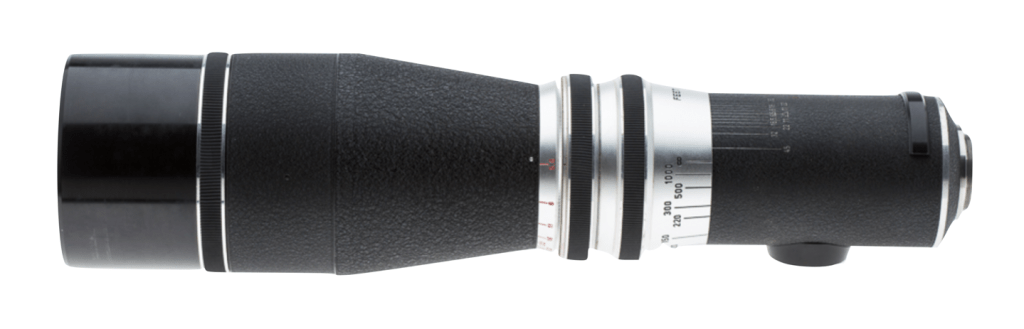
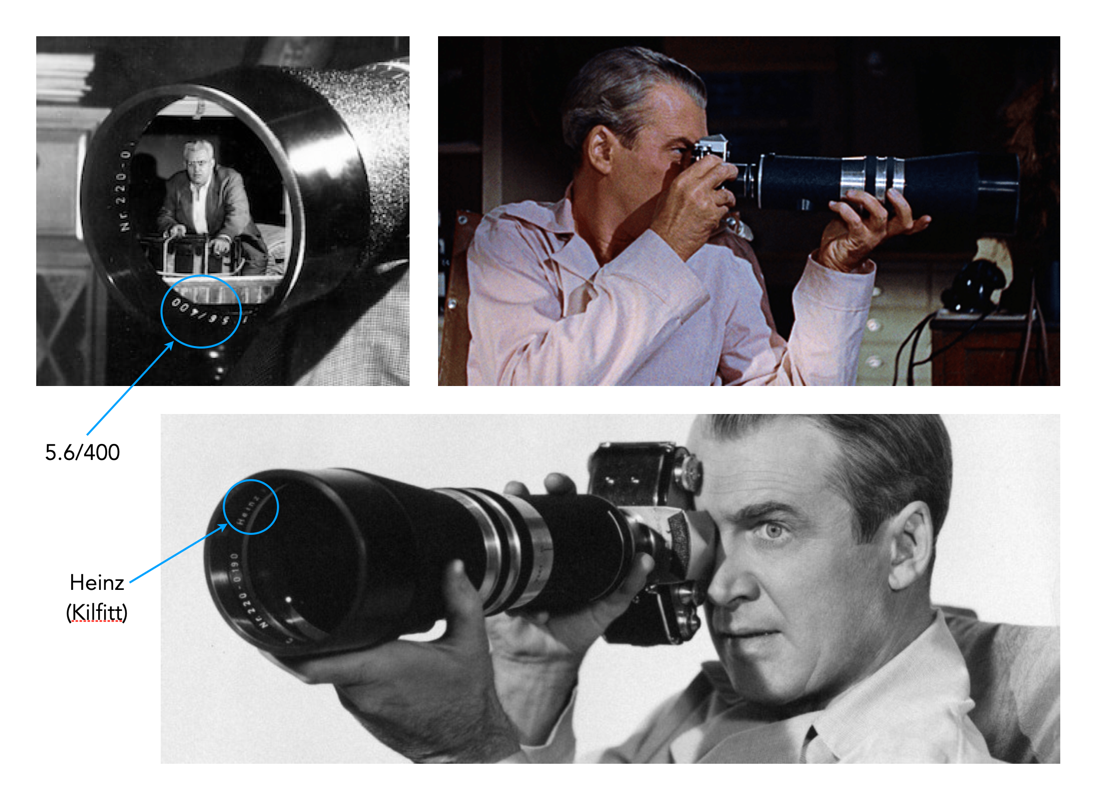
    The telephoto lens used by Jefferies in the movie is the Kilfitt Fern-Kilar f/5.6 400mm lens. The lens fits into the category of super-telephoto lenses with focal lengths in the range of 300-600mm. A number of manufacturers produced these lenses, although in all likelihood they had a narrow market. One of the earliest ads for Kilfitt lenses in Popular Photography appears in 1953, advertising their KILAR lenses for “medium and long tele shots” – it includes the 300mm and 400mm lenses. A review of the ads section of Popular Photography in 1954 reveals that the Kilfitt 400mm was being sold alongside the f/5.5 Hugo Meyer-Goerlitz Tele-Megor (which was the lens promoted by Exakta as well), and the Astro f/5.

    The Kilfitt-Fern-Kilar 400mm f/5.6

    Literature from Heinz Kilfitt Optische Fabrik suggests the lens could be used for “nature and expedition photography“, and also for “special press and feature assignments“. It is then likely that these long lenses were used in situations where a large kit could be carried. Some may argue that Jeff used the lens for sports photography, but that is unlikely, as many photojournalists tended to focus their careers on a particular genre of photography. For example Robert Capa, upon who Jefferies character is loosely based, worked predominantly in war zones: the Spanish Civil War, WWII, Palestine, and the war in Indochina (where he was killed by a landmine). In 1951 Bruce Downes wrote an article in Popular Photography, describing David Douglas Duncan’s photo coverage of the Korean War [2]. He photographed the carnage of war using two Leica IIIc’s, “practical combat cameras” that were “…light, compact and could stand a beating.”. From the perspective of lenses, he used Nikkor lenses: a 50mm f/1.5, a 85mm f/2 and a 135mm f/3.5. No large telephoto lenses in sight.

    A steady telescope

    In addition, even sports-photojournalists did not generally use long-tele lenses. Jesse Alexander (1929-2021), a motor-sports photographer, reportedly did not use long telephotos lenses. At the start of his career in early 1950s (his first photographic assignment was the 1953 La Carrera road race in Mexico), he used a Leica with 35mm and 135mm lenses, and a Rolleiflex for close-ups and portraits. I would suggest that the 400mm lens was either something Jefferies used occasionally, perhaps for some hobby photography, or merely something added to meet the needs of film. The only real evidence of Jefferies taking sports shots is the motor racing shot that ended up with Jefferies stuck in his apartment with a broken leg. The camera used there was a large format camera (most likely a Graflex), as evidenced by the photo hanging on the wall, taken in the middle of the racetrack.

    Identifying the lens

    The biggest elephant in the room with these telephoto lenses is their weight. The f/5.6 400mm lens weighed 62oz, or 1.76kg in weight. The faster Sport-Fern-Kilar f/4 400mm lens was even heavier, at 3.1kg. These lenses were just too heavy for a photojournalist to carry and use effectively in an active situation, e.g. a war zone. Even in everyday settings, the length of the telephoto would require the use of a tripod, otherwise shake will be greatly exaggerated – “A slight jiggle that would not be noticed if the scene were filmed with a standard lens will look like something shot on a pogo stick when you use a long telephoto lens.” [1]. It might be okay to use as a de facto telescope and prop up on your knee.

    The interesting thing about Exakta is that their literature touted the idea of attaching a telephoto lens to a camera and turning it into a telescope – “a telescope that gives you long-range viewing with high magnification“. A 400mm telephoto lens would provide an eight-power photo-telescope.

    NB: Sometimes it is speculated that the lens was actually an Astro-Berlin, a German company that made some pretty cool lenses, especially for the super-super telephoto (we’re talking 2000mm, f/10). These telephotos were often seen on Exakta cameras, hence the association.

    1. Herb A. Lightman, “Choosing and using lenses”, Popular Photography, 35(3), pp.107-117 (1954)
    2. Bruce Downes, “Assignment: Korea”, Popular Photography, 28(3), pp.42-51, March (1951)

    Use of the camera in Hitchcock’s “Rear Window”

    Last week I watched Rear Window, an Alfred Hitchcock directed thriller from 1954 starring James Stewart and Grace Kelly. The story follows photojournalist, L.B. “Jeff” Jefferies, who breaks his leg while shooting an action shot at a car race (supposedly working for LIFE Magazine). Confined to a wheelchair in his New York apartment, he spends time watching the occupants of neighbouring apartments through his apartments rear window, as they go about their daily lives.  He begins to suspect that a man across the courtyard may have murdered his wife. Jeff enlists the help of his high society fashion-consultant girlfriend Lisa Freemont and his visiting nurse Stella to investigate. It’s a great movie from a period when life was likely a little simpler than it is now.

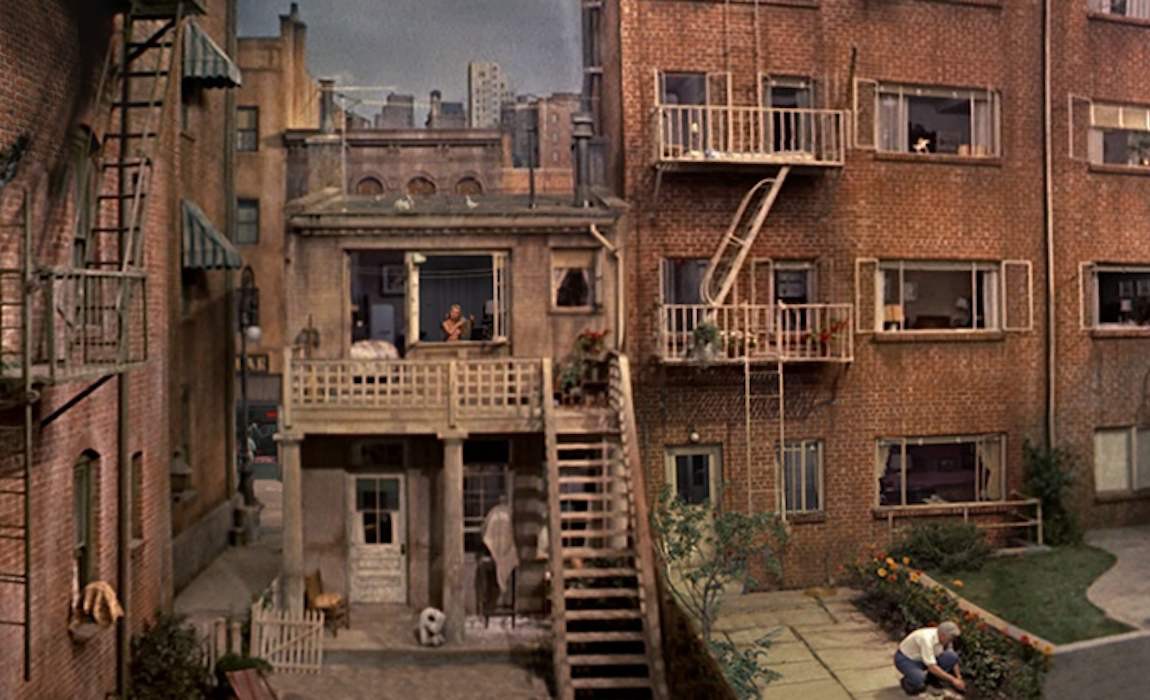
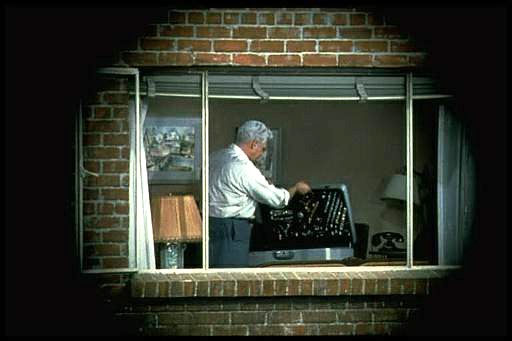
    For the early part of the movie, Jeff is just looking out the window, bored with being confined to his apartment while his cast covered leg recovers. When he deduces something is amiss across the courtyard, he pulls out his camera, with its telephoto lens to view the scene a little closer. The courtyard was supposedly 98′ wide and 185′ in length.

    Part of the courtyard.

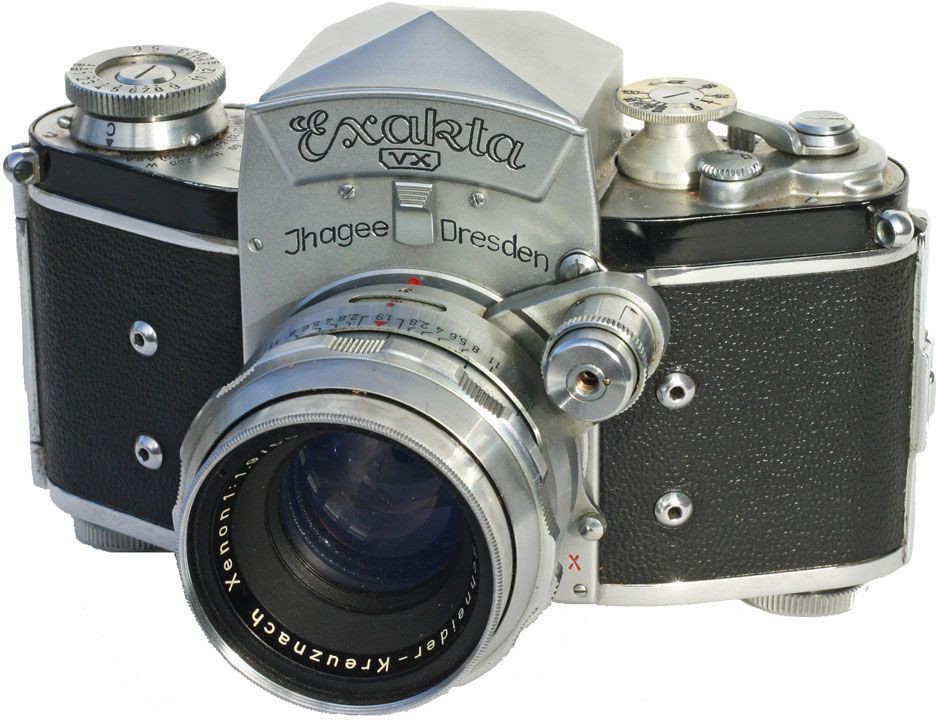
    The 35mm film camera used by Jeff is an Exakta VX Ihagee Dresden, with the Exakta logo covered by a piece of black material in the movie. Why choose the Exakta? In the time the film was shot, there were really only three 35mm camera systems with global recognition: Leica, Contax, and Exakta. Hitchcock could have used a Leica with a reflex housing for the telephoto lens (e.g. Visoflex II), but a solution with a one-eyed reflex with a prism viewfinder was more elegant. Why was the brand covered with black tape? To cover up its East German / Communist origins? This may have played a role, but more likely just an avoidance of advertising in film.

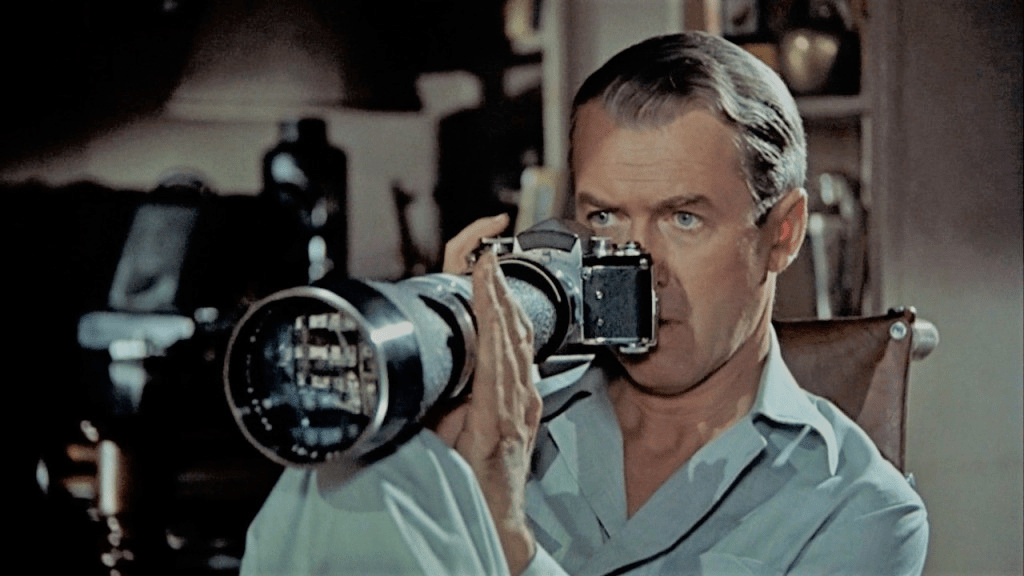
    The Exakta is an interesting choice of camera for the period, made by Ihagee Kamerawerk Steenbergen & Co, Dresden, in former East Germany and was produced between 1951-56. The Exakta is notable as being the first ever Single Lens Reflex (SLR) camera for both 127 roll film (1933), and 135 format 35mm film (1936). It’s not surprising that Jeff was using a Exakta, as before Japanese started to dominate the camera market the Exakta dominated the market, capturing perhaps 95% of SLR sales (they did kind of invent the SLR in 1936). The lens being used on the camera is a Kilfitt Fern-Kilar f/5.6 400mm telephoto lens.

    The Exakta VX

    There are a number of things that are of interest with the use of the camera. I know this is a movie, and the camera was used as a prop, but here goes. Firstly, as a press photographer, it is unlikely he would have used a 400mm lens. Jeff’s character was supposedly based on war photographer Robert Capa, used a Contax II with a 50mm lens. (Ironically Capa was killed covering the First Indochina War in 1954, which is where Jeff’s editor wanted to send him). A 400mm lens would be more useful for a sports photographer shooting field based sports like football (soccer) or a bird watcher. The lens Jefferies uses to take the photograph on the racetrack is clearly a wide-angle (and frankly taken from a very dangerous viewpoint).

    Is Jeff pushing the shutter button?

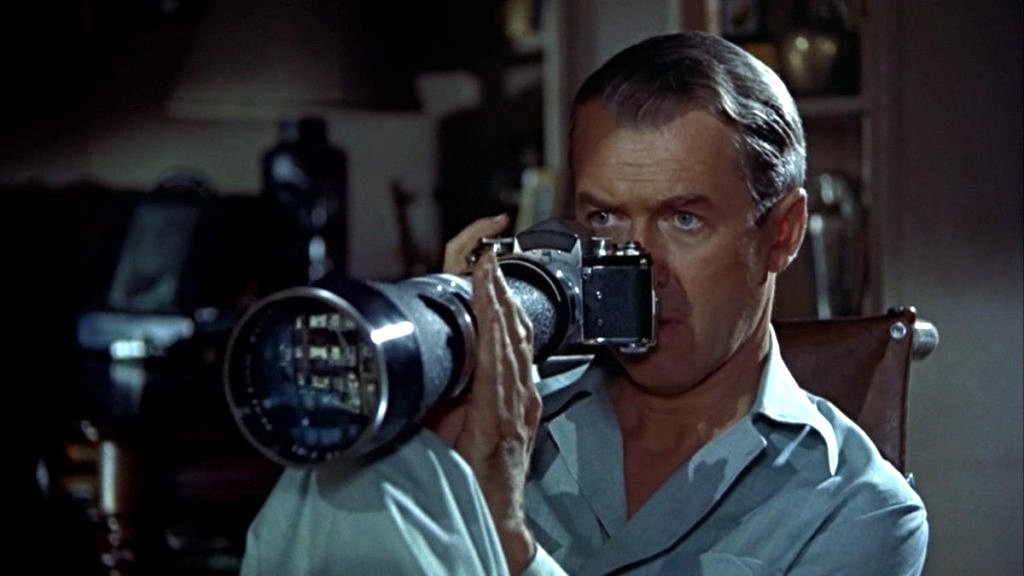
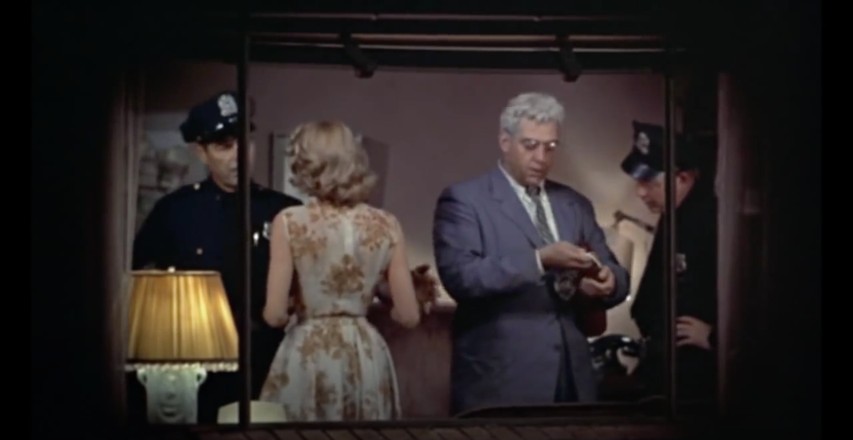
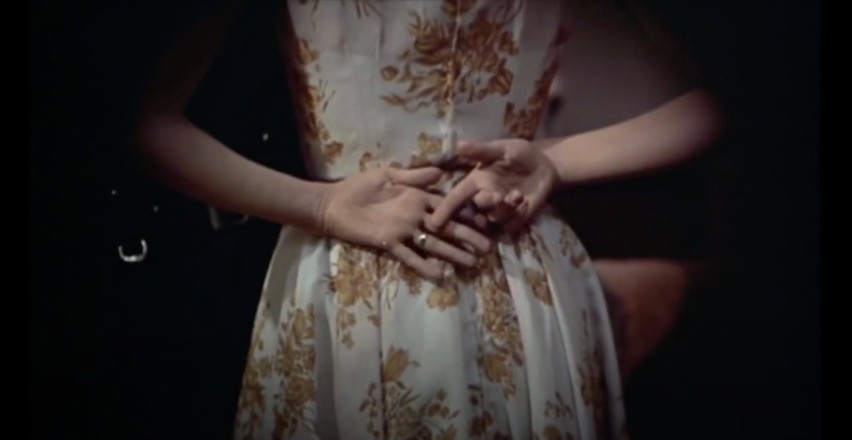
    Next there is the issue of the view through the lens itself, which it seems is solely for cinematic effect. I know from a cinematography point-of-view, Hitchcock was trying to imply that the view was through a camera, showing a circular view, but camera views are rectangular. Next there is the issue of the “focal length” of the lens, which seems to be quite flexible. There are two scenes (shown below) taken seconds apart in Thorwald’s apartment, and viewed through the Kilfitt Fern-Kilar 400mm lens. One shows a close-up of Lisa’s hand behind her back (showing where she has slipped on the victim’s wedding ring). This would mean that the 400mm lens had the ability to zoom, which was not possible (and likely act like a 800-1200mm lens). There is also the issue of light intensity, which doesn’t seem to change, even though it is nighttime. The wonders of artistic license.

    Two shots, seconds apart, taken with the 400mm lens.

    The field-of-view for the 400mm lens is about right for most shots, at 8-9 feet horizontally, and 5-6 feet vertically. At times it looks as though Jeff is taking photos, however the shutter release button is on the photographers left side of the camera, so from this we know he did not take any photographs. In addition, Jeff never actually cocks the shutter, which is a requirement for looking through the viewfinder – the mirror stays up after exposure, so viewfinder is dark, cocking the shutter returns the mirror to normal position (and transports the film to the next exposure).

    Lars Thorwald, shown through the framed camera shot, and approximates the FOV of the lens quite well.

    Which leads us to the issue of photographs. why would a photojournalist, who takes photographs for a living, not take any photographs of things happening across the courtyard? If he would have taken some photographs, then he would of at least had pictures of suspicious behaviour to show his friend Det. Lt. Doyle. But not once did we hear Jeffries depress the shutter button (and you would hear it because it is noisy). He may have taken photographs at other times, but not during the setting in the movie.

    P.S. The lens was manufactured by Heinz Kilfitt Optische Fabrik (1946-64) from Munich (West Germany). Kilfitt was an innovative lens maker, producing the world’s first 35mm macro lens, the Kilfitt 4 cm f/3.5 Makro-Kilar in 1955.

    Further reading:

    Tracking Down and Testing the Camera from ‘Rear Window’ (1954), Thomas Bloomfield (PetaPixel, 2024)