Should you buy a superfast lens?

A superfast lens, is one with a very large aperture, say f/1.2 to f/1.0 (whereas an ultrafast is typically sub-f/1.0). The craze for super-fast lenses began in Japan in the 1950s, with the Zunow 50mm f/1.1 appearing in 1953. There was a lull in the latter decades of the 20th century, but the last ten years has seen a resurgence of these uber-fast f/1.2 and larger aperture lenses. There is always a lot of hype about these lenses – they are expensive, and supposedly offer some sort of nirvanic photographic experience. The question is, should you spend the money to indulge in super-fastness? First let’s look at some aspects of super-fast lenses that make them attractive.

Do you need a superfast lens” ?

The faster the lens is, the more light it lets in

The larger the aperture, the more light that is let into the lens, and in photography, light is good. Moving from a f/1.8 to a f/1.2 lens provides 1.17 stops more light (where one stop doubles the light). For example a 50mm lens with a speed of f/1.8 has an effective aperture of 606mm2. Another 50mm lens with a speed of f/1.2 has an effective aperture of 1363mm2.

If we consider shooting at f/1.8 versus f/1.2, the larger aperture will mean the ability to shoot at faster shutter speeds – if we assume a constant ISO, then increasing the aperture by 1.17 stops means the difference between shooting at 1/500 at f/1.8 and 1/1250 at f/1.2. The second thing is that assuming the shutter speed is fixed, you can shoot at a lower ISO setting – e.g. at a shutter speed of 1/500 it means it means an ISO difference between 400 and 160. However modern sensors work really well at high ISO settings, so perhaps the advantage of a fast lens isn’t as critical?

Faster lenses produce better aesthetics

If it’s one thing that large aperture lenses are good at, it’s aesthetics. This is because the lower the f-number, the shallower the depth of field (DOF). Shallow DOF means a blurrier background, and theoretically better bokeh. However bokeh is a natural phenomena, and relies on the optical nature of the lens, the scene, the type of light, and distance to subject. In addition, a shallow DOF also means less of the image is in focus. It’s a double-edged sword.

Not all that glitters is gold

Of course super-fast lenses are not perfect. They have three things going against them – they are large, heavy, and expensive. They are large and heavy because of the increased amount of glass, and in auto-focus lenses, a larger focusing mechanism is required to deal with the extra glass. I have talked previously about why vintage super-fast lenses were so expensive, and in reality the same basic reasons can be attributed to super-fast digital lenses. For example the Fujifilm XF 50mm f/1.0 R WR lens sells for C$2,000, and is a whopping 845g in weight, almost dwarfing any Fuji camera it is attached to. The other issue with super-fast lenses has always been that they aren’t really that sharp until they are stopped down somewhat. The Fuji 50mm f/1.0 reviews well, but even then some reviewers note that it isn’t that sharp until stopped down to f/2.8 or smaller. But reviews are subjective, and so you really have to test the lens to see if it fits your needs.

Brand or third-party lens?

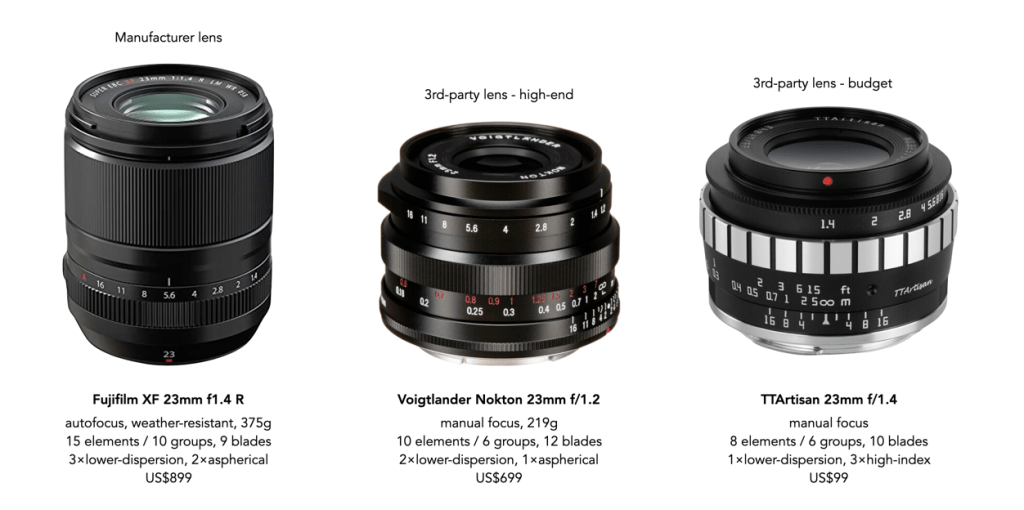
There is also the dilemma of which super/ultra fast lens to buy. There are a lot of 3rd-party lens manufacturers that produce these lenses at a reasonable cost. I mean you can buy the Meike 50mm f/0.95 for about C$400, or the TTArtisan 50mm f/1.2 for about C$140. The Meike actually gets really good reviews. The reality is that 3rd-party lenses offer a good quality for the price, even better than could be found on the vintage market. Of course the Fuji 50mm f/1.0 is in a class of its own, offering autofocus for a f/1.0 (most lenses of this speed are manual focus), and exceptional bokeh.

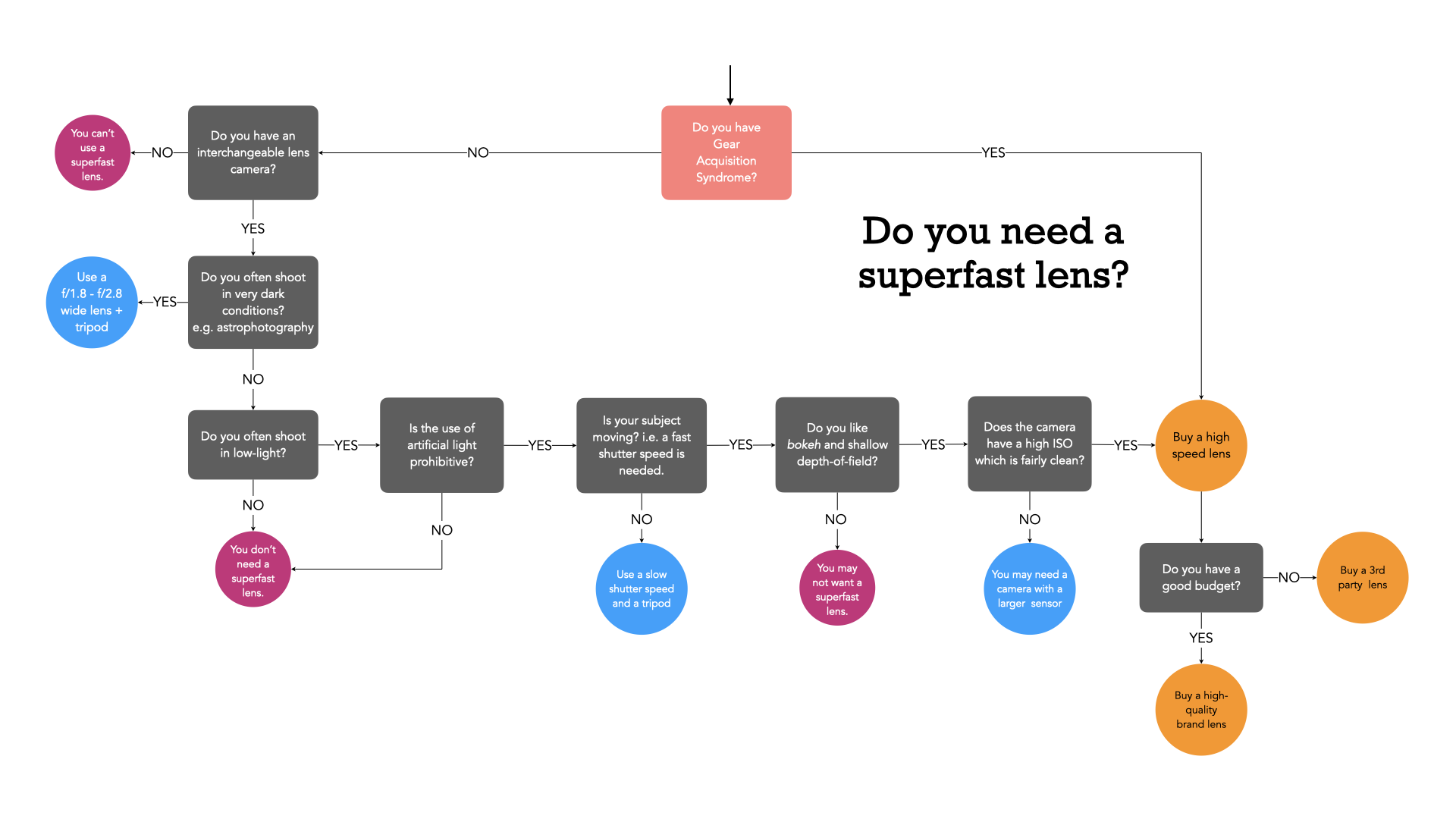
So should you buy a super-fast lens? Well, perhaps it boils down to whether you really need more light? This may mean you shoot a lot in low-light conditions, or in a case of the Fuji 50mm f/1.0, a superlative lens for portraiture. For a further foray into these lenses, check out “Are modern ultrafast lenses useful?“.

✿ The number of stops difference between two apertures A and B can be calculated by first finding C=A/B. The number of stops difference is then log(C)/log(sqrt(2)). So the difference between f/1.8 and f/1.2 is 1.17 stops.

Why are superfast aperture lenses so big?

A 50mm lens is always a 50mm right? They are in terms of focal length, but shouldn’t they all have similar dimensions? So why are lenses with super/ultra-wide apertures sometimes so much larger, and hence so much more expensive?

If there has been one notable change in the evolution of lenses, it has been the gradual move towards larger (faster) apertures. The craze for superfast lenses began in Japan in the 1950s, with Fujinon introducing the first f/1.2 5cm lens in 1954. After the initial fervour, it seems like the need for these lenses with large apertures disappeared, only reappearing in the past decade while at the same time moving into the realm of sub-f/1 ultrafasts. There are many advantages to ultra wide aperture lenses, but basically fast lenses let in a lot of light, and more light is good. The simple reason why bigger aperture equals bigger lens is more often than not to do with the need for more glass. It was no different with historical superfast lenses. The Canon 50mm f/0.95 which debuted in 1961 was 605g.

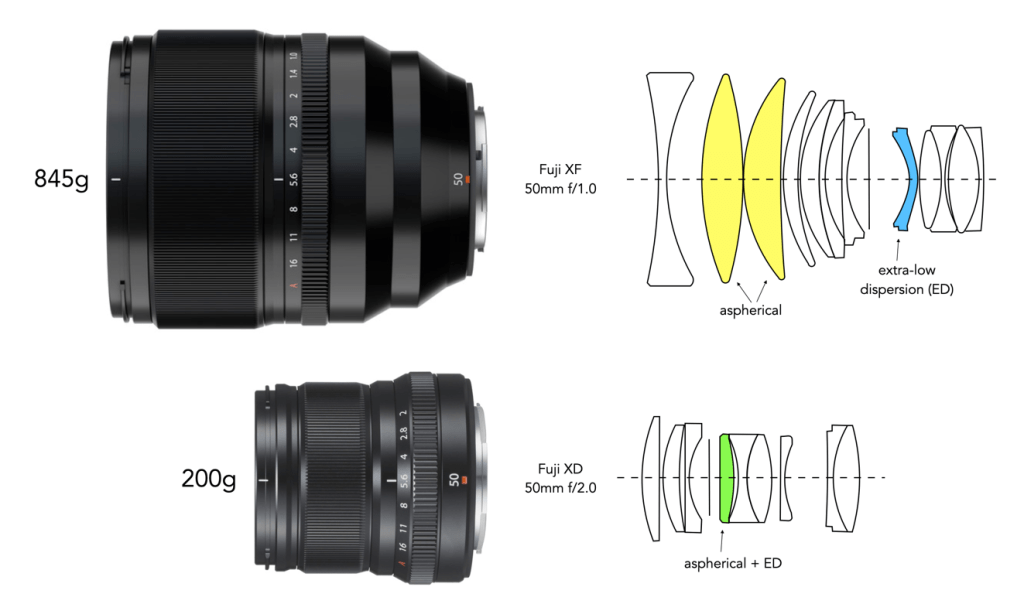
A comparison of the two Fujifilm 50mm lenses – f/1.0 versus f/2.0 showing the physical differences

Lenses are designed with the maximum aperture in mind. For example, a 50mm f/2.8 lens only needs an aperture with a maximum opening of 17.8mm (50/2.8), however a 50mm f/1.4 will need a maximum aperture opening of 35.7mm (note that these apertures are based on the diameter of the entrance pupil). For example consider the following two Fujifilm 50mm lenses – the “average” f/2.0 and the 2-stop faster f/1.0:

  • Fujifilm XF 50mm f/1.0 R WR – 845g, L103.5mm, ⌀87mm, 12/9 elements
  • Fujifilm XD 50mm f/2.0 R WR – 200g, L59mm, ⌀60mm, 9/6 elements

The f/1.0 is over four times as heavy as the f/2.0, and almost double the length. To get an f/2.0 on a 50mm lens you only need a 25mm aperture opening, however with a f/1.0 lens, you theoretically need a 50mm opening (aperture of the entrance pupil). Now some basic math of the surface area (SA) of an aperture circle will provide a SA of 491mm2 for the f/2.0, but a whopping 1963mm2 for the f/1.0, so roughly four times as much area which allows light to pass through fully open. Equating this to glass probably means that at least four times as much glass is needed for some of the elements in the f/1.0 lens. There is no way around this – large apertures need large glass. As the aperture of a lens increases, all of the lenses have to be scaled up to achieve the desired optical outcome.

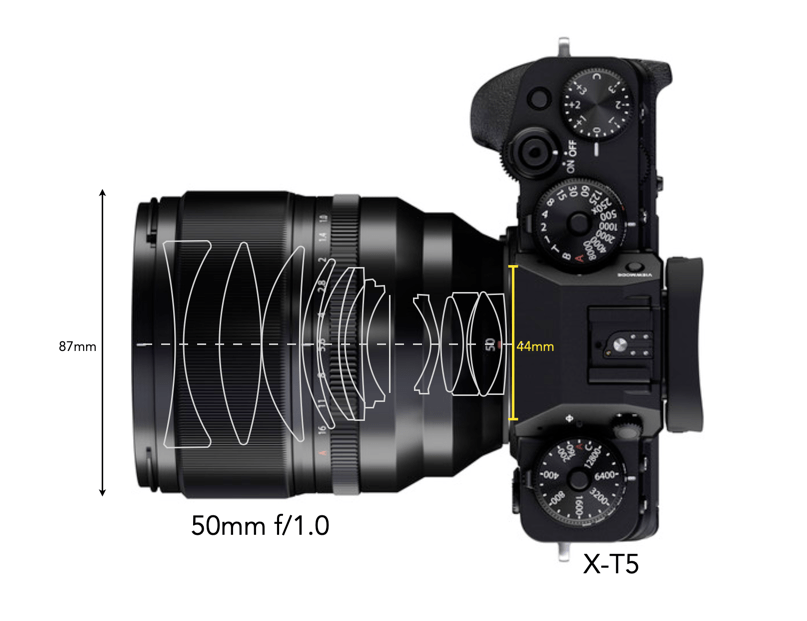
The massive scale of the Fujifilm XF 50mm on a camera (the X-T5). The lens has a diameter of 87mm, and the inner opening of the mount is only 44mm.

Larger aperture lenses also have more specialized glass in them, like with aspheric and low dispersion elements. But companies don’t just add more glass to make money – complex designs are supposed to overcome many of the limitations that are present in ultra-wide aperture lenses. Unlike their historical predecessors, modern superfast lenses have overcome many of the earlier lens deficiencies. For example in vintage superfast lenses, the lens wide-open was never as sharp as could be expected. Newer lens on the other hand are just as sharp wide open as they are stopped down to a smaller aperture.

Now not all super/ultra-wide aperture lenses are heavy and large. There are a number of 3rd-party lenses that are quite the opposite – reasonable size, and not too heavy (and invariably cheaper). But there is no such thing as a free lunch – there is always some sort of trade-off between price, size and optical quality. For example the Meike 50mm f/0.95 is only 420g, and it’s lens configuration is 7 elements in 5 groups. However fully open it is said to exhibit a good amount of chromatic aberration, some barrel distortion, and some vignetting. There is no perfect lens (but the Fuji f/1.0 comes pretty close).

✿ A fast lens is one with a wide maximum aperture. Superfast lenses are typically f/1.0-1.2, and ultrafast lenses are sub-f/1.0.

Further reading:

What’s with all the 3rd party ultra-wide and fisheye lenses?

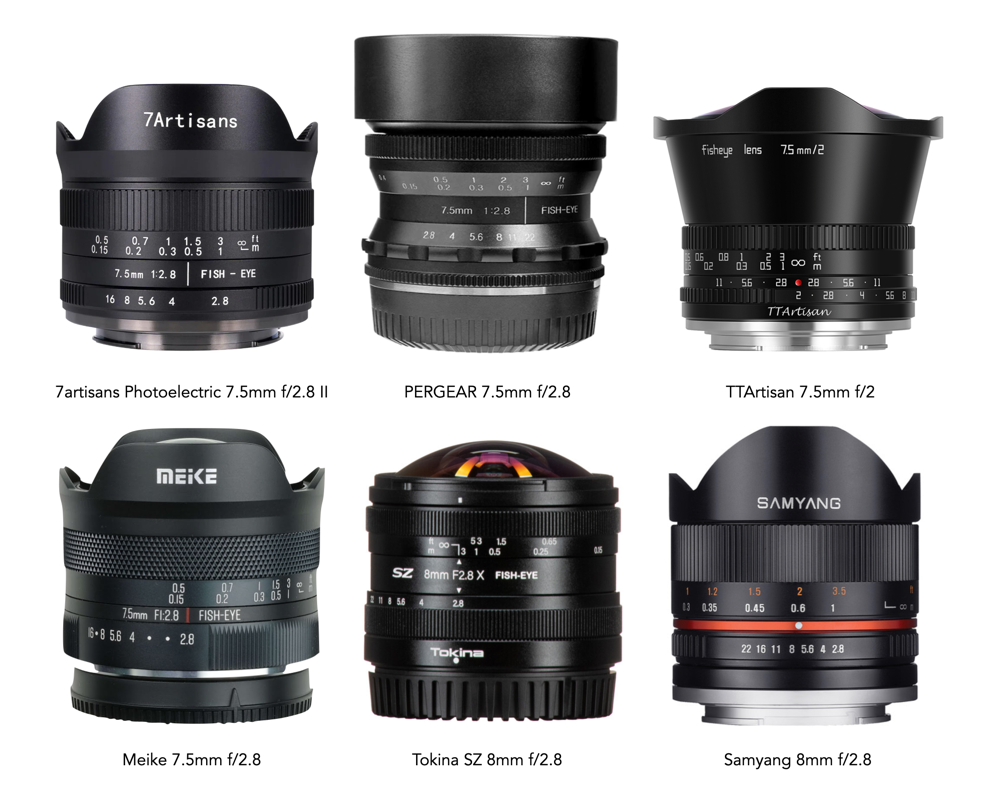
Most large camera manufacturers don’t really make a lot of sub 20mm (FF eq.) lenses. Why? Mostly the cost involved, and likely the lack of sales potential – not many people want to spend a lot of money on a lens that provides a circular fisheye image. I mean these are fun lenses to play with, but in reality aren’t really that practical for everyday use. This may be why 3rd party manufacturers have taken up the mantra, producing low-cost, often reasonable quality sub-20mm lenses. Let’s look at some for Fuji-X.

Let’s divide this into two APS-C categories, the 9-13mm ultra-wide group, and the fisheye group <=8mm. Fisheye lenses can be further categorized into circular and full-frame fisheyes. With regard to focusing MF=manual, AF=auto. Angle-of-view is shown in degrees on the diagonal.

Fisheye lenses: 4-8mm (6-12mm FF)

7artisans Photoelectric 4mm f/2.8 Circular Fisheye (225°) MF US$149
Venus Optics Laowa 4mm f/2.8 Circular Fisheye (210°) MF US$199
Meike MK-6.5mm f/2 Circular Fisheye (190°) MF US$130
7artisans Photoelectric 7.5mm f/2.8 II Fisheye (190°) MF US$139
Pergear 7.5mm f/2.8 (179°) MF US$130
TTArtisan 7.5mm f/2 (190°) MF US$149
Meike 7.5mm f/2.8 Fisheye (180°) MF US$165
Tokina SZ 8mm f/2.8 (180°) MF US$299
Samyang 8mm f/2.8 Fisheye II (180°) MF US$299

Ultra-wide lenses: 9-12mm (13.5-18mm FF)

Venus Optics Laowa 9mm f/2.8 Zero-D (119°) MF US$399
Venus Optics Laowa 10mm f/4 Cookie (109°) MF US$299
Meike 10mm f/2 (107°) MF US$449
ZEISS Touit 12mm f/2.8 (99°) AF US$999
Samyang 12mm f/2.0 NCS CS (99°) MF US$399
7artisans Photoelectric 12mm f/2.8 (102°) MF US$149
Meike MK-12mm f/2.8 (99°) MF US$170
Pergear 12mm f/2 (97°) MF US$160

So which one to choose? It’s really hard to know. It really depends on what you want to do. All these lenses will have some sort of distortion, with the notable exception being the Laowa 9mm, which is described as “Zero-D”. The circular fisheye lenses are nice from an artistic point-of-view, but don’t have that many practical applications (well they are actually used in scientific applications such as assessing forest canopy cover).

Why are these lenses so cheap? Firstly nearly all of the inexpensive lenses, bar the Zeiss 12mm, are manual focus, because obviously incorporating auto-focus mechanisms into any lens is expensive. Another reason may be competition, but it may also be the notion that many of these focal lengths are more for use in an artisanal manner. If these lenses become too expensive, they push themselves out of the market. But inexpensive doesn’t mean a cheap lens. The Laowa 9mm has 15 elements in 10 groups, likely needed to reduce the lenses distortion – so it doesn’t lack good design. Is the Laowa glass inferior to that of Fuji? Possibly, but it’s impossible to tell.

Should you buy an ultra-wide, diagonal fisheye, or even a circular fisheye lens? Well, for the cost involved many of these lenses certainly won’t break the bank, and if you are interested in exploring some artistic photography then it may be a good fit. Which one? Well that’s a bit of a conundrum. Of the six 7.5-8mm lenses, it’s hard to know which is really the best. I would suggest checking out some online reviews, and see what people think of the various lenses.

Are modern ultrafast lenses useful?

Very few high-end camera companies have delved into the sub-f/1.2 genre of lenses, even for digital. The likes of Canon and Nikon have played that game before, in the 1960s, and are too practical to make that mistake again. The only ultrafast lens produced by a camera manufacturer is the Leica Noctilux-M 50mm f/0.95 Asph. Made for digital cameras, it has been in production since 2008. But at US$13K it is hardly a lens for the masses.

“The reason to buy a high-speed lens is to allow shooting in low-light situations or with short shutter speeds. Your photos may not be super-sharp, but at least you get a picture. If you need the high speed, then this f/1.4 lens or an f/1.2 version are the ones to have. However, if you can accept a speed of f/2, which is still plenty fast, then the slower lens is sharper. As an added benefit, the f/2 lens will be less costly than a faster one.”

G.H. Smith, Camera Lenses: From box camera to digital, SPIE (2006)

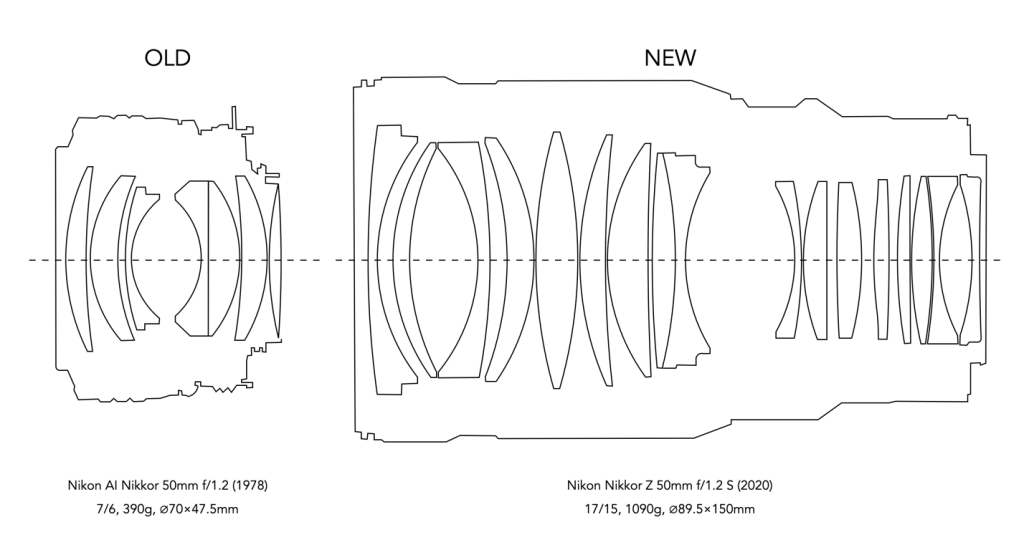
If you compare the inside of a modern digital lens versus its vintage analog compatriot, the first thing you might notice it the extreme complexity found in the modern lens. Consider the two lenses shown below. The Nikon AI Nikkor 50mm f/1.2 hailing from 1978 has 7 elements in 6 groups. Spring forward to 2020, and the Nikon Nikkor X 50mm f/1.2 S has a mind-blowing 17 elements in 15 groups. It’s also almost three times the weight of its predecessor. Is the image better? That is really in the eyes of the beholder.

Of the dedicated, high-end, lens companies only Voigtländer really stands out. They make lenses for a number of varied camera mounts. For Micro-Four Thirds (MFT) they actually offer a range of f/0.95 aspherical lenses, 10.5mm (21mm), 17.5mm (35mm), 25mm (50mm), 42.5mm (85mm), and 60mm (120mm). There is even a faster f/0.8 29mm (58mm) lens. These in reality are made for crop-sensors, with their full-frame equivalents more in the line of f/1.9. If one were to create a MFT equivalent of the Noctilux-M 50mm f/0.95, you would need something along the lines of a f/0.5. There are also third-party companies producing “inexpensive” ultrafast lenses (often by means of innovative lens designs). For example the Venus Optics Laowa, TTArtisan, Mitakon Zhongyi Speedmaster, Meike, 7artisans all have f/0.95 optics in various focal lengths, and sensors sizes. In 2022 TTArtisan introduced an f/0.95 35mm lens for APS-C for US$200.

But I do wonder why there is such interest in f/0.95 lenses? Dreamy bokeh? Why not just make f/1.0 lenses? I mean there isn’t that much difference between f/0.95 and f/1.0 – like 1/7th of a stop. I imagine it’s a marketing spiel, just like I imagine it was for Canon when they introduced their 50mm f/0.95 lens back in 1961. It’s a gimmick in the same way that items that cost $1.99 are perceived as cheaper than those marked $2. Why not go even further? I mean Voigtländer do have their f/0.8 29mm (58mm) super aspherical for MFT, which they toute as a world first (as of 2021), and introduce in their literature as the “conqueror of the night”. It’s not the fastest 35mm lens every made either, that honour goes to the Carl Zeiss Planar 50mm f/0.7.

There are limits to what lens speed will do for photography. An f/0.95 lens already has a very small depth of field, so small it makes it hard to focus. Many of these lenses may not even be that usable fully open, requiring them to be stopped down to f/2 before any semblance of usability is invoked. Sure, great for low-light but how often does anyone need that? Too many people use these lenses just for the bokeh effect, but that’s another story altogether. Somebody must be buying the Leica lens, as they are still making it. Likely more people are buying the cheaper lenses, just to experiment with. Check out this review of the TTArtisan 50mm f/0.95 by Dustin Abbott, who describes one of the pros as being “fun in low light”, and ultimately maybe that’s how we should view these ultrafast lenses, for fun, creative photography.

P.S. I do own a MFT f/0.95, more by happenstance than anything else. A few years back I bought the original Voigtländer 25mm f/0.95 (used, not new) for my Olympus MFT camera. It’s an incredibly solid lens, but it’s shallow DOF does make it tricky to focus.

Which Fuji-X 16mm lens?

The 16mm focal length for Fuji-X is the equivalent of a 24mm full-frame lens (if these things matter to you ). It’s the start of ultra-wide focal lengths, providing wide-wide without those fish-eye effects. It does give a more exaggerated sense of perspective, with subjects close to the camera appearing quite large, and the relative size of more distant subjects reducing with distance. If you are choosing a 16mm lens, what are the options? Well, just a few, two from Fuji, and another two from 3rd party companies. Three of these lenses sit around the same price point, while the fourth is more than double.

This is a good example of why choosing lenses can be tricky. Which one is best? Read any number of reviews, and you will get any number of differing opinions. Is more expensive better? I think it depends largely on what you want to get out of the lens. If this 16mm lens (24mm equivalent) is to be used extensively for travel, then the Fuji 16mm f/2.8 might be one of the best choices – it is compact and super-light (at 40% the weight of its f/1.4 sibling), it is weather-sealed, and inexpensive. It also gets an impressive amount of positive reviews. Its much pricier sibling, the wider aperture f/1.4 is heavier, but with the added bonus of having the closest shooting distance, and better performance in low-light.

Fujifilm 16mm f/1.4
R WR
Fujifilm 16mm f/2.8
R WR
Samyang 16mm f/2
ED AS UMC CS
Sigma 16mm
f/1.4 DC DN
Aperture range1.4 – 162.8 – 222 – 221.4 – 16
Minimum distance15cm17cm20cm25cm
Optical design
elements / groups
13 / 1110 / 813 / 1116 / 13
Lens design
length, ∅
73mm, 73.4mm45.4mm, 60mm115.8mm, 86.11mm92.6mm, 72.2mm
Weight375g155g615g405g
Weather sealingYesYesNodust, splash proof
Focusingautoautomanualauto
Made?JapanJapanSouth KoreaJapan
CostUS$999US$399US$359US$449
A basic comparison of 16mm lenses for Fuji-X

The Sigma 16mm offers the same wide aperture as the Fuji f/1.4, at half the cost. So for the cost-conscious it might be a good choice, but it is 20mm longer, and is built mostly from a Thermally Stable Composite” (TSC) polycarbonate material (both Fuji lenses have metal bodies). It also does not have an aperture ring, so the aperture needs to be controlled by the camera. Neither f/1.4 lens is compact, which makes sense – a larger aperture means more glass, and hence a larger lens. My final choice? The Fujifilm 16mm f/2.8. Why? I doubt I’ll need the speed of the f/1.4, and I like the lens’s light weight, and reasonable minimal distance focusing. And the price is nice.

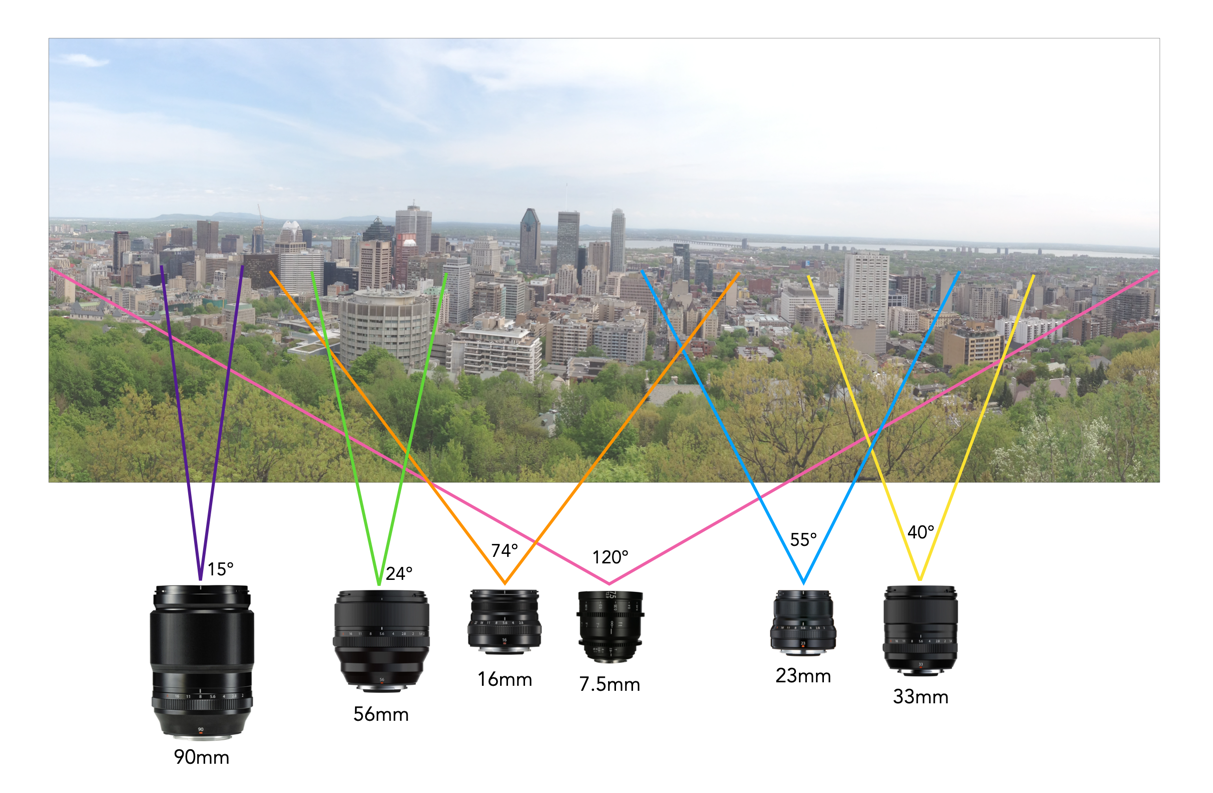
What about 13mm or 14mm lenses? Well, that’s really a personal choice. They are equivalent to 19.5mm and 21mm respectively. It really is a matter of preference. A 13mm will provide 85° (hor) AOV, and the 14mm 81° (hor). If we compare this against the 16mm at 74° (hor) it provides marginally more angle. And there aren’t many options out there. Fujifilm has a 14mm f/2.8 which sells for US$900, and Viltrox has a 13mm f/1.4 for US$459.

Further reading:

Choosing the right digital lens can be challenging

Choosing a digital camera, and a sensor size is one thing, but I think the thing that really stumps people is choosing the most appropriate lenses to use. Of course for the amateur photographer, what the lens will be used for may be the most important consideration. Travel? Landscapes? Street photography? The task is always made easier if there are some constraints on the number of lenses available. For example the range of lenses available for Micro-Four-Thirds, or even Fuji-X cameras has always been a little bit constrained, well until recently with the expansion of 3rd-party lenses.

So how do you choose the right lens? Like vintage lenses, digital lenses are principally chosen based on focal length (which advocates their use), and speed, i.e. aperture size. In addition there is cost, and “extras” such as weather sealing, and stabilization. The problem comes with the variety of lenses available – consider the long list of Fuji-X lenses, many of which are 3rd-party. Which one should you choose? Do you choose a prime or a zoom, a Fujifilm, or a third-party? Do you need an 8mm APS-C lens? Would 13mm be better? What about 16mm? Is manual focus okay, or would you prefer auto-focus? It’s not easy, even with the myriad of videos reviewing lenses.

I’ll concentrate on Fuji-X here, because it’s at the heart of my current lens dilemma (my camera is a Fujifilm X-H1). Now my photography is a mixed bag of street, landscape, architecture and travel. I currently have the 23mm f/2 R WR (which is a FF 35mm equiv.). Now I’m looking to expand, primarily a wide-angle lens. Here are some of the typical focal lengths for Fuji-X (APS-C sensor), and their applications. Measurements in ( ) represent the full-frame equivalences.

  • 50-56mm (75-85mm) – Good for portraiture.
  • 33-35mm (50-53mm) – Good for general photography, portraiture and cityscapes.
  • 23mm (35mm) – The upper end of the wide spectrum, provides more scene than the 33mm, but without the distortion of wider focal lengths. Good for street photography.
  • 18mm (28mm) – The standard choice for landscapes (and sometimes architecture), providing a relatively wide angle of view, without introducing obvious distortions.
  • 14-16mm (21-24mm) – The common lower end of the wide spectrum, good for very broad landscapes. Can include some noticeable perspective distortion, especially if the camera is tilted.

Beyond that we begin to move into the ultra-wide focal lenses, of which there seem to be quite a number. 11-13mm (16-20mm) lenses encompass more of the scene than can be seen with normal vision, so there is an innate sense of exaggerated perspective. Subjects close to the camera appear quite large, with the relative size of more distant subjects reducing quickly with distance. These lenses can be ideal for photography where the distortion does not impact the aesthetics of the image.

Various Fuji (APS-C) lenses and their associated angles of view. (Photo taken from Belvédère Kondiaronk lookout on Mont Royal, Montreal)

In reality, going down this rabbit hole has led me towards the 16mm, and possibly something like a 33-35mm. I have enough vintage lenses to cover the 50mm+ spectrum, and this makes sense as I don’t envision using them that often. And I’m going to stick with prime lenses. Some people really like zoom lenses because of the flexibility they allow, but I find I always seem to stick to one focal length – the 12-40mm on my Olympus camera used when travelling is perpetually set at 12mm (24mm). There are other compromises as well – weight can be an issue, as well as slower apertures.

Choosing a digital lens is challenging, especially for the hobbyist photographer. There are a lot of options, regardless of the sensor. Even Micro Four Thirds also has a long list of lenses. If someone is unsure, then I suggest starting with lenses from the camera manufacturer. As to focal length, choose a lens that provides the most optimal angle-of-view for the application you are most interested in. For example, if you shoot with an APS-C camera, and your focus is street photography, then a 23mm (35mm) lens is the most optimal solution.

What is a “normal” lens anyway?

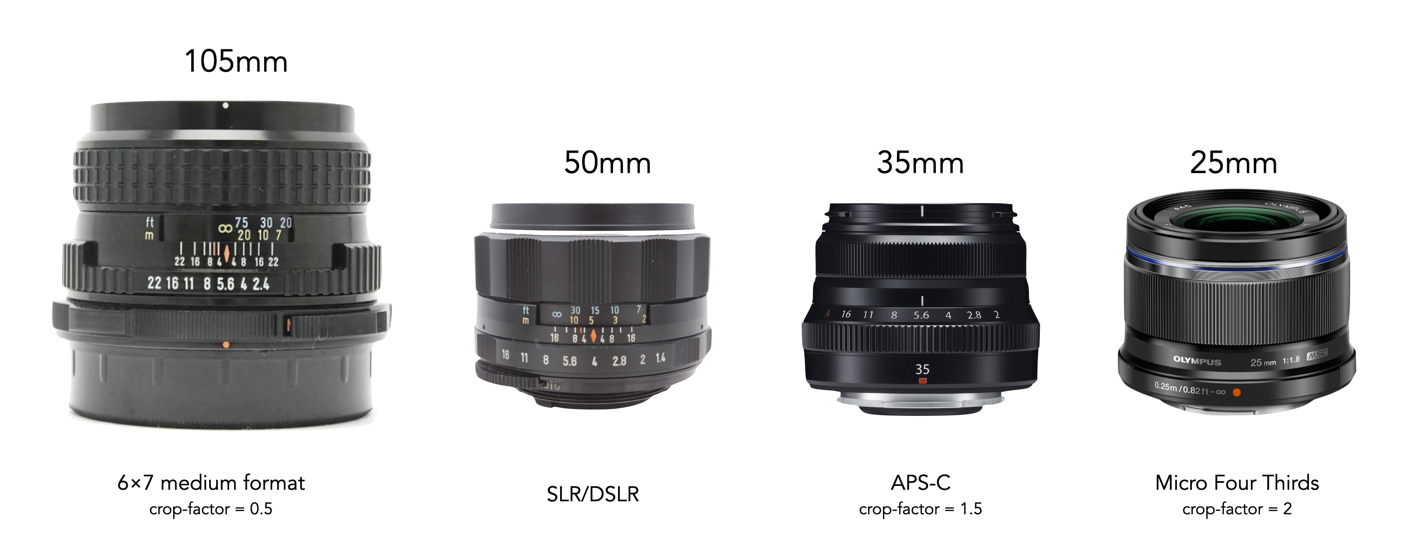
A “normal lens” for a 35mm camera, either film or digital generally refers to a lens with a focal length of 50mm. When you look through the viewfinder of a camera with a 50mm lens attached, the scene looks about the same as it does with the naked eye. Although a 50mm focal length is considered to be a normal lens for a 35mm film or DSLR camera, the same could not be said for all other formats. That’s why you don’t see a lot of 50mm lenses for Micro-Four-Thirds (MFT). A 50mm lens on MFT behaves likes a 100mm full-frame lens, because of the crop-factor, or basically because the sensor size is smaller. Of course “normal” lenses on a 35mm format camera are not exactly pigeonholed into a single focal length, instead they range anywhere from 40mm to 60mm (although this too may differ slightly depends on who describes it).

The standard idea has always been that the focal length of a normal lens should be about the same as that of the diagonal of the film frame/sensor, i.e. the measured distance from one corner of a negative’s frame to the corner diagonally opposite, in millimetres. For example the diagonal of a 36×24mm full-frame is 43mm (although most SLR cameras use a 50mm lanes as “normal”). Even other formats don’t hold true to this mathematical idea. The Olympus PEN F, half-frame camera should have a standard lens of 30mm, however the three lenses offered are instead the 38, 40, and 42mm, equivalent to 55/58/60mm (on a 35mm camera) respectively (there were also 25mm lenses, but they were considered wide angle).

Every different sized sensor has it’s own “normal” lens. Here is a list of normal focal lengths (FL) for various film/sensor sizes (D=digital; F=film), based on commonly used lenses for each system:

FormatDimensions (mm) H×WDiagonal (mm)Normal lens (mm)
16mm cine (F)7.5×10.312.725
Micro-Four-Thirds (D)13×17.321.6325
APS-C (D)15.1×22.727.335
Half-frame 35mm (F)24×183028
APS-C (F)16.7×25.130.128 (+30)
35mm film/DSLR (F,D)24×3643.350 (+55, 58)
Medium (D)33×445565
645 (F)56×4271.875
6×6 (F)56×5679.280
6×7 (F)56×6787.3105
5×4 (F)93×118150.2150