Wes Anderson’s movies are always somewhat surrealistic. In Asteroid City we are taken to a remote one-café desert town in Nevada, in 1955. The town’s claim to fame is that it is built next to a 3000-year-old meteor crater and adjoining space observatory. The movie follows a writer on his world famous fictional play about a grieving father who travels with his tech-obsessed family to Asteroid City to compete in a junior stargazer’s convention, only to have his world view disrupted forever.

The camera is supposedly a Müller Schmid, “Swiss Mountain Camera”. But of course it isn’t. Does the “Swiss Mountain Camera” have some loose nod to the Swiss camera brand ALPA? Does Müller Schmid signify anyone? The closest association I could find is a Joey Schmid-Muller (1950-), a Swiss/Australian surrealist artist. Sure, Anderson could have pulled the name out of thin air, but I highly doubt it.
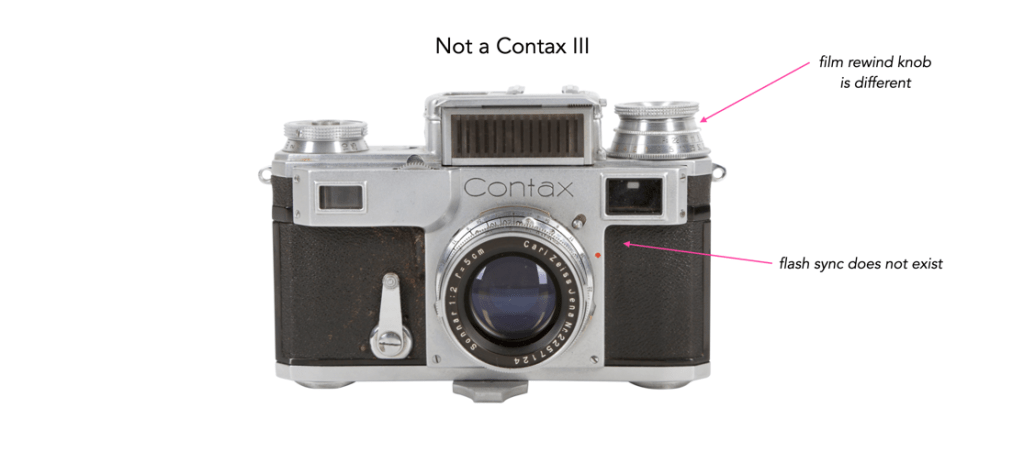
The camera of course may seem familiar to some. It seems like a rangefinder camera that came from Zeiss Ikon – perhaps a Contax? In the 1950s these cameras were produced in West Germany by Zeiss Ikon AG in the form of the Contax IIa and IIIa. Or it could have been a pre-1945 Contax II or III. The Contax III is an obvious contender, because it looks familiar, but there are two issues. Pre-war Contax III’s did not have a flash sync, and the film rewind knob was much taller. So it isn’t a Contax III. Instead we have to look further east, to Ukraine. After WW2, much of the Contax production line was taken as war reparations from the Zeiss-Ikon factories, to the Zavod Arsenal facility in Kiev. Production then started on Contax-döppelganger Kiev brand cameras in 1947 (the early models, Kiev 2, are believed to have been made from original Zeiss Ikon stock).
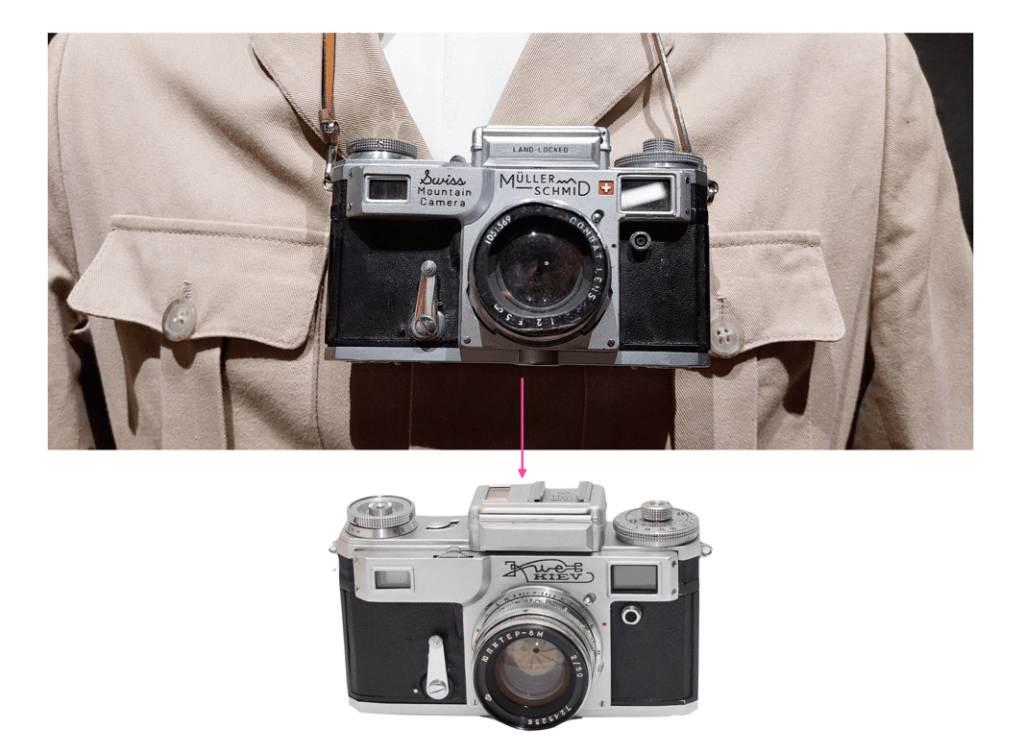
Now the Zavod factory made a bunch of different Kiev cameras, both metered and unmetered. The bump on the top identifies this as a metered Kiev. The most likely candidate is one of the most common Kiev’s, the Kiev-4, produced between 1957-79. All that has been done to this camera to convert it to a Müller Schmid is that three marking plates have been overlaid on the exiting camera – one for “Müller Schmid”, one for “Swiss Mountain Camera” plus a small Swiss flag, and one for “LAND-LOCKED” (is this somehow a nod to the fact that Switzerland is a land-locked country?). They are metal overlays because you can see the open seams in some areas.
What about the lens? It is just marked as “COMBAT LENS”, a 5cm, f/2 lens – again there is no such brand – obviously a node to the fact that Steenbeck is a war photographer. In all likelihood the lens is a Jupiter-8 50mm f/2 lens, which was the standard lens on the Kiev-4 (a copy of the Zeiss Sonnar lens of 1929). Want to buy a Kiev 4? They aren’t that expensive, you can pick one up from between US$100-200, but I would suggest buying one from a reputable source such as Fedka.com.
Further reading
- Kiev-4 : Photo-Analogue (2016)
- Kiev-4 Review : Kosmo Foto (2021)
- Kiev 4 Review – It Bites Back : James Northcote, 35mmc (2019)
- Kiev 4 – The Non-Clone : Photo Thinking (2018)
- The Look of Asteroid City
- Asteroid City behind the scenes: How the world fell under Wes Anderson’s retro-tinted spell : (2023)


 Crafting Pixels