A move back to manual photography

When I was in university I dabbled in some photography. I had two Fuji cameras, I think one was a Fuji STX-2 35mm SLR. I had a couple of standard lenses, and a 300mm telephoto that I found at home and bought an adapter for. I did some nature photography, mostly birds, putting the 300mm to good use. I did some B&W and did some of my own processing (our residence had a darkroom). But I grew tired of lugging photographic gear on trips, and eventually in the late 90’s traded in that gear, and bought a compact 35mm camera. It was just handier. When my wife and I went  to Arizona in 2000, we both took our 35mm compact cameras with us. When we came back from that trip we had 12-15 rolls of film, and at that point I concluded that I was done with analogue film, largely because of the inconvenience, and cost (I think some are still unprocessed!). The next year we bought our first digital camera, a 2MP Olympus. We took it on a trip to Switzerland and Germany, and it was great. I never went back to analogue.

Now, 18 off years later, a change of plan. There seems to be an increasing trend, unlike that of records, towards analogue cameras, and film. To this end, I went and bought an Olympus OM-2 with a 50mm f1.4 lens. It feels *awesome*. Film is readily available, and actually quite inexpensive to process. Don’t get me wrong, I’m not ditching digital, in fact I’m going to use the analogue lens on my Olympus EM-5(II), and maybe even pick up an E-1. But what I long for is the feel and artistic appeal of the analogue camera… not necessarily for travel afar, but for local photography. I long to experiment with a camera that is very simple. I want to teach my daughter (who uses one of those instant Polaroid type cameras), about the true basic art of photography., and explore the inner workings of the analogue system. In part I believe that playing with film will help me better understand the subtle  nuances with taking good photographs, without the aid of extensive digital controls. The need for more control was brought on when I started using the Voigtländer lens on my EM-5, something that required me to manually focus. It’s easy to forget how much tactile knowledge is discarded when we give over to digital control.
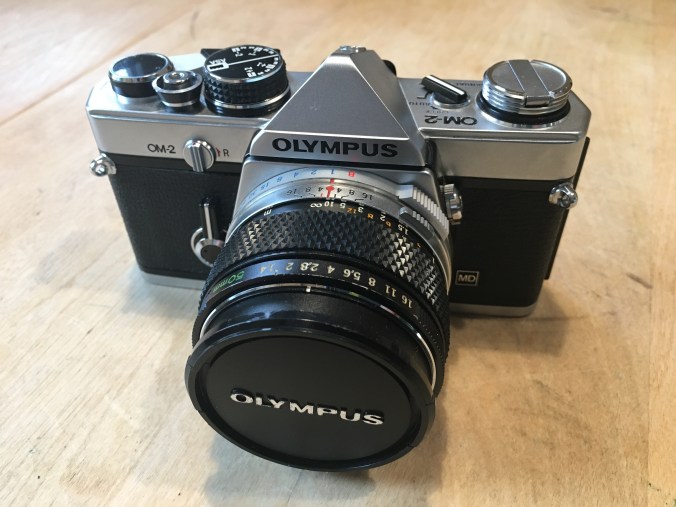
olympus manual camera

Olympus OM-2

The problem with anything digital is that we hand over our innovative processes to the machine… and I’m somewhat over that. I don’t need AI to take the perfect picture, in fact I don’t need the perfect picture. Analog photography was never perfect, but that was its beauty, just as nothing in the world is completely perfect, and maybe we should stop trying to manipulate it so that it is.

P.S. If you’re looking for a manual camera in the GTA, try F-STOP Photo Accessories, in downtown TO. That’s where I bought this camera. It’s a small shop, but they have an amazing selection of manual cameras, at *exceptional* prices.
Should a camera think?

Photographer Arnold Newman  (1918-2006) once said “The camera is a mirror with a memory, but it cannot think.”.  Has anything really changed since analog cameras evolved into digital ones? Do cameras take better pictures, or do they just take better “quality” pictures because certain tasks, e.g. exposure, have been automated? Digital cameras automatically focus a scene, and do just about everything else necessary to automate the process (except pick the scene). They perform facial recognition, and the newer ones even have types of machine learning that do various things – most likely make the task of photography even “easier”. But what’s the point? Part of the reason for taking a photograph is the experience involved. Playing with the settings, maybe focusing the lens manually – all this gives a better insight in the process of taking a photograph. Otherwise it becomes just another automated phenomena in our lives – which is *ok* for takings snaps on mobile devices I guess… but not on cameras.

What is the focal length of the human eye?

It’s funny the associations people make between cameras and the human eye. Megapixels is one, but focal length is another. It probably stems from the notion that a full-frame 50mm focal length is as close as a camera gets to human vision (well not quite). While resolution has to do with the “the number of pixels”, and “the acuity of those pixels”, i.e. how the retina works, the focal length has to do with other components of the eye. Now search the web and you will find a whole bunch of different numbers when it comes to the focal length of the eye, in fact there are a number of definitions based on the optical system.

Now the anatomy of the eye has a role to play in defining the focal length. A camera lens is composed of a series of lens elements separated by air. The eye, conversely, is composed of two lenses separated by fluids. In the front of the eye is a tough, transparent layer called the cornea, which can be considered a fixed lens. Behind the cornea is a fluid known as the aqueous humor, filling the space between the cornea and lens. The lens is transparent, like the cornea, but it can be reshaped to allow focusing of objects are differing distances (the process of changing the shape of the lens is called accommodation,and is mediated by the ciliary muscles). From the lens, light travels through another larger layer of fluid known as the vitreous humor on its way to the retina.

When the ciliary muscles are relaxed, the focal length of the lens is at its maximum, and objects at a distance are in focus. When the ciliary muscles contract, the lens assumes a more convex shape, and the focal length of the lens is shortened to bring closer objects into focus. These two limits are called the far-point and near-point respectively. 

Given this, there seem to be two ways people measure the focal length: (i) diopter, or (ii) optics based.

Focal length based on diopter

To understand diopter-based focal length of the eye, we have to understand Diopter, or the strength (refractive power) of a lens. It is calculated as the reciprocal of the focal length in metres. The refractive power of a lens is the ability of a material to bend light. A 1-diopter lens will bring a parallel beam to a focus at 1 metre. So the calculation is:

Diopter = 1 / (focal length in metres)

The average human eye functions in such a way that for a parallel beam of light coming from a distant object to be brought into focus, on the retina, the eye must have an optical power of about 59-60 diopters. In the compound lens of the human eye, about 40 diopters comes from the front surface of the cornea, the rest from the variable focus (crystalline) lens. Using this information we can calculate the focal length of human eye, as 1/Diopter, which means 1/59=16.9 and 1/60 = 16.66, or roughly 17mm.

Focal length based OPTICS

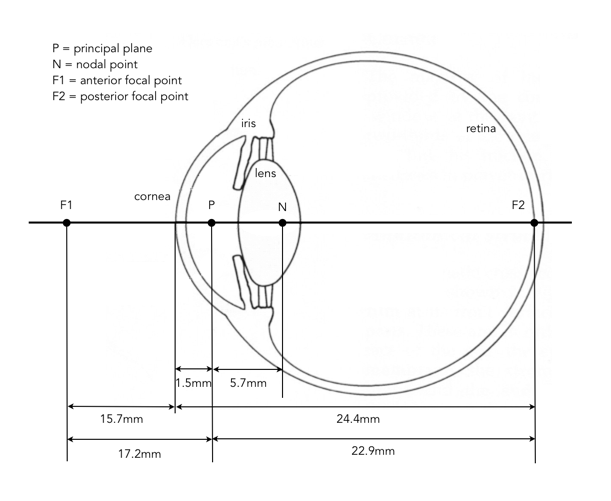
From the viewpoint of physical eye there are a number of distances to consider. If we consider the reduced eye, with a single principal plane, and nodal point. The principal plane is 1.5mm behind the anterior surface of the cornea, and a nodal point 7.2mm behind the anterior surface of the cornea. This gives an anterior focal length of 17.2mm measured from the single principal plane to the anterior focal point (F1), 15.7mm in front of the anterior surface of the cornea. The posterior focal length of 22.9mm is measured from the same plane to the posterior focal point (F2) on the retina. 

The problem with some calculations is that they fail to take into account the fluid-filled properties of the eye. Now calculate the Dioptric power of both focal lengths, using the refractive index of vitreous humour = 1.337 for the calculation of the posterior focal length :

diopter, anterior focal length = 1000/17.2 = 58.14
diopter, posterior focal length = (1000 * 1.337)/22.9 = 58.38

what about aperture?

What does this allow us to do? Calculate the aperture range of the human eye. If we assume the iris diameters are 2-8mm, and use both 17mm and 22.9mm we get the following aperture ranges:

17mm : f2.1 – f8.5
22.9mm : f2.9 – f11.5

Does any of this really matter? Only if we were making a comparison to the “normal” lens found on a camera – the 50mm. We’ll continue this in a future post.

Resolution of the human eye (iii) – things that affect visual acuity

So now we have looked at the number of overall pixels, and the acuity of pixels throughout that region. If you have read the last two posts, you, like me, might surmise that there is no possibility of associating a value with the resolution of the eye. And you would probably be right, because on top of everything else there are a number of factors which affect visual acuity.

  1. Refractive errors – Causes defocus at the retina, blurring out fine detail and sharp edges. A good example is myopia (short-sightedness).
  2. Size of pupil – Pupils act like camera apertures, allowing light into the eye. Large pupils allow more light in, possibly affecting resolution by aberrations in the eye.
  3. Illumination of the background – Less light means a lower visual acuity. As cones are the acuity masters, low light reduces their capabilities.
  4. Area of retina stimulated – Visual acuity is greatest in the fovea. At 2.5 degrees from the point the eyes are fixated upon, there is approximately a 50% loss in visual acuity.
  5. Eye movement – The eyes move, like all the time (e.g. your head doesn’t move when reading a book).

Complicated right? So what is the answer? We have looked at how non-uniform acuity may affect the resolution of the human eye. The last piece of the puzzle (maybe?) in trying to approximate the resolution of the human eye is the shape of our visual scope. When we view something, what is the “shape of the picture” being created. On a digital camera it is a rectangle. Not so with the human visual system. Because of the non-uniformity of acuity, the shape of the region being “captured” really depends on the application. If you are viewing a landscape vista, you are looking at an overall scene, whereas reading a book, the “capture area” is quite narrow (although the overall shape of information being input is the same, peripheral areas are seemingly ignored, because the fovea is concentrating on processing the words being read). To provide a sense of the visual field of binocular vision, here is an image from a 1964 NASA report, Bioastronautics Data Book:

This diagram shows the normal field of view of a pair of human eyes. The central white portion represents the region seen by both eyes. The dashed portions, right and left, represent the regions seen by the right and left eyes, respectively. The cut-off by the brows, cheeks, and nose is shown by the black area. Head and eyes are motionless in this case. Not quite, but almost an ellipse. But you can see how this complicates things even further when trying to approximate resolution. Instead of a rectangular field-of-view of 135°×190°, assume the shape of an ellipse, which gives (95*67.5)*π = 20145, which converts to 72.5 megapixels for 1 arc minute sized pixels – which is marginally lower than the 75 megapixels of the bounding rectangle.

So what’s the answer? What *is* the resolution of the human eye? If you wanted a number to represent the eyes pixelation, I would verge on the conservative side, and give the resolution of the eye a relatively low number, and by this I mean using the 1 arc minute acuity value, and estimating the “resolution” of the human visual system at somewhere around 100 megapixels. This likely factors in some sort of compromise for the region of the fovea with high acuity, and the remainder of the field of view with low resolution. It may also take into account the fact that the human vision system operates more like streaming video than it does a photograph. Can the eye be compared to a camera? No, it’s far too complicated trying to decipher a quantitative value for an organic structure comprised 80% gelatinous tissue.

Maybe some mysteries of the world should remain just that.

Why the camera lies…

‘The old saying “The camera cannot lie”, is wrong of course. Photography is not objective. Firstly, every photograph is an abstract, a transformation of colour values into the grey-scale. already here there are endless possibilities of subjective representation. Secondly, only a small tone-scale is at our disposal in which to express the infinite wealth of tone values which we find in nature, from gleaming white down to the deepest black; it comprises only the thousandth even ten-thousandth, part of the original tone-scale. Thus we have not only to find an analogy to colour, we have also to transpose the entire graduation of light intensity. Thus consideration of style, of composition, play an important role in “objective” photography in addition to technical considerations, and, most of all, the personal conception of nature and ability to re-create. The photographic problem goes, therefore, much deeper than the mere depiction of something seen in the world of phenomena.’

Helmut Gernsheim in New Photo Vision, Fountain Press, 1942.

Why are lenses round, and photos rectangular?

Have you ever wondered why lenses are round, and photographs rectilinear? Obviously square lenses would not work, but why not round photographs? Well, lenses do indeed produce a circular image, however the quality of this image with respect to sharpness and brightness is not at all uniform. It is sharpest and brightest near the centre of the lens, becoming progressively less sharp and bright towards the outer edge of the circle. This deterioration is due to factors such as lens aberrations which become more pronounced towards the edges of the image. In terms of the photograph, only the inner, portion of the circular image should be used, hence why photographs are rectangular, or historically more square (before 35mm film).

Basically for lenses on a particular sensor, the diameter of the circle has to be larger than the diagonal of the frame. The example below shows a Full Frame 24mm×36mm sensor and its associated image circle with a diameter of 43.27mm.

This basically means that the image sensor only makes use of roughly 59% of the image circle (the sensor is 864mm², the image circle 1470mm²). Using a circular fisheye lens, or one that is smaller than the sensor, will result in a circular image. For example, using a small 16mm cinematographic lens on a full frame sensor.

In some cases, such in the case of the Leica D-LUX 6, the camera allows swapping between a bunch of aspect ratios: 16:9, 4:3, 3:2, and 1:1. This camera has a 1/1.7″ sensor (crop factor of 4.6). The actual sensor size is 3678 x 2745 pixels.

The camera does lie – a paradox of sorts

The greatest misconception about photography is that the camera is “all seeing”. But as we previously explored the camera does lie. The majority of photographs are lies because they don’t have any basis in fact. First and foremost, photographs are 2D representations of 3D scenes, so do not capture the world as it truly is. Black and white photographs are monochromatic representations of a coloured reality, and “frozen” stills represent moving objects. Yet every photograph is a true rendition of a subject/object/scene at one particular moment in time. This is something of a paradox – everything visible in the cameras field of view is authentic, but it lacks the intricate qualities of the real scene. You can take a picture of a sunrise on a beach, but there will be missing the factors that make it a memorable scene – the wind blowing (sure video can capture this), the smell of the sea, the warmth of the first rays of the sun, the feel of the sand on the beach. The camera then produces a lie, in so much as it only tells a portion of a story, or distorts it in some manner.  A difference exists between a photograph, and the subject/scene it depicts. It is a snapshot in time, nothing more.

Conversely, the camera allows us to capture things the human eye cannot perceive. It allows differences in viewing angles – a fisheye lens can see 180° in extremes, and although the human eyes can perceive 120° individually, dual eye overlap is only about 120°, and of that the central angle of view is only about 40-60°. Our peripheral vision is only good enough for sensing motion, and huge objects. Camera’s are also capable of stopping motion – human eyes can’t, we have no ability to slow down a video, or “freeze” motion. Therefore the cameras ability to lie can be beneficial, producing images that are more effectual than the actual experience.

Examples include far-away scenes that the human eye is incapable of perceiving, yet a telephoto lens can show quite distinctly. Another is high speed photography of an egg being dropped on a hard surface, where each frame represents milliseconds in time, yet clearly depicts each facet of the egg hitting the surface with clarity the human eye is incapable of. Or, an image where blur and unsharpness (or bokeh), have been used with great effect to isolate a quality of a particular subject/object (human eyes don’t actively perceive the unsharp regions of our vision). In all these cases the subject/object is shown in a way different to how the eye would perceive them, and in many cases the photograph contains information that is lost to the human eye. Of course a photograph can also hide information. A photograph of a small village in a valley may veil the fact that a large expressway lies behind the photographer – the viewer of the photograph sees only a secluded village.

For good or bad, cameras do lie.

The camera does not lie

There is an old phrase, “the camera does not lie“, which can be interpreted as both true and false. In historic photos where there was little done in the way of manipulation, the photograph often did hold the truth of what appeared in the scene. In modern photographs that are “enhanced” this is often not the case. But there is another perspective. The phrase is true because the camera objectively captures everything in the scene within its field of view. But it is also false, because the human eye, is not all seeing, perceiving the world in a highly subjective manner – focusing on the object (or person) of interest. Most photographs tend to contain far too much information, visual “flotsam” that is selectively discarded by the human visual system. The rendition of colours can also appear “unnatural” in photographs because of issues with white balance, film types (in analog cameras), and sensors (digital cameras). 

What the human eye sees (left) versus the camera (right)

A good example of how the human eye and camera lens perceive things differently is shown in the two photos above. The photograph on the right contains photographic perspective distortion (keystoning), where the tall buildings tend to “fall” or “lean” within the picture. The human eye (simulated on the left) on the other hand, corrects for this issue, and so does not perceive it.  To photograph a tall building, the camera is often tilted upward, and in position the vertical lines of the building converge toward the top of the picture. The convergence of vertical lines is a natural manifestation of perspective which we find acceptable in the horizontal plane (e.g. the convergence of railway tracks in the distance), but which seems unnatural in the vertical plane.

There are many other factors that influence the outcome of a picture. Some are associated with the physical abilities of a camera and its associated lenses, others the environment. For example the colour of ambient light (e.g. a colour cast created by the sun setting), perspective (the wider a lens the more distortion introduced), or contrast (e.g. B&W images becoming “flat”). While the camera does not lie, it rarely exactly reproduces the world as we see it. Or maybe we don’t perceive the world around us as it truly is.

Resolution of the human eye (ii) – visual acuity

In the previous post, from a pure pixel viewpoint, we got a mixed bag of numbers to represent the human eye in terms of megapixels. One of the caveats was that not all pixels are created equal. A sensor in a camera has a certain resolution, and each pixel has the same visual acuity – whether a pixel becomes sharp or blurry is dependent on characteristics such as the lens, and depth-of-field. The human eye does not have a uniform acuity.

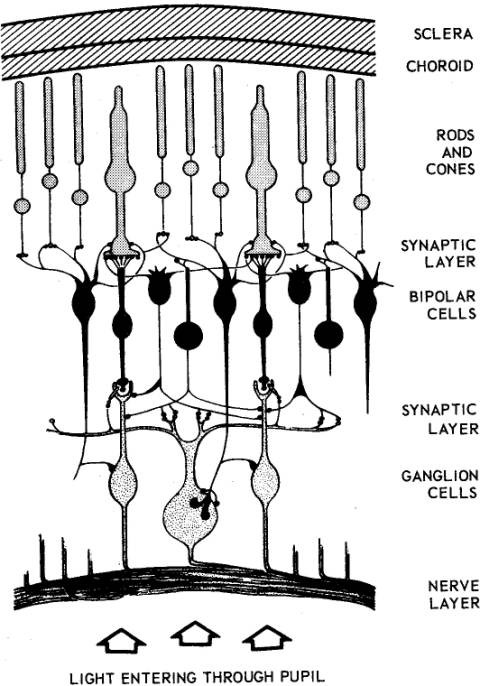
But resolution is about more than just how many pixels – it is about determining fine details. As noted in the last post, the information from the rods in coupled together, whereas the information from each cone has a direct link to the ganglion cells. Cones are therefore extremely important in vision, because without them we would view everything as we do in our peripheral vision, oh and without colour (people who can’t see colour have a condition called achromatopsia).

Layers of the Retina

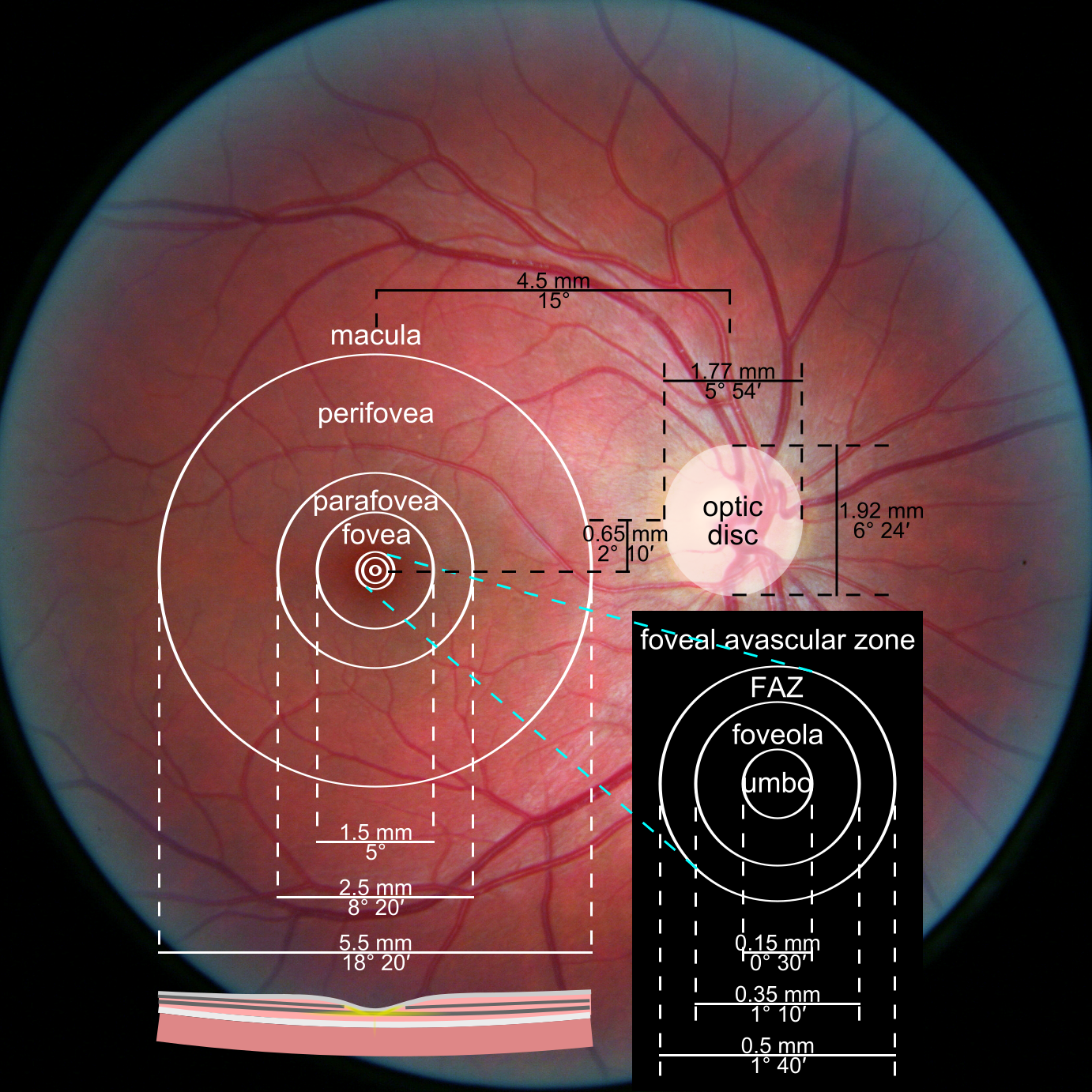
Cones are however, not uniformly distributed throughout the retina – they are packed more tightly in the centre of the eyes visual field, in a place known as the fovea. So how does this effect the resolution of the eye? The fovea (which means pit), or fovea centralis, is located in the centre of a region known as the macula lutea, a small oval region located exactly in the centre of the posterior portion of the retina. The macula lutea is 4.5-5.5mm in diameter, and the fovea lies directly in the centre. The arrangement of these components of the retina is shown below.

Components of the retina.
Photograph: Danny Hope from Brighton & Hove, UKDiagram: User:Zyxwv99 [CC BY 2.0 (https://creativecommons.org/licenses/by/2.0)%5D

The fovea has a diameter of 1.5mm (although it varies slightly based on the study), and a field of view of approximately 5°. Therefore the fovea has an area of approximately 1.77mm². The fovea has roughly 158,000 cones per mm ² (see note). The density in the remainder of the retina is 9,000 cones per mm². So, the resolution of the human eye is much greater in the centre, than on the periphery. This high density of cones is achieved by decreasing the diameter of the cone outer segments such that foveal cones resemble rods in their appearance. The increased density of cones in the fovea is accompanied by a decrease in the density of rods. Within the fovea is a region called the foveola which has a diameter of about 0.3mm, and a field of view of 1° – this region contains only cones. The figure below (from 1935) shows the density of rods and cones in the retina.

Density of rods and cones in the retina.
Adapted from Osterberg, G., “Topography of the layer of rods and cones in the retina”, Acta Opthalmologica, 6, pp.1-103 (1935).

The fovea has the highest visual acuity in the eye. Why? One reason may be the concentration of colour-sensitive cones. Most photoreceptors in the retina are located behind retinal blood vessels and cells which absorb light before it reaches the photoreceptor cells. The fovea lacks the supporting cells and blood vessels, and only contains photoreceptors. This means that visual acuity is sharpest there, and drops significantly moving away from this central region.

For example pick a paragraph of text, and stare at a word in the middle of it. The visual stimulus in the middle of the field of view falls in the fovea and is in the sharpest focus. Without moving your eye, notice that the words on the periphery of the paragraph are not in complete focus. The images in the peripheral vision have a “blurred” appearance, and the words cannot be clearly identified (although we can’t see this properly, obviously). The eyes receive data from a field of view of 190-200°, but acuity of most of that range is quite poor. If you view the word from approximately 50cm away, then the field of view is about ±2.2cm from the word – beyond that things get fuzzier. Note that each eye obviously has its own fovea, but when you focus on a point both fovea overlap, but the resolution doesn’t increase.

The restriction of highest acuity vision to the fovea is the main reason we  spend so much time moving our eyes (and heads) around. From a processing perspective, the fovea represents 1% of the retina, but the brains visual cortex devotes 50% of its computation to input from the fovea. So in the fovea, resolution is equivalent of a TIFF, whereas elsewhere it’s a JPEG. So, if the sharpest and most brilliantly coloured human vision comes from the fovea, what is its resolution?

Again this is a somewhat loaded question, but let’s attempt it anyway. If the fovea has a field of view of 5°, and assuming a circular region, we can create a circular region with a radius 2.5 degrees = 19.635 degrees2, and 60×60 = 3600 arcmin2/degree2. Assume a “pixel” acuity  of 0.3×0.3=0.09 arcmin2. This gives us 19.635*3600 / 0.09 = 785,400 pixels. Even if we round up we get a resolution of about 1MP for the fovea. And honestly, the actual point of highest acuity may be even smaller than that  – if we considered the foveola, we’re looking at a mere 125,000 pixels.

NOTE
Note: There are many studies relating to the size of the fovea, and the density of photoreceptors, given that each human is a distinct being, there is no one exact number.

Jonas, J.B., Schneider, U., Naumann, G.O.H., “Count and density of human retinal photoreceptors”, Graefe’s Archive for Clinical and Experimental Ophthalmology, 230(6), pp.505-510 (1992).

For more information on the anatomy of the retina.
Everything you wanted to know about visual acuity.