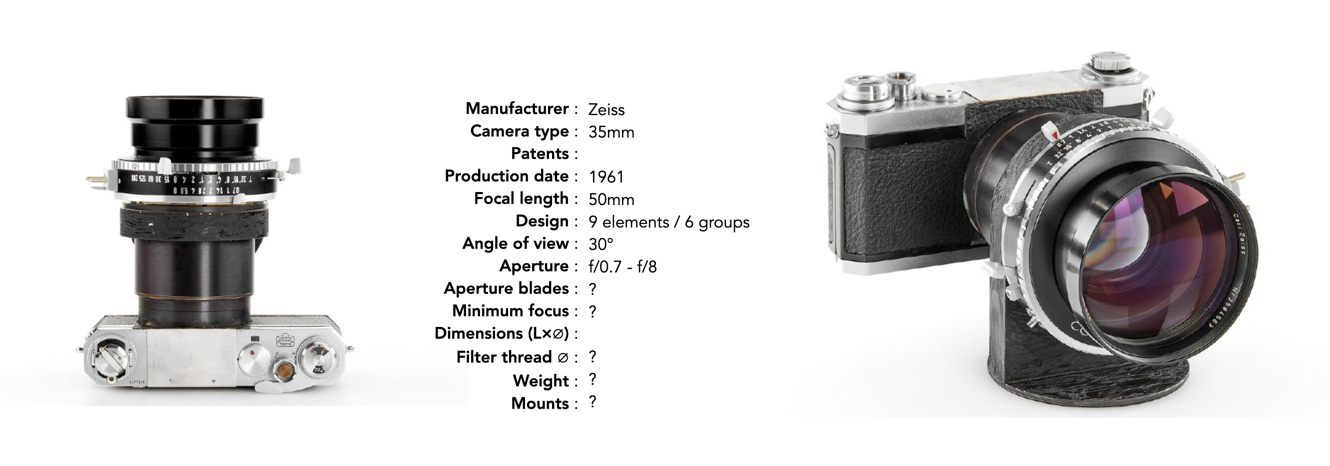
The quintessential vintage ultra-fast camera lens is the Zeiss Planar 50mm f/0.7. It was developed in 1961 for a specific purpose, namely to photograph the dark side of the moon during the NASA Apollo lunar missions. Only 10 lenses were built, one was kept by Zeiss, 6 went to NASA and 3 were sold to director Stanley Kubrick. Kubrick used the lenses to film scenes lit only by candlelight in the movie “Barry Lyndon” (1975).
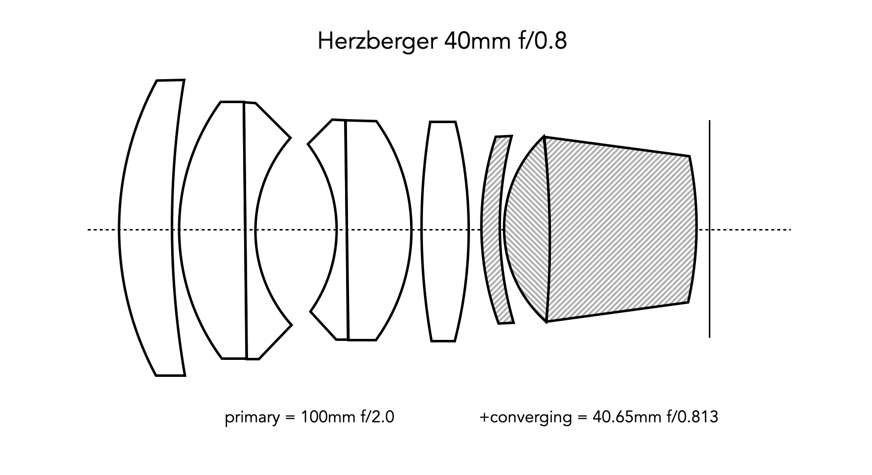
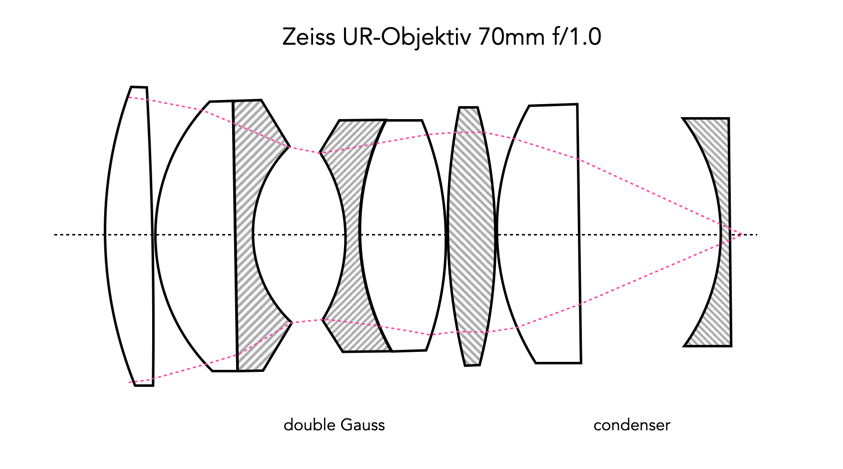
There is a similarity, at least in the double-Gauss optical design – it is essentially a Gauss front with two doublets glued together and a rear group which functioned as a condenser. (copies of optical diagram). The 50mm f/0.7 Planar was designed by Dr. Erhard Glatzel (1925-2002) and Hans Sauer. It is supposedly based on an f/0.8 lens designed by Maximilian Herzberger (1900-1982) for Kodak in 1937. Looking at the two schematics, they look quite similar. The idea is to take the 70mm f/1, and by adding a condenser, brute-force the lens into a 50mm f/0.7. The condenser actually shortens the focal length and condenses the light – in reality adding a ×0.7 teleconverter that gives 1 f-stop.
But this lens has an interesting backstory. According to Marco Cavina, who has done a lot of research into the origin of this lens (and others), the design of this lens was derived at least in part from lenses designed for the German war effort. During WW2, Zeiss Jena designed a series of lenses for infrared devices to be used for night vision in various weapons systems. One such lens was the Zeiss UR-Objektiv 70mm f/1.0. The design documents were apparently recovered during Operation Paperclip from the Zeiss Jena factory before the factory was occupied by the Soviets and then provided to the new Zeiss Oberkochen.
The design went through four prototypes before achieving the final configuration [1]. The final scheme was optimized on an IBM 7090, which had been in operation since the late 1950s. The lenses were used on a modified Hasselblad camera.
Glatzel, E., “New developments in the field of photographic objectives”, British Journal of Photography, 117, pp.426-443 (1970)
There are a whole lot of contemporary super-fast lenses, but that is to be expected from modern optical technology. For example the Voigtländer 50mm f/1.2 Nokton E is still a simple 8 element lens, but contains two optical elements each with two aspherical surfaces, helping to reduce lens aberrations. The Nikon Nikkor Z 50mm f/1.2 on the other hand has 17 elements in 15 groups, with three aspherical and two low-dispersion elements (but at 150mm in length, and 1090g it is a true monster). These lenses are now commonplace, but what about their vintage counterparts?
By the mid 1950s, lenses with speeds of f/2 and f/1.4 were commonplace. Lenses with large apertures such as f/1.0 were also available for applications such as radiography and motion-pictures. Sub-f/1.4 lenses for the 35mm “miniature” cameras had also started to appear. The literature of the period, such as Popular Photography, wrote a series of articles over the years, investigating these new fast lenses. Many of these technology reviews were not damning, but neither were they an acclamation of a new era in photography.
The September 1955 issue included an article “The new superspeed lenses – how useful will they be”, by Bob Schwalberg [2]. Schwalberg describes the rumours that superspeed lenses with apertures of f/1.1 and f/1.2 were in the offing from three different Japanese manufacturers. He suggested that although an f/1.4 lens should mathematically pass 100% more light than an f/2 lens, the actual results are more like 50%. Using the pretext that actual light transmission is 50% of that indicated, he surmises that an f/1.1 lens would only be 30% faster than an f/1.4 lens, but maybe even less due to more elements, and an increased number of light absorbing light-to-air surfaces. These tests were made by comparing exposures at different apertures changing nothing else. Schwalberg concedes that the lenses would be good for use with colour film, however doubted whether the same could be said for black-and-white film. One of the reasons was the reduced depth-of-field, although he concedes it is no worse than for the f/1.4 but regardless both require very close focusing for sharp pictures.
Norman Rothschild described the Zunow 50mm f/1.1 lens in a 1956 article [4], putting the lens through a series of tests, and exploring whether the addition of new optical elements would effect the speed advantage of the lens. He used an exposure meter (Norwood Model A) taped to the back of a Leica M-3 to measure light-transmission of the Zunow, and two control lenses (f/2, f/1.8). The findings indicated that the readings for the f/1.1 proportionally higher than those for the f/2. He also performed a number of practical field tests. Colour photos made with the lens were found to be ”warm, or reddish, but not displeasingly so”. Rothschild questioned the practicality of the lens, with its shallow depth of field, but concluded that while focusing was challenging, it is “no more severe than a press photographer using an f/3.5 lens on a 4×5 camera”.
When asking why these lenses weren’t more popular during the period they were developed, there are likely a number of differing factors. Foremost was cost. Lenses such as 50mm f/1.2 may have tested the limits of both manufacturing processes, and price to consumer. Making lenses with apertures larger than this may have been an act of sheer folly, as is testament to the few that were manufactured. Development costs associated with these lenses were likely steep, as was the use of optical elements containing rare-earth metals, and ultra-precise manufacturing techniques. To all but the professional photographer, these lenses were prohibitively expensive (and still are). When these fast lenses started to appear there was as much skepticism than there was praise. In a follow up article in 1956, “Another look at superspeed camera lenses”, Bob Schwalberg made the following points [3]:
The exposure gain obtained from f/1.1 and f/1.2 lenses was easier to obtain from additional development of f/1.4 and f/1.5 negatives.
Apertures larger than f/2 were seldom used for B&W work, but would be advantageous in colour work.
The reduced depth-of-field which limits the usefulness of f/1.4 and f/1.5 lenses at full aperture will further limit the usefulness of the f/1.1 and f/1.2 lenses.
The lenses are large and heavy, sometimes obscuring the rangefinder and viewfinder windows.
The lenses are “extraordinarily” expensive. A 50mm f/1.1 lens retailed for $3 more than a Leica M-3 with aa 50mm f/2 Summicron lens.
Lens apertures greater than f/2 with a small amount of over-exposure can lead to drastic loss of definition and detail resolution. Tests shows that “at f/1.4 as little as 1/2 stop overexposure can kill sharpness”. Three times as much overexposure is required to produce the same ill-effects at f/2.
Schwalberg called it the “super-aperture problem”. He goes on to suggest that what was needed was not faster lenses, but better lenses, citing that film resolution was increasing to the point where lenses were not capable of producing.
In another Popular Photography article in 1956, it was suggested the ultimate value of f/1.1 and f/1.2 lenses was still a matter of conjecture [5]: “Speeds of f/1.4, f/1.5, and f/2, have long been with us and have proven extremely practical. Unless you are in the darkest, blackest, dingiest location, and unless every bit of shutter speed counts because of subject movement, it is highly advisable to limit black-and-white shooting to a maximum aperture of f/2.” The article cited a series of limiting factors that made photographers wary of the usefulness of sub f/2 lenses [5]:
Depth of field – this only comes apparent at close distances, but a larger opening will result in a shallower DOF. A 50mm lens focused at 4ft has 3.5” of depth at f/1.5 and 4.75” at F/2. A smaller DOF will require more precision in focusing.
The gain in light transmission is often less than can be expected. Light transmission is directly proportional to the square of the f-number. f/2 squares to 4, and f/1.4 to 1.96. Theoretically then, f/1.4 should transmit approximately 100% more light, however tests have shown that it is likely only 50-60%. The reasoning is that the more the diaphragm is opened, the more we depend upon light rays from the periphery of the lens. These rays enter at a steeper angle of incidence than those on the edges at smaller f-stops. There is therefore greater loss through internal reflection.
The other issue is that apertures greater than f/2 require exacting levels of exposure. overexposure at f/1.4 can ruin crisp detail. Errors at f/2 are more forgiving.
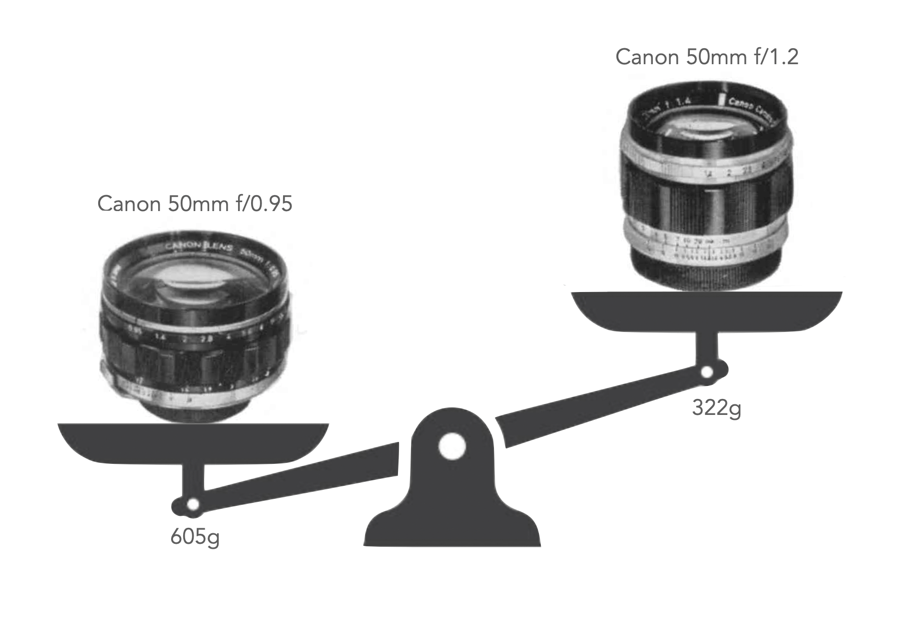
The other issue was weight – these lenses were heavy. The SMC Pentax 50mm f/1.2 (1975) was 385g, and had a maximum diameter of 65mm. The f/1.4 of the same era was only 266g, meaning the f/1.2 was a 45% increase in weight. When the Nikkor-N 50mm f/1.2 first appeared, its internal mount was problematic, with the mount not really able to support the weight of the lens, causing the mount to bend. In addition, the focusing wheel on the camera could not be used because it could not handle the weight of the lens. The weight of the lens was 425g, in comparison a comparable 50mm f/2 was around 200g.
There were many factors which contributed to the lack of interest in fast lenses. By the mid 1960s colour film was faster, and so there was less need for faster lenses. There were a number of f/1.2 options, but also many more options are f/1.4 at a much lower price point. So why bother purchasing a vintage sub-f/1.4 lens? One reason is for the character it provides, or for shooting in extreme low-light conditions. Why not to buy them? Mostly they are expensive.
Further reading:
G.H. Smith, Camera Lenses: From box camera to digital (2006)
Bob Schwalberg, “The new superspeed lenses – how useful will they be”, Popular Photography, 37(2), p.48 (September, 1955)
Bob Schwalberg, “Another look at superspeed camera lenses”, Popular Photography (April, 1956)
Norman Rothschild, “Meet the Zunow f/1.1”, Popular Photography, pp.126/128 (February, 1956)
“The Versatile 50-mm Lens”, Popular Photography, 39(2) pp.40,41,84 (August, 1956)
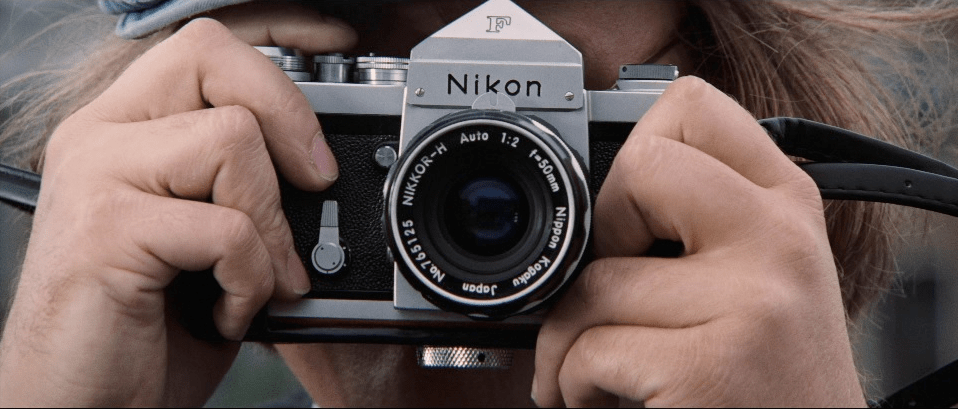
In 1971, two of the villains in the James Bond movie, Diamonds Are Forever used a Nikon F to take photos. The question is why the Nikon F? I mean it’s not like it was a new camera. First unveiled in 1959, it was no doubt an influential camera, but a decade later was it still cutting edge?
It was not the only time Nikon cameras were used in movies. The list is actually quite long, including the likes of The French Connection, Jaws, and Apocalypse Now (here’s another list of cameras in movies and TV shows). Nor was it the only camera used in Bond films – Bond used a Rolleiflex T in From Russia with Love (1963), a in Goldfinger (1964), a Nikonos Calypso in Thunderball (1965), and a Minox subminiature in On Her Majesty’s Secret Service (1969).
The Nikon F was at the forefront of SLR technology in the 1960s, and had a wide audience of users, from photojournalists covering the Vietnam War, to NASA. In March 1968 the Nikon F was laboratory tested by Popular Photography. Reviewers found little to complain about, it was an easy camera to function with, and extremely well built, except for the fact that it was heavy, “like a military tank of a camera”. It had a presence which was hard to dispute.
Choosing a camera for any movie may be a mere factor of chance. A personal preference of the director, or somebody facilitating props. Sometimes it’s product placement, although considering the Nikon F2 was released in the same year as the movie, it’s unlikely that is the case.
Some of the most interesting vintage lenses are the sub-f/1.2 lenses, of which there are very few. In the 1950s Japanese lens makers wanted to push the envelope, racing to construct the fastest lenses possible. There were four contenders: the Zunow 50mm f/1.1, the Nippon Kogaku’s Nikkor-N.C 50mm f/1.1, Konishiroku (Konica’s predecessor) Hexanon 60mm f/1.2 and the Fujinon 50mm f1.2 LTM. This spurned research which led to the development of the Canon 50mm f/0.95 (1961), which at the time was the largest aperture of any cameras lens in the world. The other, which did not appear until 1976 was the Leitz (Canada) Noctilux-M 50mm f/1.0.
(Note that these lenses were made for 35mm rangefinder cameras.)
Why were these lenses developed?
The most obvious reason was the race to produce fast lenses. An article in the February 1956 issue of Popular Photography sheds more light on the issue. The article, titled “Meet the Zunow f/1.1” [1], by Norman Rothschild, described the virtues of the Zunow lens (more on that below), and concluded with one of the reasons these lenses were of interest, namely that it opened up new areas for the “available-light man”, i.e. the person who wanted to use only natural light, especially with slow colour films. This makes sense, as Kodachrome had an ASA speed of 10, and Type A’s speed was ASA 16. Even Kodachrome II released in 1961 only had a speed of 25 ISO. Conversely, black and white film of the period was much faster: Kodak Super-XX was 200 ISO, and Ilford FP3 was 125 ISO. Ilford HPS, introduced in 1954 pushed the ISO to 800. The newer Ektachrome and Anscochrome colour films were rated at ASA 32. In the patent for the Zunow f/1.1 lens [3], the authors claimed that objectives with apertures wider than f/1.4 were in more demand. In reality, the race to make even faster lenses was little different to the race to get to the moon.
Zunow 50mm f/1.1
The first of the sub-5/1.2 lenses was the Zunow 50mm f/1.1. Teikoku Kōgaku Kenkyūjo was founded by Suzuki Sakuta circa 1930 and worked for other companies grinding lenses. The company started working on fast lens around 1948, with the first prototypes completed in 1950, and the 50mm f/1.1 Zunow released in 1953. It made a number of lenses for rangefinder cameras, including slower 50mm lenses in f/1.3, and f/1.9, a f/1.7 35mm, and a 100mm f/2 lenses. In 1956 it became the Zunow Kōgaku Kōgyō K.K., or Zunow Optical Industry Co., Ltd., but closed its doors in early 1961. During the last years the company designed a couple of camera’s including a prototype of a Leica copy, the Teica, and the Zunow SLR, the first 35mm SLR camera with auto diaphragm, instant-return mirror, and bayonet mount interchangeable lenses (only about 500 were ever produced).
The Zunow 50mm f/1.1 was derived from the Sonnar-type f/1.5 lens. The patent for the Zunow f/1.1 lens [3] describes the lens as “an improved photographic objective suited for use with a camera that takes 36×24mm pictures”. Many of these fast lenses were actually manufactured for the cine industry. For example the company produced Zunow-Elmo Cine f/1.1 lenses for D-mount in 38mm and 6.5mm (and these lenses are reasonably priced, circa US$500, however not very useful for 35mm). The Zunow 50mm f/1.1 is today a vary rare lens. Sales are are US$5-10K depending on condition. The price for this lens in 1956 was US$450.
1953 – Zunow f/1.1 5cm, Leica M39 mount/Nikon S, 9 elements in 5 groups.
1955 – Zunow f/1.1 50mm, Leica M39 mount/Nikon S, 8 elements in 5 groups.
Nikkor-N 50mm f/1.1
Hot on the heals of Zunow was the Nikkor-N 5cm f/1.1 developed by Nippon Kogaku. Introduced in 1956, it was the second sub-f/1.2 lens produced. The lens was designed by Saburo Murakami, who received a patent for it in 1958 [5]. While the Zunow was an extension of the Sonnar-type lens, the Nikkor lens was of a gaussian type. It was also made using an optical glass made using the rare earth element Lanthanum in three of its optical elements. The lens was made in three differing mounts: the original internal Nikon mount (for use on Nikon S2, SP/S3 cameras), the external Nikon mount, and the Leica M39 mount. The original lens mount was an internal mount, and the heavy weight of the lens (425g) could damage the focusing mount, so it was redesigned in 1959 with an external mount. The lens had a gigantic lens hood with cut-outs for setting the focus with the rangefinder through the viewfinder.
1956 – Nikon Nikkor-N[.C] 50mm f/1.1, Leica screw mount/Nikon S, 9 elements in 6 groups (Nikon, 1200 units; M39, 300 units)
1959 – Nikon Nikkor-N 50mm f/1.1, Leica screw mount/Nikon S, 9 elements in 6 groups (1800 units)
A 1959 price list shows that this lens sold for US$299.50. Today the price of this lens is anywhere in the range $5-10K. Too few were manufactured to make this lens the least bit affordable. Nippon Kogaku also supposedly developed an experimental f/1.0 lens for the Nikon S, but it never went into production.
Canon 50mm f/0.95
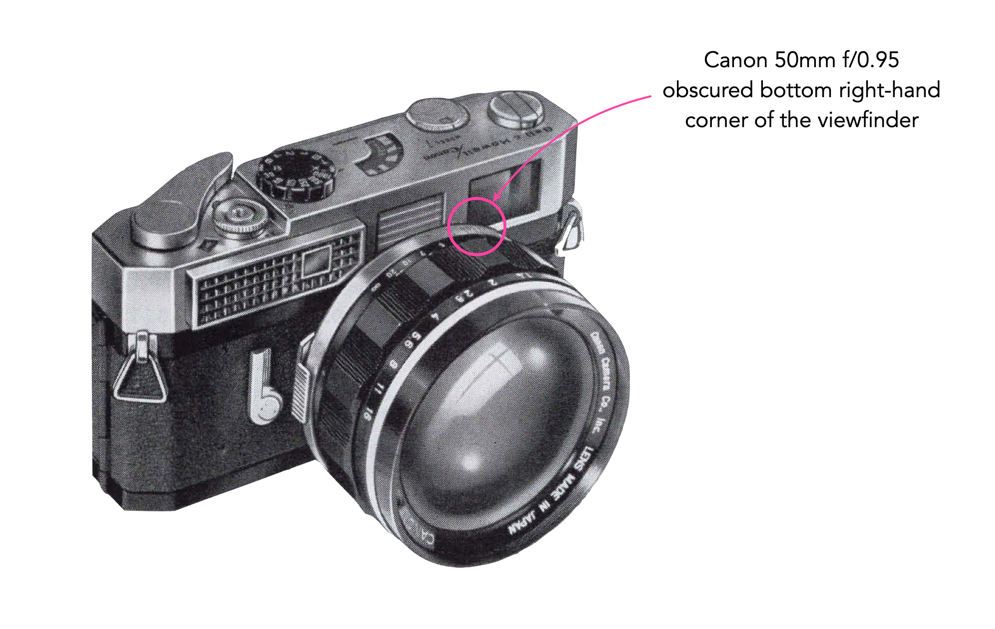
In August 1961, Canon released the 50mm f/0.95, designed as a standard lens for the Canon 7 rangefinder camera. It was the world’s fastest lens. The Canon f/0.95 was often advertised attached to the Model 7 camera – the Canon “dream” lens. The advertising generally touted the fact that it was “the world’s fastest lens, four times brighter than the human eye” (how this could be measured is questionable). It is Gauss type lens with 7 elements in 5 groups. The lens was so large on the Canon 7 that it obscured a good part of the view in the bottom right-hand corner of the viewfinder, and partially obscured the field-of-view.
In a 1970 Canon price list, the 50mm f/0.95 rangefinder lens sold for $320, with the f/1.2 at $220. To put this into context, $320 in 1970 is worth about $2320 today, and a Canon 7 with a f/0.95 lens in average condition sells for around this value. Lenses in mint condition are valued at around $5K.
The verdict?
So why did these lenses not catch on? Cost for one. While f/1.2 lenses were expensive, faster lenses were even more expensive. For specialist applications, the development of these lenses likely made sense, but for the average photographer likely not. There were a number of articles circa 1950 in magazines like Poplular Photography which seemed to downplay their value, which likely contributed to their decline. It is notable that by the the early 1960s, Nikon stopped advertising its 50mm f/1.1 lens, and never produced another sub-f/1.2 lens. By the late 1960s even Canon had ceased production of the f/0.95.
There were probably more sub f/1.2 lenses created for non-photographic applications, in many different focal lengths. For example x-ray machines (Leitz 50mm f/0.75), D-mount film cameras (e.g. Kern Switar 13mm f/0.9), C-mount for film, medical and scientific imaging (e.g. Angenieux 35mm f/0.95), and aerial photography lenses (e.g. Zeiss Planar 50mm f/0.7). Not until recently have super-fast lenses once again appeared, likely because they are technologically better lenses, made much cheaper than they ever could have been in the 1950s and 60s.
References:
Norman Rothschild, “Meet the Zunow f/1.1”, Popular Photography, pp.126/128, February (1956)
Kogoro Yamada, “Japanese photographic objectives for use with 35mm cameras”, Photographic Science and Engineering 2(1), p.6-13 (1958)
U.S. Patent 2,715,354, Sakuta Suzuki et al., “Photographic Objective with Wide Relative Aperture”, August 16, (1955)
Hagiya Takeshi, Zunō kamera tanjō: Sengo kokusan kamera jū monogatari (The birth of the Zunow camera: Ten stories of postwar Japanese camera makers) Japanese only (1999)
U.S. Patent 2,828,671, “Wide Aperture Photographic Objectives”, April 1, 1958.
The term plastic is somewhat relative – it actually means any material that is moldable, shapable, ductile. At extremely high temperatures even rocks can become plastic. The most common use of the word is likely to describe a synthetic material made from a wide range of organic polymers. The first plastic made from synthetic materials was Bakelite, which was invented in 1907. It was used in the 1930s to make cameras such as the Kodak Baby Brownie, and Purma Special. Plastic materials such as methyl methacrylate, or acrylic (often better known by its trade names, e.g. Lucite, Plexiglas, Perspex), were developed in the 1920s, largely to make unbreakable eyeglasses.
There was little interest in the use of plastics as substitutes for optical glass until WW2. Many plastic materials were examined during the war period, but few were found to have the right optical characteristics for use in photographic lenses. After the war, research continued, and plastics replaced glass in a number of non-critical optical purposes. But in the realms of photography, few if any manufacturers gave up their dependence on glass, save perhaps for lenses in inexpensive box-cameras. In 1946 Andrew Hecht wrote an article on plastic lenses [1]. The first statement he made was “Plastic lenses are here, and they are here to stay…”. Hecht suggested they would only be economical in lenses of 2.5” or more in diameter. The article focuses on Thomas S. Curtis Laboratories, which produced thousands of lenses up to 18” in diameter for the US Army. These lenses were manufactured from large slabs produced in electric furnaces which is then cut, and shaped on lathes, ground and polished. The article seemed to focus on lenses for applications such as industrial magnifiers.
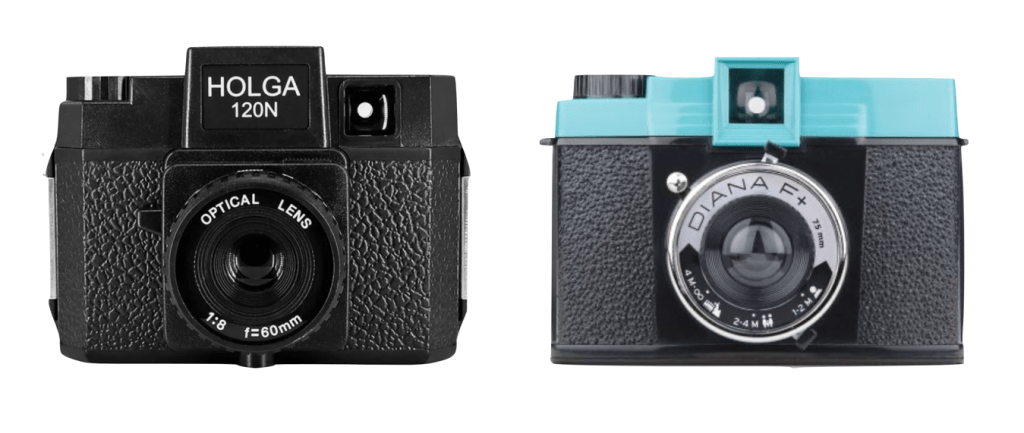
The HOLGA 120N and DIANA cameras with plastic lenses
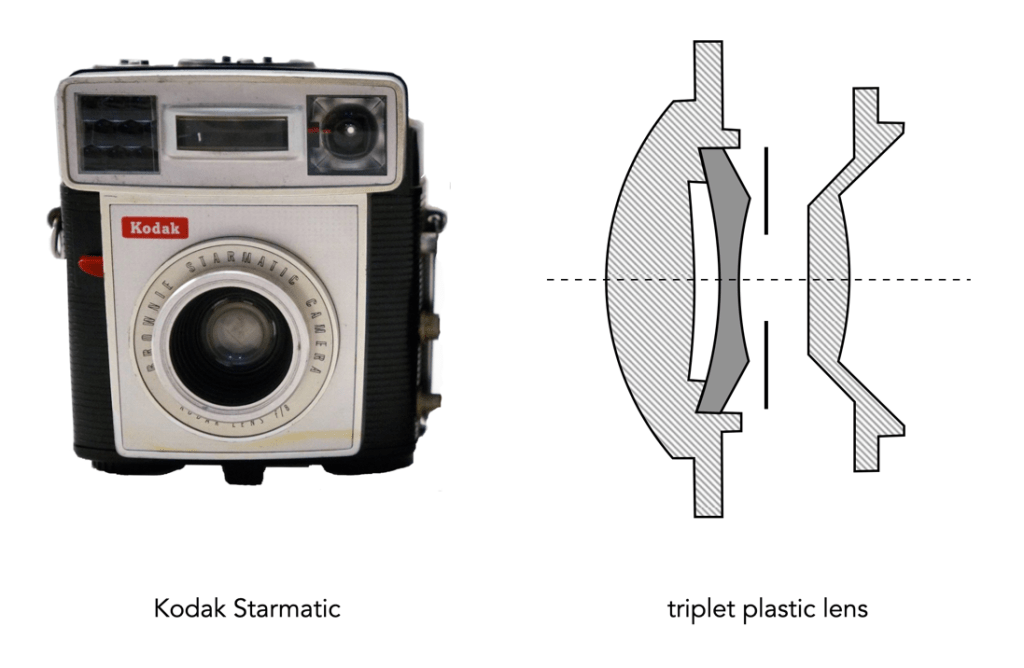
The 1950s saw a growing trend towards the idea of using plastics in cameras. In 1952 Kodak was experimenting with plastic viewfinders in its simple cameras, and by 1957 was making injection molded meniscus lenses for use in snapshot cameras. In 1959 it was using triplet lenses with an f/8 aperture in its Starmatic Brownie cameras. The March 1961 issue of Modern Plastics [2] had an article on plastic lenses, with a cover touting “Lenses – The Focus is on Plastics”. The article describes large plastic lenses made of acrylic, 4-30” in size, used in applications such as magnifiers and reflectors. The article described the many benefits of plastic lenses: reduced weight, more light transmission, impervious to thermal shock, and chip-proof. However of the varied applications it suggests the “prospects are not overly bright for injection molded methacrylate”, largely due to the refractive index. Doubts had already started to set in.
Lloyd Varden investigated plastic lenses in the August 1961 of Popular Photography [3]. He describes a long list of properties that glass had that made it superior to plastic: (i) range of refractive indexes, and dispersion values available, (ii) homogeneity, (iii) physical hardness, (iv) transparency, (v) selective absorption, i.e. absence of colour, (vi) light and atmospheric stability, (vii) freedom from excessive bubbles, (viii) thermal expansion, (ix) moisture absorption, (x) chemical reactivity and solubility, and economy in manufacturing. Unfortunately, plastics of the period could not match up to all these requirements. Plastics could have a high degree of transparency, a low selective absorption, and an absence of bubbles, but failed in other categories such as physical hardness, making them susceptible to scratches, or a high refractive index/low dispersive power.
In 1964 Leonard Lipton wrote Popular Photography article, again looking at plastic lenses: “Plastic Lenses: Good Enough!” [4], in which he said “we are already deep into the plastic lens revolution.” He estimated that in 1963 five million plastic lenses were manufactured, and good photographic objectives could be made up to f/8. He suggests that Kodak was reluctant to admit their inexpensive cameras contained plastic lenses, largely due to the perception that the public associated plastic with an inferior product. Kodak instead preferred to use the term “acrylic”. Many companies were at the time using plastic in products such as viewfinders, and slide viewers. Lipton’s article was a lengthly one, describing the virtues of plastic (over glass), how plastic has dealt with issues such as striation, and changes in temperature, the process of molding lenses, and their limitations.
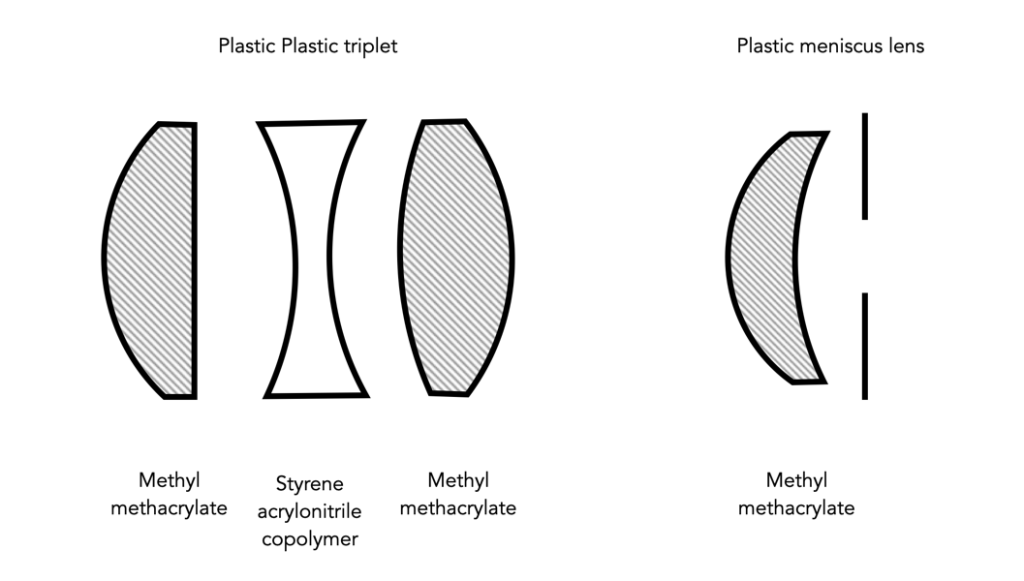
Plastic lenses are typically molded from polymers such as methyl methacrylate (MM), and styrene acrylonitrile copolymer (SAC). Optical glass is chemically nothing like optical grade plastic. Plastic has a definite molecular structure, whereas glass does not. Plastic is basically made from carbon, hydrogen and oxygen, whereas glass can contain a wide variety of materials, e.g. silicon dioxide, barium, boron, lead, and even thorium. The single biggest benefit of plastic is that it could be injection molded. Glass on the other hand, could not be injection molded as it would produce surface irregularities, which would then have to be ground and polished out (modern glass can be precision moulded). Injection molding allowed for complex shapes to be made easily, and inexpensively. Early plastic lenses suffered from something called “striation” whereby a lens has regions which with an index of refraction different from the rest of the lens, resulting in fuzzy pictures. It was caused by uneven cooling in the mold, but by the mid-60s this had been eliminated from lenses.
Plastics were said to suffer from defects, e.g. becoming pitted, or discoloured. However as they were usually used in simple, small lenses, this was hardly ever a real issue. Scratching (of the outer lens) was reduced through the use of plastics like Plexiglas V100, another acrylic which is very hard. The biggest issue with plastic lenses centred around the index of refraction (IR), which is a dimensionless number that indicates the light bending ability of a medium. The IR of plastics was (and is) rather low compared to optical glass. Acrylic has an IR of 1.49, and styrene acrylonitrile copolymer, 1.57. Compare this against modern glass of the period, at 1.52 to 1.89. Another problem was the fact that the IR of acrylics decreases as temperatures increases, changing the focus. Some plastic lenses were designed to automatically compensate for this. For example the plastic f/8 Cooke triplet, which used lens elements made from both acrylic and SAC. The focus of the acrylic elements (front and rear) increases, while the focus of the middle SAC lens decreases, balancing out any changes in focus.
The plastic lenses: Cooke triplet and the single lens
Lipton went a long way to describe the manufacturing benefits of plastic (and the drawbacks of optical glass) [4]. Optical glass is made by melting raw materials, which is processed when it cools into glass. Optical glass requires a number of steps including grinding, polishing, and testing, which made them expensive to manufacture. Plastic lenses on the other hand were simple to manufacture:
“Plastic lenses are made in air conditioned pressurized rooms, and in the case of Plexiglas or Lucite, the plastic, in powder form, is fed to a machine where it is heated and softened. It may be heated to a temperature of 400 to 500 degrees Fahrenheit. The softened plastic is then forced, under a pressure of at least 16,000 pounds per square inch, into a mold when it remains until it cools enough to retain the mold’s shape. The mold is then opened, and the lens is popped out, ready to be used as is, or assembled with other elements with no necessity for working to a finished size.”
Not that manufacturing optical plastics didn’t have its limitations. It was challenging to mold large diameter optical lenses, lenses with plane surfaces, and those with thick centres and thin edges. Lipton considered two stumbling blocks prohibiting the creation of high-speed 35mm lenses: low refractive indices, and the inability to mold large diameter lenses. In fact Dr. Rudolf Kingslake, director of optical design for Kodak, said of plastic objectives: “It’s the low indicies of refraction that are stopping us, it’s just a matter of substituting plastic for glass.”[4].
In 1972 Bob Schwalberg wrote an article describing why glass still reigned supreme [5]. He suggested SLR pentaprisms were a good candidate for conversion to acrylic which would reduce production costs. Schwalberg outlines five benefits:
Lower cost – Raw materials are cheaper, and less expensive to work.
Complete form freedom – Aspherical (non-spherical curvature) lenses are expensive to make in glass.
Exceptional clarity – Not all optical glass is perfectly colourless, the highest grades of optical plastics are quite colourless, and their clarity frequently superior.
Light weight – Plastic lenses are lighter.
High impact resistance – Glass is brittle, plastics are flexible.
and five counter-arguments:
Too limited range of optical specifications – i.e. The refractive index, and the dispersion. Refractive indexes for optical plastics are close to 1.5, optical glass ranges from 1.42 to 1.95.
Poor curve holdability – Accurate lens curvatures are critical for quality performance. Plastic lenses have poor curve conformity because of (3) below, and their inherent flexibility. Glass is stronger and more stable, it holds curvature much better in the face of external forces.
High temperature coefficients – The expansion and contraction of optical plastics is much greater than for optical glass. Muti-element plastic lenses have been developed with elements possessing opposing temperature coefficients. Unthinkable for precision camera lenses.
Clear plastics are hygroscopic – They absorb airborne moisture. Optical media must be isotropic, i.e. equal in all directions. The absorption of moisture destroys this homogeneity.
Low abrasion resistance – Plastics are softer and more prone to scratching than optical glass.
The Kodak Starmatic and its lens
Many of the cameras that use(d) plastic lenses are considered to be “toy” cameras. In 1959 Kodak introduced the Starmatic, the top of Kodak’s Brownie line. It had an 44mm f/8 three-element, plastic lens. The Lomography Diana appearing in the 1960s, and was made entirely of plastic (and in 1975 cost less than $2). The Polaroid Pronto Land camera (mid 1970s), also had a 116mm 3-element Polatriplet plastic lens. Most Holga cameras, had a 60mm f/8 plastic meniscus lens.
But the breakthroughs and sophisticated designs associated with plastic lenses never really materialized. In the end, low refractive indices, and the inability to successfully mold large diameter lenses may have been stumbling blocks to making 35mm lenses from plastic. There are some plastic optical materials [6] that have reached a refractive index of as high as 1.68, e.g. PolyEtherImide, but they often suffer from having a lower transmission rate (36-82% for PolyEtherImide, versus 92% for acrylic). Leica APO glass, on the other hand, has a refractive index of 1.9005.
Apart from their use in inexpensive cameras, there is another use of optical plastic, that is in hybridaspherics. A hybrid aspherical element is a lens element consisting of a glass base upon which plastic is glued, creating the desired aspheric shape. They are typically used in zoom lenses, e.g. the Nikon 28-70mm f/3.5-4.5 AF, first introduced in 1991. Companies like Tamron use hybrid aspherical lenses, likely to reduce the cost of the lenses. Lipton somewhat predicted this use in 1964 [4] when he suggested it would be difficult to grind an aspheric lens in optical glass, yet the manufacture of aspheric lenses in plastic would be no problem. Ironically, many smartphones have lenses which are actually plastic. This is not surprising considering the small size of the lenses required for mobile devices – it is less of a technological challenge, and hence costs less to manufacture (but as manufacturers don’t publish lens diagrams, it’s hard to know). For example the Leica lenses used in Huawei smartphones are plastic. Are there smartphones with glass elements? Sure, but they are usually quite expensive.
Ultimately the inability to derive high precision optics is one of the reasons we don’t see more plastic lenses. But there is another, human factor involved in companies shying away from the use of plastics – the perception of quality. Glass is more associated with quality that plastic, whereas plastic is considered “cheap”, and disposable. This is largely due to its use in inexpensive cameras, and the stigma attached to plastic itself.
Andrew B. Hecht, “And Now Plastic Lenses”, Popular Photography, 18(5) pp.72-74,128 (1946)
“Learn from Lenses”, Modern Plastics, 38(7), pp.90-93 (1961)
Lloyd E. Varden, “Plastic Lenses”, Popular Photography, 49(2) p.48,97,98 (August, 1961)
Leonard Lipton, “Plastic Lenses: Good Enough!”, Popular Photography, 55(2) p.44-45,100-101 (August, 1964)
Bob Schwalberg, “Plastic optics vs. glass, and why glass still reigns”, Popular Photography, 70(2) p.52,118 (1972)
Kingslake, R., Johnson, R.B., “The Work of the Lens Designer”, in Lens Design Fundamentals, 2nd ed. (2010)
When lenses first appeared they had a particular shape, a double convex lens, that was very similar to a certain pulse, namely the lentil. The name lens derived from the Latin name for the plant, lens culinaris.
“LENS (Latin , lens, a small bean or lentil). A lens is a piece of transparent material (usually glass) bounded by curved surfaces (generally spherical, including flat).
An English dictionary of the early 18th century [1] describes a lens as related to optics to be a “small concave or convex glass”. By 1768 [2] it was described as “a glass, spherically convex on both sides”.
The word lentil comes from the Old French lentille, which in turn comes from Latin lenticula. When lenses first appeared, they looked like the lentil seed, and likely due to the fact that technical terms were derived from Greek or Latin, simply named them lens. In German, one term used is Linse, but it is more common to use the term Objektiv. The term Linse is from the Old High German linsa, from a Proto-Indo-European root.
Dictionarium Anglo-Britannicum, John Kersey (1708)
A Dictionary of the English Language, Samuel Johnson (1768)
Why was the 50mm lens considered the “normal” lens used on 35mm cameras? Why not 40mm or 60mm? When Barnack introduced his revolutionary Leica camera, he used a traditional method of selecting the lens – the most commonly used lens has a focal length should be approximately equal to the diagonal of the negative, which is how the 50mm likely evolved. The Leica I came with a fixed 50mm lens, and even when the Leica II appeared in 1932 with interchangeable lenses, the viewfinder was designed to work with 50mm lenses. Zeiss Contax lens brochures from the 1930s mark 50mm lenses as “universal lenses”, “For all-round use and subjects which occur in every-day photography…”. Nikon also made the point that “Nikkor normal lenses cover a picture angle of approximately 45°, corresponding closely to the angle of view of the human eye”.
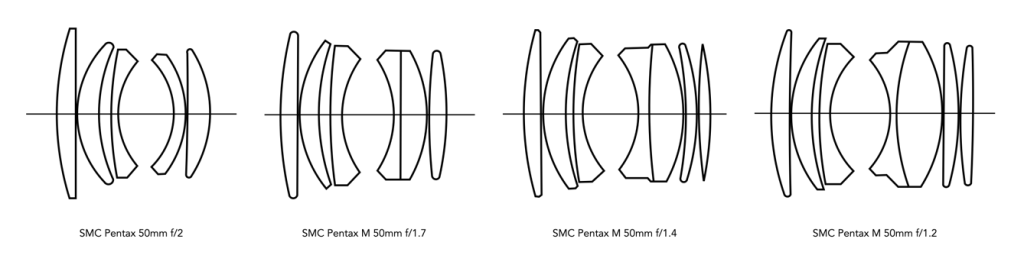
It is then no surprise that 50mm is the most ubiquitous analog lens. By the 1950s, most interchangeable lens cameras came standard with a 50mm lens, ensuring that novice photographers could capture sharp photographs in a variety of conditions without requiring a books worth of knowledge. Nikon in one of their lens brochures suggested “the 50mm focal length has become the standard lens for all around work”. This deep-seeded ideology is probably why 50mm lenses came in so many speeds – the same Nikon brochure provides an f/3.5, f/2, f/1.4, and f/1.1 50mm lenses. Many camera manufacturers followed suit. The late 1970s “standard” line-up for Asahi Pentax included four 50mm lenses (f/1.2, f/1.4, f/1.7, f/2) and a 40mm f/2.8 which they touted as being “extremely versatile”.
Fig.1: How many normal’s is too many normal’s? (Pentax SMC lenses)
There are a number of arguments that have traditionally been made as to why 50mm is “normal”. The most common argument of course is that the 50mm lens has a diagonal angle-of-view (AOV) of about 45° which approximates the AOV of the human eye. But in reality it makes assumptions about what “normal vision” is , and the ability of a 50mm lens to reproduce it. The idea that 50mm best approximates human vision has more to do with the evolution of lenses than it has to do with any correspondence between the human eye and a lens. There are other arguments, for instance that 50mm reproduces facial proportions, depth and perspective roughly as how our eyes perceive them. Many manufacturers drove this point home by saying 50mm lenses “give pictures of natural, i.e. normal, perspective”.
Fig.2: Angle of views of the human vision system
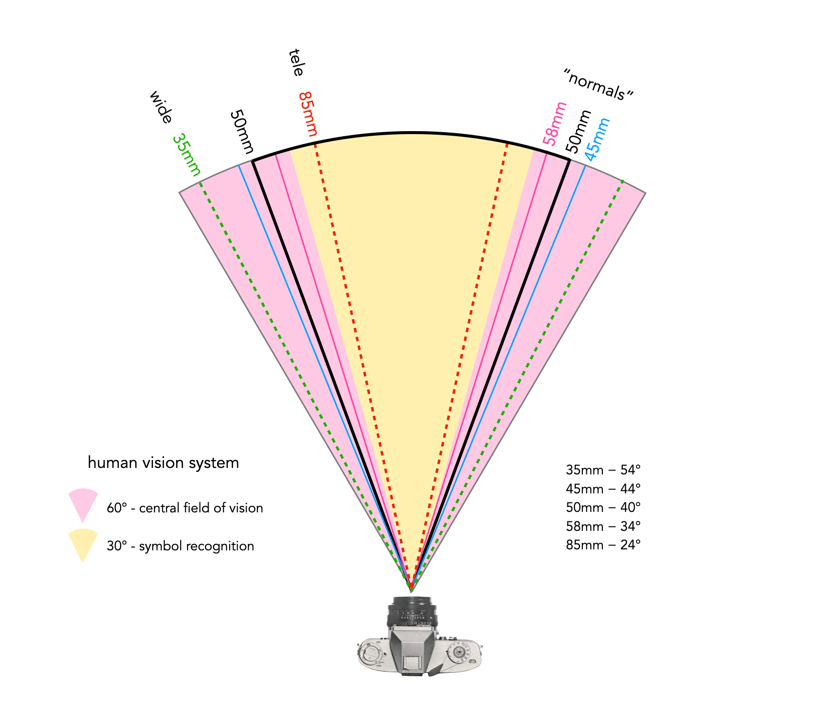
Firstly we should remember that “normal” human vision is binocular, while camera lenses are not. The eye is also composed of a gel-like material, versus the glass of lens elements. So there are already fundamental structural and functional differences. There is also the matter of AOV. A lens generally has one AOV, whereas the human visual system (HVS) has a series, based on differing abilities to focus – binocular vision is approximately 120° of view, of which only 60° is the central field of vision (the remainder is peripheral vision), and only 30° of that is vision capable of symbol recognition (even less is capable of sharp focusing, perhaps 5°?). Note that I use horizontal AOV in comparisons, because it is easier for people to conceptualize than diagonal AOV.
Fig.3: AOV of various lens focal lengths against the AOV of the human vision system
In reference to Figure 3, for the hard limits, a 67mm lens would likely best approximate the 30° region of the HVS that deals with symbol recognition, whereas a 31mm would best approximate the 60° central field of vision. If we were simply to take the middle ground, at 45°, we get a 43mm lens, which actually matches the diagonal of the 24×36mm frame.
But how closely does the 50mm AOV resembles that of the human visual system (HVS)? In terms of horizontal vision, a 50mm lens has a 40° AOV, so it’s not that far removed from that of the 43mm lens. Part of the problem lies with the fact that it is hard to establish an exact value that represents the “normal viewing angle” of the HVS. This is why other lens fit into this “normal” category – the 40mm (48°), the 45mm (44°), the 55mm (36°) and the 58mm (34°). Herbert Keppler may have put it best in his book The Asahi Pentax Way (1966):
“A normal focal length lens on any camera is considered to be a lens whose focal length closely approximates the diagonal of the picture area produced on the film. With 35mm cameras, this actually works out to be about 43mm, generally considered a little too short to produce the best angle of coverage and most pleasing perspective. Consequently, makers of 35mm cameras have varied their “normal” focal lengths between 50 and 58mm. With early single lens reflexes the longer 58mm length was in general use. However, in recent years there seems to be a trend to slightly shorter focal lengths which produce a greater angle of view. Current Pentax models use both 50 and 55mm focal length lenses.”
In some respects it seems like 50mm was chosen because it is close to what could be perceived as the AOV of the HVS, such that it is, and provided a nice rounded focal length value. By the 1950s, the 50mm had become “the standard” lens, with 35mm and 85mm lenses providing wide and telephoto capabilities respectively (a 35mm lens has an AOV of 54°, and the 85mm lens has an AOV of 24°, and surprisingly, 50mm sits smack dab in the middle of these). Many brochures simply identified it as an “all-round” lens. It is difficult to pinpoint where the reference of 50mm approximating the AOV of the human eye may have first appeared.
With the move to digital, the exact notion of a 50mm “normal” lens has not exactly persevered. This is primarily because the industry has moved away from 36×24mm being the normal film/sensor size, even though we hang onto the idea of 35mm equivalency. While a 50mm lens might be considered “normal” on a full-frame sensor, on an APS-C sensor a “normal” lens would be 35mm, because it is “equivalent” to a 50mm full-frame lens, from the perspective of focal length and more importantly AOV. Note that Zeiss still allude to the fact that the “focal length of the ZEISS Planar T* 1.4/50 is equal to the perspective of the human eye.”
In the 1940s, a lens speed of f/3.5 was quite normal, an f/2 very fast. The world first f/1.4 lens for a 35mm camera appeared in 1950, when Nikon released the NIKKOR-S 5cm f/1.4. That sparked a series of f/1.4 lenses from most manufacturers. But this wasn’t fast enough. In the world of vintage lenses, f/1.2 lenses are almost the holy grail. Fujinon was the first to introduce an f/1.2 5cm lens in 1954 for rangefinder cameras. Canon introduced a 50mm f/1.2 lens, for the Canon S series in 1956. Many manufacturers followed suit, producing one or more lenses in the decades to come. Japanese camera companies lead the way in super-fast normal lenses. Some milestones:
First f/1.2 for SLR (1962) – Canon Super-Canonmatic R 58mm f/1.2
First f/1.2 55mm lens (1965) – Nikon Nikkor-S Auto 55mm f/1.2
First f/1.2 50mm lens for SLR (1975) – Pentax SMC 50mm f/1.2
Fig.1: The ever increasing complexities of optical elements in lenses with large apertures from f/2 to f/1.2(Asahi Pentax)
Aside from the fact that these f/1.2 lenses represent the pinnacle of wide-open lenses of the period, what makes them so expensive (both then and now)?
Rarity – Although a large number of manufacturers developed f/1.2 lenses, in may cases fewer were manufactured than slower lenses. For example, the Fujinon 5cm f/1.2 lens was made in limited amounts, less than 1000 by all accounts, but because of this ranges from $4000-20000.
Larger glass – As the speed of a lens increased, so too did the size of its optical elements. An f/1.2 lens had much more glass than say an f/2.8, e.g. a 50mm f/2.8 lens would have an effective aperture of 25mm, while an f/1.2 50mm would have one of 41.7mm. This means the optical elements had to be much larger for an f/1.2 lens.
Better glass – Larger optical elements also mean they had to be of a higher quality, with less tolerance for defects such as bubbles. Some optical elements may have been made of rare-earth metals to improve optical qualities, and reduce aberrations.
More optical elements – As lenses got faster, more elements needed to be added to counter optical aberrations.
Inner mechanisms – Larger optical elements meant one of two things for the lens housing (i.e. barrel): (i) make it a lot larger, and therefore increase the size of all the components, or (ii) make it marginally larger, and reduce the size of the mechanisms within the lens, e.g. aperture control, so they become more compact.
Complexmanufacturing – Specialized glass needed new processes to ensure high manufacturing tolerances, e.g. finer levels of polishing.
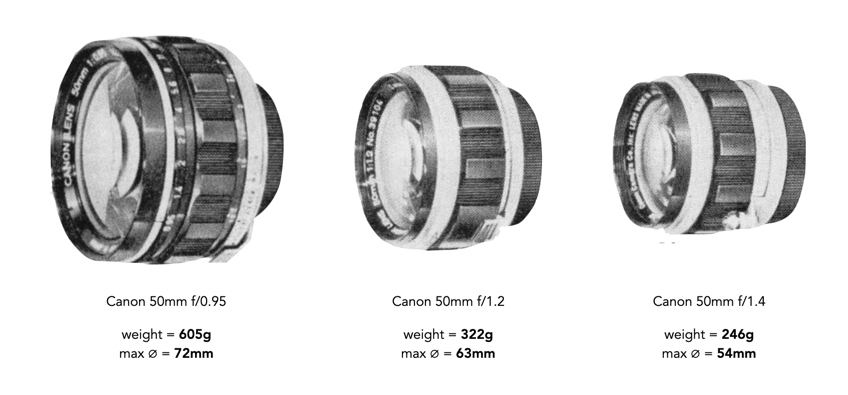
Fig.2: The ever increasing size and weight of lenses with large apertures(the Canon rangefinder series)
All these elements contributed to an increase in the cost of these “revolutionary” lenses. However, although we consider them expensive now, f/1.2 lenses were always expensive. In 1957, the Canon 50mm f/1.2 rangefinder lens sold for US$250, with the Fujinon 50mm f/1.2 at $299.50 [1]. The Canon 50mm f/1.8 on the other hand sold for $125, and a Canon V with a 50mm f/1.8 lens sold for $325. A 1970 Canon price [2] list provides a better perspective, with information for the lenses for the Canon 7/7s rangefinder. The slower 50mm lens sold for $55 (f/2.8), and $120 (f/1.8), while the f/1.4 sold for $160 and the f/1.2 for $220 (the f/0.95 was the most expensive at $320). SLR lenses were cheaper, although Canon did not make a 50mm f/1.2 (until 1980), it did make a 55mm f/1.2, which sold for $165.
Note that $220 in 2022 dollars is $1608. Today, some of these lenses fetch a good price, depending on condition. The Canon 50mm f/1.2 sells for around $400-600 based on condition. The series of f/1.2 lenses made by Tomioka Kogaku circa 1970 regularly sell for between C$800-1700.
The price of nostalgia.
Further reading:
“Photographic Lenses”, Popular Photography 40(4), April, p.168 (1957)
Canon Systems Equipment, Bell & Howell Co. March 1970
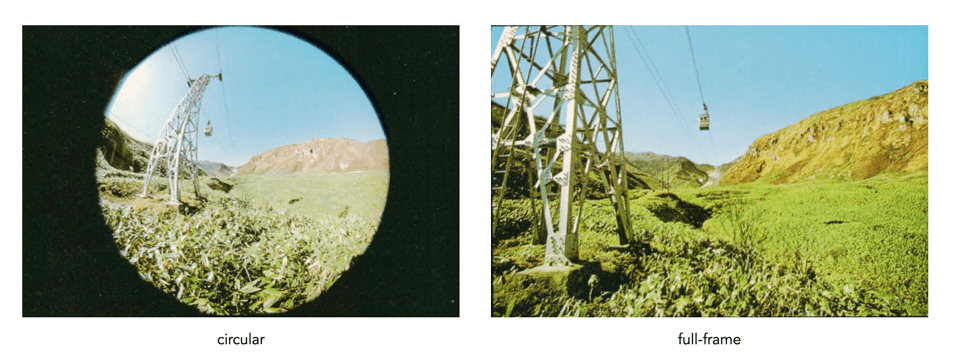
I love vintage lenses, and in the future, I will be posting much more on them. The question I want to look at here is the usefulness of vintage fish-eye lenses on crop sensors. Typically 35mm fisheye lenses are categorized into circular, and full-frame (or diagonal). A circular fisheye is typically in the range 8-10mm, with full-frame fisheye’s typically 15-17mm. The difference is shown in Figure 1.
Fig. 1: Circular 7.5mm versus full-frame 17mm
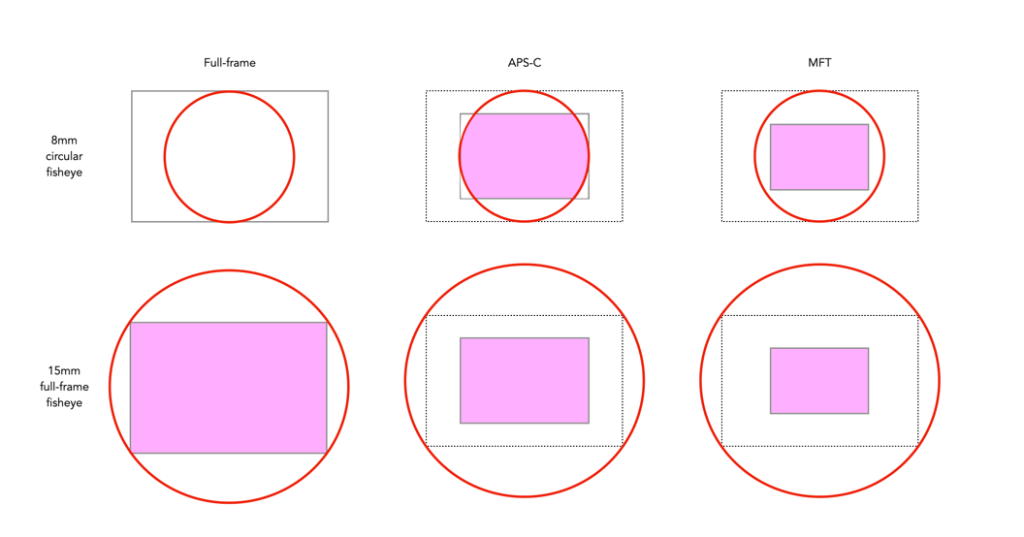
The problem arises with the fact that fish-eye lenses are different. So different that the projection itself can be one of a number of differing types, for example equidistant, and equisolid. That aside, using a fisheye lens on a crop-sensor format produces much different results. This of course has to do with the crop factor. An 8mm circular fisheye on a camera with an APS-C sensor will have an AOV (Angle-of-View) equivalent to a 12mm lens. A 15mm full-frame fisheye will similarly have an AOV equivalent of a 22.5mm lens. A camera with a MFT sensor will produce an even smaller image. The effect of crop-sensors on both circular and full-frame fisheye lenses is shown in Figure 2.
Fig.2: Picture areas in circular and full-frame fisheye lenses on full-frame, and crop-sensors
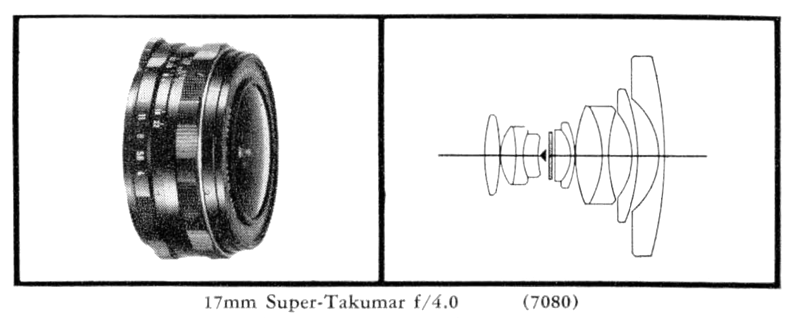
In particular, let’s look at the Asahi Super Takumar 17mm f/4 fish-eye lens. Produced from 1967-1971, in a couple of renditions, this lens has a 160° angle of view, in the diagonal, 130° in the horizontal. This is a popular vintage full-frame fisheye lens.
Fig.3: The Super-Takumar 17mm
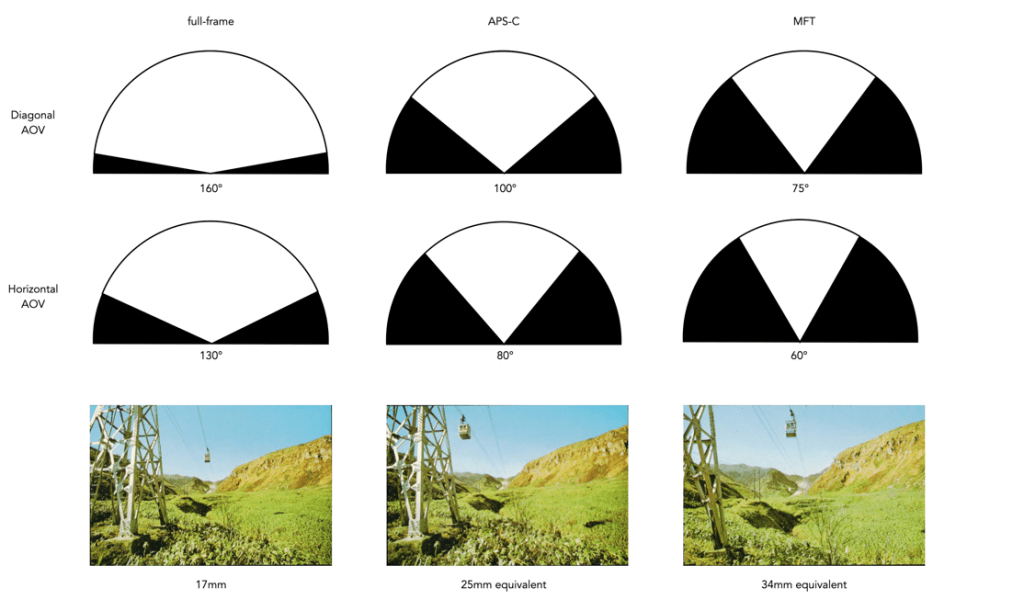
The effect of using this lens on a crop-sensor camera is shown in Figure 4. It effectively looses a lot of its fisheye-ness. In the case of an APS-C sensor, the 160° in the diagonal reduces to 100°, which is on the cusp of being an ultra-wide. When associated with a MFT sensor, the AOV reduces again to 75°, now a wide angle lens. Figure 4 also shows the horizontal AOV, which is easier to comprehend.
Fig.4: The Angle-of-View of the Super-Takumar 17mm of various sensors
The bottom line is, that a full-frame camera is the best place to use a vintage fish-eye lens. Using one on a crop-sensor will limit its “fisheye-ness”. Is it then worthwhile to purchase a 17mm Takumar? Sure if you want to play with the lens, experiment with it’s cool built-in filters (good for B&W), or are looking for a wide-angle lens equivalent, any sort of fisheye effect will never be achieved. In many circumstances, if you want a more pronounced fisheye effect on a crop-sensor, it may be better to use a modern fisheye instead.
NB: Some Asahi Pentax catalogs suggest the 17mm has an AOV of 160°, while others suggest 180°.







 Crafting Pixels