The first forays into computer designed lenses

The early years of lens design, and particularly photographic lens design, were not for the faint-of-heart. Calculations were performed using mechanical calculators, books of trigonometric tables, Fuller’s cylindrical slide rules with helical scales, and people who known as ‘computers’ as assistants. Probably the most important tool in lens design was geometrical ray tracing, a technique by which the paths of light rays emanating from a point in an object are traced through several lens elements following the laws of geometrical optics to determine the manner in which these rays recombine in the image. An ideal lens would see all rays from a point recombine a corresponding point [3].

A Fuller’s spiral cylindrical slide rule (Keuffel & Esser 4015). This had a helical scale which allowed for 50 turns around the cylinder. It was equivalent to a traditional slide rule 500 inches (12.7m) in length. They could provide results of up to 4-5 significant digits.

One of the original pioneers of the use of computers in designing lenses was Charles Wynne. The design of his revolutionary f/0.71 lens took more than two years. At the time Alan Turing, working on the Manchester computer at Manchester University was looking for some arduous tasks to test the capability of the new machine. Wynne send the provisional design for the lens, including copies of the ray-trace equations. The computer wasn’t exactly up to the task, due to something like its thermionic valves failing, so the calculations results appeared long after the prototype had been completed.

By 1955 the next generation of computers were appearing, and with increased complexity a realization that they would be required to enhance optical formulae. This lead to the creation of dedicated computers to perform lens calculations. In continental Europe, by 1953 Leitz had in operation the Z5, a relay computer from Conrad Zuse. To keep up with the number crunching needs of lens design, Carl Zeiss Jena developed a relay computer, the Oprema [6], in 1954/55 (the first in the GDR). The computer was developed by a team led by Wilhelm Kämmerer and Herbert Kortum – it took up a floor area of 55m², had 17,000 relays, and used 500km of cables. It was in operation until 1963, and reduced calculations that would have taken an hour by hand to a few seconds. On the other side of the globe in 1956, Dr. Okazaki Bunji created Japan’s first electronic computer, for Fuji [5]. Known as the FUJIC, it was designed to perform lens calculations, and supposedly was 2000 times faster than the equivalent human calculation.

Post 1955, Wynne began work on the first Atlas computer, developing programs for ray-tracing. In 1959 Wynne, with his colleague at the Wray company, Michael Nunn, published their pair of classic papers on Wynne’s invention for iterative lens design with digital computers, with work performed on a Ferranti Mark 1 [1,2]. Later work [4] continued on a Ferranti Mercury computer.

Further reading:

  1. Wynne, C.G., “Lens Designing by Electronic Digital Computer: I”, Proceedings of the Physical Society, 73(5), pp.777-787 (May 1959)
  2. Nunn, M., Wynne, C.G., “Lens Designing by Electronic Digital Computer: II”, Proceedings of the Physical Society, 74(3), pp.316-329 (Sept. 1959)
  3. Finkelstein, N.A., “Small digital computers and automatic optical design”, in Proc. Eastern Joint Computer Conference: Design and Application of Small Digital Computers, pp. 81-85 (1954)
  4. Wynne, C.G., Wormell, P.M.J.H., “Lens Design by Computer”, Applied Optics, 2(12), pp.1233-1238 (1963)
  5. Okazaki, B., “The first electronic computer in Japan: The birth of FUJIC and its death”, BIT (Tokyo), 3(12), pp.1091-1097 (1971)
  6. Winkler, J.F.H., “Oprema – The Relay Computer of Carl Zeiss Jena“, (2019)
  7. Kidger, M.J., “The Application of Electronic Computer to the Design of Optical Systems, including Aspheric Lenses”, PhD Dissertation, University of London (1971)
  8. The World’s Largest Commercial Cylindrical Slide Rule has a Scale Length of 24m, Herbert Bruderer (2020)
Why choose a vintage lens?

There are many reasons why people choose to use vintage lenses. Many just opt for the chance of experimenting with their photography. Some people buy a particular lens for the Bokeh it produces, or its level of sharpness, or just perhaps for its unique character. Some use vintage lenses as an alternative to expensive digital lenses.

They have character

From a technical viewpoint vintage lenses are not better than modern lenses – in fact from an optical viewpoint they are likely quite inferior – in theory anyways. What they are however, is much simpler in design. There is no auto-anything – manual focus is top dog, as is aperture adjustment. They also have qualities that modern lenses often try to avoid in their design, e.g. optical aberrations. Yet it is these imperfections that provide vintage lenses with one thing new lenses often lack – a sense of character. We’re talking contrast, distortion, chromatic aberrations, illumination (flaring), and vignetting. This gives the images created a very distinctive look (although likely not as distinctive as it would coupled with various types of film). Sometimes this is in the way they render out-of-focus regions in a image or perhaps the sharpness of the image, or colour-rendition. Some people like to use vintage lenses because they produce nice contrast, or have nice bokeh, but it is all highly subjective. One person’s “bokeh-monster” will be another nightmare.

Some people may choose to use only vintage 50mm lenses. You may question why someone needs half a dozen different 50mm lenses, but the reality is that they may all have unique, noteworthy attributes. Many manufacturers produced a number of 50mm lenses at any given time, all with differing characteristics. For example, they may have used different (i) lens formulae, (ii) optical glass, (iii) aperture system (e.g number of blades), or (iv) lens speed. A lens is the sum of all its characteristics, not just the focal length.

They are (mostly) available at a good price

One of the main reasons people like to choose vintage lenses is affordability. Most vintage lenses fall into the “reasonably priced” category, usually somewhere in the range of US$80-250. It’s hard to talk too specifically about lens prices because of the broad range of lenses. However within the scope of a particular lens it is also possible to have a wide gamut of prices usually largely dependent on the condition of the lens. There are a lot of good vintage lenses that don’t get a lot of coverage that are extremely well positioned from a price point.

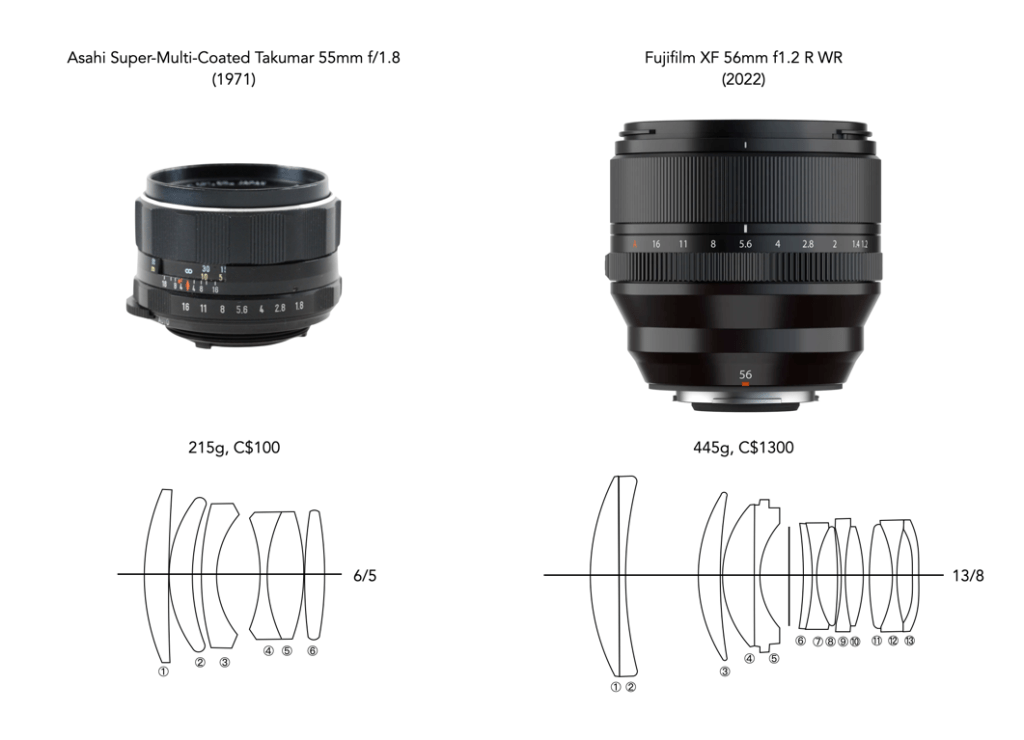
There are of course some vintage lenses that are expensive, but that is usually because they are (i) rare, or (ii) too popular. For example superfast 50mm f/1.2 lenses are not cheap, but you probably don’t need a superfast lens. Others, like say the Zeiss 50mm Pancolar, is expensive because it is well known to be a good lenses. Sometimes a good lens will be talked up by someone in a video – this causes a run on them, and hence pushes up the cost. Some lenses like the Pancolar 55mm f/1.4 are so rare they are often advertised in the C$3-5K range. Vintage lenses are often chosen as an alternative to modern lenses, or perhaps to try out a lens of a certain focal length before buying a modern version. For example, an 85mm equivalent for the Fuji-X system would be the Fujifilm XF 56mm f/1.2 R WR, which retails for about C$1300. It is possible to get an Asahi Super-Multi-Coated Takumar 55mm f/1.8 for about C$100 – slightly slower, but less than 10% of the cost.

They are well built (but can have some flaws)

Lenses of a certain vintage are built like proverbial tanks. Many of those built prior to 1970 are predominantly made of metal and glass. It was in the 1970s that plastics started to creep into the manufacturing process. There are pros and cons to each. More recent vintage lenses likely have lens coatings and optics that are much better than older lenses whereas earlier 35mm lenses featured solidly build body’s with aluminum lens barrels and stainless steel mounts. Of course not all vintage lenses are worthy. The downside is that vintage lenses can suffer from any number of maladies, some superficial like cosmetic scratches on the barrel, some affecting the functionality such as stiff focusing ring, and others more serious affecting the optical surfaces of the lens, e.g haze, scratches, and fungus. The other thing to think about is weight. Modern lenses typically have a lot more optical elements, and hence are larger and heavier than most equivalent vintage lenses.

They provide an education

One of the issues with digital cameras is that so much is automated. That’s not a bad thing in a lot of situations because it allows you to concentrate on framing the shot. However because of this, the inner workings of the camera are sometimes lost to the photographer. Using vintage lenses means you have to gain a more intimate understanding of how apertures work, and master the art of focusing. However on the flip-side you do gain better control of the photographic process.

They are eco-friendly

Lastly, using vintage lenses is very eco-friendly. The lenses already exist, and apart from buying an adapter, which can be used for any vintage lens with the same mount, there is very little in the way of a carbon footprint (save postage if bought online). Well-built products, have a longevity that keeps them out of landfills. Vintage lenses are inherently sustainable for a number of reasons: (i) No requirement for more materials to build the lenses (plastics, electronics, glass); (ii) Little to no pollution; and (iii) Interchangeability, i.e. the same lens can be used on different cameras, and so changing systems only means acquiring a new adapter.

The origins of Asahi’s Takumar

In the days of film cameras, every company had it’s own way of “naming” cameras and lenses. This made it very easy to identify a lens. Asahi Pentax had the ubiquitous Takumar (TA-KOO-MA) name associated with its 35mm SLR and 6×7 lenses. The name would adorn the lenses from the period of the Asahiflex cameras with their M37 mount, through the M42 mount until 1975 when the switch to K-mount came with a change to the lens branding.

Asahi was founded by in 1919 by Kumao Kajiwara as Asahi Optical Joint Stock Co. Asahi began making film projection lenses in 1923, and by the early 1930s was producing camera lenses for the likes of future companies Minolta (1932), and Konica (1933). In 1937 with the installation of a military government in Japan, Asahi’s operations came under government control. By this time Kajiwara had passed away (it is not clear exactly when), and the business passed to his nephew Saburo Matsumoto (possibly 1936?). It was Matsumoto who had the vision of producing a compact reflex camera. In 1938 he bought a small factory in Tokyo and renamed it as Asahi Optical Co. Ltd.

It seems as though the lens series was named in honour of one of the founders brother, Takuma Kajiwara. There might have been the analogy that photography was a means of painting with light, and lenses were like an artists brushes. On a side note, the name Takuma in Japanese is an amalgam of “taku” meaning “expand, open, support”, and “ma” meaning “real, genuine”.

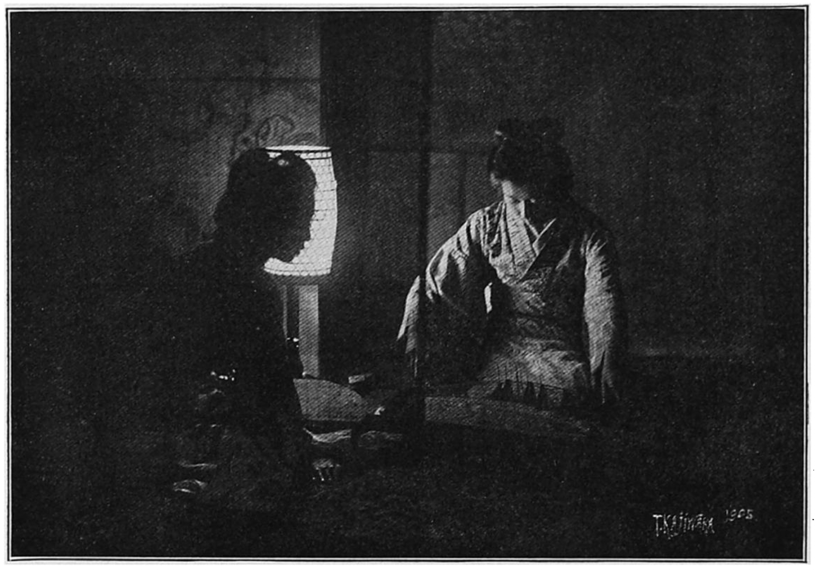
A photograph by Takuma titled “Domestic Life in Japan”, published in the September 1905 issue of Brush and Pencil (“St. Louis Art at the Portland Exposition” XVI(3), p.75).

Takuma Kajiwara (1876-1960) was a Japanese-American photographic artist and painter who specialize d in portraits. Born in Kyushi, Japan he was the third of five brothers in a Samurai family. Emigrating to America at the age of 17, he settled in Seattle, and became a photographer. He later moved to St.Louis and opened a portrait studio, turning from photography to painting. In 1935 he moved to New York. In 1951 he won the gold medal of honour for oils from the Allied Artists of America for his expressionist painting of the Garden of Eden titled “It All Happened in Six Days”. Takuma himself had an interest in cameras, patenting a camera in 1915 (Patent No. US1193392).

Note that it is really hard to determine the exact story due to the lack of accessible information.

Are all 50mm lenses equivalent?

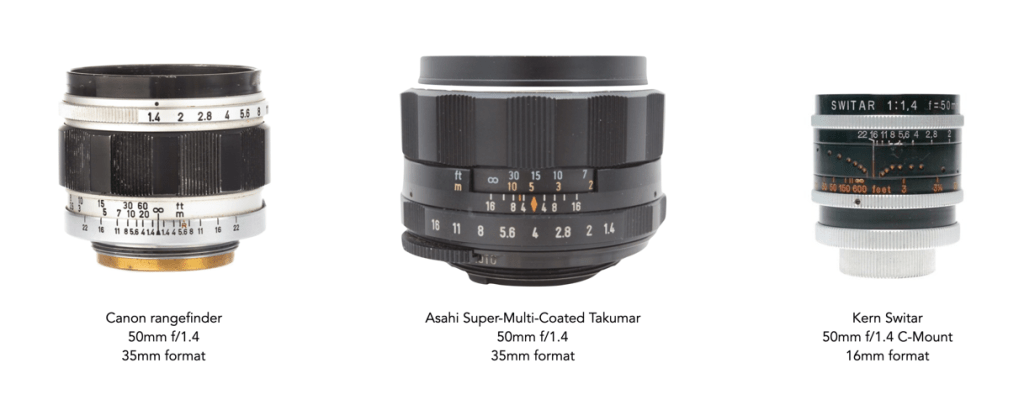
So a 50mm lens is a 50mm lens, is a 50mm lens, right? Well that’s not exactly true. The focal length of a 50mm lens is always 50mm, regardless of the system it is associated with. The focal length of a lens is independent of the camera system. So a 50mm lens on an SLR will have the same focal length as a 50mm lens on a DSLR, which is the same as one on an APS-C sensor, or a medium-format sensor. What is different is how they behave in terms of angle-of-view (AOV), with respect to a particular sensor size.

Fig.1: 50mm lenses all have the same focal length

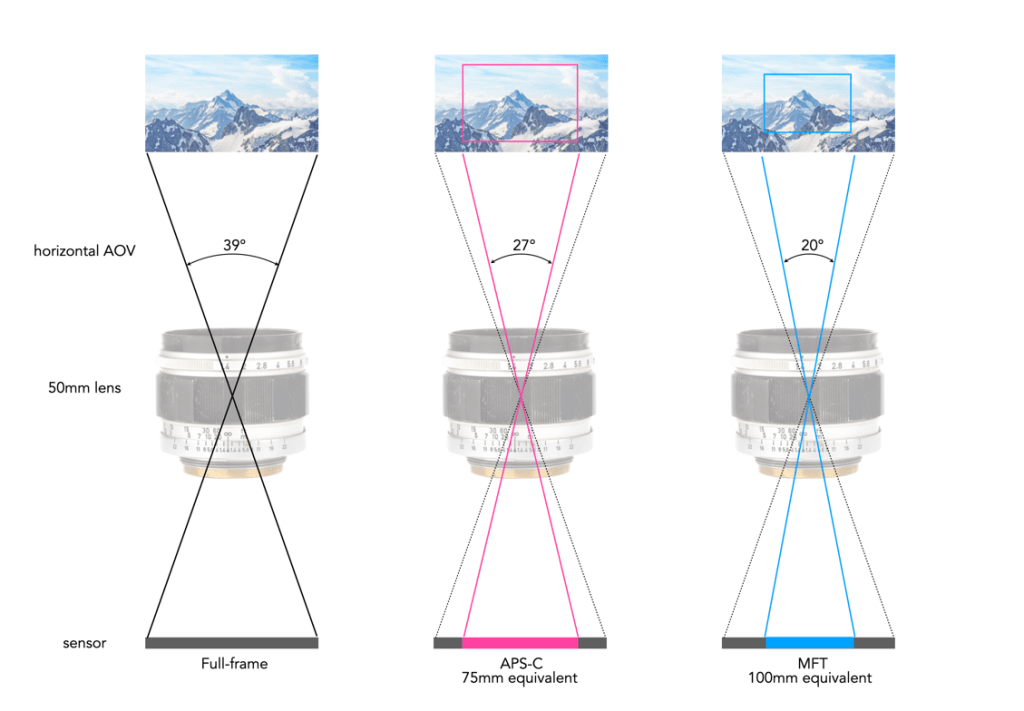
Table 1 shows the behavioural differences of 50mm lenses on various systems. For example a 50mm lens from a 35mm rangefinder camera has a (horizontal) AOV of 39.6°, whereas the AOV of an APS-C camera, is 26.6°. This is because due to crop-factors, a 50mm lens on an APS-C sensor is equivalent to a 75mm on a full-frame camera (from an AOV perspective). To get a 39.6° equivalent AOV on an APS-C camera, you need roughly a 33mm lens – but the closest lens to this is a 35mm APS-C lens (35mm×1.5≈52mm).

SystemAOV (diag)AOV (hor)Crop-factorFF equiv.
16mm cine14.5°11.7°×3.4170mm
1″ sensor18.2°14.6°×2.7135mm
Micro-Four Thirds24.5°19.6°×2.0100mm
APS-C31.7°26.6°×1.575mm
film SLR46.8°39.6°×1.050mm
film rangefinder 46.8°39.6°×1.050mm
digital SLR (full-frame)46.8°39.6°×1.050mm
digital Medium (44×33mm)57.4°47.5°×0.840mm
6×7 (72×56mm)84°67.6°×0.525mm
4×5”117°104°×0.2713.5mm
Table 1: Differences in 50mm lenses used on different systems

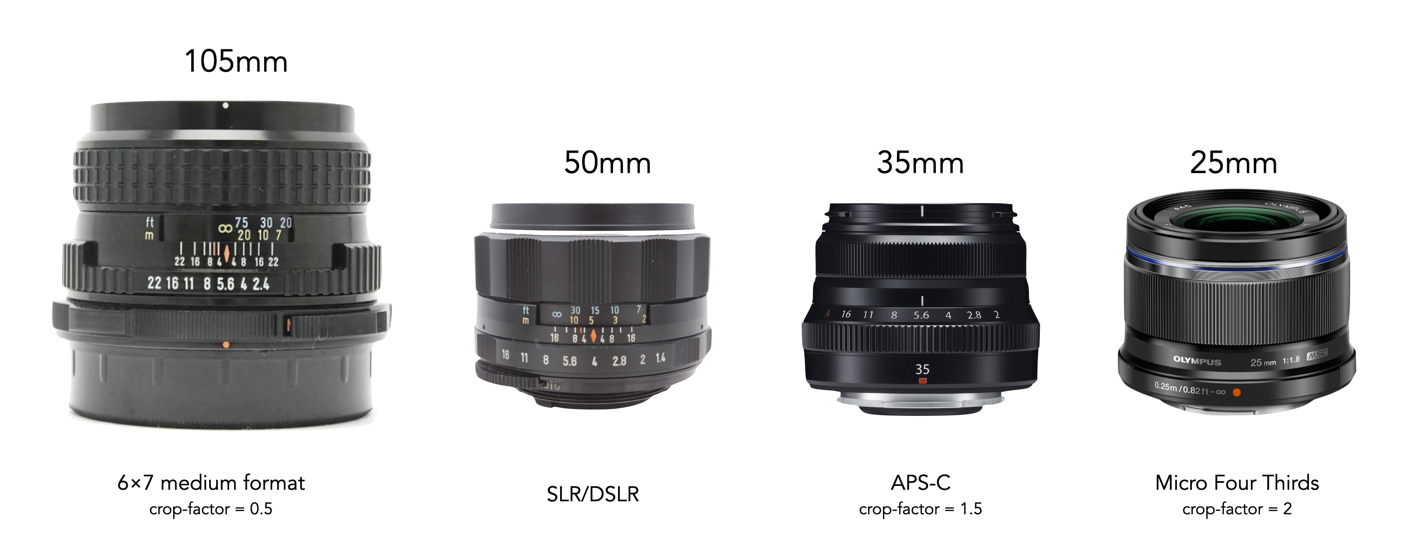
Note that because a 50mm lens on a Micro-Four-Thirds camera behaves like a 100mm FF lens, most manufacturers won’t sell a native 50mm MFT lens, opting instead for the 50mm FF equivalent – the 25mm. That’s because a 25mm MFT lens provides the “normal” angle-of-view, just like a 35mm APS-C lens, or a 100mm 6×7 lens. A vintage 50mm SLR lens used on an APS-C camera will behave like it was designed for APS-C, i.e. it will have a horizontal AOV of around 26.6°. The remaining 6.5° either side is just cut off because of the smaller sensor (as shown in Figure 2).

Fig.2: A visualization of what a 50mm lens sees on different sensors.

Invariably, all focal lengths are treated similarly. A 35mm is always 35mm, an 85mm is always 85mm. It’s just their behaviour, or rather their “view on life”, that changes.

What is a “normal” lens anyway?

A “normal lens” for a 35mm camera, either film or digital generally refers to a lens with a focal length of 50mm. When you look through the viewfinder of a camera with a 50mm lens attached, the scene looks about the same as it does with the naked eye. Although a 50mm focal length is considered to be a normal lens for a 35mm film or DSLR camera, the same could not be said for all other formats. That’s why you don’t see a lot of 50mm lenses for Micro-Four-Thirds (MFT). A 50mm lens on MFT behaves likes a 100mm full-frame lens, because of the crop-factor, or basically because the sensor size is smaller. Of course “normal” lenses on a 35mm format camera are not exactly pigeonholed into a single focal length, instead they range anywhere from 40mm to 60mm (although this too may differ slightly depends on who describes it).

The standard idea has always been that the focal length of a normal lens should be about the same as that of the diagonal of the film frame/sensor, i.e. the measured distance from one corner of a negative’s frame to the corner diagonally opposite, in millimetres. For example the diagonal of a 36×24mm full-frame is 43mm (although most SLR cameras use a 50mm lanes as “normal”). Even other formats don’t hold true to this mathematical idea. The Olympus PEN F, half-frame camera should have a standard lens of 30mm, however the three lenses offered are instead the 38, 40, and 42mm, equivalent to 55/58/60mm (on a 35mm camera) respectively (there were also 25mm lenses, but they were considered wide angle).

Every different sized sensor has it’s own “normal” lens. Here is a list of normal focal lengths (FL) for various film/sensor sizes (D=digital; F=film), based on commonly used lenses for each system:

FormatDimensions (mm) H×WDiagonal (mm)Normal lens (mm)
16mm cine (F)7.5×10.312.725
Micro-Four-Thirds (D)13×17.321.6325
APS-C (D)15.1×22.727.335
Half-frame 35mm (F)24×183028
APS-C (F)16.7×25.130.128 (+30)
35mm film/DSLR (F,D)24×3643.350 (+55, 58)
Medium (D)33×445565
645 (F)56×4271.875
6×6 (F)56×5679.280
6×7 (F)56×6787.3105
5×4 (F)93×118150.2150

Ultrafast lenses – the Noctilux 50mm f/1

After Canon and Nikon gave up on their sub-f/1.1 lenses, there was a lull for a while. In all possibility it was likely considered that film would just get so fast there would be little need for these light behemoths. But high ISO film was only introduced in the mid to late 1970s – Fujicolor 400 (1976), Kodakcolor 400 (1977). Indeed faster films begat faster lenses.

The Leitz 50mm Noctilux f/1 for Leica M cameras appeared in 1976, designed by Walter Mandler (1922-2005) and produced by Ernst Leitz Canada. It was a successor to the earlier Noctilux f/1.2. Bob Schwalberg reviewed the lens in 1976 [1]. His observation was that it had a high optical contrast and almost no flare at f/1, “outimaging” its compatriots the Noctilux f/1.2 and the Summilux f/1.4.

The lens was manufactured for a long time, from 1976-2007. The name Noctilux, was designated for three lenses with differing apertures:

  • Leitz Noctilux 50mm f/1.2 aspherical (1966-1976).
  • Leitz/Leica Noctilux-M 50mm f/1.0 (1976-2007).
  • Leica Noctilux 50mm f/0.95/50mm ASPH (2008- )

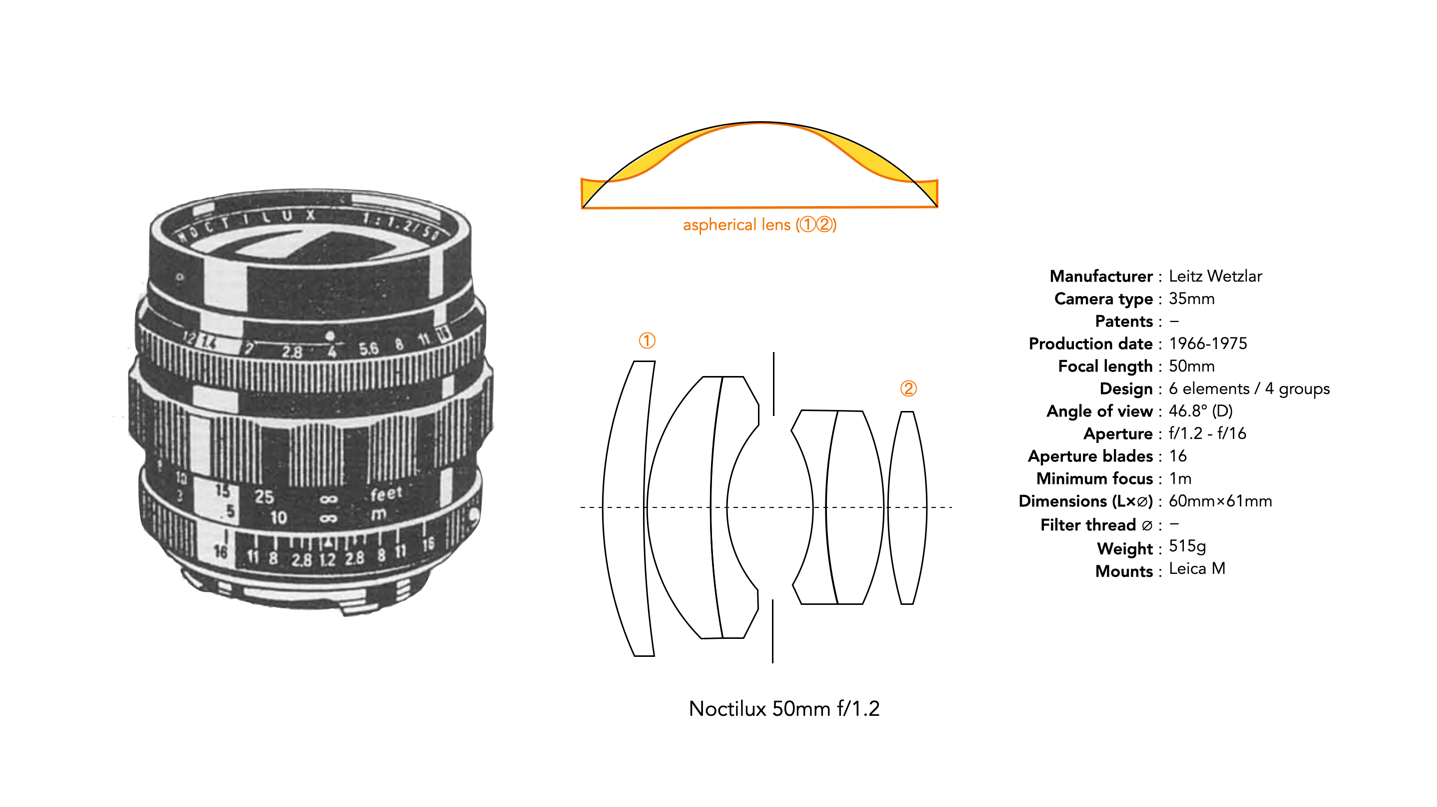
The lens was constructed using only spherical curvatures, as opposed to the f/1.2 which used two aspherical surfaces with a 6/4 design. The earlier design was likely changed because the aspherical lenses were too expensive to manufacture. The f/1 uses a modified Gauss design of seven elements in six groups with an “air-lens” between the second and third elements. The second and fifth elements were made using Noctilux 900403 glass. The 1st, 6th, and 7th elements were made with Lanthanum glass (LaK12, LaF21). The 900403 glass, developed at the Leitz Glass Laboratory had a higher zirconium oxide content giving it a refractive index of 1.9005 and a dispersion value of 40. (This glass had a melting point of 1600°C, and had to be cooled in a controlled manner over 10-12 days).

But it was no light lens. It was 63mm in diameter, and weighed about 600g. It still suffered from the one thing all ultrafast lenses suffer from – a narrow DOF (2” at 5 feet). When released it sold for US$855. They now routinely sell for C$8,000-11,000.

References:

  1. Bob Schwalberg, “50-mm Noctilux f/1: Sharpest superspeed lens yet?”, Popular Photography, 78(2), pp. 80,81,105 (1976) Dominique Guebey Jungle, “Leitz Noctilux 50mm f:1.0”

Further reading:

Superfast lenses – the original Noctilux 50mm f/1.2

When it was released in 1966, the Leica Noctilux 50mm f/1.2 was an altogether different animal. It was great at shooting in low light, expensive and difficult to make. That’s probably why less than 2000 were made. By the mid 1960s, there were a number of players in the sub-f/1.4 field, primarily for shooting in low light. Nikon, Canon, and Minolta all had f/1.2 lenses. Work on the use of aspherical elements in lenses began in the late 1950s.

The Noctilux 50mm f/1.2 was produced from 1966 until 1975, and was the worlds first lens to feature aspherical elements. The name Noctilux is a combination of Nocti, which is derived from the word nocturnal, while Lux is Latin for light.

“Even at f/1.2 the NOCTILUX produces so very little flare that strong light-sources are imaged with only minimum halo surround. Brightly back-lighted subjects, anathema to poorly corrected high-aperture lenses, have clear, accurate outlines.” [2]

This was supposedly the first Leitz lens to sacrifice some resolution in order to gain contrast. Bill Pierce who wrote a brief article on the new lens in 1967 remarked: “To the best of my knowledge, rather extensive in this tiny field, none previous to the Noctilux could deliver a clean, biting journalistic image at maximum aperture.” [1]

“Superior optical contrast due to high correction for coma and all other critical aberrations and due to freedom from internal reflections, make the NOCTILUX the ·ideal high-aperture lens for use with high-speed available-light films.” [2]

The first prototypes were made in April of 1964 Designed by Helmut Marx and Paul Sindel (Helmut Marx was Professor Max Berek’s successor as head of the photographic lens design in Wetzlar, and creator of the first Summicron 50 in 1953). The Noctilux 50mm f/1.2 was released in 1966. The Leica Noctilux 50mm f/1.2 is a 6-element Gauss variant with 4 members. It has two aspherical elements (front and rear) which were made on a specially built grinding machine that had to be operated manually. There was only one machine, and only one person capable of operating it (Gerd Bergmann), so many elements had to be discarded as rubbish.

It was sometimes claimed to be the fastest production lens in the world, because other manufacturers lenses often proved to be slower than indicated. After the release in 1966 there was much research to produce an f/1 version of the lens with 3 Aspherical elements, but in 1970 the project was abandoned because the aspherical technology was in its infancy, and the production costs were immense. The f/1.2 lens remained in production until only 1975 with 1757 units produced. A new version of the lens, the Noctilux-M 50mm f/1.2 ASPH was released in 2021, with the construction only minimally changed. The new lens sells at US$7900, which is a bargain considering the old lens can sell for upwards of $US70,000.

References:

  1. Bill Pierce, “Because it was possible”, Popular Photography, 60(1), p.135-156 (1967)
  2. Leica brochure, “50mm NOCTILUX f/1.2

Further reading:

The other NASA lens – the Angenieux f/0.95

Before the Zeiss f/0.7 there were other lenses used in the space race. The Ranger program was a series of unmanned missions to space launched by NASA in the early 1960s, primarily to obtain the first close-up images of the surface of the moon. Ranger 1, launched in August 1961 failed to launch. It was not until Ranger 7, launched in July 1964, that the first high-resolution images of the lunar surface were obtained.

The mission carried six lenses, two wide-angle, and four narrow-angle that transmitted on two channels. The F (for full) system had one wide-angle and one narrow-angle camera. The P (for partial) channel had 4 cameras: two wide-angle and 2 narrow-angle. The images provided better resolution than was available from Earth based views by a factor of 1000. All 6 cameras were RCA-Vidicon slow scan TV cameras using C-mount optics.

Three of the cameras (A,P3,P4) had a 25mm f/l lens and three had a 76mm f/2 lens [1]. The wide-angle lenses used were made by French optical company Angenieux and were 25mm M1 lenses with an adapter attached to mount them to the Vidicon cameras. Strangely enough the NASA documentation specs [1] these lenses out with f/1.0 apertures, but these lenses seem to actually be f/0.95.

The P.Angenieux Paris 25mm f0.95 Type M1 was developed in 1953. The patent for the lens, was issued in 1955 [2]. It is a 8 element lens in 6 groups. It is derived from the Gauss-type, from which is differs by the fact that each of the front lens, and the rear lens is subdivided into two lenses. This allows for the increase in relative aperture while retaining good correction for spherical aberrations.

You can still pick up one of these lenses today for circa US$500.

Further reading

  1. Ranger VII Photographs of the Moon Part I: Camera “A” Series, Jet Propulsion Laboratory, California Institute of Technology (August 27, 1964)
  2. Pierre Angenieux, “Large Aperture Six Component Optical Objective”, US Patent #2,701,982 (Feb.15, 1955)
  3. Adorable 25s – 25mm F0.95 Speed Lens Comparison on Lumix GH3, 3D-KRAFT! (Feb. 2013)

Ultrafast lenses – the Simlar 50mm f/0.7

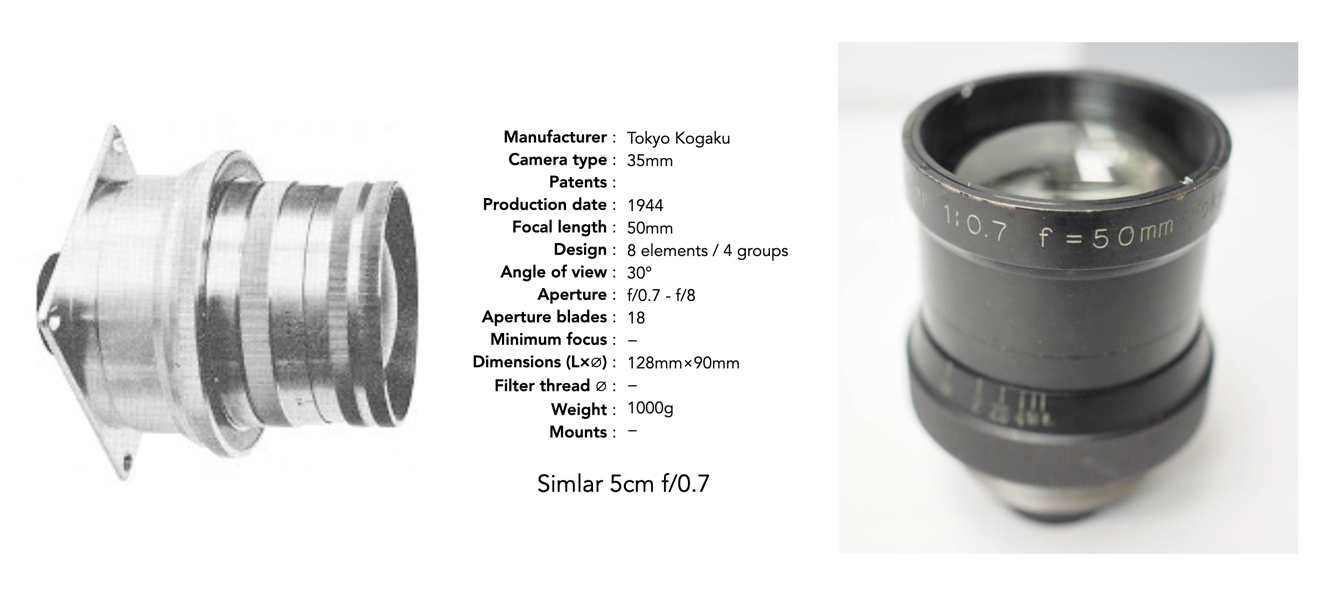
The Zeiss 50mm f/0.7 Planar was not the only f/0.7 lens of the period. There was also the Simlar 50mm f/0.7. The Simlar lenses were made by Tokyo Kogaku, which would eventually become Topcon (Japan). The original lens was designed by Maruyama Shūji. The story of the lens originates from the December 1951 issue of Asahi Camera [1]. It was ordered by the Japanese Army for use in nighttime reconnaissance photography, and was completed in 1944. Before it could be used for its intended purpose, the copies of the lens were claimed by the Aeronautical Engineering Institute of Tachikawa for X-ray medical photography. The article suggests ten copies were made by wars end, but their fate is unknown except for one lens kept by Maruyama Shūji.

A second, postwar version of the camera was produced in 1951 – the dimensions and the weight had both changed (123.7mm×105mm ∅, 2.5kg). Only three copies of the lens were made, of which two were supposedly used on a Antarctic expedition by the Mainichi Newspaper. The Trade and Industry of Japan publication from 1955 shows the lens.

The strange thing about the second series is that the weight of the lens changed from 1kg to 2.5kg, which is a substantial increase. I would beckon to suggest that the design of the original series was copied from either the wartime Zeiss objective, or perhaps the Herzberger objective. When the war was over, there was either issues with using the patent, or an inability to obtain the proper glass, adding extra weight. However there does not seem to be any surviving pictures of the second series.

For those interested, here is a link to another lens, the Simlar-F 180mm f/1.5 produced in 1942. It provides a sense of the aesthetics of the Simlar lenses.

Further reading:

  1. Asahi Camera December 1951. “Toki no wadai: Hachi-nen mae ni Nihon de dekite ita F0.7 no renzu” (時の話題・八年前に日本で出来ていたF0.7のレンズ, Topic of the time: An f/0.7 lens made in Japan eight years ago). P.84.
  2. Topcon Club – Lenses

Rear Window – the “other” camera?

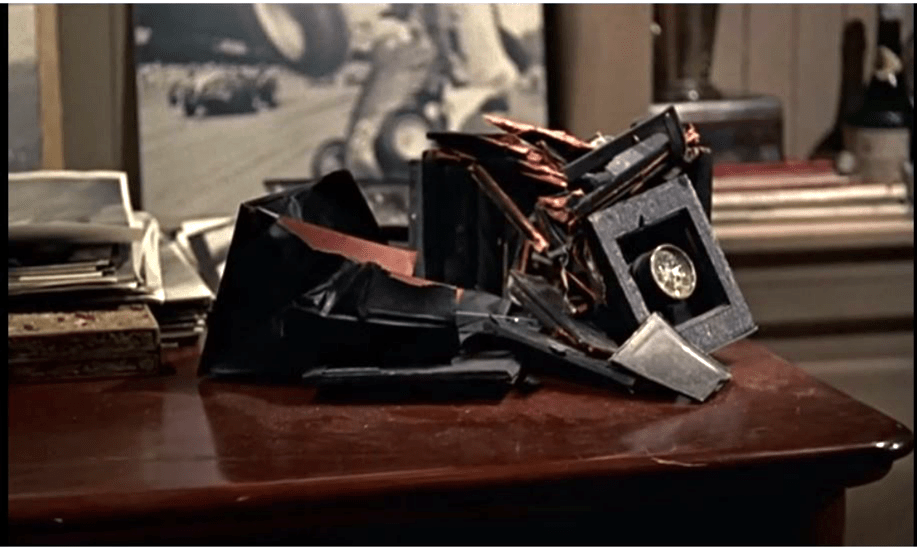
Although L.B. “Jeff” Jefferies used an Exakta camera in Hitchcock’s “Rear Window”, there were other cameras present in the room – most notably the one that took the photograph on the racetrack that lead to Jeff being in a wheelchair with a broken leg. What was that camera?

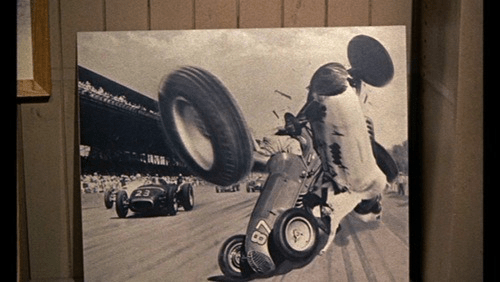
From the image shown it is clear that it is a large-format camera, most likely a Graflex Speed Graphic, a type of press cameras. As the name implies, these cameras were mainstays of press photographers until the 1960s, cumbersome but often preferred for their large negatives which allowed extensive cropping and enlargement without loss of detail. Considering the closeness of the shot taken by the camera on the track, it is a wonder Jefferies survived at all.

The broken Graflex camera?
The photo of the crash