Ernst Ludwig Optisches Werk Weixdorf Objektive was established in 1924 in Lausa near Dresden by Ernst Ludwig. The town of Lausa merged with the neighbour town of Weixdorf in 1938. Pre-war lenses are usually marked with Ludwig Lausa Dresden. The company made cameras for various types of cameras, e.g. 35mm viewfinders and SLRs. After the war, production resumed quickly, as the factory was undamaged, with Ernst Ludwig still at the helm.
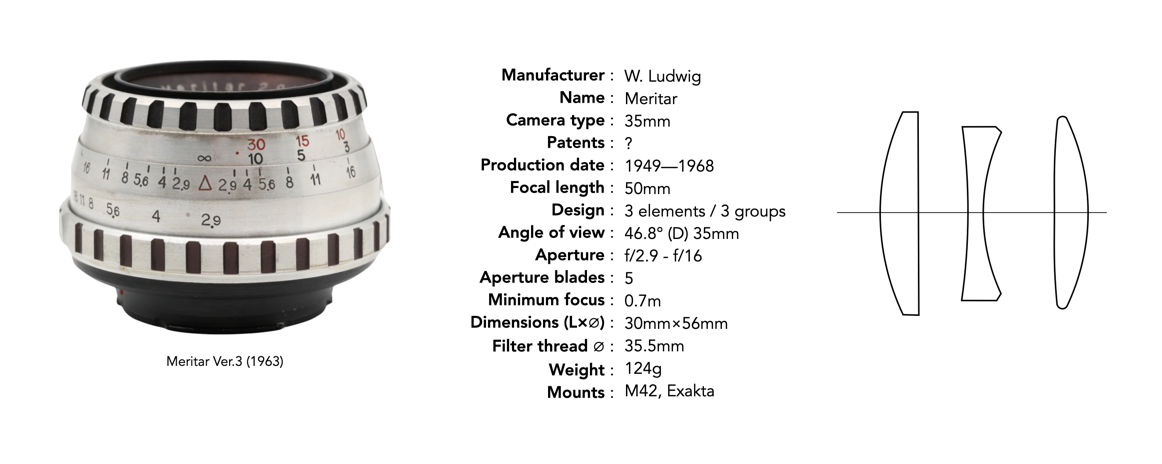
Fig.1: The most famous Ludwig lens, the Meritar 50mm
The company produced a number of different, inexpensive lenses, but is likely best known for the Meritar 50mm. With the introduction of the EXA camera in 1951, Ludwig became an original supplier, along with Carl Zeiss Jena, and Meyer Optik. The Meritar was a cheap lens using three air-spaced elements, i.e. the Cooke triplet. Lenses were produced with the Exakta mount for the Ihagee cameras, and some in the M42 mount. The Meritar 50mm f/2.9 was derived from the Victar could be manufactured inexpensively and therefore harmonized very well with the new, inexpensive Exa SLR. It was initially a manual lens, but eventually upgraded to preset diaphragm (1957).
The Meritar was a cheap lens. To put this into context, in the late 1950s the f/2.9 sold for 52 DM, whereas a basic Tessar 50mm f/2.8 was 139 DM, the Biotar 58mm f/2 305 DM. In fact the 3-lens Meritar was considered to be the cheapest lens outfitted on the EXA. In fact EXA + Meritar always offered the cheapest combination until production of these lenses ceased in the early 1970s. Although by 1961, there were eight standard choices for 50mm lenses for the EXA (II), all of but of which were faster.
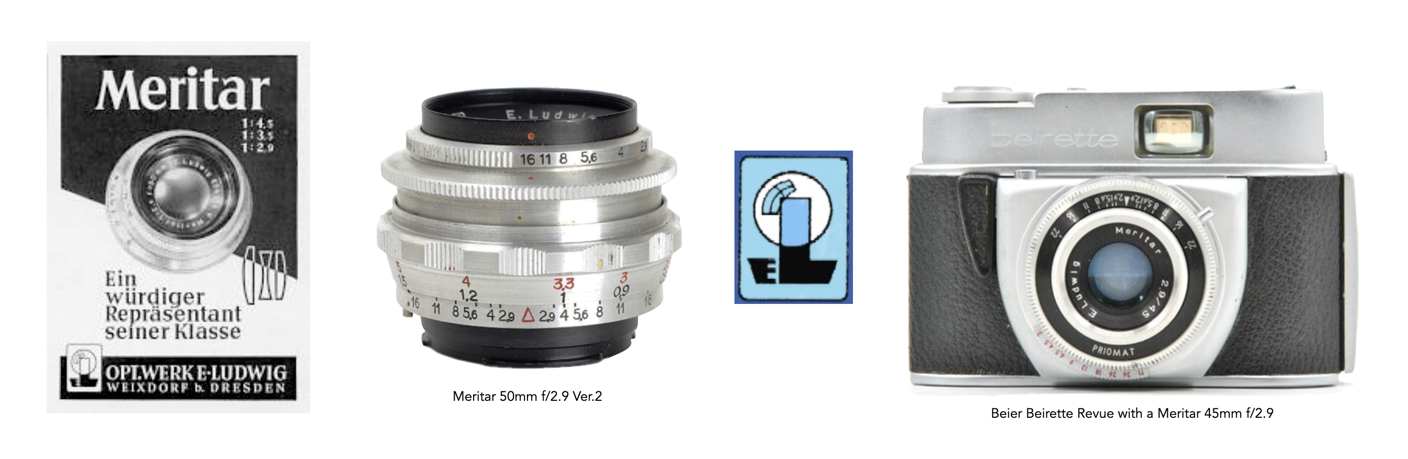
Fig.2: Ludwig produced few advertisements, and produced a lot of inexpensive lenses for the likes of viewfinders cameras
Prior to the Meritar series, the company produced other lenses including the Victar 5cm f/2.9 (Exakta, Praktiflex), Victar 75mm f/2.9 (Reflex-Korelle) and Peronar 50mm f/2.9 (Exakta). Victar and Meritar were also used in cameras with central shutters (Beier Precisa, Beirax). In 1959 the East German state ‘acquired’ a small stake in the company, with Ludwig still at the company until 1968. In 1972 the company became the state owned VEB Optisches Werk Weixdorf, and in 1980 it was absorbed by the VEB Pentacon.
“Naturally I take full advantage of the possibilities of different lenses, but I don’t carry a suitcase full of them: an Elmar 50mm, a wide-angle 35mm, and an 85mm − these are my tools, with, of course, the latest, the f/1.5, for night photography. I take advantage of these various depths, I open or close the shutter, or I leave a full aperture: it depends on my needs.”
‘A Reporter, Interview with Daniel Masclet (1951)’ in Henri Cartier-Bresson, Interviews and Conversations 1951-1998, p.13 (2017)
The Mecaflex is a 35mm SLR made by German designer Heinz Kilfitt, who is better known for having designed the successful Robot camera, and high precision lenses such as the Macro Kilar, and Voigtländer Zoomar (the first 35mm zoom lens). Presented at Photokina in 1951, it was first sold in 1953, they were manufactured for Kilfitt by Metz Apparatefabrik located in Fürth, Bavaria (West Germany). Production by Metz continued until 1958 but few units were actually built. Metz, dissatisfied with the collaboration withdrew from the partnership shortly afterwards. Production then shifted to Société d’Etude et Recherche Optique et Acoustique (S.E.R.O.A.) a camera maker in Monaco. This camera is better known as the Kilfitt Mecaflex, with the lenses also produced by Kilfitt.
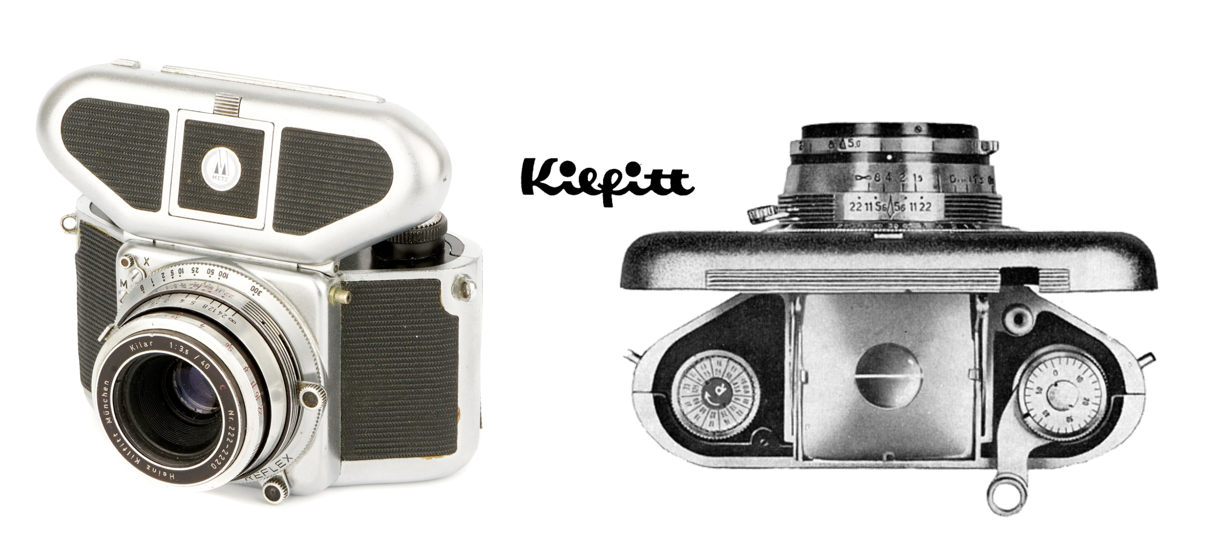
Fig.1: The Mecaflex camera
It was a very aesthetically pleasing and compact camera at 9×6.5×6.5cm. However it was quite heavy at 700g. It had a flip-top cover which gave it very clean lines when closed. When opened to 90 degrees, the cover revealed the waist-level viewfinder and top-plate controls. The size of its exposures was a smaller 24×24mm, providing for more images on a film roll (some 50). One of interesting features was an early spring-loaded diaphragm. When the shutter and spring-loaded diaphragm mechanism of the Mecaflex are cocked, a bright, parallax-free ground-glass image appears, and this remains bright until the shutter is released. A push-up finder was also provided as an accessory. which could be inserted into the viewfinder
Like many other West German cameras, it too incorporated a Prontor behind-the-lens leaf shutter with speeds of 1 to 1/300s (+B). The camera had a bayonet mount, and used lenses designed by Kilfitt, and it was usually paired with a Kilar 40mm f/3.5 or f/2.8. The other lenses were the 40mm Makro-Kilar’s and Tele-Kilar 105mm f/4.5. Some additional lenses were made under license by SOM Berthiot (Paris). The camera was produced until 1958. It is possible to still find these for around C$1300-2000.
Specifications:
Type: 35mm SLR camera Manufacturer: Metz (West Germany) ver.1, Kilfitt ver.2 Model: Mecaflex Production period: 1953−1958 Format: 24×24mm on 135 film Lens mount: bayonet Standard lens: Kilar 40mm f/3.5 Shutter: leaf-shutter, Prontor-Reflex behind-the-lens Shutter speeds: 1 to 1/300 sec., B (1 to 1/250s, B in the SEROA camera) Viewfinder: waist-level viewfinder + central split-image rangefinder Mirror: yes Exposure meter: − Flash synchronization: X, M Self-timer: − Aperture control: − Film advance: lever wind Weight/dimensions: 700 grams / 900×650×650mm
“The 50mm. Not the 35mm: it’s too big, too wide! With that, photographers all think they are Tintoretto. Even if everything is sharp, it is still a distortion. With the 50mm, you keep a certain distance. I know, they are going to say again that I am ‘classic’. I don’t care: to me, the 50mm remains the closest thing there is to the human gaze. You can shoot everything with it − streets, landscapes, or portraits. When you have the eye of a painter and a visual grammar, you work with a 50mm without even thinking that with a 35mm you’d get more depth of field. Painting, drawing, photography, documentary film: to me, it’s all one.”
‘We Always Talk Too Much, Conversation with Pierre Assouline (1994)’ in Henri Cartier-Bresson, Interviews and Conversations 1951-1998, p.134 (2017)
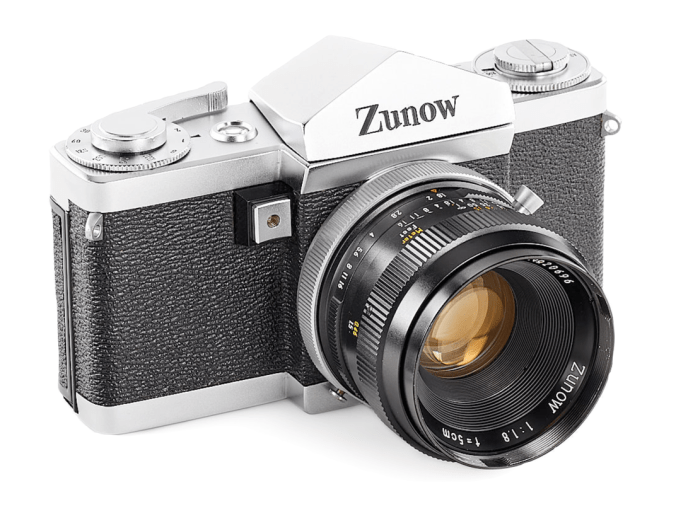
Zunow was a Japanese company best known for it’s innovation in superfast lenses. During the last few years of its existence, the company designed a couple of camera’s including a prototype of a Leica copy, the Teica, and their first 35mm SLR, the Zunow Pentaflex or ‘Zunowflex’. Work on the camera supposedly began around 1956, but it was only produced for a short time, from 1958-1959). The Zunowflex had a compact design, inspired by the likes of the Miranda T, or even the Praktina.
The design of the Zunow Pentaflex was initiated by Kiyoshi Arao, the managing director in charge of technology who had been transferred from Chiyoda Kogaku Seiko Co., Ltd. Zunow Optical was originally a lens factory with no experience in camera bodies, and Arao himself had little experience with 35mm SLRs, so went on to study the Miranda. Arao would leave the company due to conflicts around the time of the camera’s release (joining Mamiya Optical). The camera was first announced in the April 1958 issue of the monthly magazine Shashin Kōgyō.
This camera brought solutions to many of the issues outstanding with SLRs together into one camera. It was a very aesthetically pleasing camera, with a streamlined look, that would become normal for cameras in the 1960s. The elegant look was designed by Kenji Ekuan from GK Industrial Research Institute. Ekuan was an industrial designed best known for designing Kikkoman’s iconic soy sauce bottle, and a series of Japanese trains. The design was started from a completely new idea, taking the spirit of ancient Japanese “Noh” as its model, combining complex mechanisms into a simple and concise form.
Fig.1: The Zunow SLR with a Zunow 5cm f/1.8 lens
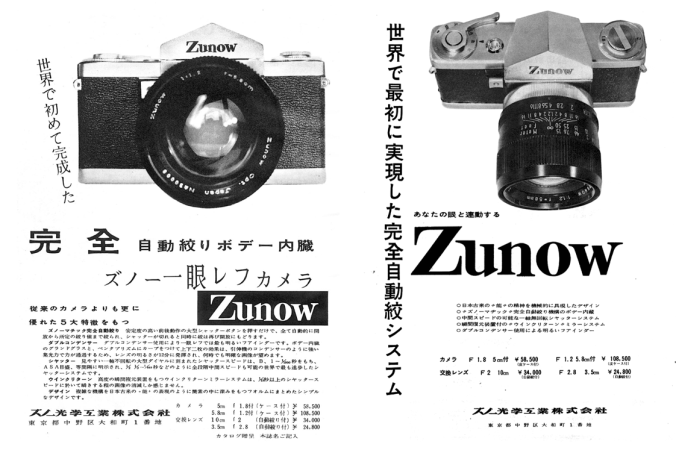
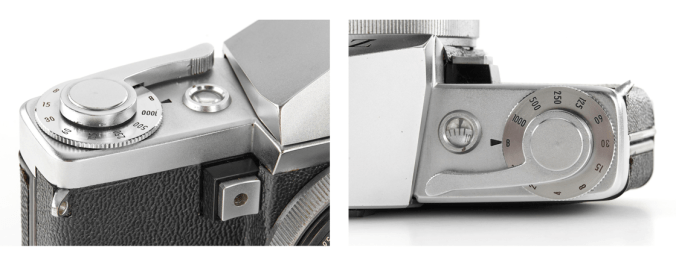
Where it broke from convention was the fact that the shutter release was front mounted, similar to how the Exakta and Miranda cameras were laid out, and the speed dial was situated beneath the wind lever, a concept which didn’t appear until much later on the Canon AE-1. It had a removable pentaprism, and interchangeable focusing screens. Supposedly a waist-level viewfinder was also available. It also had a right-hand front shutter release, and a lever wind, not found on many SLRs of the period (except for the Exakta which was left-handed, the Mecaflex, and the Asahi Pentax). The camera had a focal-plane shutter with speeds from 1 to 1/1000 sec, plus B.
It was the first Japanese camera to have an internally coupled automatic lens diaphragm, the “ZUNOWmatic” diaphragm system, when most cameras of the era had a pre-set system, meaning a lever had to be moved to open the diaphragm after the photograph had been taken. It worked like this: when the shutter release is triggered, “the automatic diaphragm actuating ring revolves and trips the auto-diaphragm “tail” of the lens mount, diaphragm closes down to previously determined aperture, mirror springs up out of the way, Shutter operates, mirror then returns to normal “seeing” position, diaphragm actuating ring revolves again, kicks the pin back into position and reopens diaphragm to maximum aperture” [1].
Fig.2: Japanese ads for the Zunow
The instant return mirror, was something Zunow called the “Wink Return”, which supposedly was quiet, or put another way – “quiet it is, silent it is not” [1]. In its marketing material the company suggested that traditional SLRs had issues with mirror return, i.e. there is a shock, and the sound of the shutter is loud. The “wink Return” was suppose to eliminate unpleasant noise and shock with almost no blackout effect. The lever was considered by some to be “heavy”, but the shutter release is “surprising light” [1]. There is a single shutter speed dial, with equally spaced speeds (which few SLRs had), which allowed for the choice of intermediary speeds. Another unique feature is an internal synchro-switch which automatically sets FP or X sync as shutter speeds are changed from fast to slow. The downside is that the camera was heavy at 620g.
Fig.2: The minimalistic clean lines of lines of the camera gave it a very aesthetically appealing feel.
One potential limitation of the camera was its proprietary breech mount, and a range of only six lenses: 35mm f/2.8, 50mm f/1.8, 58mm f/1.2, 100mm f/2, 200mm f/4, 400mm f/5.6, and 800mm f/8. Only the lenses 100mm and shorter had auto diaphragms. There were lens mount adapters to allow the use of M42, Exakta and L39 lenses, likely reducing the need to produce an entire range of lenses. Supposedly the lens provided with the camera was the Zunow 58mm f/1.2, which would have been the fastest SLR lens of the period (the only evidence of its existence seem to be the ads in Figure 2).
However in all reality there were issues with the camera. Adding new features to a camera implies that a substantial amount of testing must be performed before mass production commences. It has been suggested that hundreds of cameras were sold, however a lack of quality control meant many were returned [2] (this may be in part because most of the parts were outsourced, with the factory only doing assembly [3]). Other parts of the system, such as other interchangeable viewfinders were also lacking. There were also functional problems with the camera, for example the fully automatic aperture was slow, resulting in incidents of the aperture lagging behind the shutter [2]. Of the cameras existing today apparently few work perfectly [2].
The camera was only sold in Japan, and in total only about 500 were produced (at the rate of 8 cameras per day [1]). In 1959 the speculation was that it would be expensive in the US, as the Zunow + 58mm f/1.2 lens sold for US$300 in Japan. However Zunow was in a poor financial situation and was not able to capitalize on the design, closing the company in 1961. These cameras are now extremely rare. Auctions, where they occur then to suggest prices of around the US$20,000 mark.
Specifications:
Type: 35mm SLR camera Manufacturer: Zunow (Japan) Model: Zunowflex Production period: 1958−1959 Format: 24×36mm on 135 film Lens mount: breech Standard lens: 5.8cm f/1.2, 5cm f/1.8 Shutter: focal-plane, single-axis non-rotating dial type Shutter speeds: 1 to 1/1000 sec., B Viewfinder: SLR with non-removable pentaprism Mirror: “Wink return” system Exposure meter: − Flash synchronization: FP, X automatic switching Self-timer: − Aperture control: Instant opening and closing type built into the body, fully-automatic Film advance: 180° operation lever wind, prevention of double exposures, automatic frame counter Weight/dimensions: 615 grams / 144×88×56mm
Further reading:
Tsuneo Baba, “Zunow: Indication of things to come in 35mm single-lens reflexes?”, Modern Photography, 23(4), p.110 (1959)
Kosho Miura, “Systematic Survey on 35 mm High End Camera – History from Leica to SLR”, National Museum of Nature and Science Survey Reports of Systematization of Technology, 25, pp.55-56 (Mar. 2018)
Interview with Suzuki Takeo, CEO of Ace Optical (son of Zunow’s president), May 2006 (PDF)
The sloppy generation is made up of those who think the 35-mm camera is so simple to use that it can do everything merely by sighting and pressing the button. Everything about the camera invites careless behavior on the part of the photographer. It is such a marvelous precision instrument that the uninitiated get the impression it will do the technical job willy-nilly. See how easy it is: Read the builtin meter, set the shutter, focus, press the button, advance the film, shoot again. Film is cheap, shoot fast, advance, click, advance, click until the roll is used up… all the while forgetting the little things that demand clear thinking and seeing: the way the light falls, composition, background, gestures, expressions, camera angle, decisive moment. Film is cheap, just shoot away, and on the law of averages you’re bound to come up with good pictures. A monkey could do that?
Bruce Downes, “Is 35-mm producing a generation of sloppy photographers?”, Popular Photography, 43(2) p.43(1958)
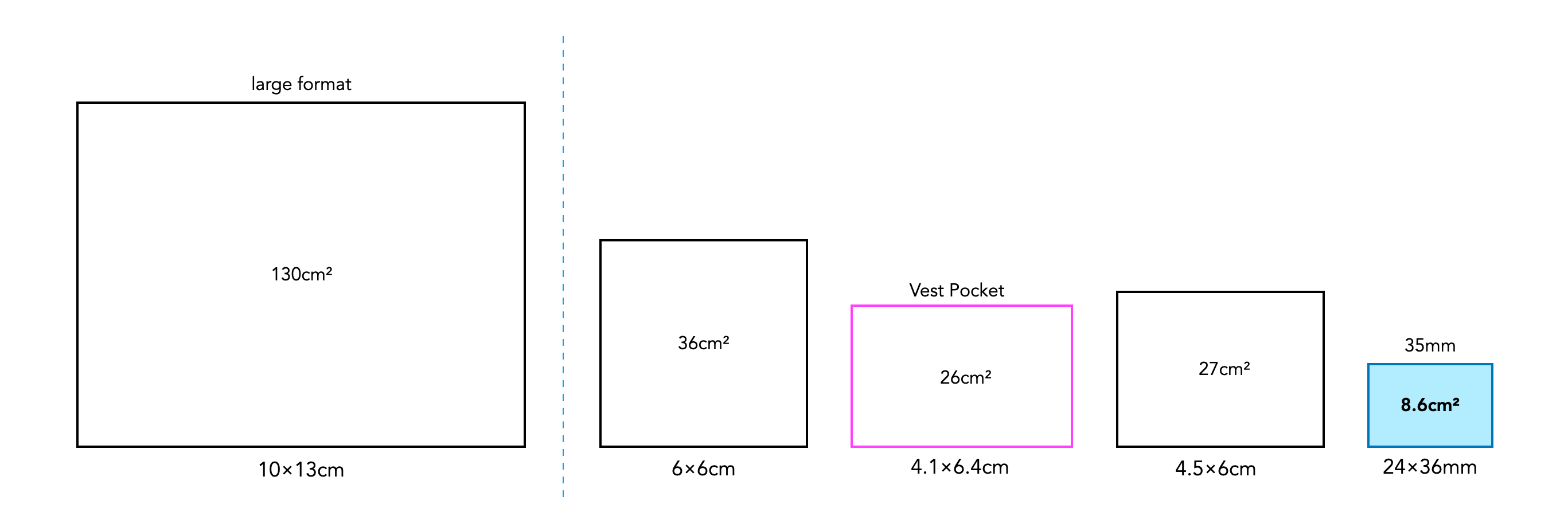
In the years following the arrival of the Leica (1926) the process of using it came to be known as ‘miniature photography’. Magazines of the period were full of techniques under the heading ‘miniature camera’, and the term itself would last until the early 1950s (the term was unknown before the Leica). Prior to this it was the age of large format cameras, which is any format larger than 9×12cm with one of the most common being the 10×13cm (4×5″). Probably the smallest format camera prior to 1926 was the Kodak Vest Pocket (VP) camera (1912-1934) which produced an image 2½×1⅝” (6.4×4.1cm) in size. By the early 1930s, photographers had become very miniature camera conscious. Big was out, small was in, but miniature started to evolve beyond 35mm, including any camera which took pictures smaller than 6×6cm (2¼×2¼”).
Fig.1: A comparison of ‘miniature’ size formats
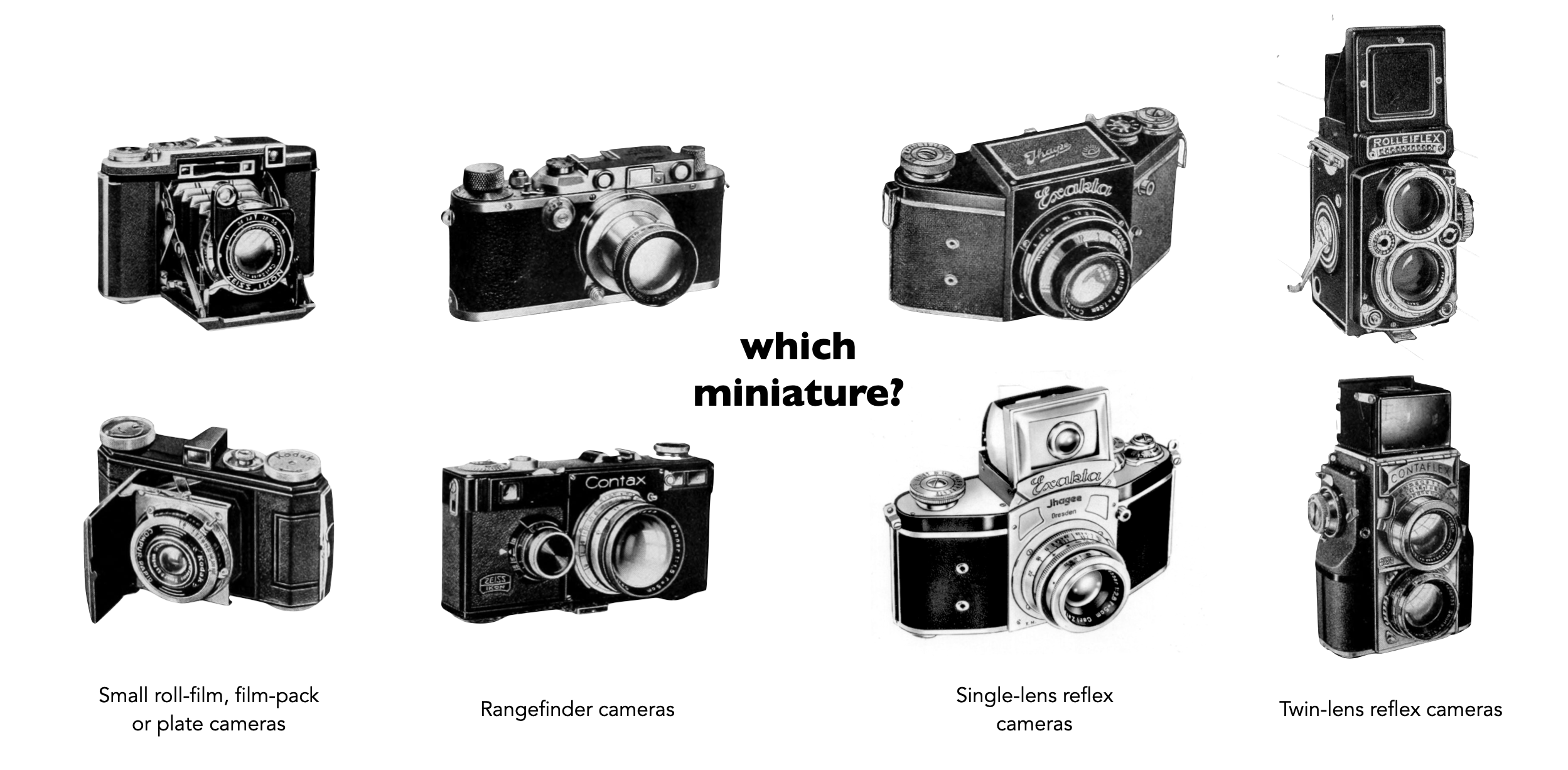
The question is why were formats like 6×6cm included in the definition of miniature? Inevitably, in view of the success of 35mm film cameras like the Leica other cameras began to appear in the category, essentially creating an industry within an industry in which manufacturers vied with one another to produce innovations based on the miniature theme. However in many cases these manufacturers just broadened the category to fit their camera rather than produce anything innovative. By the mid-1930s, there were circa four categories of miniature cameras:
Small roll-film, film-pack or plate cameras, with negatives 2¼×3¼” or smaller that have one lens and a fixed bellows. Cameras included the Zeiss Ikonta (4.5/6/9×6cm), Foth Derby(24×36), Kodak Retina (24×36mm), and Voigtländer Virtus (4.5×6cm).
Rangefinder cameras with a single lens or interchangeable lenses with negative sizes from 24×36mm to 2¼×3¼”. Cameras included the Leitz Leica and Zeiss Contax (24×36mm), Zeiss Super Ikonta (4.5/6×6cm) and Super Nettel (24×36mm).
Single lens reflex cameras, which have a single lens with negatives ranging from 24×36mm to 4×6.5cm. This includes cameras like the Exakta (4×6.5cm), Kine Exakta (24×36mm), National Graflex (6×6.5cm), and Noviflex (6×6cm).
Twin lens reflex cameras which have two lenses, and Cameras included the likes of the Rolleiflex and Rolleicord (6×6cm), Zeiss Ikoflex (6×6cm), Voigtländer Brilliant and Superb (6×6cm), Welta Perfekta (6×6cm). Many of these were limited to a single focal length. Another camera was the Zeiss Contaflex (24×36mm) which had a built-in electric cell exposure meter.
Indeed the March 10th, 1937 issue of The Amateur Photographer & Cinematographer outlines the ‘Modern Miniature Cameras’ available at the time by size [3]: a total of 98 cameras − 24×36mm (20), 24×36mm reflex (2), 3×4cm (15), 3×4cm reflex (1), 4×4cm reflex (1), 4×6.5cm (8), 4×6.5cm reflex (3), 4×6.5cm on 3¼×2¼ film (23), 6×6cm on 3¼×2¼ film (7), 6×6cm reflex (13), and five non-standard.
Fig.2: Too many miniatures
In late 1936 a heated debate on the topic started in the ‘Letters to the Editor’ section of The Amateur Photographer & Cinematographer. It stemmed from an article in the November 4th 1936 issue titled ‘What is a Miniature Camera?’ [1]. In it the definition of a miniature camera was one which took a picture of 6×6cm (2¼×2¼) or less. However the article also suggested that a camera taking a 4.5×6cm picture on 3½×2½ film (using a mask) could also be classed as a miniature. What followed was a litany of responses. In the Jan.6 1937 issue, one B.Z. Simpson suggested that “the only rationale definition of the miniature camera relates to the area of the negative used which must for the purpose be smaller than the V.P. size negative.” He goes on to say that “cameras using V.P. size… are not miniature at all, but ordinary size cameras.” [2].
Now we have 2¼” square and even 3¼×2¼” users crying out to be allowed within the ‘select circle’. If this matter goes much farther we shall shortly have the man with the half-plate calling himself a miniaturist.
Murdoch, J.N., “Letters to the Editor: Miniature Cameras”, The Amateur Photographer & Cinematographer, Jan.13 (1937)
Some seemed to settle on the idea of 5 square inches being the threshold, which would include 2¼×2¼ (6×6cm) cameras. Other objected to 6×6cm cameras being left out on the principle that the square shape utilizes the maximum area of the circular lens field (never mind that to compare a square image to a 24×36mm you would really be talking about a 36×36mm). Still others seemed to think the concept of miniature could be defined based on the focal length of the normal lens employed, e.g. 5cm for 24×36mm. It seemed that no-one wanted to be left out. The trend would continue until the industry was interrupted by the war, after which it was fundamentally altered.
By the early 1950s, the 6×6 had morphed on into its own category, the medium-format camera, and many of the other formats had disappeared altogether as the world’s photographers embraced 35mm. The miniature category itself contracted back to 35mm, but opened to include many differing types of 35mm. Here are some 35mm camera types from the early 1950s:
Rangefinder cameras with interchangeable lenses − e.g. Canon IV-S2, Zeiss Contax IIa/IIIa, Foca Universal, Leica IIf/IIIf, Nikon
Rangefinder cameras with fixed lenses − e.g. Argus C4, Kodak Retina IIa, Voigtländer Vitessa
Rangefinder cameras with fixed lenses + separate film-shutter wind − e.g. Zeiss Ikon Contessa 35, Konica I/II, Voigtländer Vito III.
Viewfinder cameras with fixed lenses + separate film-shutter wind − e.g. Argus A4, Zeiss Ikon Contina, Welta Welti, Kodak Retinette, King Regula I/II, Braun Paxette
Rapid sequence cameras − e.g. Robot Star
Reflex cameras, waist-level − e.g. Alpa 4, Exa, Exakta VX, Praktiflex FX, Praktica FX
Reflex cameras, eye-level − e.g. Alpa 5/6, Contax S/D, Rectaflex
Further reading:
“What is a Miniature Camera?”, The Amateur Photographer & Cinematographer, p.15 Nov.4 (1936)
Simpson, B.Z., “Letters to the Editor: What is a Miniature Camera?”, The Amateur Photographer & Cinematographer, Jan.6 (1937)
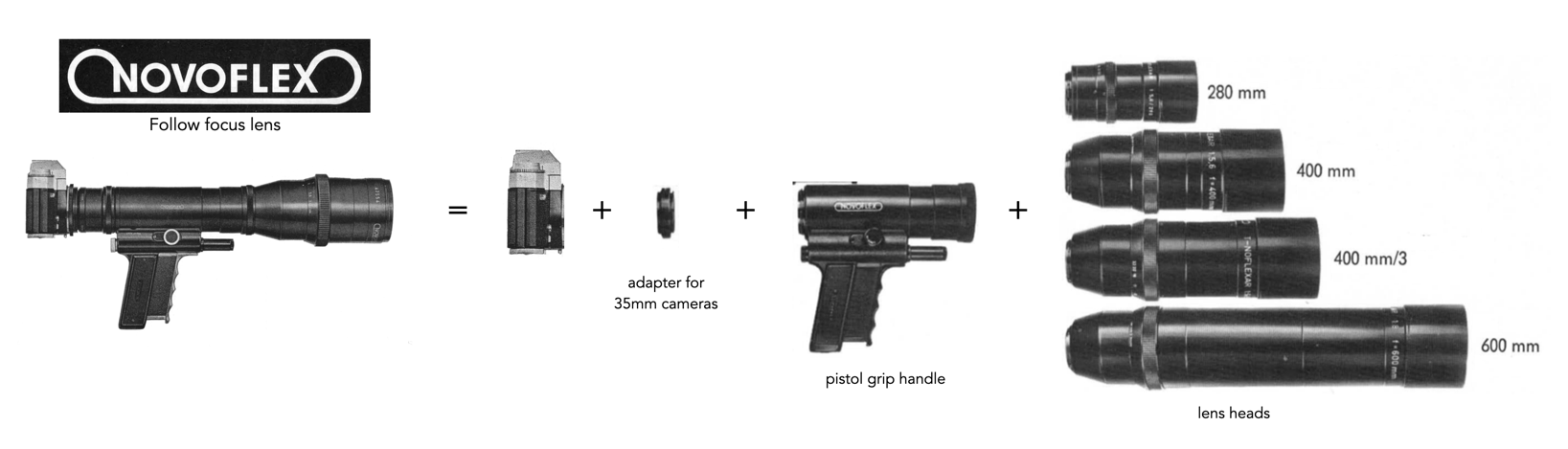
Novoflex is a German maker of lenses and camera accessories (macro bellows, tripods, tilt-shift bellows, etc.). It was founded in 1948 by photographer Karl Müller Jr. In 1949 the company produced the reflex housings for Leica, which allowed SLR lenses to be modified for use on Leica cameras. These were initially marketed under the name Reproflex, until being changed to Novoflex in 1950. From 1954 housings were also made for Contax cameras.
Fig.1: The basic Novoflex Follow-Focus lens system
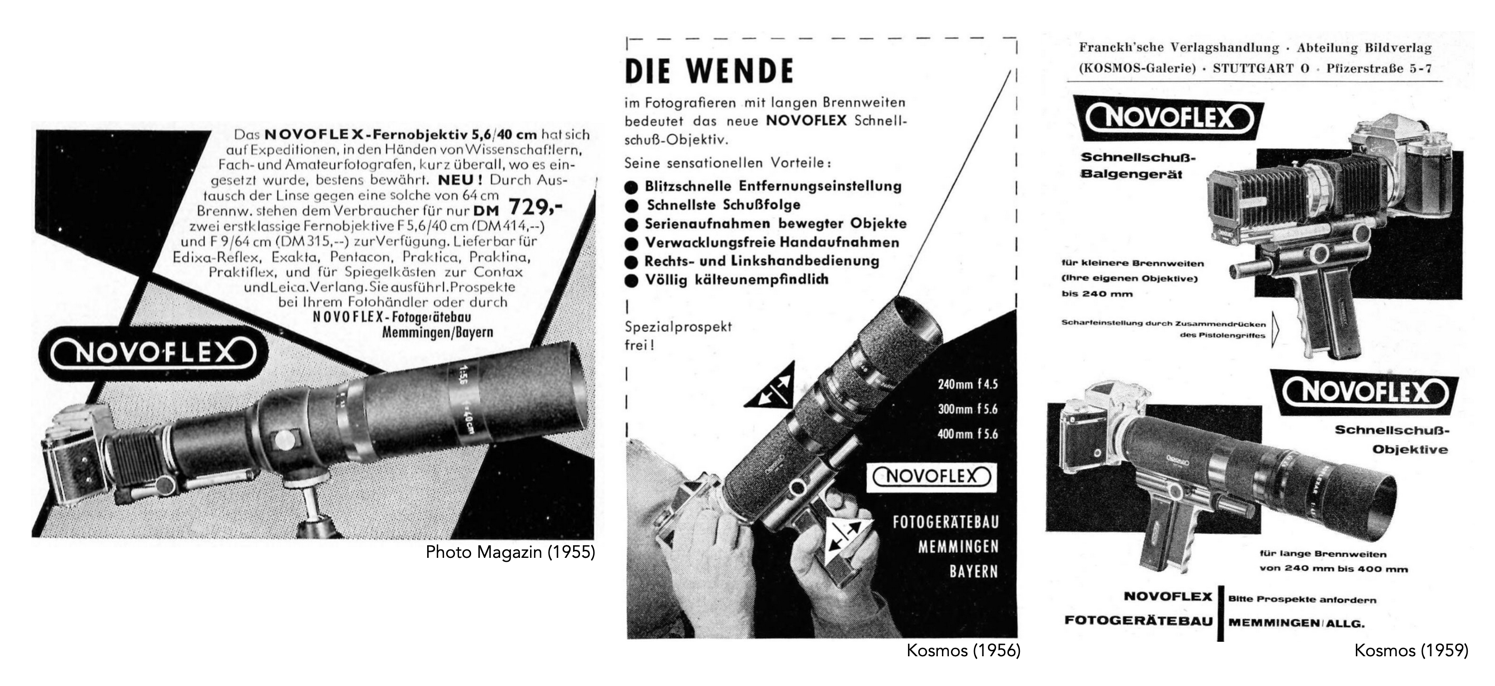
In 1956 they started production of their first lenses, the Novoflex Follow Focus lenses. The Follow Focus lens system was interesting because it included a pistol-grip focusing device that allows the user to go from infinity to minimum focus in a split second. Essentially it provides one-handed focusing. According to the company this was useful for “wildlife subjects in full flight, sports, the fleeting moment, the unexpected are unusual picture opportunities that must be taken at peak-action.”
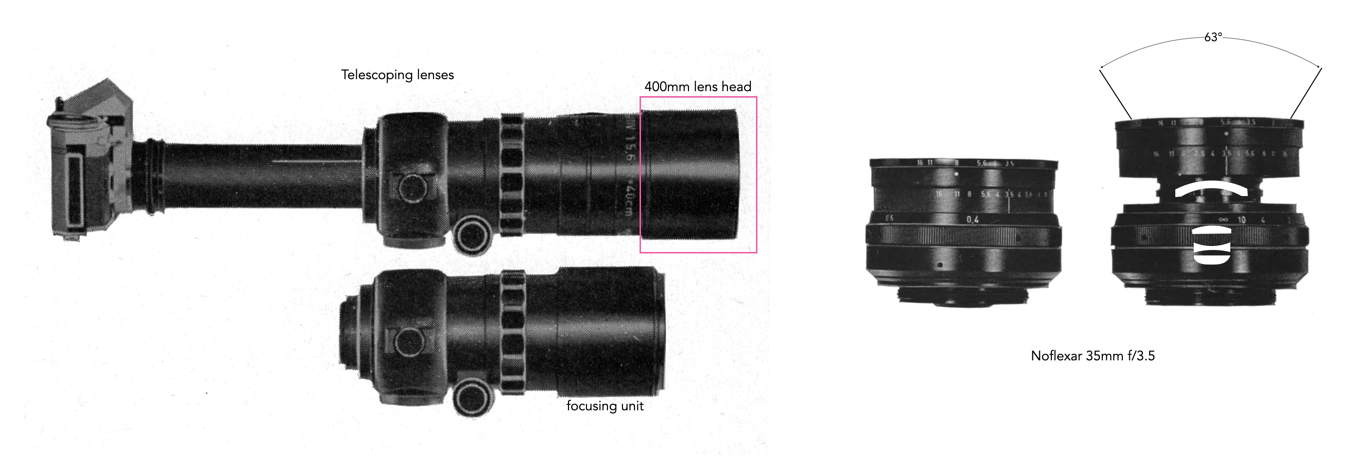
Fig.2: The telescoping lens and Noflexar
This was followed in 1960 with nesting telephoto lenses, advertised as ‘telescopic tele lenses’. These were designed in order to make telephoto lenses easier to transport, being able to collapse to half their size. The focusing unit could be equipped with lens heads for 400mm and 640mm. In 1962 the company introduced the ‘2-in-1 lens’, 35mm f/3.5 Noflexar, a macro wide-angle lens with a focusing range from infinity to 2.75”, and a reproduction ratio of 1:2. In 1969 the company started making automatic bellows devices. The company had an extensive range of ancillary products for many camera systems. This included a wide-angle macro lenses, bellow units, follow-focus lenses, slide copiers, and associated coupling adapters.
Fig.3: Vintage ads for Novoflex lenses
Novoflex is still an active company, producing photographic accessories such as auto-bellows, tripods, macro systems and camera-lens adapters.
Cameras from the 1930s, especially early SLRs and Leica-type rangefinders may be some of the most sought after ones, but are they worth buying? Well perhaps if they are to used solely as part of a collection, because many may be too old for practical use.
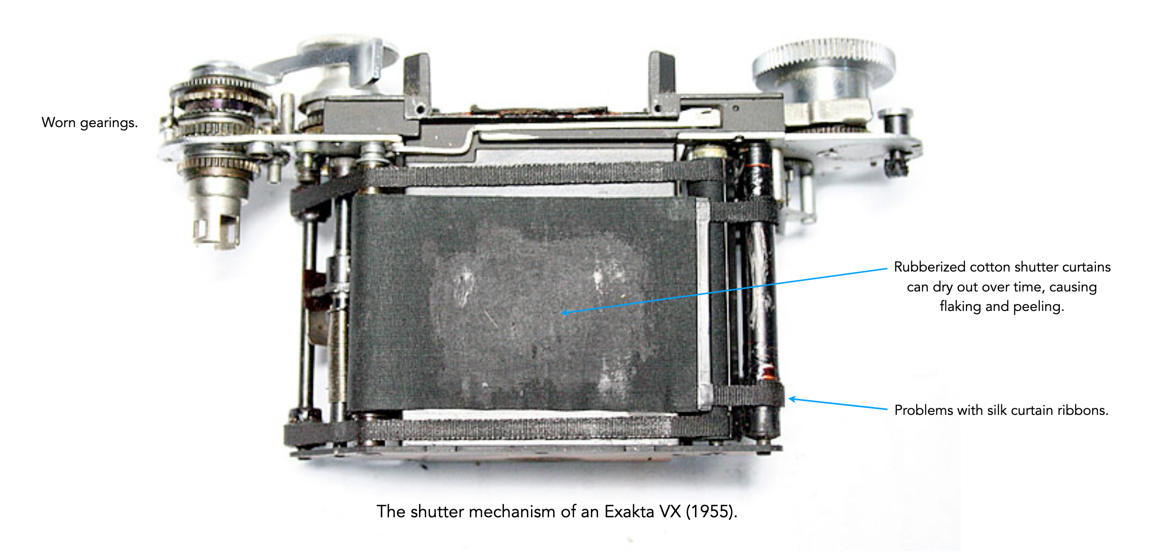
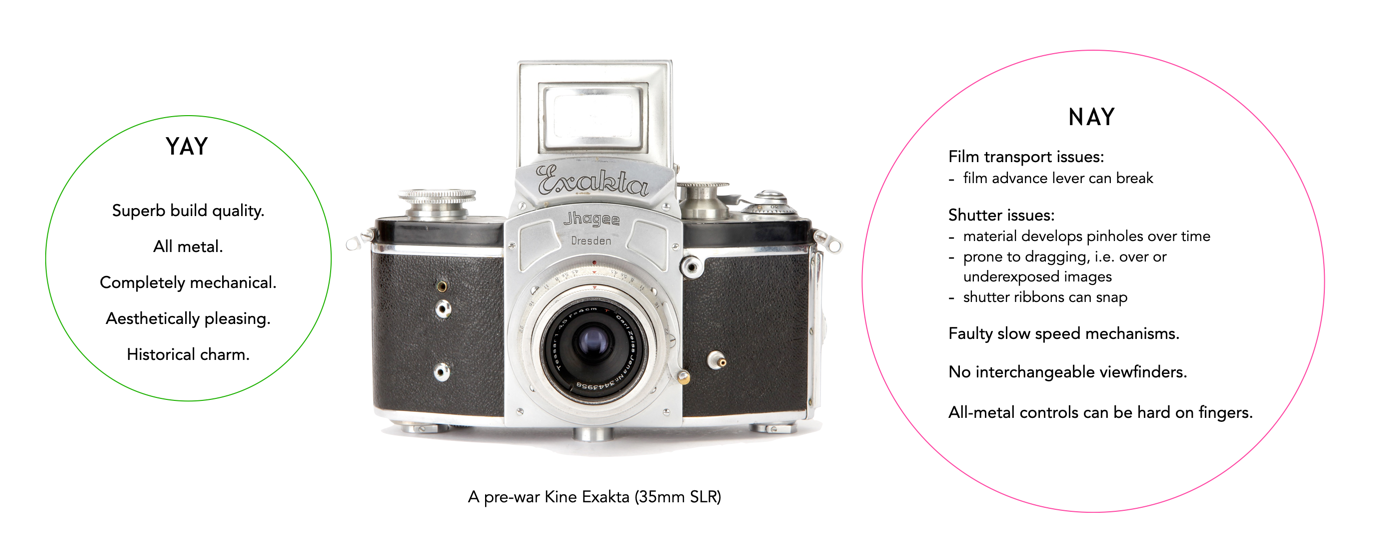
Many of the cameras from this period, be they Leica’s, Contax’s or Exakta’s, are old – now anywhere from 85-95 years old. Although they were mostly handcrafted using solid materials, it’s crazy to think that their lifespan was expected to be 30 years, let along 90. For example the Kine Exakta was a huge design advance when it was introduced in 1936, but these SLRs are seldom that useful today. There is no guarantee that the cloth shutter has held up well to the many decades of use, and in all likelihood decades of little use. The machinery inside each camera, much like a classic mechanical watch, has likely been subjected to wear and tear, and infiltration of dust. Even if the shutter appears to work, there is no assurance that the shutter speeds will at all be accurate. A shutter typically relies on a complex system of gears, springs, curtains, and ribbons. Friction and lubrication are critical for accurate speeds, especially at faster shutter speeds. If not properly maintained, the shutter speeds can become inconsistent. Old cameras were extremely complex, and complexity never ages well.
Fig.1: The shutter mechanism of a post-war Exakta VX, very similar to the original, and suffered from the same issues. In fact Ihagee never stopped using cloth shutters. (This picture comes from the website http://www.zorkikat.com, archived on WayBackMachine)
Personally, I think that buying a pre-war SLR should be regarded as being something of a lottery. Whereas it might have been easy to find someone to repair these cameras in the 1990s, this has become much harder. Parts are also hard to find, and often require a “donor” camera, but these cameras are old as well. I would suggest if you really want to buy one to use, that you also find a cheap “for parts” camera, although replacing a shutter curtain will require more than an “old” donor (cloth shutter curtains will degrade even in perfect storage conditions). And repairs won’t be cheap. An alternative might be buying old cameras from a very reputable store that deals in old cameras, and has vetted and possibly serviced the camera. Yes, it will be more expensive, however the hassle and cost of repairs may be even more.
Fig.2: Pros and cons of the pre-war Kine Exakta
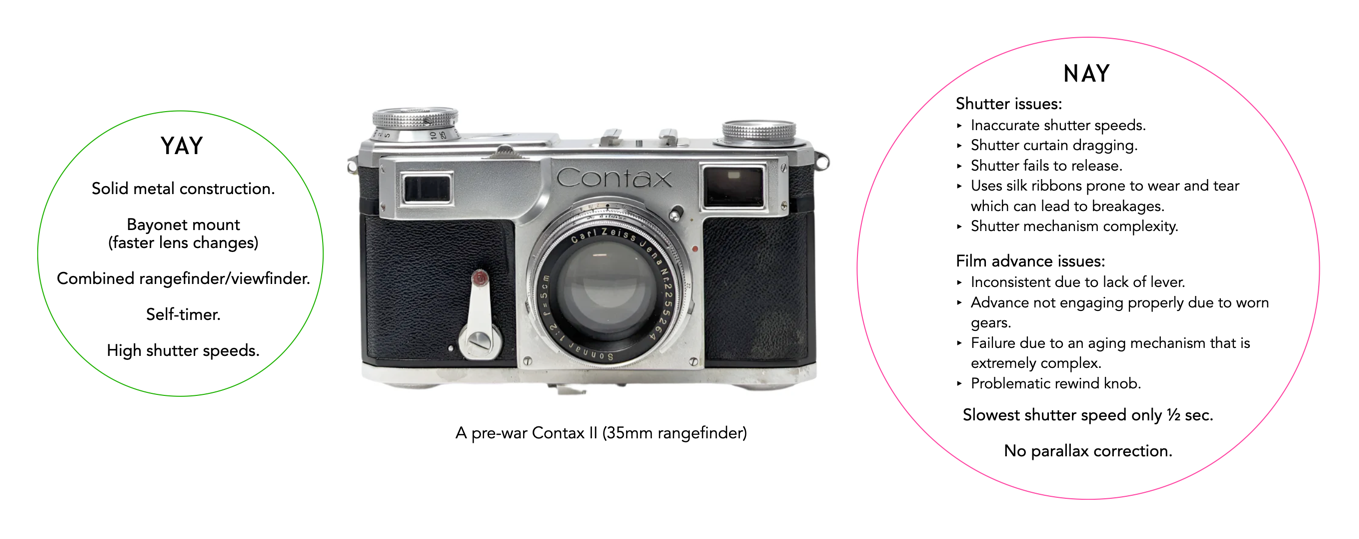
There are of course different “levels” of repairs. Shutter speeds that all test as working, but may be slow, with the worn mechanisms that cause the shutter curtain to stick, or operate at incorrect speeds. There may also be dusty viewfinders, dirty mirrors, and general aging of parts. Cloth shutter curtains may also have pinhole perforations or even tears, leading to light leaks. The shutter curtains of many of these early cameras were also controlled using silk ribbons, which are also prone to wear and tear over time. Shutter issues are more challenging to repair, because it is time consuming to strip a camera back to get at the shutter mechanism. Bottom-line, repairs are labour intensive and hence expensive.
Of course the war years may be even more dubious. Although cameras were produced in smaller amounts, there were caveats to this period. Firstly, shortages of raw materials, and in some cases of appropriately skilled technicians meant that cameras could have been produced below the standard of pre-war years. There was also a distinct lack of parts, so fixes to cameras were often made on an ad hoc basis.
Fig.3: Pros and cons of the pre-war Contax
Reliable may be a questionable adjective when it comes to old things, especially old mechanical things. A camera can sit in its original box for 90 years, never opened and still age. It may be that even a “mint” condition camera will work for a few rolls of film and then stop dead in its tracks. Ivor Matanle, in his 1986 book Collecting and Using Classic Cameras, said this of pre-war Exaktas: ‘The pre-war Exaktas are attractive, but are now old and usually less reliable – a fact that is hardly surprising, in view of their complexity.’. If someone were interested in vintage cameras for practical use, I would steer the towards post-war cameras, and then in reality to those of the late 1950s, and 1960s – the quality is likely better, and they are a bit younger. If you buy a pre-war camera for use, then you have to live with the notion that at some point it may just become something to look at.
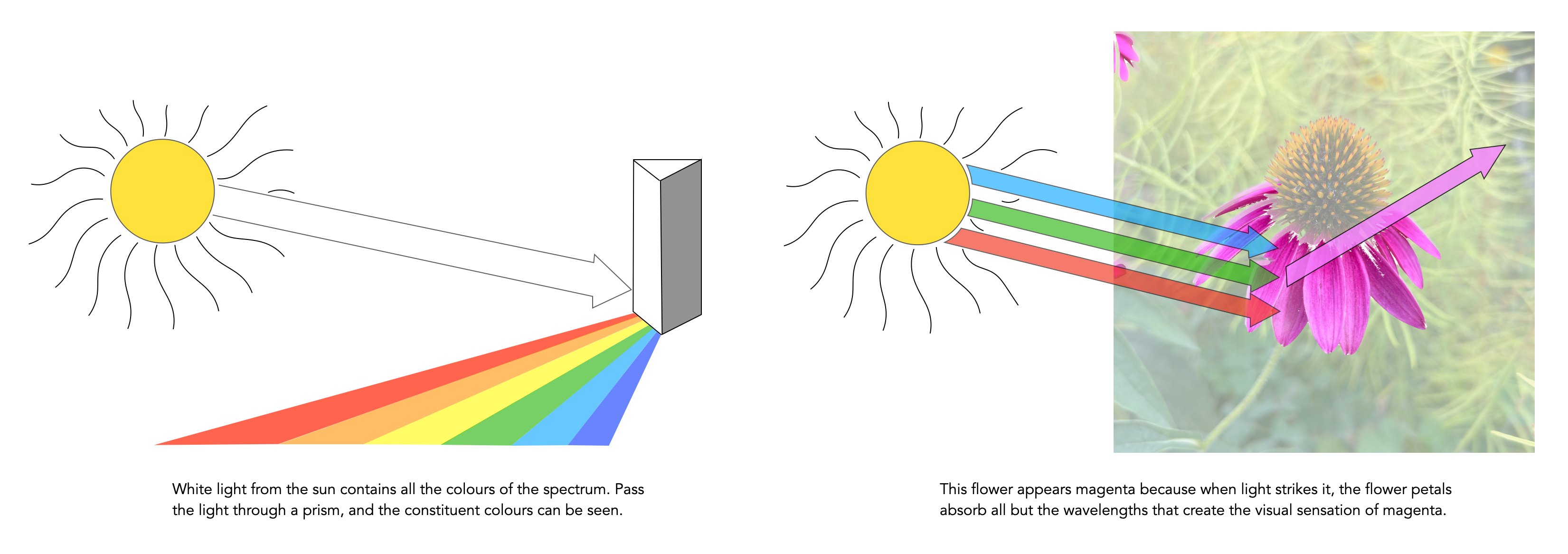
Light from the sun has appears to have no hue or colour of its own; it is “white” light. But it actually does contain all colours, and if it is projected through a prism it will be separated into a band of colours like a rainbow. A coloured object, for example a flower, has colour because when light strikes it, the flower petals reflect their hue components or wavelengths of the light while absorbing other colours. In the example below the flower reflects the ‘magenta’ components, and the human eye being sensitive to these reflected wavelengths, sees them as magenta. Dyes, such as those found in paint, and colour prints acts just like the flower does in selectively absorbing and reflecting certain wavelengths of light and therefore producing colour.
 Crafting Pixels