Some people collect what others would consider to be the most horrendous cameras. But what are considered the worst? A camera can obviously be bad for any number of reasons. It might be unreliable, ugly, lack usability, too heavy, too light, crappy lenses or useless without batteries. Some were too complex, and challenging at the best of times. Others had that one feature that just didn’t work well, condemning a perfectly good camera. Incorporating a proprietary lens mount that nobody else used, or only offering half a dozen lenses also condemned a camera. But while a whole slew of cameras might fit the criteria, it is hard to list them because of subjective opinion. If a camera only lasted in a catalogue for one year, then in all likelihood even the manufacturer thought ill of it.
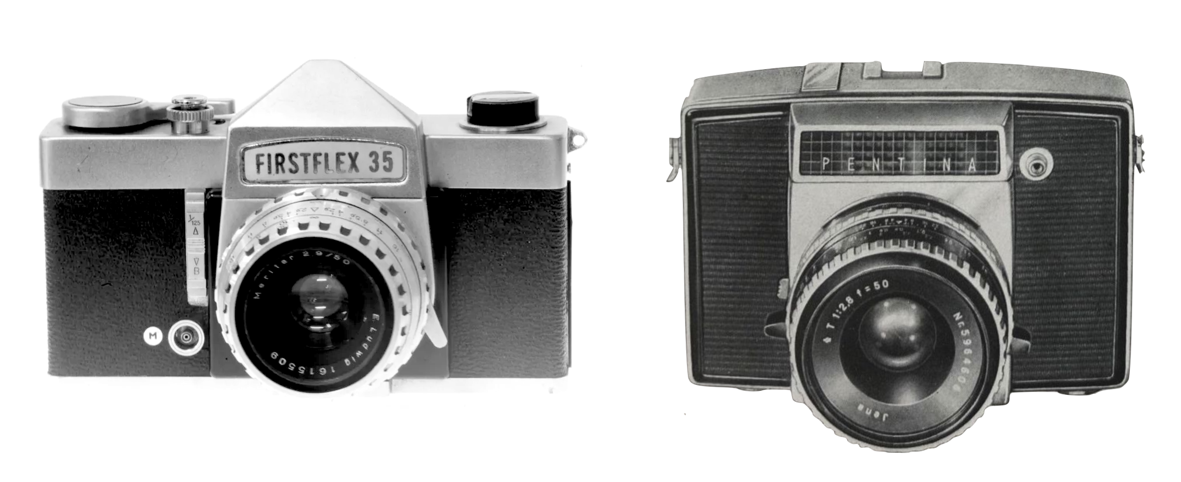
The only place that didn’t produce any bad cameras (or any good ones for that matter) was the Southern Hemisphere, where arguably very few cameras were ever made. The Japanese on the whole produced good cameras, with a few exceptions. One is a camera made by Japanese company Tokiwa Seiki K.K., which operated in the 1950s. There were a lot of start-up camera manufacturers during this period, all trying to cash in on the market… not all were successful at what they produced. They produced a number of 120, and a few 35mm SLRs, one of which was the Firstflex 35 (or any one of Soligor-35, Windsorflex-35 and Lafayette-35). Produced in 1955 it was a leaf-shutter SLR with a waist-level viewfinder and specialized bayonet mount. The second version of the camera (1958), had a pentaprism viewfinder and Exakta lens mount, but it had a shutter that doubled as a mirror, and only two speeds, 1/125s and B. Hardly at all useful. Its successor, the PLUSflex-35 added 1/60s.
The Firstflex 35 and Pentina cameras − not exactly ugly, but suffering from design flaws.
On the German side there is the Pentina, made by VEB Kamera- und Kinowerke Dresden in the 1960s. This camera used a leaf shutter which was a departure from the usual focal-plane shutter used in East Germany, and likely somewhat of a backwards step as East Germany lost its ability to produce high-end leaf shutters after the war (both companies of the leaf-shutter monopoly, Deckel and Gauthier were situated in West Germany), meaning they had to reinvent the technology. But the camera had a non-standard bayonet mount, a meagre choice of four lenses, and was extremely chunky looking as the designers had opted for ‘clean design’ with the camera enclosing the pentaprism, rather than exposing it with a roof-shaped top. According to various sources this camera could be summed up by the fact that they were hated by repairmen. The Pentina was, in the words of Kampermann on the Dutch blog Vintage-Photo, the result of ‘...megalomania, building something that had never been built before, extravagant in design and over-complicated in technical innovation’. The Pentina may have been the most extraordinary design of an SLR of the period, but its eccentric design may have lead to its short production period, with only 45,000 units were built between 1961 and 1965 with as many as seven variants.
Note that identifying the ‘worst’ SLR is a very individualistic endeavour. One person’s Dali is another ones Monet, so to speak.
White is out, except on a few vintage models. Real gold is definitely out unless one was given a gold one by the manufacturers for being such a good photographer. So are animal skins (snake, mink or otherwise). But most important, all colours that look right for boats lost at sea (orange, red, yellow, etc.) are wrong for real cameras. This is because cameras finished in vivid colours may reflect onto the subject and thus produce unnatural hues in the final results.
The key choice is then between chrome and black. Most standard finishes are black and chrome but the status element increases as the total volume of chrome reduces, and the black increases. An all black camera, made thus by the manufacturers, is the hallmark of the very serious amateur and some professionals. Slightly upmarket of this is the mixed chrome/black example with the chrome bits hand-painted matt black. This spells dedicated amateur or the professional who is important enough not to care and does not have to answer to a newspaper for the equipment. The finishing touch in this scale is the odd spot of white paint on all the dials at the most commonly used settings. Definitely the ultimate professional image or superb fakery.
John Courtis ‘Bluff your way in photography’ (1993)
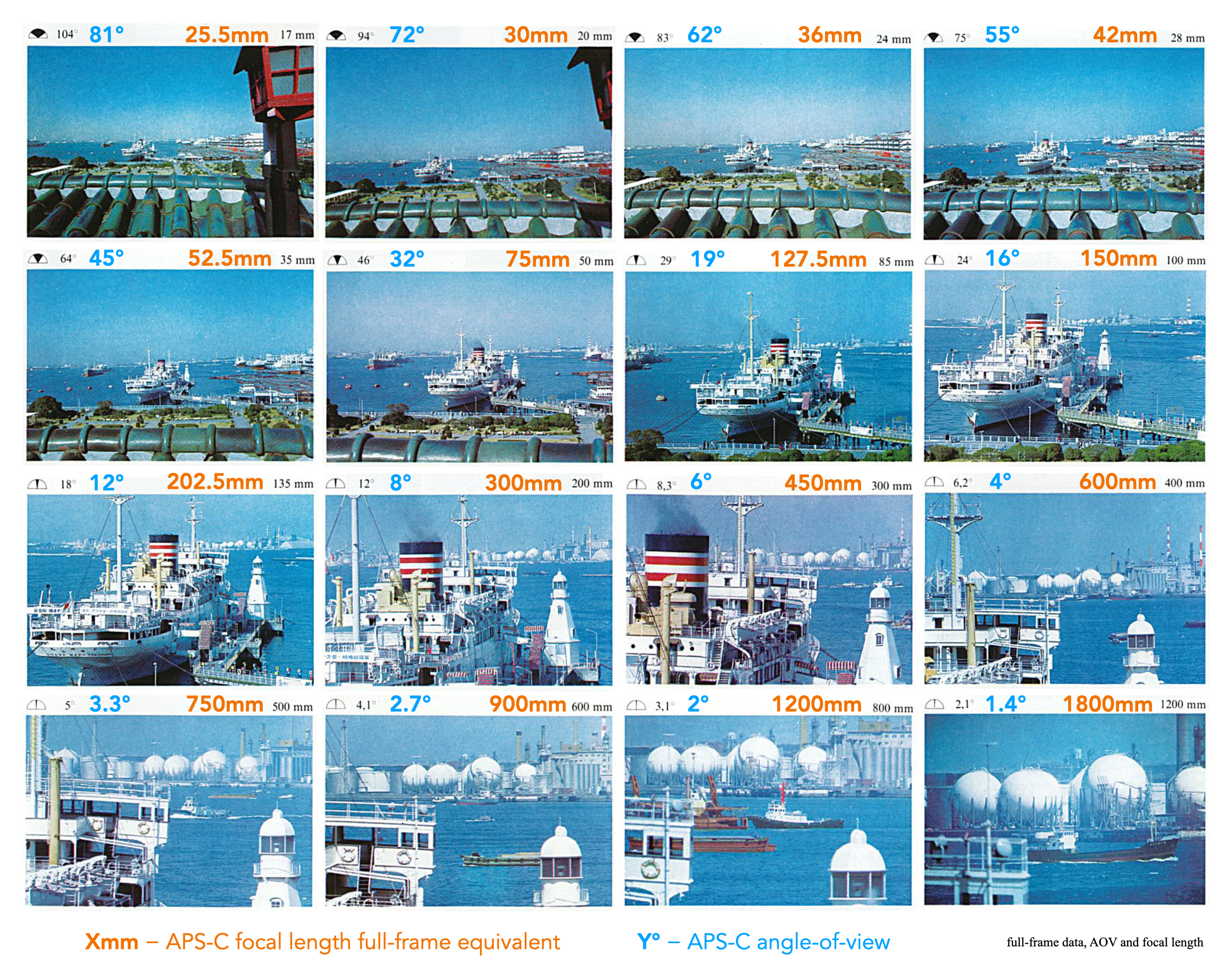
The image below shows some classic vintage focal lengths in terms of use on APS-C cameras. It shows the original 35mm SLR angle-of-view (AOV) and focal length (in black), and the converted AOV (blue) and the equivalent full-frame focal length (orange).
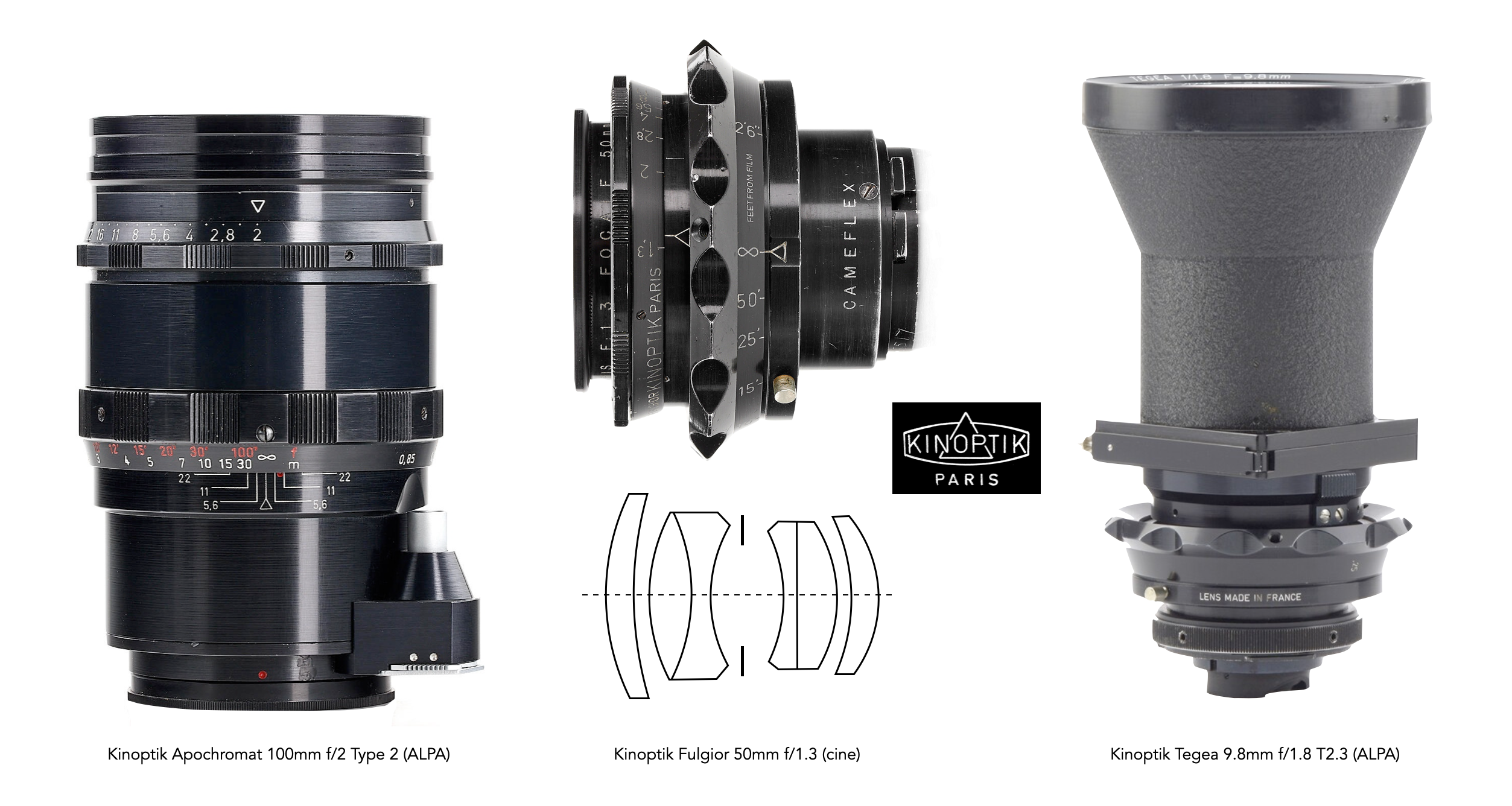
Kinoptik was founded in Paris in 1932 by Georges Grosset and Georges Perthuis. Grosset began by creating 35mm camera optics with a series of Apochromat lenses in 1939 (lenses with better correction of chromatic and spherical aberrations), all with the same double-gauss optical structure.
The workshop was destroyed by the RAF in March 1942. Production resumed in the summer, however during the German occupation they were forced to produce Askania camera sights. However this didn’t stop Grosset from designing two new lenses, the Fulgior 50mm f/1.3 (which was used on the Rectaflex), and the Apochromat-C 32mm f/2.8. Postwar, French cinema boomed and Kinoptik concentrated its efforts on the cinema business. It designed numerous lenses for 16mm, Super-16 and 35mm cine cameras.
In the early 1950s they also diversified into optical systems for microfilm, medical radiology, and control of industrial furnaces. The company bore the Japanese competition in the 1960s better than most of its European counterparts due to its business in professional cinema equipment. From a 35mm perspective, Kinoptik produced a number of lenses for ALPA, as well as Leica, Nikon, Canon and Minolta. Examples include the Apochromat 100mm f/2 and the Aplanat 500mm f/5.6. The Apochromat 100mm f/2 was described as having exclusive correction of all primary colours, critical sharpness and highest contrast, even at full aperture.
Fig.1: Various Kinoptik lenses
After the death of Georges Grosset, his wife Marie-Louise Grosset took over running of the company, and hired French optician Edgar Hugues (1915-2004) who became technical director of the company from 1957-1964. He designed the 75mm f/1.1, 100mm f/1.3 as well as the Lynxar 60mm f/0.7, arguably the fastest French lens ever created. He also designed the Tegea rectilinear “fish-eye” lenses (130° angle-of-view for 24×36mm). One such lens, the Tegea 9.8mm f/1.8 was used by the likes of Stanley Kubrick in films like A Clockwork Orange (1971) and The Shining (1980).
In 1981 the company was sold to Société de Fabrication d’Instruments de Mesure, after which it underwent numerous integrations, mergers, and acquisitions before closing in 2003. The lenses were by no means inexpensive. In 1980 prices, the 50mm f/2 Macro-Apochromat sold for US$999, and the 100mm f/2 Auto-Apochromat for US$799. Vintage Kinoptik lenses are still vogue in the film industry, often rehoused in new bodies. The Apochromat 100mm f/2 sells for anywhere from US$5000-7000 on todays market.
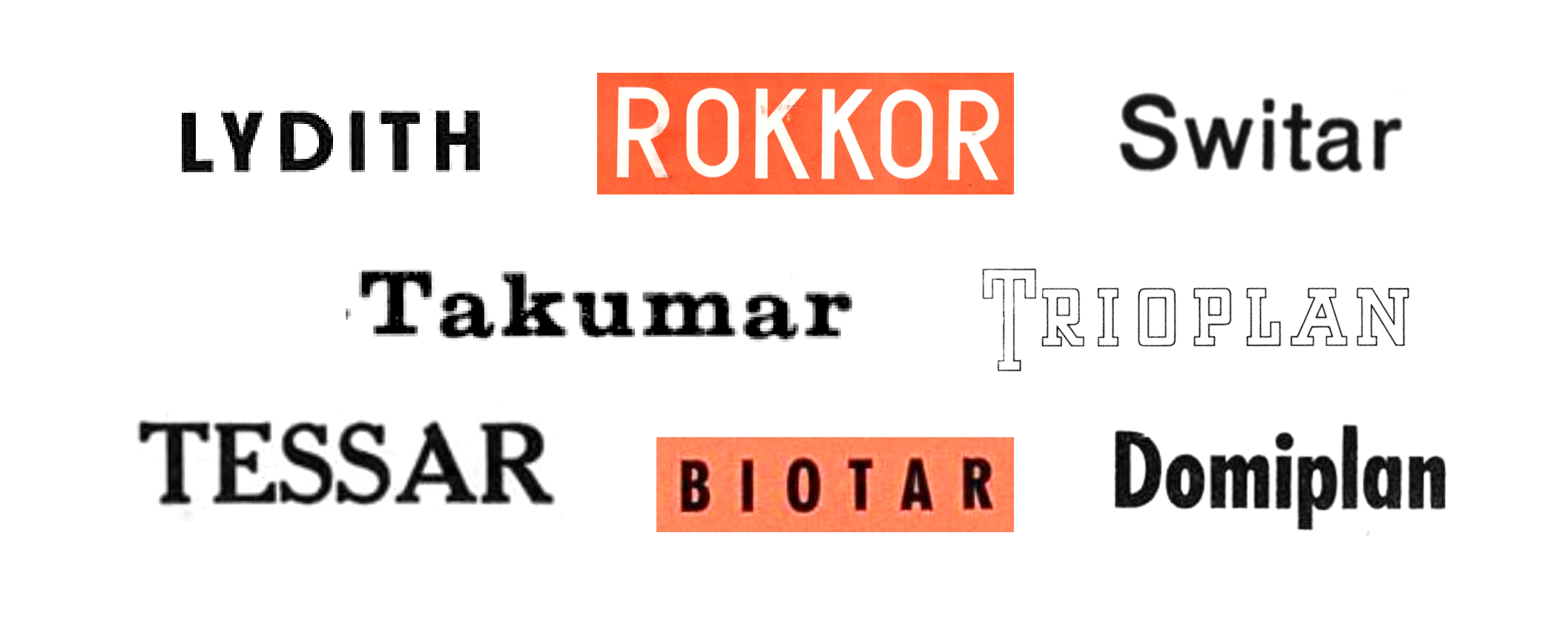
There was a time when lens manufacturers gave their lenses names − the likes of Pancolar (Zeiss Jena), Noctilux (Leica), Biotar (Zeiss), Switar (Kern). In some cases the names were derived from Latin words, which were meant to describe some intrinsic characteristic of the lens. For example Leica’s Summilux. The combination of ‘summi’ (meaning ‘highest point’) and ‘lux’ (Latin for ‘light’) results in the intimation of ‘maximum light’ – referring to the enhanced light-gathering abilities of these lenses. The name appeared in 1959, and has been a staple ever since.
Fig.1: Various historic lens names
But in the modern era, few companies do this anymore. There seem to be three exceptions: Leica, Zeiss, and Voigtländer, although to be honest, most Japanese companies did not give names to individual lenses. Asahi was the exception with the Takumar line, although it signified a time period and technology more than the characteristics of an individual lens. Leica still use names for historical families of lenses. Some of this may be tradition, helping users to identify certain characteristics of a lens just by reading the name. Zeiss is another company that still names its family of lenses, e.g. Touit (a small Brazilian parrot). Giving lens families names makes things a lot simpler, and also provides a better brand association. That’s why people still remember Zeiss’s Pancolar lenses, or Asahi’s Takumars.
Names existed to invoke some sort of an emotion. Like giving a lens a name gave it a sense of power. It is more likely to be remembered than the modern trend of adding a string of incomprehensible hieroglyphs of abbreviations – something most people forget in quiet quickly. But once you have heard of the legend that is the Pancolar, you are unlikely to forget it. The likes of Pancolar and Flektogon bring memories of lenses with exceptional background blur (aka bokeh), from East Germany. There are of course the classics of German lens design: Zeiss’s Tessar, Planar, Sonnar, or Voigtländer’s Ultron.
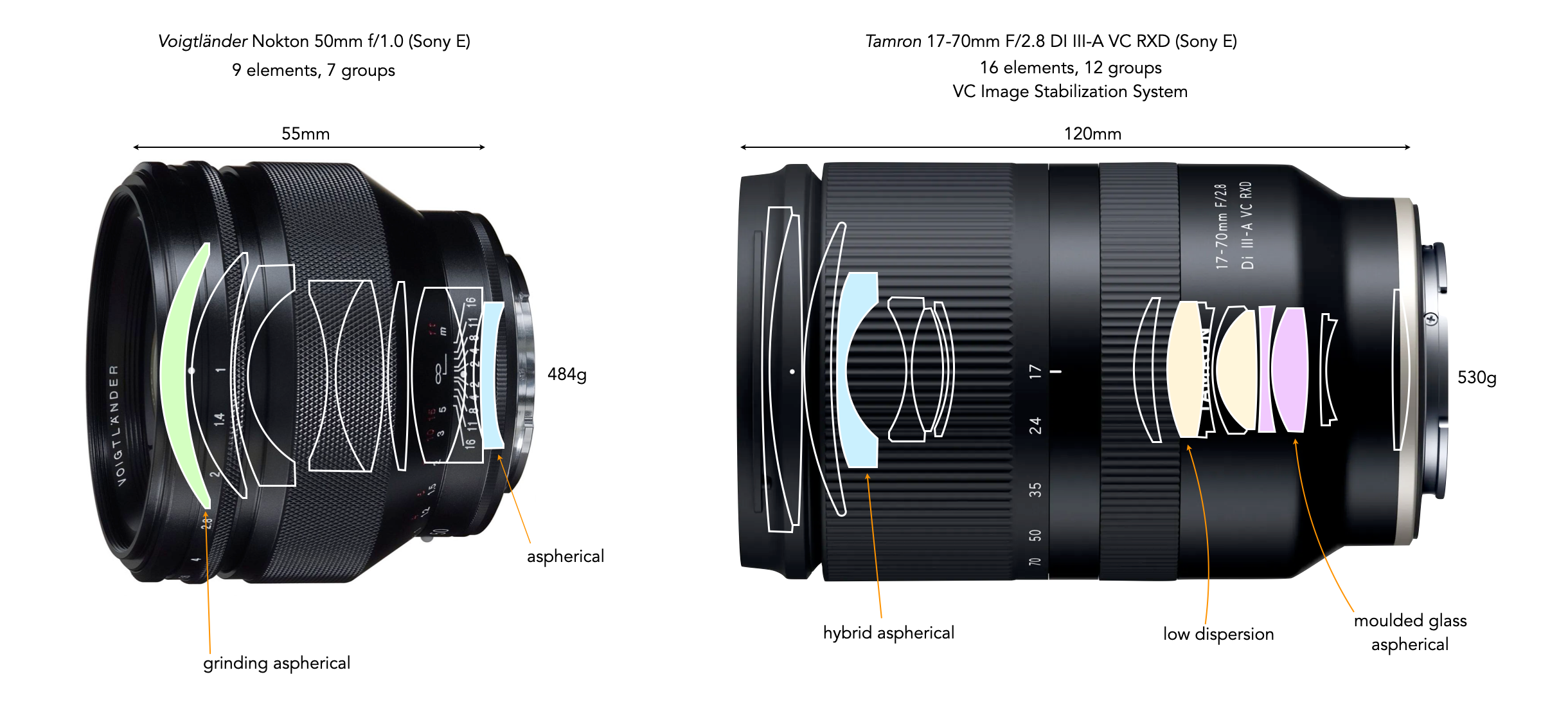
Fig.2: What’s in a name? The VoigtländerNokton
Perhaps because there are always new lenses, and it would be hard to keep up with new names? Perhaps in the information age, names have been supplanted by acronyms, and abbreviations? It’s no different to cameras, which no longer have names anymore either. The Ricoh GR series was (supposedly) named after two of the first cameras marketed by Riken Kōgaku Kōgyō, the predecessor of Ricoh, namely Gokoku, and Ricohl. But without digging for it, nobody actually seems to know what GR means.
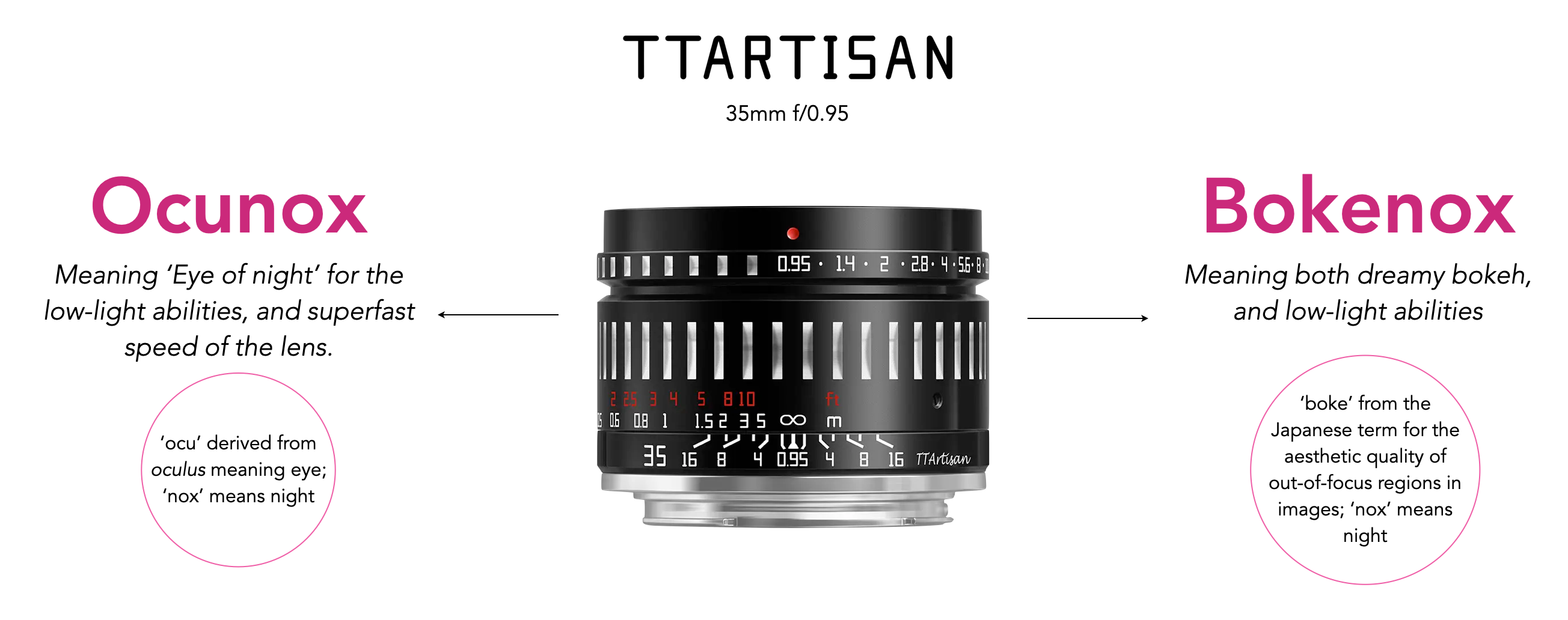
Fig.3: Some naming ideas for TTArtisan’s 35mm f/0.95 lens
I would like to see lens manufacturers look at giving lenses actual meaningful names. Not all of them of course, but perhaps families of lenses. Perhaps a line of lenses named after prominent lens designers, like Willi Merté who designed the Biotar for Carl Zeiss in 1927. Or a fish-eye series named after physicist Robert W. Wood who coined the term ‘fisheye lens’ in 1906. TTArtisan has a few lenses with a vintage striped aesthetic, why not give them a name that pays homage to the 1960s lenses? Or perhaps a name associated with the abilities of the lens. Two name suggestions for the TTArtisan 35mm f/0.95 are shown in Figure 3. I’m not suggesting that coming up with viable names will be easy, but once established they will help strengthen brand association.
One of the biggest dilemmas for novice photographers when choosing a digital lens is whether you buy a prime or a zoom? This is an age old debate, probably dating back to the 1970s when zoom lenses started to make real inroads into the SLR lens market. Back then zoom lenses were at a major disadvantage from a quality perspective, but over time they have improved in quality, and proliferated in quantity. Here we look at the major differences between the two.
Fig.1: A comparison of a modern prime (50mm normal) versus a modern zoom lens (wide-to-short telephoto, 17-70mm), both full-frame.
Zoom lenses
A zoom lens is a lens designed with a variable focal length. This allows the lens to be modified to any focal length between the specified range, meaning the angle-of-view (AOV) of the lens will change with the focal length. For example 16-80mm means the lens is widest at 16mm, and at full zoom at 80mm. There are zoom lenses that are narrow in focus, e.g. wide-angle zooms where the zoom range covers wide-angle focal lengths, and there are others that are more broadly scoped, e.g. 17-300mm, covering wide-angle all the way through medium length telephoto. Some zooms have a fixed aperture, i.e. one maximum aperture, others have a variable aperture which changes with the focal length selected, e.g. a 28-60mm f/4-5.6 means that 28mm the aperture is f/4, while at 60mm the aperture is f/5.6.
Many cameras come standard with a kit lens which is typically a zoom. For example Fuji-X (APS-C) often pairs a 15-45mm zoom (f/3.5-5.6), with covers a horizontal AOV of 77.32° to 29.8° − wide angle to low-telephoto to cover from landscapes to portrait shots. Other Fuji cameras are paired with 16-80mm or even 18-120mm. Note that the downside to kit lens, is that they are typically of lower quality.
Pros:
Versatility − Zoom lenses offer a lot of flexibility, allowing the focal length to be changed on-the-fly (so there is no need to swap-out lenses). This makes them ideal for situations where there is a need to quickly adjust the framing.
Convenience − There is no need to carry multiple lenses to cover different focal lengths.
Discretion − A scene can be captured without having to get too close. Using one lens also means it may not be necessary to carry a camera bag.
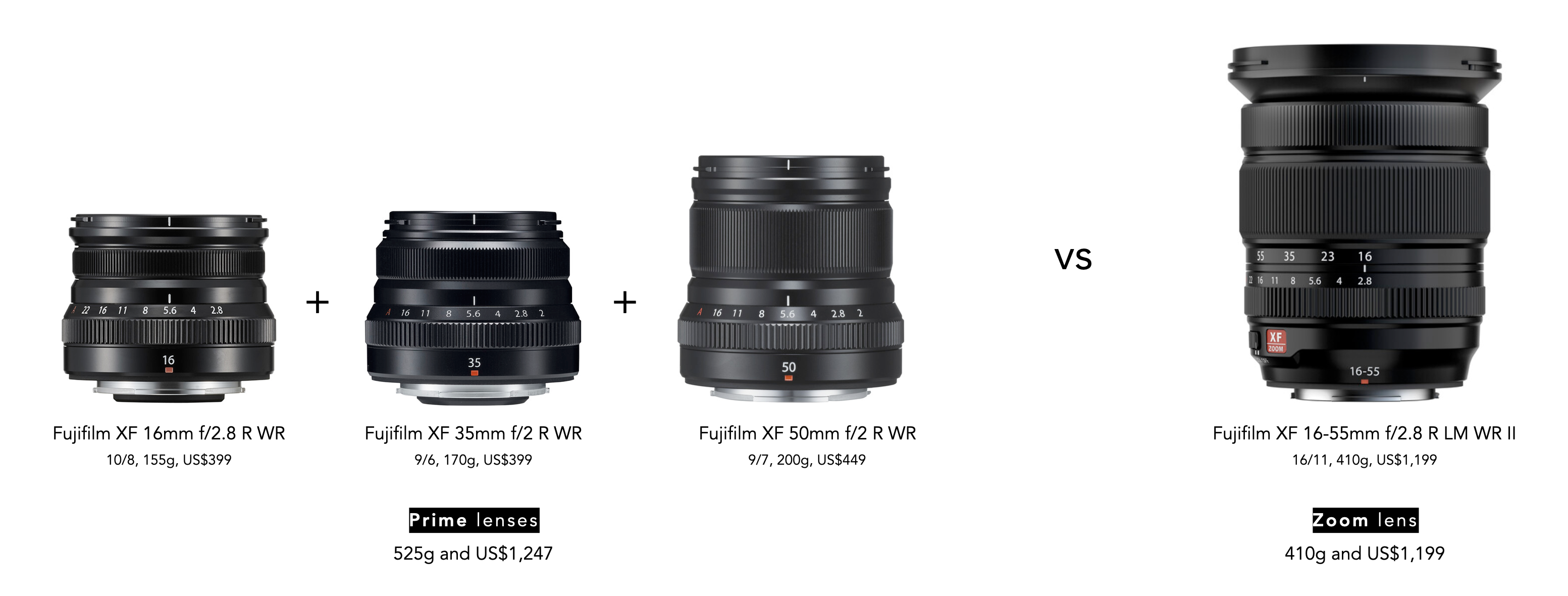
Portability − A single zoom lens can replace 2-3 prime lenses. This means less weight to tote around, and less lens swapping, so although the zoom may weigh more, it may be less than the sum of primes.
Cons:
Opticalquality − Zooms can sometimes be less sharp than primes because of their complex, variable nature. However the gap between the quality of zooms versus primes is narrowing. An expensive zoom is likely to have better optical quality than a cheap one.
Aperture − Professional zooms have a maximum aperture of around f/2.8, or even f/4, making them less than optimal for low-light situations, i.e. slow.
Price − Zoom lenses can be expensive, because the zoom mechanism and lens configuration can be complex. Kit zooms are cheap, the Fuji-X 15-45mm is around C$325. The Fuji-X 16-80mm is C$880. Wide zooms can be even more expensive with the Fuji 10-24mm going for C$1050.
Weight − Generally quality zooms can be heavier than primes because the lens body is physically larger, and there are more complex mechanisms inside, e.g. auto-focusing motors.
Lens selection − Some platforms do not offer that many zoom lenses. For example there are a lot of third-party lenses in the Fuji-X environment, however most are prime lenses (probably due to the lower cost). Apart from Fuji native zooms, the only real competitors are Sigma and Tamron.
Fig.2: A comparison of a 16-55mm zoom lens with three ‘equivalent’ prime lenses to covert the same range of focal lengths (note that the closest to a 55mm prime is a 56mm f/1.2 which puts it outside the bounds of comparison from the perspective of aperture).
Prime lenses
A prime lens is a lens with a fixed focal length, meaning it cannot change. It has an AOV that is set, so making an object fill more of the frame requires getting closer to the subject. For example a 16mm Fuji-X prime offers a horizontal AOV of 73.74°, no more, no less. So to enlarge a subject and make it fill more of the frame, the camera has to be moved physically closer to it. To make a subject fit a frame, the camera must be moved away. In terms of prime lenses, a wide angle might be 28mm, a normal lens 50mm, and a portrait lens 85mm (full frame). In comparison a 28-85mm zoom lens offers all these focal lengths (and many in between) in a single lens. Prime lenses are typically fast, with maximum apertures of f/1.8, f/1.4 or even f/1.2 (or faster).
Pros:
Opticalquality − Prime lenses are focused on one focal length, and as such often have better optics. This includes having a better depth of field, sharpness, and rendered bokeh. Better optics = better image.
Aperture − Prime lenses are faster than zoom lenses, i.e. they have larger maximum apertures than zooms. They can have apertures as wide as f/0.95, but typically they are between f/1.2 and f/2.8. This makes them better in low-light situations, and helps them produce a shallower depth-of-field. This often negates the need for a flash or high ISOs that can introduce noise.
Focusing speed − Auto-focusing generally works a little faster on prime lenses.
Price − Prime lenses have fewer moving parts and as such can be less expensive. The caveat here are specialty lenses, superfast lenses e.g. f/1.2, and super-telephoto lenses. Prime lenses have the same range of cheap “kit” to expensive high-end lenses, but often it is possible to purchase a good prime for a reasonable cost. Note that superfast lenses can be significantly more expensive than their f/1.8 counterparts.
Compactness/Weight − Many normal prime lenses are generally lighter and more compact than zoom lenses.
Bokeh − Wide apertures provide a shallow depth of field, which makes primes ideal for taking portraits and artistic shots containing the coveted background blur known as bokeh.
Cons:
Limitedversatility − Prime lenses only have one focal length, so it might be necessary to carry more than one lens to cover a gamut of scenarios. Adjusting a composition will require moving towards or away from the subject.
Inconvenience − With prime lenses it may be necessary to carry multiple lenses to cover different focal lengths. This impacts how much needs to be carried in the field.
Discretion − Carrying more than one lens might require changing lenses on-the-fly, because different lenses may be used for different scenes. A camera bag might be a requirement.
Portability − While a zoom lenses can replace a number of prime lenses, working only with primes may require carrying 2-3 lenses with different focal lengths. This means more weight to tote around, and more lens swapping.
Weight − There are circumstances where primes can be heavy, e.g. super-fast lenses often require more glass, which makes them heavier than other primes, and telephoto lenses can be larger and heavier than telephoto zoom lenses.
Choosing between a prime and a zoom lens really depends on photographic priorities, i.e. what is needed in a particular situation. Zoom lenses can be hard to use well for the inexperienced photographer − e.g. they often stay in one position, and zoom to capture everything, versus using a prime lens where you are forced to move in order to gain photographic perspective. Every optical design has its strengths and weaknesses, but as a prime lens is optimized for a single focal length in many cases it has a greater capacity for fewer weaknesses and more strengths. This may include characteristics such as: image quality (contrast, sharpness, distortion, flare control), colour aberrations, lens speed, size and weight, focusing ability, focus shift, etc.
Feinmess was founded by Gustav Heyde (1846-1930) in Dresden (1872) as Gustav Heyde – Mathematical-Mechanical Institute & Optical Precision Workshop (Feinmess roughly translates to “fine measurement”). The company produced astronomical and geodetic precision devices: binoculars, domes and refractors for observatories, telescopes, theodolites (land surveying devices), hand-held rangefinders for aerotopography, and actino-photometers (light meters). From 1931 the company was converted to a limited partnership and concentrated on arms production. In 1945 the company operated under the name Gustav Heyde GmbH. After the war the company was expropriated by the state of Saxony operating as Optik, VVB für feinmechanische und optische Geräte. Finally in 1948 it changed its name to Optik – Feinmess Dresden VEB.
In the 1950s, Welta (Freital) requested a lens for their Belfoca 1 and 2, medium format cameras. There was so much demand for lenses that Feinmess accepted the order, never having produced lenses before. The optical design office was set up by Ihagee, and work on the design of the lens was taken over by Claus Lieberwirth is August 1953. From 1954 the Bonotar was created as a 105mm, f/4.5 lens. A second lens, the 105mm f/6.5 Bonar was derived from the Bonotar. Both lenses were simple in construction, and inexpensive. About 20,000 M42 and 4,000 Exakta mount Bonotars were produced. The lens established itself as a cheaper alternative to the popular Meyer Optik Trioplan. In 1960 production of both lenses was halted, and the optics department was eventually merged into VEB Carl Zeiss Jena.
Interestingly, VEB Feinmess was used in the 1950s as “shield” company, especially for patent applications related to VEB Zeiss Ikon, due to the issues with Zeiss-Ikon Stuttgart. This is why camera patents for well known GDR products are the property of VEB Feinmess, until the founding of VEB Kamera-and-Kinowerk in 1959. There are literally hundreds of patents for lenses, viewfinder systems, motor winding systems, and viewfinder cameras (to name but a few) − all products that Feinmess did not manufacture.
The company still exists today, recently renamed from Feinmess Dresden GmbH to Steinmeyer Mechatronik GmbH, and makes various measuring instruments, positioning systems and optical devices. Bonotar 105mm lenses can be found for between €60-90.
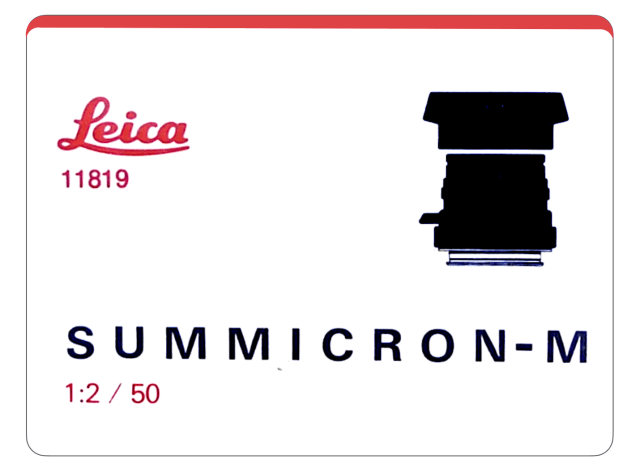
Lens descriptors, those one-liners that describe the characteristics of a lens use to be simpler. Consider the older Leica lens box shown below. A brand, a lens name, aperture, focal length, and a lens profile. But then maybe lenses were simpler? I guess they could have festooned the descriptor with lens coatings, and other fancy acronyms describing interesting lens features, but they didn’t, probably because whoever was in charge of marketing realized that lens descriptors need to be simple.
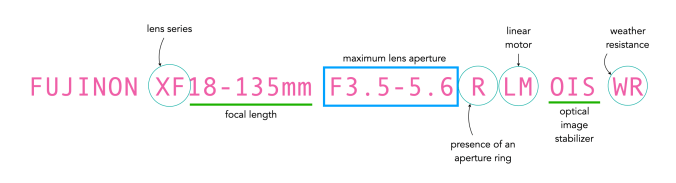
Many companies now give their lenses such complex descriptors it’s easy for people to get confused. Often the difference between two generations of a lens is the addition of another acronym on the newer lens. Take Fujifilm lenses as an example. I love Fujifilm lenses, but their names are a bit of a mouthful… to the extent that Fujifilm actually includes a section in their brochures called ‘Lens Names Explained‘. Here is an example of a Fujifilm lens descriptor:
There is a lot of information in this label, mostly describing the characteristics of the lens, such as weather-resistance, the type of motor driving the focusing mechanism, and whether the lens has a physical aperture ring or not. Most companies that produce lenses seem to have some sort of guide to explain their terminology. Canon provides ‘How to read a lens name‘ where they talk about lens mount, focal length and aperture (the easiest things to explain), and then a myriad of abbreviations to explain technology: L (Luxury), DO (diffractive optics), DS (defocus smoothing coating), IS (image stabilization), and focusing motor (USM/Nano USM/STM/Macro). or perhaps Sony’s ‘Lens terminology‘?
For the average user, it’s just too much information. Can things be improved? Yes − by simplifying naming conventions, i.e. removing the acronyms and abbreviations. Put them somewhere else, because most people in the first instance are interested in ① focal length, ② maximum aperture, and perhaps ③ weather resistance (and let’s be honest, price). I’m not even sure it matters if the acknowledgement of aspherical lens elements is necessary, or even the type of focusing motor. The only people that likely care are professional photographers. I mean most lenses have pages contains their specs that people will read, so is there any point to including so much detail in a lens descriptor? Perhaps try and create some industry standard symbols. For example using a symbol to denote weather resistance, e.g. ☔︎.
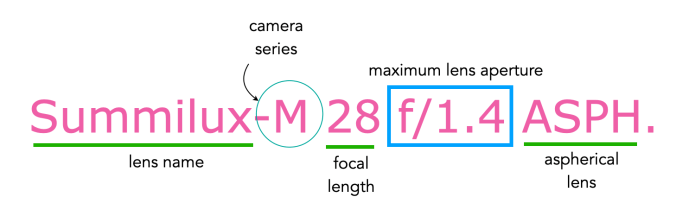
Below is a much simpler description of a Leica lens. Mostly just the basics, although I don’t really know why they include the fact the lens contains aspherical elements (ASPH)?
Although I always thought that in the age of different sensor sizes, it might be better to forgo the focal length, and replace it with the lenses angle-of-view (the horizontal one that is, not the nonsensical diagonal one). So for the example lens above (for full frame) this would be 65°. This would also avoid the whole issue with designating lenses, e.g. crop-sensor. Maybe the issue is also that lenses really don’t have ‘names’ anymore, well except for maybe Leica and Zeiss.
I understand, digital lenses are way more complex than their historical counterparts, and companies are continuously adding new features. But where does it end? Do we add lens elements/group data to the descriptor? What about lens coatings? The presence of ASPH already shows some creep of internal technology onto the side of a lens box. How important is it to know that a lens has aspherical elements? Do we also need to signify the existence pf extra-low dispersion glass?
I get it, it’s all about selling the lens, but the more complicated a lens descriptor is, the more questions that have to be asked.
I previously covered choosing a camera for travel, now I thought I would provide some insight into choosing lenses for travel, in the context of an amateur photographer. There are many varied opinions on this travel photography, although I have to believe some come from photographers who aren’t really amateurs. This post speaks more to the traveller, who I consider distinctly different to the tourist. The tourist is a person who is just there to take photographs, with little interest in knowing the story behind the objects in the scene. They just care that they photographed the scene. The traveller is intrinsically interested in what they photograph. There are many forms of tourist ranging from the person who takes photos with an iPad to that annoying person who is fully decking out with a full-frame camera with the largest zoom lens available.
Travel photography, at least for the amateur, can suffer from what is commonly known as overpacking. You think you are going to need a bunch of lenses and accessories, and you end up with a bag overstuffed with gear. From my own experiences, you never end up using half of it. More important may be a couple of lenses for the large camera, and a secondary pocket-size camera, something like a Ricoh GR III. This ancillary camera is perfectly suited to street photography because it is designed to do just that, in a more discrete way (and offers macro as well). But back to the lenses. The reality is that you likely only need 1-2 lenses, or if you prefer zooms, a single lens.
The best travel combo is a normal and an ultra-wide lens
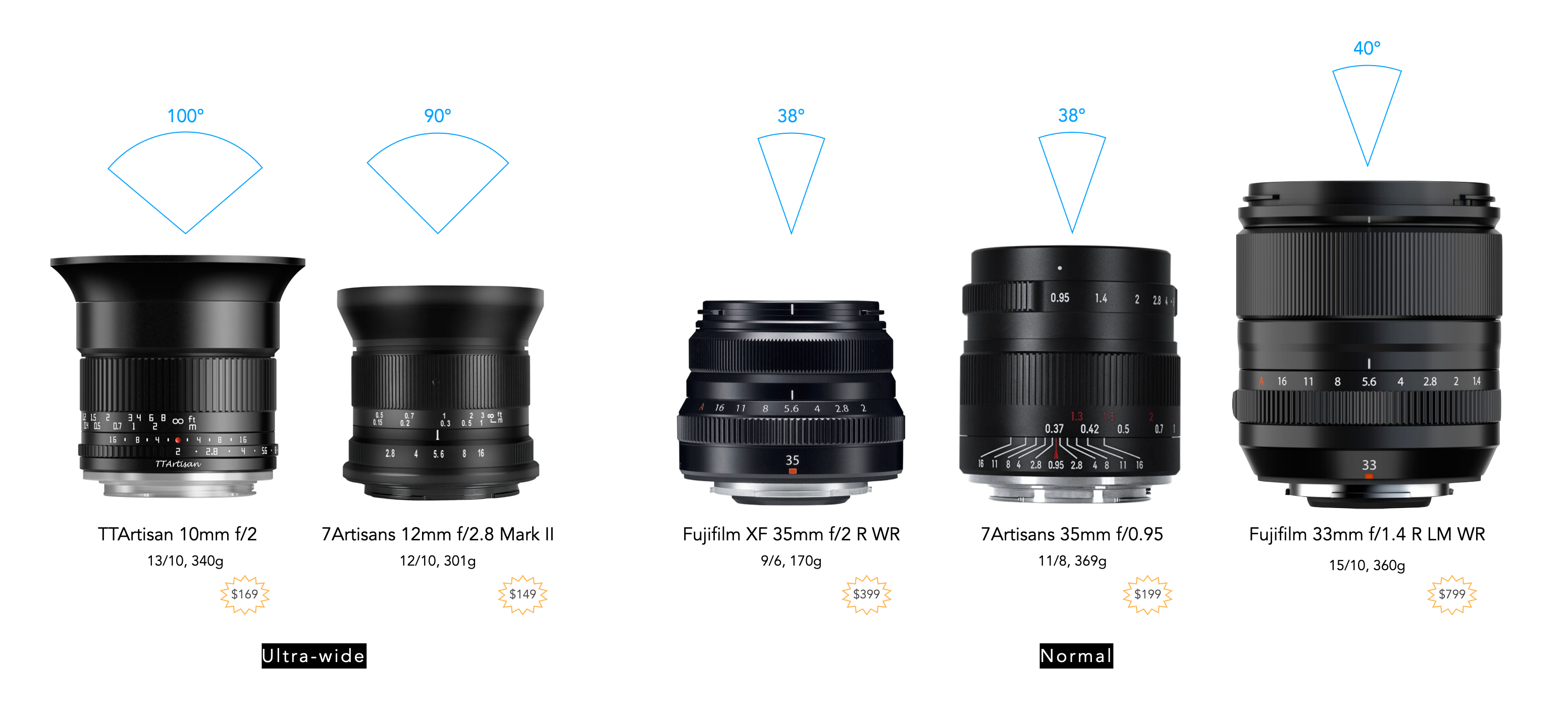
When you travel, you are trying to replicate in photographs what you see with your eyes. This means a normal lens, something in the range 40-55mm (or 26-36mm for APS-C), which provides roughly the same perspective as you see with your own eyes. A normal lens is good because it is inconspicuous, often quite compact, and quite adaptable to street photography. The faster normal’s also have the added benefit of performing well in low-light conditions, for example museums where flashes are often prohibited. For example with the Fuji-X system, a good choice might be a 35mm f/2 R WR, which provides a low-cost, weather-resistant normal lens (US$400, 170g), or the faster 33mm f/1.4 R LM WR (US$800, 360g).
Fig.1: Choices for ultra-wide and normal lenses (Fuji-X)
Travel general involves scenes that are expansive, whether that is natural landscapes, streetscapes or simply photographing in tight spaces. The best lenses replicating this immersive experience in photographic form is an ultra-wide-angle lens. There are many situations, especially in older cities, where an ultra-wide angle lens helps transform a simple street into a dramatic scene. This means lenses in the range of 15−20mm (10−13mm for APS-C). Some Fuji-X choices for normal and ultra-wide lenses are shown in Figure 1.
Here are some of the things to consider when choosing a lens for travel photography:
weather-resistance − Not every day is sunny when travelling, so having some protection against moisture and dust is a good idea.
auto-focus + manual focus − Auto-focus makes taking photography easier, especially as the window for taking a shot can be limited. It’s also nice to have some control over more artistic shots with the option of manual focus.
a reasonable large aperture, good for low-light − Nobody wants to lug a flash around when touring, as it can be somewhat invasive.
compact enough to fit in a pocket − For a secondary lens, it’s handy just top be able to fit it in a pocket, or small bag.
This isn’t the telephoto you’re looking for
Some will argue that a telephoto while travelling is a must-have, helping to capture scenes that are physically out of reach, I would argue the opposite. On most trips, telephoto lenses just aren’t needed. They might be great for a safari, but traipsing through the alps, or the streets of Rome, there is little need for a telephoto. There may be some shots you won’t get, particularly those in the distance, but frankly travel is about immersing yourself in the immediate surroundings. There wouldn’t be much point in taking a photo of a Roman statue from a distance.
A zoom lens for those who want a single lens
For those who prefer a single lens, then the answer might be a zoom lens. Firstly, avoid the superzoom lens – these are cover everything from wide to ultra-telephoto providing a broad range of focal lengths. These offer exceptional flexibility, but at the expense of being heavy, which can impact travel portability. In addition they often just aren’t wide enough. For example Tamron makes a 18-300mm lens for Fuji-X cameras (f/3.5-f/6.3), which covers everything really – in terms of FF this is 27-450mm. That’s a *lot* of lens. But the lens is 620g, which is heavy, well heavier than I would want to lug around everyday, and at f/3.5 it is kind-of slow. Besides which, based on the previous discussion, there is little need for a telephoto zoom when travelling.
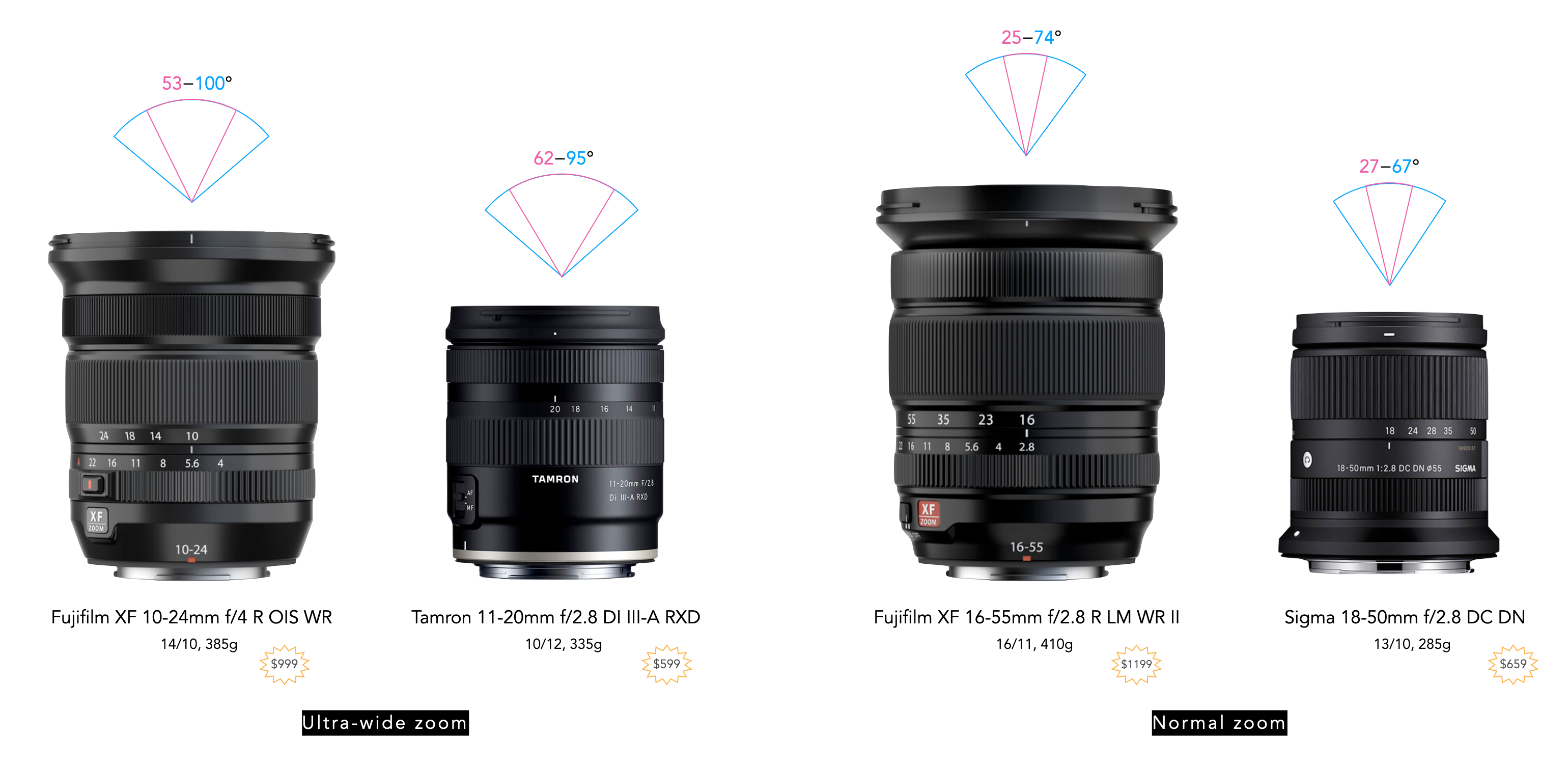
Fig.2: Choices for ultra-wide and normal zoom lenses (Fuji-X).
If you only want a zoom lens, stick to one which encompasses wide, normal, and perhaps portrait – for Fuji this would be something like a 16-55mm (24-82.5mm FF), considered by some to be the “Swiss Army Knife” of lenses. Or perhaps the lighter, less expensive Sigma 18-50mm (27-75mm FF). Figure 2 shows a series of potential zooms for Fuji-X, all of which are autofocus (generally for Fuji-X, the only autofocus lenses are restricted to Fujifilm, Sigma and Tamron lenses).
Artisanal lenses
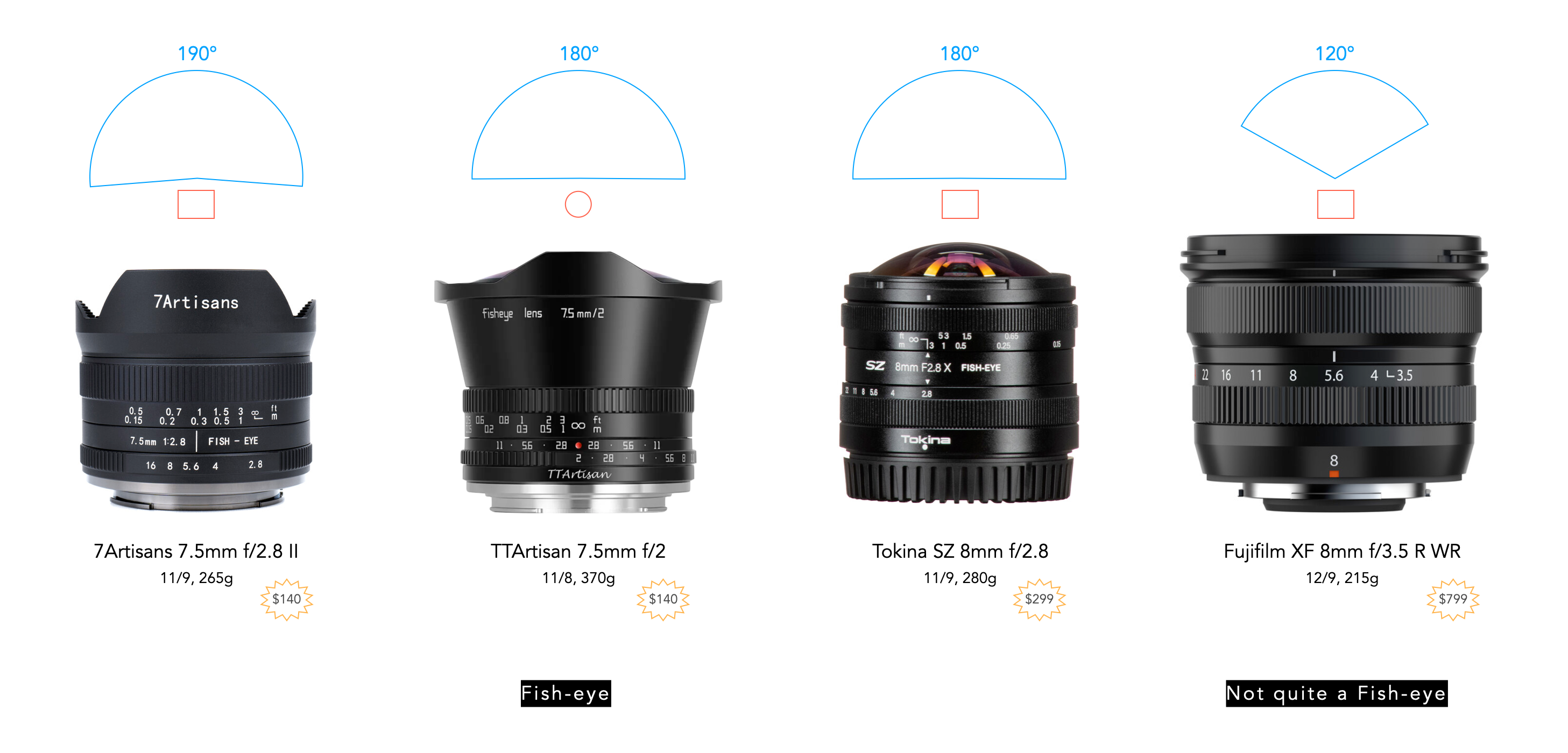
Another interesting lens to take along is a fish-eye lens, allowing for the creation of whimsical and fun travel photographs. A fish-eye is the wider alternative to the ultra-wide, and generally comes in a circular, or diagonal format. Both these formats generally exhibit some form of distortion, hence the reason they are usually used in a more artistic way. They are also perfect for photographing large, cavernous spaces, i.e. those whose grandeur would not be represented clearly by any other lens, e.g. cathedral ceilings. What about distortion? Consider it part of the art. Figure 3 shows some fish-eye choices for Fuji-X.
Fig.3: Choices for fish-eye lenses (Fuji-X)
The final choice?
In many cases you will end up using a single lens for 80-90% of the time. What that lens is, is really up to the needs of the photographer. What if you had to choose only one lens to take long on your travels? Some people photograph an entire trip entirely using a 35mm lens (APS-C 23mm), others may choose a versatile zoom. Or perhaps the best option is to compact zoom, and a wide aperture normal, e.g. 35mm f/1.4 (APS-C). A 35mm lens (23mm APS-C) is suitable for most landscapes, and covers most aspects of daily life encountered in street photography. For example the Fujifilm 23mm f/2 R WR is compact, lightweight, and has a horizontal AOV of 55°, which is reasonable. On the downside, low-light situations aren’t fantastic, and close-up shots can be soft. But it is weather resistant, less expensive than one of Fuji’s top lenses, and is fast to focus. Everything is a compromise.
Many people will push native lenses only, e.g. Fujifilm – it’s not necessary, there are many good 3rd party lenses, the only caveat being that many are manual focus only.
N.B. Prices are in US$, and AOV’s shown in the figures are always horizontal.
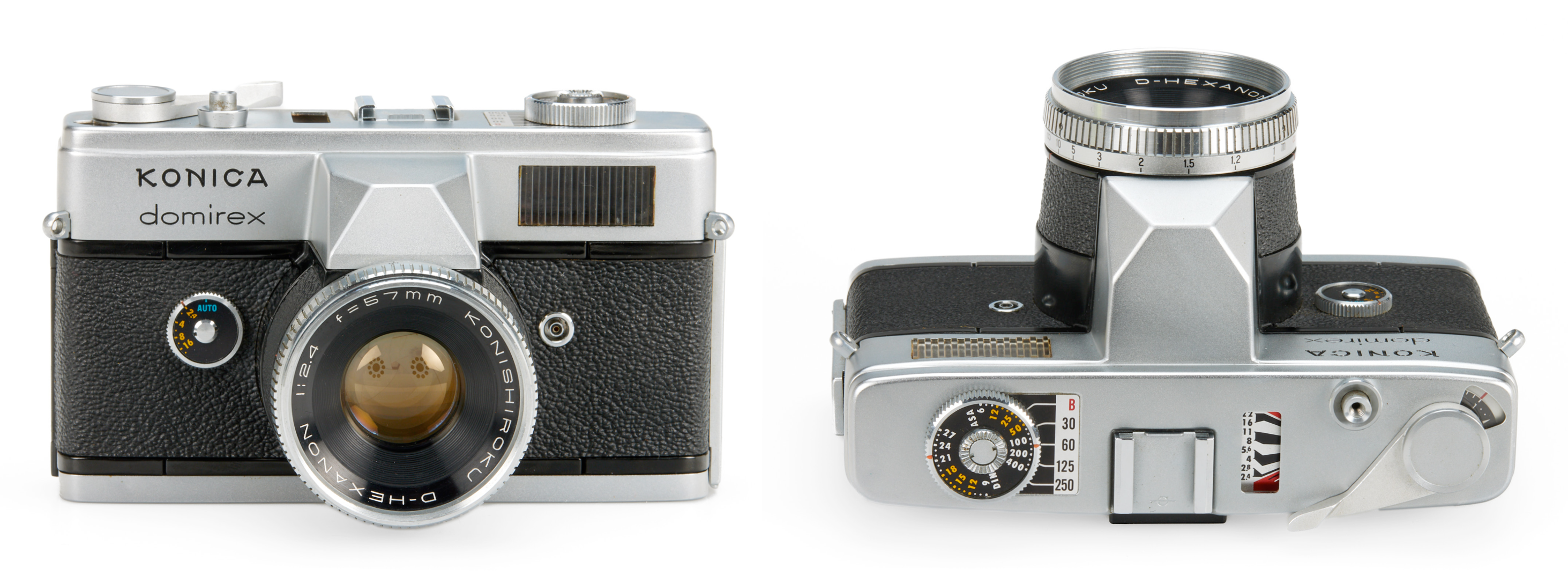
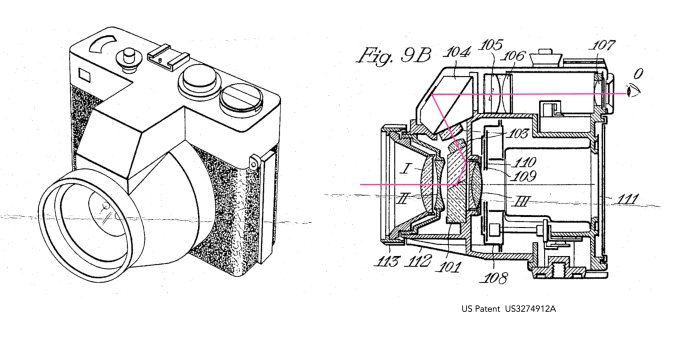
The Konica Domirex was a prototype SLR camera which made its debut at Photokina in 1963. It had a very unique mirror mechanism, that effectively eliminated the need for the mirror to flip-up when the shutter release was triggered. The Domirex was a fixed-lens SLR with a 4-speed Seiko leaf shutter, and a Hexanon 57mm f/2.4 lens (but it actually looked like a rangefinder camera). The camera was described in US patent US3274912A, ‘Single-Lens Reflex Camera’, (1966, submitted 1962).
The concept was based on the idea of a beam-splitter reflex (BSR) which appeared in the mid 1960s [1]. Unlike an SLR which uses a mirror to reflect incoming light from the lens up through a pentaprism or waist-level viewfinder, the BSR deflects only a small portion of the light up through the viewfinder, with the remainder continuing on to the image plane. This was by no means a new concept, a similar idea had been used for a number of years in 16mm cine cameras – Bolex-REX and Arriflex 16.
Fig.1: The Konica Domirex
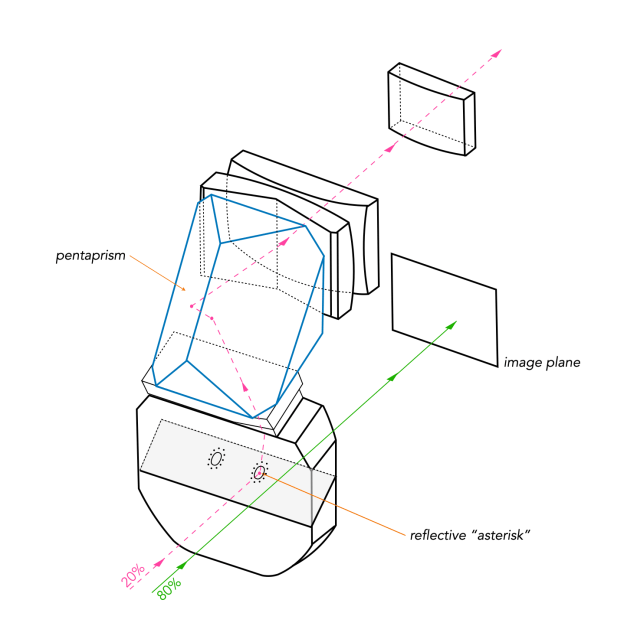
In the case of the Domirex it works in the following manner. Between the lens elements is a small optical block containing two small “asterisk-shaped” semi-reflective silvered surfaces, placed in the path of the light rays. These “mirrors” are fixed and inclined at 45° (these are off-axis, one to the left and one to the right), and carefully positioned so not as to cause issues with the exposed image. They send a portion of light from the lens to the roof prism, while the remaining light continues its trajectory towards the film. The roof prism takes up less space in the top of the housing but protrudes slightly towards the front, covering the upper part of the optical block. The camera also had both horizontal and vertical split-image rangefinders for focusing, and did not use ground-glass for focusing (which might have hindered the minimal amount of light passing through the viewfinder).
Fig.2: The beam-split reflex mechanism of the Domirex
Norman Rothschild reviewed the prototype in 1965 in Popular Photography [2]. The first thing he noted was “the one thing you’d expect to hear, is absolutely missing”, of course he is referring to the sound of the mirror. This design has the distinct advantage of not needing a large mirror that has to flip up in order for the light to pass through to the image plane during exposure. A large mirror causes mirror-black out, even if only for an instant, vibration, and of course noise. Get rid of the moving mirror, and there is no black-out, no vibration, and very little noise.
There were of course some inherent downsides to the design. As only a small amount of light is sent to the viewfinder, the viewfinder image would be much darker, than when 100% of light is reflected by means of a mirror. Could this loss of light have been a problem? Rothschild [2] suggested that the light loss was around 20%, meaning 80% of the light passed through to the image plane. But he seems to have had no problem focusing the camera, even in “relatively dim light”. This may be been due to the quality of the pentaprism, the lack of ground-glass, and split-rangefinder.
Fig.3: The Konica patent precursor to the Domirex
Perhaps the greatest problem would be the lack of interchangeable lenses. The prototype would have had to be modified to allow for interchangeable lenses. This could be accomplished by creating lenses incorporating the 45° reflective surfaces – but this would ultimately make them more expensive than traditional lenses. The camera also used a leaf-type shutter, which was certainly on the way out in the early 1960s, supplanted by the focal-plane shutter. By 1963 there was likely too much influence from existing SLR technologies to attempt to release a new technology. It is distinctly possible that as Mike Eckman suggests [3], the Canon Pellix, released in 1965, was a better option. It was a more conventional 35mm SLR, but with a semi-reflective mirror that accomplished the same aim as the BSR. But it offered a ground-glass, fully interchangeable lenses and a focal-plane shutter.
Rothschild though that the beam-splitting reflex design would eventually succeed in becoming part of the overall SLR market [2]. Rothschild’s final comment in the article was “the Dominex is worth waiting for, even if this takes a while.”. Sadly he would be wrong. Having likely made only prototypes, there aren’t many of these cameras about, however one of the original prototypes sold in spring 2024 for €12,000.
Further reading:
Bill Pierce, “SLR’s Without Moving Mirrors: The Split-Beam System”, Popular Photography, 55, pp.64, 126 (June, 1964)
Norman Rothschild, “Konica Domirex – A prototype”, Popular Photography, 54, pp.65-67 (June, 1965)


 Crafting Pixels