Should the “rule of thirds” be broken?

The “Rule of Thirds” (ROT) is a concept used for the composition of a photograph. It states that the centre of interest in a photograph should be placed at any one of the four intersections of four imaginary lines, two of which bisect the frame horizontally, and two of which bisect it vertically, dividing the picture into thirds each way. It’s main goal is to move the subject out of the centre of the image, because having the subject to one side produces visual interest.
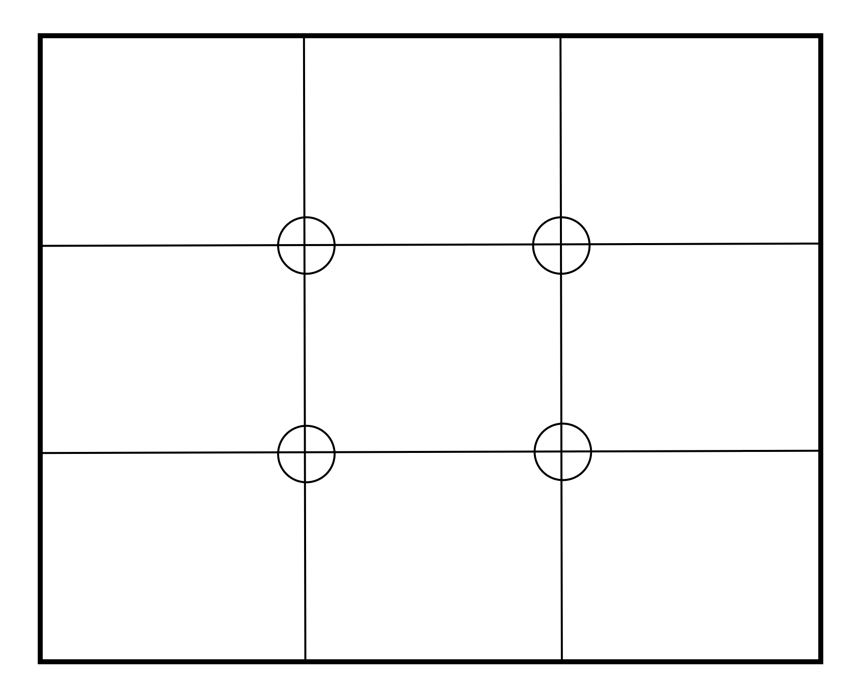
Fig.1: The “Rule of Thirds” grid

But this idea did not originate in photography, but rather art, i.e. painting. In 1783 Sir Joshua Reynolds taught at the Royal Academy of Arts in London, mentioning in his discourses how a painting works best when the use of light and dark has a ratio of approximately ⅓ : ⅔. It is described in a book entitled “Remarks on rural scenery : with twenty etchings of cottages, from nature : and some observations and precepts relative to the pictoresque“, by John Thomas Smith and Joseph Downes in 1797, where is it first defined.

Two distinct, equal lights, should never appear in the same picture : One should be principal, and the rest sub-ordinate, both in dimension and degree : Unequal parts and gradations lead the attention easily from part to part, while parts of equal appearance hold it awkardly suspended, as if unable to determine which of those parts is to be considered as the subordinate. “And ” to give the utmost force and solidity to your work, some part of ” the picture should be as light, and some as dark as possible: ” These two extremes are then to be harmonized and reconciled ” to each other.”

Analogous to this “Rule of thirds”, ( if I may be allowed so to call it ) I have presumed to think that, in connecting or in breaking the various lines of a picture, it would likewise be a good rule to do it, in general, by a similar scheme of proportion ; for example, in a design of landscape, to determine the sky at about two-thirds ; or else at about one-third, so that the material objects might occupy the other two : Again, two thirds of one element, ( as of water ) to one third of another element ( as of land ) ; and then both together to make but one third of the picture, of which the two other thirds should go for the sky and serial perspectives.

How it got to photography is somewhat mystical. Search for it in books of the mid-20th century, and you won’t find it. For example The Amateur Photographer’s Handbook, by Aaron Sussman, published for about four decades from 1941 on wards does not mention it. It is possible that it transitioned from the cinematic industry where it is commonly used [1]. Consider the examples shown in Figure 2. In the left image, the character clearly is framed in the right third of the frame, whilst in the right image the background and foreground characters are framed at opposite sides of the intersecting lines.
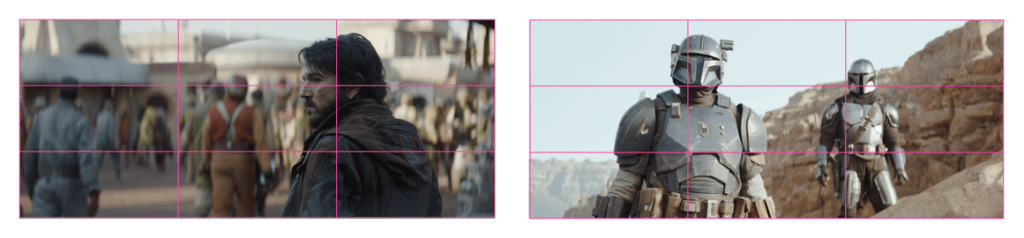
Fig.2: Use of “Rule of Thirds” in cinematography

By the 1980s it was often mentioned in passing as a mean of composition, but the past two decades has seen it blossom online, both for use in still photography and video. You can commonly find it being used as the composition guides overlaid on screens on cameras as a means to help with composition.

But is it the most optimal means of composition? Hardly. The rule of thirds is not mandatory and when the composition demands it, it can and should be violated. In reality it shouldn’t even be perceived a rule, but rather a guideline. Some photographers believe that an over reliance on this method of composition can lead to boring photographs. Of course the “rule of thirds” isn’t the only method of composition, indeed there are numerous others, some of which are shown in Figure 3. The best composition method is the one that best suits the particular scene being photographed.
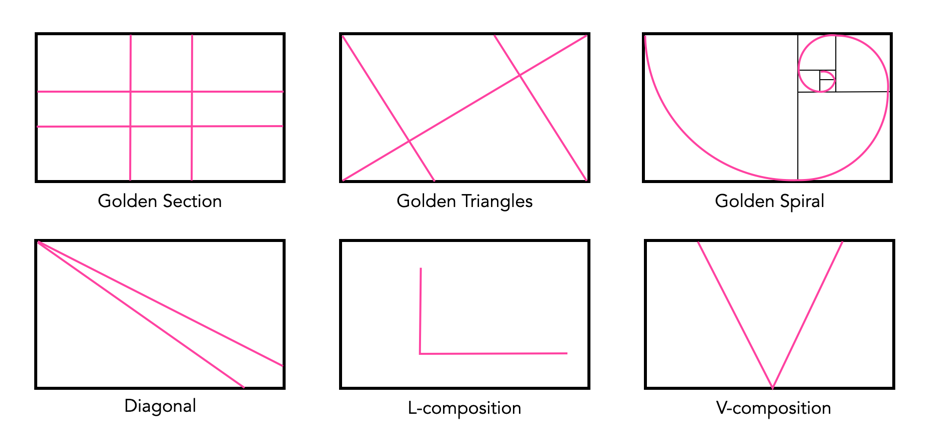
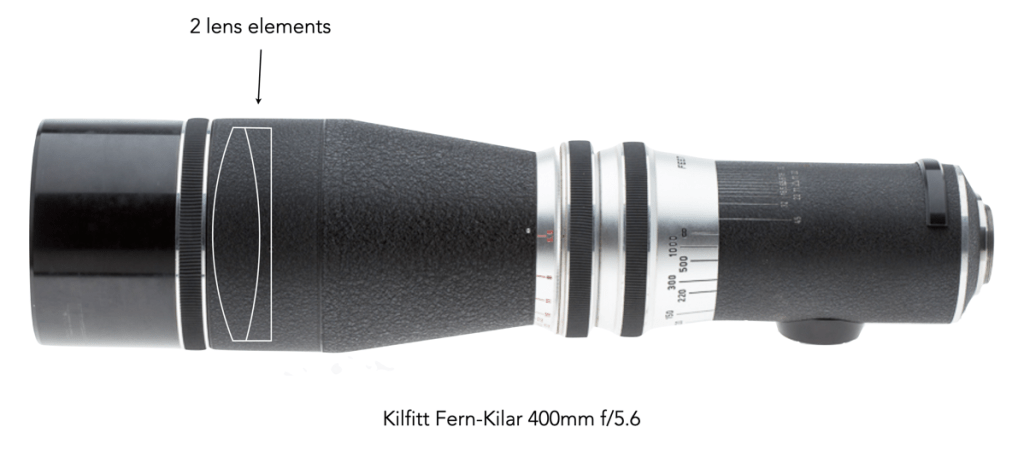
Fig.3: Alternative methods of composition

Further reading

  1. What is the Rule of Thirds? How to use this technique to capture dynamic images (2023)
  2. Filmmaking 101: What Is the Rule of Thirds & How Filmmakers Use It (and break it) (2021)
  3. Why The Golden Ratio Is Better Than The Rule Of Thirds (2022)

Vintage lenses – Why do some long-focus lenses have so few elements?

Lenses are funny. Lenses with small focal lengths usually contain a lot of glass, conversely those with long focal lengths contain very little. Why is this the case? Shouldn’t telephoto lenses be filled with optical elements? The answer is no, and it’s because of the nature of how telephoto lenses, or in this case long-focus lenses, work – vintage telephoto lenses are not all built in the same way.

The famous 400mm lens from “Rear Window” only has two lens elements.

There are some vintage long-focus lenses that have a mere two elements – many of these lenses have extremely long focal lengths. These two-element lenses were often cemented together, positioned in front of the diaphragm, with very little in the way of anything else in the lens barrel. Simple lenses of the type are capable of excellent definition if the field is restricted to a few degrees from the axis and the aperture is not too great.

This type of 2-element lens was made by a number of different manufacturers:

  • Astro-Gesellschaft (Berlin) − Astro-Fernbild 200-1000mm
  • Kilfitt − Fern-Kilar (400mm f/5.6, 600mm f/5.6)
  • Tewe − Telon (400mm, 500mm, 600mm, and 800mm)
  • Komura − 800mm f/8
  • Carl Zeiss Jena − Fernobjektiv 500mm f/8 (1934)
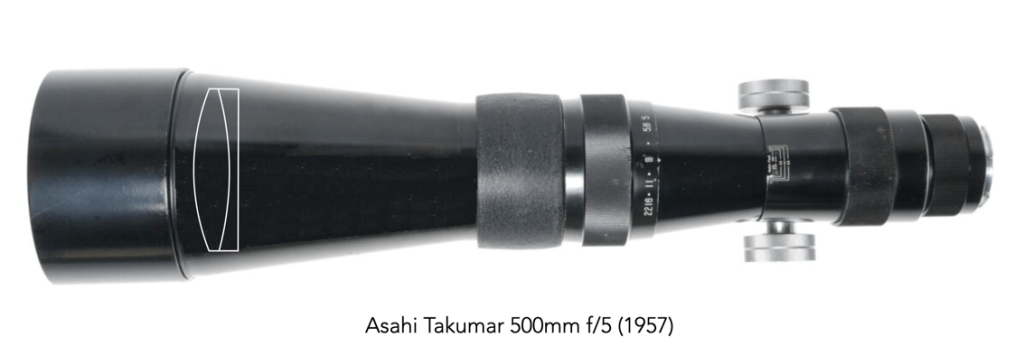
  • Asahi − Asahi Takumar 500mm f/5 (1957)
  • Canon − R Bellows 600mm F/5.6, 800mm f/8, 1000mm f/11 (1960)

What focal length is that?

Having a hard time trying to decide on a focal length? Below is an easy visual guide to the most common focal lengths, displaying the amount of a scene captured. Note these are full-frame/35mm focal lengths, so smaller sensors will require calculating equivalencies. For example the view shown for the 50mm lens below would be equivalent to what is seen by a 33mm lens on an APS-C camera, or a 25mm lens on a Micro-Four-Thirds camera. The 135mm lens view would be equivalent to a 90mm APS-C or a 68mm MFT lens.

Focal length views for classic 35mm lens (+DSLR) cameras.

Keppler on the truth about lenses

Some of the truths about lenses for “prism reflexes” by Herbert Keppler in his book, Keppler on the Eye-Level Reflex (1960).

  1. No two lenses, even if they are the same aperture, the same focal length and the same make, are exactly alike in performance.
  2. The best camera and lens makers, while producing the best lenses, also let a number of “dogs” get by (in error, we hope).
  3. While no lens is perfect, some few lenses are capable of astounding performance.
  4. A company which produces one astounding lens is quite capable of making another which is equally as bad as the first is good.
  5. Almost no lens made for single-lens reflexes delivers its best performance at full opening. Almost all produce better results at f/5.6 and f/8.
  6. The quality of lenses can only be discussed in comparison with other lenses since there is no practical-to-use standard of optical perfection.

Vintage lenses – What do lens markings mean?

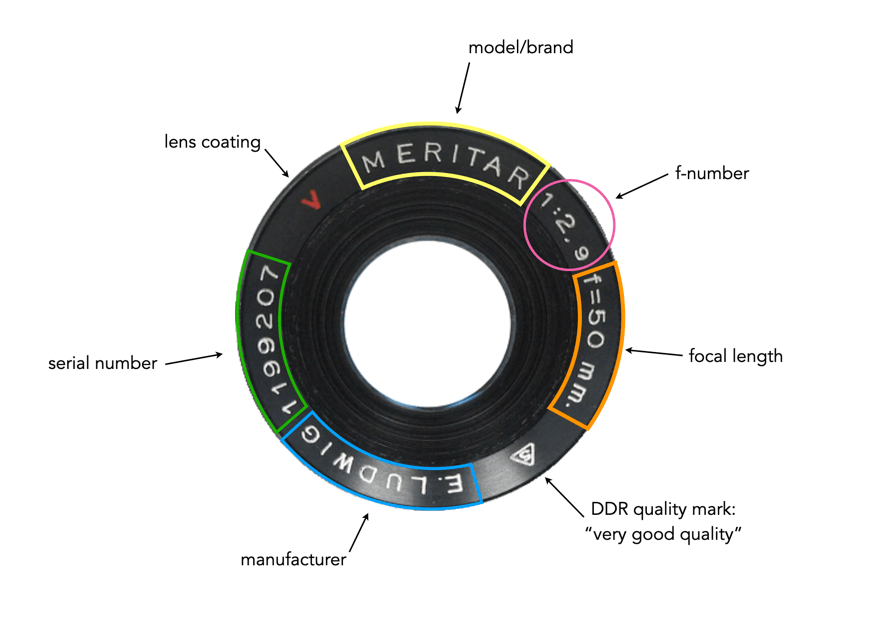
Vintage lenses are festooned with markings. There are the numbers related to focusing, and the f-stop values, but the details engraved upon the lens name plate will explain most things about the lens. This post will look at vintage lens markings by investigating a few examples. In general, most lenses have 5-6 markings: (i) lens model/brand; (ii) maximum aperture (speed); (iii) focal length, (iv) serial number; (v) company; and (vi) place of manufacture (these are shown in Figure 1 using colour coding to highlight). In addition there may be some symbols used to denote specialty characteristics such as lens coatings. These markings are usually found on the front of the lens on the rim sounding the first element. On lenses where there is no room on the front of the lens, the lens marking are usually found circumscribed around the outside of the lens.

Fig 1. The various markings on a lens (colour coded)

The first two items described are the manufacturer (or brand), and the type or name of the lens. In this case the manufacturer is E.Ludwig, and the type or name of the lens is a MERITAR. Most vintage lenses also provide the len’s serial number on the name plate – in this case 1199207. With come manufacturers the serial number helps track down information like where, and when it was manufactured. The most important information is the 1:2.9, which basically specifies the speed (maximum aperture) of the lens, here f/2.9. The last piece of information is f=50mm which specifies the focal length of the lens. On this particular lens there is also two additional symbols which specify lens coating and a quality mark.

Fig 2. Lens markings on various brands (same colour-coding as Fig.1, with the addition of red to denote place of manufacture)

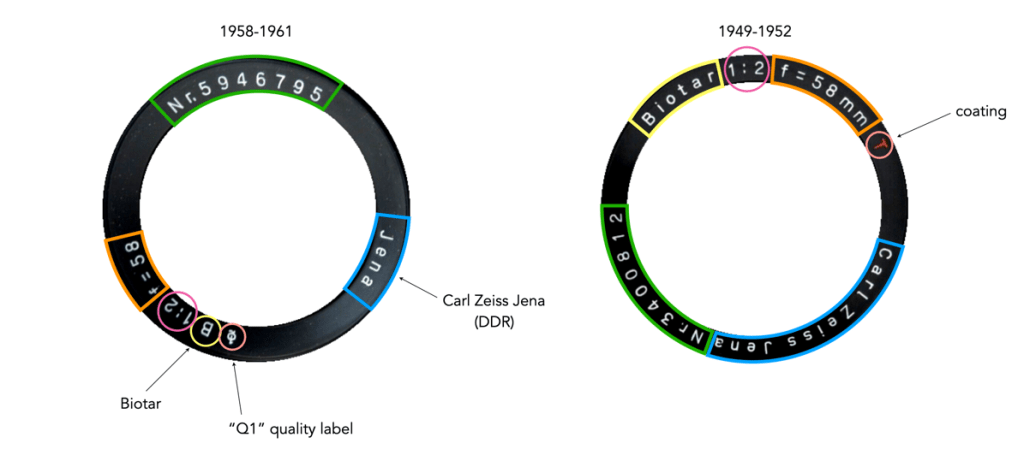
Figure 2 shows three more examples of lens markings from Kilfitt, Asahi, and Enna. Figure 3 shows lens markings from Zeiss Biotar 58mm f/2 lenses from two differing periods. The latter one has more cryptic lens marking – there is less info here because the lens was produced during the infamous Zeiss trademark dispute. Zeiss Jena in East Germany marked the Biotar lenses with a “B”, in order for them to be sold in the west.

Fig 3. Zeiss Biotar lenses from two differing periods

The focal length/aperture combination is the one thing that can be described in a number of different ways. The f-number is normally specified using a ratio, 1:x, rather than the f/ term. On some lenses the length and aperture are combined in the form aperture/focal length, e.g. 2.8/50. It’s actually somewhat rare to see f being used to specify maximum aperture, instead it is often used to signify focal length, e.g. f=58mm. Focal length is nearly always specified in metric, the only difference being that up until about 1950, many lenses were specified in centimetres, whereas afterwards the focal length became more standardized using millimetres. So an early lens might have been 5cm, versus the more standardized 50mm.

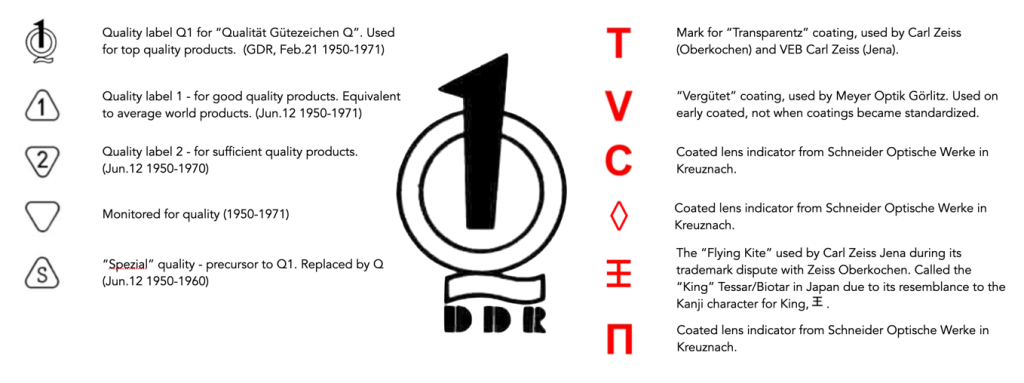
Fig 4. Specialized lens markings found on various German lenses.

Sometimes vintage lenses also carry other markings. Sometimes instead of a brand name, there is a logo to signify a brand. This is common in vintage Russian lenses where the same lens could have been manufactured in more than one plant. Some lenses also have a number with the diameter symbol, ∅, which indicates the filter size of the lens in mm. Some lenses also use letters to signify the presence of lens coatings, e.g. Meyer Optik specified a lens coating using a red “V”, after the focal length (which means Vergütet = coating). Examples of specialized lens markings for German lenses is shown in Figure 5.

Fig 5. Types of specialized lens markings found on German lenses.

Keppler on collecting

Among the many things I resent about digital imaging is the slamming of the door on one of my favorite hobbies, camera collecting. Aside from getting a discontinued model cheap to use as a backup, can you tell me why someone would be excited about buying an obsolete digital camera for any purpose other than to use as a doorstop?

Herbert Keppler, On the joys of collecting. (Popular Photography & Imaging, August 2007)

War reparations at Carl Zeiss Jena – where did the dismantled equipment go?

The Soviets reportedly stripped Carl Zeiss Jena of 93% of its equipment, most of which was redistributed throughout factories in the USSR. This included 14 of the 16 glass furnaces at Zeiss [4], machines, office supplies and equipment, stocks and raw materials, boilers, elevators, switchboards etc. [5]. So what happened to the equipment taken by the Soviets as war reparations from the Jena plant from October 1946 to April 1947?

The majority of the dismantled equipment was transferred to three cities in the USSR – Moscow, Leningrad, and Kiev [8]. To Moscow went the rangefinder equipment, to Leningrad the equipment for the production of microscopes, micrometers and fine measuring devices, and to Kiev the geodetic equipment and the Contax Camera section [8]. Most of it seems to have been transferred to two factories in Russia: No.349, and No.393.

The Optical-Mechanical Plant No.349 near Leningrad (now St. Petersburg) was founded in 1914 in Petrograd. In 1919 it was nationalized, and in 1921 it was renamed the Factory of State Optics. Further reorganizations resulted in the factory in Leningrad becoming Gosudarstvennyy Opticheskiy Mekhanicheskiy Zavod (GOMZ), or State Optical-Mechanical Factory, in 1932. In 1965 GOMZ changed its name to LOMO (Leningradskoe Optiko Mekhanichesko Obedinenie), or Leningrad Optical-Mechanical Union. They produced optics for the Soviet military and space programs, as well as consumer cameras. Seventy-nine of the Zeiss experts from Jena were assigned to GOMZ, and the existing equipment in various parts of the factory was replaced by equipment dismantled from Jena [2]. By mid-1947 the process was completed, and the Soviet personnel were trained on using the equipment. A CIA report on the facility [2] suggests that much of the dismantled equipment stored in the open, or spoiled by mishandling, and the Soviets gained very little from the seized equipment [2].

Zavod (factory) No.393 is located in the small town of Krasnogorsk, a few kilometers from Moscow. Krasnogorsky Zavod was founded in 1942. During the Soviet era it became known as Krasnogorskiy Mechanicheskiy Zavod (Krasnogorskiy Mechanical Works), or KMZ for short. After 1945 it began producing lenses to Carl Zeiss specifications. The machinery at No.393 seems to be almost entirely made up of machines dismantled from Zeiss, Jena [6]. All the grinding and polishing machines at No.393 were transferred from Jena, amounting to one-third of the entire Zeiss plant as it existed prior to dismantling (100 lens grinding machines, 300 milling machines, and 100 metal grinding machines) [3]. The largest segment of machines was the 400 lathes of various sizes. All optical glass used at No.393 from 1946 to 1952 was from Jena, and of good quality [3].

No.393 produced a lot of optical items, including the Zorky camera, designated “FED”, and associated 5cm lenses. The Zorky was essentially a copy of the Leica IIc manufactured during the period 1940-1944. By 1951, about 400 cameras per month were being produced [6]. By 1947 the plant also made Moscow II 6×9cm camera, aerial cameras, photo-rectifiers, phototheodolites, 16mm motion picture cameras, and a series of military items.

The Contax camera section went to Arsenal No.1 in Kiev, Ukraine [8]. By the later 1940s this plant was making reproductions of the Contax II and Contax III cameras. These would morph into Kiev II and III cameras, eventually modified into the Kiev and 4A and 4AM. Some of the equipment also made it to smaller factories in the USSR. A good example of this is Optical Plant No.230 near the small town of Lytkarino (not far from Moscow). They received 50-60 grinding and polishing machines from Jena [7], although the CIA reports this as “bad and uncared-for equipment”. Some of the equipment was used to outfit a vacant optical plant in Zagorsk. Zeiss specialists installed the machinery, and trained Soviet workers [1].

The dismantling was in many ways not considered to be optimally successful, in all likelihood because insufficient care was taken with the sensitive equipment [4].

✽ Please note that while some people seem to regard the Soviet dismantling of equipment in East Germany to be looting, it was actually part of the reparation payments agreed upon in the Potsdam Agreement.

Further reading:

Please note that the CIA links don’t seem to work sometimes (since the issues with the US government websites began).

  1. Zeiss Specialists in the USSR”, Central Intelligence Agency, Information Report, 17 December (1952)
  2. Optical-Mechanical Factory No.349 GOMZ in Leningrad”, Central Intelligence Agency, Information Report, 23 June (1954)
  3. Quantity and Types of Optical Machinery and Equipment at Zavod 393 in Krasnogorsk and at Zeiss in Jena”, Central Intelligence Agency, Information Report, 25 August (1953)
  4. Zeiss and Schott and Genossen, Jena”, Central Intelligence Agency, Information Report, 1 April (1947)
  5. Organization and Production of the Carl Zeiss Plant at Jena”, Central Intelligence Agency, Information Report, 31 August (1953)
  6. Production at Factory 393 at Krasnogorsk”, Central Intelligence Agency, Information Report, 20 August (1953)
  7. Optical Plant in Lytkarino”, Central Intelligence Agency, Information Report, 19 January (1950)
  8. Activities and Production at Arsenal No.1 Kiev”, Central Intelligence Agency, Information Report, 6 February (1953)

What about the other camera on Sister Boniface Mysteries?

Of course people are also going to ask about the second camera seen on Sister Boniface Mysteries… the one belonging to Ruth Penny, Editor-in-Chief of the Albion Bugle. What is clear is that it is an Asahi Pentax model, likely an S2, S3, or even an SV (again the “Asahi Pentax” label has been covered up, but the Asahi design is still present). The S2 was introduced in 1959, the S3 in 1961, or even the SV (1963). For the S2, the lens is likely the Auto-Takumar 55mm f/2, for the S3, the Auto-Takumar 55mm f/1.8. It’s hard to make an exact designation because the camera’s all have a similar form, and the specific type markings appear atop the camera near the film rewind lever.

Look… a Pentax!

The flash seems to be a Metz Mecablitz 101 from the late 1950s/early 1960s. Note that these cameras had different designations based on market: S designated cameras were for the Japanese and European markets, and H for the North American (NA) market (as Asahi Optical was represented in North America by Honeywell Corp). So the S2 was designated the H2 in the NA market.

What camera is used on Sister Boniface Mysteries?

In the first episode of Sister Boniface Mysteries (BritBox), we are introduced to Sister Boniface, a Catholic nun with a PhD in forensic science. Now part of her job as police scientific adviser involves taking photographs, obviously given the time period in the early 1960s, she uses a 35mm SLR camera – but what camera?

The camera is introduced in the first episode, “Unnatural Causes”.

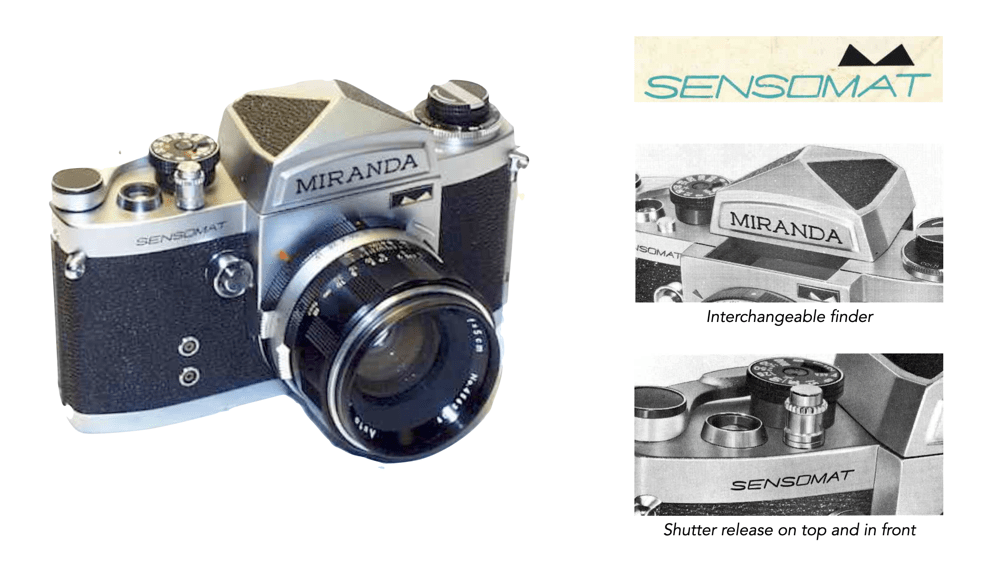
Well, it isn’t actually too hard to figure out the camera, despite the fact that the branding has been covered by black tape – the camera is from Japanese company Miranda, founded in 1947 and produced 35mm cameras from 1953 to 1976 (it was named Miranda Camera in 1957). During that period they introduced some 30 differing models nearly all with interchangeable pentaprism’s. The camera itself is a Miranda Sensomat, introduced in 1969. It was a budget camera, which had TTL CdS stop-down meter built-in the under mirror. The Sensomat range was produced from 1969-1974. The lens is likely the Auto-Miranda 50mm f/1.8, and the camera sold in 1969 for US$190 – it was advertised as being affordable.

The Miranda Sensomat

The interesting thing about the use of this camera is that the series is set in the early 1960s, and the camera was released in 1969, so there is some historical disparity. If one were choosing a Miranda camera of the period, a Miranda D might have been more appropriate. As to why the Miranda was chosen? Likely it was just a prop, it’s doubtful anyone thought about using a more historically significant camera for the period. Why cover up the brand? Likely due to not having to pay licensing fees, although it is unclear as to who currently owns the Miranda trademark.

Further reading: