There aren’t many Swiss companies that manufacturer lenses apart from Kern, but one lens exists in the form of Volpi AG, a company based in Urdorf near Zurich. The company specialized in higher-end projection systems. In the early 1970s the company produced a lens called the Peri-Apollar 360°.
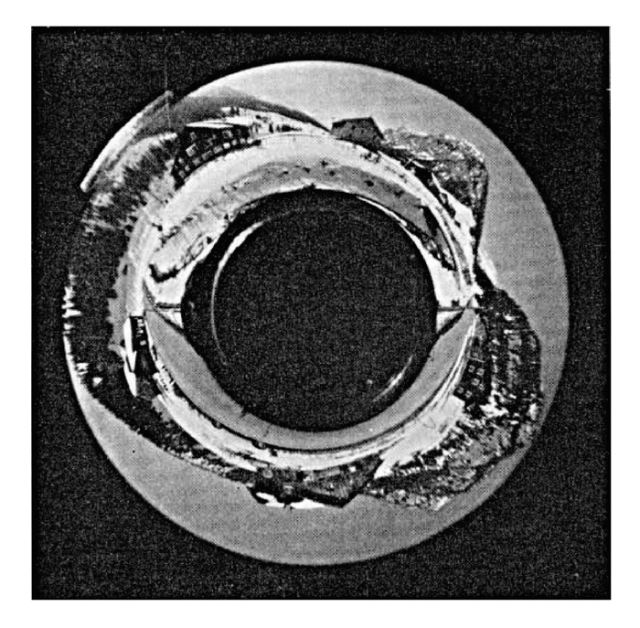
The Peri-Apollar 360°, nicknamed the “optical bell”, or “Swissorama” lens, does not use the fisheye principle or any of the other well-known panorama methods. It was developed by H. Brachvogel of Volpi AG, allowing the capture of 360° seamlessly in one image. If the camera is pointed with the lens in a vertical position, then the camera and photographer are covered by the centre of the image, which is blocked out. The inner edge of the circular ring is the lower edge of the image, the outer edge is the upper edge of the image.

The lens came in two focal lengths 25mm f/4, and 40mm f/5.6. The lenses could be adapted to many differing formats, including 16mm, 35mm, and 120 film (and could also be used as a periscope without a camera). The lens covers a complete circular image of 360°, without any gaps. When mounted in vertical position, the field of view has an angle of 60°, i.e. 30° above, and 30° below the horizon. The image is created according to the rules of central projection, where all verticals in the object field converge in a radially symmetric manner in the centre of the image. The lens was not actually intended for taking pictures in the horizontal direction
The light enters the protruding glass dome (which is an aspherical lens), and is refracted inwards at the transition between air and glass, and then totally reflected at the opposite glass-air interface. In this way the ring-shaped image is created in the front glass body. It then passes through a corrective lens and is projected onto the film by a lens of normal construction. Distance and f/stops can be set as with any normal lens.

The marketing material for the lens suggested applications in numerous fields, industrial applications, e.g. remote observation of pipes, police and military applications, recording of traffic intersections, aviation, and internal observation of nuclear reactors. The 25mm f/4 C-mount lens (with an attachable 90° periscope viewfinder sold for US$4,995 (1983); and the ALPA 40mm f/5.6 was US$3,595 (1977). In the US it was marketed by Karl Heitz. The lens is often attributed to Kinoptic because it appeared in their catalogs, however they did not produce the lens.
Lens specifications:
| 24mm×36mm | 16mm film | |
|---|---|---|
| lens | 40mm f/5.6 | 25mm f/4 |
| focal length of the peri-lens | 20mm | 15mm |
| aperture of the peri-lens | f/1 | f/1 |
| outer diameter of the image | 23mm | 11mm |
| inner diameter of the image | 8mm | 4mm |
| degrees, horizontal | 360° | 360° |
| degrees, vertical | 2×30° | 2×30° |
| number of lens elements | 8 | 4 |
| aperture range | f/5.6 to f/22 | f/4 to f/22 |
| close focusing distance | 0.1m | 0.1m |
| weight | 900g | 750g |
Acknowledgement:
Data for the table, and help with schematics adapted from information in “Fisheye-Objektive und verwandte Abbildungstechniken (IV)”, J. Scheibel in PHOTO-TECHNIK UND WIRTSCHAFT, No.8, pp. 225-227 (1973)
 Crafting Pixels