We now look at a fast telephoto lens – the Zoomatar 180mm f/1.3. This lens may have been a natural successor to the Grand-Kilar, the lens that seemingly never was. It was produced in the period after Zoomar Inc. took over Heinz Kilfitt. It is one of the fastest lenses above 100mm.
It was one of two super-fast telephoto lenses produced by Kilfitt in the 1960s, the other being the Zoomatar 75mm f/1.3. Both were intended for use in cinematography, with the 180mm also able to cover the 36×24mm area of normal SLRs. It seems like the 180mm lens was designed with the sole purpose to allow a maximum amount of light in, and it had the proportions to justify this – it was 250mm in length, had a diameter of 166mm, and weighed an astonishing 7kg – heavier than their Reflectar 1000mm f/8.
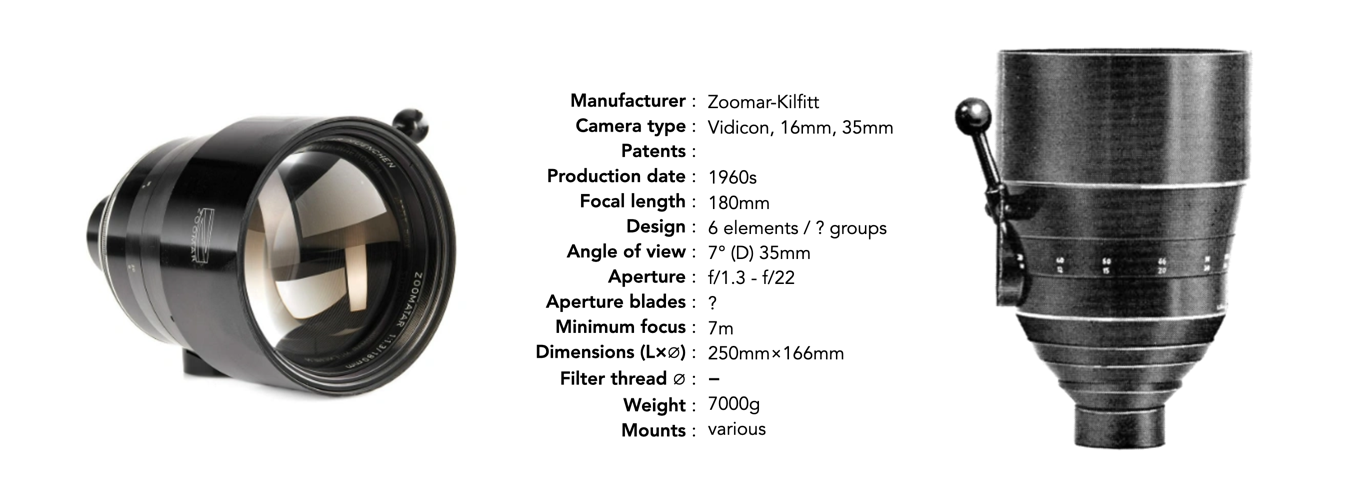
It has an optical scheme with six lenses, with a large difference between the diameter of the front (140mm) and rear (31mm) elements. Interestingly, because this lens was a cinematographic lenses, there is also some data on light transmission. Supposedly the light transmission was 80%, giving a T-stop of 1.5. Unlike the 75mm lens which was only supplied in C-mount, the 180mm lens came in various film formats (16mm and 35mm cine), in addition to 35mm. This means the angle-of-view could range from 3° on 16mm film to 7° on 35mm film. In 2011, one of these lenses sold on eBay for US$10,480.

Considering it sold in the mid-$2000’s in the 1970s, I don’t imagine many were actually manufactured (I have seen estimates of between 50-70). Zoomar did however create an even faster lens, relative to focal length – the Super Zoomatar 240mm f/1.2 – it was a behemoth at 11kg. It was originally developed for instrumentation cameras and for use with image intensifier tubes.
 Crafting Pixels