A superfast lens, is one with a very large aperture, say f/1.2 to f/1.0 (whereas an ultrafast is typically sub-f/1.0). The craze for super-fast lenses began in Japan in the 1950s, with the Zunow 50mm f/1.1 appearing in 1953. There was a lull in the latter decades of the 20th century, but the last ten years has seen a resurgence of these uber-fast f/1.2 and larger aperture lenses. There is always a lot of hype about these lenses – they are expensive, and supposedly offer some sort of nirvanic photographic experience. The question is, should you spend the money to indulge in super-fastness? First let’s look at some aspects of super-fast lenses that make them attractive.
The faster the lens is, the more light it lets in
The larger the aperture, the more light that is let into the lens, and in photography, light is good. Moving from a f/1.8 to a f/1.2 lens provides 1.17 stops more light (where one stop doubles the light). For example a 50mm lens with a speed of f/1.8 has an effective aperture of 606mm2. Another 50mm lens with a speed of f/1.2 has an effective aperture of 1363mm2.
If we consider shooting at f/1.8 versus f/1.2, the larger aperture will mean the ability to shoot at faster shutter speeds – if we assume a constant ISO, then increasing the aperture by 1.17 stops means the difference between shooting at 1/500 at f/1.8 and 1/1250 at f/1.2. The second thing is that assuming the shutter speed is fixed, you can shoot at a lower ISO setting – e.g. at a shutter speed of 1/500 it means it means an ISO difference between 400 and 160. However modern sensors work really well at high ISO settings, so perhaps the advantage of a fast lens isn’t as critical?
Faster lenses produce better aesthetics
If it’s one thing that large aperture lenses are good at, it’s aesthetics. This is because the lower the f-number, the shallower the depth of field (DOF). Shallow DOF means a blurrier background, and theoretically better bokeh. However bokeh is a natural phenomena, and relies on the optical nature of the lens, the scene, the type of light, and distance to subject. In addition, a shallow DOF also means less of the image is in focus. It’s a double-edged sword.
Not all that glitters is gold
Of course super-fast lenses are not perfect. They have three things going against them – they are large, heavy, and expensive. They are large and heavy because of the increased amount of glass, and in auto-focus lenses, a larger focusing mechanism is required to deal with the extra glass. I have talked previously about why vintage super-fast lenses were so expensive, and in reality the same basic reasons can be attributed to super-fast digital lenses. For example the Fujifilm XF 50mm f/1.0 R WR lens sells for C$2,000, and is a whopping 845g in weight, almost dwarfing any Fuji camera it is attached to. The other issue with super-fast lenses has always been that they aren’t really that sharp until they are stopped down somewhat. The Fuji 50mm f/1.0 reviews well, but even then some reviewers note that it isn’t that sharp until stopped down to f/2.8 or smaller. But reviews are subjective, and so you really have to test the lens to see if it fits your needs.
Brand or third-party lens?
There is also the dilemma of which super/ultra fast lens to buy. There are a lot of 3rd-party lens manufacturers that produce these lenses at a reasonable cost. I mean you can buy the Meike 50mm f/0.95 for about C$400, or the TTArtisan 50mm f/1.2 for about C$140. The Meike actually gets really good reviews. The reality is that 3rd-party lenses offer a good quality for the price, even better than could be found on the vintage market. Of course the Fuji 50mm f/1.0 is in a class of its own, offering autofocus for a f/1.0 (most lenses of this speed are manual focus), and exceptional bokeh.
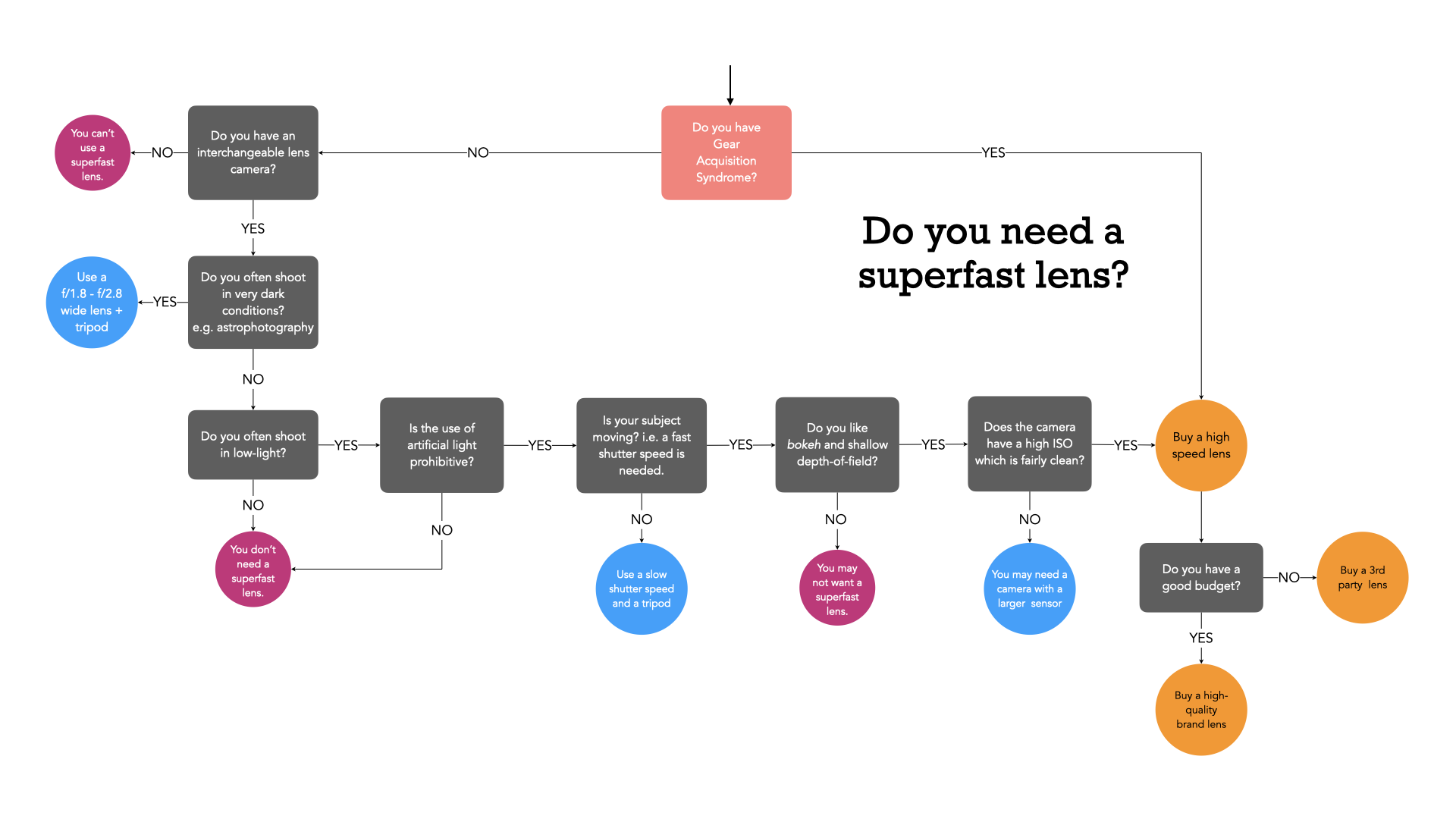
So should you buy a super-fast lens? Well, perhaps it boils down to whether you really need more light? This may mean you shoot a lot in low-light conditions, or in a case of the Fuji 50mm f/1.0, a superlative lens for portraiture. For a further foray into these lenses, check out “Are modern ultrafast lenses useful?“.
✿ The number of stops difference between two apertures A and B can be calculated by first finding C=A/B. The number of stops difference is then log(C)/log(sqrt(2)). So the difference between f/1.8 and f/1.2 is 1.17 stops.
 Crafting Pixels
Pingback: Camera gear that amateur photographers should avoid | Crafting Pixels