A 50mm lens is always a 50mm right? They are in terms of focal length, but shouldn’t they all have similar dimensions? So why are lenses with super/ultra-wide apertures sometimes so much larger, and hence so much more expensive?
If there has been one notable change in the evolution of lenses, it has been the gradual move towards larger (faster) apertures. The craze for superfast lenses began in Japan in the 1950s, with Fujinon introducing the first f/1.2 5cm lens in 1954. After the initial fervour, it seems like the need for these lenses with large apertures disappeared, only reappearing in the past decade while at the same time moving into the realm of sub-f/1 ultrafasts. There are many advantages to ultra wide aperture lenses, but basically fast lenses let in a lot of light, and more light is good. The simple reason why bigger aperture equals bigger lens is more often than not to do with the need for more glass. It was no different with historical superfast lenses. The Canon 50mm f/0.95 which debuted in 1961 was 605g.
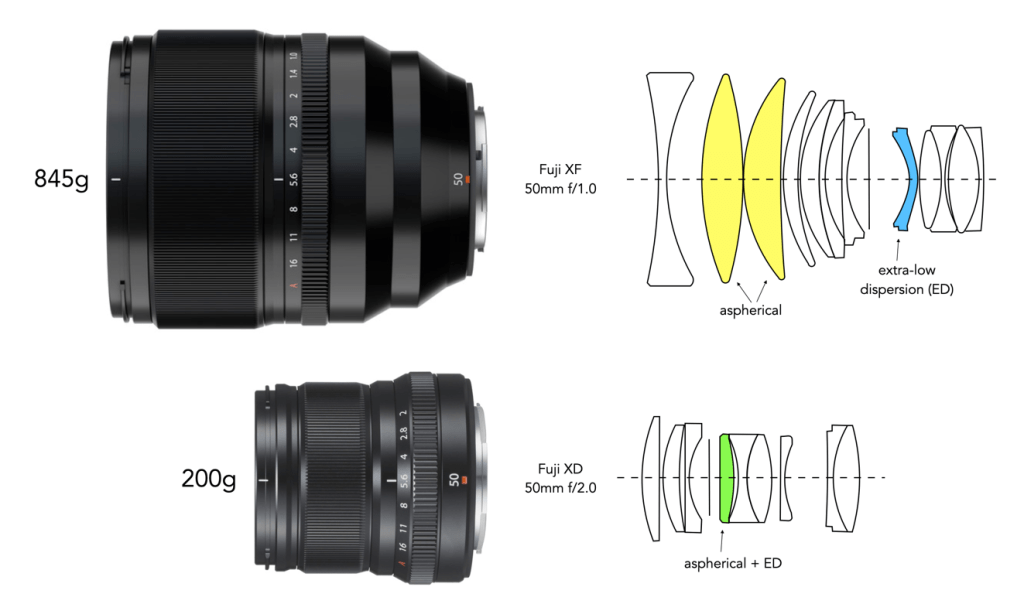
Lenses are designed with the maximum aperture in mind. For example, a 50mm f/2.8 lens only needs an aperture with a maximum opening of 17.8mm (50/2.8), however a 50mm f/1.4 will need a maximum aperture opening of 35.7mm (note that these apertures are based on the diameter of the entrance pupil). For example consider the following two Fujifilm 50mm lenses – the “average” f/2.0 and the 2-stop faster f/1.0:
- Fujifilm XF 50mm f/1.0 R WR – 845g, L103.5mm, ⌀87mm, 12/9 elements
- Fujifilm XD 50mm f/2.0 R WR – 200g, L59mm, ⌀60mm, 9/6 elements
The f/1.0 is over four times as heavy as the f/2.0, and almost double the length. To get an f/2.0 on a 50mm lens you only need a 25mm aperture opening, however with a f/1.0 lens, you theoretically need a 50mm opening (aperture of the entrance pupil). Now some basic math of the surface area (SA) of an aperture circle will provide a SA of 491mm2 for the f/2.0, but a whopping 1963mm2 for the f/1.0, so roughly four times as much area which allows light to pass through fully open. Equating this to glass probably means that at least four times as much glass is needed for some of the elements in the f/1.0 lens. There is no way around this – large apertures need large glass. As the aperture of a lens increases, all of the lenses have to be scaled up to achieve the desired optical outcome.
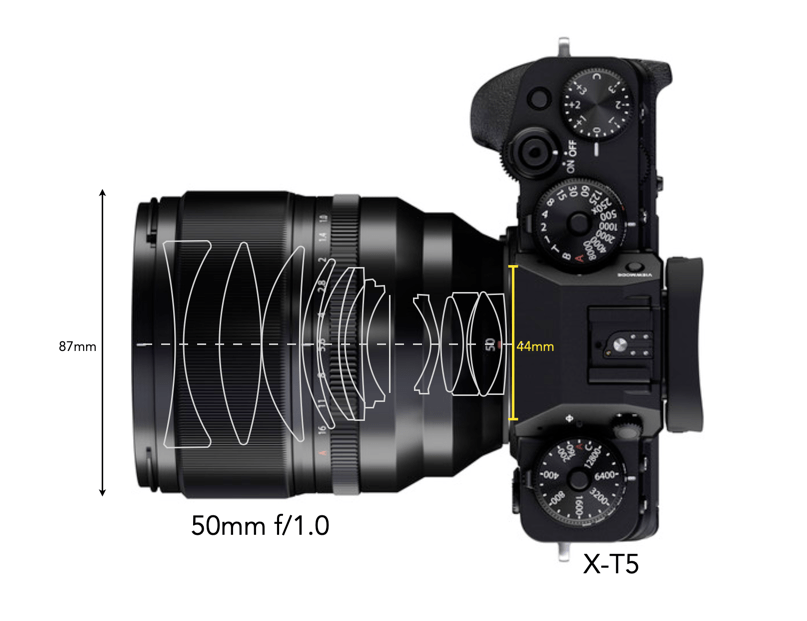
Larger aperture lenses also have more specialized glass in them, like with aspheric and low dispersion elements. But companies don’t just add more glass to make money – complex designs are supposed to overcome many of the limitations that are present in ultra-wide aperture lenses. Unlike their historical predecessors, modern superfast lenses have overcome many of the earlier lens deficiencies. For example in vintage superfast lenses, the lens wide-open was never as sharp as could be expected. Newer lens on the other hand are just as sharp wide open as they are stopped down to a smaller aperture.
Now not all super/ultra-wide aperture lenses are heavy and large. There are a number of 3rd-party lenses that are quite the opposite – reasonable size, and not too heavy (and invariably cheaper). But there is no such thing as a free lunch – there is always some sort of trade-off between price, size and optical quality. For example the Meike 50mm f/0.95 is only 420g, and it’s lens configuration is 7 elements in 5 groups. However fully open it is said to exhibit a good amount of chromatic aberration, some barrel distortion, and some vignetting. There is no perfect lens (but the Fuji f/1.0 comes pretty close).
✿ A fast lens is one with a wide maximum aperture. Superfast lenses are typically f/1.0-1.2, and ultrafast lenses are sub-f/1.0.
Further reading:
- Fujifilm 50mm f/1 Lens Review, Shotkit
 Crafting Pixels
Pingback: Should you buy a superfast lens? | Crafting Pixels