In the 1950s, the Japanese camera industry was at war, and the prize was super-fast lenses. There were several manufacturers involved in this race – Zunow, Nippon Kogaku, Konishiroku and Fujinon. Although the ultimate target was likely the German optical industry. The Fujinon 5cm f/1.2 was to appear in 1954. It was built in the Leica LTM screw mount (800 pieces), the Nikon S rangefinder mount (50 pieces) and the Contax S mount.
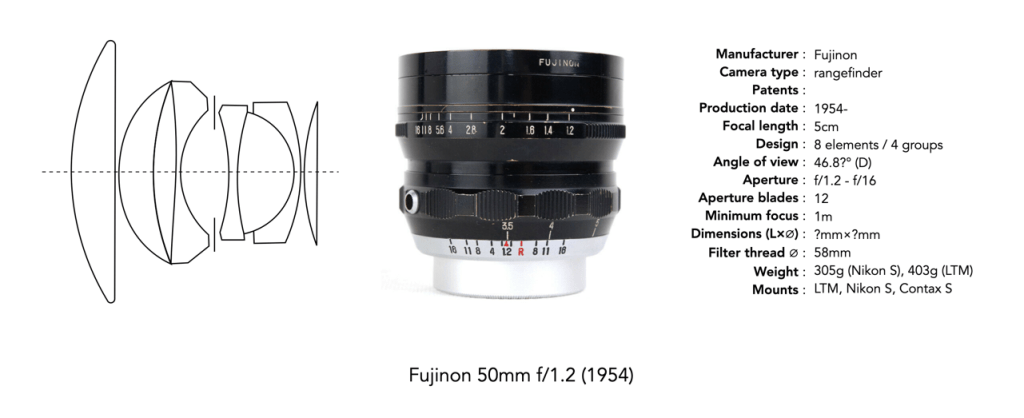
The lens was designed by Fuji designer Ryoichi Doi. The lens is said to have been based on the Solinon 5cm f/1.5, which was also designed by Doi and patented in 1948 (J#191,452). The lens was based on Sonnar design, and the next step was to push it to f/1.3 using conventional glass. This was followed by a prototype f/1.2 with 9 elements, and finally the production 8-element design. Six of the eight lens optics were high speed lenses. These lenses used four types of new types of glass with low refractive index and high dispersion, the aim being to minimize flare caused by aberrations and achieve high-contrast imaging. The lens was designed to ensure ample light reached the edges of the frame, having a front lens diameter was 51.5mm, and the rear lens diameter was 28mm.
A 1959 price list shows that this lens sold for US$299.50. Today the price of this lens is anywhere north of $20K. Too few were manufactured to make this lens the least bit affordable.
 Crafting Pixels