Post-WW2 there were still a lot of camera companies in Germany, and particularly in East Germany. In fact the heart of the German camera industry lay in Dresden, Jena and the surround area. Over the next decade, many of the companies were merged into a series of VEBs (Volkseigener Betrieb or Publicly Owned Enterprise) culminating with VEB Pentacon.
On January 1, 1959 a series of Dresden camera manufacturers were merged to create the large state-owned VEB Kamera und Kinowerke Dresden (KKWD). The company was a conglomerate of existing companies which produced a broad range of products and had numerous production sites. Joining them together meant production could be rationalized, yet cameras were still produced under their brands names, e.g. Contax, Welta, Altissa, Reflekta, Belfoca.
- VEB Kinowerke Dresden − Formerly VEB Zeiss Ikon
- VEB Kamera-Werke Niedersedlitz − This is where the Praktiflex, precursor of the Praktica, was invented; it included VEB Belca-Werk absorbed in 1957.
- VEB Welta-Kamera Werke Freital − This included the VEB Reflekta-Kamerawerk Tharandt and Welta-Kamera-Werk Freital (Reflekta II, Weltaflex und Penti).
- VEB Altissa Kamerawerke Dresden − Formerly Altissa-Camera-Werk Berthold Altmann, (including Altissa, Altiflex and Altix cameras).
- VEB Aspecta Dresden − Formerly Filmosto-Projektoren Johannes (including projectors, enlargers, lenses).
In 1964 the company was renamed to VEB Pentacon Dresden Kamera-und Kinowerke. This was intended to provide a catchy name for the company (not forgetting that a lot of its products were intended for Western markets). Pentacon was already being used as the export name for the mirror Contax D, and was derived from PENTAprisma and CONtax. Pentacon used the stylized silhouette of the Ernemann Tower (on the old Ernemann camera factory site, which belonged to the former Zeiss Ikon) as its corporate logo. The company continued to produce good SLRs: Praktica V (1964), Praktica Nova with return mirror (1964), Praktica Nova B with uncoupled light meter (1965), Praktica Mat for the first time with TTL interior light metering (1965). In 1966 the 6×6 format Pentacon Six appeared, with the Praktica PL Nova I in 1967.
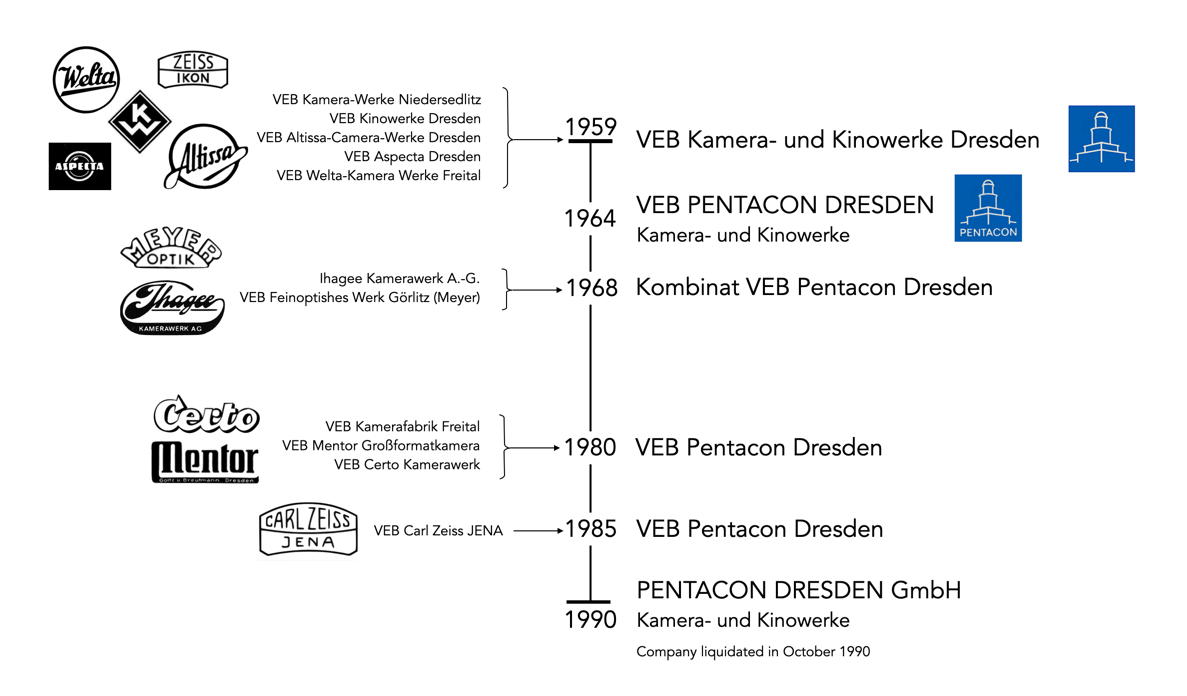
On January 2, 1968, the VEB was restructured, and more companies were added into the fold, including Ihagee Kamerawerk (which had remained independent until this point), and VEB Feinoptisches Werk Görlitz. The name became Kombinat VEB Pentacon Dresden.
- Ihagee Kamerawerk AG i.V. − Produced Exakta and Exa cameras.
- VEB Feinoptisches Werk Görlitz − Formerly Meyer-Optik Görlitz
The continuous expansion and bundling of technical expertise and concentration of the production capacities of the Pentacon, led to the incorporation of three more companies in 1980.
- VEB Kameratechnik Freital − Formerly Freitaler camera industry Beier & Co., including Beirette cameras.
- VEB Mentor Großformatkamera − large format cameras
- VEB Certo Kamerawerk Dresden − folding cameras
On January 1, 1985, the VEB Pentacon, which by now had absorbed most of the East German camera industry was formally incorporated into Kombinat VEB Carl Zeiss Jena. This move amalgamated nearly the entire East German photography industry under the Zeiss umbrella. There were scarce few years between this and the reunification of Germany. After reunification, VEB Carl Zeiss Jena was reabsorbed into the Stiftung and was completely restructured. VEB Pentacon was renamed PENTACON DRESDEN GmbH, in July 1990, but by October it was being liquidated.
 Crafting Pixels