So if you are planning to purchase a new camera with “upgraded megapixels”, what makes the most sense? In many cases, people will tend to continue using the same brand or sensor. This makes sense from the perspective of existing equipment such as lenses, but sometimes an increase in resolution requires moving to a new sensor. There are of course many things to consider, but the primary ones when it comes to the images produced by a sensor are: aggregate MP and linear dimensions (we will consider image pixels rather than sensor photosites). Aggregate MP are the total number of pixels in an image, whereas linear dimensions relate to the width and height of an image. Doubling the number of pixels in an image does not double an images linear dimensions. Basically doubling the megapixels will double the aggregate megapixels in an image. To double the linear dimensions of an image, the megapixels need to be quadrupled. So 24MP needs to ramp up to 96MP in order to double the linear dimensions.
Table 1 shows some sample multiplication factors for aggregate and linear dimensions when upgrading megapixels, ignoring sensor size. The image sizes offer a sense of what is what is offered, with the standard MP sizes offered by various manufacturers shown in Table 2.
| → | 16MP | 24MP | 30MP | 40MP | 48MP | 60MP |
|---|---|---|---|---|---|---|
| 16MP | − | 1.5 (1.2) | 1.9 (1.4) | 2.5 (1.6) | 3.0 (1.7) | 3.75 (1.9) |
| 24MP | − | − | 1.25 (1.1) | 1.7 (1.3) | 2.0 (1.4) | 2.5 (1.6) |
| 30MP | − | − | − | 1.3 (1.2) | 1.6 (1.3) | 2.0 (1.4) |
| 40MP | − | − | − | − | 1.2 (1.1) | 1.5 (1.2) |
| 48MP | − | − | − | − | − | 1.25 (1.1) |
Same sensor, more pixels
First consider a different aggregate of megapixels on the same size sensor – the example compares two Fuji cameras, both of which use an APS-C sensor (23.6×15.8mm).
Fuji X-H2 − 40MP, 7728×5152
Fuji X-H2S − 26MP, 6240×4160
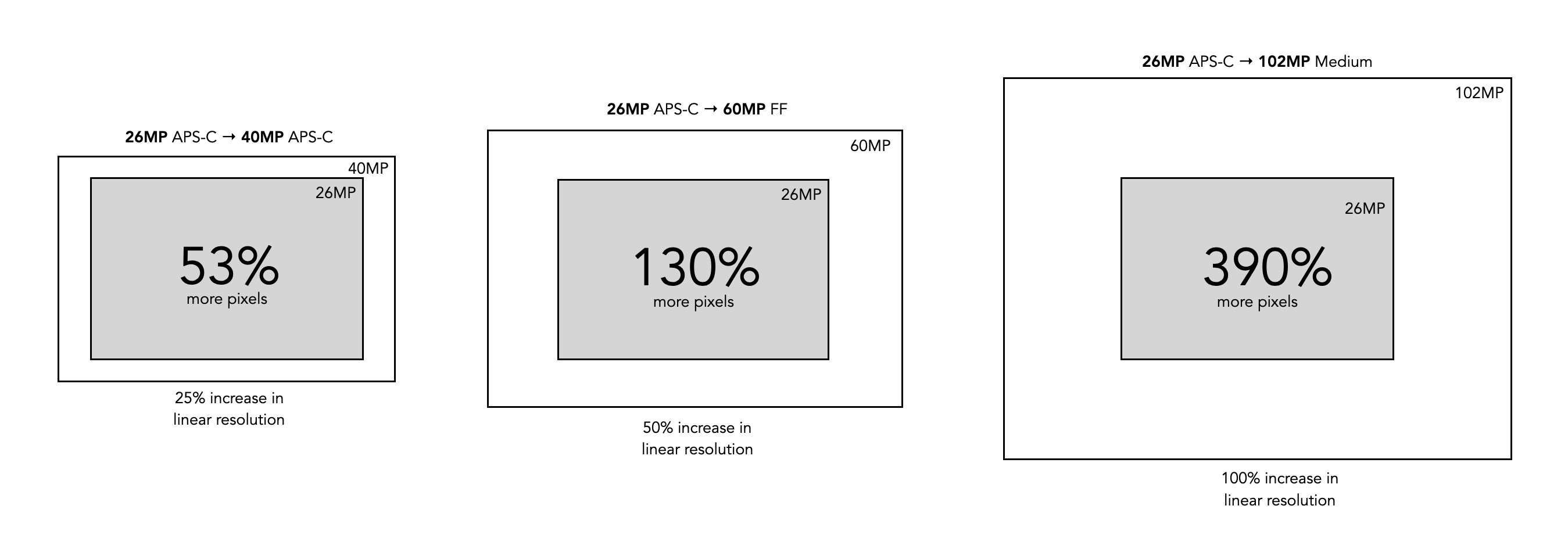
So there are 1.53 times more pixels in the 40MP sensor, however from the perspective of linear resolution (comparing dimensions), there is only a 1.24 times differential. This means that horizontally (and vertically) there are only one-quarter more pixels in the 40MP versus the 26MP. But because they are on the same size sensor, the only thing that really changes is the size of the photosites (known as the pitch). Cramming more photosites on a sensor means that the photosites get smaller. In this case the pitch reduces from 3.78µm (microns) in the X-H2S to 3.05µm in the X-H2. Not an incredible difference, but one that may affect things such as low-light performance (if you care about these sort of things).
Larger sensor, same pixels
Then there is the issue of upgrading to a larger sensor. If we were to upgrade from an APS-C sensor to an FF sensor, then we typically get more photosites on the sensor. But not always. For example consider the following upgrade from a Fuji X-H2 to a Leica M10-R:
FF: Leica M10-R (41MP, 7864×5200)
APS-C: Fuji X-H2 (40MP, 7728×5152)
So there are very few differences from the perspective of either image resolution, or linear resolution (dimensions). The big difference here is the photosite pitch. The Leica has a pitch of 4.59µm, versus the 3.05µm of the Fuji. From the perspective of photosite area, this means that 21µm² versus 9.3µm², or 2.25 times the light-gathering space on the full-frame sensor. How much difference this makes from the perspective of the end-picture is uncertain due to the multiplicities of factors involved, and computational post-processing each camera provides. But it is something to consider.
Larger sensor, more pixels
Finally there is upgrading to more pixels on a larger sensor. If we were to upgrade from an APS-C sensor (Fuji X-H2S) to a FF sensor (Sony a7R V) with more pixels:
FF: Sony a7R V (61MP, 9504×6336)
APS-C: Fuji X-H2S (26MP, 6240×4160)
Like the first example, there are 2.3 times more pixels in the 61 MP sensor, however from the perspective of linear resolution, there is only a 1.52 times differential. The challenge here can be that the photosite pitch can actually remain the same. The pitch on the Fuji sensor is 3.78µm, versus the 3.73µm of the Sony.
| brand | MFT | APS-C | Full-frame | Medium |
|---|---|---|---|---|
| Canon | − | 24, 33 | 24, 45 | − |
| Fuji | − | 16, 24, 26, 40 | − | 51, 102 |
| Leica | 17 | 16, 24 | 24, 41, 47, 60 | − |
| Nikon | − | 21, 24 | 24, 25, 46 | − |
| OM/Olympus | 16, 20 | − | − | − |
| Panasonic | 20, 25 | − | 24, 47 | − |
| Sony | − | 24, 26 | 33, 42, 50, 60, 61 | − |
Upgrading cameras is not a trivial thing, but one of the main reasons people do so is more megapixels. Of all the brands listed above, only one, Fuji, has taken the next step, and introduced a medium format camera (apart from the medium format camera manufacturers, e.g. Hasselblad), allowing for increased sensor size and increased pixels, but not at the expense of photosite size. The Fujifilm GFX 100S has a medium format sensor, 44×33mm in size, providing 102MP with 3.76µm. This means it provides approximately double the dimensional pixels as a Fuji 24MP APS-C camera (and yes it costs almost three times as much, but there’s no such thing as a free lunch).
At the end of the day, you have to justify why more pixels are needed to yourself. They are only part of the equation in the acquisition of good images, but small upgrades like 24MP to 40MP may not actually provide much of a payback.
 Crafting Pixels
Pingback: The APS-C dilemma | Crafting Pixels
Pingback: Choosing an APS-C camera: 26MP or 40MP? | Crafting Pixels