In a galaxy, far, far away, they used cameras with lenses from Carl Zeiss Jena. It’s true, Vader was into photography, he had a dark-room and everything. Actually I never saw anyone with a still camera of any sort in the Star Wars universe, but I guess they must have existed – they did use “holocams”. So how did a reference to a sci-fi classic get associated with the design of a lens?
In some of the early SLR lenses from CZJ, especially lens series like the Pancolar, many people describe them as being “Star Wars” lenses. What does this really mean? These lenses often have another moniker – “zebra” lenses, because of their striped design. Does the zebra somehow associated them with Star Wars? Most of the talk of Star Wars revolves around the Carl Zeiss Jena Pancolar lenses, and in particular the 50mm f/2 (and in odd cases the f/1.8).
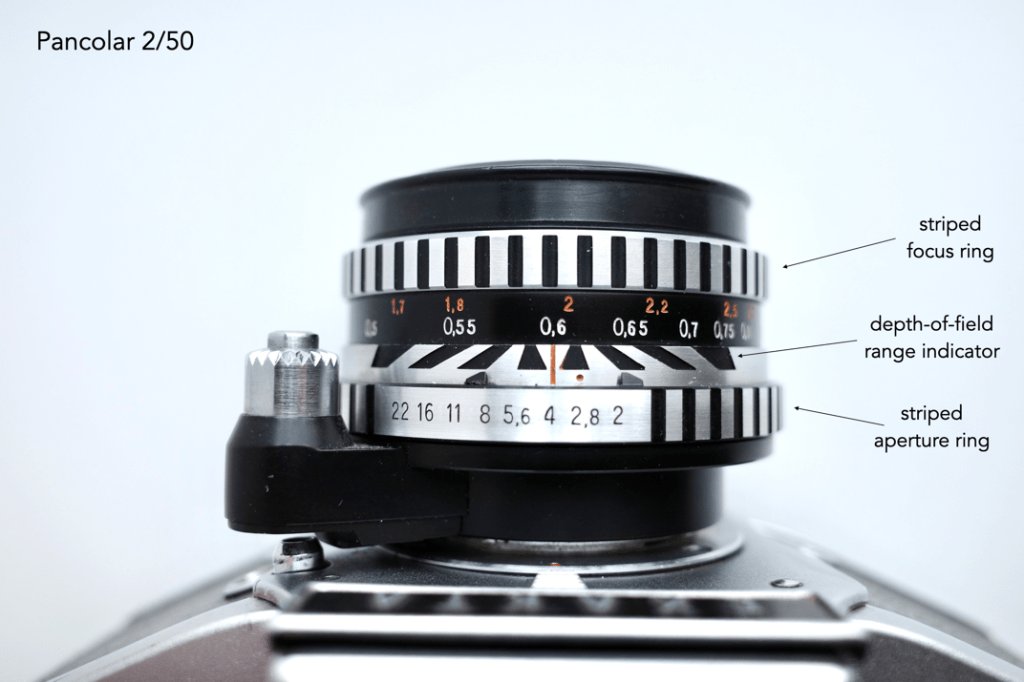
The Pancolar 50mm f/2, which first appeared as the Flexon 50mm f/2, was produced from 1959-69 (made mostly for Exakta mount), and had a number of differing aesthetic looks. Most differed by a change in the grip ring in the front of the lens, from a leather to plastic knobs, and finally to the stripped aluminum ring. Except for the earliest version of these lenses, they all sported the “converging” look of the “depth-of-field range indicator” (DoFRI), which appeared around 1962. Basically when the aperture was altered, the indicators (early models in red as shown, later models in black) would move in and out appropriately, so at f/2 they would converge at the red central line. A Zeiss brochure from 1962 which contained four lenses: Flektogon 4/50mm, Flektogon 2.8/35mm, Tessar 2.8/50mm and Pancolar 2/50mm. Strangely enough, the Pancolar was the only one with this converging distance design.
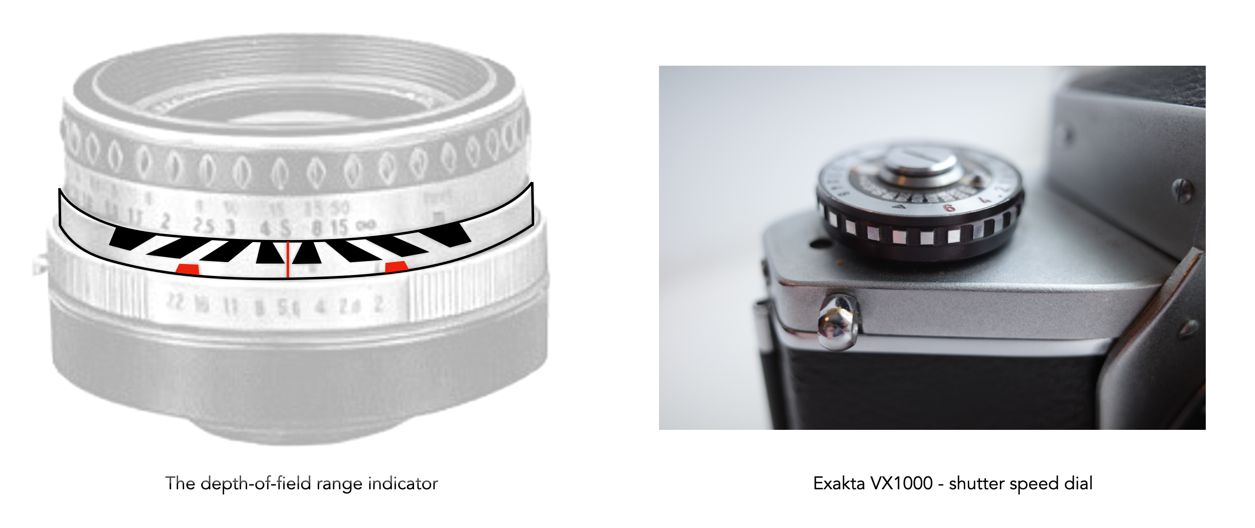
The “zebra design” is the colloquial term for lenses with grip rings that are aluminum – with vertical straight knurling that alternate black and bare aluminum. Supposedly this striped design evolved from the Exakta VX1000 which when released in 1966 had a shutter-speed selection knob of a similar design. The Pancolar 50mm f/2 also adopted the zebra design circa 1966, while still retaining the converging depth scale. The zebra looks was eventually replaced by the black-look lenses in the early 1970s.
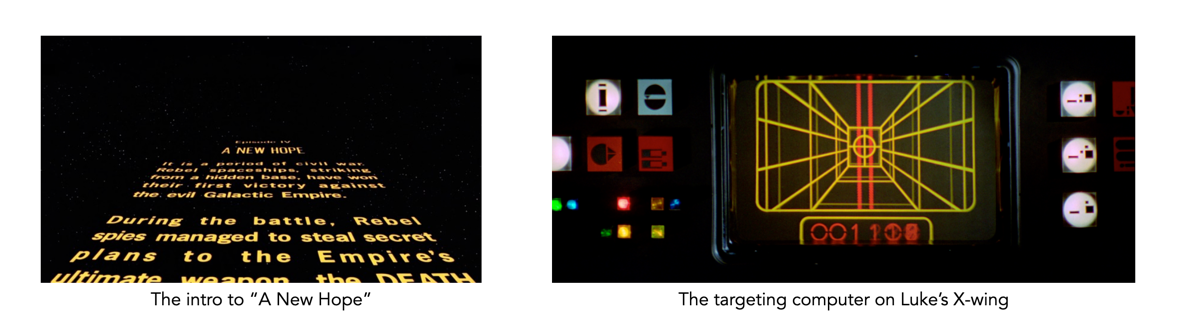
Some suggest the Star Wars moniker it is named for the characteristic look of the DoFRI, reminiscent of those very yellow credits at the beginning of the film. If anything, I think the range indicator could be better attributed to the targeting computer in Luke’s X-wing used on the trench run on the Death Star (Episode IV). It shows the same converging lines, and deals with a similar concept, i.e. distances of a sort. On later models of the 50mm f/2, the strips existed on the tandem with the DoFRI, but when the Pancolar 50mm f/1.8 appeared, it maintained the striped appearance, but lost the converging look DoFRI, opting instead for a more traditional one.
It seems then that the use of strips to describe the “Star Wars” look has no real basis. There were other Zeiss lenses that took on the zebra design, as well as other manufacturers, e.g. Meyer-Optik, Asahi (e.g. the Auto-Takumar 55mm f/1.9), using the design well into the 1970s, and no one ever talks about “Star Wars Takumars”.
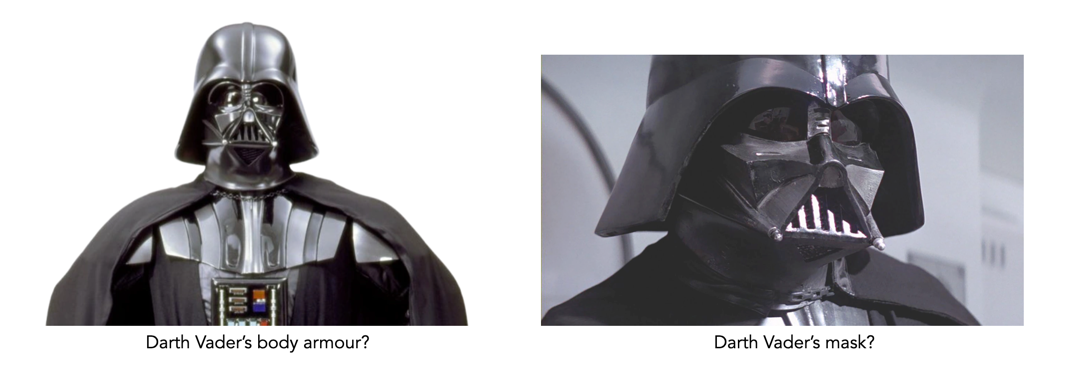
The reality is, no one really knows where the term originated or why it came into use. Were these lenses associated with Star Wars because of the striped design? Or perhaps it was a play on the “good” versus “evil” of West versus East Germany? If you look at a lens in isolation, it does have an association, but a dark one – it does share some characteristics with Darth Vader. It’s cloaked in blackness, and perhaps the striped design is associated with the strips on Vader’s armour? Or perhaps the strips were reminiscent of the mouth grill on Vader’s mask?
Maybe it just has a Star Wars feel about it, and you know, the more I look at it, the more I feel that way – maybe I’m being drawn in by the Force… must buy more…
 Crafting Pixels
Pingback: The aesthetic appeal of mid-century vintage lenses | Crafting Pixels