Before the advent of digital cameras, the standard reference format for photography was 35mm film, with frames 36×24mm in size. Everything in analog photography had the same frame of reference (well except for medium format, but let’s ignore that). In the early development of digital sensors, there were cost and technological issues with developing a sensor the same size as 35mm film. The first commercially available dSLR, the Nikon QV-1000C, released in 1988, had a ⅔” sensor with a crop-factor of 4. The first full-frame dSLR would not appear until 2002, the Contax N Digital, sporting 6 megapixels.
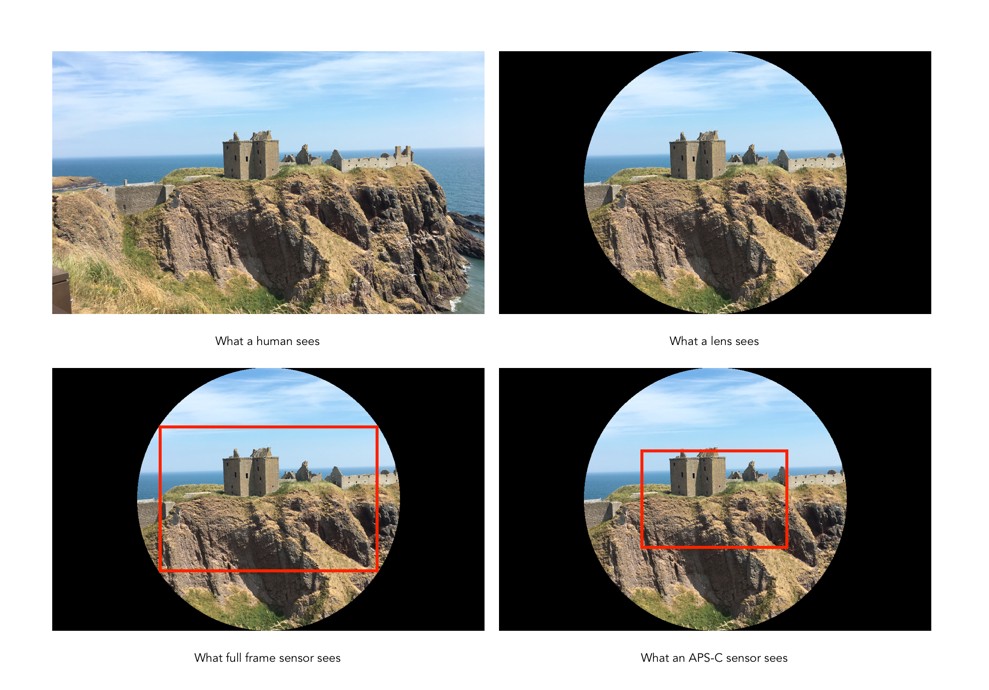
Using a camera with a sensor smaller presented one significant problem – the field of view of images captured using these sensors was narrower than the reference 35mm standard. When camera manufacturers started creating sensors smaller than 36×24mm, they had to create a term which described them in relation to a 35mm film-frame (full-frame). For that reason the term crop sensor is used to describe a sensor that is some percentage smaller than a full-frame sensor (sometimes the term cropped is used interchangeably). The picture a crop sensor creates is “cropped” in relation to the picture created with a full-frame sensor (using the lenses with the same focal length). The sensor does not actually cut anything, it’s just that parts of the image are simply ignored. To illustrate what happens in a full-frame versus a cropped sensor, consider Fig.1.

Lenses project a circular image, the “image circle”, but a sensor only records a rectangular portion of the scene. A full-frame sensor, like the one from the Leica SL2 captures a large portion of the 35mm lens circle, whereas the Micro-Four-Thirds cropped sensor of the Olympus OM-D E-M1, only captures the central portion of the lens – the rest of the image falls outside the scope of the sensor (the FF sensor is shown as a dashed box). While crop-sensor lenses are smaller than those of full-frame cameras, there are limits to reducing their size from the perspective of optics, and light capture. Fig.2 shows another perspective on crop sensors based on a real scene, comparing a full-frame sensor to an APS-C sensor (assuming the same “size” lenses, say 50mm).
The benefits of crop-sensors
- Crop-sensors are smaller than full-frame sensors, therefore the cameras are generally smaller. This means cameras are generally smaller in dimensions and weigh less.
- The cost of crop-sensor cameras, and the cost of their lenses is generally lower than FF.
- A smaller size of lens is required. For example, a MFT camera only requires a 150mm lens to achieve the equivalent of a 300mm FF lens, in terms of field-of-view.
The limitations of crop-sensors
- Lenses on a crop-sensor camera with the same focal-length as those on a full-frame camera will generally have a smaller AOV. For example a FF 50mm lens will have an AOV=39.6°, while a APS-C 50mm lens would have an AOV=26.6°. To get a similar AOV on the cropped sensor APS-C, a 33mm equivalent lens would have to be used.
- A cropped sensor captures less of the lens image circle than a full-frame.
- A cropped sensor captures less light than a full-frame (which has larger photosites which are more sensitive to light).
Common crop-sensors
A list of the most common crop-sensor sizes currently used in digital cameras, as well as the average sensor sizes (sensors from different manufacturers can differ by as much as 0.5mm in size), and example cameras is summarized in Table 1. A complete list of sensor sizes can be found here. Smartphones are in a league of their own, and usually have small sensors of the type 1/n”. For example the Apple iPhone 12 Pro max has 4 cameras – the tele camera uses a 1/3.4″ (4.23×3.17mm) sensor, and the tele camera a 1/3.6″ sensor (4×3mm).
| Type | Example Cameras | |
|---|---|---|
| 1/2.3″ | 6.16×4.62mm | Sony HX99, Panasonic Lumix DC-ZS80, Nikon Coolpix P950 |
| 1″ | 13.2×8.8mm | Canon Powershot G7X M3, Sony X100 VII |
| MFT / m43 | 17.3×13mm | Panasonic Lumix DC-G95, Olympus OM-D E-M1 Mark III |
| APS-C (Canon) | 23.3×14.9mm | Canon EOS M50 Mark II |
| APS-C | 23.5×15.6mm | Ricoh GRIII, Fuji X-E3, Sony α6600, Sigma sd Quattro |
| 35mm Full Frame | 36×24mm | Sigma fpL, Canon EOS R5, Sony α, Leica SL2-S, Nikon Z6II |
| Medium format | 44×33mm | Fuji GFX 100 |
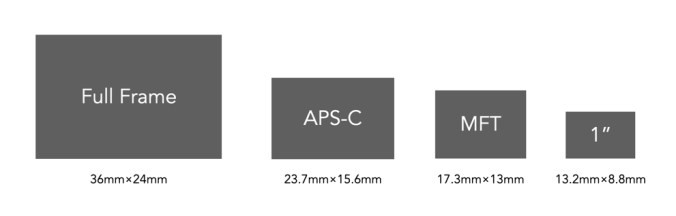
Figure 3 shows the relative sizes of three of the more common crop sensors: APS-C (Advanced Photo System type-C), MFT (Micro-Four-Thirds), and 1″, as compared to a full-frame sensor. The APS-C sensor size is modelled on the Advantix film developed by Kodak, where the Classic image format had a size of 25.1×16.7mm.
Defunct crop-sensors
Below is a list of sensors which are basically defunct, usually because they are not currently being used in any new cameras.
| Type | Sensor size | Example Cameras |
|---|---|---|
| 1/1.7″ | 7.53×5.64mm | Nikon Coolpix P340 (2014), Olympus Stylus 1 (2013), Leica C (2013) |
| 2/3″ | 8.8×6.6mm | Fujifilm FinePix X10 (2011) |
| APS-C Foveon | 20.7×13.8mm | Sigma DP series (2006-2011) |
| APS-H Foveon | 26.6×17.9mm | Sigma sd Quattro H (2016) |
| APS-H | 27×18mm | Leica M8(2006), Canon EOS 1D Mark IV (2009) |
 Crafting Pixels
Pingback: The term “crop-sensor” has become a bit nonsensical | Crafting Pixels