Digital cameras usually come with the ability to change the aspect ratio of the image being captured. The aspect ratio has a little to do with the size of the image, but more to do with its shape. The aspect ratio describes the relationship between an image’s width  and height (H), and is generally expressed as a ratio W:H (the width always comes first). For example a 24MP sensor with 6000×4000 pixels has an aspect ratio of 3:2.
Choosing a different sized aspect ratio will change the shape of the image, and the number of pixels stored in it. When using a different aspect ratio, the image is effectively cropped with the pixels outside the frame of the aspect ratio thrown away.

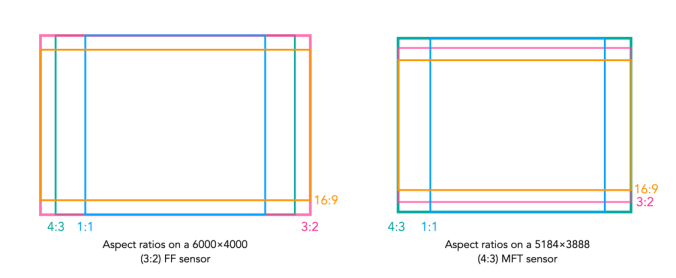
The four most common examples of aspect ratios are:
- 4:3
- Used when photos to be printed are 5×7″, or 8×10″.
- Quite good for landscape photographs.
- The standard ratio for MFT sensor cameras.
- 3:2
- The closest to the Golden Ratio of 1.618:1, which makes things appear aesthetically pleasing.
- Corresponds to 4×6″ printed photographs.
- The default ratio for 35mm cameras, and many digital cameras, e.g FF, APS-C sensors.
- 16:9
- Commonly used for panarama’s, or cinematographic purposes.
- The most common ratio for video formats, e.g. 1920×1080
- The standard aspect ratio of HDTV and cinema screens.
- 1:1
- Used for capturing square images, and to simplify scenes.
- The standard ratio for many medium-format cameras.
- Commonly used in social media, e.g. Instagram.
How an aspect ratio appears on a sensor is dependent on the sensors default aspect ratio.
Analog 35mm cameras rarely had the ability to change the aspect ratio. One exception to the rule is the Konica Auto-Reflex, a 35mm camera with the ability to switch between full and half-frame (18×24mm) in the middle of a roll of film. It achieved this by moving a set of blinds in to change the size of the exposed area of the film plane to half-frame.
 Crafting Pixels